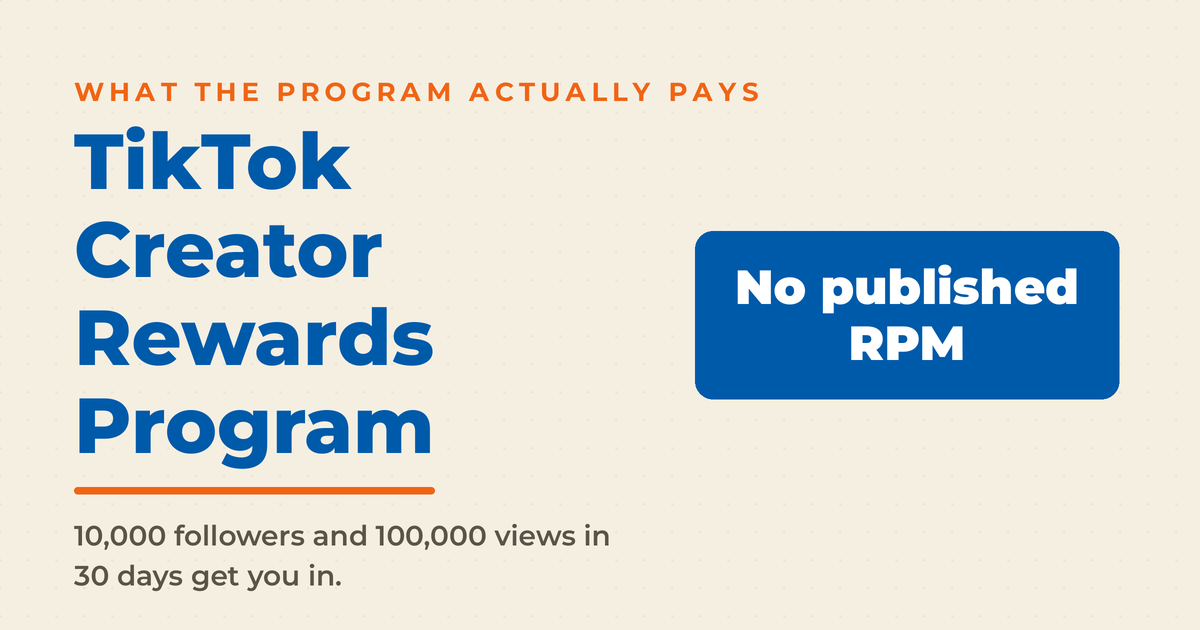

Ten thousand followers. A hundred thousand views in thirty days. Those two numbers are the gate between posting on TikTok for free and getting paid by TikTok directly.
The Creator Rewards Program is how that payment happens now. It replaced the old Creator Fund, the money is real, and the application takes about ninety seconds. The restrictions are where things get interesting, and they are the part almost every article about this program races past.
I teach personal branding and influencer marketing at UCLA Extension, and social media marketing to executives at Rutgers Business School. I also run a Fractional CMO practice. So I see this question from both chairs. There is the creator trying to turn views into income, and the entrepreneurial business owner working out whether platform payouts belong in a marketing plan at all.
Both deserve the same thing: a straight answer about what TikTok pays, what it refuses to pay for, and how that compares to the programs creators weigh it against.
Key Takeaways
✅ TikTok’s gate is 10,000 followers plus 100,000 video views in the last 30 days, and only Personal Accounts qualify. Business Accounts are shut out entirely.
✅ Only original videos over one minute long earn rewards. TikTok rules out Duets, Stitches, and sponsored content from the definition of original.
✅ Payment runs on qualified views, not the view count on your video. A view counts once per account, has to come from the For You feed, and has to run past five seconds.
✅ TikTok publishes no pay rate at all. YouTube publishes exact splits: 55% of watch page ad revenue, 45% on Shorts, 70% on fan funding.
✅ Meta will pay you to bring your TikTok audience to Facebook. Creator Fast Track guarantees $1,000 a month to creators with 100,000 followers on TikTok, Instagram, or YouTube.
✅ Treat rewards as one income thread, never the whole rope. Every serious creator I know earns from three or four sources. The ones leaning on a single platform payout panic every time a policy changes.
What Is the TikTok Creator Rewards Program?
The Creator Rewards Program is TikTok’s direct payment program that pays eligible creators based on how their videos perform. TikTok calculates payment from qualified views and a rate called RPM, or rewards per 1,000 qualified views. Only original videos longer than one minute earn anything under it.
It grew out of the Creativity Program Beta and replaced the Creator Fund. That older program paid from a fixed pool, which got thinner as more creators joined. TikTok describes the new formula as reworked to deliver higher average gross revenue for qualified video views. Creators also get a dashboard showing estimated rewards, qualified view counts, and per-video eligibility, plus the ability to appeal when a video gets ruled out.
That last piece matters more than it sounds. Under the Creator Fund, plenty of creators had no idea why a payout shrank. Now you can at least see which videos qualified and contest the ones that did not.
Still building toward the threshold? Start with the wider menu of options in how to make money on TikTok. Rewards are one line item on it, nothing more.
Who Qualifies for the TikTok Creator Rewards Program?
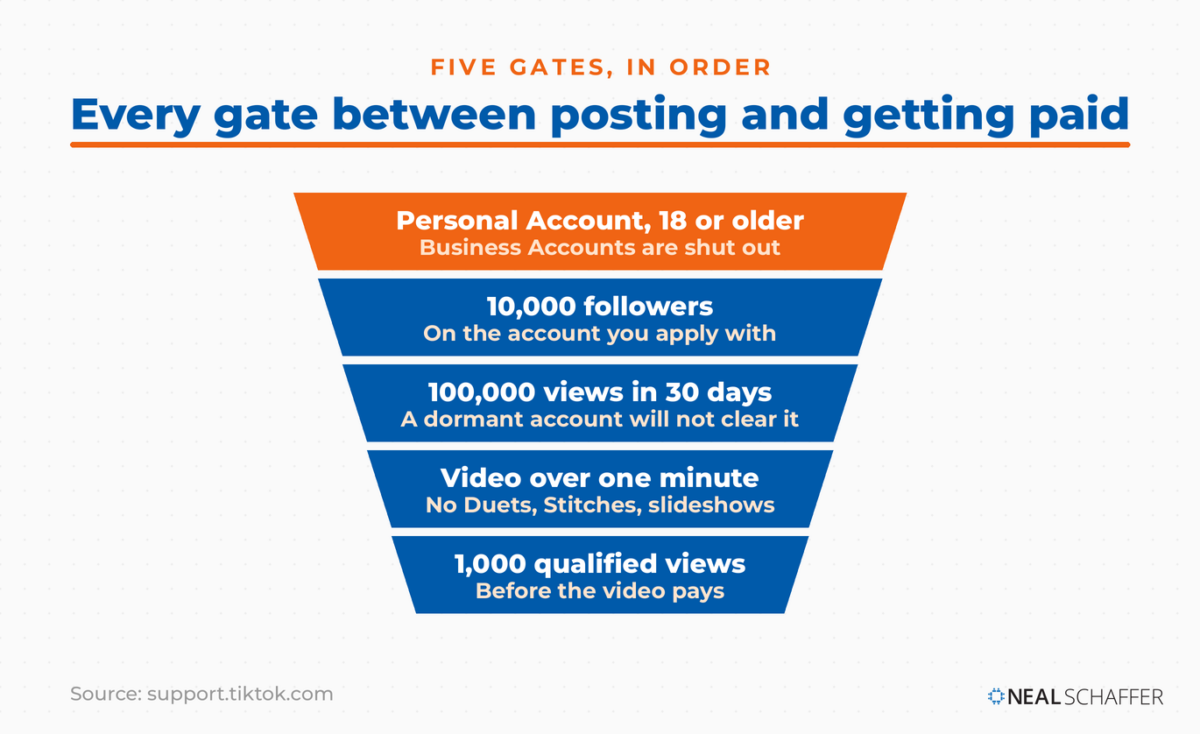
To join, TikTok requires you to be at least 18 and to hold a Personal Account in good standing. You also need 10,000 followers and 100,000 video views in the past 30 days, in a country where the program runs. Business Accounts and government-linked accounts do not qualify.
The account requirements
- Age 18 or older, or 19 in South Korea, based on the birthdate on your account
- 10,000 followers on the account you are applying with
- 100,000 video views in the last 30 days, so a dormant account with a big follower count will not clear the bar
- A Personal Account, not a Business Account
- Authentic account information, meaning your real name and date of birth
- An eligible country. TikTok publishes separate program terms for Brazil, France, Germany, Japan, South Korea, the United Kingdom, and the United States
That Business Account exclusion deserves a paragraph of its own, because it catches marketers constantly. If you switched to a Business Account for the analytics or to run ads, you are not eligible for rewards on that account. You have to weigh commercial music licensing and business tooling against direct payment, and for most brands the tooling wins. For a solo creator building a personal brand, it usually does not. If you are still weighing that trade before you apply, the business versus personal account comparison walks through everything the switch adds and everything it quietly costs.
The video requirements
Clearing the account gate does not mean your videos earn. Each video has to be original, filmed and produced by you, at least one minute long, and posted after you were accepted. It also has to reach 1,000 qualified For You feed views before it collects anything.
What Counts as a Qualified View?
A qualified view is a unique view from the For You feed where the viewer watched more than five seconds. TikTok excludes fraudulent views, paid views, promoted views, artificial views, and views from people who marked your video as not interested. Repeat views from the same account count once, no matter how many times that person rewatches.
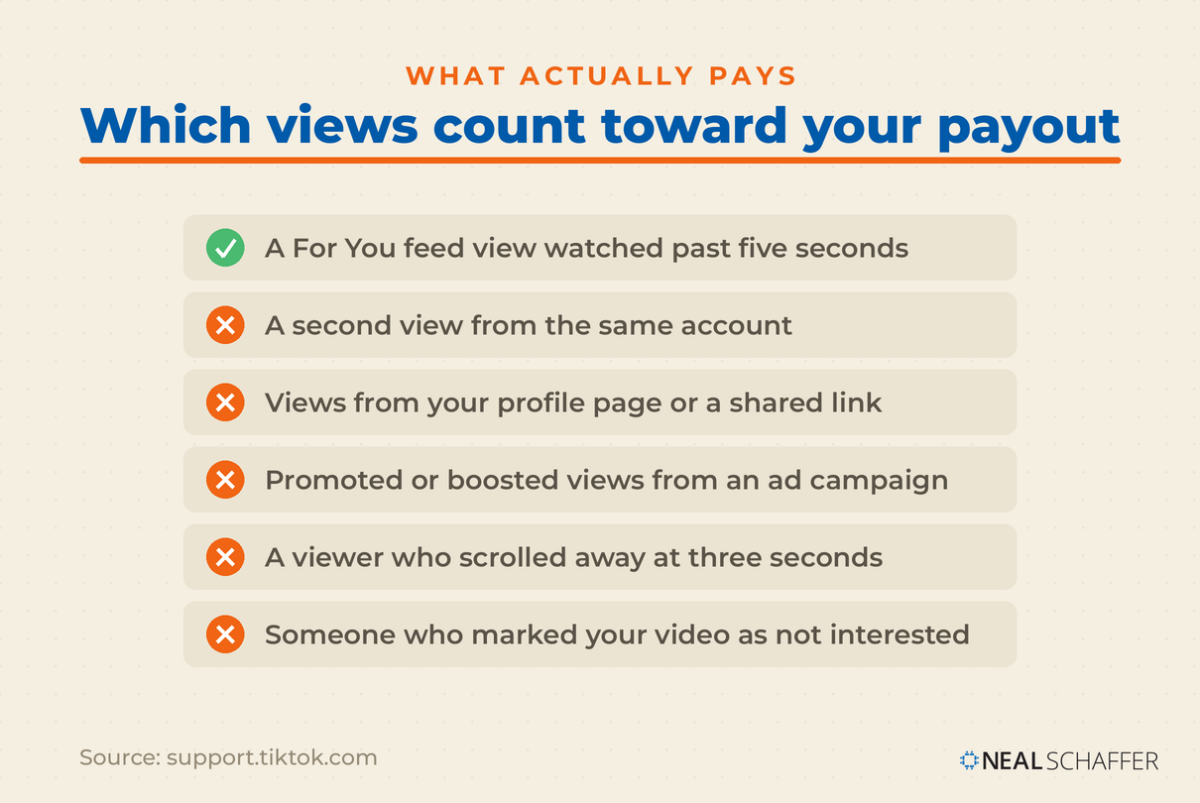
The distance between your public view count and your qualified view count is the single biggest reason payouts land lower than creators expect. A video showing 400,000 views in the app is not a video with 400,000 paying views. Plenty of traffic sits outside the count. Your profile page, shares beyond the For You feed, ad campaigns you boosted, viewers who bailed at three seconds: none of it pays.
Which reframes what you should optimize for. Retention past five seconds and For You feed distribution are the two levers that turn raw reach into paid reach. Both trace back to how the TikTok algorithm works, and to the audience scale laid out in my TikTok statistics post.
How Does TikTok Calculate Your Rewards?
Payment arrives in two parts. Standard Reward multiplies your qualified views by your RPM. Additional Reward layers on top for videos TikTok judges well crafted, engaging, and specialized. Five inputs move your RPM, and TikTok names all five: video performance, search value, location, video engagement, and advertising value.
| RPM input | What TikTok measures | What you can do about it |
|---|---|---|
| Video performance | Average watch time and finish rates | Write for completion, not for the hook alone |
| Search value | Search traffic your content generates, including views on the search page | Title and caption around real queries, the way you would a blog post |
| Location | Where you are based and where your video is viewed | Largely outside your control; audience geography sets your ceiling |
| Video engagement | How many viewers interact with the content | Give people a specific reason to comment, not a generic prompt |
| Advertising value | Your viewers’ ad watch time on TikTok | Build an audience that actually uses the app, not drive-by traffic |
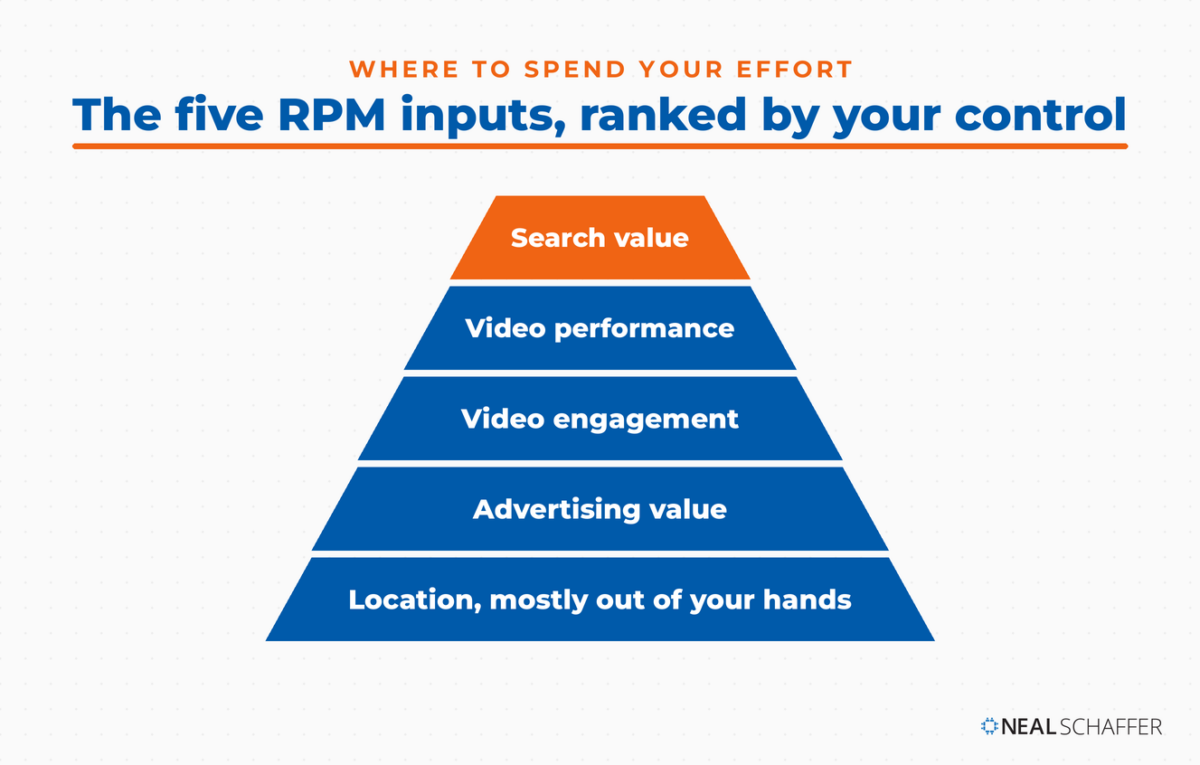
Search value is the input that gets overlooked, and it is the one I would push hardest on. TikTok is telling you plainly that content answering questions people search for earns a better rate. That is search optimization inside a social app, and it rewards the same discipline that wins in Google.
For Additional Reward, TikTok asks for 1080p or higher, clear visuals, polished editing, and a focus on a specific area of expertise. Production quality has a dollar value attached now, which is a real shift from the era when a shaky phone video could carry a channel. I use Adobe Express for this kind of quick video work, and I should disclose that I serve as an official Adobe Express Ambassador.
How Much Does the Creator Rewards Program Actually Pay?
TikTok does not publish an RPM figure anywhere. It publishes the formula and the five inputs, then lets the rate vary by video, niche, and viewer location. Every specific dollar amount you find in a roundup is creator-reported rather than platform-published, and those reported ranges contradict each other badly.
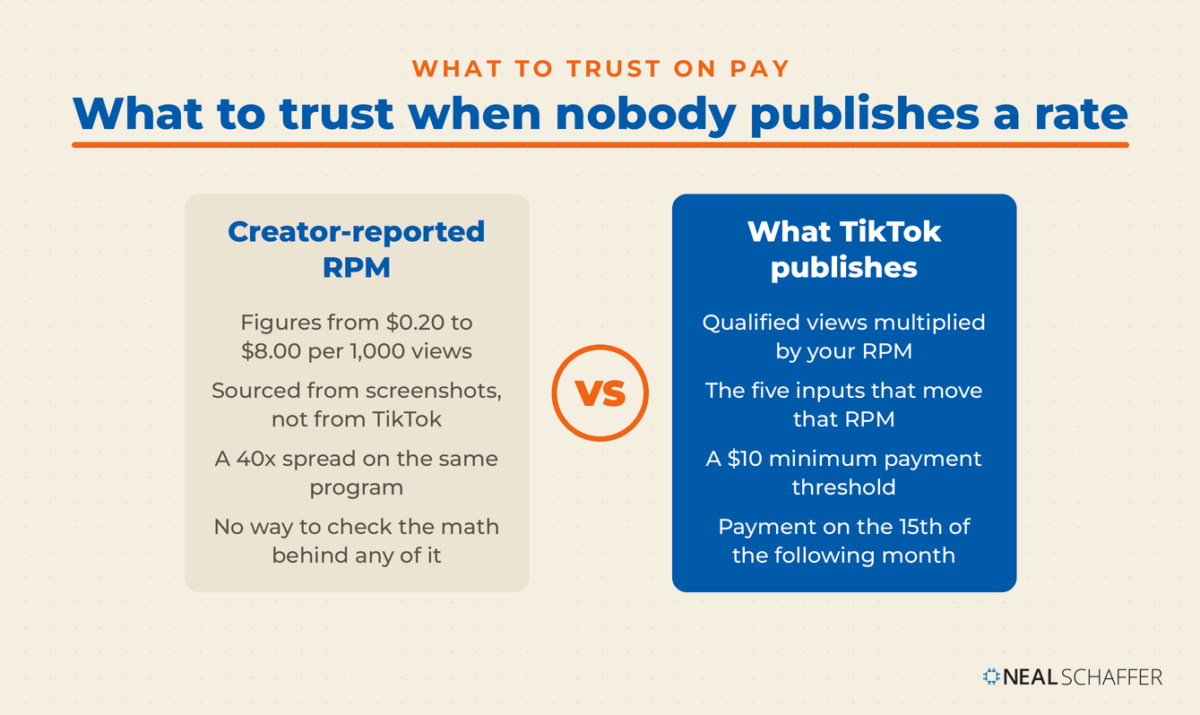
I went looking for a number I could stand behind and could not find one. Published figures run from twenty cents per thousand views to eight dollars per thousand, depending on which site you land on. That is not a range. That is a shrug. Anyone quoting you a confident RPM is quoting other people’s screenshots.
Make LinkedIn Your Best Source of Clients
My latest book helps professionals, entrepreneurs, and business owners turn LinkedIn from a static profile into a real source of clients and growth.
Maximizing LinkedIn for Business Growth gives you clear, practical steps to build a profile that gets noticed and a network that actually sends business your way.
Grab your copy on Amazon and put it to work this week. Click the cover or the button below to get started.

What TikTok does publish is the mechanics, and those are worth knowing:
- Rewards start once an eligible video passes 1,000 qualified For You feed views
- Estimated rewards appear in the dashboard roughly one to three days after views accrue
- Payment threshold is $10 or the local equivalent
- Payment lands on the 15th of the following month
- PayPal is the only payout method for creators in the United States, South Korea, Brazil, the United Kingdom, France, and Germany, while Japan gets Payoneer or bank transfer
For a rough sense of scale, try the TikTok money calculator. The earnings ranges in how much TikTokers make give you the creator-reported picture, caveats attached.
How Does the Creator Rewards Program Compare to the YouTube Partner Program?
YouTube publishes exact revenue shares and TikTok publishes none. YouTube pays 55% of net revenue on watch page ads, 45% of allocated Creator Pool revenue on Shorts, and 70% on fan funding features. Entry differs too: TikTok gates on followers plus recent views, while YouTube gates on subscribers plus watch hours or Shorts views. For the comparison beyond payouts, including audience and production workflow, see TikTok vs. YouTube for content creators.
To get in, YouTube asks for 1,000 subscribers. You also need either 4,000 valid public watch hours in the last 12 months or 10 million valid public Shorts views in the last 90 days. Watch hours from Shorts in the Shorts Feed do not count toward the 4,000.
| TikTok Creator Rewards | YouTube Partner Program | |
|---|---|---|
| Follower or subscriber gate | 10,000 followers | 1,000 subscribers |
| Activity gate | 100,000 views in 30 days | 4,000 watch hours in 12 months, or 10M Shorts views in 90 days |
| Content that earns | Original videos over 1 minute | Long-form video and Shorts |
| Published pay rate | None | 55% watch page ads, 45% Shorts, 70% fan funding |
| Account type | Personal Accounts only | Any channel meeting the policies |
| Review time | About 3 days | Typically about a month |
| Payout floor | $10 | Local payment threshold via AdSense |
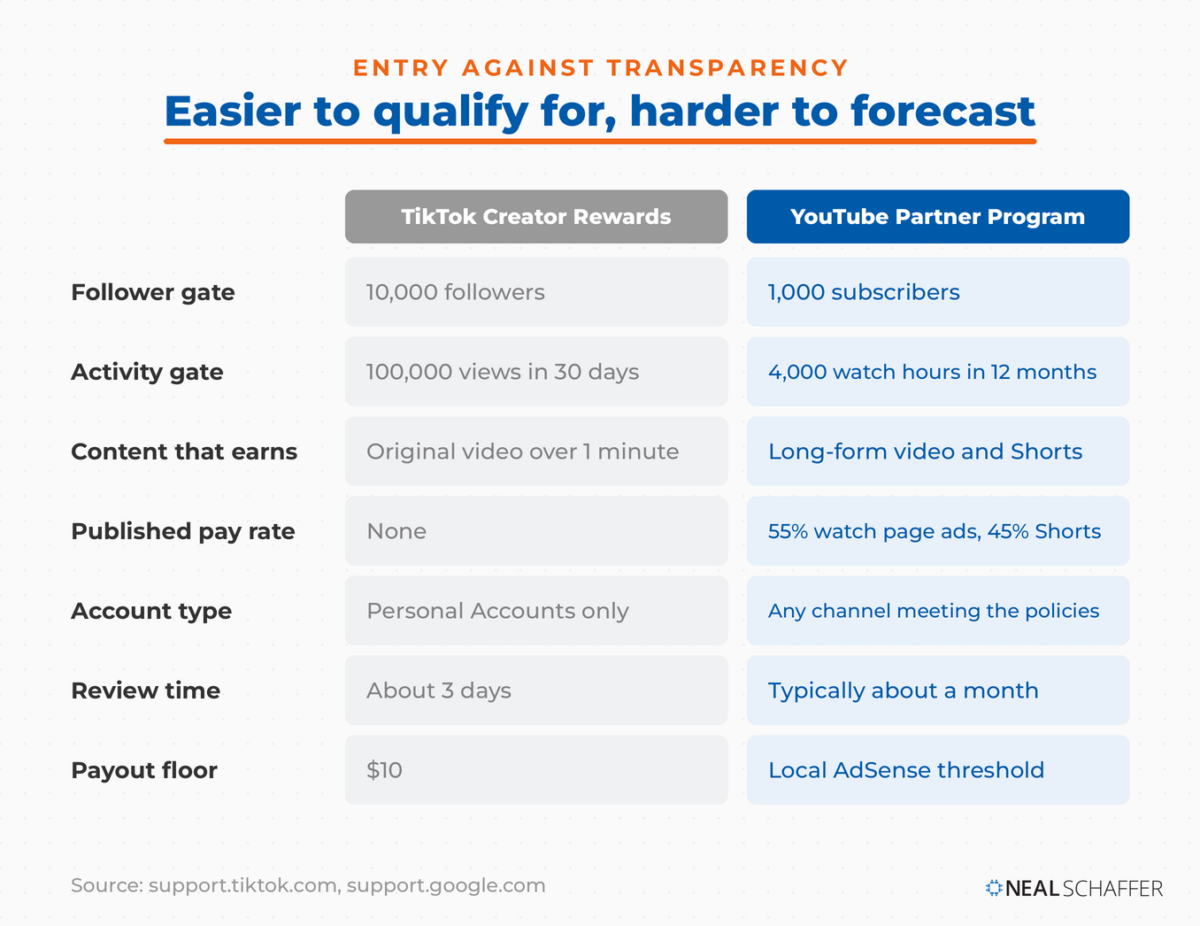
Read that table sideways and a pattern shows up. TikTok is far easier to qualify for on subscriber-equivalent terms and far harder to forecast, because you cannot model income against a rate the platform refuses to name. YouTube is harder to enter and completely transparent once you are in. If predictability matters to your business, that difference is the whole story, and it is why making money on YouTube still anchors more full-time creator incomes than TikTok does. The monetization path for YouTube Shorts is the closest apples-to-apples comparison if short vertical video is your format.
What Does Meta Pay Creators, and How Is That Different?
Meta’s answer is Facebook Content Monetization, which merged In-Stream Ads, Ads on Reels, and the Performance Bonus into a single program covering reels, longer videos, photos, and text posts. The catch sits in access rather than rate: Meta runs the program by invitation, so there is no published follower threshold to work toward. If you are weighing it for a business, my full breakdown of Facebook content monetization covers what the program actually pays.
The scale is not small. Facebook paid content creators nearly $3 billion in 2025, a 35% jump over the prior year and its highest annual total. Reels took 60% of that payout, with the rest going to Stories, photos, and text posts. The count of creators earning more than $10,000 a year on Facebook grew by over 30% year over year.
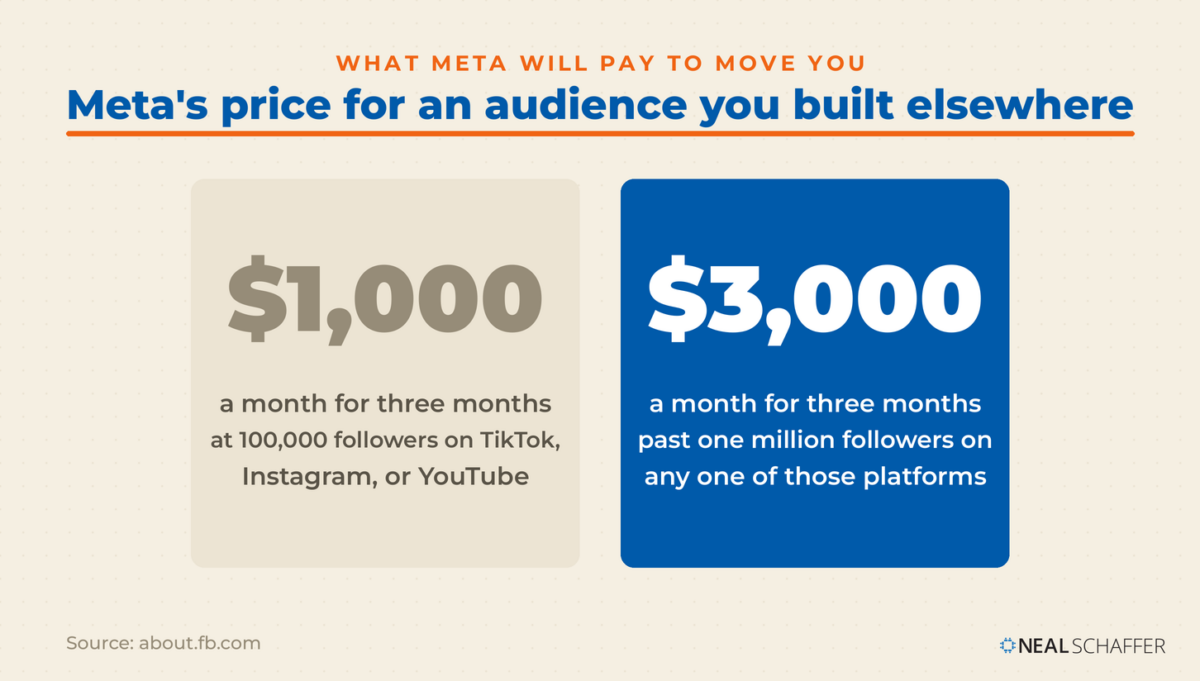
Meta is also openly recruiting from TikTok. Creator Fast Track offers three months of guaranteed pay. That means $1,000 a month for creators with at least 100,000 followers on Instagram, TikTok, or YouTube, and $3,000 a month for anyone past a million followers on one of those platforms. Read that as a competitor putting a price on the audience you already built somewhere else. If you are a brand paying creators, notice who sets these terms. The platform can change them at any time, which is the risk in building creator partnerships on rented land.
The program structure Meta published pays on engagement, views, and plays across eligible public content. Instagram sits outside this particular program, which is why creators there still assemble income from gifts, subscriptions, and brand work rather than a single view-based payout. If Instagram is your main stage, the options in how to monetize Instagram are a more useful map than anything on the Facebook side.
Which Program Deserves Your Best Content?
No single answer fits every creator, but the three programs reward genuinely different behavior. TikTok pays for original one-minute video with strong retention and search value. YouTube pays a published percentage across formats and rewards library depth. Meta pays across nearly every format but decides who gets in.
| If your priority is… | Build on |
|---|---|
| Fastest path to any direct payout | TikTok, given a 10,000 follower gate versus 4,000 watch hours |
| Forecastable income you can plan a business around | YouTube, because the splits are published |
| Earning from formats other than video | Facebook, which pays on photos and text posts |
| Reaching buyers rather than viewers | Instagram, monetized through commerce and brand work |
| Owning the audience outright | Email and your own site, where no policy change can reach you |
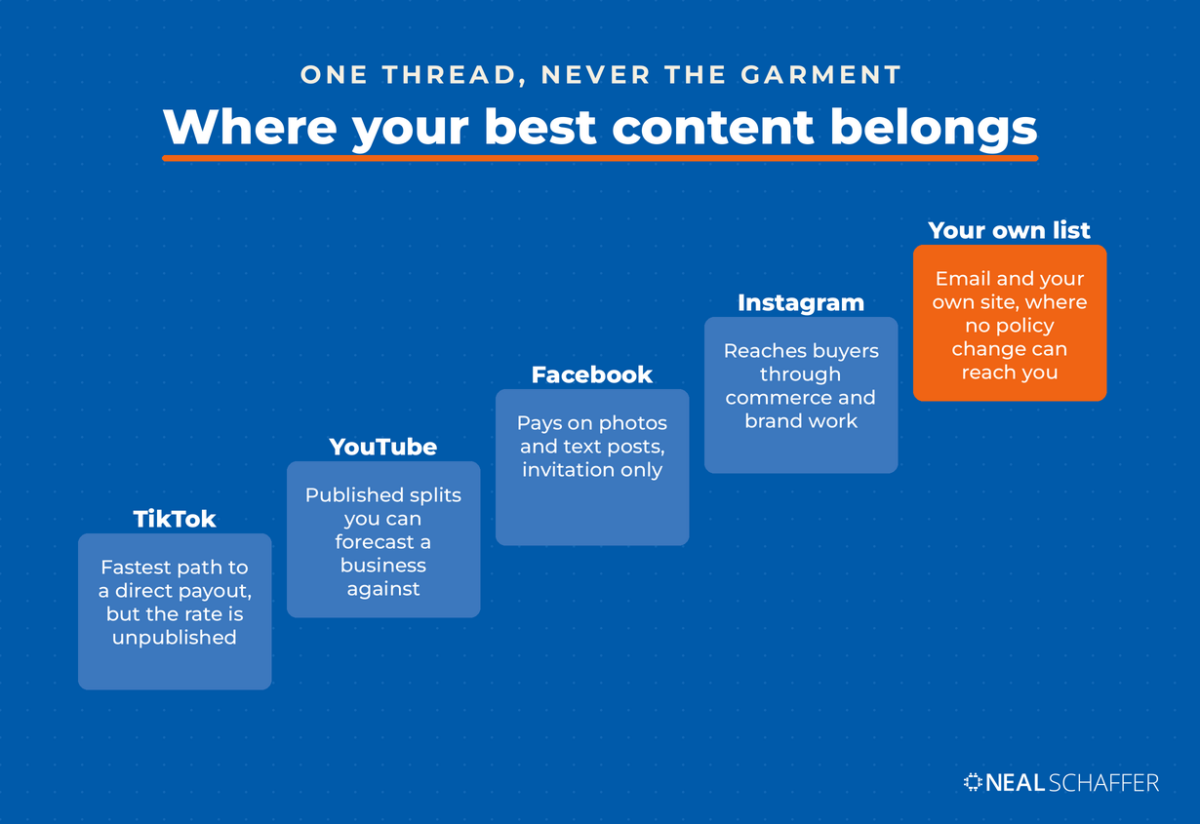
That last row is the one I would underline. On a recent episode of my podcast Your Digital Marketing Coach, I made the case plainly: “The more revenue streams you cultivate, each aligned with your niche and audience, the more resilient and profitable your brand becomes and the better you can mitigate the risks of only monetizing through one revenue stream or with one brand partner.”
The same principle sits at the center of Digital Threads. Platform payouts are one thread, never the garment.
What Most Creators Get Wrong About the Creator Rewards Program
Five traps account for most of the disappointment I hear about this program, and four of them are written directly into TikTok’s own rules. Reading the eligibility page carefully beats learning any of these the expensive way, after a month of content turns out to have earned nothing.
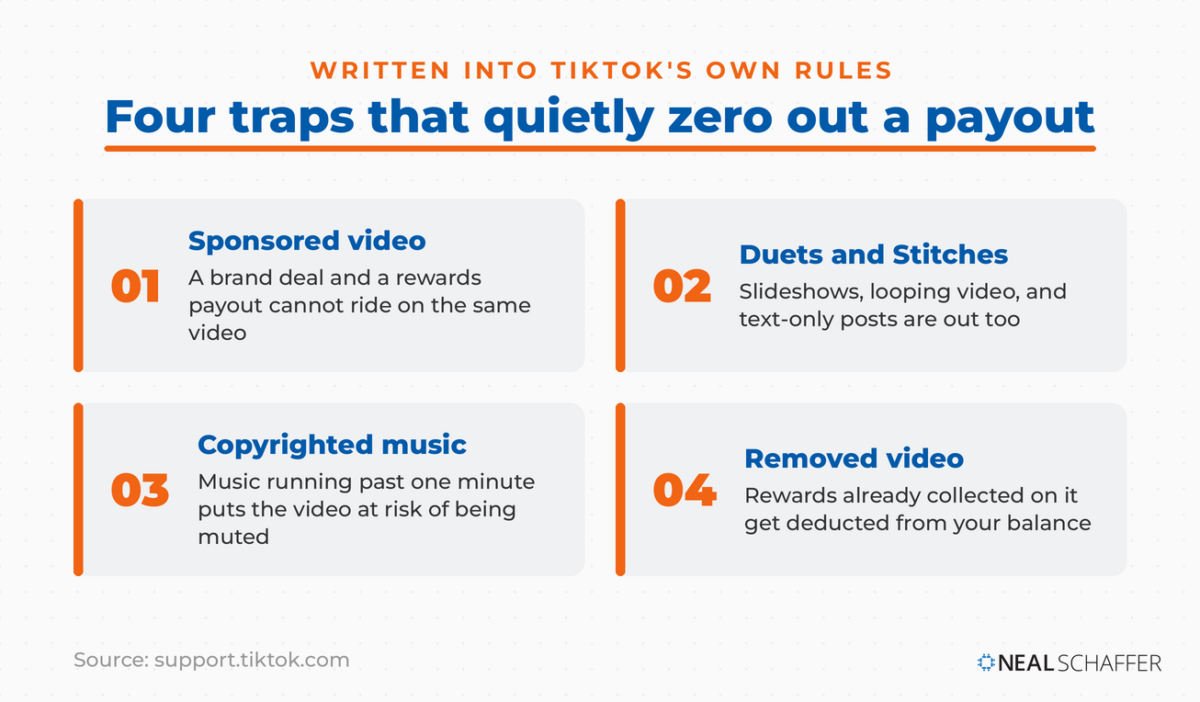
Sponsored videos do not earn rewards. Advertisements, paid promotions, and sponsored content are excluded, which means a brand deal and a rewards payout cannot ride on the same video. Plan them as separate content lines. Sponsored posts carry disclosure duties too. The FTC is explicit that the disclosure belongs with the endorsement message itself, not buried in a profile or behind a More link.
Duets, Stitches, and slideshows are out. So is content reproduced from others with only small changes, looping video, and posts that are only text overlays. If photo mode slideshows are a big part of your output, none of that output earns here.
Copyrighted music running over a minute is a liability. Videos in the program carrying copyrighted music for more than one minute risk being muted, which on a one-minute-minimum program is an awkward collision.
Rewards can be taken back. If a video is later removed for a policy violation, rewards already collected on it get deducted from your balance. Earnings are provisional until they are paid out.
Chasing the one-minute minimum wrecks good short videos. Padding a tight 35-second idea to 61 seconds hurts your completion rate, which then hurts the RPM input that pays you. Make long videos when you have long ideas. Getting more views on TikTok has never come from artificially stretched content, and it will not start now.
How Do You Apply for the Creator Rewards Program?
Application runs entirely in the app and takes under two minutes. Open your profile, tap the Menu button, select TikTok Studio, then tap Creator Rewards Program. TikTok replies within roughly three days. If you are turned down and believe you qualify, you can appeal within 30 days or reapply 30 days after that appeal window closes.
Two practical notes before you tap apply. Only videos posted after your acceptance can collect rewards, so there is no back-pay on the library that got you eligible in the first place. And you will need to complete payout setup and tax onboarding before any money moves.
If you are still short of the follower gate, the fundamentals matter more than the application. Consistency, format, and posting rhythm close that gap. Spend the next ninety days on the timing data in the best time to post on TikTok and the tactics in how to go viral on TikTok.
Frequently Asked Questions
Yes. TikTok explicitly allows participation in other monetization programs while you are enrolled. The restriction is per video, not per account: a video carrying a paid promotion will not collect rewards, so brand content and rewards content have to live in separate posts.
Check its length first. Videos under one minute earn nothing under this program regardless of how far they travel. After that, check whether it was a Duet or Stitch. Then check whether it cleared 1,000 qualified For You feed views, and where its traffic actually came from.
The opposite. Business Accounts are excluded from the Creator Rewards Program. If direct payment is your goal, you need a Personal Account in good standing, which means giving up some of the business tooling that comes with the other account type.
YouTube is more predictable because the revenue splits are published and the same rate applies to everyone. TikTok is easier to qualify for. Creators who need to forecast income lean YouTube; creators who want a payout switched on sooner lean TikTok. Plenty of people who make a living as content creators run both.
TikTok says about three days from application. Appeals on a rejected account or a disqualified video take roughly the same three days.
Put These Numbers to Work on Your Own Channel
Start by checking two things this week: whether your account is Personal rather than Business, and whether your last thirty days actually cleared 100,000 views. Those two checks decide whether the Creator Rewards Program is a live option or a goal for next quarter. If it is live, apply. Then build a content line of original one-minute videos aimed at questions people search for, because search value is the RPM input you control most directly.
Then widen the frame. Direct platform payouts are the smallest revenue line for nearly every creator earning real money, so pair rewards with brand work, affiliate income, or your own products. The numbers in my creator economy statistics post put that in perspective. For a clearer picture of what full-time creators charge, read becoming a TikTok influencer next. Want help working through your own channel mix? My Digital First Mastermind exists for exactly that kind of planning. A free preview of Digital Threads will start you on the strategy behind it.