
TikTok has just under 2 billion monthly active users, which makes it the fifth-largest social platform in the world, according to Sprout Social. For brands, the real question was never whether to show up on TikTok. It’s which creators to work with. And most brands get that decision wrong.
I see the same pattern again and again. A brand picks a creator by follower count, runs one sponsored post, sees mediocre numbers, and decides TikTok influencer marketing “doesn’t work.” The follower number is the metric most brands lead with. It’s also the one I tell them to ignore first.
I wrote The Age of Influence and I teach personal branding and influencer marketing at UCLA Extension. As a Fractional CMO, I help brands build creator strategies that actually move revenue. So when I talk about working with TikTok creators, I’m coming at it from the brand side of the table, not the fan side. This is a practical look at who the top TikTok influencers are, how the tiers and money work, and how to choose creators who deliver.
Key Takeaways
✅ TikTok has just under 2 billion monthly active users, making it the fifth-largest social platform globally.
✅ The global influencer marketing industry has grown past $30 billion, with double-digit annual growth, and TikTok sits near the center of it.
✅ Engagement, not follower count, is the metric that predicts a good brand partnership. TikTok has the highest median engagement rate of the major platforms.
✅ Smaller creators (nano and micro) routinely out-engage mega-influencers, which is why fit beats reach for most campaigns.
✅ TikTok pays creators directly through the Creator Rewards Program, but brand deals, TikTok Shop, and affiliate income are where most of the money is.
✅ The partnerships that pay off treat creators as long-term relationships, not one-off campaign placements.
Why Do TikTok Influencers Matter for Brands in 2026?
TikTok influencers matter because TikTok has become a discovery and search engine, not just an entertainment app. Younger buyers go there to find products, restaurants, and how-to answers before they ever touch Google. A creator your audience already trusts can put your product inside that discovery loop in a way an ad rarely can.
The numbers behind that shift are hard to argue with. Adobe’s 2026 search survey, reported by Search Engine Journal, found that 49% of US consumers have used TikTok as a search engine, rising to 65% among Gen Z. eMarketer estimates that more than six in ten US Gen Z consumers use TikTok at least once a month. And Pew Research Center reports that more than 40% of US adults under 30 now regularly get news on the platform. When a generation searches, shops, and stays informed on one app, the creators on that app become a primary marketing channel.
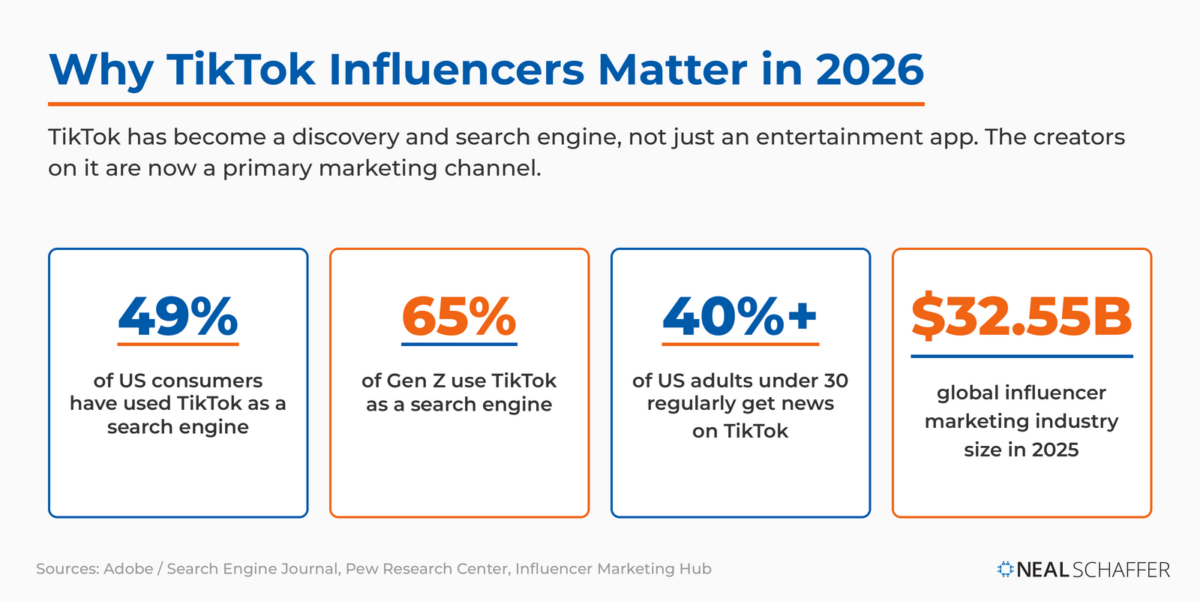
That’s why budgets keep climbing. The global influencer marketing industry reached $32.55 billion in 2025, up from $24 billion in 2024, per the Influencer Marketing Hub benchmark report. If you want the broader picture of where creator spend is going, the latest influencer marketing statistics tell the story better than any single headline. TikTok sits near the center of that growth, and so does the wider creator economy it feeds.
Who Are the Top TikTok Influencers Right Now?
The top TikTok influencers are the creators who built massive, loyal audiences by mastering short-form video on their own terms. These are publicly known names with tens of millions of followers each. I’m not ranking them or claiming to have evaluated creators I’ve never worked with. I’m pointing to what brands can learn from how each one operates.
If you want the current follower counts in ranked order, I keep an updated list of who has the most followers on TikTok. Below, the lesson matters more than the leaderboard.
Khaby Lame
Khaby Lame built one of the largest followings on the platform with almost no spoken words. His silent reaction videos translate across every language, which is exactly why global brands like working with him. The takeaway for marketers: format and clarity travel further than dialogue. Visual storytelling lowers the barrier for international audiences.
Charli D’Amelio
Charli D’Amelio was one of TikTok’s first breakout stars, and she’s still relevant because she diversified. Dance got her noticed. Brand lines, a media presence, and product collaborations kept her there. For brands, she’s a case study in why you partner with creators who are building durable businesses, not chasing a single viral moment.
MrBeast (Jimmy Donaldson)
MrBeast brings his giveaway-and-challenge format to TikTok from YouTube, and it works because the format is built for attention. He’s a reminder that the strongest creators design content around a repeatable hook, then carry that hook across platforms. Brands that partner with creators like this are buying into a proven content engine.
Bella Poarch
Bella Poarch went viral on a single lip-sync video and then did the hard part: she stayed. A distinct aesthetic and a move into music kept her audience engaged long after the first hit. The brand lesson is that one viral video is a spark, not a strategy. Look for creators who can follow it up.
Addison Rae
Addison Rae used early TikTok fame as a launchpad into music, acting, and beauty. She’s a clean example of cross-platform career building. When you evaluate a creator for a partnership, ask where they’re headed, not just where they are. The ones who are scaling beyond the app often make the most committed partners.
Zach King
Zach King’s “digital magic” edits are some of the most shareable content on the platform. His videos work because they reward a rewatch, and rewatches are gold to TikTok’s algorithm. For brands, he shows that production craft still matters. A creator who can make people watch twice is a creator who can hold attention on your message.
Spencer X
Spencer X turned beatboxing into a global following by owning a hyper-specific skill. He’s proof that niche talent scales on TikTok when it’s genuinely distinctive. If your product fits a specialized world, a creator who dominates that niche will almost always outperform a generalist with a bigger number next to their name.
The D’Amelio Family
The D’Amelios turned individual fame into a family brand with shows, products, and partnerships. They’re a useful example of how creator influence compounds when it’s built into a business rather than left as a personality. Brands working with creator families or collectives can tap several audiences at once.
Category Creators Worth Watching
Mega-names get the headlines, but the creators who drive actual purchases usually live inside specific communities. SkinTok, FoodTok, BookTok, fashion, gaming, and fitness each have their own trusted voices. For most brands, a creator who owns one of these niches is a better bet than a celebrity with broad but shallow reach.
Beauty and skincare creators like Hyram Yarbro built audiences on honest product breakdowns:
Fashion and lifestyle creators like Remi Bader earn trust through relatable, inclusive content:
The Digital Marketing Playbook for Small Teams
My latest book helps small businesses, entrepreneurs, and marketers bring search, email, and social together into one digital marketing strategy that actually compounds.
Drawing on my work as a Fractional CMO, Digital Threads turns complicated tactics into a clear, practical plan you can follow, whatever your budget or team size.
Grab your copy on Amazon and start weaving your own digital threads. Click the cover or the button below to get started.

Food creators like Nick DiGiovanni turn high-craft cooking into content people save and share:
BookTok single-handedly revived backlist titles and minted bestsellers through pure community enthusiasm:
Gaming creators package complex play into quick, satisfying clips:
Fitness and wellness creators build engaged communities around routines and motivation:
What Are the TikTok Influencer Tiers?
TikTok influencers are grouped into tiers by audience size: nano, micro, mid-tier, macro, and mega. The tiers matter because reach and engagement move in opposite directions. As follower counts climb, engagement rates tend to fall, so the “biggest” creator is rarely the most effective one for a targeted campaign.
The data backs this up. The Influencer Marketing Factory puts TikTok’s median engagement rate around 8% in 2026, the highest of the major social platforms, with smaller accounts consistently out-engaging the mega-tier. I’ve watched this play out with clients for years: smaller often means stronger when you measure real influence instead of vanity reach.
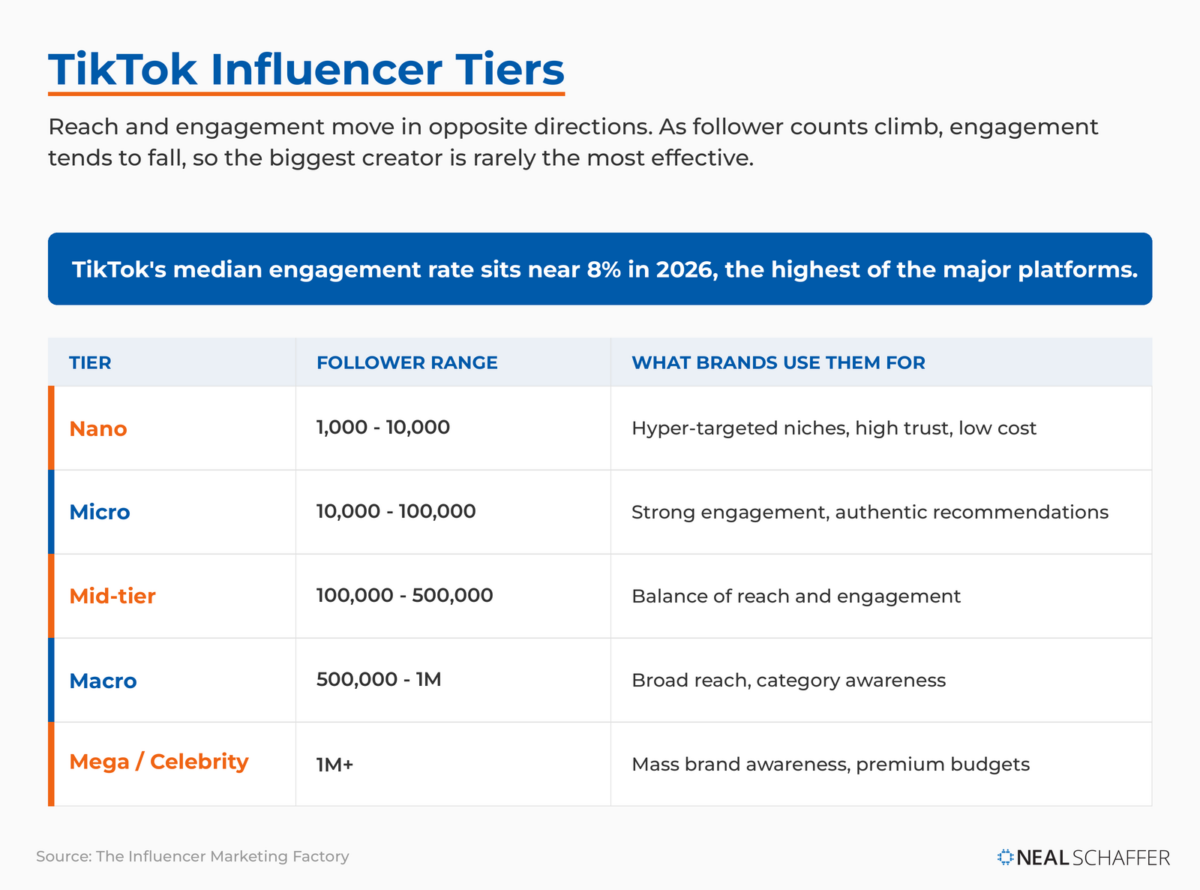
This is where I lean on a point I made in The Age of Influence: your community is always a subset of your potential audience. A nano creator with 8,000 deeply engaged followers in your exact niche can drive more sales than a macro creator with a million casual viewers. I map out the full landscape of influencer tiers and the broader types of influencers in more depth, but the short version is this: match the tier to the goal. Use micro-influencers and nano-influencers for targeted engagement and conversions, and save macro and mega creators for the awareness plays that justify their rates.
How Do TikTok Influencers Make Money?
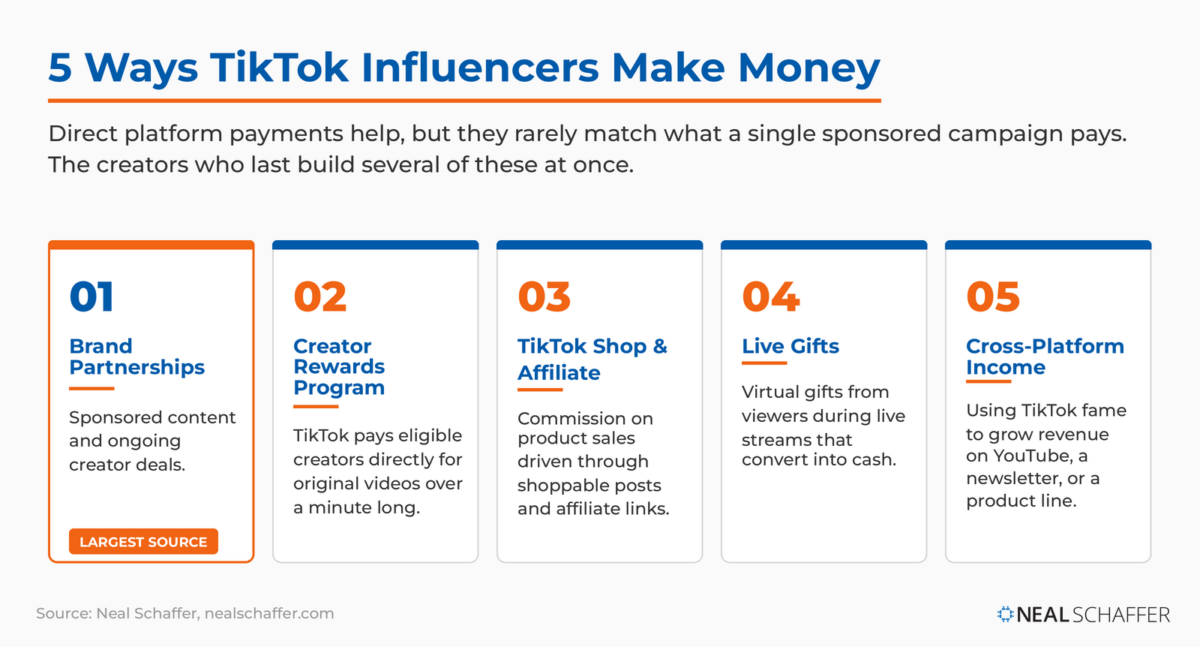
TikTok influencers make money through five main channels: brand partnerships, the Creator Rewards Program, TikTok Shop and affiliate sales, live gifts, and cross-platform monetization. Brand deals are the largest source for most creators by a wide margin. Direct platform payments help, but they rarely match what a single sponsored campaign pays.
Brand partnership rates swing enormously based on tier, niche, engagement, and usage rights. Influencer Marketing Hub’s rate research puts typical TikTok rates anywhere from about $50 to $50,000 or more per video. Here’s the rough shape of it:
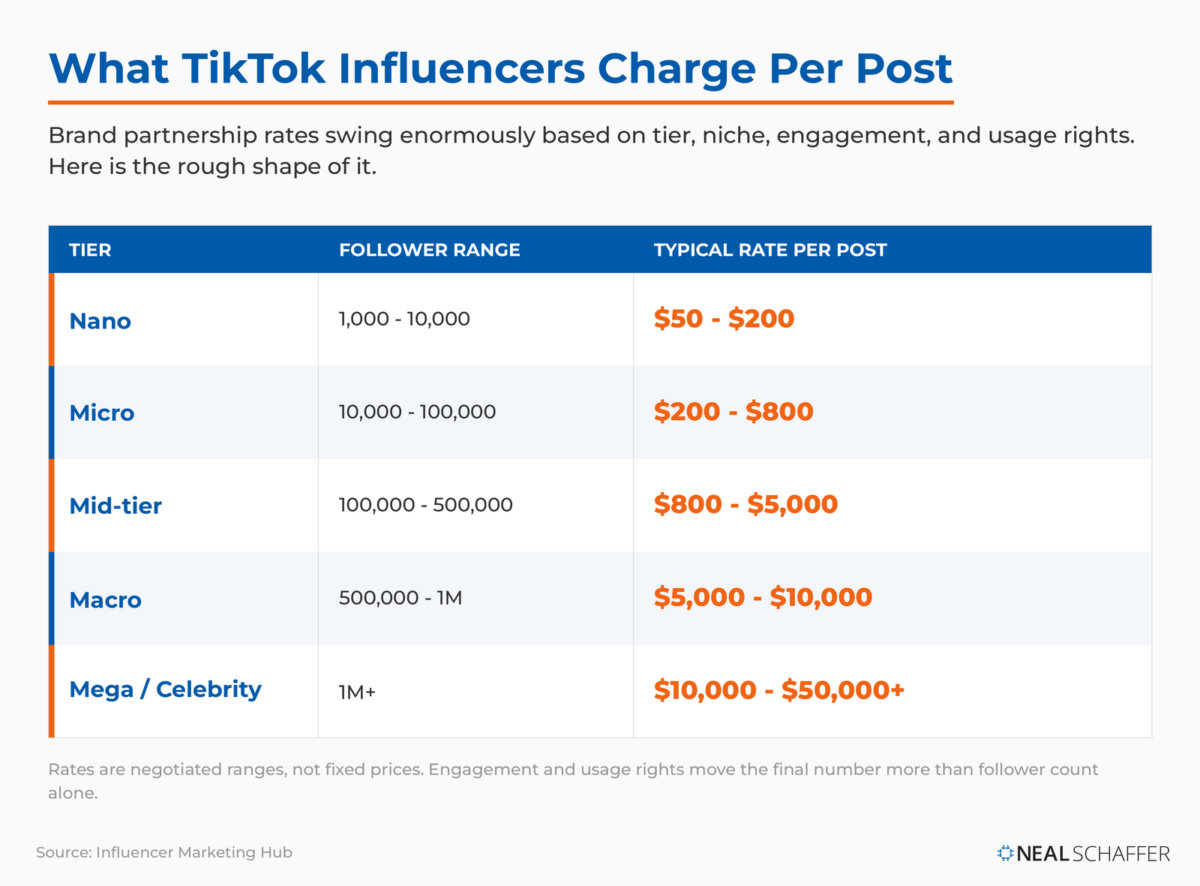
On the platform side, TikTok pays eligible creators directly through its Creator Rewards Program, which replaced the old Creator Fund in late 2023. To qualify, a creator must be at least 18, have 10,000 followers and 100,000 video views in the prior 30 days, and post original videos over a minute long. TikTok doesn’t publish a fixed per-view rate, and reported payouts vary widely by niche, geography, and how “original” the system judges the content. Treat direct platform pay as a bonus, not the business model.
The rest of the money comes from TikTok Shop and affiliate links, live-stream gifts that convert into cash, and using TikTok fame to grow income on YouTube, a newsletter, or a product line. The creators who last build several of these at once. If you’re curious how the totals actually add up, I dig into how much TikTokers make and how creators turn TikTok into income.
How Should Brands Find and Vet TikTok Influencers?
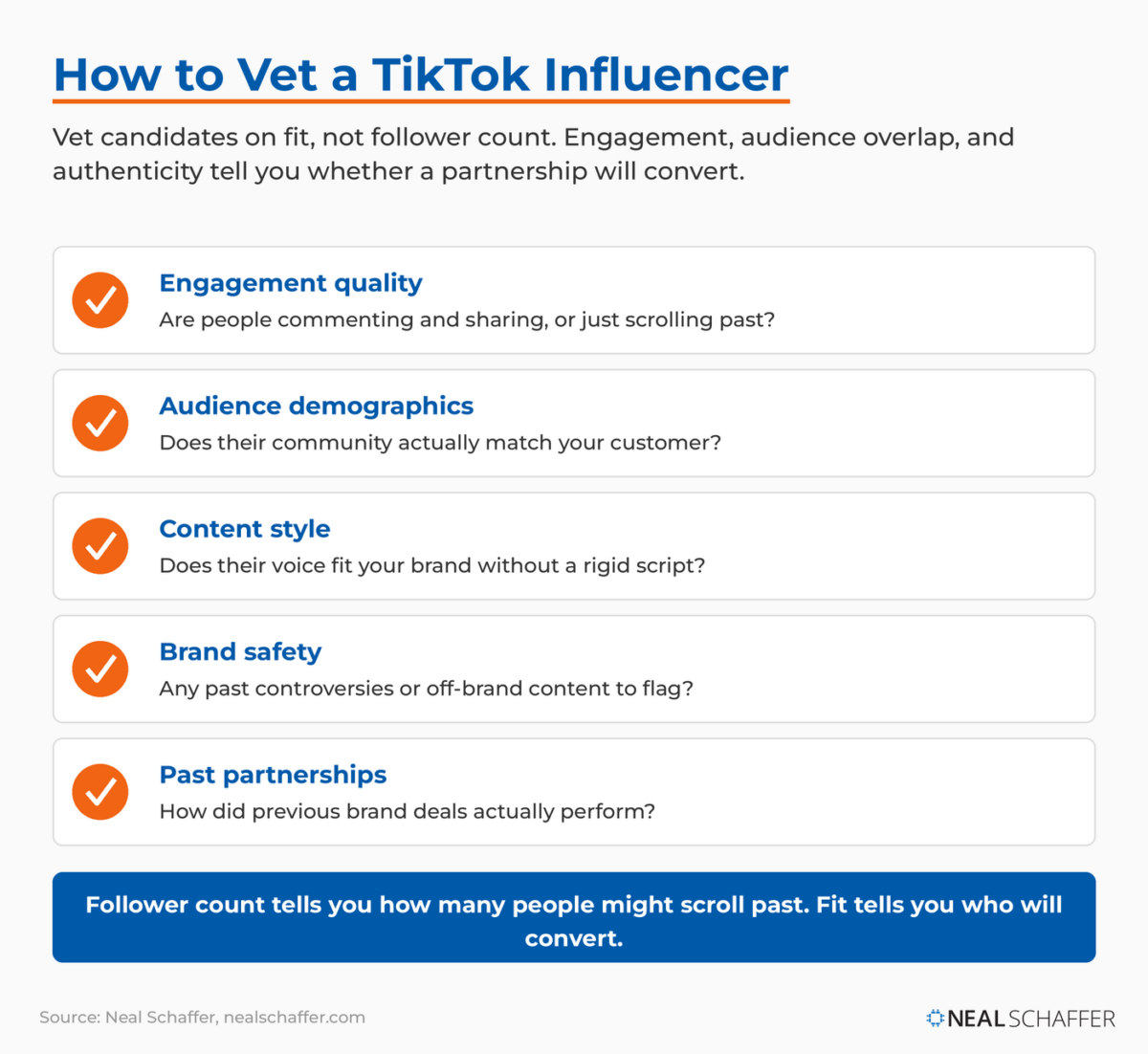
Brands should find TikTok influencers through a mix of discovery tools and hands-on time inside the app, then vet candidates on fit rather than follower count. Look at engagement quality, audience demographics, content style, brand safety, and past partnerships. The goal is alignment between the creator’s community and your customer, not the biggest possible number.
That’s harder than it sounds, because old habits die slowly. In my experience, most brands still pick creators on follower size first and treat engagement as a tiebreaker. I think that’s backwards, and the smartest brands I work with have flipped it. Engagement, audience overlap, and content authenticity tell you whether a partnership will convert. Follower count just tells you how many people might scroll past.
For the search itself, start with TikTok’s own Creator Marketplace, then layer in third-party tools like Favikon, Kolsquare, and Sprout Social to filter by niche, engagement, and audience data. Tools save time, but they don’t replace judgment. Spend real hours watching a creator’s videos and reading their comments before you reach out. When you’re ready to build a repeatable process, my approach to finding the right influencers and shaping an influencer marketing strategy starts with fit and works outward from there.
One more idea from The Age of Influence that applies directly here: you can either buy reach or build it. Paying a big creator for a one-time post buys you a moment. Cultivating a roster of aligned creators, and building your own brand into something people want to follow, compounds over time. Influencer marketing works like a marriage. The brands that win treat creator relationships as long-term commitments, not one-night stands.
What Makes a TikTok Influencer Partnership Actually Work?
A TikTok influencer partnership works when the brand gives creative freedom, sets clear expectations, and measures the right outcomes. Creators know their audience better than you do, so a tight brief paired with room to interpret it almost always beats a rigid script. Then you define success up front and track it against real business goals.
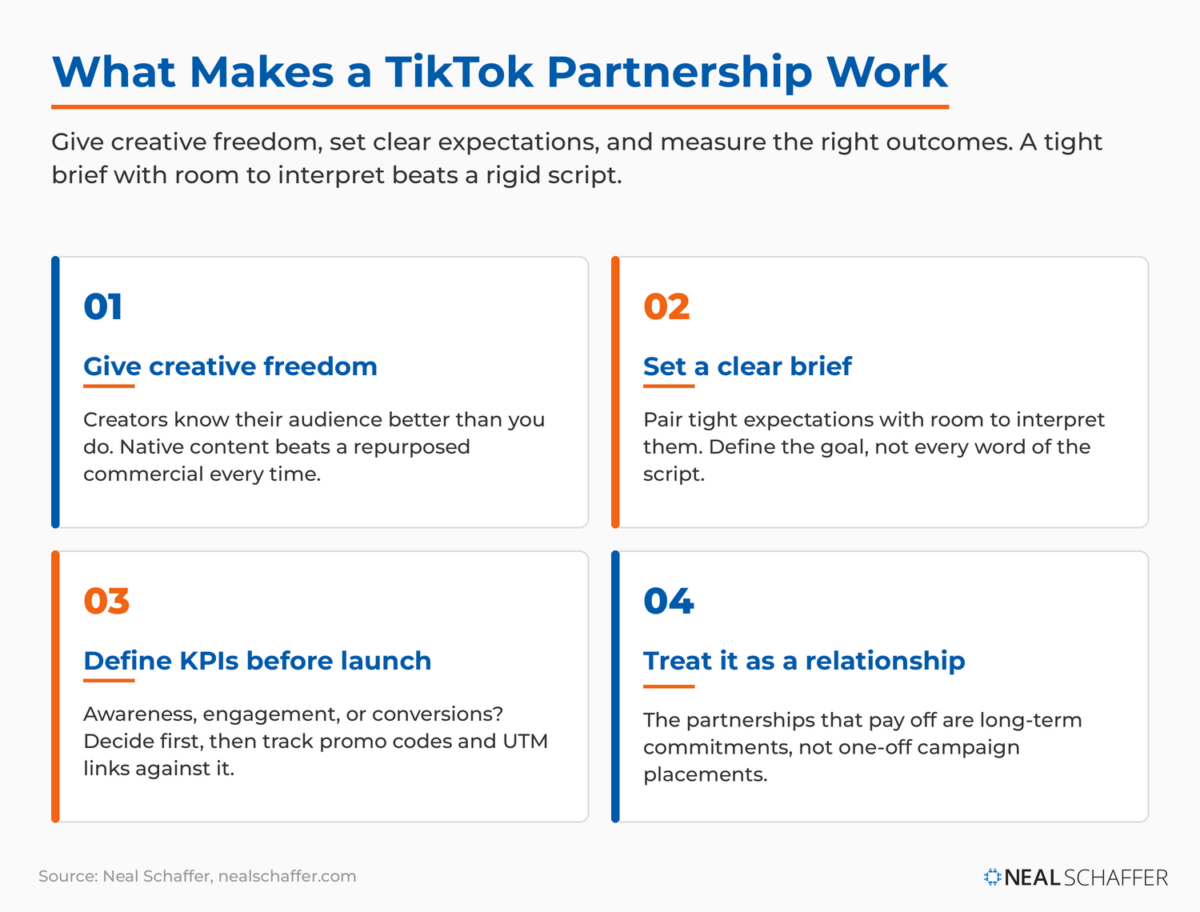
This is the part most brands skip, and it’s why so many partnerships look like generic ads. As Lindsey Bond, a former TikTok employee now at Pluto Ventures, put it on SARAL Academy: “the typical influencer looks different on TikTok than it does on Instagram.” Content that feels native to TikTok outperforms anything that smells like a repurposed commercial. Hootsuite’s algorithm research makes the same point from the data side: TikTok heavily weights watch time and early engagement, so content that holds attention gets distribution. Polished ad copy that people scroll past gets buried.
Set your KPIs before launch. Are you measuring awareness, engagement, or conversions? Use unique discount codes, UTM links, and post-campaign surveys to attribute what the creator actually drove, then compare cost-per-result against your other channels. The payoff can be substantial: Statista reports that the most successful brands earned over half a billion dollars in earned media value from TikTok influencer campaigns in the first half of 2024 alone.
And don’t treat disclosure as an afterthought. Sponsored content has to be clearly labeled under the FTC’s endorsement guides, and the obligation sits with both the brand and the creator. I walk through the practical side of staying compliant in my piece on FTC influencer guidelines, and there’s more on building a full program in my work on TikTok influencer marketing.
How Do You Become a TikTok Influencer?
You become a TikTok influencer by owning a specific niche, posting consistently, and earning watch time with strong opening hooks. The platform rewards content that keeps people watching, so completion rate and engagement matter far more than how many followers you start with. A complete unknown can reach a huge audience if the video performs.
Pick one topic and become the person people associate with it. Post often, lead every video with a hook in the first few seconds, and study what your data tells you. TikTok’s interest-based distribution means your content reaches people who care about your subject, whether or not they follow you, which is why understanding how the TikTok algorithm works is worth the effort. If you’re serious about the creator path, I’ve laid out the steps for becoming a TikTok influencer from a standing start.
Frequently Asked Questions About TikTok Influencers
Khaby Lame has held the top spot among individual creators, built almost entirely on silent comedy with universal appeal. Because rankings shift constantly, I keep an updated list of who has the most followers on TikTok rather than freezing a number here.
It depends heavily on tier and engagement. Typical rates run from roughly $50 to $200 for nano-influencers up to $10,000 to $50,000 or more for mega-creators. Most brand-creator deals land somewhere in the middle once engagement and usage rights are factored in.
Yes, through the Creator Rewards Program, for creators who are at least 18, have 10,000 followers and 100,000 recent views, and post original videos over a minute. But for most creators, brand partnerships, TikTok Shop, and affiliate income far outweigh direct platform payments.
Often, yes. Micro-influencers usually deliver higher engagement and a more targeted, trusting audience, which makes them strong for conversions on a defined budget. Macro and mega creators are better suited to broad awareness campaigns where reach is the goal and the budget can absorb premium rates.
Start with clear KPIs and proper attribution. Unique promo codes, UTM parameters, and creator-specific landing pages let you tie sales and traffic back to each partnership, so you can compare cost-per-acquisition against your other marketing channels honestly.
Ready to Put TikTok Influencers to Work for Your Brand?
Working with TikTok creators comes down to a few disciplined moves. Choose creators by fit and engagement, not follower count. Give them creative freedom inside a clear brief. Set your KPIs before launch, and treat the relationship as a long-term partnership. Get those right, and TikTok becomes a channel you can plan around.
If you want to ground your strategy in current data, the latest TikTok stats are worth bookmarking before you brief your first creator. And if you’d like help building a coordinated creator strategy alongside your other digital channels, you can get in touch about Fractional CMO services or grab a free preview of The Age of Influence to start with the fundamentals.