
In November 2021, Facebook invited me into a paid creator program built around Reels.
I took it seriously. I went far enough into the process to see exactly what participating would require of me. The specific terms were confidential and they stay that way. What I can tell you is the shape of the deal: a set number of Reels, on a set schedule, for a set window, in exchange for guaranteed pay.
Then I said no. And in the years since, I have not been invited back.
I have spent the last fifteen years as a Fractional CMO advising businesses on where to put their content effort. I teach social media at Rutgers Business School and influencer marketing at UCLA Extension. I have written six books on digital and social marketing. So when a platform offers to pay me for content, my first question is not how much. It is what the money costs.
That question is the one almost nobody answers. Nearly every guide to Facebook content monetization is written for a creator chasing a payout. Very few are written for a business owner deciding whether any of this deserves space on the calendar. This one is.
Key Takeaways
✅ Facebook Content Monetization is invite-only, and Meta publishes no follower threshold for it at all. The eligibility numbers circulating online belong to programs Meta shut down.
✅ The three Facebook-funded programs most guides still describe, In-Stream Ads, Ads on Reels and the Performance Bonus, were discontinued on August 31, 2025.
✅ The only guaranteed pay Meta publishes is Creator Fast Track, and it runs for three months. It pays $100 to $450 a month at 20,000 to 99,999 followers, up to $3,000 a month above a million, in exchange for 15 reels every month.
✅ Facebook paid creators nearly $3 billion in 2025, its highest total ever, and 60% of it went to reels.
✅ For most business pages the arithmetic does not work. The entire entry tier guarantee, $300 to $1,350 for 45 reels over three months, is worth less than one client sourced from the same audience.
What Is Facebook Content Monetization?
Facebook Content Monetization is Meta’s single invite-only program that pays creators based on how their public Facebook content performs. It replaced three separate earning programs. One application, one eligibility check, one set of earnings insights inside Meta Business Suite, covering reels, longer videos, Stories, photos and text posts.
Meta announced it in October 2024, explaining that it merges In-stream ads, Ads on Reels and the Performance Bonus into one program. The reason given was fragmentation. At the time, only about a third of monetizing creators on Facebook earned from more than one Facebook-funded program. Each one had its own availability, its own thresholds and its own sign-up.
Consolidation was overdue and it is genuinely better. One program, one dashboard, every format eligible. But the part that matters for anyone reading this is that it is still, in mid 2026, invite-only, with invitations distributed periodically. Meta says invitations arrive through the Facebook app, email, Meta Business Suite and the Professional dashboard. Anyone can submit an interest form from that dashboard. Nobody can apply and be accepted on the strength of hitting a number.
Why Did I Turn Down Facebook’s Reels Invitation?
I said no because the product was not ready. Facebook Reels was brand new in late 2021, the creation tools were thin, and viewing behavior on Facebook had not caught up to the format. The money was real. The asset I would have been building with all those videos was not.
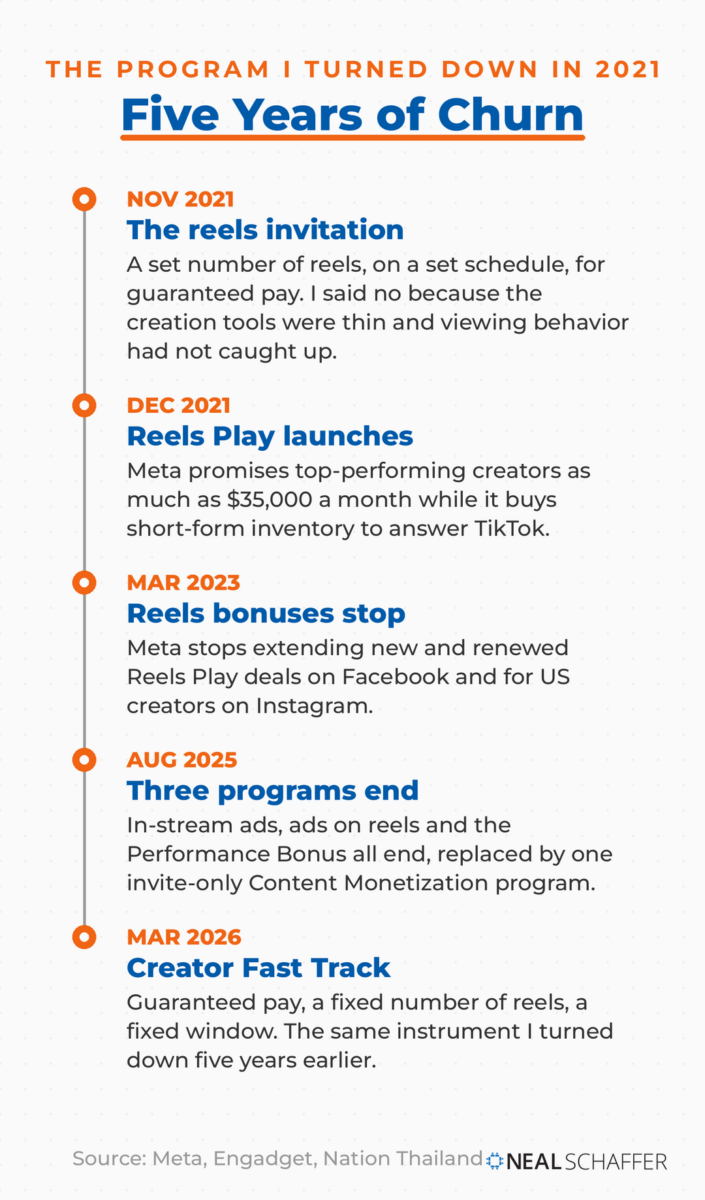
Look at the timing. My invitation came in November 2021. The Reels Play bonus program launched in December of that year, promising top-performing creators as much as $35,000 a month. Meta was buying short-form video inventory as fast as it could, because TikTok was eating its lunch and Reels was the answer. I was one of a great many people getting that kind of email at that moment.
Now the honest part. I did not see the shutdown coming, and I want to be clear that I am not claiming otherwise. I walked away over a product judgment about editing tools and audience behavior in one specific quarter. Meta ended those programs for an entirely different reason: it decided that sharing ad revenue was a better business than paying bonuses out of pocket. Different logic, same outcome. I got lucky on the timing, not smart.
Which is also why the 2021 story cannot carry the 2026 verdict. Reels grew up. The tools are good now. So the case below rests on what the current programs pay, not on what I thought about Reels five years ago.
What Happened to the Facebook Monetization Numbers You Are Reading About?
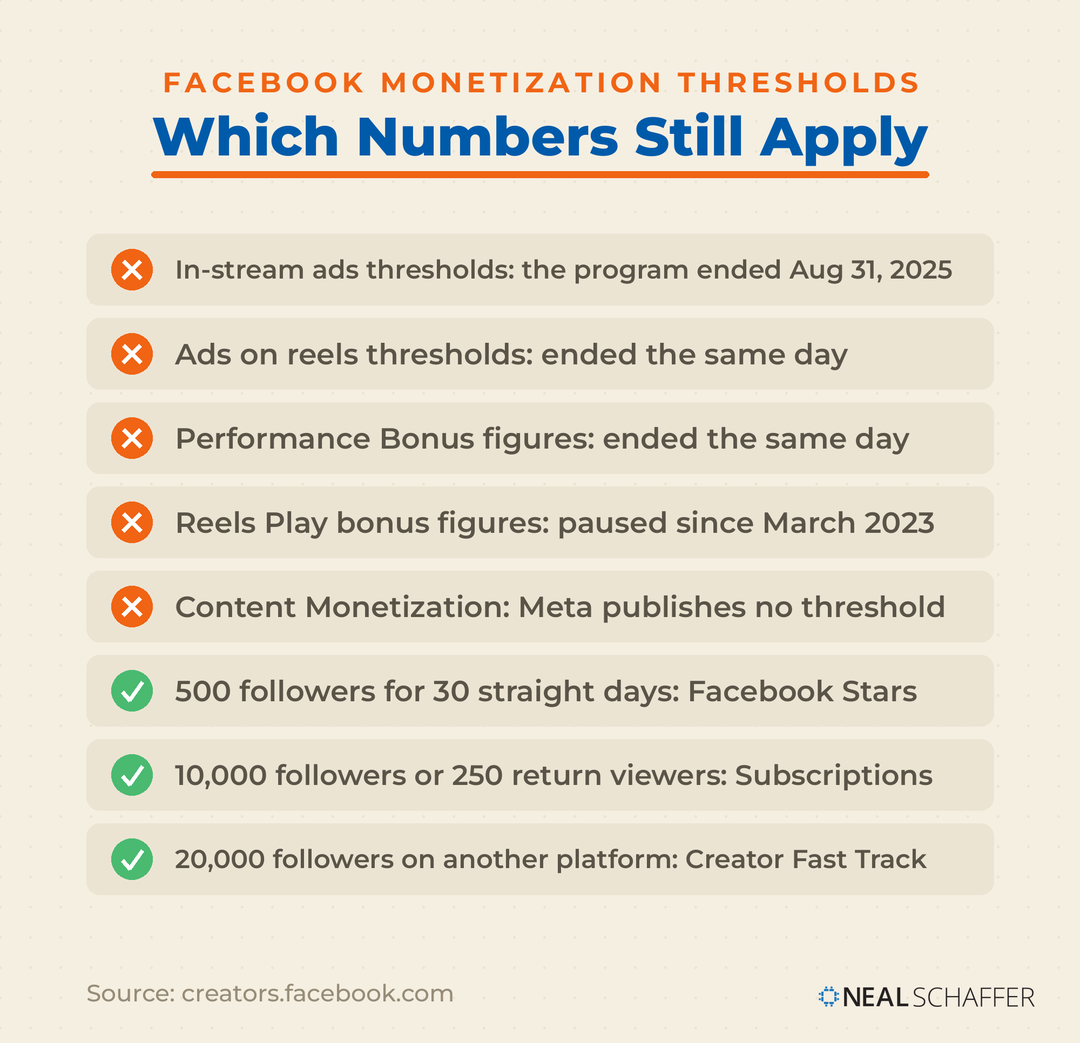
Nearly every eligibility figure still circulating for Facebook monetization describes a program that no longer exists. Meta paused the Reels Play bonus in March 2023. It then discontinued In-Stream Ads, Ads on Reels and the Performance Bonus on August 31, 2025, folding all three into Content Monetization. The thresholds people quote are archaeology.
The pause came first. In March 2023, Meta stopped paying Reels bonuses to creators on Facebook and to US-based creators on Instagram. It told reporters it would honor existing commitments and possibly bring the program back in targeted ways. The stated direction was a shift toward advertising revenue share on Reels.
Then came the sunset. Facebook confirmed that in-stream ads, ads in Reels and the Performance Bonus would all end on August 31, 2025, with Content Monetization as the single replacement. That date is the dividing line. Any article describing how to qualify for in-stream ads with a specific follower count and a specific watch-minute total is describing a program that was switched off almost a year ago.
This pattern is not unique to Facebook, by the way. A headline creator fund, then quiet decay, then consolidation into ad revenue share. That cycle has now run its course on every major platform. It is why the current state of YouTube Shorts monetization and of Instagram monetization looks so similar to Facebook’s. Platforms rent attention to creators. They do not sell it.
How Do You Qualify for Facebook Content Monetization?
Meta publishes no follower threshold for Content Monetization, because the program is invite-only rather than application-based. What Meta does publish are the thresholds for its other earning products, Stars and Subscriptions, plus the eligibility rules for Creator Fast Track. Those are the only numbers you can actually check against your own page today.
Here is what Meta itself states for each program, as of August 2026.
| Program | What Meta publishes as the requirement | How you get in |
|---|---|---|
| Content Monetization | No follower or view threshold published | Invitation only; submit an interest form from the Professional dashboard |
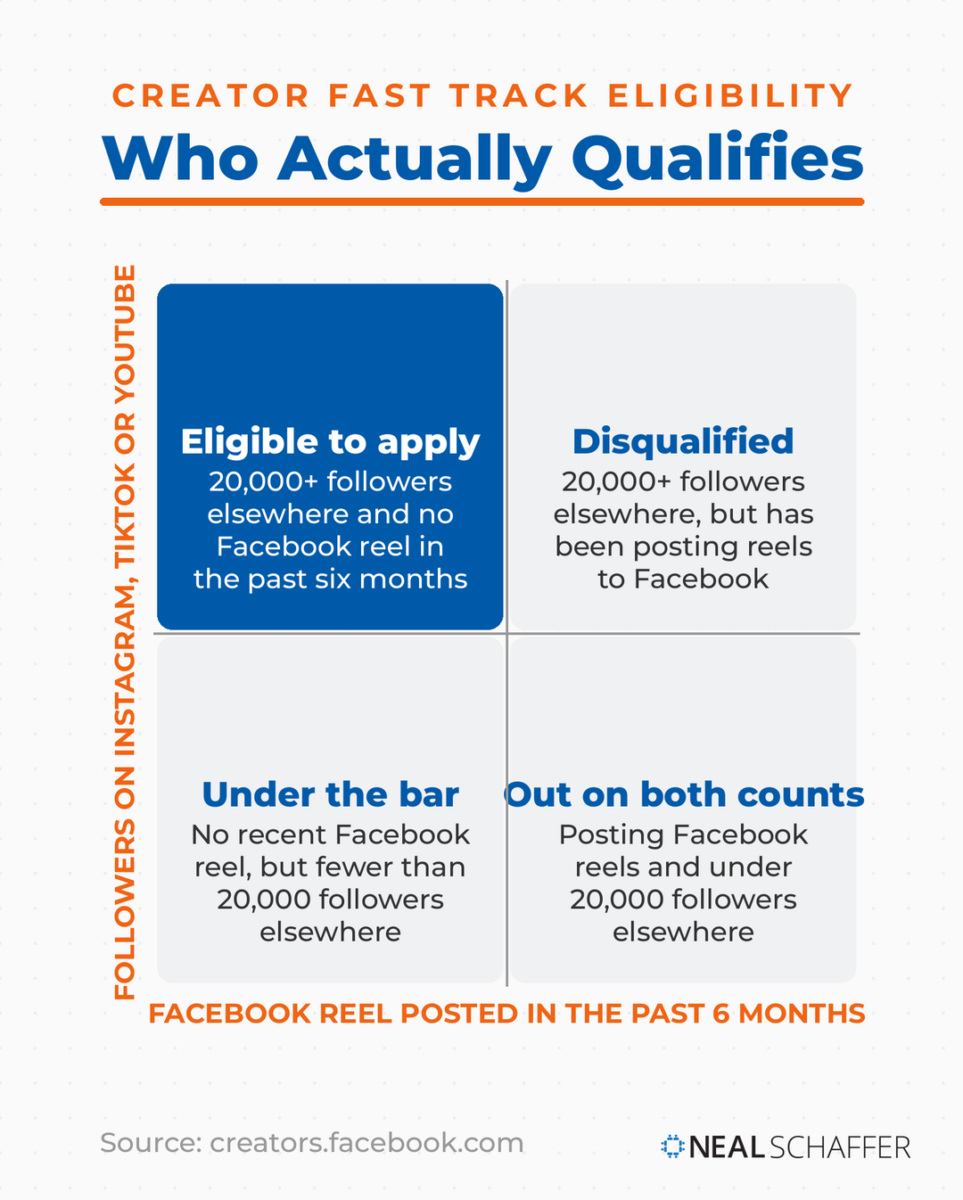
| Creator Fast Track | 20,000+ followers on Instagram, TikTok or YouTube, 30,000 video views there in 60 days, and no Facebook reel posted in the last 6 months | Apply; US, Canada, UK and Australia only |
| Facebook Stars | 500 followers for 30 consecutive days | Turn it on, subject to Partner Monetization Policies |
| Subscriptions | 10,000 followers or 250+ return viewers, plus either 50,000 post engagements or 180,000 watch minutes in 60 days | Page-level review, then product-level review |
Notice the shape of that table. The program everyone writes about is the one with no published bar, and the two products with clear published bars are the ones almost nobody covers. Stars at 500 followers for 30 days is the lowest genuine entry point Meta offers, and a business page that has been running for a year almost certainly clears it.
There is also a wrinkle in Creator Fast Track worth reading twice: you are disqualified if you have posted a Facebook reel in the past six months. The guaranteed money is aimed squarely at creators who have been ignoring Facebook, not at the business that has been dutifully posting to it. Loyalty is the thing being penalized here.
Turn LinkedIn Into a Real Growth Channel
My latest book helps professionals, entrepreneurs, and business owners turn LinkedIn from a static profile into a real source of clients and growth.
Maximizing LinkedIn for Business Growth gives you clear, practical steps to build a profile that gets noticed and a network that actually sends business your way.
Grab your copy on Amazon and put it to work this week. Click the cover or the button below to get started.

What Does Facebook Content Monetization Actually Pay?
Content Monetization has no rate card, because payouts track how individual posts perform. The one place Meta publishes guaranteed numbers is Creator Fast Track, launched in March 2026: $100 to $450 a month at 20,000 to 99,999 followers, $1,000 a month from 100,000, and $3,000 a month above one million followers.
Those tiers come with a workload. Meta requires 15 eligible reels a month, uploaded across at least 10 separate days, for three months. Run that against the pay and you get a number Meta does not print anywhere, so I did the division myself.
| Follower tier (Instagram, TikTok or YouTube) | Guaranteed pay per month | Reels required per month | Effective pay per reel |
|---|---|---|---|
| 20,000 to 99,999 | $100 to $450 | 15 | $6.67 to $30 |
| 100,000 to 999,999 | $1,000 | 15 | About $67 |
| 1,000,000+ | $3,000 | 15 | $200 |
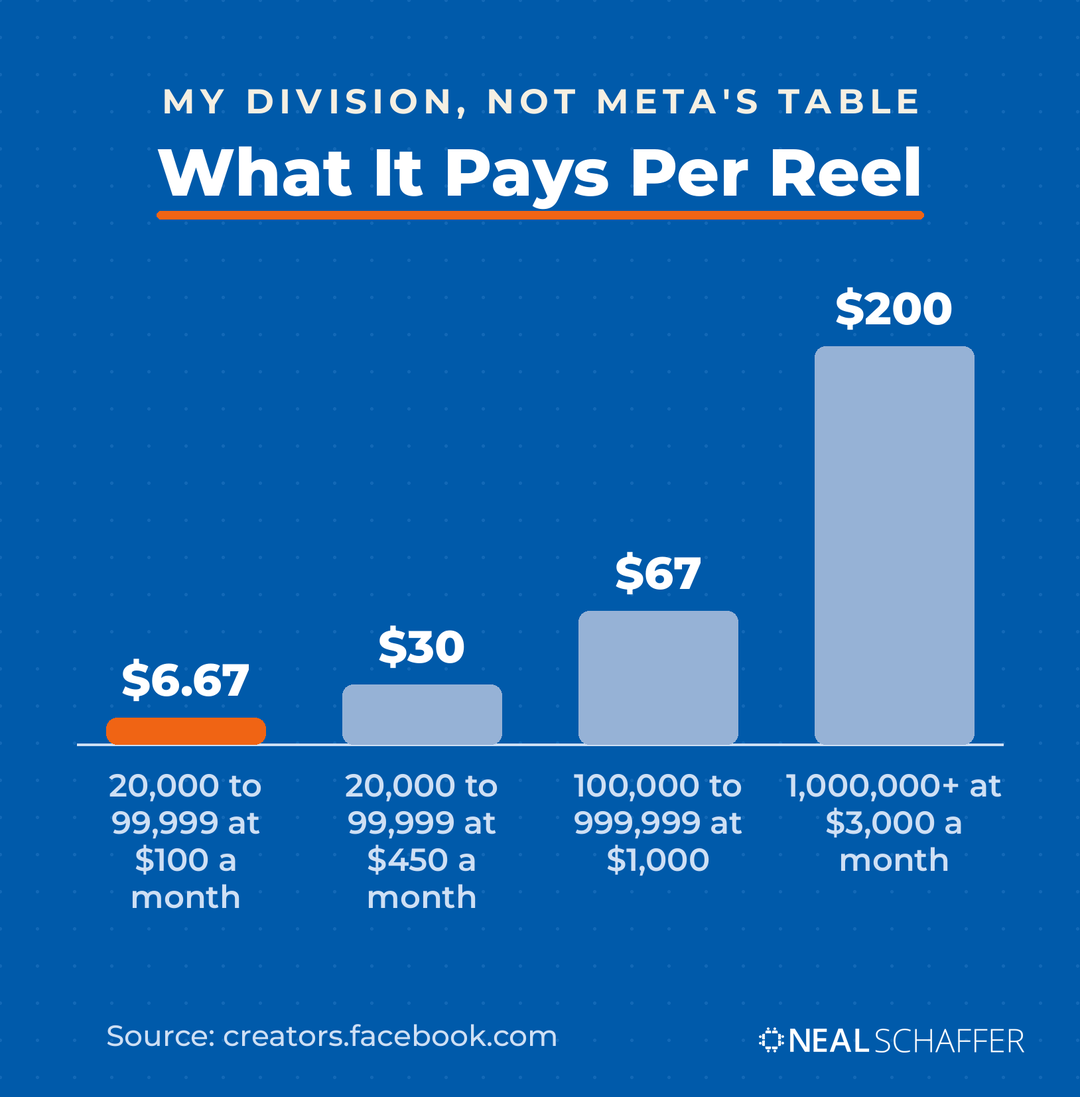
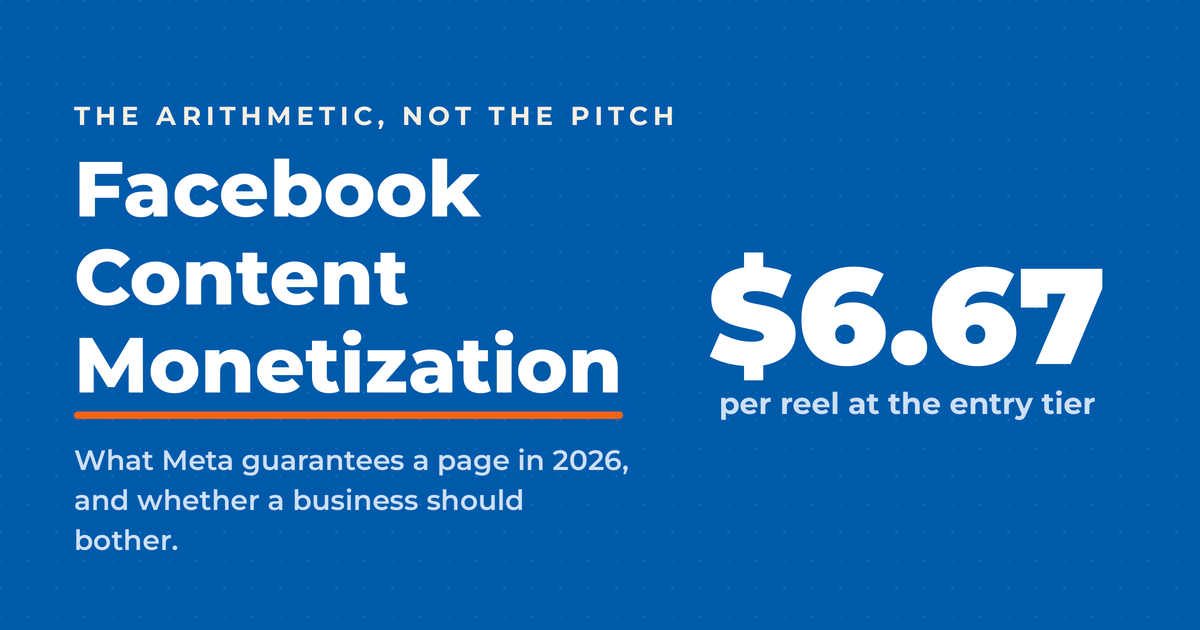
Six dollars and sixty-seven cents per video, at the bottom tier, for original work that you filmed. That is the guaranteed floor of Facebook creator monetization in 2026, and it is worth setting next to the $35,000 a month the Reels Play bonus dangled at its 2021 launch.
To be fair to Meta, the aggregate numbers are real and they are growing. That nearly $3 billion paid out in 2025 was a 35% increase year over year, and 60% of it went to reels. Meta also reports that the number of creators earning more than $10,000 a year on Facebook grew by more than 30%. Money is flowing. It is just flowing toward people whose entire job is making video.
One more detail that gets glossed over in most coverage. Payouts run on qualified views, and Meta excludes repeat views and views shorter than five seconds from the count. Your view number and your paid view number are two different numbers, and the second one is smaller.
Is Facebook Content Monetization Worth It for a Business?
For most business pages, no. The guaranteed pay tops out at $3,000 a month and requires a million followers somewhere else, while the entry tier pays less per month than a single hour of most professional services. The same reels, pointed at your own offer instead of at Meta’s payout, are worth more.
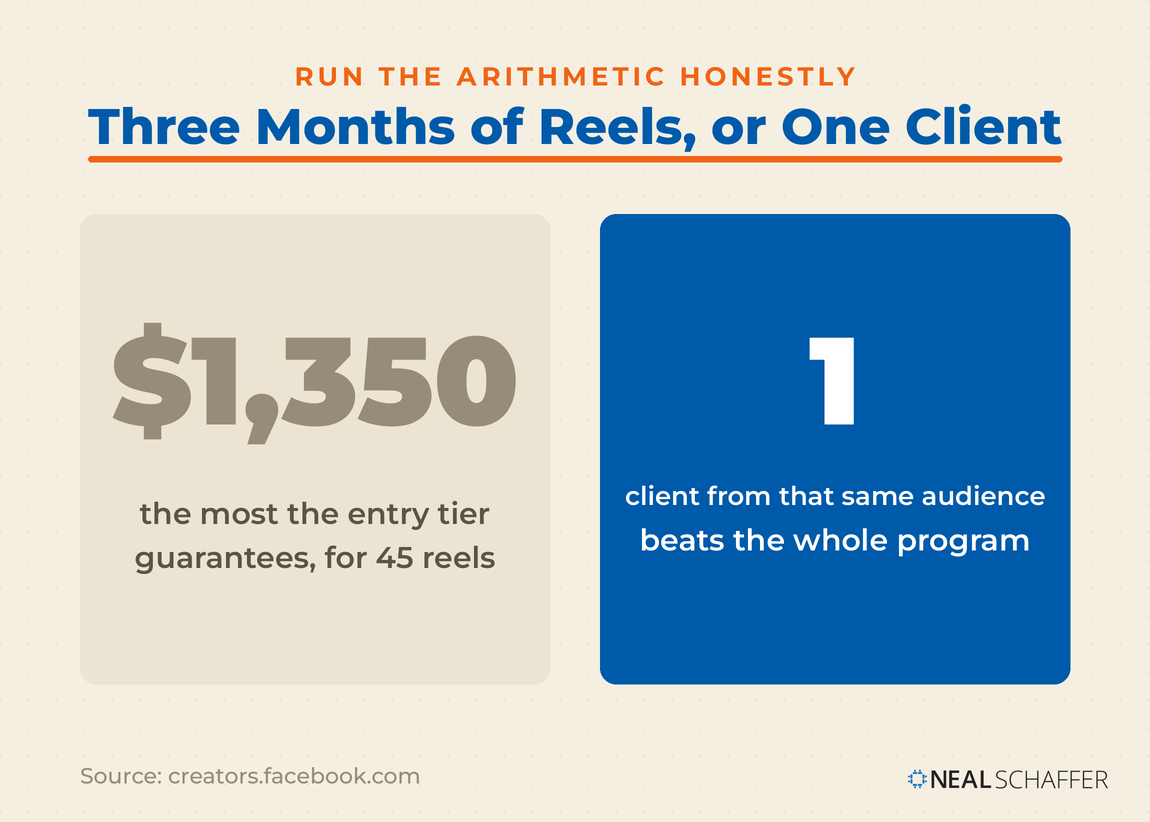
Run the comparison honestly. Creator Fast Track guarantees three months, not a year. A business page in the 20,000 to 99,999 follower band earns $300 to $1,350 across the whole program, and produces 45 original reels to get it. For nearly every business I have worked with, one client sourced from that same audience beats the entire run. That is the whole argument, and it does not require any hand-waving about brand value to work.
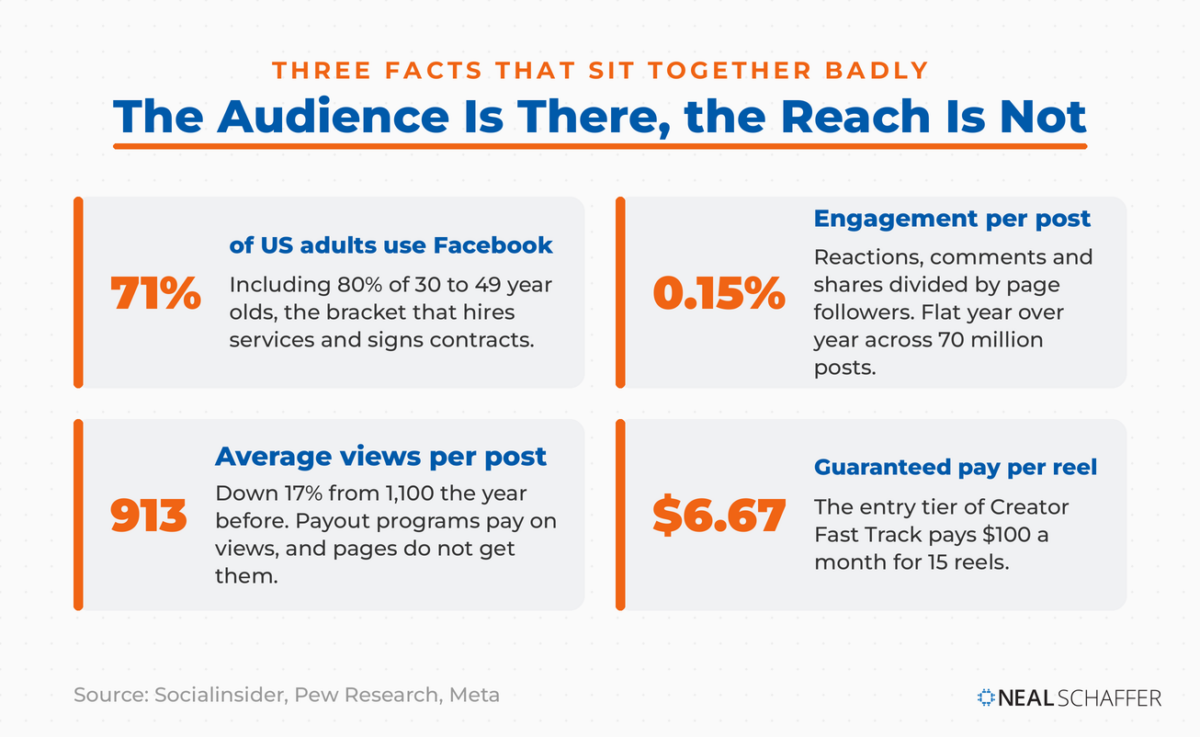
The distribution math makes it worse. Socialinsider’s analysis of 70 million posts puts the average Facebook engagement rate at 0.15% and average views per Facebook post at 913, down 17% year over year. Payout programs pay on views. Business pages do not get views. Ask any page owner watching their reach and you will hear the same thing. Understanding how the Facebook algorithm distributes content matters more to a business than any payout table.
None of which means the audience is gone. Pew Research finds that 71% of US adults use Facebook, including 80% of 30 to 49 year olds, the bracket that buys houses, hires contractors and signs service contracts. The people are there. The free distribution is not, and the payout is a rounding error. Those three facts sit together uncomfortably, and the resolution is to treat Facebook as a place to reach buyers rather than a place to collect checks.
I made this argument on my podcast years before Content Monetization existed. On an episode of my podcast Your Digital Marketing Coach, I put it this way:
“Don’t build social media influence, build business. Build influence to build your business. Without business, any influential status that you have has no meaning.”
The point has aged well, and the reason is structural. As I wrote in Digital Threads, everything outside your website and your email list comes from rented land. A platform payout is the most rented income there is. It exists at Meta’s discretion, on Meta’s timetable, at a rate Meta sets and has already cut twice. Ask the creators who built a monthly income on the Reels Play bonus how that went, or look at what happened to everyone relying on in-stream ads last August.
What Should a Business Page Do on Facebook Instead?
Treat reels as distribution rather than as inventory you are selling to Meta. The same video that earns six dollars from a payout program can send a viewer to your booking page, your email list or your group, where the value is yours to keep. Then switch on the low-threshold earning products, which cost nothing to enable.
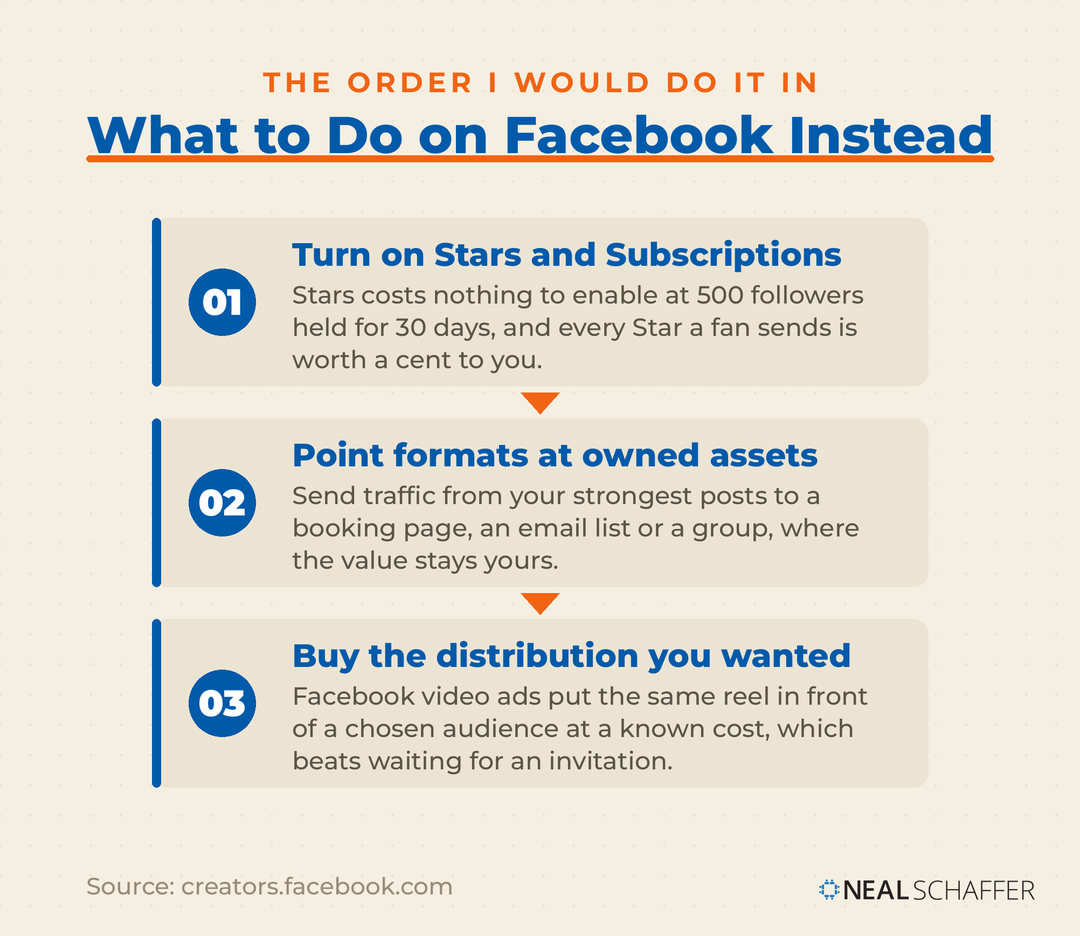
Three moves, in the order I would make them.
Turn on Stars and Subscriptions if you clear the bar. Stars costs you nothing to enable at 500 followers and each Star a fan sends is worth a cent to you. Subscriptions is a real recurring product if you have an actual community and can clear the engagement thresholds. Neither will replace revenue. Both are free to switch on, and unlike Content Monetization you can qualify by decision rather than by invitation.
Point your best-performing formats at owned assets. This is where the effort actually compounds. Study which Facebook post ideas earn engagement for your page, build Facebook engagement posts that start conversations rather than chase views, and route the traffic somewhere you control. If community is the play, creating a Facebook group gives you a surface where reach is not throttled the same way a page is.
Buy the distribution you were hoping to earn. For businesses with an offer that converts, Facebook video ads put your reel in front of a chosen audience at a known cost. That is a more predictable transaction than hoping a payout program invites you. The wider set of Facebook features available to pages has grown a lot, and most of them serve a business better than the monetization tab does.
If direct content revenue is genuinely your goal rather than a side effect, other platforms pay better for the same labor. The economics of making money on YouTube and making money on TikTok still beat Facebook’s for creators. And the highest-margin option is not a platform program at all. Owning the audience through blog monetization, or building a direct offer the way creators do on Instagram, keeps the revenue attached to you. My analysis of how influencers actually make money lands in the same place: sponsorships and their own products dwarf platform payouts.
Would I Say Yes If Facebook Invited Me Back Tomorrow?
Under three conditions, yes. The reels would have to be repurposed from work I am already producing. The program would have to allow a link or an offer in the content. And the guaranteed pay would have to clear what those same hours produce elsewhere in my business. Miss one and it is a no.
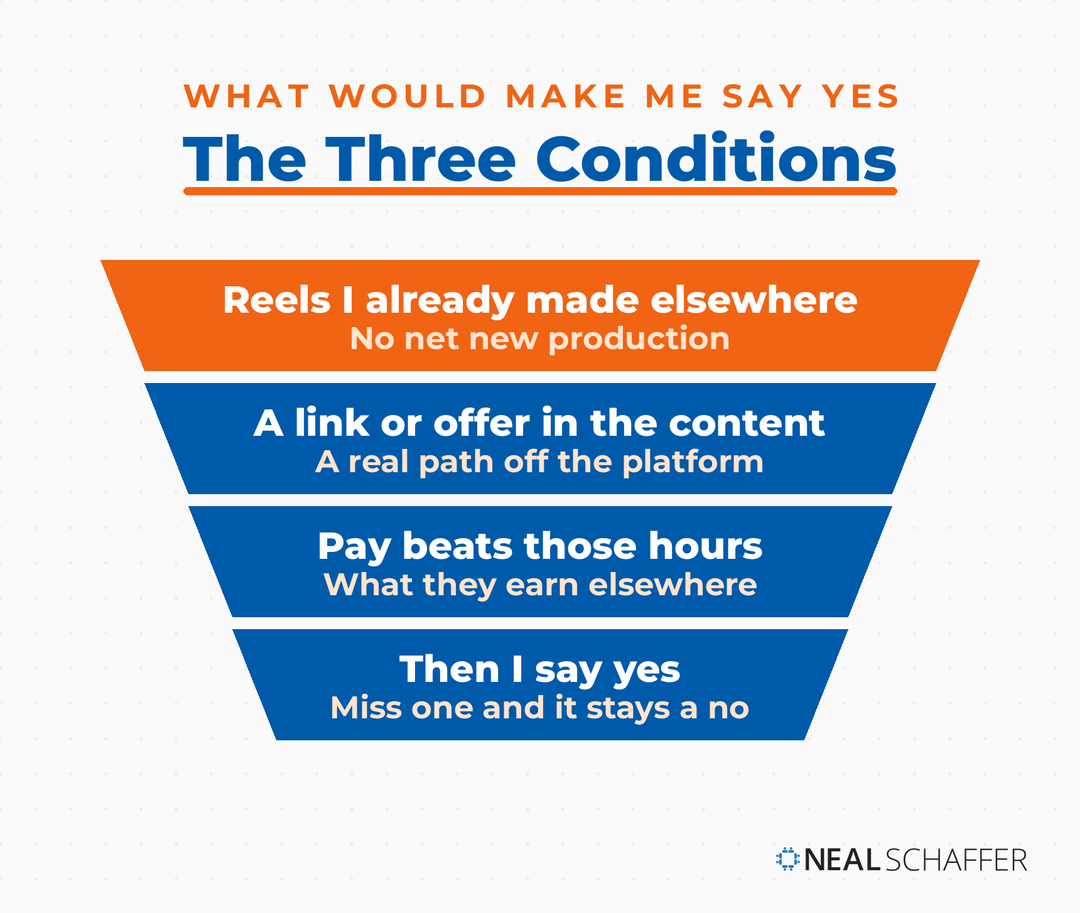
I am stating conditions rather than a verdict on purpose. Meta has changed these rules three times in five years, and it will change them again. A flat “not worth it” ages badly the moment the rate moves. Conditions do not.
The condition that matters most is the second one. Everything above comes down to whether the content builds something that survives the program ending. A reel that sends someone to my email list survives August 31. A reel that only earned a payout does not. If Meta ever lets creators pair guaranteed pay with a real path off the platform, my answer changes that day.
Notice, too, that Creator Fast Track has almost exactly the shape of the offer I turned down in 2021: guaranteed money, a fixed number of reels, a fixed window. Five years of program churn later, Meta has arrived back at the same instrument. That tells you something about how much of this is strategy and how much is inventory buying.
Frequently Asked Questions About Facebook Content Monetization
Meta does not publish a follower requirement, because the program is invite-only. Any figure you see quoted, whether it is 5,000 or 10,000, comes from one of the retired programs. The published thresholds that still apply are 500 followers for Stars and 10,000 followers or 250 return viewers for Subscriptions.
Yes. Meta has said it plans open enrollment eventually and has been sending invitations in waves. But as of August 2026 the program page still describes it as invite-only. You can submit an interest form from the Monetization tab of your Professional dashboard.
Meta does not publish a per-thousand rate. Any figure you find quoted is somebody’s estimate from their own dashboard. Meta now reports an Earnings Rate metric inside the program, showing approximate earnings per 1,000 qualified views for your own content.
Very few do. The published guaranteed tiers cap at $3,000 a month for creators with over a million followers on another platform, and the entry tier pays $100 to $450. Businesses generally earn far more by using the same content to generate leads than by collecting the payout.
Put These Numbers Against Your Own Pipeline
Before you spend a quarter chasing an invitation, do the arithmetic this post is built on. What the guaranteed tier pays for three months of reels, against what one new customer from that audience is worth to you. For most businesses that comparison ends the debate in about thirty seconds. It also frees up the calendar for content that feeds the pipeline.
To understand what is actually working on the platform right now, the current Facebook statistics are the numbers I would start from. My work on Facebook marketing puts the pieces together for a business rather than a creator. And if you would rather build a coordinated plan across your channels than chase one platform’s payout, download a free preview of Digital Threads or talk to me about Fractional CMO services.