Editorial Note: I may earn a commission when you visit links that appear on my website.
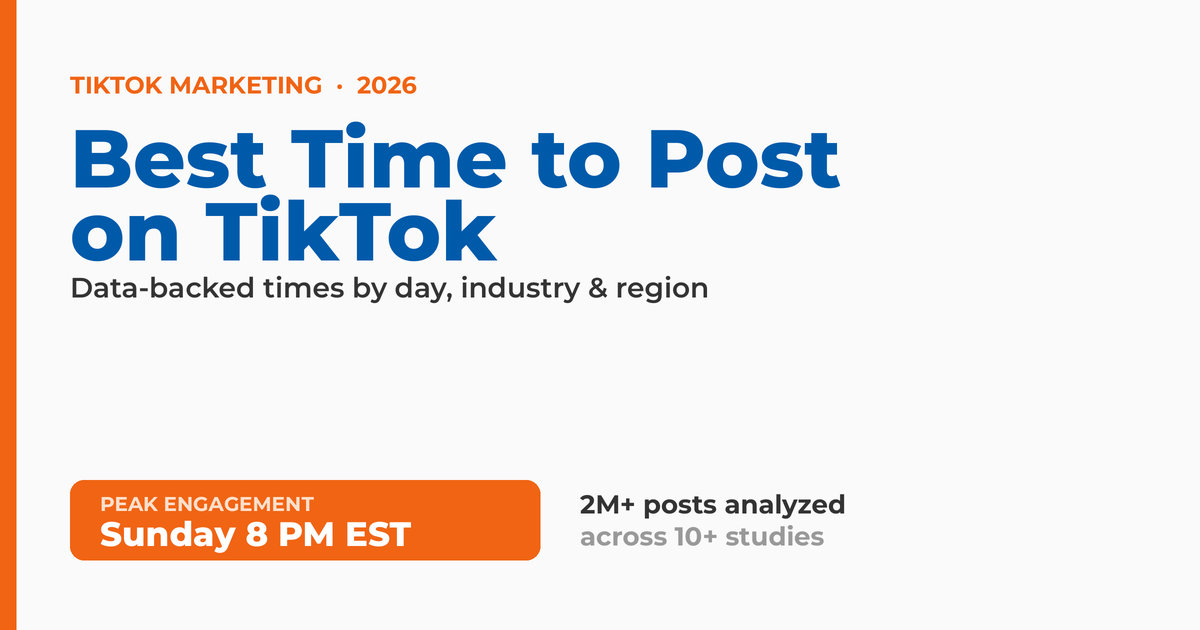
Best Time to Post on TikTok in 2026: Data-Backed Times by Day, Industry & Region
Think about it: You’ve just created what might be your best TikTok ever. The hook is sharp, the editing is clean, and the content genuinely delivers value. You hit publish at 3 AM because you finally finished editing—and the video goes nowhere.
Sound familiar? I’ve been there, and so has every content creator who’s ever underestimated the power of timing.
Here’s the reality: In 2026, TikTok has nearly 2 billion monthly active users, and the average user opens the app 20 times per day. That’s an incredible amount of competition for attention—and an incredible opportunity if you know when your audience is actually scrolling.
This guide distills findings from over 10 major industry studies analyzing more than 2 million TikTok posts. I’ve cross-referenced data from Buffer, Sprout Social, Hootsuite, and Influencer Marketing Hub to give you the most accurate, actionable timing recommendations for 2026.
Key Takeaways
✅ Sunday 8 PM is the single highest-engagement time globally, followed by Tuesday 4 PM and Wednesday 2–5 PM
✅ Engagement rises significantly between 1 PM and 8 PM across all days of the week
✅ Thursday 1 PM and Saturday 4 PM–4 AM are the worst posting windows to avoid
✅ Your TikTok Analytics “Follower Activity” tab shows when your specific audience is online—use it
✅ Post 1–4 high-quality videos per day for optimal algorithm favor; consistency beats volume
✅ All recommended times are in EST—adjust for your local time zone and audience location
The Ever-Shifting Sands of TikTok: Why Timing Still Matters in 2026
The TikTok algorithm is constantly evolving. What worked six months ago doesn’t guarantee results today. With the platform now reaching 1.99 billion monthly active users, the competition for attention has never been fiercer.
But here’s what hasn’t changed: The algorithm still tests new content with a small initial audience before deciding whether to push it to the For You Page. And the speed of that early engagement directly influences how far your video travels.
Timing isn’t about gaming the system. It’s about putting your content in front of people who are actually there to see it.
Beyond the Algorithm: Understanding the “Why” Behind Peak Posting Times
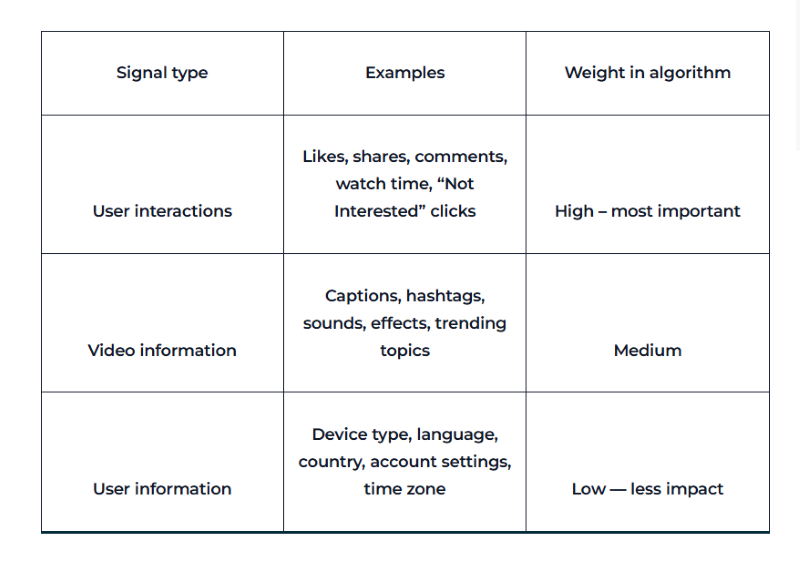
When TikTok publishes your video, it shows it to a small test audience first. According to Hootsuite’s algorithm research, the platform evaluates three primary signals: user interactions (watches, likes, shares, comments), video information (captions, sounds, hashtags), and device/account settings.
Here’s why timing matters in this equation:
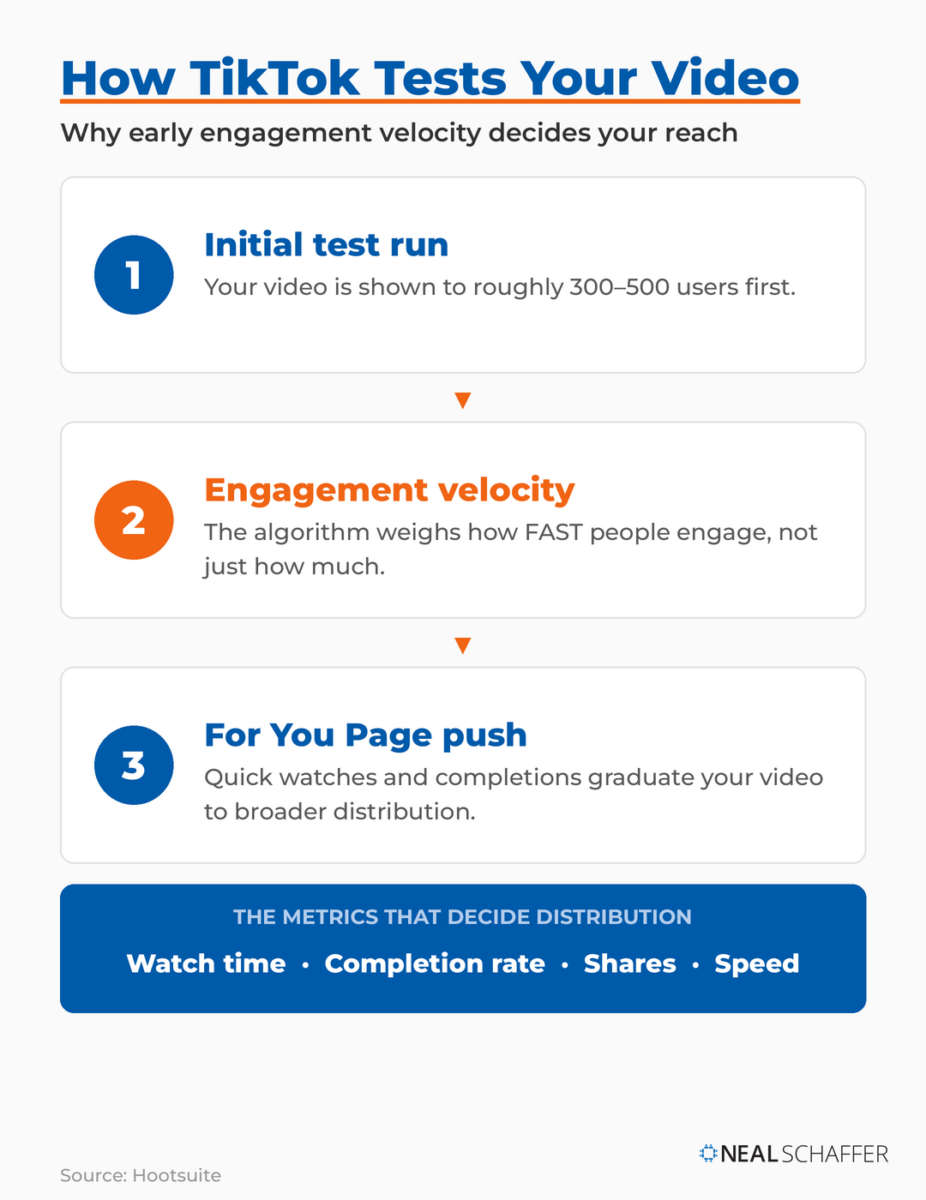
The Initial Test Run: Your video gets shown to roughly 300-500 users initially. If those users engage quickly and watch through to the end, TikTok pushes it to more people.
Early Engagement Velocity: The algorithm heavily weights how fast engagement happens, not just how much. A video that gets 50 likes in the first 30 minutes performs better algorithmically than one that gets 100 likes over 24 hours.
Recent Content Priority: TikTok’s algorithm favors fresh content. Older videos can still surface, but newer posts get priority in the initial distribution phase.
The Key Metrics: Watch time, completion rate, shares, and speed of engagement all determine whether your video graduates from the test audience to broader distribution.
This is why posting when your audience is active isn’t optional—it’s the foundation of TikTok success.
The Gold Standard: My Data-Driven Approach to TikTok Timing
You’re not here for guesswork. Neither am I. The timing recommendations in this guide come from rigorous analysis of multiple authoritative sources.
How I Gathered This 2026 Data
To bring you the most accurate timing data, I analyzed and cross-referenced findings from:
- Buffer: Analysis of posting patterns across their user base
- Sprout Social: Industry-specific engagement data
- Hootsuite: Comprehensive platform analysis with engagement heatmaps
- Influencer Marketing Hub: Data segmented by content type and industry vertical
- SocialPilot: Analysis of 700,000+ TikTok posts
Combined, these sources represent analysis of over 2 million TikTok posts across industries, regions, and content types.
From Raw Data to Actionable Insights: My Analytical Methodology
When sources disagreed (and they often did), I weighted data based on:
- Sample size: Larger studies carried more weight
- Recency: 2025-2026 data took priority over older research
- Methodology transparency: Sources that explained how they collected data ranked higher
- Cross-source validation: Times that appeared across multiple studies were prioritized
All times are standardized to Eastern Standard Time (EST) with guidance for converting to your local time zone.
I also incorporated user behavior analysis—studying how audiences actually interact with content at different times—to add practical context to the numbers.
The Universal Sweet Spot: Best Times to Post on TikTok at a Glance
The single best time to post on TikTok is Sunday at 8 PM EST. According to Buffer’s data, this time slot consistently generates the highest engagement rates globally, followed by Tuesday at 4 PM and Wednesday between 2–5 PM.
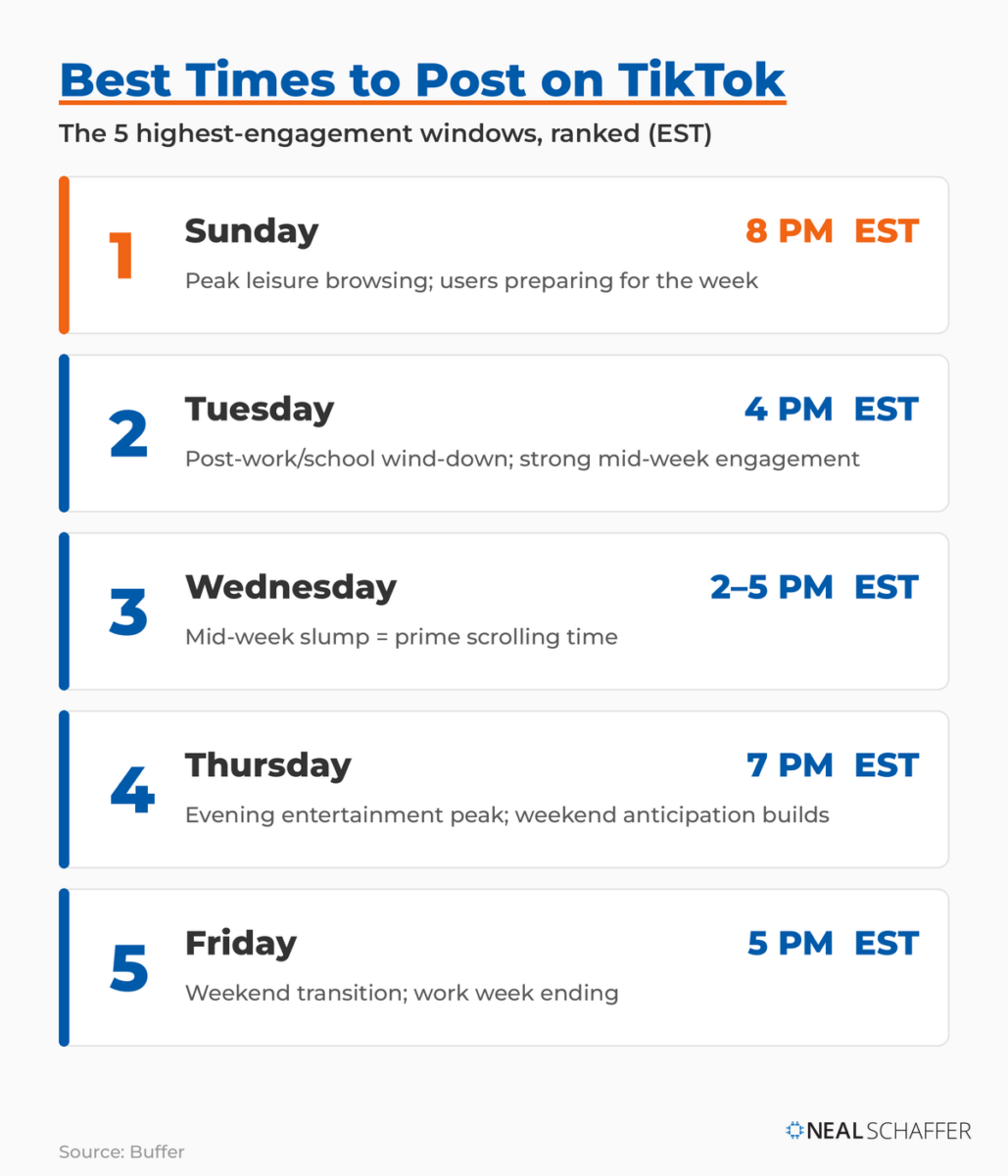
A Week at a Glance: Hour-by-Hour Breakdown for Maximum Engagement
| Rank | Day & Time (EST) | Why It Works |
|---|---|---|
| 🥇 | Sunday 8 PM | Peak leisure browsing; users preparing for the week |
| 🥈 | Tuesday 4 PM | Post-work/school wind-down; strong mid-week engagement |
| 🥉 | Wednesday 2–5 PM | Mid-week slump = prime scrolling time |
| 4th | Thursday 7 PM | Evening entertainment peak; weekend anticipation builds |
| 5th | Friday 5 PM | Weekend transition; work week ending |
Quick Stat: Engagement rises significantly between 1 PM and 8 PM globally across all days of the week, according to Sprout Social’s analysis.
Important: All times listed are in EST. If your audience is in a different time zone, adjust accordingly. A California-based creator targeting East Coast audiences should post at 5 PM PST to hit that 8 PM EST sweet spot.
Best Times to Post on TikTok by Day of the Week
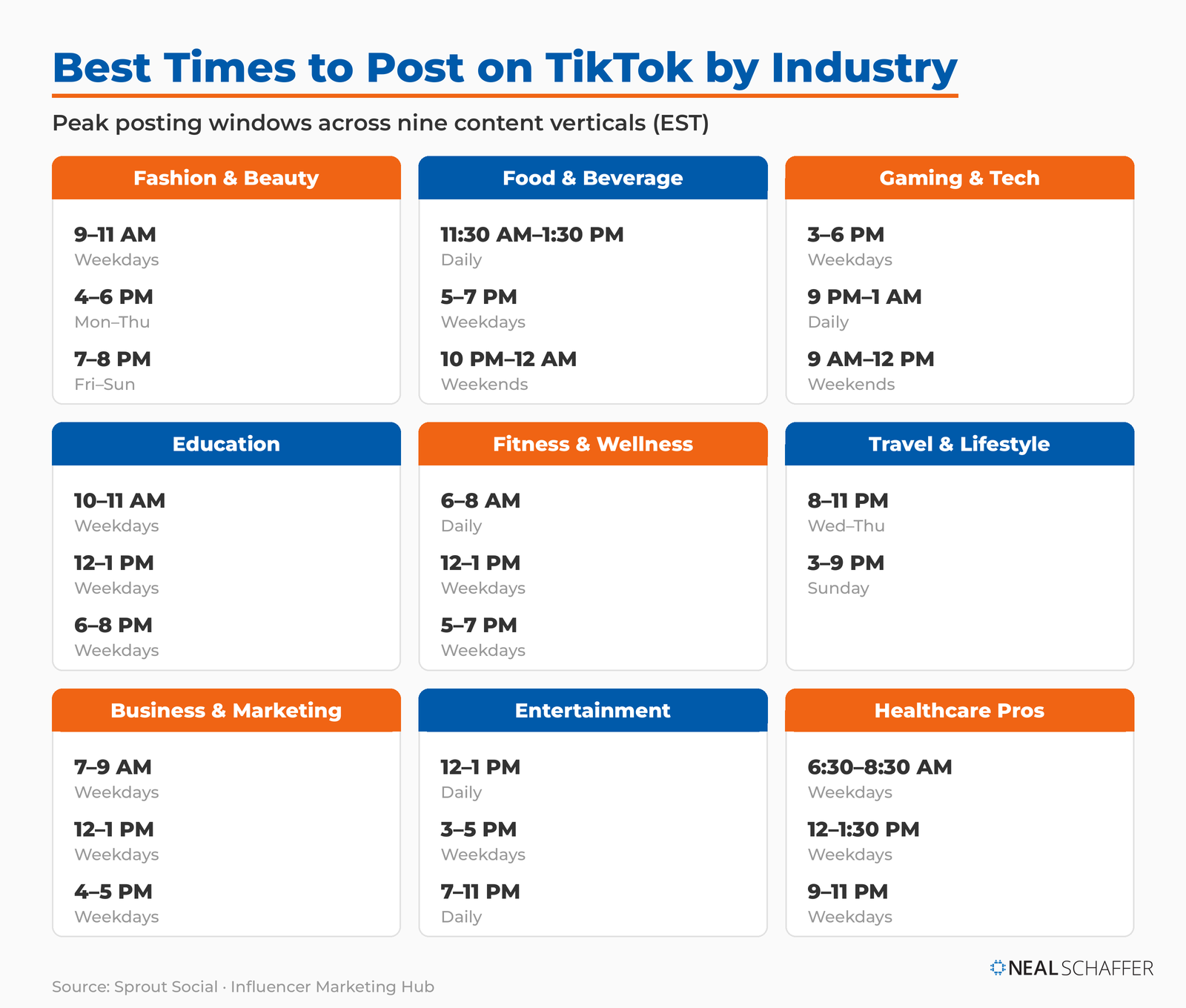
Let me break down each day so you can plan your content calendar strategically.
Monday: Fresh Week Energy
Best Times: 6 AM, 10 AM, 10 PM EST
Monday engagement follows a predictable pattern. Early morning catches commuters scrolling before work. Mid-morning hits the first break of the week. Late evening captures people unwinding after a demanding first day back.
Content Alignment: Educational and informative content performs particularly well on Mondays. People are in a planning mindset, looking for tips, tutorials, and how-to content that sets up their week.
If you’re creating short-form video content with a business or educational angle, Monday morning is your moment.
Tuesday: The Momentum Builder
Best Time: 4 PM EST (primary), with secondary windows at 2 AM, 9 AM, and 3 PM
Tuesday consistently ranks as one of the best days to post on TikTok. Sprout Social’s data shows a broad, reliable engagement window spanning the afternoon hours.
The 4 PM slot captures the post-work/school transition when people shift from productive mode to leisure mode. The 3 PM window catches school dismissals and early afternoon energy dips.
Why 2 AM and 4 AM? These times catch night owls, early shift workers, and international audiences waking up in different time zones. If you have a global following, don’t dismiss these unconventional windows.
Wednesday: Mid-Week Magic (With a Caveat)
Best Times: 2 PM–5 PM EST (primary window), 7 AM, 8 AM, 11 PM
Wednesday offers some of the strongest peak engagement hours of the week. People are in the mid-week slump, seeking entertainment and distraction from the workday grind.
Content Tip: Humor and lighthearted content tends to outperform on Wednesdays. Your audience is tired and looking for a mental break—give them something to smile about.
🔍 Interesting Finding: When I analyzed the posting patterns of top creators like Khaby Lame, MrBeast, and Addison Rae, I noticed they tend to avoid Wednesday posts. This might create an opportunity—less competition from mega-creators could mean more visibility for your content.
Thursday: Building Toward the Weekend
Best Times: 9 AM, 1 PM, 7 PM EST
Thursday is a solid midweek day, with a few windows that hold up well as weekend anticipation builds and people drift out of deep work mode. The morning commute around 9 AM catches an early scroll, and the early afternoon is where the strongest datasets land: Sprout Social’s 2026 analysis of nearly two billion engagements puts Thursday’s peak window at 1 to 5 PM.
The 7 PM slot is the most reliable of the three. People are home and settling into evening entertainment after dinner, and it holds up as a strong window across several 2026 studies.
The big datasets disagree on Thursday’s exact peaks more than most days, so treat these as starting points, then check your Follower Activity tab in TikTok Analytics to see when your own audience is actually online.
⚠️ Warning: The overnight hours, roughly 1 AM to 5 AM in your audience’s time zone, are the one window studies consistently agree on as a dead zone. Buffer’s analysis of 7.1 million posts shows engagement bottoming out here, when most of your audience is asleep and the algorithm has too few early signals to push your video.
Friday: Navigating the Weekend Transition
Best Times: 5–6 AM, 1–3 PM, 4–6 PM EST
Friday engagement is all about the weekend transition. Early morning catches fitness enthusiasts and international audiences. Afternoon windows capture the collective sigh of relief as the work week ends.
According to Shopify’s research, the 5–6 AM window on Friday catches commuters and viewers in other time zones, while the 1–3 PM and 4–6 PM slots capture the weekend mood shift.
Content Consideration: Friday content should match the energy shift. Weekend plans, entertainment recommendations, and feel-good content tend to resonate.
Saturday: The Weekend Wild Card
Best Times: 11 AM, 7 PM, 8 PM EST
Saturday patterns differ significantly from weekdays. Mornings are often slow as people catch up on sleep or run errands. Late morning engagement picks up after people have had breakfast and settled into weekend mode.
The early evening hours (7–8 PM) are prime Saturday entertainment time. People are home, relaxed, and looking for content to enjoy.
MrBeast Saturday Success: The creator frequently posts on Saturday evenings, capitalizing on the leisure browsing peak.
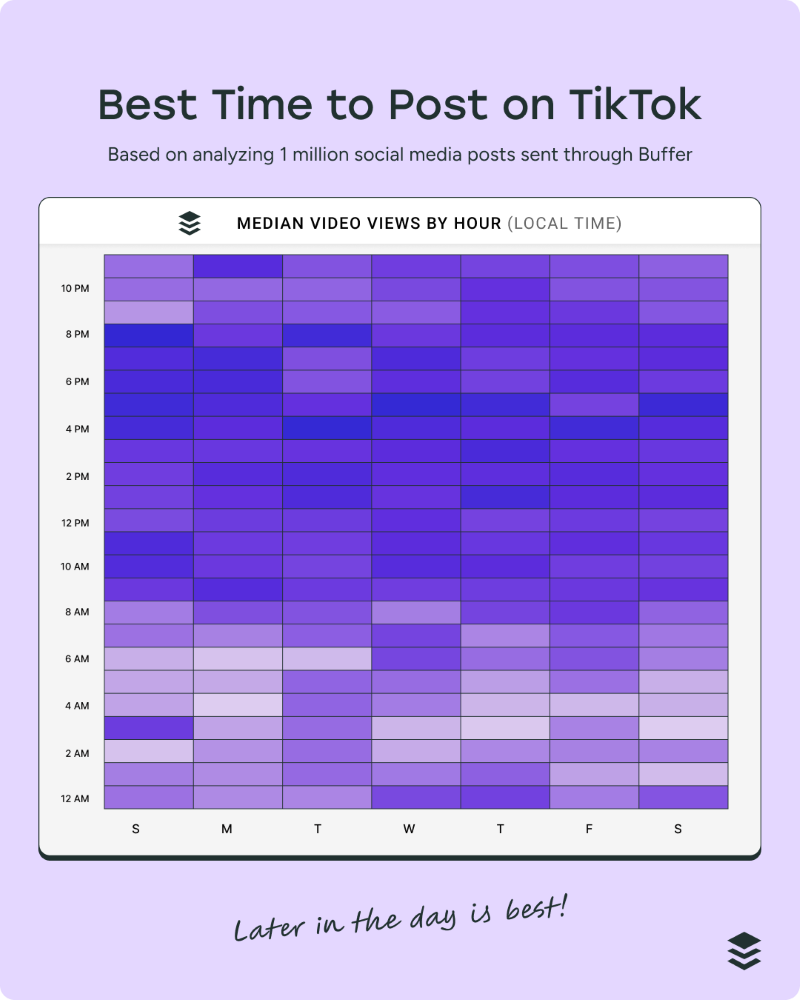
⚠️ Worst Window: Saturday 4 PM–4 AM shows an extended dead zone in some datasets. Buffer’s research identifies Saturday as the worst overall day for TikTok posting, with notably lower views compared to other days.
Sunday: The Engagement Champion
Best Times: 7 AM, 8 AM, 4 PM, 8 PM (peak) EST
🏆 Sunday 8 PM is the single highest-engagement time on TikTok.
Why? People are in peak leisure mode. The weekend is winding down, the “Sunday scaries” are setting in, and scrolling TikTok provides the perfect distraction from thinking about Monday.
The 4 PM window is also strong—a consistent engagement champion as people finish weekend activities and settle in at home.
Kimberly Loaiza’s Sunday Strategy: One of TikTok’s most-followed creators consistently posts on Sundays, and her engagement rates reflect the platform-wide pattern.
If you can only post once per week, make it Sunday evening.
Best Posting Times by Industry Vertical
General timing data is helpful, but your specific industry has its own engagement patterns. Here’s what the research shows for different verticals:
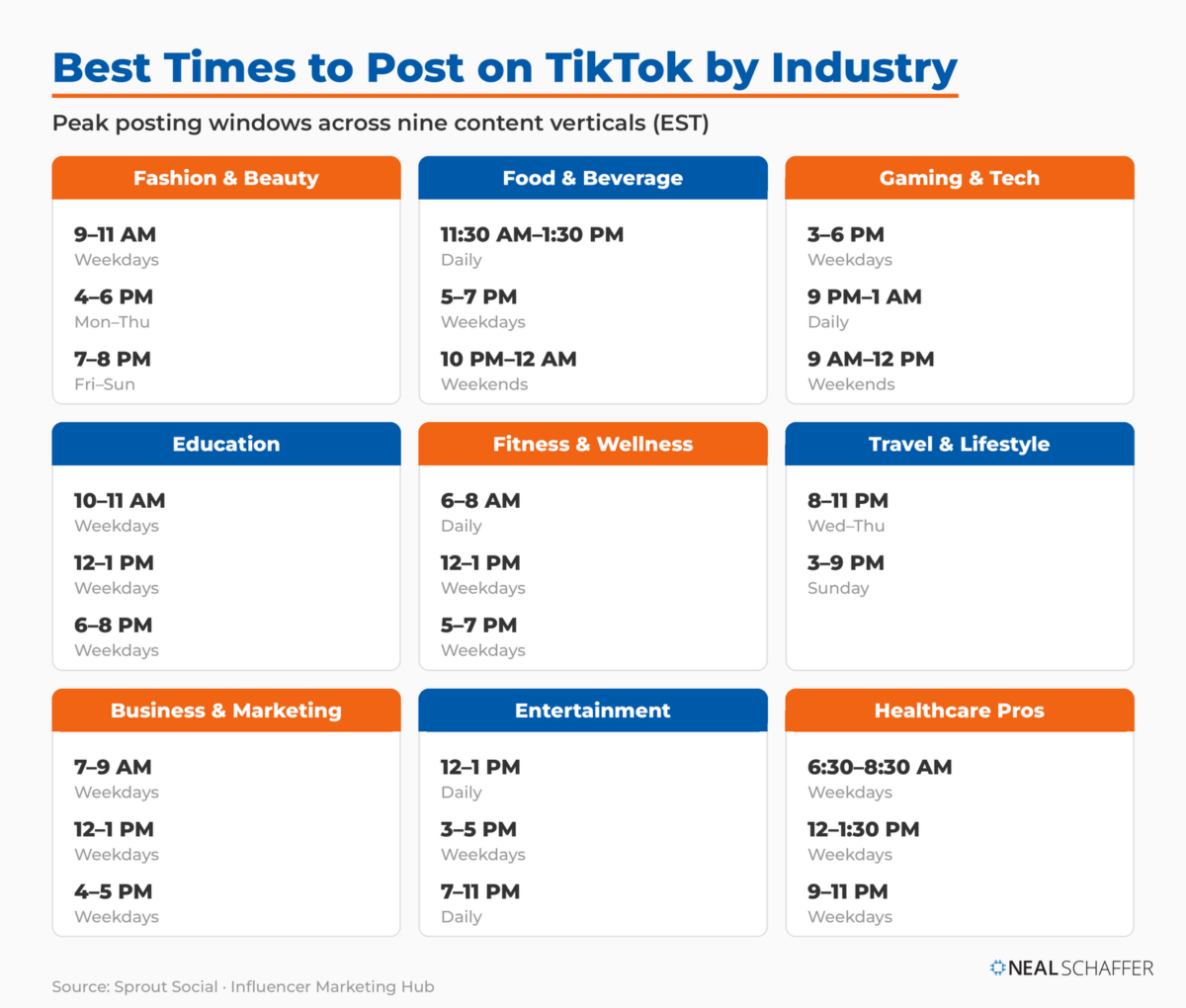
Fashion & Beauty: Catching the Trendsetters
| Time Window | Best Days | Why It Works |
|---|---|---|
| 9–11 AM | Weekdays | Morning routine inspiration |
| 4–6 PM | Mon–Thu | Post-work browsing |
| 7–8 PM | Fri–Sun | Weekend event prep |
Fashion and beauty audiences browse during leisure hours when they’re dreaming, planning outfits, or seeking inspiration for events. Weekend late afternoons perform particularly well as people prepare for social activities.
This aligns with what I’ve seen in Instagram content strategy—visual, lifestyle content thrives when audiences have time to browse and imagine.
Food & Beverage: When Hunger Strikes
| Time Window | Best Days | Why It Works |
|---|---|---|
| 11:30 AM–1:30 PM | Daily | Lunch planning and cravings |
| 5–7 PM | Weekdays | Dinner prep and recipe searching |
| 10 PM–12 AM | Weekends | Late-night snack cravings |
Food content engagement maps directly to meal times and hunger cycles. According to Influencer Marketing Hub, posting when people are thinking about food (rather than when they’ve just eaten) drives significantly higher engagement.
Gaming & Tech: Engaging the Niche Enthusiasts
| Time Window | Best Days | Why It Works |
|---|---|---|
| 3–6 PM | Weekdays | Post-school/work gaming time |
| 9 PM–1 AM | Daily | Late-night gaming sessions |
| 9 AM–12 PM | Weekends | Weekend morning gaming |
Gaming audiences skew younger and have extended evening hours. If you’re creating tech or gaming content, don’t be afraid to post late—your audience is likely still awake.
Education & Learning: Primetime for Knowledge Consumption
| Time Window | Best Days | Why It Works |
|---|---|---|
| 10–11 AM | Weekdays | Mid-morning learning breaks |
| 12–1 PM | Weekdays | Lunch break skill-building |
| 6–8 PM | Weekdays | Dedicated evening learning |
| 3–5 PM | Sunday | Week-ahead preparation |
According to Sprout Social, education content on TikTok performs best on Tuesdays and Wednesdays. Your audience is in learning mode and actively seeking knowledge during structured break times.
Fitness & Wellness: Inspiring Action
| Time Window | Best Days | Why It Works |
|---|---|---|
| 6–8 AM | Daily | Pre-workout motivation |
| 12–1 PM | Weekdays | Lunch workout inspiration |
| 5–7 PM | Weekdays | Post-work gym motivation |
Morning content catches fitness enthusiasts before their workout. Evening content hits the post-work gym crowd. If you’re posting workout content, think about when your audience is about to exercise, not after they’ve finished.
Travel & Lifestyle: Fueling Wanderlust
| Time Window | Best Days | Why It Works |
|---|---|---|
| 8–11 PM | Wed–Thu | Mid-week escape dreaming |
| 3–9 PM | Sunday | Weekend trip planning |
Travel content thrives when people are dreaming and planning. Mid-week evenings catch people mentally escaping the workday. Sunday afternoons capture planning energy for future trips.
Business & Marketing: Reaching Professionals
| Time Window | Best Days | Why It Works |
|---|---|---|
| 7–9 AM | Weekdays | Commute scrolling |
| 12–1 PM | Weekdays | Lunch break learning |
| 4–5 PM | Weekdays | End-of-day industry catch-up |
Professional audiences engage during specific business-related windows. According to Sprout Social’s industry data, finance content peaks in early mornings, while legal professionals engage most on early AM Monday/Tuesday slots.
If you’re doing TikTok marketing for B2B purposes, focus on these professional break times.
Entertainment & Comedy: Laughter Anytime
| Time Window | Best Days | Why It Works |
|---|---|---|
| 12–1 PM | Daily | Lunch break entertainment |
| 3–5 PM | Weekdays | Post-school/work wind-down |
| 7–11 PM | Daily | Prime evening entertainment |
Comedy content has the broadest acceptable posting window, but evenings remain strongest. People actively seek entertainment and distraction during these hours.
Healthcare & Wellness Professionals
| Time Window | Best Days | Why It Works |
|---|---|---|
| 6:30–8:30 AM | Weekdays | Pre-shift catch-up |
| 12–1:30 PM | Weekdays | Lunch break education |
| 9–11 PM | Weekdays | Post-shift decompression |
Healthcare professionals have unique schedules. According to industry analysis, Wednesday and Friday mornings show particular strength for this audience.
The Global Reach: Best Posting Times by Geographic Region
TikTok is a global platform. If your audience spans multiple time zones, you need a regional strategy.
North America: Early Birds and Night Owls
East Coast (EST):
- Weekdays: 7–9 AM, 12–1 PM, 7–10 PM
- Weekends: 10 AM–12 PM, 7–9 PM
West Coast (PST):
- Weekdays: 6–8 AM, 12–1 PM, 7–9 PM
- Weekends: 9–11 AM, 6–8 PM
The 3-hour time difference between coasts means content posted at East Coast evening times can still catch West Coast afternoon scrollers.
Europe: Diverse Schedules, Common Ground
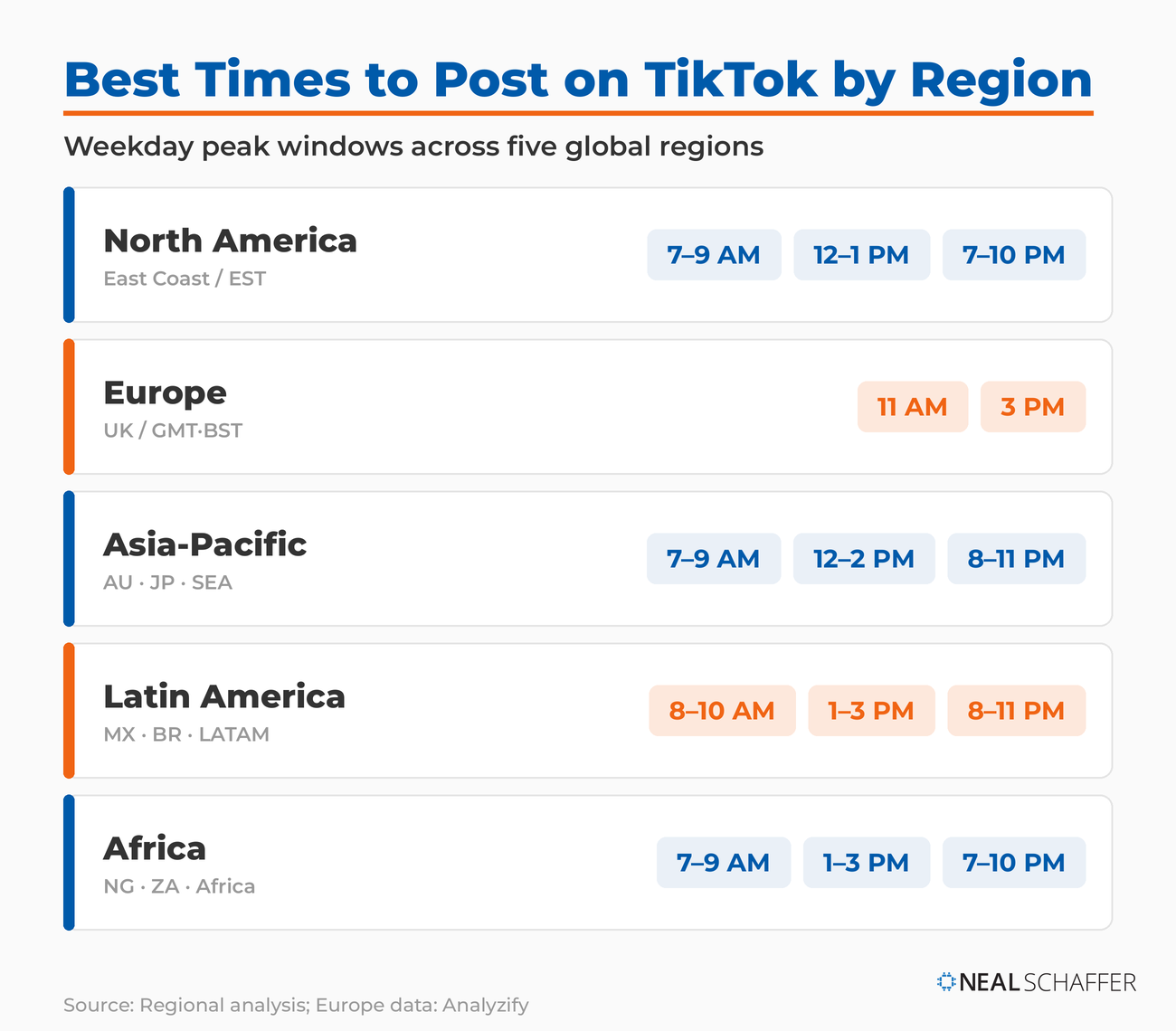
According to Analyzify’s research:
UK (GMT/BST): 11 AM and 3 PM weekdays, 9 AM and 2 PM weekends
Continental Europe (CET): 10 AM and 2 PM weekdays, 8 AM and 1 PM weekends
Post-lunch and late evening hours show consistently strong engagement across European countries. The 7–10 PM window captures prime evening leisure time.
Asia-Pacific: High Engagement in the East
Australia, Japan, Southeast Asia:
- Weekdays: 7–9 AM, 12–2 PM, 8–11 PM
- Weekends: 10 AM–1 PM, 7–10 PM
APAC audiences show strong morning peaks and extended evening activity. The sheer volume of users means engagement is generally high across many time slots.
Latin America: Vibrant Community Engagement
Mexico, Brazil, and broader LATAM:
- Weekdays: 8–10 AM, 1–3 PM, 8–11 PM
- Weekends: 11 AM–1 PM, 8–10 PM
Latin American audiences tend toward later evening engagement, reflecting cultural patterns of extended family time and social activity at night.
Africa: Emerging Trends and Growing Audiences
Nigeria, South Africa, and broader Africa:
- Weekdays: 7–9 AM, 1–3 PM, 7–10 PM
- Weekends: 10 AM–12 PM, 6–9 PM
TikTok’s growth in Africa is accelerating rapidly. Mobile-first engagement is paramount here, and content resonating with local trends performs exceptionally well during standard leisure hours.
Managing a Global Audience: The Multi-Post Strategy
If your audience spans multiple regions, consider posting at both 9 AM EST and 9 PM EST. This strategy catches:
- Morning audiences in North America and Europe
- Evening audiences in APAC
- Various windows across Latin America and Africa
⚠️ Cannibalization Warning: Back-to-back posts compete for algorithm attention. Space your posts at least 3–4 hours apart to give each video room to breathe and find its audience.
Beyond the Clock: Factors That Influence Your Personal Best Posting Time
General data gives you a starting point. But your specific audience is what ultimately determines your best posting times.
Understanding Your Audience: The Heart of Your TikTok Strategy
Demographics fundamentally shape scrolling habits:
- Students: Often active later at night and throughout weekends
- Working professionals: Peak during commutes and lunch breaks
- Parents: Active during nap times and after bedtime
Think about who you’re trying to reach and when they realistically have time to scroll. A B2B marketer targeting executives will have different timing than a creator making content for college students.
Content Format: Short-Form vs. Long-Form, Trends vs. Evergreen
Different content formats perform better at different times:
| Content Type | Best Time Windows | Why |
|---|---|---|
| Short videos (<60s) | Commutes, lunch breaks | Quick consumption during brief windows |
| Long videos (>60s) | Evenings, weekends | Dedicated viewing time required |
| Live Streams | Weekday evenings 7–11 PM, Weekend afternoons 1–4 PM | Requires scheduled, engaged viewing |
| Text/Carousels | Mid-morning 9–11 AM, Lunch 12–1 PM | Browsing during work breaks |
According to Restream’s analysis, live streams perform best between 6–11 AM or 7–11 PM, with Tuesday, Thursday, and Friday being optimal days.
If you’re still figuring out your optimal TikTok video length, that decision should inform your timing strategy too.
Your Unique Niche: Finding Your Tribe
Niche audiences have niche behaviors. A cryptocurrency community might be most active during market hours. A parenting community might peak during nap times. A gaming community might not wake up until noon.
The more specific your niche, the more your timing might diverge from general recommendations. High-effort niches (where quality matters more than quantity) may also benefit from lower posting frequency but more strategic timing.
TikTok Analytics: Your Personal Data Scientist
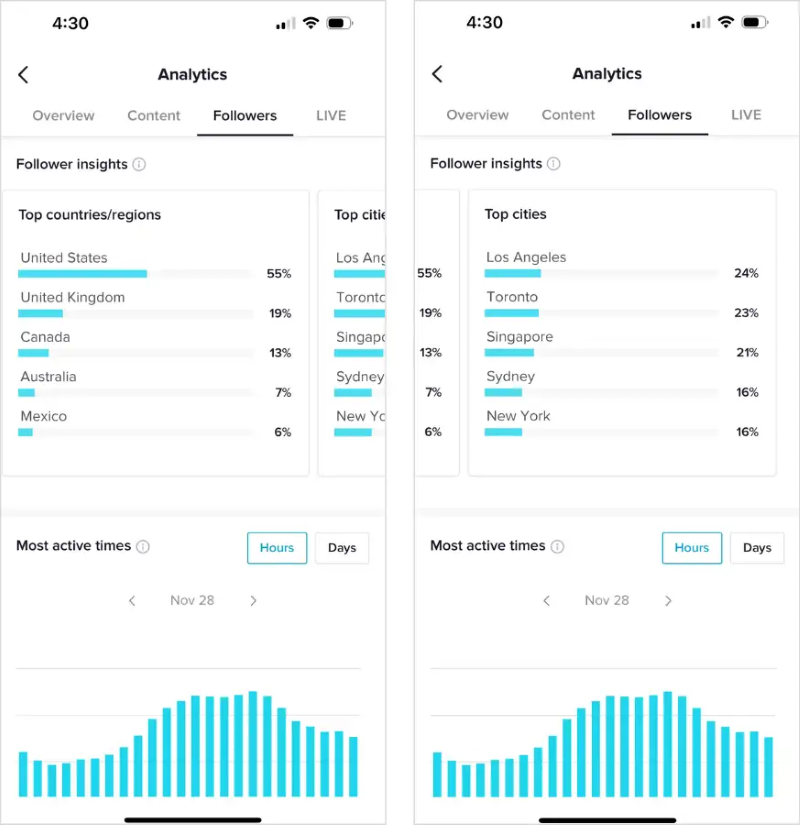
Your TikTok Analytics is the single most valuable resource for timing optimization, and the Follower Activity heatmap is only one of the numbers worth reading in there. My guide to TikTok analytics covers what each tab reports, what a business account adds on top, and which metrics deserve your attention once your posting schedule is sorted. Here’s how to access your audience’s specific active times:
- Go to your TikTok profile
- Tap the three-line menu
- Select “Creator tools” → “Analytics”
- Navigate to the “Followers” tab
- Scroll to “Follower activity”
You’ll see a heatmap showing exactly when your followers are most active, broken down by hour and day.
Important Note: TikTok Analytics displays data in YOUR local time zone—not your audience’s. If you’re in California but your audience is mostly on the East Coast, you need to account for that 3-hour difference.
Understanding how the TikTok algorithm works makes this data even more actionable.
The Art of Experimentation: How to Find Your Best Time to Post
Data is your starting point. Experimentation is how you find your truth.
Trial and Error: A Scientific Approach to Social Media
Treat your social media strategy like a science experiment:
- Start with recommended times: Use this guide’s data as your initial hypotheses
- Pick a new time: Choose a promising slot outside your usual schedule
- Post consistently: For 2–4 weeks, post at this new time on specific days
- Observe and measure: Track engagement rates in your analytics
- Iterate: Keep what works, discard what doesn’t, test new hypotheses
Why general data is just a starting point: The studies I referenced analyzed millions of posts—but none of those posts were your posts to your audience. Your followers might have unique patterns that diverge from the averages.
A/B Testing Your Posting Schedule
For a more rigorous approach:
Hypothesis: “Posting on Tuesdays at 3 PM will yield higher engagement than Tuesdays at 7 PM”
Method:
- Post similar quality content at both times over several weeks
- Control variables: similar topic, similar effort level, similar hashtags
- Track results in a spreadsheet
What to measure:
- Views in first hour
- Engagement rate (likes + comments + shares + saves ÷ views)
- Follower growth from each post
After 4–6 data points at each time, you’ll have statistically meaningful results specific to your account.
Monitoring Your Metrics: Beyond Likes and Views
Likes and views are vanity metrics. These indicators matter more:
- Watch time and completion rate: How long are people actually watching?
- Shares: The strongest signal of value—people sharing your content with others
- Saves: Utility signal—people want to reference your content later
- Comments: Community engagement and algorithm fuel
- Follower growth: Did the post convert viewers into followers?
For businesses, also track the engagement vs. conversion question: Are your best-timed posts actually driving traffic, leads, or sales? The most engaging time might not be the most converting time.
Using social media tracker tools can help you track these metrics more systematically.
Debunking TikTok Myths: Common Misconceptions About Posting Times
The internet is full of TikTok advice. Much of it is wrong.
“Always Post at 7 PM”: The Danger of Generic Advice
Yes, evenings are generally strong. But “always” is the problem word. My research shows peak times throughout the day, and for many niches or global audiences, 7 PM might be completely wrong.
Your 7 PM ≠ their 7 PM. If you’re in Los Angeles posting at 7 PM local time, you’re missing the East Coast’s 10 PM wind-down entirely. If your audience is international, your local evening might be their middle-of-the-night dead zone.
“More Posts Equal More Reach”: Quality Over Quantity
TikTok recommends posting 1–4 times per day to keep your content active in the algorithm. But here’s what that guidance misses: the algorithm rewards consistency and quality, not spam.
Buffer’s research found that going from 1 post to 2–5 posts per week can boost engagement. But there’s a ceiling—and crossing it with low-quality content hurts more than it helps.
The burnout factor matters too. Sustainable content creation beats aggressive posting schedules that you can’t maintain long-term.
“Only Trending Audio Matters”: The Power of Originality
Trending audio can give a video a boost. But some of TikTok’s most viral content uses original audio or no audio at all (looking at you, Khaby Lame).
Timing and trends work together, but original content that resonates with your specific audience often outperforms generic trend-jacking. Develop your unique voice—that’s what builds loyal followers rather than fleeting views.
This connects to what I’ve written about in TikTok organic strategy: authenticity and consistency beat trend-chasing every time.
“Weekends Are Dead”: The Sunday Surprise
Many creators believe weekend engagement tanks because people are “out living life.” The data tells a different story.
Sunday 8 PM is actually peak engagement—the highest-performing time slot in Buffer’s entire dataset. Saturday myths are also overblown; while Saturday shows more variable engagement, the 7–8 PM evening window remains strong.
Don’t neglect the weekend. It’s an engagement goldmine.
Worst Times to Post on TikTok (And Why)
Knowing when NOT to post is just as valuable as knowing when to post.
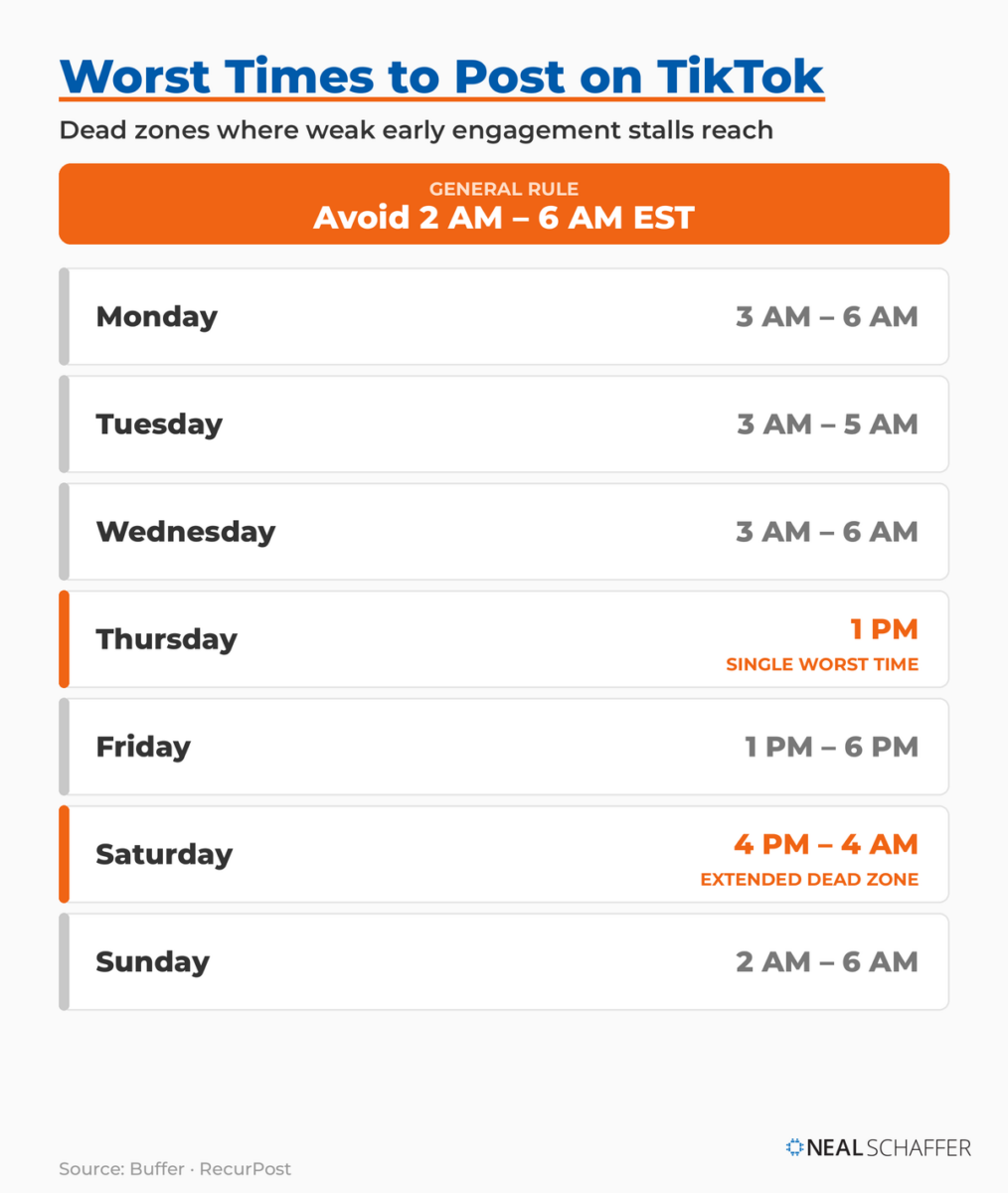
General Rule: Avoid 2 AM – 6 AM EST
Unless you’re specifically targeting international audiences or night owls, the pre-dawn hours are a dead zone. Most of your audience is asleep, and the algorithm won’t have enough initial engagement to push your content.
Day-by-Day Worst Windows
| Day | Worst Time | Why It Fails |
|---|---|---|
| Monday | 3 AM – 6 AM | Audience sleeping before work week |
| Tuesday | 3 AM – 5 AM | Same as Monday |
| Wednesday | 3 AM – 6 AM | Same pattern |
| Thursday | 1 PM | Lowest engagement in multiple datasets |
| Friday | 1 PM – 6 PM | Engagement dip in some studies |
| Saturday | 4 PM – 4 AM | Extended dead zone |
| Sunday | 2 AM – 6 AM | Late night/early morning lull |
Thursday 1 PM stands out as particularly weak—RecurPost identifies it as the single worst time to post across their dataset.
Saturday’s extended dead zone (4 PM – 4 AM) is backed by Buffer’s research, which identifies Saturday as the overall worst day for TikTok posting.
Why these times fail: Low user activity means your initial test audience won’t engage quickly enough. The algorithm interprets weak early engagement as a signal that your content isn’t valuable, limiting its distribution.
Tools and Resources to Optimize Your TikTok Posting Strategy
You don’t have to navigate timing optimization alone.
In-App Analytics: Your First Stop
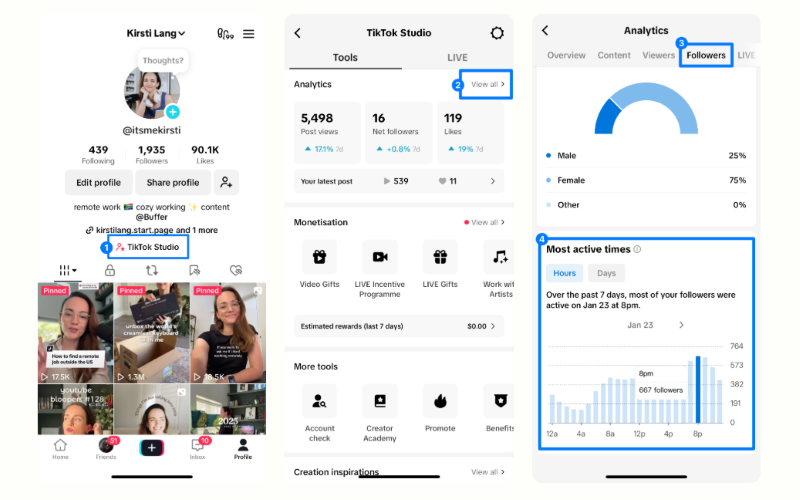
TikTok’s native analytics (available for Creator and Business accounts, including TikTok Pro account holders) provide everything you need:
How to access:
- Profile → Menu (three lines)
- Creator tools → Analytics
- Followers tab → Follower activity
What you’ll find:
- Hourly activity breakdown showing when your followers are online
- Day-by-day engagement patterns
- Geographic distribution of your audience
This data is tailored to YOUR content and YOUR audience—more valuable than any general study.
Important: You need a Creator or Business account to access analytics. If you haven’t switched yet, it takes 30 seconds and costs nothing.
Third-Party Analytics Tools: Deeper Dives
For creators and businesses wanting more granular insights, several social media management tools offer TikTok-specific analytics:
- Sprout Social: Comprehensive engagement analytics with best-time recommendations
- Later: Visual planning with optimal timing suggestions
- Hootsuite: Cross-platform analysis and scheduling
- Flick: AI-powered content planning with timing optimization
These tools often aggregate your historical data within their analytics dashboard to provide personalized “best time” recommendations based on when YOUR content has performed best.
For tracking what your audience is saying about your brand or industry, social listening tools can also inform your timing decisions by revealing when conversations peak.
Scheduling Tools: Streamlining Your Workflow
Once you know your best times, scheduling ensures you hit them consistently without being glued to your phone:
Native TikTok Scheduling: Available through TikTok Studio on desktop for Business and Creator accounts. Simple but effective.
Third-Party Options: Social media scheduling tools like Later, Hootsuite, Buffer, and social media automation platforms can schedule TikTok posts alongside your other platforms.
Using a scheduler frees you to focus on content creation while your posts go live at optimal times automatically. For tools built around TikTok specifically, I compare 15 TikTok management apps for scheduling, analytics, and video creation.
The Future of TikTok Posting: What 2027 and Beyond Holds
Understanding where TikTok is heading helps you stay ahead of the curve.
AI and Personalized Feeds: The Evolving Algorithm
TikTok’s For You Page is already a masterpiece of AI personalization. By 2027, expect even greater sophistication:
- Hyper-personalized timing: The algorithm may eventually serve your content to users at their individual optimal viewing times, reducing the importance of universal posting schedules
- Predictive distribution: AI will get better at predicting which content will resonate before initial engagement data is even collected
- Micro-moment targeting: The algorithm might identify specific emotional states or contexts where users are most receptive to certain content types
This doesn’t mean timing becomes irrelevant—it means your analytics-informed timing becomes even more important than generic recommendations.
Short-Form Video Dominance: Staying Ahead of the Curve

Short-form video isn’t going away. If anything, it’s expanding:
- Cross-platform strategy: Your TikTok timing insights apply to Instagram Reels and YouTube Shorts too
- Format evolution: Longer TikTok formats (up to 10 minutes) may require different timing strategies than quick 15-second hits
- Interactive features: Live shopping, polls, and other interactive elements will require dedicated timing strategies
The creators who thrive will be those who adapt their timing strategies as the platform evolves.
Community Building: The Enduring Power of Connection
Here’s the truth that outlasts any algorithm change: community engagement beats pure reach every time.
A thousand engaged followers who comment, share, and return for every video are worth more than a million passive viewers. Your marketing strategy should prioritize community connection over viral potential.
This means:
- Posting when your existing community is most active, not just when general audiences peak
- Using timing to facilitate conversation, not just view counts
- Building relationships through consistent presence rather than sporadic viral attempts
The algorithm rewards engagement. Real community engagement—the kind you build through consistent, well-timed presence—is the most sustainable path to growth.
Frequently Asked Questions
What is the single best time to post on TikTok?
Sunday at 8 PM EST is the highest-engagement time globally according to Buffer’s data. However, your personal best time depends on your specific audience—check your TikTok Analytics “Follower Activity” tab to see when your followers are actually online.
Does posting time matter more than content quality?
No. Content quality is king. A perfectly timed mediocre video will still underperform a high-quality video posted at a slightly less optimal time. Think of timing as an amplifier—it enhances good content but can’t fix bad content. Prioritize creating valuable content first, then optimize timing.
How many times a day should I post on TikTok?
TikTok recommends 1–4 posts per day to stay active in the algorithm. For most creators, 1–3 high-quality posts per day is the sweet spot. Buffer’s research suggests 2–5 posts per week can significantly boost engagement without risking burnout or quality drops.
What time zone does TikTok Analytics use?
TikTok Analytics displays follower activity data in YOUR local time zone (based on your device settings), not your audience’s time zone. If your audience is in different regions, you’ll need to convert the data accordingly.
Should I post at the same time every day?
Consistency helps, but rigidity doesn’t. Find 2–3 optimal windows that work for your audience and rotate between them. Posting at exactly the same time every day might cause you to miss other high-engagement windows. A consistent weekly schedule (e.g., “always post at 7 PM on Mondays and Thursdays”) is often better than daily repetition.
Can I schedule TikTok posts in advance?
Yes. TikTok offers native scheduling through TikTok Studio on desktop for Business and Creator accounts. Third-party tools like Later, Hootsuite, and Buffer also support TikTok scheduling. Learn more about social media scheduling options here.
Do hashtags affect when I should post?
Not directly. Hashtags help the algorithm categorize your content and show it to relevant audiences. Use relevant hashtags regardless of posting time—but time your posts so those relevant audiences are actually online to discover your hashtagged content.
How long does TikTok take to push my video?
TikTok begins evaluating your video immediately after posting, showing it to a small initial test audience (typically 300–500 users). Based on early engagement (watch time, likes, comments, shares), the algorithm decides whether to expand distribution. This “push” can happen within minutes for viral content or take hours for slower-building videos. Optimal timing ensures your test audience is active and engaged when that initial evaluation happens.
Final Thoughts: Consistency, Quality, and Community Are Your True North
Here’s what I want you to take away from this: Timing optimizes your reach, but it doesn’t replace the fundamentals.
The trinity of TikTok success remains:
- Consistency: Show up regularly at times your audience expects you
- Quality: Create content that genuinely entertains, educates, or inspires
- Community: Engage with your followers like real people, not just view counts
Your data is always more valuable than generic benchmarks. Use this guide as a starting point, but let your TikTok Analytics guide your personalized strategy. Track your video performance over time to understand what truly resonates with your audience.
Your 3-Step Action Plan
- Start with our general data: Use the timing recommendations in this guide as your initial schedule
- Test with your audience: Run 2–4 week experiments at different times, tracking engagement
- Iterate based on YOUR analytics: Let the “Follower Activity” data in TikTok Analytics reveal your audience’s true patterns
The algorithm will keep evolving. Trends will come and go. But authentic connection with a community that values your content? That’s what builds lasting TikTok success.
Now stop reading about timing and go create something worth posting. Your audience is waiting—you just have to meet them at the right moment.
Looking to join a community of entrepreneurs to leverage digital marketing as your strategic engine of growth? Check out my Digital First Group Coaching Community!
Actionable advice for your digital / content / influencer / social media marketing.
Join 13,000+ smart professionals who subscribe to my regular updates.