
Two advertisers can run the same offer to the same audience in the same week and pay wildly different prices. One pays $4 to reach a thousand people. The other pays $12. Neither of them changed a bid.
That gap is placement, creative, and objective doing their work inside Meta’s auction. And most of the articles you’ll find on the cost for Instagram ads flatten all of it into a single blended average, which is the least useful number in the whole conversation.
I’ve been advising businesses on paid and organic social since long before Reels existed. I teach influencer marketing at UCLA Extension, I work as a fractional CMO helping companies decide where their budget should actually go, and I’ve watched clients get burned by benchmark numbers that had nothing to do with their situation. This post is for the business owner or marketer who needs to build a real budget, not admire a national average.
So I’m going to answer three questions specifically. What do Feed, Reels, and Stories ads each cost? How does that compare to running the same budget on Facebook, given that Meta will happily spend your money on both? And how does Instagram stack up against TikTok, X, Pinterest, and YouTube?
Key Takeaways
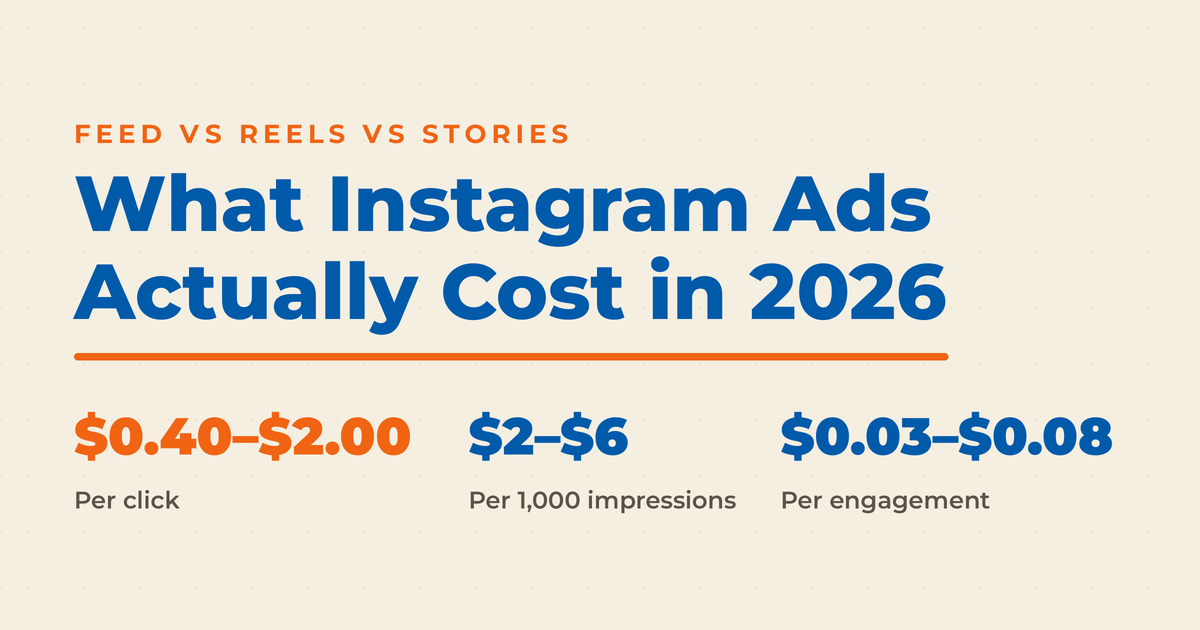
✅ Instagram ads run roughly $0.40 to $2.00 per click and $2 to $6 per thousand impressions for better-performing campaigns, according to WordStream’s 2026 benchmark data, with engagement costing $0.03 to $0.08.
✅ Reels deliver the cheapest impressions and the most expensive clicks. In Gupta Media’s tracker, Instagram Reels ads averaged a $4.29 CPM with a $1.21 cost per link click, while Stories ran a $7.25 CPM with a $0.94 cost per link click.
✅ Instagram carries higher CPMs than Facebook inside the same ad account. Emplifi’s 2026 benchmarks found Instagram the most expensive placement group on a CPM basis, with Facebook more efficient and Facebook spend still concentrated in Feed.
✅ Meta’s prices are climbing, not falling. Meta reported that its average price per ad rose 12% year over year in Q1 2026, with ad impressions up 19%.
✅ TikTok, Pinterest, and YouTube all clear the auction cheaper than Meta on impressions. Gupta Media’s 2025 cross-platform averages put Meta at $8.19, YouTube at $4.99, TikTok at $4.82, and Pinterest at $4.67.
✅ Cheap impressions are not cheap customers. The platform with the lowest CPM in your account is frequently not the platform with the lowest cost per sale, which is the only number that pays your salary.
What Is the Average Cost for Instagram Ads in 2026?
The cost for Instagram ads in 2026 is an auction price, not a rate card, and it lands between $0.40 and $2.00 per click, $2 and $6 per thousand impressions on well-run campaigns, and $0.03 to $0.08 per engagement. Meta charges you based on what your ad wins in real-time bidding against every other advertiser chasing the same person.
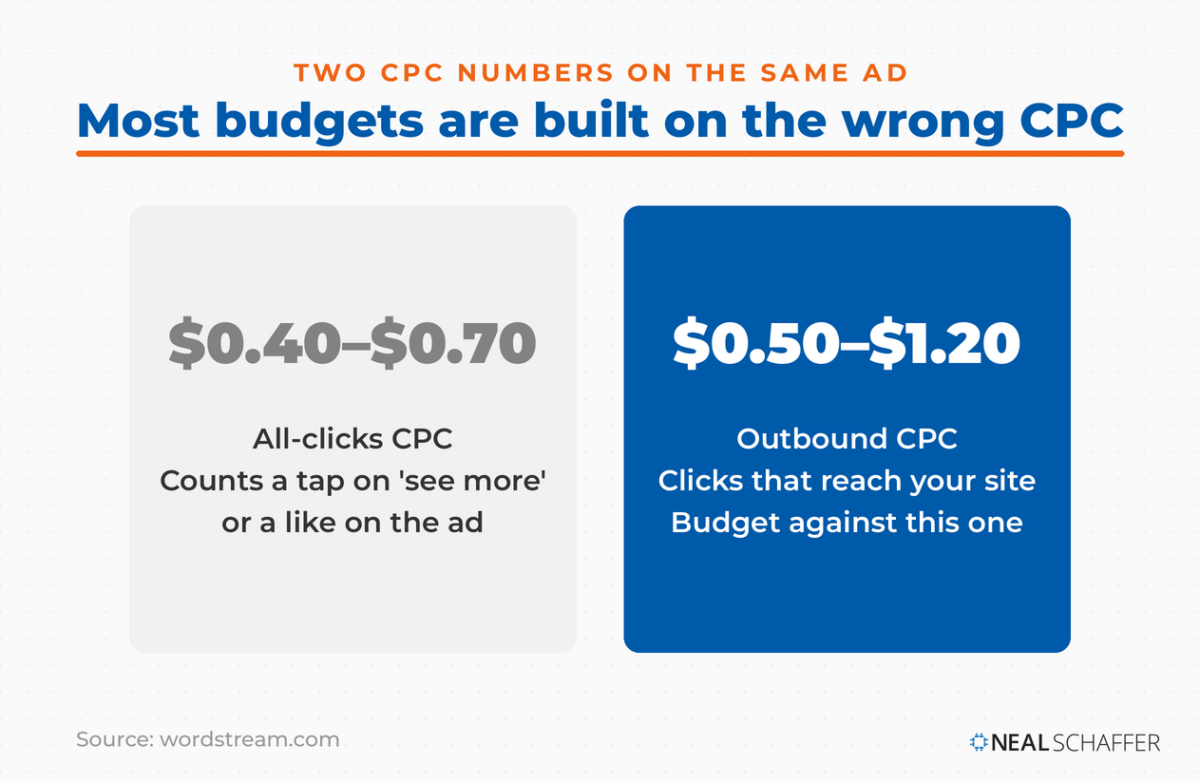
Those WordStream ranges are worth pulling apart, because the click number hides a definition problem. The $0.40 to $0.70 figure counts every click, including someone tapping “see more” to expand your caption. Clicks that actually send someone to your website run higher, around $0.50 to $1.20. If you budget against the first number and get billed on the second, your forecast is off by half before you write a word of copy.
CPM behaves differently. A tightly targeted campaign with creative people genuinely want to watch can hold a $2 to $6 CPM. A campaign in a crowded vertical with tired creative drifts past $10 without anything obviously breaking. Same platform, same week.
### What Most Instagram Ad Cost Guides Get Wrong
Nearly every roundup on this topic quotes one blended average and moves on. Two problems with that.
The first is that a blended Instagram average mixes Feed, Reels, and Stories inventory that price very differently, which I’ll break down in the next section. Averaging them together produces a number that describes no actual campaign.
The second is that most published “Facebook ads cost” benchmarks are really Meta benchmarks, covering both platforms at once. WordStream’s own figures, for instance, are labeled Meta Ads: an average CPC of $0.70 for traffic campaigns and $1.92 for leads campaigns, with an average cost per lead of $27.66. Useful numbers. They just don’t isolate Facebook from Instagram, so you can’t use them to decide between the two.
There’s also a directional truth that no benchmark table shows you: prices are rising. Meta reported a 12% year-over-year increase in average price per ad in Q1 2026, alongside 19% more impressions delivered. More inventory and higher prices at the same time means demand is outrunning supply. Any benchmark you read from 2024 is describing a cheaper auction than the one you’re bidding in.
How Much Do Instagram Feed, Reels, and Stories Ads Cost?
Instagram’s three main placements price inversely to each other on impressions and clicks. Reels are the cheapest way to be seen and the most expensive way to be clicked. Stories sit in the middle on impressions and deliver the cheapest link clicks. Feed costs the most on both counts and tends to carry the strongest purchase intent.
Gupta Media tracks these placements separately, which is what makes their data genuinely useful here rather than just another average. In their January 2025 format breakdown, Reels ads came in at a $4.29 CPM with a 0.35% link click-through rate, while Stories ads ran a $7.25 CPM with a 0.77% link click-through rate. Blended Instagram in June 2025 sat at an $8.16 CPM with a $0.69 cost per link click and a 1.19% link click-through rate. Those are the most recent placement-level figures published rather than modeled, and the shape of the gap has held since.
| Placement | Relative CPM | Relative cost per link click | What it’s best at |
|---|---|---|---|
| Reels | Lowest | Highest | Cheap reach, cold-audience prospecting, video-native creative |
| Stories | Middle | Lowest | Retargeting, time-limited offers, swipe-through traffic |
| Feed | Highest | Middle to high | Considered purchases, carousel product storytelling |
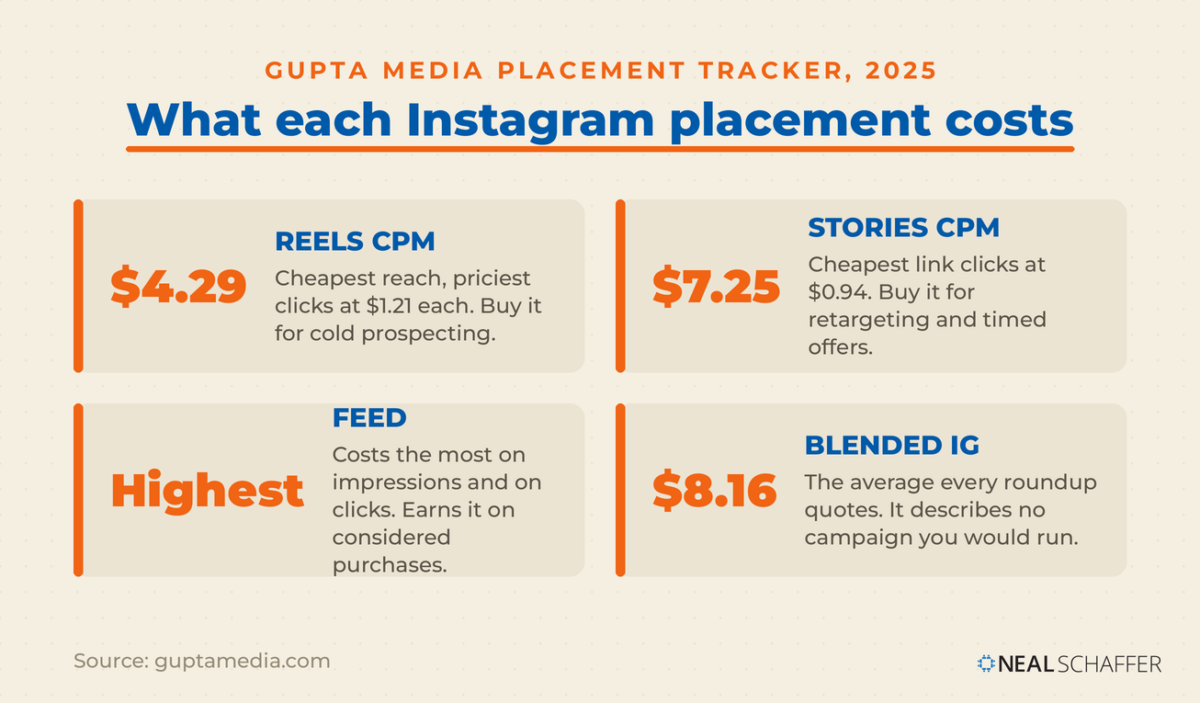
Read that table twice, because the implication runs against the advice you’ll see everywhere. “Shift budget to Reels, it’s cheaper” is true only if you’re buying impressions. If you’re buying clicks to a landing page, Reels ran about 29% more expensive per click than Stories in that same dataset. People scroll Reels in discovery mode. They’re not in a tapping-through-to-your-site frame of mind.
This is also why Reels inventory stays comparatively cheap: supply keeps expanding. Emplifi found Instagram ad spend spreading across Feed, Stories, and Reels, with Reels investment nearly tripling over the measured period. Advertiser demand is chasing that inventory, but it hasn’t caught up yet. That window won’t stay open forever.
Practically, the placement decision is a creative decision. Reels ads need vertical, sound-on, hook-in-two-seconds video or they underperform badly, and if you don’t already know how Instagram Reels work as a format, buying the placement won’t save you. Stories ads need the same vertical framing but tolerate simpler execution. Feed is where a well-built Instagram carousel earns its keep, because swiping is a form of attention you can’t buy in a six-second vertical clip.
One more practical note. Boosting a post from the app and building a campaign in Ads Manager both draw from the same auction, so the CPM and CPC benchmarks apply to both. What differs is control. If you’re deciding whether boosting an Instagram post is enough for your goal, the honest answer is that it’s fine for reach and weak for conversions.
Do Instagram Ads Cost More Than Facebook Ads?
Yes, on impressions. Emplifi’s 2026 benchmark analysis found Instagram carrying the highest CPMs of the platforms measured, with Facebook meaningfully more efficient, and Facebook spend still concentrated in Feed placements while Instagram spend splits across three surfaces. The gap is real, but it’s narrower than most advertisers assume, and it comes with something in return.
Turn LinkedIn Into a Real Growth Channel
My latest book helps professionals, entrepreneurs, and business owners turn LinkedIn from a static profile into a real source of clients and growth.
Maximizing LinkedIn for Business Growth gives you clear, practical steps to build a profile that gets noticed and a network that actually sends business your way.
Grab your copy on Amazon and put it to work this week. Click the cover or the button below to get started.

That something is engagement. Socialinsider’s analysis of 70 million posts puts Instagram’s engagement rate by followers at 0.45% through the first half of 2026, against Facebook’s 0.13%. That’s organic, not paid, but it tells you something about attention density on each platform. You’re paying an Instagram premium for an audience that interacts more with what it sees.
| Question | ||
|---|---|---|
| Relative CPM | Lower | Higher |
| Where spend concentrates | Feed | Split across Feed, Stories, Reels |
| Organic engagement rate (2026) | 0.13% | 0.45% |
| Audience skew | Broader age range | Younger, more visual |
| Creative demand | Tolerates static and link posts | Punishes anything not built vertical-first |
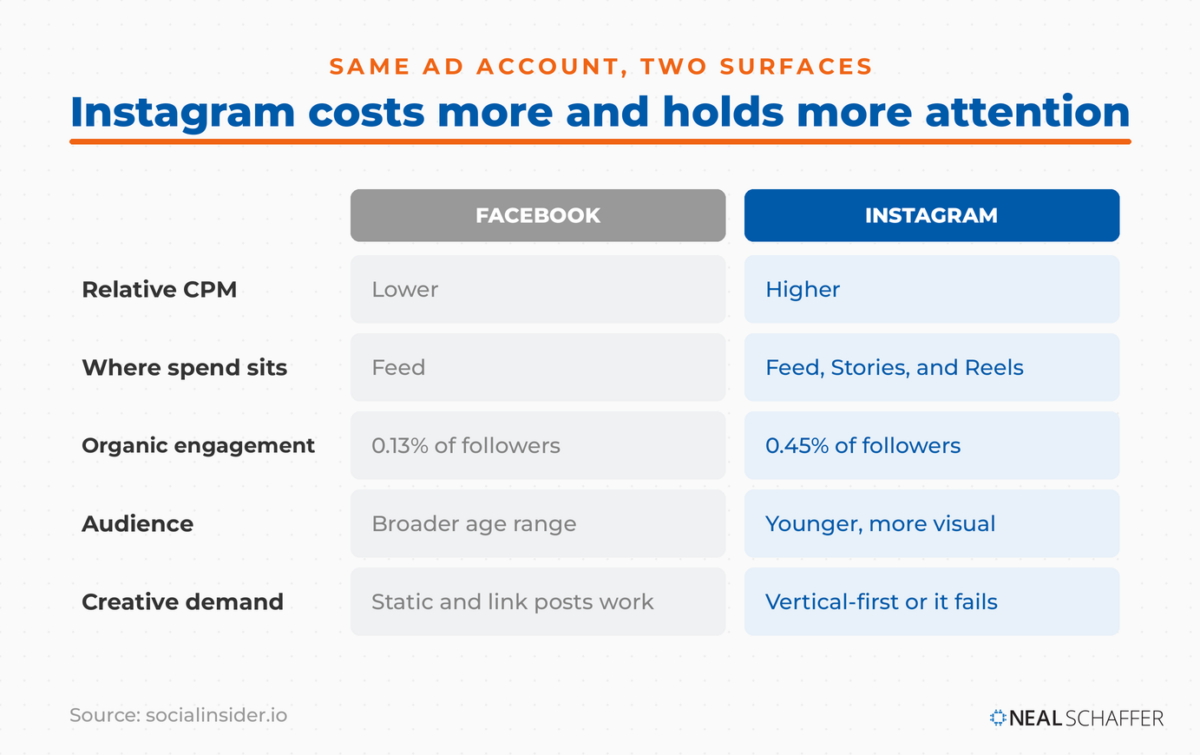
One setting underneath this question decides most of the answer. If you never touch placements, Meta’s default puts your ad on both platforms and decides the split for you. So the question most people actually mean when they ask whether Instagram costs more than Facebook is: should I stop Meta from doing that?
I’ve looked hard at the cost of Facebook ads, and the short version is that the two platforms are close enough on cost per result that the platform label is rarely the right thing to optimize. The targeting layer you build matters far more than which blue-chip Meta surface the impression lands on.
Should You Split Instagram and Facebook Into Separate Campaigns?
Usually no. Restricting delivery to Instagram only removes cheaper inventory from the auction and forces your budget to compete for a smaller pool of placements, which typically raises your cost per result rather than lowering it. Let the system spread spend, then read the placement breakdown afterward.
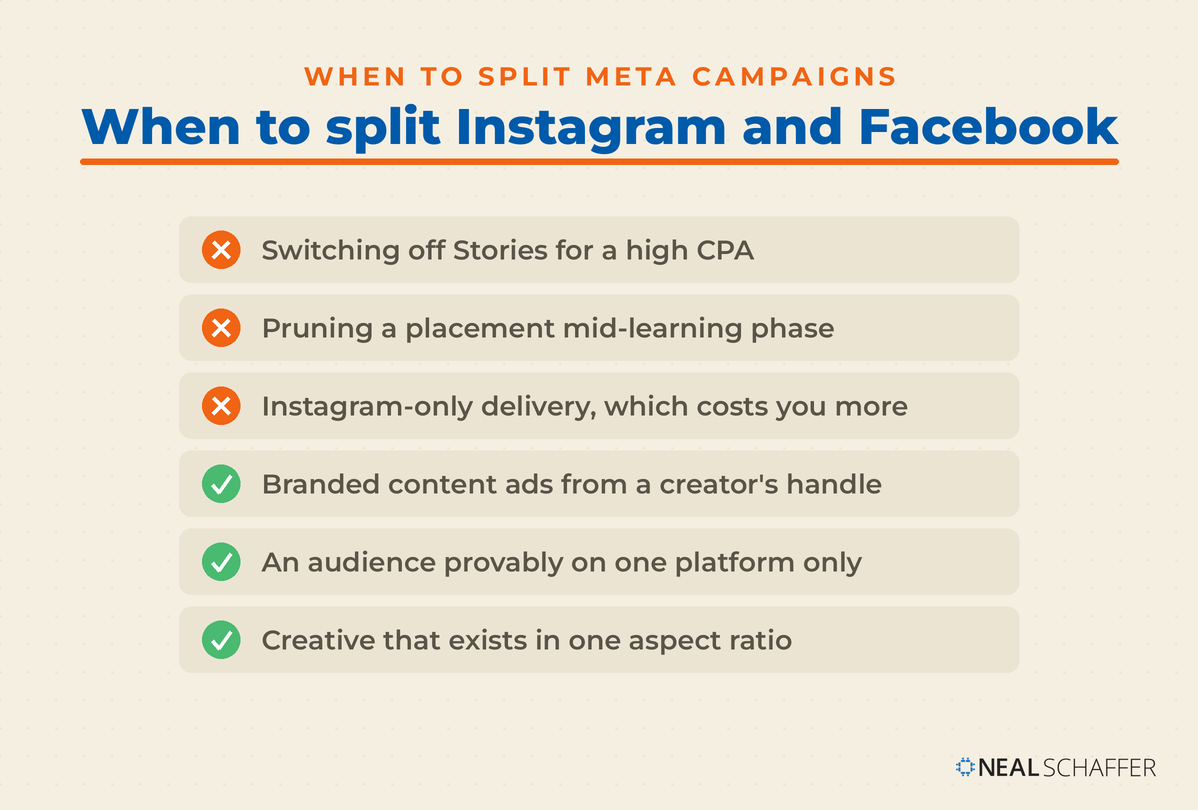
WordStream makes this point directly in their cost guidance: using automatic placements and serving across both Facebook and Instagram gives the algorithm more room, and reduces the competition your budget faces on Instagram’s smaller set of ad placements. More surfaces, more chances to find a cheap conversion.
The instinct to split runs strong anyway, and I understand why. You look at the breakdown, see Instagram Stories costing more per conversion than Facebook Feed, and want to switch Stories off. Resist that for at least a full learning cycle. The delivery system is optimizing for the lowest average cost across all placements, not the lowest cost in each one individually, and pruning the “expensive” placement often just raises the average everywhere else.
Split only when you have a specific reason. Branded content ads that need to run from a creator’s handle. A product whose audience is demonstrably on one platform. Creative that exists in only one aspect ratio. Otherwise you’re paying for the privilege of second-guessing a system with more data than you have.
Working with a real estate client, I found that carousel photos on Facebook outperformed video on Instagram, which is the opposite of what the conventional wisdom would have predicted. I only knew because the campaign ran across both and the data told me. If I’d split them from day one based on assumptions, I’d have optimized toward the wrong platform and never seen it. Agents running campaigns of their own can go deeper with this guide to Facebook ads for real estate.
A quick reality check on boosting, too, since a lot of small businesses run their entire paid program this way: boosting a Facebook post and boosting an Instagram post are separate actions with separate spend, and neither gives you the placement breakdown you need to make this decision well.
How Does the Cost for Instagram Ads Compare to TikTok, X, Pinterest, and YouTube?
Instagram is the most expensive major social platform on impressions, and the others aren’t close. Gupta Media’s 2025 tracker averages put Meta at an $8.19 CPM against YouTube at $4.99, TikTok at $4.82, and Pinterest at $4.67. Emplifi separately found X carrying the lowest CPMs of any platform in its 2026 measurement.
| Platform | Average CPM (Gupta Media, 2025) | Budget mechanics worth knowing |
|---|---|---|
| Meta (Instagram + Facebook) | $8.19 | Auction across placements; Advantage+ splits spend for you |
| YouTube | $4.99 | CPV bidding charges on a qualifying view, not an impression |
| TikTok | $4.82 | Hard floors of $50 per campaign and $20 per ad group |
| $4.67 | Objective sets the billing model: CPM, CPC, or CPV | |
| X | Not published in this dataset | Daily budgets set at ad group level, optional campaign spend cap |
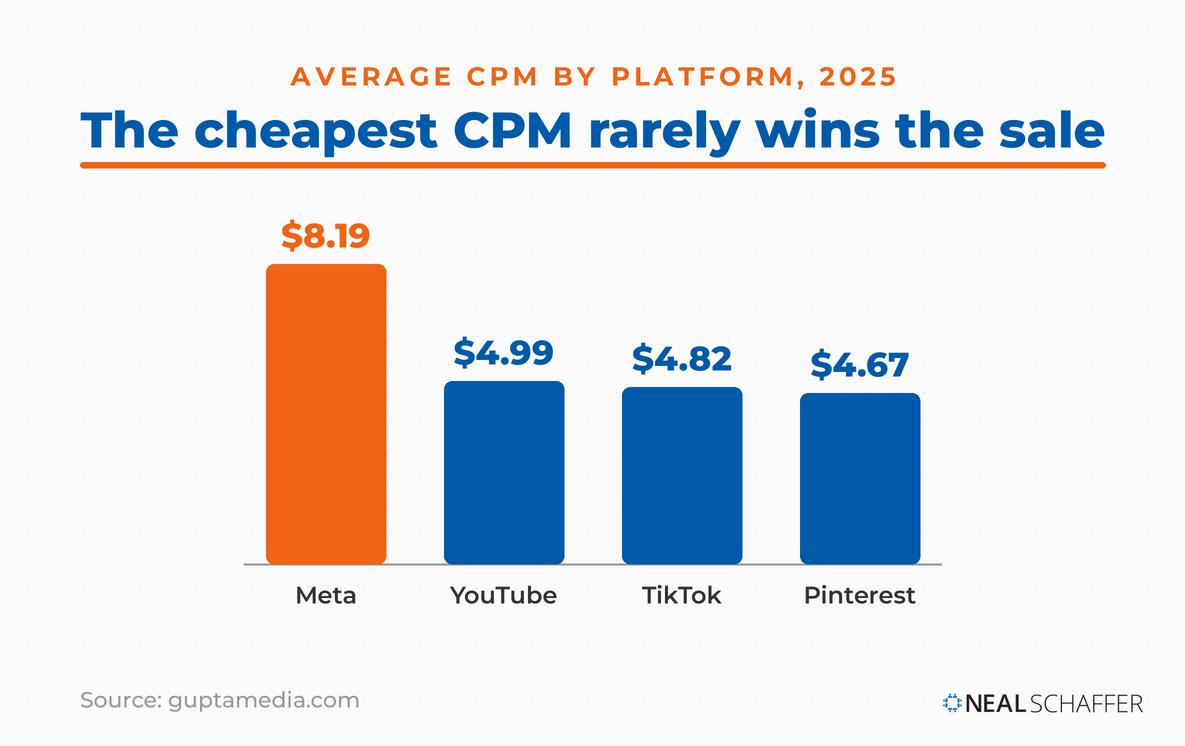
Those numbers deserve context rather than a victory lap for whoever’s cheapest.
TikTok is the clearest alternative on price and the least forgiving on creative. It also has the strictest entry requirements of the group: TikTok’s own documentation sets a minimum budget of $50 at the campaign level and $20 at the ad group level. Those are floors for delivery, not floors for learning. An ad group scraping along at $20 a day will run, but it won’t gather enough conversion data to optimize toward anything.
YouTube prices differently enough that a CPM comparison is almost misleading. With cost-per-view bidding, Google charges you when a viewer watches 30 seconds of your in-stream ad, or the whole thing if it’s shorter, or interacts with it, whichever happens first. Someone who skips at five seconds costs you nothing. That’s a genuinely different risk profile than paying for an impression somebody scrolled past.
Pinterest is a planning-intent platform, and cheap impressions there reach people who are researching a purchase weeks out rather than buying today. That’s an argument for it as a top-of-funnel complement, not a Meta replacement. If you’re weighing it, understanding how Pinterest works for marketing matters more than the CPM.
X is the cheapest inventory and the smallest audience, which is exactly the tradeoff it sounds like. On budget mechanics, X’s default campaign structure has you set a daily budget and flight dates at the ad group level, with an optional spend cap at the campaign level. If you’ve run promoted posts on X before, the cost efficiency is real and the ceiling on scale is real too.
The honest summary: Instagram costs more per impression because more advertisers want those impressions, and a lot of them are getting a return. Chasing the cheapest CPM across platforms is how you end up with a beautiful cost-per-thousand report and no additional revenue. The same logic holds when the alternative is search rather than social, which is the heart of the Facebook Ads vs Google Ads decision.
What Actually Drives Your Instagram Ad Costs Up or Down?
Four things move your cost for Instagram ads more than any bid setting: creative quality, audience size, campaign objective, and seasonality. Creative is the one you control most directly and the one most advertisers under-invest in, because Meta rewards ads people engage with by charging less to show them.
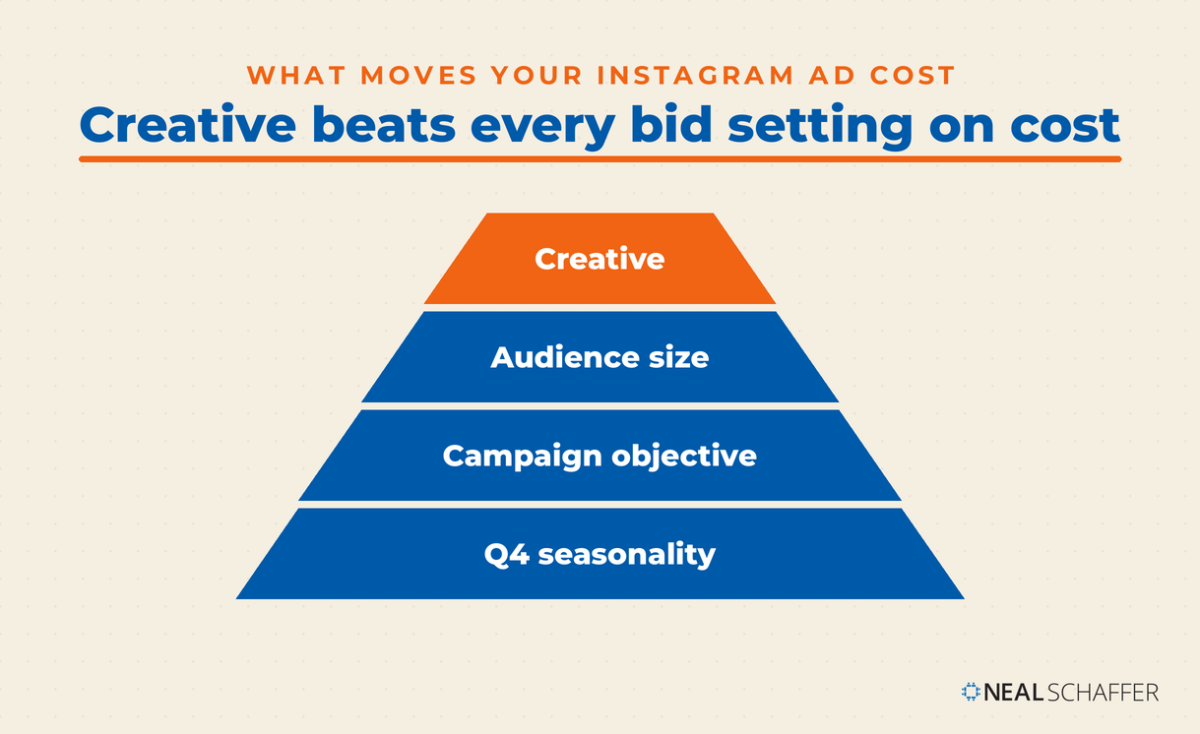
Creative quality. This is the whole game. An ad with a strong hook earns a higher engagement rate, which earns cheaper delivery, which compounds across the entire campaign. Weak creative quietly inflates every metric downstream. If your CPM is double the benchmark, look at the first two seconds of your video before you look at your bid strategy.
Audience size. Narrow audiences cost more, not less. Everyone competing for the same small pool bids the price up, and retargeting pools are small by definition, which is why retargeting CPMs look alarming next to prospecting. Broad targeting with strong creative has been the more efficient play for a few years now.
Campaign objective. Awareness is cheap. Conversions are expensive. Meta is charging you for the difficulty of the outcome you asked for, so comparing a conversion campaign’s CPM to an all-industry blended average will always make you feel like you’re overpaying.
Seasonality. Q4 competition raises prices for everyone, and the Black Friday and Cyber Monday window is the most expensive inventory of the year. Q1 is the cheapest time to test new creative, which is when you should be doing it anyway.
There’s a fifth factor that never shows up in benchmark tables: what happens after the click. In Digital Threads I make the case that paid social is one thread among several and not a shortcut, and that promoting to a warm audience will always outperform advertising to a cold one. That’s a cost argument as much as a strategy argument. An audience that already knows you converts at a rate that makes your CPM almost irrelevant.
On an episode of my podcast Your Digital Marketing Coach about Facebook ads strategy, I put it this way: “the ROI is not just the revenue from one ad spend, one campaign, it is the revenue that we can expect from a customer over their lifetime.”
That reframe changes what “expensive” means. A $40 cost per acquisition looks brutal against a $50 product and perfectly reasonable against a customer who buys four times a year.
How Much Should You Budget for Instagram Ads?
Budget by what you need to learn, not by what the platform will let you spend. Meta’s minimums are low enough to be misleading, and a campaign spending $5 a day will technically deliver while producing nothing you can make a decision from. Plan for enough volume to exit the learning phase on a single well-funded ad set.
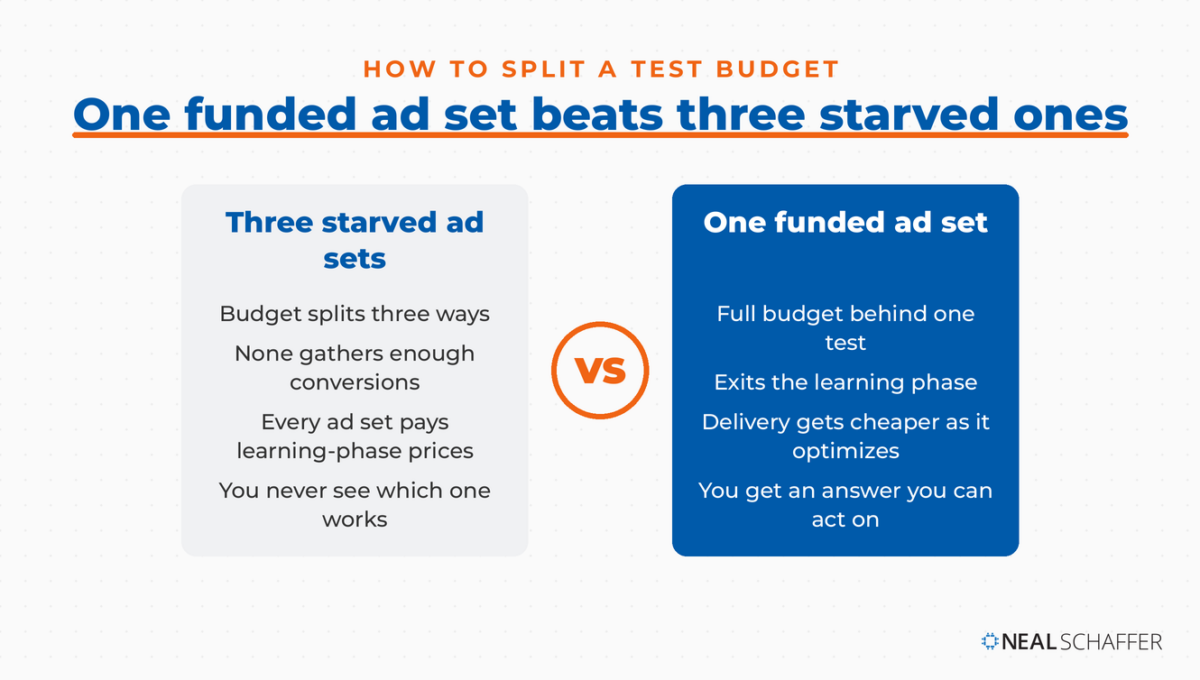
My rule with clients is one properly funded ad set beats three starved ones, every time. Splitting a small budget across multiple ad sets means none of them accumulates enough conversion data to optimize, so you pay learning-phase prices indefinitely and never graduate to efficient delivery.
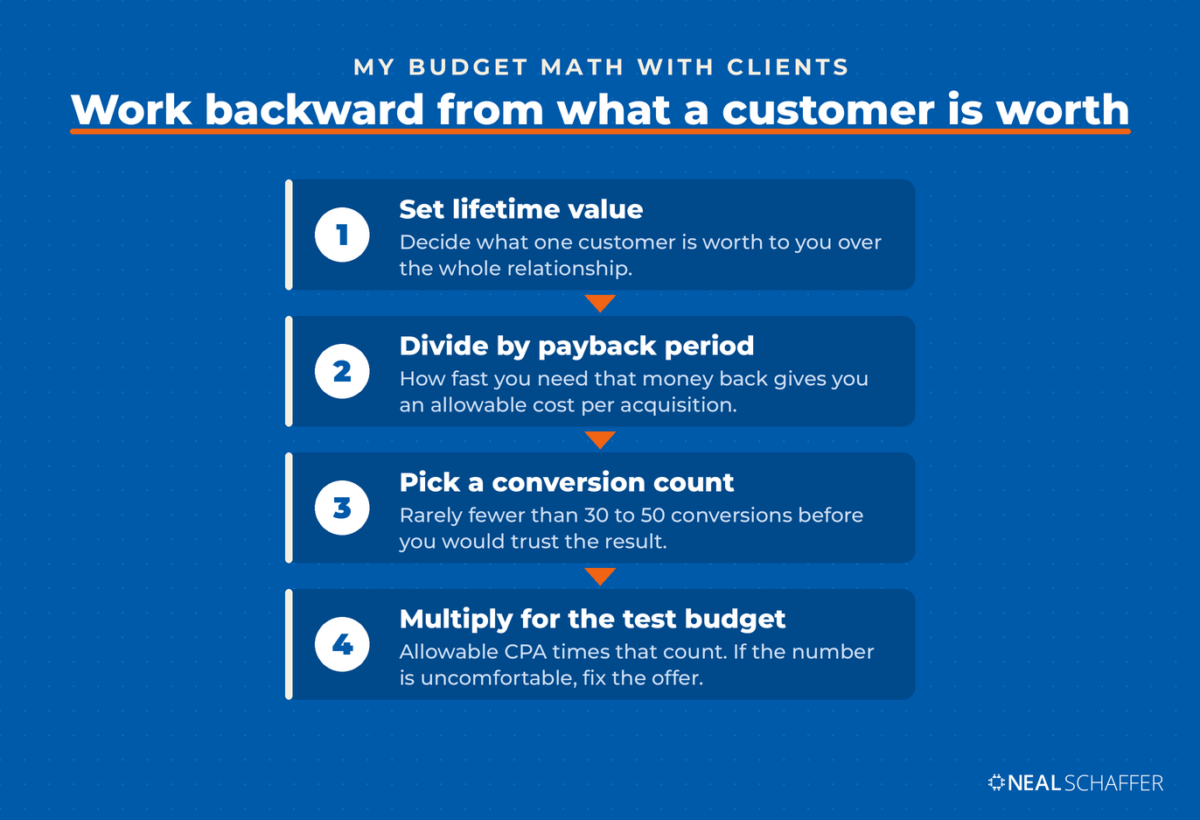
Work backward from your economics instead. Decide what a customer is worth over their lifetime, divide by your target payback period, and that gives you an allowable cost per acquisition. Multiply by the number of conversions you need to see before you’d trust the result, which is rarely fewer than 30 to 50. That’s your test budget. If that number is uncomfortable, the answer isn’t to spend less; it’s to fix the offer or wait until you can fund a real test.
Three campaign types cover most of what my clients run. Traffic campaigns to get people onto the site where they can be retargeted. Video view campaigns, which build a cheap retargeting pool because you only pay for actual views. And conversion campaigns for the people already deep in the funnel. Running all three in sequence costs less in total than hammering cold audiences with conversion campaigns and wondering why the cost per purchase won’t come down. Those objectives sit on top of the ad formats themselves, which this rundown of Facebook ad types covers format by format.
If you’re at the earlier end of this, the mechanics of social media advertising for a small business are worth getting straight before you scale spend, and it’s worth knowing what advertising on Instagram actually offers beyond the click. The latest Instagram statistics are also a useful sanity check on whether your audience is even here in the numbers you’re assuming.
Frequently Asked Questions About the Cost for Instagram Ads
You can run ads for a few dollars a day, but a realistic testing budget for most small businesses is $20 to $50 daily on a single ad set. Below that, campaigns struggle to gather enough conversion data to optimize, so you pay higher costs for longer without learning anything actionable.
On a CPM basis, yes. Instagram carries the highest impression costs among major placements, while Facebook runs more efficiently and concentrates its spend in Feed. On cost per result, the two are often close enough that splitting them into separate campaigns costs you more than it saves.
It depends what you’re buying. Reels have the lowest CPM, so they’re cheapest for reach. Stories have the lowest cost per link click, so they’re cheapest for traffic. Feed is the most expensive on both but tends to convert best for considered purchases.
The most common causes are creative fatigue after two or three weeks in market, an audience that’s too narrow, a seasonal spike in competition, or a recent switch to a lower-funnel objective. Check your frequency metric first. If it’s climbing, your audience has seen the ad too many times and the auction is charging you for their indifference.
TikTok is meaningfully cheaper on impressions, but it demands native, creator-style video and enforces higher minimum budgets. Instagram costs more per impression and gives you a more developed conversion system and a broader age range. For most businesses the answer is to test both against cost per acquisition rather than picking on CPM.
Ready to Build an Instagram Ad Budget That Holds Up?
Your own account is the only benchmark that matters. Pull the last 90 days in Ads Manager, break the report down by placement, and find out what Feed, Reels, and Stories actually cost you. Then fix your creative before you touch your bids, because creative is where the savings live.
If you want the wider picture of how paid social fits alongside your other channels, download a free preview of Digital Threads, which lays out the order I recommend building these channels in. If you’d rather have help constructing the whole thing, take a look at my fractional CMO services. And if you’re still deciding how paid fits with everything else you’re doing on the platform, start with Instagram marketing strategy.