Welcome to my website! The purpose of this page is to give you an introduction to who I am, how I have been helping professionals and businesses, how I can help you, and some additional resources for your reference.
We all have a book to write about our life, and I am no different. I think it is especially important for businesses to understand those professionals that they engage with as speakers, consultants, or influencers, and that is why I want to be completely transparent as to who I am and why I do why I do. I hope that other speakers and influencers follow suit and become more transparent as to who they are as well.
Let’s begin with who I am.
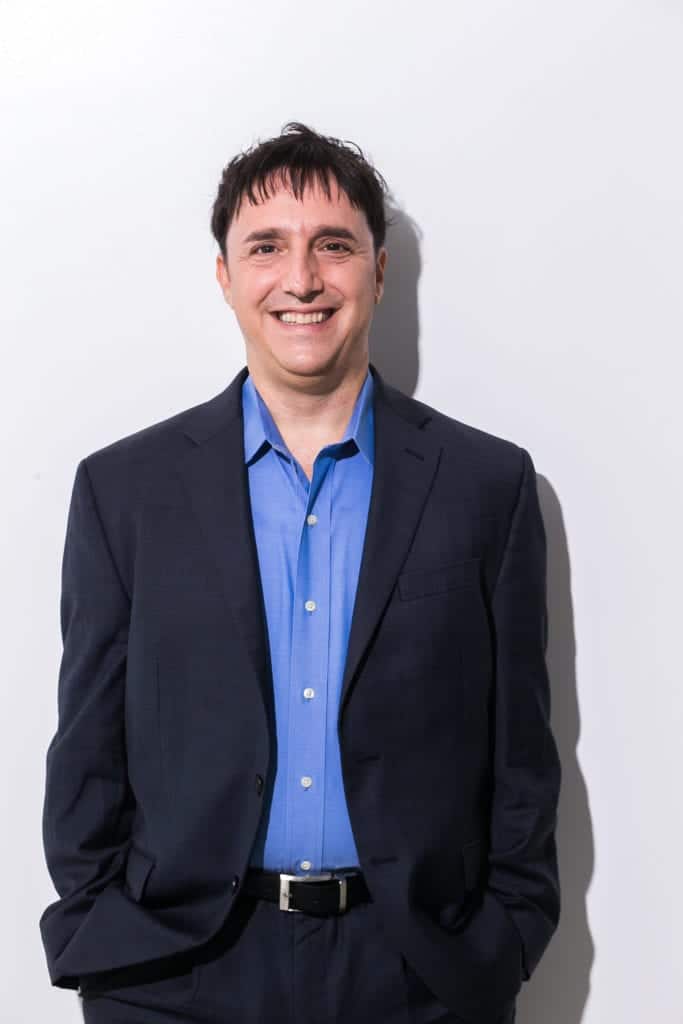
Who is Neal Schaffer?
For a quick summary of who I am you probably want to check out this video of mine which gives a snapshot summary of myself:
My official bio that I use when I speak at conferences looks like this:
Neal Schaffer’s Official Bio
Neal Schaffer is a leading global authority on digital and social media marketing, internationally recognized as a keynote speaker, Fractional CMO, and university educator who helps businesses succeed in the digital-first economy. He is the author of six books on digital and social media marketing, including Digital Threads (2024), The Age of Influence (HarperCollins Leadership, 2020), Maximize Your Social (Wiley, 2013), and Maximizing LinkedIn for Business Growth (2nd ed., 2026). Neal teaches social media marketing to executives at Rutgers Business School and personal branding and influencer marketing at UCLA Extension. He hosts the Your Digital Marketing Coach podcast and has keynoted in 14 countries across 4 continents. An official Adobe Express Ambassador, Neal’s work has been featured in the Wall Street Journal, Fortune, Inc., Mashable, Huffington Post, the Christian Science Monitor, and the LinkedIn Business Blog. He is President of PDCA Social, based in Irvine, California, and is fluent in Japanese and Mandarin Chinese.
How I Can Help You
I help businesses and professionals in a few distinct ways. Pick the path that fits where you are:
- Fractional CMO services give growth-stage companies senior marketing leadership and strategy without a full-time hire.
- Digital First Mastermind is my group coaching community for marketers and entrepreneurs building digital-first businesses.
- Speaking brings keynotes and workshops on AI-first marketing, influencer strategy, personal branding, and LinkedIn for business growth to your event.
- Books include six titles on digital and social media marketing, among them Digital Threads and Maximizing LinkedIn for Business Growth.
- Your Digital Marketing Coach podcast publishes weekly with practical strategy and expert guest interviews.
- Newsletter sends practical digital marketing tactics straight to your inbox.
- Blog offers hundreds of in-depth guides across every digital marketing channel.
My official speaker’s reel gives you a feel for my presence on stage and what I talk about as a speaker:
That’s a LOT for a first-time visitor to digest! So let’s take a step back and let me introduce you to who I am as a person and how I got to be who I am and where I am today.
My Personal Background
We all have a story to tell, so this is mine. Part of why I will go into a thorough background of myself is not only to tell you why I am who I am and what are the past experiences I draw on when helping people and companies, but also to help connect my own dots, as made famous by Steve Jobs’ famous Stanford University speech:
My Early Days
I was born the 5th of 5 sons to my parents and grew up in Rancho Palos Verdes, California. My father was a learning specialist in our local school district and soon became an elementary school teacher. When I was young I remember visiting my dad’s Kindergarten and 1st grade classes at the local elementary school.
Needless to say education was something that was top priority in our household.
Since my dad started by teaching children with reading disabilities, he came up with innovative ways to educate them by making reading FUN. He often created his own teaching materials for his classrooms, and other teachers thought they were so good that they borrowed them.
Then my father had an idea: Why not create a “textbook” filled with all of his best worksheets and bring them to the California Teacher’s Association annual conference to see how many he could sell? I still remember collating his first book, putting metal fasteners in the page holes to make it appear as a “book.” That weekend my father sold out of the 200 books he brought to the conference, and Frank Schaffer Publications was born.
I bring up this story to point out two things that you should know about me:
- Going back to my roots and connecting the dots, I have the DNA of an educator, someone who truly wants to help others succeed.
- I have an entrepreneurial bug that I caught looking at the role model of my father. This “bug” is what drives me to do more everyday, both for my own business as well as for all of the clients I work with.
Those two parts of me wouldn’t manifest themselves until later in life. Growing up I enjoyed sports and music, playing AYSO soccer in elementary school, joining a long-distance cycling club in middle school, and running cross country in high school. I played the violin elementary and middle school and transformed my violin into an electric one in high school where I played in a band and even was featured on two tracks on a vinyl piece called “The Mighty Feeble.”
While visual social media has become an important part of my job today, I became fascinated with and a student of the original social media: art. More specifically I became intrigued by art history, and even in high school I was taking extension courses on art history at UCLA, had the school create an art history AP class for me, and after entering college actually did two internships at museums: The Whitney Museum of American Art (New York City) and the Museum of Contemporary Art (Los Angeles).
My College Days
I fast-forwarded a bit there, but after graduating from high school, while most of my friends stayed in California, I decided to take the road less traveled and attend a small liberal arts college in Massachusetts, Amherst College. It is from that college that I graduated, but it’s also the time when I had the most impactful event that would influence the direction of my life.
Before attending Amherst, at high school most of my friends were Asian-American. My high school class was about 30% Asian-American, but that number was much higher in the classes I was taking. Most of my friends became Japanese-American, Chinese-American, and Korean-American, and I was already attending birthday parties in high school where I was the only non-Asian-American. In parallel with my journey in art history, I decided to also seek and learn more about the culture and history of my friends and their descendants. I decided that I would do this by learning an Asian language in college and then spending my Junior Year Abroad in an Asian country to further learn the language.
I mention this because in parallel to studying art history, I was also studying Mandarin Chinese. I took my first two years at Amherst with a teacher from Taiwan, and thus I was schooled in traditional Chinese characters, much more complex than the simplified Chinese characters introduced by Mao Ze Dong in mainland China. It is also why, although my junior year abroad exchange program was with Beijing Normal University in Beijing, China, I first did a summer school intensive Chinese program at Tunghai University in Taichung, Taiwan.
That summer in Taiwan was one of the best of my life. The people, the culture, the food, the country … it was an amazing experience. I made many friends who I would visit after traveling to Beijing, and I learned very much how to study a foreign language by simply making many local friends and having as many local experiences as I could. This method of studying foreign language is exactly the same approach I take with social media: Like a foreign language, unless you become an avid user and passionate member of the community, you will never master it.
My First Near-Death Experience (Taiwan)
While I had an awesome time, I did have my first near-death experience in Taiwan that summer. I went with friends to see the famous sunrise from Alishan Mountain, but due to a typhoon that hit the island, all transportation was stopped. We had to literally walk several miles down the mountain to the nearest town. While walking down the mountain road, we found one stretch of road that had been washed out. It was about a 30 meter stretch with the only way getting to the other side was by straddling the rain gutters to the side of the road which somehow survived the torrential rains.
As I was straddling the rain gutter trying not to look down at the 15 meter or so drop, all I could think was about getting to the other side safely. Amazingly all 10 or so of us got to the other side safely, but it was an experience that I still remember today that drives me to make the most out of every day I am here on this Earth.
That was until I had another, more terrifying near-death experience that Junior year in Beijing, China.
My Second Near-Death Experience (China)
My roommate and I decided to go to the beautiful city of Harbin in northeast China to see their famous ice lantern festival, where lights are placed inside of beautiful ice sculptures for an amazing site. If you have never heard of this check out this video below for highlights of a recent festival!
We got to Harbin early and decided to check out the city. Being close to the Russian border near Siberia, needless to say it was a cold city! That was where I saw, for the first time in my life, a huge river that was completely frozen by the icy temperatures: The Heilongjiang River!
To get a feel for how large this river is, check out this video which shows how they harvest ice from the river for the ice festival mentioned above:
I had a habit of taking selfies with my camera, long before selfies existed, so imagine being on a huge frozen river with my roommate looking for a location to place the camera for a self-timed photo! And then I saw some boats harbored in the frozen river, a perfect location to place my camera for the photo!
I still vividly remember placing my camera on the boat, running back to join my roommate in the photo, hearing the camera take the photo, and then walking back to get the camera.
With camera in hand I walked back to my roommate, and that is when I felt the ground below me start to fall.
It was as if I was in a slow-motion movie, but I distinctly remember the ice under me breaking, and I was slowly falling into a very deep river.
As I was waist deep in frozen water, I reached out at the ice surrounding me, trying to get a grasp and somehow protect myself from going any deeper into the frozen river.
Somehow – and to this day I still consider it a miracle – the ice around me did not break and I was able to pull myself out of the water with my own strength. My roommate cautioned me to walk around the hole so as not to further widen it, and I was able to get back to where my roommate was standing and back to ground for safety.
Life can flash by you in a second, and when I hear about children that die falling into ice holes on lakes and rivers, I shudder thinking that could have been me.
That was one more experience that taught me that every day should be lived to its fullest as if it might be your last.
Until that point I was still planning on being an art history major and working in an art museum after graduation – until a historic event happened in Beijing, China just a few months after my near-death experience in Harbin.
The Historical Event That Changed My Life
It all started on an average day in April of that school year, just a few weeks from finishing my Junior year abroad in Beijing: A high-ranking Communist Party official who was revered by college students because he was a fellow intellectual had died. People began going to Tian An Men Square to lay wreaths in mourning of the passing of this great man.
And then the demonstrations began.
There are many historical factors that go into what became know as the Tian An Men Demonstrations leading up to the Tian An Men Incident, but all I saw were demonstrations first by university students in Beijing – and later by average people in Beijing – growing with each day. My university happened to be the closest one to Tian An Men Square, so often student demonstrators would march by my university where our students would join them and then walk to Tian An Men Square, an 8 kilometer walk!
I frequented Tian An Men Square at this time and was always able to strike up a conversation with Chinese people around me. It was an incredible time to learn more about China but also teach about what it was like to grow up and live in the United States.
As it turns out, my memories of the demonstrations were all peaceful – my university ended up closing down early for the summer because of the demonstrations. I decided to go back to Taiwan for the summer, and it was on that 2-day train ride from Beijing to Guangzhou when the then Prime Minister of China announced martial law in Beijing. I had witnessed all of the peaceful and largest demonstrations, but after I left Beijing things had definitely turned violent…
Fast forward to a month after the Tian An Men Incident when I returned to Beijing to meet my roommate and friends for a pre-planned Silk Road Tour. I was the only one of the group to return, and I returned to a city where the military was marching on the train platform, the streets were empty, and gunshots could be heard at night.
I came back to a city that was void of life, where all of the incredible energy I had witnesses had been sapped from it. It was unreal. For those of you who might not remember what happened during those times, this is a good summary taken straight from interviews of those who participated as well as other historic footage:
It was at that point that I realized that art history was very much removed from what I had witnesses over the last several weeks. I wanted to have a mission in life where I could serve others on a daily basis, and in my own way contribute to world peace.
I vowed to return to China at some point, but since most foreign companies pulled their investments out of China, that wouldn’t happen for several years…
After that Silk Road Tour that I ended up going on a month later with my roommate and friends, I stopped off in a country on my way back to the United States that would forever change the course of my life.
The Japan Connection
A lot of people know that I do business in and travel frequently to Japan, but until now I’ve only mentioned China. It is true that I learned Mandarin Chinese before Japanese, but how, when, and where does Japan fit into the equation?
When I went to study Chinese in China, it was not a popular language to study as it is today. The Japanese class at Amherst College had a few times more students than the “niche” and at the time unpopular Chinese class did at the time. Why? Because it was the time of the “bubble” in Japan when Japanese companies were aggressively expanding globally and their economy was at a peak.
My Japan connection actually started in China, for my roommate – and a majority of the foreign exchange students living in the same dormitory – were from Japan. Through my roommate I was able to make friends with many of those Japanese foreign students, and some of these relationships remain to this day. It was in China where I was introduced to Japan and Japanese culture, and thus on my way back to the United States, I decided to pay my roommate a visit in Kawasaki, Japan, where he invited me to stay at his house for a week.
That week changed my perspective on life. While China was dark and gloomy at the time, Japan was booming – and was FUN! I thought to myself, “If China is the future of the global economy, Japan is one of the leaders in TODAY’s economy. So why not learn Japanese senior year at Amherst College and then start my career in Japan? After a few years in Japan I can move back to China and grow my career there.”
And that is EXACTLY what I did!
I went back to Amherst College, excelled at Japanese – probably due to the fact that learning Chinese had made it easier for me to learn foreign languages, especially those with Chinese characters – and then invested my Christmas break to see friends from Beijing in Japan.
At the same time I reached out to a number of Japanese companies that advertised in a magazine I found in my career center, letting them know that I would be in Japan over winter break and would love to meet with them.
Only one of the companies I reached out responded, and that would be the company I began my career with after graduating from college: ROHM Semiconductor, headquartered in the ancient capital city of Kyoto, Japan, where I would live for my first 9 years after graduating from Amherst.
After a summer at the International Christian University in Tokyo, I began my career in the Finance Division at the headquarters of ROHM Semiconductor in Kyoto, Japan.
My Professional Background before Social Media
Whenever you work with or hire someone with expertise in digital or social media marketing, it’s important to understand their professional background before social media, assuming they are old enough to have worked before the advent of social. The reason why is that this will paint a picture as to what their unique perspective to social is. You can only work based on your experiences, and these experiences influence how you will help businesses with their social media marketing.
This is my story as my professional experience before social media is what provides me to have the unique perspective on social that I have.
ROHM Semiconductor
I began my career at ROHM as the first full-time foreign employee at this 2+ billon dollar global revenue company. Starting with two years of experience in finance, I moved over to business planning, helping establish a new logistical infrastructure for our sales office in Singapore as well as a new factory in Dalian, China while also managing potential joint ventures in China.
I always wanted to move into sales, and finally had my chance, beginning with working to support our Singapore sales in the Asian Sales department and then chosen to launch our sales offices in China. At 27, I became the youngest person in company history to become a Team Leader (係長 in Japanese).
I flourished in China, being able to draw on both my language skills and my understanding of Chinese culture and society. From zero brand recognition I established a sales presence for ROHM in China, creating 3 sales offices in Shanghai, Beijing, and Dalian and managing a staff of over a dozen while generating tens of millions of dollars of sales from scratch.
My experience at ROHM deeply impacted my views on social media from the following two things:
- It was at ROHM where as part of my employee training I learned about the Deming Circle, or PDCA Cycle. This is the source of the framework that I would use to develop social media strategies later in life and become the centerpiece that I talk about in my Maximize Your Social book as well as how I run my marketing agency, which is appropriately named PDCA Social.
- Doing business in China without any previous brand recognition and zero marketing support meant that I had to take an extremely holistic perspective on business. There as no cookie-cutter formula for generating business in China; on the contrary, it really was based on relationships and partnerships, and when you helped other people there, they never forgot about you. This was where I got my first extremely holistic business experience that would impact my views on sales and marketing as well as digital and social media until today.
ROHM was never a household name in Japan, but their Christmas night-time illuminations became the talk of the town and are now the biggest in Kyoto. You can check them out here:
Procter & Gamble
If you were to look at my LinkedIn profile, you would not see me having any work experience at P&G. This is true. But after working at ROHM for more than eight years and realizing that although I lived in Japan for that span, my track record at succeeding in business was in China and not Japan, I wanted to create a successful track record in Japan.
Due to different salary structures, I realized my best bet was to work with a foreign equity company, and I immediately had offers from a few different American companies.
One of those was Procter & Gamble, who had their Asia headquarters in Kobe, Japan at the time. As P&G only traditionally took new employees straight out of university or with only a few years of work experience, I would have been exception to the rule. I got an offer to become a product marketer and help promote sales of their Bounce product for clothes drying.
While I did not take the offer on the table for various reasons, I did learn that consumer brands spent a lot of money on focus groups trying to understand the needs of people. Since the advent of social media, I have been arguing that social media is one big focus group, should you use it in such a way and have the right tools and talent to gather and analyze the data.
Wind River
I ended up taking a new position to launch a Western Japan Sales Office for the embedded software company Wind River in Osaka. Previously at ROHM I had sold semiconductors and other hardware to consumer electronics, telecommunications, etc. manufacturers in China. This new role at Wind River would have me do the same thing but selling the software that runs on those chips and to companies in Japan.
My stint at Wind River ended up being a short one – shortly after entering the company we merged with our biggest competitor who had an equal size staff in Japan, and the organization and roles changed significantly.
Wind River, by the way, would end up being bought out by Intel.
However, being at Wind River did give me the opportunity to get exposed to many other companies in the industry, one of which, a partner company, became my new employer.
Espial
Espial was a startup out of Ottawa, Canada developing embedded Java software for consumer electronics devices and trying to get into that tornado of exponential growth that startups need to later cross the chasm. They were making headways in the United States and Europe but Asia had lagged behind. I was hired to be their Regional VP of Sales covering the Asia Pacific and, in essence, launching business from scratch for them as I had done for ROHM in China.
I flourished at Espial and over the next few years went from zero sales to generating more than 1/4 of global sales from Asia. I continued with my holistic way of doing business in Asia, often wearing many hats as well, and had new experiences in doing business not only in China and Japan but in Korea and Taiwan as well.
The seven years I spent at Espial further prepared me well for understanding how to generate business from scratch with zero brand recognition in competitive foreign markets. This is the professional experience and business acumen that I brought with me as social media as an industry found me.
Note that all of this professional experience before social media is primarily that of B2B sales, but having to wear many hats running sales offices means that I was also involved in marketing, business development, recruiting, customer support – pretty much everything we needed to do to launch and grow our business in Asia.
There was one more professional experience I had before relaunching my career in social media…
DataPath
It was my role at DataPath that would be destined to bring me into social media.
Before getting hired at DataPath, I found myself back from living in Asia for more than a decade and being in transition for the first time here in the United States. My professional network was either overseas or dispersed around the country, not based locally in Southern California. This is where I began to use LinkedIn religiously to help network both locally and within my industry.
While LinkedIn was not instrumental in helping me find my job back then as it was still early days for social media in general, after I found my job at DataPath I decided to launch a blog. During my few months in transition I had become an active member of many LinkedIn Groups as well as responded to many questions on the now-defunct LinkedIn Answers. I wanted to use my experience to help build my network, so I decided that putting my knowledge about LinkedIn into a blog would help me to efficiently network well into the future even after finding my job. It was when I got my job offer when I actually launched my blog on WordPress.com through a WordPress application inside LinkedIn that used to be supported inside the app.
I launched my blog on July 10, 2008, and it was called “Expert Answers to Your LinkedIn Questions.” As you can see, I entered social media without any career objective and just wanted to add value where I could.
3 1/2 months after I was hired at DataPath, the company went through a restructure and I was once again back in transition. This was the first time this has ever happened to me, and because I am passionate about what I do, it really stung. I realized that I had to create something that no one could ever take away from me. My answer to that was My Personal Brand.
My Professional Background Since Social Media
While in transition I continued to blog and found inspiration to do so while networking on LinkedIn. I also began to network more frequently offline locally in Orange County, California, and became known as the LinkedIn expert. All of these online and offline networking experiences fueled my blog content, which I was beginning to see increases in both web traffic from as well as comments and engagements online.
My First Book and Windmill Networking
As the author of six books, it may sound odd when I tell you that I never planned to become an author, and I certainly never thought that I would make a career out of social media. But that is the truth.
Being in transition for an extended time living outside of field of domain expertise here in the United States during a global economic meltdown meant that career opportunities were few to find. On the other hand, I began to regularly blog with the free time I had now in parallel to accelerating the online networking activities on LinkedIn as well as my local networking here in Southern California.
At one point I distinctly remember my wife asking me, “Why don’t you write a book?” At the time, ebooks were the rage in Japan (my wife is Japanese), but I never thought of myself as an author.
One day I went into my blogs and wrote an outline of a book on LinkedIn that I might write. It turns out that 25% of the chapters that I would write for the book were already published as part of my blog! Perhaps writing a book wouldn’t be so hard after all…
At that time, my only interest was to get the book published, so I decided to go the self-publishing route. Compared to those times, it was much harder to find services and resources to help self-published authors. Fortunately Amazon had bought a firm called Booksurge that helped self-published authors, and once I saw how easy it was, I published my first book, “Windmill Networking: Understanding, Leveraging and Maximizing LinkedIn.”
It was also at this time that I rebranded my blog and move from a WordPress.com domain to WordPress.org and my own domain. I wanted to build a brand bigger than who I was, and the concept of Windmill Networking that I had created made it a natural choice. Thus, my blog was reborn on windmillnetworking.com.
My First Speaking Engagements
I already had my first speaking engagement prior to the publication of my first book back in September of 2009, but it was the publication of that book which put me on the radar for a number of local speaking events here in Southern California.
The turning point was when I spoke on LinkedIn at the Gravity Summit at UCLA in front of hundreds of people in December of 2009.
The Launch of My Social Media Strategy Consulting Business
A combination of publishing my first book, local networking, and speaking led to the culmination of being asked for social media help by four different businesses over the span of two weeks in January, 2010. These four businesses were from a variety of industries and included:
- an asset management firm (financial services)
- one of the schools at the University of California at Irvine (education)
- a startup creating a new social search engine (information technology)
- a provider of landscaping hardware and services (gardening)
At that time I didn’t have a business model nor prior professional experience, and social media as well was very much in its infancy. However, after speaking with these four businesses, I came to the conclusion that these companies needed then what they still need now vis a vis social media marketing: Strategy and Education.
Since I never had an agency background, I never offered to “do” their social media for them. I also thought that any company’s social media should be done internally by themselves when possible. What would I put in a proposal and how much would I charge to help them?
That’s where I created my signature Social Media Strategy Consulting program. It’s also where, when looking for a framework for social media strategy that didn’t exist at the time, I went back and connected the dots to learning about PDCA, and thus that became the basis for every social media strategy I have written since.
It is also interesting that at this very same time, right when I received the draft contract for my first social media strategy customer from my lawyer,
I ended up selling this program to dozens of companies over the years, but it consisted of a few meetings where I learned about each company’s objectives and branding. It was also through these meetings where a lot of the education aspects that I was able to provide companies were implemented.
The meetings culminated in the creation of a detailed social media marketing strategy which was tens of pages long and customized in every aspect for each customer.
Maximizing LinkedIn for Sales and Social Media Marketing
2010 was a busy year for my social media strategy consulting. It’s also the year where I decided to graduate from just being a LinkedIn expert and build up authority on other social networking sites. My clients needed me to advise them on which social networks were best for them to participate on, regardless of what expertise I might have. This is why I never wanted to become an expert on just one thing and stick to a particular niche. I thought it wasn’t aligned with customer demand.
On the other hand, as social media marketing became my career, I realized that “Windmill Networking” was not the ideal brand to build a business off of. As LinkedIn was still where I had my deepest expertise at the time, I wanted to write a LinkedIn book, but this time for business that would get my brand out there and be known for the expertise I possess.
The second book, Maximizing LinkedIn for Sales and Social Media Marketing, was again self-published, but this time with Createspace, and Amazon subsidiary that had absorbed Booksurge. It became much easier to publish a book the second time around in 2011, and it literally ended the “LinkedIn chapter” of my career.
Even today I am still known as a LinkedIn expert and still conduct social selling trainings. In fact, this book was written well before the terms “social selling” and “employee advocacy”, two concepts that I talk about in my book, were even talked about! If I was to write another LinkedIn book, it would definitely be based on the concepts and framework I introduced in this book.
Maximize Social Business
Guest blogging has become a huge enterprise of its own, but when I had my first guest blogger reach out to me back in August of 2011, I had no idea how much it would transform my digital presence. I believe that the 2011-2012 era was a renaissance of professionals who wanted to blog more as well as publish on other sites, so within several months I quickly had a roster of several people who were blogging for me at windmillnetworking.com
After awhile I thought it made sense that a new digital entity be created to give respect to the guest bloggers and how my personal blog had been transformed into a media site, and that is when windmillnetworking.com became Maximize Social Business, a media entity which lasted for several years and had dozens of bloggers guest blog for it. It wasn’t until early 2019 that I migrated everything to nealschaffer.com, but a lot happened during those several years.
Maximize Your Social
After Maximizing LinkedIn for Sales launched in 2011, my consulting work kept expanding beyond LinkedIn into broader social media strategy. The companies I was advising needed a framework that worked across platforms, not a LinkedIn-only playbook. That is when I went back to my ROHM Semiconductor days and pulled the PDCA Cycle into my social media strategy work. PDCA gave me a way to structure social media marketing strategy that was repeatable, measurable, and tied directly to business objectives.
Maximize Your Social, published by Wiley in 2013, was where I put that framework and all of my social media marketing consulting experience into book form. It was my first traditionally-published book, a significant shift from the self-publishing I had done with my first two titles. Wiley brought editorial discipline, distribution, and credibility that opened doors my earlier books had not. The PDCA framework I introduced in this book is still the foundation of every social media and digital marketing strategy I write today, and it is also why my agency is named PDCA Social.
This book also marked the formalization of my consulting practice. Until Maximize Your Social, I was a consultant who had written some books. After Maximize Your Social, I was an author whose framework businesses wanted to apply. The book gave me a methodology to teach, and the speaking engagements that followed went from “what is social media” talks to deeper strategy workshops grounded in PDCA.
University Educator
Long before I taught my first university class, my father had already taught me what it meant to be an educator. He spent his career teaching children with learning disabilities and built Frank Schaffer Publications around the worksheets he created to make reading fun. The DNA of an educator was in our household before I knew it was something I wanted for myself.
That part of me did not surface in my career until well into my social media work. My speaking engagements were teaching of a kind, but conference keynotes are short, and audiences move on. I wanted to teach material that builds over weeks, with students who actually do the work and report back on what worked. That is what brought me to formal university teaching.
Today I teach social media marketing to executives at Rutgers Business School and personal branding and influencer marketing at UCLA Extension. Executive education at Rutgers gives me sophisticated audiences who are running real teams and applying what we cover the same week we cover it. UCLA Extension lets me teach personal branding to professionals who are building or rebuilding their careers, which is some of the most rewarding teaching I do. Both programs ground my consulting work in current realities, because students will absolutely tell you when something stops working.
Along the way I have also taught content marketing at the Solvay Brussels School Vietnam and social media marketing at the Irish Management Institute, and have guest lectured at the University of Jyvaskyla in Finland, UCLA, USC, and many other universities. I currently serve on the Marketing Executive Council at Nova Southeastern University’s Huizenga College of Business and Entrepreneurship.
Social Tools Summit
A few years into my social media consulting work, I noticed a gap in the conference circuit. There were plenty of events covering platforms and strategy, but very little that brought social media marketing technology vendors together with the marketers who needed to evaluate them. The decision-making layer between “we need to do social media” and “here is exactly what we will use to do it” was largely missing from the conversation.
That is what led me to launch the Social Tools Summit, an event focused specifically on the tools layer of social media marketing. The conference brought tool vendors and practitioner marketers together for hands-on demonstrations, comparison panels, and the kind of in-depth conversations you cannot have on a vendor’s own webinar. It became one of the more focused events in the industry for the two years it ran. Keynote speakers included Michael Brito, Christopher Penn, and Dave Kerpen.
The Summit eventually wound down as the broader market consolidated around fewer dominant tools and the need for a tools-specific event diminished. I learned a lot from running it, especially about how a niche event is fundamentally different from a niche book or a niche consulting practice. Both experiences helped me later when I designed the Digital First Mastermind around a similarly focused angle.
My Digital and Social Media Marketing Agency PDCA Social
My consulting practice formally became PDCA Social, the digital and social media marketing agency I still lead today, named after the PDCA Cycle I learned during my employee training at ROHM Semiconductor in Kyoto. PDCA stands for Plan, Do, Check, Act, and it is the framework that every social media strategy and Fractional CMO engagement I run still follows.
The agency began as me alone with a handful of clients and grew into a small team that handles social media strategy, content marketing, influencer marketing, and full Fractional CMO engagements. I have intentionally kept the agency small and focused on strategy and consulting work rather than building a large execution shop. The model lets me stay personally involved with every client engagement, which is what most businesses are hiring me for in the first place.
PDCA Social is also the entity behind everything else I do, from my books and podcast to my Digital First Mastermind. Keeping all of that under one company simplifies the business side considerably, and it also keeps a consistent strategic philosophy across every product and service we offer.
The Rebranding of Neal Schaffer
For the first decade of my social media work, my online presence lived under two different brand identities. Windmill Networking was the original concept brand, a metaphor for how social media networking spread in directions you could not always predict. Maximize Social Business was the next phase, a media entity that hosted dozens of guest bloggers and grew into a respected industry publication.
By the late 2010s, those concept brands had become limiting rather than helpful. People knew me before they knew either brand, and explaining to a new prospect that Neal Schaffer also runs Maximize Social Business added friction to every conversation. It was time to consolidate.
In early 2019, I migrated everything to nealschaffer.com, retired the Windmill Networking and Maximize Social Business domains as primary brands, and committed to building the Neal Schaffer brand as the singular identity for all my work. The decision was not without cost. Maximize Social Business had real domain authority and traffic, and rolling that into a new domain meant taking a short-term hit on rankings. But the long-term simplification of having one brand to invest in has been worth it many times over. Today every book, every keynote, every consulting engagement, every newsletter, and every podcast episode reinforces a single brand instead of three competing ones.
The Age of Influence
By the late 2010s, influencer marketing had moved from a niche tactic used by lifestyle brands to a mainstream channel that B2B and B2C businesses alike were trying to figure out. Most of the influencer marketing conversations I was having with consulting clients were starting from the same baseline confusion about what influencer marketing actually was, who counted as an influencer, how to find the right ones, and how to measure whether any of it worked.
I wrote The Age of Influence to give marketers a real framework for that question. The book makes the case that influence is no longer something a small handful of celebrities possess. It is something every employee, customer, and creator with an audience holds to some degree, and the businesses that understand how to work with all of those influence layers are the ones that win in modern marketing.
HarperCollins Leadership published The Age of Influence in March 2020. The timing was difficult, because the global pandemic hit just weeks before launch, and what would have been a substantial speaking and book tour collapsed into a virtual launch overnight. The book still found its audience, and the influencer marketing framework it introduced is one I continue to use with consulting clients today. The Age of Influence also reinforced something I had already learned with Maximize Your Social: the books that perform best long-term are the ones grounded in a framework, not a tactic.
Digital First Group Coaching Membership Community
After years of running one-on-one Fractional CMO engagements and writing books that reach a broad audience, I noticed a gap in the middle. Some businesses needed more than a book but could not justify a full Fractional CMO engagement. Some entrepreneurs were trying to figure out digital marketing on their own but wanted access to a community of peers and an expert they could ask real questions of.
That is the gap the Digital First Mastermind was designed to fill. The Mastermind is a group coaching community for marketers and entrepreneurs who are serious about building digital-first businesses. Members get direct access to me through regular group coaching calls, a private community for peer-to-peer questions, structured learning resources I have developed over years of consulting work, and the accountability that comes from working alongside other operators navigating the same challenges.
The model works because it matches how most growing businesses actually want to learn. They want frameworks, not just inspiration. They want feedback on their specific situation, not generic advice. They want access to other operators dealing with similar challenges. The Digital First Mastermind delivers on all three, at a price point that is sustainable for a small business or an independent professional.
Maximizing LinkedIn for Business Growth
For years I had been maintaining a 50-page ebook on LinkedIn that I refreshed annually for a long-term enterprise client. The ebook was thorough for what it needed to be, but every year I would read it back and notice the same thing: the strategic thinking behind LinkedIn marketing was getting deeper, the platform was evolving, and a 50-page tactical guide could not hold the full picture anymore.
Looking at the broader LinkedIn book market, I saw the same gap on a larger scale. LinkedIn books had been saying basically the same things for a decade, mostly focused on individual tactics rather than the holistic strategy that businesses actually need to grow on the platform. Profile optimization tips, connection request templates, post format checklists. All useful, but stuck at the tactical layer while LinkedIn itself had matured into a far more strategic channel for content marketing, personal branding, social selling, and B2B influence.
In September 2024, I self-published the first edition of Maximizing LinkedIn for Business Growth, the strategic LinkedIn book I felt the market was missing. The book expanded the original 50-page ebook into a 100+ page foundation covering how businesses should think about LinkedIn at the strategy layer, not just the tactic layer. Publishing it also re-energized my thought leadership in LinkedIn, personal branding, and social selling, areas I had been writing about since my first book in 2009 but had not given a fresh book-length treatment in over a decade.
Digital Threads
In the years following the publication of The Age of Influence, new Fractional CMO clients started finding me with what looked like a single problem: they needed help with influencer marketing. The book had positioned me as the influencer marketing expert, and that became the entry point for many of these engagements. But once we actually got into the work, the influencer marketing question was almost never the real problem. It was the symptom that brought them in.
Like a doctor walking through a patient’s symptoms, I kept diagnosing the same underlying issues, again and again, before we could even talk about influencer strategy productively. Foundational digital marketing was broken at most of these companies. Their SEO was an afterthought, their email lists were dormant or non-existent, their content strategy was a posting calendar rather than a system. Influencer marketing felt like the shiny new fix because everything else had been quietly neglected during the years when social media and influencer marketing had pulled all the strategic oxygen out of the room.
That repeated diagnosis is what became Digital Threads, which I self-published in October 2024. The book synthesizes several years of Fractional CMO engagements into a framework I call SES, for Search, Email, and Social. The argument is that these three channels are integral parts of one connected system, not three separate marketing programs with three separate KPIs. Search, email, and social each have equal worth, and the businesses that win in the modern digital landscape are the ones that weave the three together rather than betting everything on whichever channel is trending. Digital Threads was also the first book I wrote specifically for small businesses and entrepreneurs, because that was the audience that kept showing up at my door asking for help. It is the book I wish I could have handed every small business owner who came to me during the influencer-shiny-object era convinced that one channel would solve everything.
What’s Next?
The most recent chapter in my professional work has been the AI-first transition that has reshaped digital marketing since 2023. Generative AI has changed how content gets created, how research gets done, how customer interactions get handled, and how marketers spend their time. I serve as an Adobe Express Ambassador, which keeps me close to the practical applications of AI in everyday content creation. The work ahead is about meeting marketers, entrepreneurs, and businesses where they actually are in this transition, which is somewhere between “AI is interesting” and “I have rebuilt my workflow around it.”
Several projects are in motion. I am updating Digital Threads into a modern AI AND Digital-First marketing playbook, expanding the SES framework to reflect how AI changes the way search, email, and social actually work together in 2026 and beyond. I am writing a new book on personal branding, the topic I have taught at UCLA Extension for years but have not yet given full book-length treatment. And I am developing a program to help entrepreneurs, executives, and founders write their first business book with AI assistance, drawing on everything I have learned across six books of my own about what makes a business book worth writing and how to actually get it done.
On the business side, I am building a Shopify store for my books and services. The goal is to remove friction from both reading my work and doing business with me. Right now, depending on what someone is looking for, they end up on Amazon, on books.nealschaffer.com, on a membership page, on a Fractional CMO inquiry form, or somewhere else entirely. A single commerce hub simplifies that journey considerably.
I continue to develop new speeches and refine existing ones, with the goal of surprising, delighting, entertaining, and inspiring audiences to use digital marketing and AI to serve more people and make more time for themselves. That last part is the part I care about most. The promise of these tools has always been that they would give us back time and human energy for the things that matter, and most marketers I talk to feel like the opposite has happened. The work ahead, for me, is about making good on that original promise.
How I Help Businesses and Professionals Today
Neal works with clients seeking his social media expertise in the following ways:
Fractional CMO Marketing Consulting
For growth-stage companies that need senior marketing leadership without a full-time CMO hire, Neal serves as a Fractional CMO across digital marketing strategy, content marketing, influencer marketing, social media marketing, and the SES Framework that ties search, email, and social into one connected system. Engagements typically last six to twelve months and combine strategic direction with hands-on execution oversight, so the team Neal works with actually ships the strategy rather than filing it. Learn more about Neal’s Fractional CMO services.
Digital and Social Media Marketing Speaker
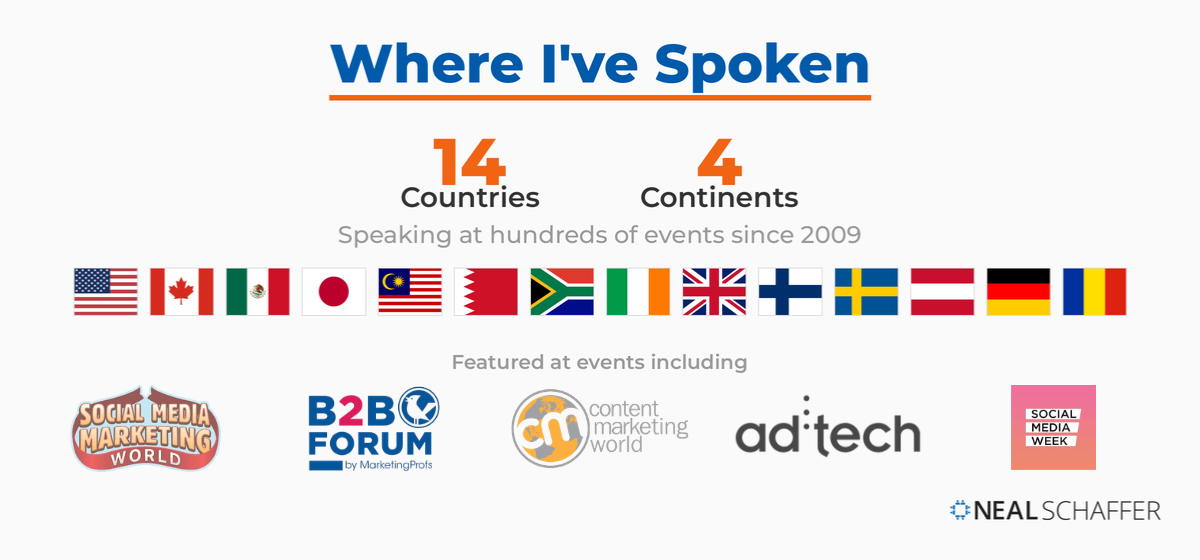
Whether it’s a keynote speech, presentation for a professional association, or a hands-on workshop for an internal audience, Neal delivers customized content with concrete takeaways calibrated to your audience. Neal has keynoted in 14 countries across 4 continents at events including CES, CEBIT, Content Marketing World, MarketingProfs B2B Forum, and Social Media Marketing World, covering topics that range from AI-first marketing and influencer strategy to personal branding and LinkedIn for business growth. Learn more about booking Neal as a speaker.
Group Digital Marketing Coaching
For entrepreneurs and marketers who want strategic guidance and a community of peers but don’t need a full Fractional CMO engagement, the Digital First Mastermind delivers structured group coaching, direct access to Neal through regular calls, a private community for peer-to-peer questions, and the accountability that comes from working alongside other operators navigating similar challenges. The membership is designed specifically for digital-first businesses, drawing on the SES Framework introduced in Digital Threads and the personal branding playbook Neal teaches at UCLA Extension. Learn more about the Digital First Mastermind.
Digital and Social Media Marketing Educator
Neal is often called upon to help educate internal sales and marketing teams on a wide variety of social media-related topics, including Social Media Strategy, Social Selling, Employee Advocacy, Personal Branding, Influencer Marketing, Paid Social, Content Marketing, Social Media Tools, as well as the mechanics of how each social network works. In this respect, Neal offers private workshops as well as classes through the Rutgers University Business School as well as UCLA Extension.
Where to Get Started in Learning Digital and Social Media Marketing
As digital and social media marketing covers a lot of ground, this is where I would start. Read the blog for tactics on the channel you care about most, subscribe to the Your Digital Marketing Coach podcast for weekly strategy, and pick up one of my books when you want the full framework. If you would rather have a roadmap delivered to you, join my newsletter.
Professional Recognition
Adobe Express Ambassador (Adobe)
Marketing Executive Council Member (Nova Southeastern University, H. Wayne Huizenga College of Business and Entrepreneurship)
Top 10 Marketing Thought Leaders (CMO.com)
Forbes Top 50 Social Media Power Influencer (Forbes)
Forbes Top 5 Social Selling Influencer (Forbes)
Top 5 Marketing Thought Leader (Contact Monkey)
The 15 Most Influential Educators in Digital Marketing (Online Marketing Institute)
Top 20 Digital Marketing Strategists (Online Marketing Institute)
31 Influencers to Follow (Marketo)
Top 50 Social Media Influencers on Twitter (Cision)
103 Genuine Marketing Thought Leaders to Follow (Salesforce)
What would you like to do now?
Book Neal as a Digital and Social Media Marketing Speaker
Join Neal’s Digital First Mastermind
Want to learn more about me? Check out some of these videos:
Featured on Cox Business
LinkedIn Marketing Solutions Interview
My Presentation at CeBit in Hanover, Germany
Lately Live Interview on Social Strategies for Business
Interview with the President of Diner’s Club
Social Media Week Copenhagen Interview
Customer Testimonials
Neal brings his passion, experience and creativity to help us embrace social media for our company. Neal’s energy and expertise prove to be critical for us as we developed our comprehensive social media strategy in a collaborative meaningful endeavor. We continue to consult with Neal as we navigate this new frontier of social media. Thank you Neal. – Ed Aschoff, CEO, Dansure
Best investment I made this year was hiring Neal Schaffer as a Social Media Marketing consultant. He’s brilliant, and a really good guy to boot. – Joe Rogers, CEO, American Joe
About two years ago we launched our company based on a business model recommended by Neal in a consulting engagement. The results have been fantastic. Based on Neal’s recommended social media strategies we have grown from zero members to the point where thousands of the key decision-makers in our industry are members and visit our website each day. Our revenues have exceeded many times our original goals. I can’t say enough about how much Neal’s work helped us getting to where we are today. – Rusty Braziel, President, RBN Energy
Selected Mentions of Neal Schaffer in the Media
Cision “How to Generate Leads From Social Conversations“
LinkedIn “Will AR, VR, or AI Hold the Most Promise for B2B Marketers?“
Oracle “ABM Quickly Evolved from Latest Trend to What Felt Like Full Adoption“
Inc “41 Must-Read Books to Boost Your Social Media Skills“
University of Jyväskylä Executive MBA “Three Tweets – EMBA Event in the Twitter Era“
Convince & Convert “43 Expert Tips on How to Future-Proof Your Content Strategy“
Hubspot “How to Build a Memorable Personal Brand on Twitter“
Social Media Examiner “Twitter Ads: How to Advertise With Twitter“
AdWeek “Marketers Are Getting the Snapchat Targeting Data They Want. Will That Scare Off Users?“
Inc. “What Digital Marketing Resolutions Do You Have?”
Huffington Post “Plan for the Distribution of Your Content Appropriately“
Mashable “How to Nail Your LinkedIn Profile“
Christian Science Monitor “How Twitter is Crowdsourcing Its War on Trolls“
Huffington Post “33 Entrepreneurs Share Their Biggest Lessons Learned from Failure”
Forbes “Meet The Top 30 Social Salespeople In The World”
Huffington Post “6 Surprising Things That Turn Employers Off”
Avance EMBA “Defining Social Business and Social Media throughout the Enterprise”
HootSuite “Solution Partner Spotlight: The Art of Selling a Social Media Solution”
Experian “Neal Schaffer: How to Create a Successful Social Media Strategy [Hangout]” (
Social Media Examiner “Social Strategy: How to Build a Sustainable Social Media Marketing Plan” [Podcast Interview]
Hootsuite “What Does It Take to Be One of the Top 50 Social Media Power Influencers?“
Diners Club “Diners Club | Social Media Marketing World | Interview with Neal Schaffer”
HR.com “The Best Career Advice You Aren’t Using“
[Japanese] 現代ビジネス ”2013年、ますます必要になる「ソーシャルメディア・リテラシー教育&研修」”
Content Marketing Institute “100+ Social Media and Content Marketing Predictions“
Marketo “Expert Tips for Optimizing LinkedIn for Lead Generation“
Forbes “How to Power Your Professional Networking Through LinkedIn”
Forbes “Who are the Social Media Top 50 Social Media Power Influencers”
Buffer “The 15 Top Blogs With The New Buffer Button, And Why Your Blog Needs One”
Wall Street Journal MarketWatch “Blogging All the Way to the Bank”
“USA-Japan Social Media Panel Report” [Japanese]