
I have never spent a dollar on TikTok ads.
I wrote this post while working out whether I should. My paid budget goes to Facebook Lead Ads, TikTok keeps coming up, and at some point “I should look into that” has to turn into actually looking into it. What follows is what I found, shared on the assumption that plenty of you are standing where I am. Curious. Not yet spending. Not sure whether TikTok earns a line in the budget. I will tell you where I landed, and the two things that would change my answer.
Full disclosure on where I am coming from. I am a Fractional CMO and the author of six books on digital and social media marketing. I also teach social media marketing at Rutgers Business School and UCLA Extension. And I post on TikTok as part of my own organic strategy. Fewer than a thousand followers, and a nagging sense that I have not been as deliberate about it as I tell my clients to be.
So this one is written for the business owner or marketer weighing the same call. Not for the agency looking to justify a retainer.
Four things get covered. The ad products TikTok has that no other platform offers. What the entry costs really look like next to Facebook. What the case studies do and do not prove. And the question almost nobody asks out loud: if organic reach on TikTok is still this good, why pay at all?
Key Takeaways
✅ TikTok Shop is the reason to care. US TikTok Shop sales grew 108% in 2025 to reach $15.82 billion. The ad products wired into it have no equivalent on Facebook or Instagram.
✅ The entry price is higher than you think. TikTok enforces a minimum of $50 per day at campaign level and $20 at ad group level. My own Facebook ad account’s floor is one dollar a day.
✅ You gave up the controls. Since July 2025, GMV Max is the default and only supported campaign type for TikTok Shop Ads. Bidding, placement, and audience selection are automated.
✅ Yes, TikTok has frictionless lead forms. The Lead Generation objective opens an in-app Instant Form that pre-populates fields. You can attach the same form to an organic post.
✅ Organic first, then paid. Paid works best as amplification of content that already proved itself. That sequencing is why I have not started spending on TikTok yet.
What Is TikTok Advertising, Exactly?
TikTok advertising is the paid distribution system that places branded video into the For You feed, search results, and TikTok Shop surfaces through TikTok Ads Manager. You buy it on an auction against objectives like traffic, lead generation, and sales. You can also promote existing organic posts rather than building ads from scratch.
There are really three doors into it, and confusing them is where most beginners waste money.
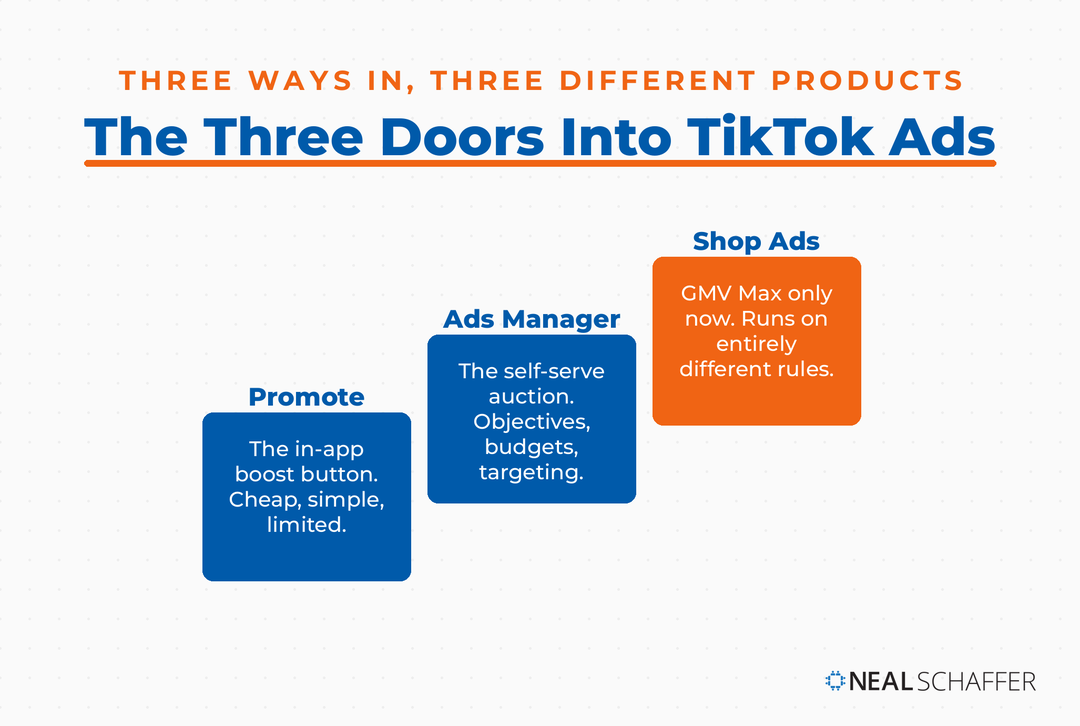
The first door is Promote, the in-app boost button on a video you already published. Simple, cheap, and limited.
Next comes TikTok Ads Manager, the full self-serve auction platform where you pick an objective, build ad groups, set budgets, and control targeting. This is where lead generation, traffic, app install, and website conversion campaigns live.
Last is TikTok Shop Ads, which you reach through Seller Center or Ads Manager if you sell products inside TikTok. It runs on entirely different rules from the other two. I will come back to it, because it is the single most interesting thing about advertising on this platform.
Which TikTok Ad Formats Can You Actually Buy?
TikTok ad formats fall into three buying tiers. Auction formats any business can run from Ads Manager, commerce formats that require a TikTok Shop, and reservation formats sold as fixed buys to large brands. Most businesses will only ever touch the first two, and the auction formats are where the practical work happens.
| Format | What it is | Who it fits |
|---|---|---|
| In-Feed Ads | Video that plays natively in the For You feed | Anyone testing the platform |
| Spark Ads | Paid distribution behind an existing organic post, yours or a creator’s | Brands with content that already performs |
| Lead Generation with Instant Form | In-app form that opens from the ad’s call to action | Service businesses, B2B, anyone collecting emails |
| Catalog Ads | Product recommendations pulled from your product feed | Ecommerce driving to your own site |
| Smart+ | Automated campaign management across targeting, creative, and budget | Advertisers with creative volume, though agency results are mixed |
| GMV Max | Automated system that optimizes paid and organic together for Shop sales | TikTok Shop sellers only |
| TopView and other reservations | Fixed reserved placements at the top of the feed, with TopView and TopFeed now sold as one combined buy | Large brands with dedicated media budgets |
Spark Ads deserve a paragraph of their own. They let you put ad spend behind an organic post while the post keeps its original identity, its comments, its likes, and the creator’s handle. Engagement earned during the paid run flows back to the original post. That mechanic is why I keep telling clients to treat their creator and UGC content as an advertising asset rather than a content calendar filler. You are not making an ad. You are buying more distribution for something that already earned attention.
Reservation formats like TopView sit at the other end of the spectrum. They are bought on fixed commitments, not the auction, and the entry price lives in a different universe from a small-business test budget. If you came here to decide whether to spend a few hundred dollars, reservation buys are not your product.
What Makes TikTok Shop Ads Different From Every Other Platform?
TikTok Shop Ads are commerce campaigns that optimize toward gross merchandise value inside TikTok’s own checkout. They blend paid, organic, and affiliate creator content into one system. No other major social platform sells advertising that treats your organic videos and your affiliates’ videos as inventory the algorithm can amplify on your behalf.
That is the genuinely unique thing, and it is also the thing that changed most recently. As of July 2025, GMV Max became the default and only supported campaign type for TikTok Shop Ads. You can no longer create, edit, or duplicate Video Shopping Ads, Product Shopping Ads, or LIVE Shopping Ads with TikTok Shop as the destination. Existing campaigns keep delivering, but the manual controls are gone.
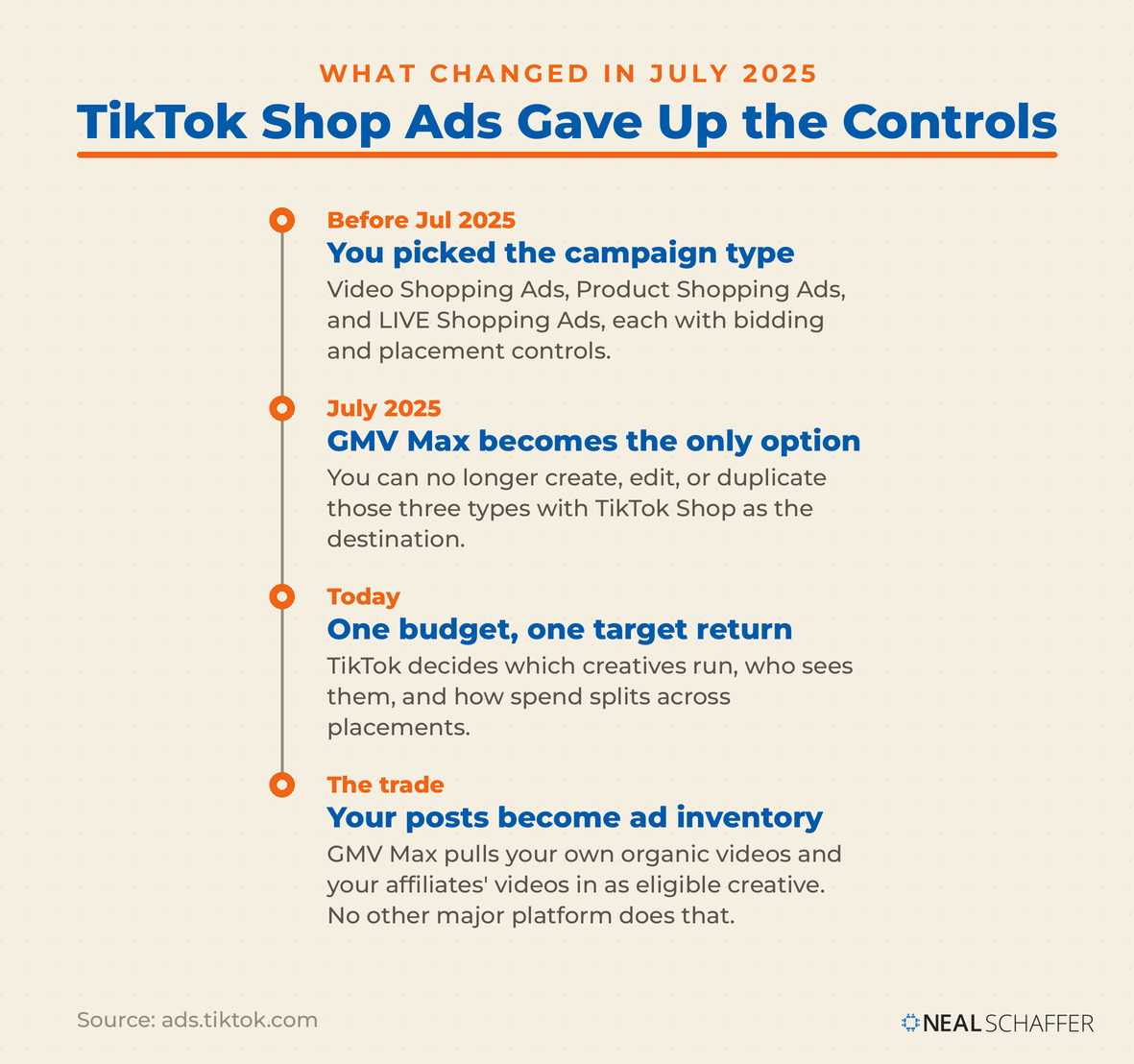
What replaced them is a system where you set a budget and a target return. TikTok then decides which creatives to run, who to show them to, and how to split spend across placements. Meta did this with Advantage+ and Google did it with Performance Max. TikTok went further, because GMV Max pulls in affiliate creator videos and your own organic posts as eligible creative, not only the ads you built.
Why did they do it? Follow the commerce numbers. US TikTok Shop sales grew 407% in 2024. By the end of 2025 the platform held 18.2% of all US social commerce, a share expected to reach 24.1% by 2027. Rachel Wolff, retail and ecommerce analyst at Emarketer, summed it up when the firm published its first TikTok Shop forecast. “TikTok’s ability to blend shopping and entertainment is turning the platform into an ecommerce powerhouse.”
There is a cost most guides skip. TikTok’s own documentation states that sellers may need to pay commission on sales an affiliate video generates when it runs as an ad. Your true cost of acquisition is media plus commission. Model it as media alone and you will convince yourself a campaign is profitable when it is not. That interaction between paid spend and creator partnerships on TikTok is where the real margin math lives.
How Much Does TikTok Advertising Cost Compared to Facebook?
TikTok is cheaper per impression than Meta but carries a much higher entry floor. TikTok requires at least $50 per day at campaign level and $20 per day at ad group level. My own Facebook ad account will let me run a campaign on a single dollar a day. Cheap media does not mean cheap to start.
Those budget minimums are hard gates. Enter less and the campaign will not launch. Lifetime budgets follow the same math at the ad group level, calculated as the daily minimum times the number of scheduled days, so a 31-day ad group needs $620 before TikTok will take it.
Make Your Marketing Finally Work Together
My latest book helps small businesses, entrepreneurs, and marketers bring search, email, and social together into one digital marketing strategy that actually compounds.
Drawing on my work as a Fractional CMO, Digital Threads turns complicated tactics into a clear, practical plan you can follow, whatever your budget or team size.
Grab your copy on Amazon and start weaving your own digital threads. Click the cover or the button below to get started.

On media price, TikTok is genuinely the cheaper auction. Gupta Media, which tracks social ad rates daily across billions of impressions, reported TikTok at a $4.26 CPM against Meta’s $6.36 at the end of January 2026. That gap has held for years, though it is narrowing as more advertisers pile in.
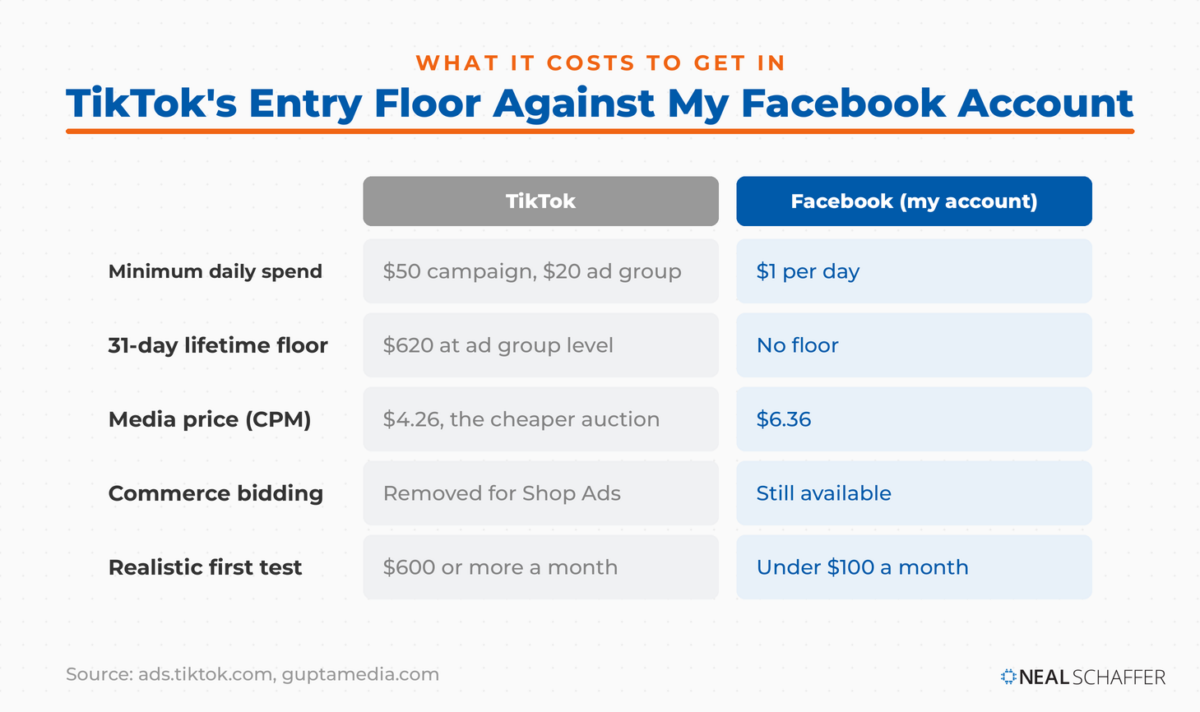
| TikTok | Facebook (my account) | |
|---|---|---|
| Minimum daily spend | $50 campaign, $20 ad group | $1 |
| Typical CPM | Roughly $4 to $6 | Roughly $6 to $7 |
| Manual bidding for commerce | Removed for Shop Ads | Still available |
| Realistic first test | $600 or more per month | Under $100 per month |
Now the firsthand part. I run Facebook Lead Ads promoting the free preview of my book Maximizing LinkedIn for Business Growth, optimized for lead generation against a cold prospecting audience. Over a few months I have spent a few hundred dollars, and my cost per lead has stayed under a dollar. That is my benchmark, and it is why I am not in a hurry to move budget. For the fuller picture on that channel, I have written about what Facebook advertising costs and whether Facebook advertising still works.
A sub-dollar cost per lead is not a number I expect to replicate on a platform where the minimum credible test runs roughly ten times my current monthly spend. Your math may be completely different. If you sell a physical product with margin, TikTok’s cheaper impressions and native checkout absorb that floor easily. If you sell consulting to executives, they probably cannot.
Does TikTok Have Frictionless Lead Forms Like Facebook?
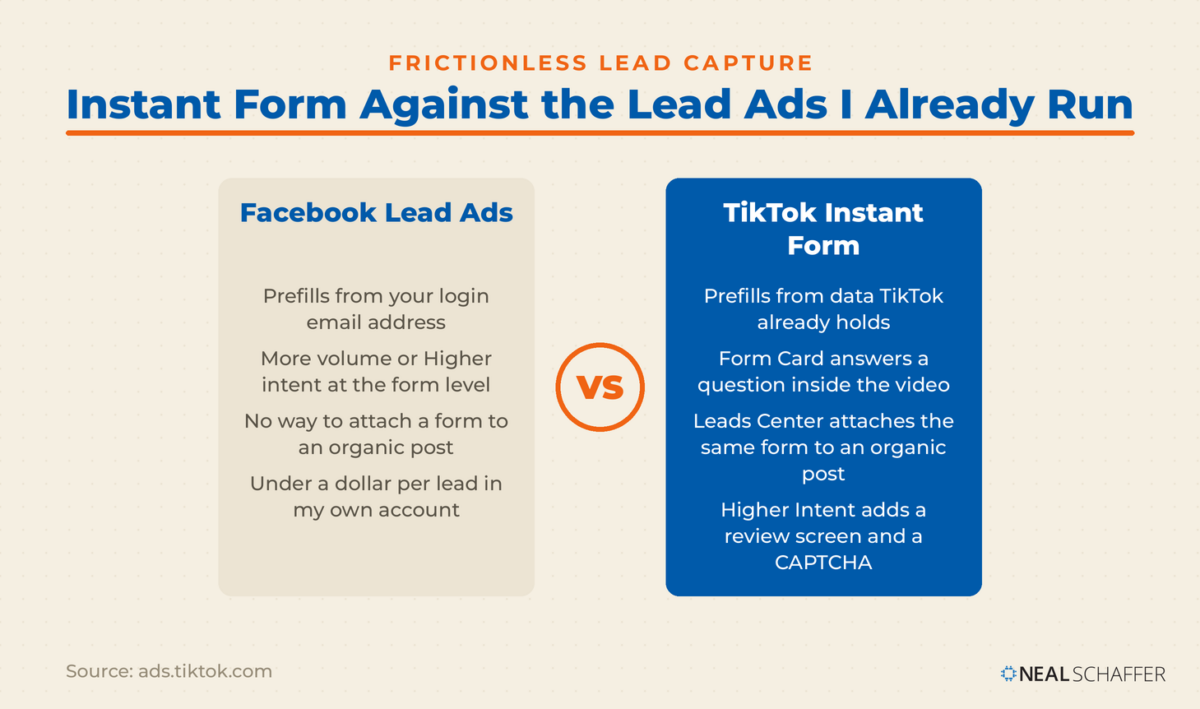
Yes. TikTok’s Lead Generation objective opens an Instant Form inside the app. Those forms pre-populate fields from information TikTok already holds, so the user never leaves the feed or types an email address. TikTok also offers something Meta does not, which is the ability to attach the same lead form to an organic post.
This matters to me specifically. The reason I prefer Facebook Lead Ads is that the form fills itself in with the email address someone actually logs in with. The data comes back accurate and the person barely has to think about it. TikTok’s own documentation makes the same argument for Instant Forms. They load faster than a landing page, they can pre-populate fields, and the leads sync to a CRM through Zapier, LeadsBridge, or a custom API.
Two differences are worth knowing before you assume the platforms are equivalent.
TikTok has a shorter path in some cases. Alongside the standard tap-through form, there is a Form Card that lets someone answer a question directly on the in-feed video without opening a form at all. One fewer step than Meta’s flow.
Then there is Leads Center, which lets you build an Instant Form once and share it to an organic post rather than only to a paid campaign. You add the link before publishing, choose lead gen, pick the form, and the published video carries a Get quote tag. Facebook has nothing that clean for organic posts. If you are already producing short-form video on TikTok, that alone is worth testing before you spend anything.
Both platforms also make you trade volume against quality at the form level. Meta gives you More volume or Higher intent, where higher intent adds a review step so people confirm their details. TikTok offers the same choice, and its Higher Intent setting adds a review screen plus a CAPTCHA. One catch worth knowing: TikTok’s Higher Intent is not available with the Form Card, so the fastest path is also the one you cannot filter.
One caution on data quality. Prefilled is not the same as verified, on either platform. Meta’s own help documentation notes that people can edit their prefilled answers as they fill out the form, and the same is true on TikTok. Prefill removes friction. It does not guarantee you a working email address.
Which TikTok Advertising Case Studies Actually Prove Something?
TikTok publishes a large library of advertiser case studies showing strong returns from Spark Ads and Shop campaigns. They are useful for understanding which mechanics the platform rewards. They should also be read knowing TikTok selected them. Treat them as evidence of what is possible, not as an average outcome.
One caveat before the numbers. Several of the flagship Spark Ads studies TikTok still surfaces date from 2023 and 2024, so read them as proof of mechanism rather than as current benchmarks.
Three worth your time, all published by TikTok:
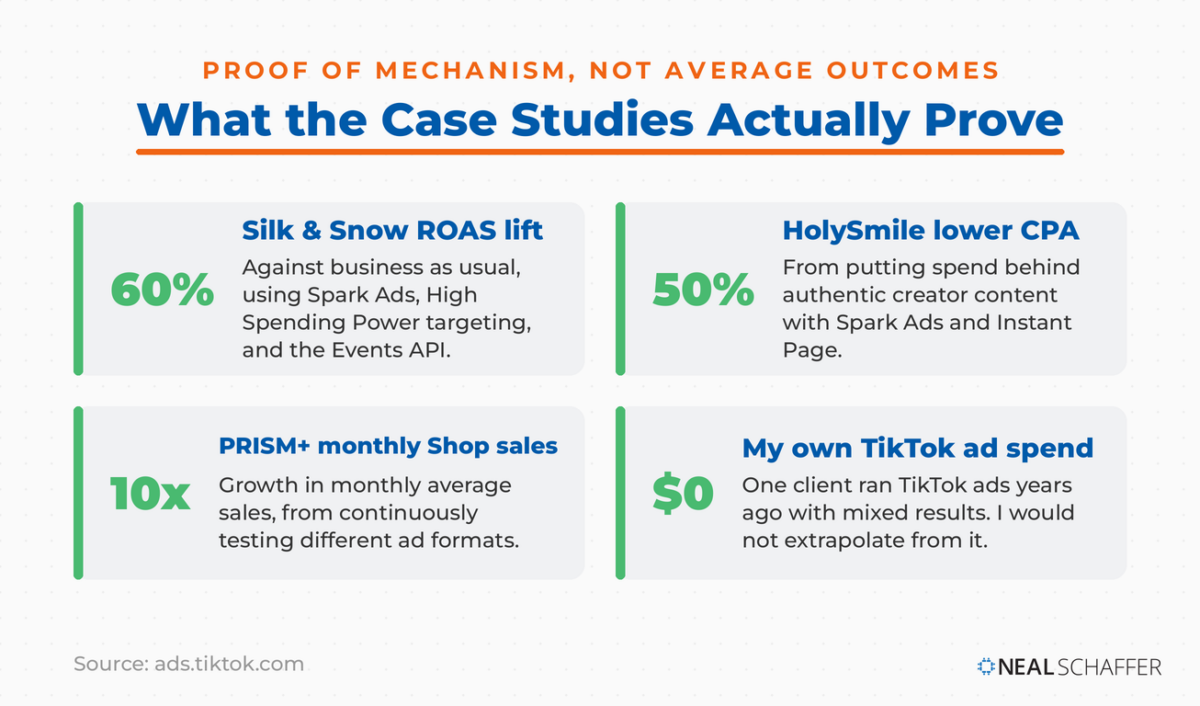
Silk & Snow, a premium mattress and bedding brand, reported a 60% lift in ROAS and a 38% lower CPA. The combination was Spark Ads plus High Spending Power targeting plus the Events API. The interesting part is not the ROAS number. It is that the win came from creator content and better conversion data, not from clever targeting alone.
HolySmile, a teeth whitening brand, saw a 50% lower CPA and a 30% decrease in CPC by putting spend behind authentic creator content with Spark Ads and Instant Page. Same pattern.
PRISM+, a Singaporean electronics brand, hit 10x growth in monthly average sales on TikTok Shop by continuously testing different ad formats. That word “continuously” is doing heavy lifting. Creative fatigue on TikTok is fast, and one winning video is not a strategy.
The pattern across all three is the actual takeaway. Paid distribution behind proven creator or organic content beat purpose-built ads. Nobody in those studies won by making a better commercial.
I will be equally honest about my own evidence, which is thin. One client of mine ran TikTok ads several years ago, when the ad platform was young, and the results were mixed. Nothing since. I would not extrapolate anything from that today. GMV Max, Spark Ads, and TikTok Shop did not exist in their current form when they ran it. It is a data point about an earlier platform, not this one.
If Organic Reach on TikTok Is So Good, Why Advertise at All?
Because organic and paid do different jobs. Organic proves which creative earns attention. Paid buys more of that attention on demand, reaches people your followers cannot, and lets you hit a deadline. On TikTok the two are unusually well connected, since the ad system can amplify the organic posts that already worked.
This is the argument I make in Digital Threads, where paid media gets its own chapter and a deliberate position in the sequence. Paid is always available when you have the budget, but it comes after the other work. Once you have woven your search, email, and social threads, injecting money scales a voice that exists. Spend before that and you are paying to find out whether you have one.
Three situations make paid worth it on any platform, TikTok included.
Bridging the visibility gap. Your buyer researches across a lot of channels. Paid puts you in the ones where your organic presence is weak.
Retargeting. Cold reach is expensive. People who already engaged sit further down the funnel and cost less to convert, which is the same logic behind Facebook ads retargeting.
Time-limited pushes. A launch, an event, a sale. Organic will not obey your calendar. Paid will.
As I put it in Digital Threads: a decade ago when I wrote Maximize Your Social, there were many purists who said that you shouldn’t advertise on social media, that this defeats the purpose of its organic entity. They were right. After all, there’s truly nothing social about a paid advert. The reality is, though, that if you want to be seen where people spend more of their time online than anywhere else, you simply have to pay to play.
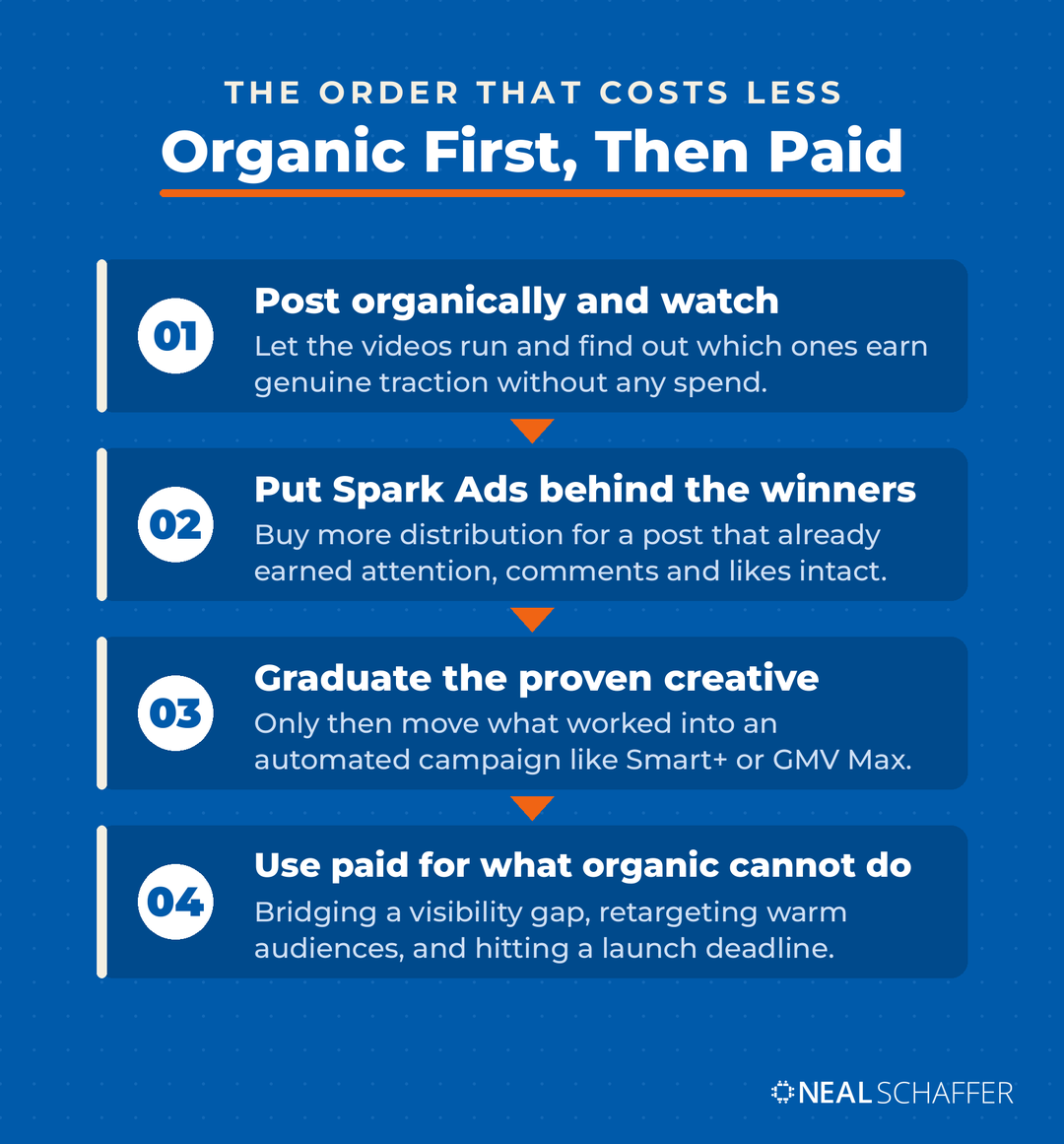
The practical sequence on TikTok looks like this. Let organic run and watch which videos earn genuine traction. Put Spark Ads spend behind the ones that did. Only then graduate proven creative into an automated campaign. Understanding how the TikTok algorithm works matters more here than on any other ad platform, because you are buying acceleration for something the algorithm already liked. If your organic videos are getting nowhere, ads will not rescue them. They will just cost you money faster.
What Most TikTok Advertising Guides Get Wrong
Most guides assume the answer to “should I advertise on TikTok” is yes, then spend four thousand words on setup. The honest answer is often no, or not yet. Three other mistakes show up constantly, and each one costs real money.
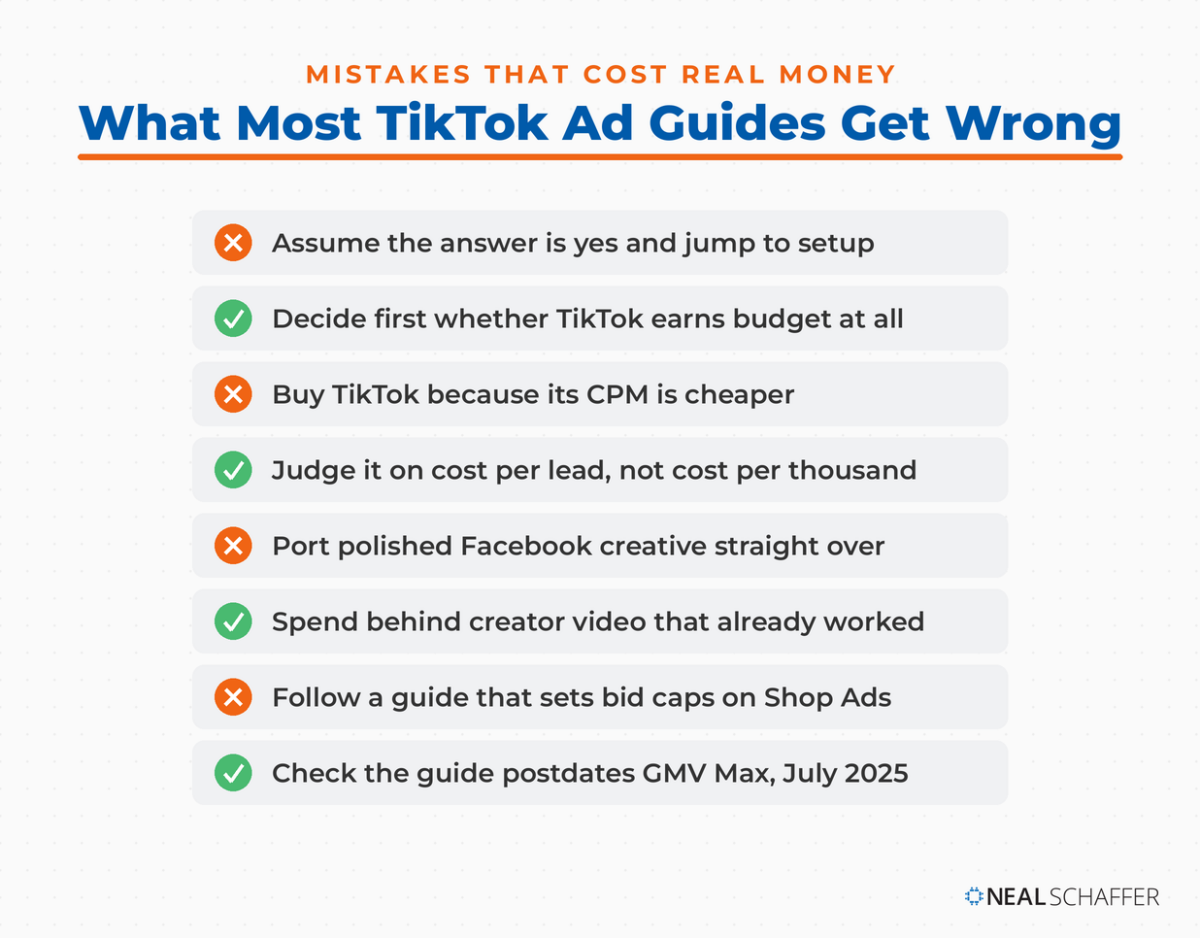
Quoting CPM as if it were the point. Cheap impressions are only cheap if they convert. TikTok’s lower CPM is real, and it is meaningless if your creative does not work on the platform. I would rather pay Meta’s premium and hit a sub-dollar cost per lead than pay TikTok’s discount for impressions that go nowhere.
Telling you to port your Facebook creative over. This is the single most reliable way to waste a TikTok budget. Ads that look like ads get scrolled. The platform’s own case studies keep pointing at creator content and native-feeling video, and every one of the three above won that way. Repurposing a polished brand film is not a TikTok strategy, and studying what is trending on TikTok will teach you more than any ad course.
Not updating for GMV Max. Plenty of guides still walk you through manual bid caps and placement controls for Shop campaigns that no longer exist. If a post published this year tells you to set a bid cap on a Video Shopping Ad, it was not written by someone who opened Ads Manager recently.
A strategic point sits underneath all of this. TikTok Shop’s growth is the reason the ad platform is worth watching at all. Take away the ability to sell inside the app and the strongest argument for advertising there gets much weaker. A lot of what you read about TikTok advertising is really about ecommerce wearing a general-purpose costume.
Who Should Advertise on TikTok, and Who Should Not?
TikTok advertising fits businesses selling physical products at consumer price points, especially those eligible for TikTok Shop, and any brand with creator content that already performs organically. It fits poorly for high-consideration B2B services, businesses without video production capacity, and anyone whose realistic monthly test budget sits under a few hundred dollars.
| Advertise on TikTok if | Think twice if |
|---|---|
| You sell a physical product with margin, especially in beauty, apparel, food, or supplements | You sell high-ticket B2B services with long sales cycles |
| You have or can get creator content that performs organically | Your only creative is repurposed from other platforms |
| You can commit $600 or more a month to a real test | Your total paid budget is a couple hundred dollars |
| You are launching something on a deadline | You have no organic presence to amplify |
| Your buyers are under 40 | Your buyers are executives you would reach faster on LinkedIn |
I sit in the second column today, and I want to be specific about why, because “it depends” is a useless answer.
My business sells consulting, speaking, and books to marketers and business owners. My cost per lead on Facebook is under a dollar for an audience that converts. A minimum credible TikTok test costs roughly ten times what I currently spend per month, aimed at an audience that skews younger than my buyers.
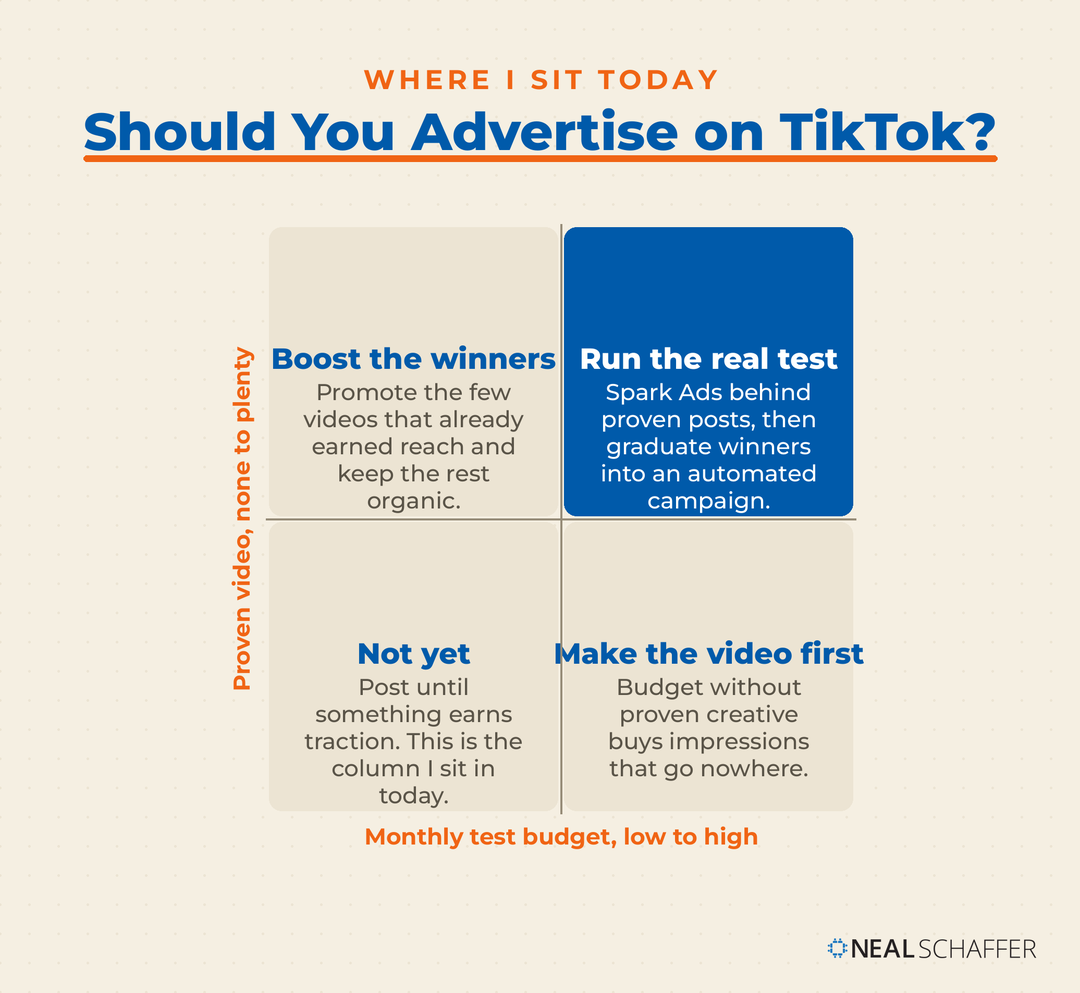
Two things would change that calculation, and I have thought about both.
If I launch a TikTok Shop, the argument flips immediately. Selling books and digital products through native in-app checkout is a different business from paying for clicks to a landing page. Add GMV Max amplifying affiliate creator videos I did not have to make, and you have the version of TikTok advertising that exists nowhere else.
And if I were pushing a new book on Amazon, TikTok would sit near the top of my list. Not for directly attributed sales, which are hard to track on Amazon anyway. For word of mouth. BookTok did not become a publishing force by accident, and when something goes viral on TikTok, the earned reach dwarfs whatever you paid to light the fire.
Frequently Asked Questions About TikTok Advertising
TikTok’s hard floor is $50 per day at campaign level and $20 per day at ad group level. Practically, plan on $600 or more per month for a test that generates enough data to be worth reading. Anything less keeps the campaign alive without teaching you much.
Per impression, usually yes. TikTok’s CPM has run consistently below Meta’s for several years. Whether that makes TikTok cheaper for you depends entirely on conversion rate. Cheap impressions on creative that does not fit the platform are the most expensive thing you can buy.
Not effectively. Video is the only native format that performs, and static or repurposed creative gets ignored. The good news is you do not have to produce it all yourself, since Spark Ads let you put spend behind a creator’s post with their authorization.
The ownership question is settled, but settled is not the same as smooth. In January 2026, ByteDance closed a deal moving control of TikTok’s US operations to a joint venture, with Oracle, Silver Lake, and MGX among the investors. Commercial activities including advertising and ecommerce stayed with ByteDance. That is why Forrester principal analyst Kelsey Chickering expects ad buying to continue much as before, with media performance the open question. The bumps have been real, from technical problems to contested policy changes alongside TikTok’s NewFronts pitch on stability. Ad accounts, Shop, and Ads Manager kept running throughout, but if you are planning a launch, build in a buffer.
No. Lead generation, traffic, app install, and website conversion campaigns all run without one. But TikTok Shop is what opens up the ad products that exist nowhere else. Sell physical products and skip it, and you are advertising on TikTok without the reason to advertise on TikTok.
Start Where Your Content Already Works
Take one thing from this post and make it the sequence. Post organically, find out which videos earn real traction, then put money behind those specific videos rather than building ads from nothing. That order costs less, teaches you more, and it is the pattern behind every TikTok case study worth reading.
Before you commit a budget, look at where the platform actually stands right now. I keep a running set of TikTok statistics for exactly that purpose. And if you are weighing TikTok against the other paid channels competing for the same dollars, start with social media advertising for small business.
Would you rather have someone build the whole paid and organic plan with you instead of testing your way through it? That is what I do as a Fractional CMO. You can also grab a free preview of Digital Threads, where the chapter on scaling with paid media lays out how I decide when a channel has earned budget.