
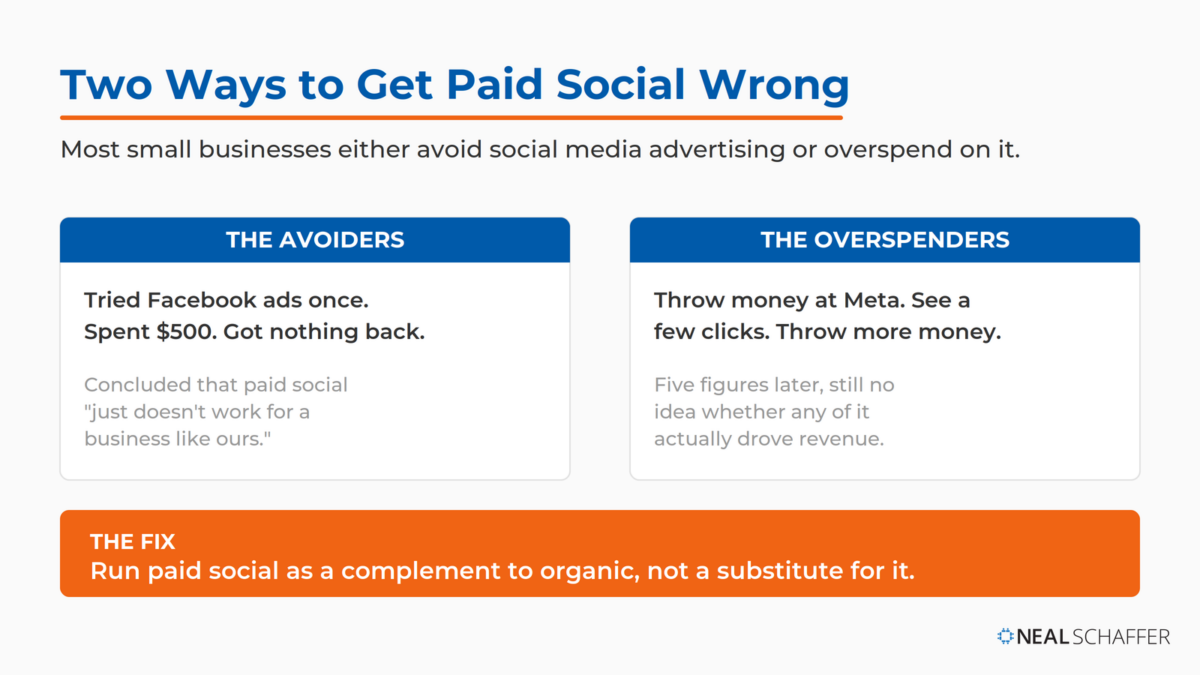
Most small businesses I work with sit in one of two camps on social media advertising. Camp one avoids it entirely because they tried Facebook ads once, spent $500, got nothing, and decided paid social just doesn’t work for businesses like theirs. Camp two does the opposite. They throw money at Meta, see a few clicks, throw more money at it, and a year later realize they’ve spent five figures with no idea whether any of it actually drove revenue.
Both camps are making the same mistake. They’re treating paid social as a standalone channel that should generate results in isolation. It doesn’t work that way. As I wrote in Digital Threads, paid social is an important digital thread, but it is not a shortcut. It works as an amplifier on top of an organic foundation, and the small businesses that get real returns from it are the ones who understand that order.
Having taught social media marketing at Rutgers Business School and worked as a fractional CMO with companies of every size for over a decade, I’ve seen this pattern repeat across industries. The businesses that win at small business social media advertising aren’t the ones spending the most. They’re the ones treating ad spend, organic content, and influencer collaborations as three threads of the same strategy, not three separate budgets.
This guide breaks down how to actually do that.
Key Takeaways
✅ Paid social is a complement to organic, not a replacement. Promoting cold to strangers always converts worse than promoting to a warm audience built through organic content. Run paid only after the organic foundation exists.
✅ The two failure modes are avoidance and over-investment. Either extreme produces the same outcome: poor ROI. The strategic middle ground is small, structured tests on platforms where your audience already spends time.
✅ Global social ad spend will hit roughly $338.75 billion in 2026, according to Statista’s market forecast, and competition is rising faster than budgets. Small businesses can’t out-spend the enterprise. They have to out-think it.
✅ Influencer marketing, UGC, and creator collaborations are forms of social media advertising. Treating them as separate categories is one of the biggest strategic mistakes small businesses make. Folded into the ad strategy, they make every dollar more efficient.
✅ Measurement is non-negotiable. If you can’t trace ad spend to specific revenue, lead, or pipeline outcomes within 30 to 60 days, you’re not advertising. You’re donating.
What Is Social Media Advertising for Small Business?
Social media advertising for small business is the practice of running paid promotional campaigns on platforms like Facebook, Instagram, TikTok, LinkedIn, and Pinterest to reach specific audiences with controlled spend. For small businesses, it differs from enterprise advertising in scale and approach: smaller budgets, narrower targeting, faster iteration cycles, and a heavier reliance on organic content and creator partnerships to make every dollar work harder.
The category covers traditional paid placements (boosted posts, in-feed ads, Stories ads, video ads), paid partnerships with creators and influencers, and increasingly, paid amplification of user-generated content. According to LocaliQ’s 2026 Small Business Marketing Trends Report, 56% of small businesses now use social media advertising in their marketing mix, and 47% plan to invest more in it this year. The broader picture in my social media marketing statistics tracking shows the category is no longer optional for businesses that want share of voice. But the way most small businesses run it leaves a lot of money on the table.
Why Most Small Business Social Media Ads Fail
Most small business social media ads fail because they skip the foundation. The business has no organic audience, no clear customer profile, no creative testing system, and no measurement plan. They go straight to the boost button, target broadly, run for a week, and call it a failure when the leads don’t show up. The strategy was the problem, not the ads.
The pattern is consistent. Sprout Social’s 2026 social media statistics report that around 80% of marketing leaders plan to shift budget from other channels into social, and 87% expect their paid social spend to increase. As that money floods in, competition for attention rises, cost per impression climbs, and the small businesses without a content foundation get squeezed out fastest. You can’t bid your way past a brand with five years of organic equity, an engaged audience, and a creator network.
There’s a second pattern I see often: businesses treating ads as a shortcut to skip the work of building an audience. The math doesn’t support it. Cold-audience ads almost always convert worse than warm-audience ads or retargeting campaigns. A business that has spent six months building an organic following, capturing email subscribers, and accumulating pixel data can run a $300 retargeting campaign and outperform a competitor running a $3,000 cold campaign. That’s the compounding advantage organic builds for paid.
The Foundation: Why Paid Social Only Works With an Organic Strategy
Paid social only works with an organic strategy because every metric that determines ad performance is shaped by what your organic presence has already built. Organic content tells you which messages connect. Organic followers feed your retargeting audience. Organic engagement signals tell the algorithm your account deserves reach. Without that foundation, ad spend pays to teach you what should be free knowledge.
Building the organic side first is not optional. Before any small business spends meaningfully on social ads, they need a documented social media strategy that defines the audience, the platforms, the content pillars, and the success metrics. Without those four pieces, ad campaigns become guesswork dressed up as a budget line.
Once the foundation is in place, paid social plays a specific role: amplification. Take the organic posts that have already proven their resonance (best save rates, share rates, comment quality) and put paid behind them. This is how small businesses with $500 to $3,000 monthly ad budgets can produce results that look like enterprise output. The creative is already validated. The audience is already warm. The ad is just turning up the volume on something that’s already working.
| Stage | What it does | Typical small business spend |
|---|---|---|
| Organic foundation | Builds audience, tests creative, generates pixel data | Time-cost only; tools $0–$100/mo |
| Retargeting paid social | Re-engages warm audience (site visitors, video viewers, email list) | $200–$800/mo |
| Lookalike / interest paid social | Expands reach using audience signals from retargeting | $500–$2,500/mo |
| Influencer / creator paid | Borrows trust and content from a third party | $300–$5,000/campaign |
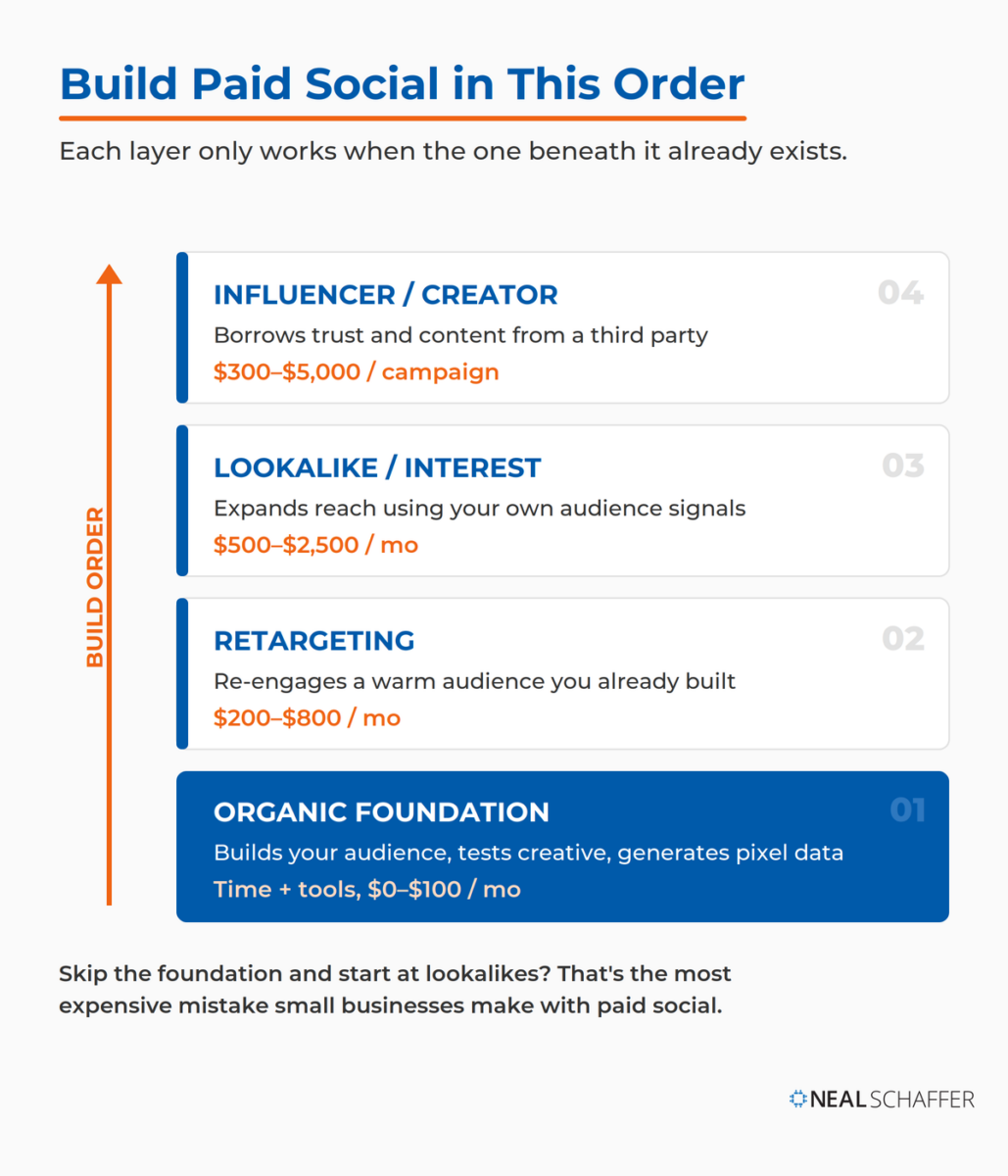
The order matters. Skipping the foundation and starting at lookalike audiences is the most common small business advertising mistake I see, and it can also be the most expensive.
How Much Should a Small Business Spend on Social Media Advertising?
There’s no universal right number. The rule of thumb the U.S. Small Business Administration has long cited is 7% to 8% of gross revenue for businesses under $5 million, and Gartner’s 2025 CMO Spend Survey puts the cross-industry average at 7.7%, with paid media the largest single share. For paid social, start with a test budget you can evaluate in 30 days.
Three rules I share with every fractional CMO client when we set the paid social budget:
- Don’t spend more on paid than you spent on organic in the same period. If you posted twice this week and shot one piece of video content, you don’t have enough creative to justify a $2,000 ad budget. Paid amplifies content. No content, no amplification.
- Budget for the test, not the win. Plan to spend $300 to $500 to learn what works on a given platform before scaling. If a test campaign isn’t producing actionable data within 30 days, kill it and try a different angle. Most small businesses lose money by funding losing campaigns past the point where the data was already telling them to stop.
- Reserve 20% of the paid budget for creator collaborations. I’ll explain why in the next section. Treating influencer spend as separate from the ad budget is a category mistake.
For context on what that budget actually buys, WordStream’s 2025 Facebook ads benchmarks put the average cost per click for Facebook traffic campaigns at $0.70 and average cost per lead at $27.66 across industries. Useful starting points for planning a small business test budget, alongside my own Facebook advertising costs reference for additional platform-specific pricing.
Which Platforms Should a Small Business Advertise On?
A small business should advertise on the platforms where its buyers actually spend time, not where trend stories say they should. For most consumer-facing businesses, that’s Meta first (Facebook and Instagram), TikTok for younger audiences and visual products, and Pinterest for shoppable categories. For B2B, LinkedIn leads. Spreading thin across five platforms is the most common allocation error. If your buyers are in China, none of those five apply, and my guide to Weibo advertising covers the ad formats, the CPM and CPE billing models, and the targeting on a platform where 82% of users shop online.
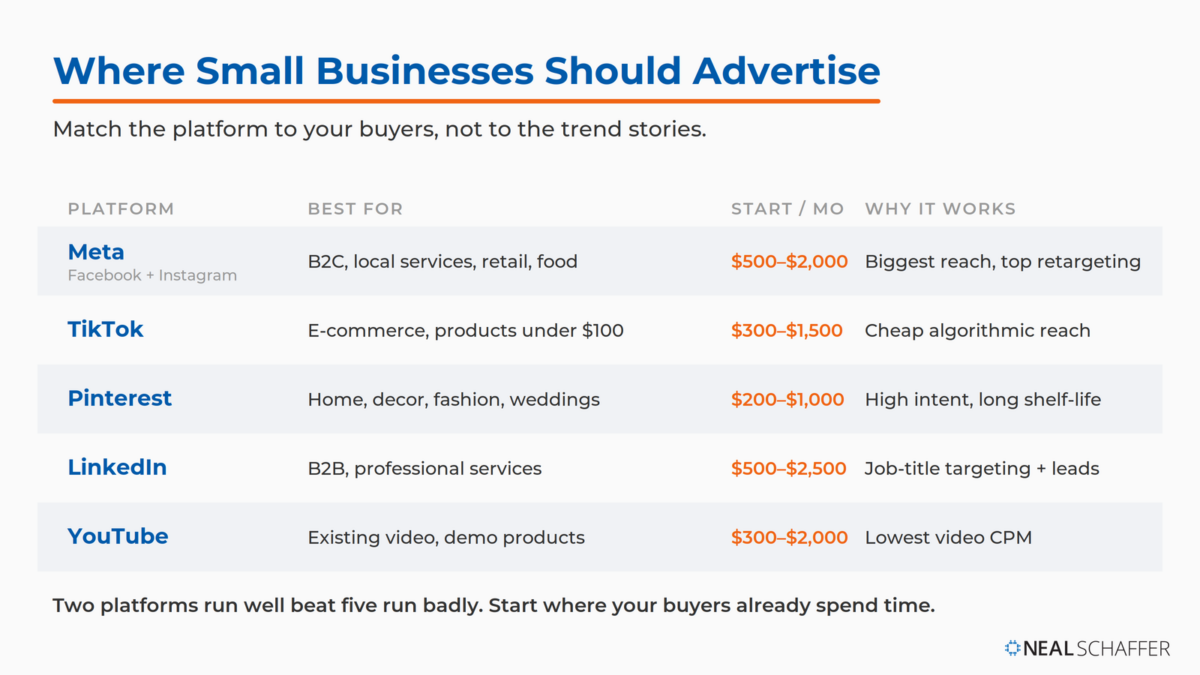
LocaliQ’s 2026 report found that 91% of businesses use Facebook for marketing, 74% use Instagram, and 48% use LinkedIn. Those are the platforms with the deepest ad ecosystems and the most mature targeting. HubSpot’s 2026 State of Marketing report adds an important wrinkle: Instagram has now passed Facebook in marketer ROI perception, with 48% of brands ranking it in their top three for return versus 42.7% for Facebook. Worth factoring in when you allocate. Below is the breakdown most small businesses should start with:
| Platform | Best for | Starting monthly spend | Strength |
|---|---|---|---|
| Meta (Facebook + Instagram) | B2C, local services, retail, food, home services | $500–$2,000 | Largest audience, mature retargeting, video formats |
| TikTok | E-commerce, products under $100, audiences under 40 | $300–$1,500 | Algorithmic reach on small budgets, native creator content |
| Home, decor, fashion, food, weddings, DIY | $200–$1,000 | High intent, long content shelf-life, female-skewed audience | |
| B2B, professional services, high-ticket B2C | $500–$2,500 | Job-title targeting, lead gen forms, high CPM but high LTV | |
| YouTube | Brands with existing video, demo-driven products | $300–$2,000 | Lowest CPM in video, strong intent on search-style placements |
For Instagram specifically, I’ve written before about the strategic benefits of advertising on Instagram for small businesses with strong visual content, and the targeting controls are still some of the best in paid social. If your creative looks like a stock photo, Instagram is unforgiving. If your creative looks native to the feed, it punches well above its weight.
Avoid the temptation to be everywhere. Two platforms run well will beat five platforms run badly every time, and most small businesses don’t have the creative bandwidth to feed five platforms. If you are deciding which two, the social media demographics behind each network are the cheapest research you will ever do, and they will tell you quickly whether your buyers are actually on the platform you assumed they were.
Is LinkedIn Actually Bringing You Business?
My latest book helps professionals, entrepreneurs, and business owners turn LinkedIn from a static profile into a real source of clients and growth.
Maximizing LinkedIn for Business Growth gives you clear, practical steps to build a profile that gets noticed and a network that actually sends business your way.
Grab your copy on Amazon and put it to work this week. Click the cover or the button below to get started.

How Do Influencer Marketing and UGC Fit Into Social Media Advertising?
Influencer marketing, creator collaborations, and user-generated content are all forms of social media advertising and should be funded from the same budget. Most small businesses treat them as separate line items, then run paid ads with weak in-house creative while ignoring the creators who could produce stronger content. Folding creator spend into the paid budget is one of the highest-return shifts available.
There are two angles to this. The first is content. A creator who lives in your category can produce a 30-second video that outperforms anything your in-house team will make this quarter, because they know the platform, the algorithm, and the audience cadence better than you do. Pay them to make it, then run it as a paid ad. That’s not a separate strategy; that’s just smarter paid social.
The second is trust. Tameka Bazile, Creator and Associate Director of B2B Social and Content at Business Insider, told Sprout Social that “audiences will gravitate toward individuals and communities that feel more human and transparent.” Brand-owned ads compete in a feed full of other brand-owned ads. Creator-made content reads as something else entirely, and Shopify’s influencer marketing research found that 36% of businesses say their partnered influencer content outperforms their own. For a small business going up against larger competitors, that gap is real advantage.
On a recent episode of my podcast Your Digital Marketing Coach, I argued that for businesses with constrained marketing budgets, influencer marketing tends to hold up better than traditional paid social, because the structure is so flexible. You can shift from paid collaborations to affiliate commissions, from product gifting to hybrid payment arrangements, without locking yourself into a fixed monthly spend. A small business doesn’t need a $10,000 influencer budget to start. It needs three micro influencers in its category and a willingness to test.
The UGC angle compounds the value. A UGC creator doesn’t need a large following at all. They’re paid to produce native-looking content the brand can then run as ads. The cost is typically a fraction of a traditional creative agency, and the conversion rate is typically higher because the content doesn’t read as an ad.
Three practical ways to fold creators into your ad strategy:
- Whitelist creator content as paid ads. With the creator’s permission, run their post from their handle as a paid ad to your target audience. The trust signal of a real account outperforms a brand handle.
- Hire UGC creators specifically for ad creative. Don’t ask them to post; ask them to produce. You own the content and run it as ads from your account.
- Build an always-on creator program. Instead of one-off campaigns, identify three to five creators in your category and work with them monthly. The compounding trust outperforms episodic spending.
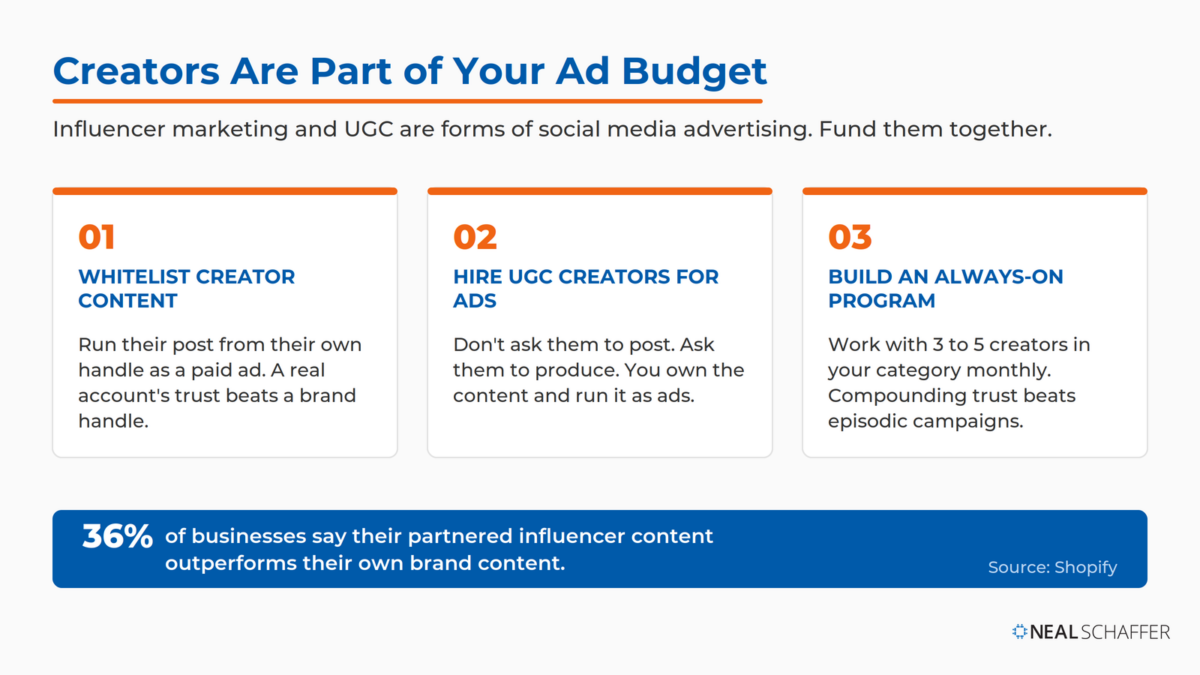
If your category fits, influencer marketing is the single largest efficiency gain available to small business ad budgets in 2026.
How Do You Measure Whether Social Media Advertising Is Working?
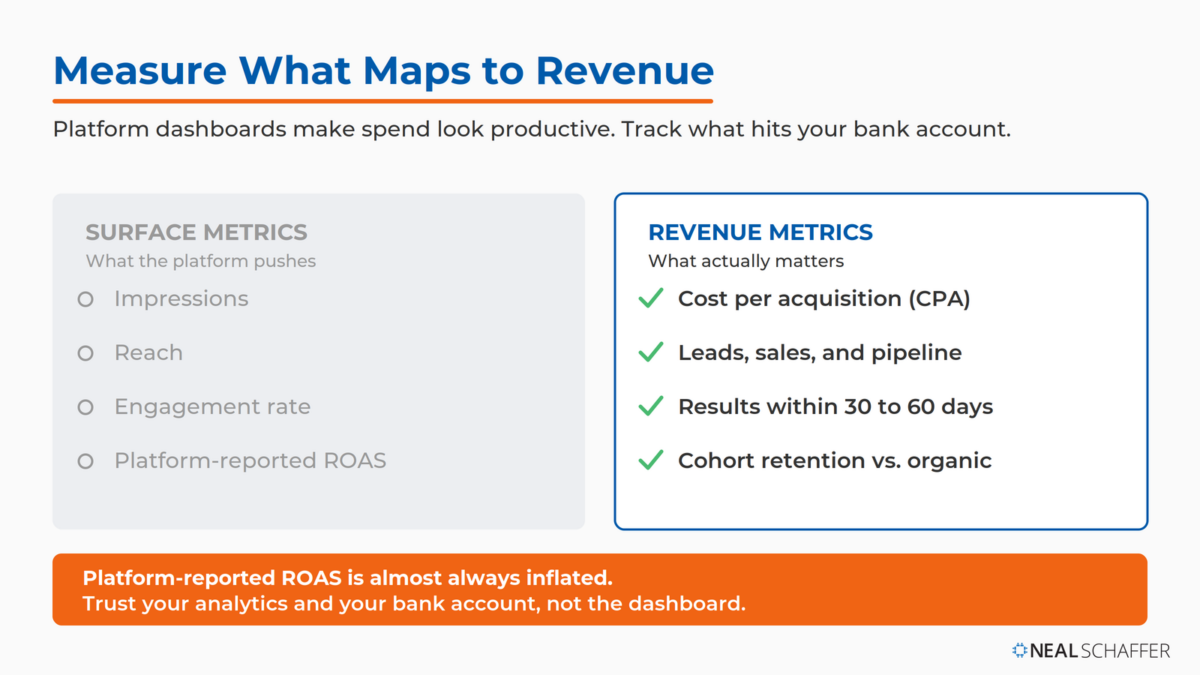
You measure whether social media advertising is working by tying ad spend to revenue outcomes (leads, sales, pipeline) within a 30 to 60 day window, not by tracking surface metrics like impressions or engagement. Most small businesses report on what the platform shows them, which is engineered to make spend look productive. The right metrics map to dollars.
The minimum measurement stack for a small business running paid social:
- Platform base pixel installed site-wide (Meta Pixel, TikTok Pixel, LinkedIn Insight Tag) across every page, with conversion events (purchases, leads, sign-ups) configured to fire on the specific pages or actions that represent them. The base pixel has to load everywhere or your retargeting and lookalike audiences never build
- UTM parameters on every ad link so traffic and conversions can be tracked in Google Analytics 4 independently of the platform’s own attribution
- A single source-of-truth dashboard that compares platform-reported conversions against analytics-reported conversions; the gap between them is usually large and worth understanding
- A defined target cost per acquisition (CPA) per platform, with kill criteria written before the campaign starts (e.g., “if CPA is above $X after 14 days, pause”)
- Monthly cohort analysis to see whether paid traffic converts at the same rate as organic, and whether retention is comparable
The framework I share with clients: if you can’t show, on demand what 90% of last month’s ad spend produced, your measurement system isn’t working. Building that visibility is where social media analytics earn their keep. The point isn’t to produce a report. The point is to know which campaigns to scale and which to kill, fast.
One thing to flag: platform-reported ROAS is almost always inflated relative to actual revenue impact. After iOS 14 and the broader privacy shift, attribution windows have narrowed and cross-platform tracking has gotten messier. Trust your analytics and your bank account, not the platform’s self-reported numbers.
Frequently Asked Questions
Most small businesses can start meaningfully with $300 to $500 per month on a single platform. That’s enough to run a structured test, generate enough data to evaluate, and scale or kill within 30 days. Starting below $300 typically produces too little data to draw conclusions. Starting above $2,000 without a content foundation typically wastes most of it.
For most small businesses with under $2,000/month in paid social spend, doing it in-house with a focused 5-hour-per-week commitment outperforms hiring an agency. Agencies typically aren’t cost-effective until ad budgets exceed $5,000/month, because their management fees consume too much of the value below that threshold. Below $5,000/month, hire a freelance specialist or fractional CMO instead.
Yes, but the bar is higher than it used to be. Facebook (and Instagram) advertising still has the largest small business audience and the most mature targeting, but creative quality matters more than ever because feed competition has intensified. Most Facebook ad failures in 2026 trace to weak creative, not weak targeting. Lead with video, lead with creator content, and avoid the boost button as your only ad tool.
Yes, by competing on relevance and creative authenticity rather than spend volume. Bigger brands have to satisfy committees, brand guidelines, and legal review, which slows them down and homogenizes their creative. Small businesses can move faster, test weirder ideas, and partner with niche creators who would never accept a big-brand contract. The biggest brands still win on awareness; small businesses can absolutely win on conversion.
Treating paid social as a substitute for the work of building an organic audience and earning trust. Paid social is an amplifier, not an audience-builder. Businesses that try to skip the organic, content, and community work and go straight to ad spend almost always overspend for underwhelming results. Build the foundation, then amplify it.
Start Small, Test Honestly, Then Scale
The small businesses winning at social media advertising in 2026 aren’t the ones with the biggest budgets. They’re the ones who treat paid, organic, and creator collaborations as three threads of the same strategy and measure the results honestly. The two failure modes (avoidance and overspending) come from the same root cause: a missing strategy. Fix the strategy, and the budget question gets easier.
If you want the data side of the picture, the social media marketing statistics I update regularly are worth bookmarking. And for the broader picture of social media marketing for small business beyond just paid spend, start there next.
If you’re a small business owner ready to build a coordinated digital strategy that ties social ads, organic content, and creator partnerships into one system, download a free preview of Digital Threads, or if you’re at the stage where you’d like senior strategic help, learn more about my fractional CMO services.