
A few months ago I went down a rabbit hole trying to open a TikTok Shop for my own books. I write about digital marketing, I host a podcast about it, and I watched author after author ride the #BookTok wave into real sales. So I figured I would do the same. Two things stopped me cold, and they are the same two things that trip up most people who assume TikTok Shop works like every other storefront.
First, TikTok Shop in the United States does not let you sell standalone digital products through checkout. My books exist as ebooks. Those are out. Second, once an order comes in, you are on the clock to get it dispatched fast. That is a very different business than uploading a PDF and collecting the payment.
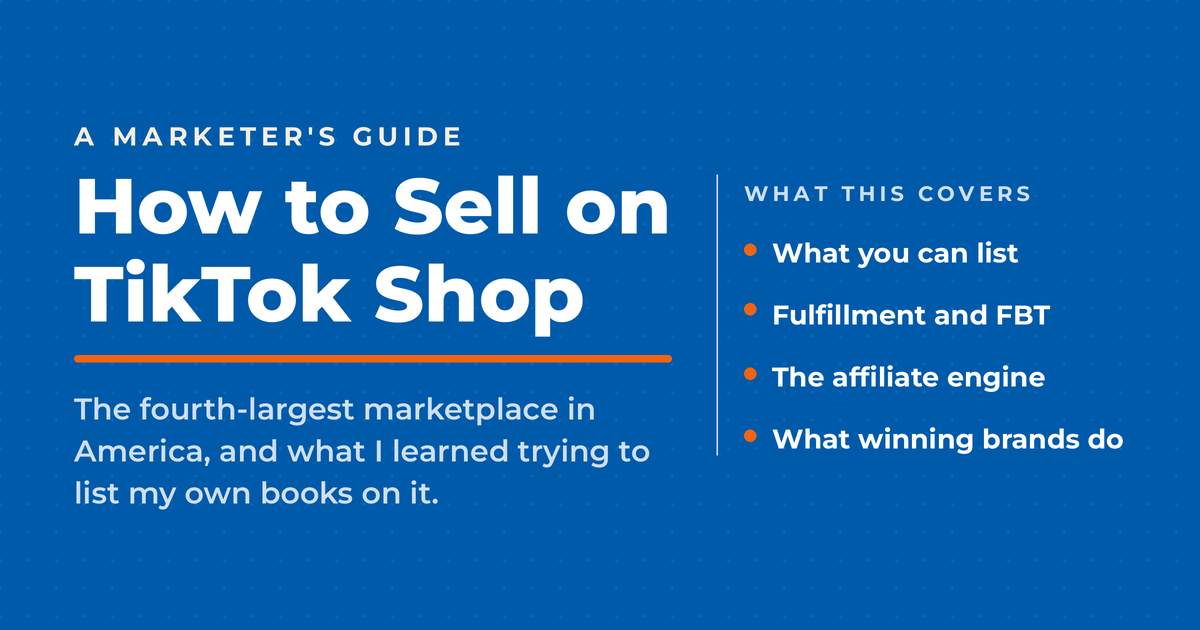
I’m Neal Schaffer. I’ve written six books on digital and social media, I teach at Rutgers Business School and UCLA Extension, and I work with companies as a Fractional CMO. I’ve also interviewed Amazon and e-commerce operators on my podcast, so I came at TikTok Shop the way a marketer should: not as a hack, but as a channel with its own economics. This guide is what I wish I’d had before I started digging. It’s written for marketers, business owners, and yes, authors and creators who want to understand the why and the how before they list a single product.
Key Takeaways
✅ TikTok Shop generated roughly $15.1 billion in U.S. sales in 2025, up 68% year over year, making it the fourth-largest e-commerce marketplace in America, ahead of Etsy, Wayfair, and SHEIN.
✅ You can sell physical products on TikTok Shop, but standalone digital products (ebooks, courses, templates) are prohibited in the U.S. unless you’re invited into a separate Virtual Goods category.
✅ Regular orders must be dispatched within two business days, so fulfillment speed is a real operating requirement, not an afterthought.
✅ Fulfilled by TikTok (FBT) is TikTok’s answer to Amazon FBA: you send inventory in, TikTok stores, packs, and ships it, and eligible products get a free 3-day delivery badge.
✅ The affiliate program turns TikTok’s creators into a pay-for-performance sales force, and it’s the single biggest growth lever most brands underuse.
How Big Is TikTok Shop, Really?
TikTok Shop is TikTok’s in-app marketplace where people buy physical products without leaving the app. In 2025 it generated about $15.1 billion in U.S. sales, up 68% year over year, which makes it the fourth-largest e-commerce marketplace in America, ahead of Etsy, Wayfair, and SHEIN. Globally it did roughly $64 billion.
Now for the number that made me sit up. Marketplace Pulse ranks the largest e-commerce marketplaces in the United States by the value of goods sold on them, and TikTok Shop lands fourth, tied with Walmart’s marketplace. An app people still think of as a place to watch dancing videos is now a bigger marketplace than Etsy, Wayfair, or SHEIN.
| Rank | U.S. marketplace | 2025 GMV |
|---|---|---|
| 1 | Amazon (third-party sales) | ~$300 billion |
| 2 | eBay | $39 billion |
| 3 | Temu | $22 billion |
| 4 | TikTok Shop | $15 billion |
| 4 | Walmart Marketplace | $15 billion |
| 6 | Wayfair | $10 billion |
| 7 | SHEIN, Etsy, and Whatnot | $6 billion each |
| 10 | Target Plus | $1 billion |
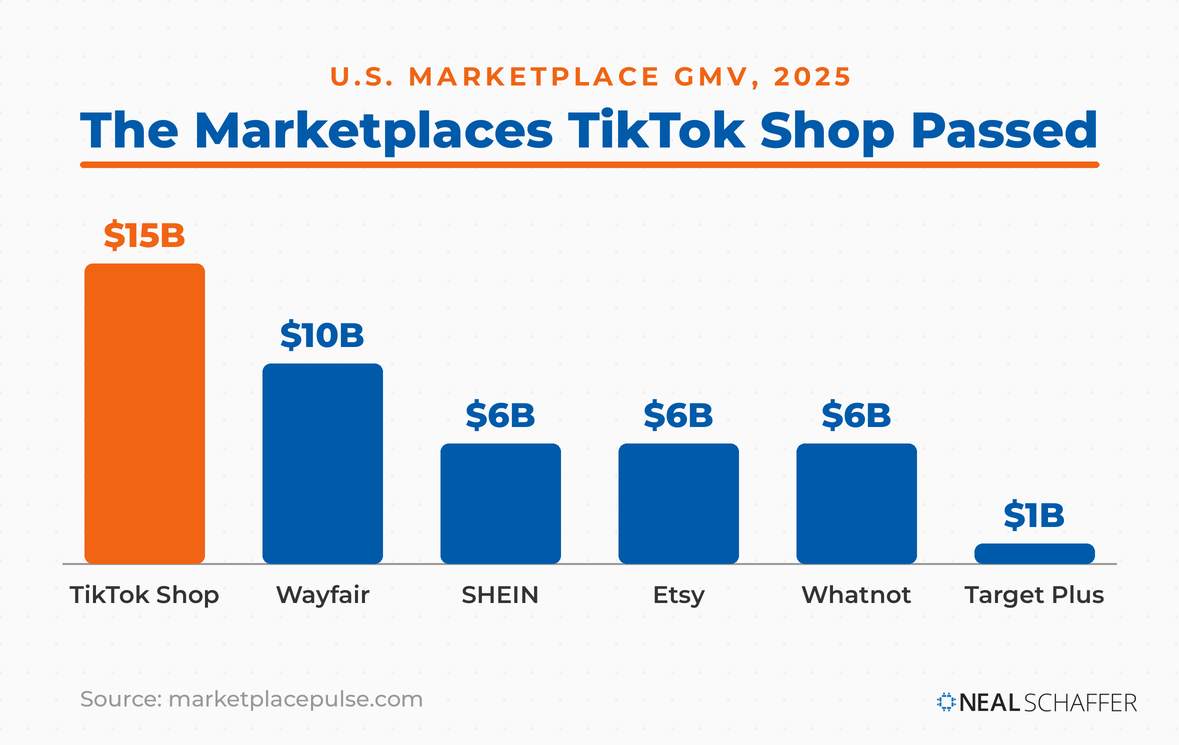
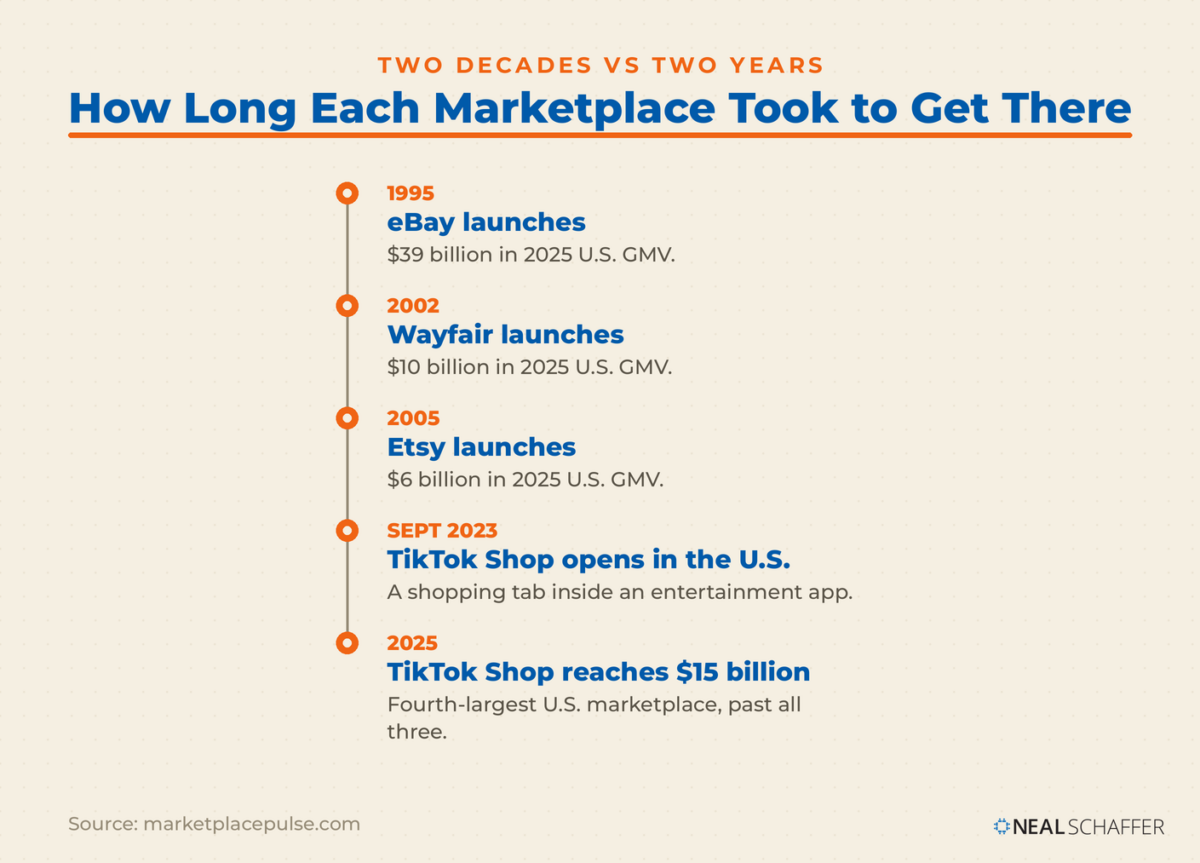
Read that table again with the founding dates in mind. eBay launched in 1995. Etsy in 2005. Wayfair in 2002. TikTok Shop opened in the United States in September 2023. It took roughly two years to pass companies that spent two decades building.
Two more comparisons worth sitting with. TikTok Shop’s U.S. sales beat Chewy, which reported $12.6 billion in net sales for fiscal 2025 and has been selling pet supplies online since 2011. And in beauty, the category where TikTok is strongest, eMarketer now calls TikTok Shop the fourth-largest health and beauty e-commerce retailer in the country.
None of this makes TikTok Shop an Amazon killer. Amazon’s third-party business alone runs roughly twenty times bigger, and it’s a marketplace ranking, so first-party giants like Apple and Target aren’t in that table. But if you’re a brand deciding where to put your next dollar, the fourth-largest marketplace in America is not a channel you pilot next quarter. It’s one you’re already late to.
That trajectory is why I stopped treating TikTok Shop as a novelty. If you want to see how the underlying audience is trending, the latest TikTok statistics are worth bookmarking, because the shopping behavior sits on top of that user growth.
The mechanics that drive sales are worth naming up front, because they shape everything else. Discovery happens through short videos, LIVE shopping streams, and a product tab, and most of the volume traces back to content rather than a search box. That’s the part traditional e-commerce folks miss. On Amazon, people arrive intending to buy. On TikTok Shop, the content creates the intent. It helps to understand how the TikTok algorithm works before you spend a dollar, because the algorithm decides who sees your product in the first place.
What Can (and Can’t) You Sell on TikTok Shop?
TikTok Shop is built for physical goods. You can sell almost any compliant physical product: beauty, apparel, home, supplements, gadgets, and yes, print books. What you generally cannot sell is a standalone digital product. TikTok’s own policy states that virtual or digital products are prohibited unless you’re approved under a separate, invite-only Virtual Goods category.
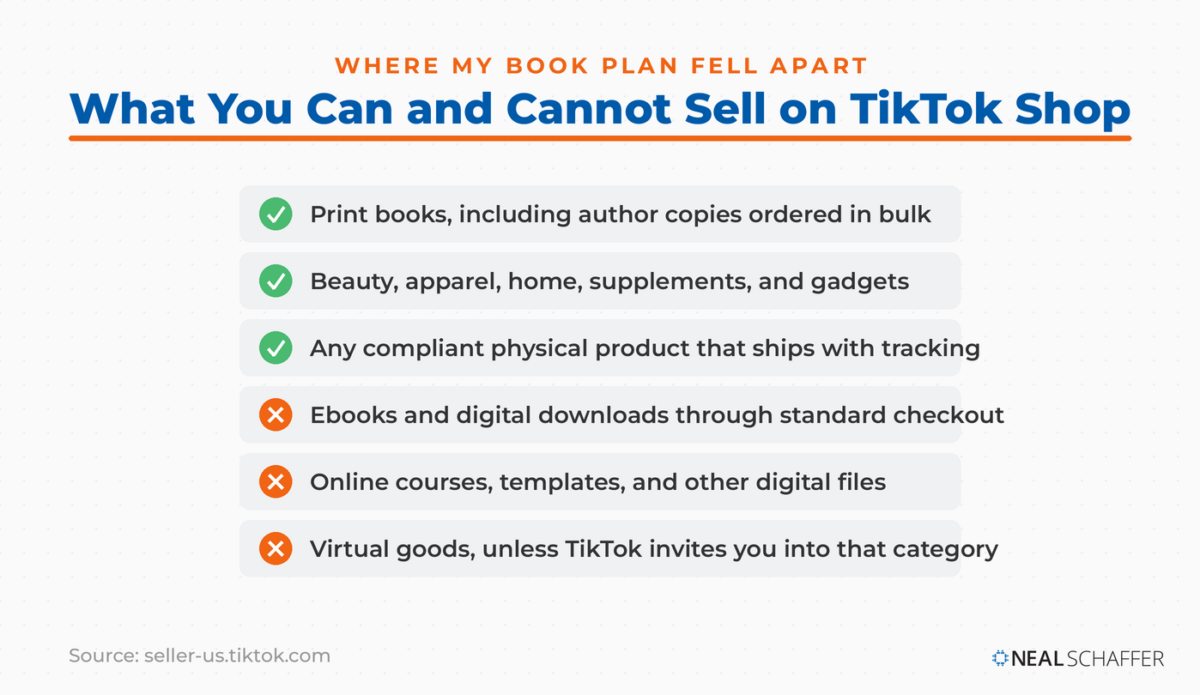
This is exactly where my book plan fell apart, and it’s worth walking through because a lot of authors and course creators hit the same wall. My ebooks are digital files. TikTok Shop’s checkout expects a tracking number for a physical package, so a digital download doesn’t fit the model. The workaround creators use is to sell the physical version through the Shop and point people to an external storefront for the digital one.
One nuance makes the #BookTok story click. The authors crushing it on TikTok Shop sell print copies. Their ebooks stay on other platforms. A common approach is to order author copies in bulk (from a printer like IngramSpark), list that physical inventory in the Shop, and ship each order themselves or through a fulfillment partner. Publishing analyst Jane Friedman has reported that TikTok says 59 million book sales have originated from BookTok content, so the demand is real. The format is just physical.
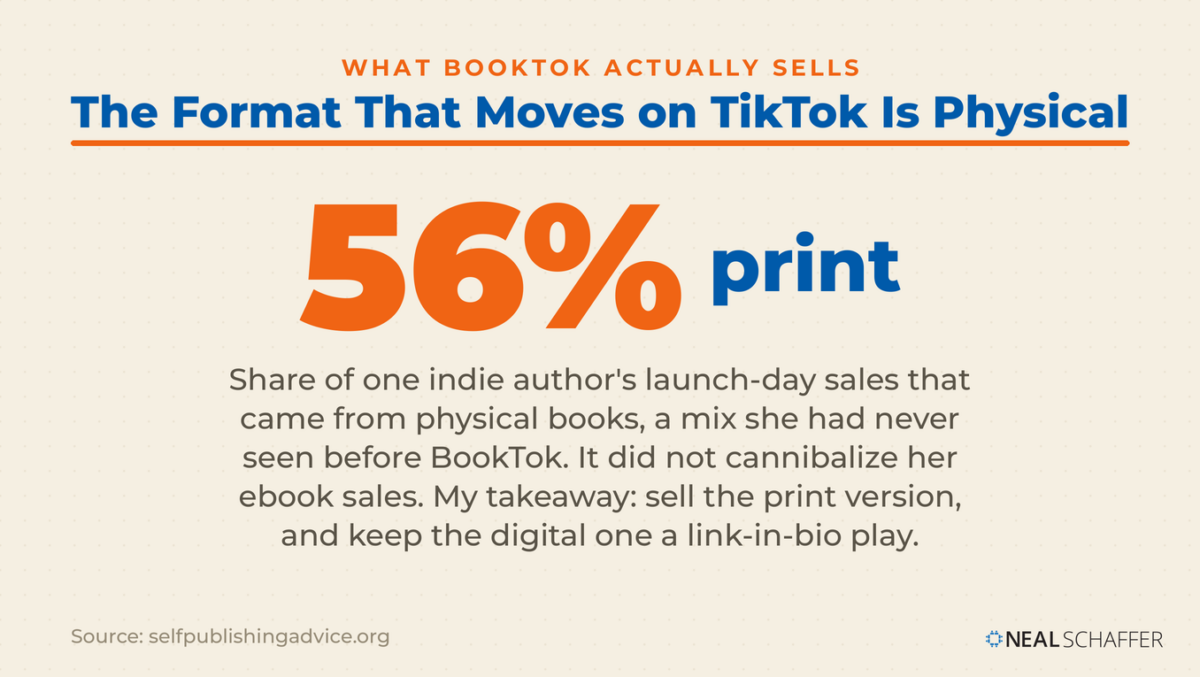
The BookTok data on physical sales is striking. Independent author Sacha Black, writing as Ruby Roe, reported that 56% of launch-day sales came from physical books, a mix she’d never seen before BookTok, and it didn’t cannibalize her ebook sales. For an industry that has assumed digital is everything, that’s a genuine shift. If your business sells anything digital, the practical takeaway is the same as mine: sell the physical version on TikTok Shop, and treat the ebook or course as a link-in-bio play. This distinction is confirmed by author-focused guidance noting that TikTok Shop doesn’t support digital products directly.
How Do You Set Up and Start Selling on TikTok Shop?
To start selling, you register in TikTok Shop Seller Center with a business license or ID, link a bank account, get approved (usually within a few business days), and upload your product catalog. Once your listings are live, you drive sales three ways: short shoppable videos, LIVE shopping streams, and the product tab. Content does the heavy lifting here.
The setup is the easy part, though one decision inside it deserves more thought than it usually gets. The handle you bind to the shop becomes its official account and has to carry the shop’s name, which is the strongest argument I found for giving a shop its own handle rather than converting the one you already post from, and I worked through that and the rest of the account-type question in my guide to the TikTok business account. The selling is where marketers earn their keep, because TikTok Shop rewards content that demonstrates a product in use, not static listings. A talking-head video about a budget tracker won’t move units. A screen recording of the tracker actually working will. The same logic applies across categories: show the product doing its job.
That’s why the skills that already work on TikTok carry straight over. Understanding how to go viral on TikTok matters more here than any listing optimization, because reach is what fills the cart. Practical distribution levers help too, like using the right TikTok hashtags to get your shoppable videos in front of the right audience, and posting at the best time to post on TikTok for your followers. None of this is different from growing a TikTok account. It’s the same playbook, pointed at a product.
LIVE shopping deserves special mention because it’s where the biggest single-session numbers happen. A creator or founder goes live for hours, demonstrates products, answers questions in real time, runs flash deals, and packs orders on camera. It feels less like a commercial and more like hanging out with someone who happens to be selling. That intimacy converts, and the brands that have scaled fastest treat LIVE as a core habit rather than a stunt.
How Does Fulfillment Work, and Is There a TikTok Version of Amazon FBA?
Yes. Fulfilled by TikTok (FBT) is TikTok’s in-house warehousing and shipping service, and it works much like Amazon FBA. You send inventory to TikTok’s fulfillment network, and TikTok handles storage, picking, packing, and delivery. Eligible FBT products earn a free 3-day delivery badge, and logistics issues are excluded from your seller performance metrics.
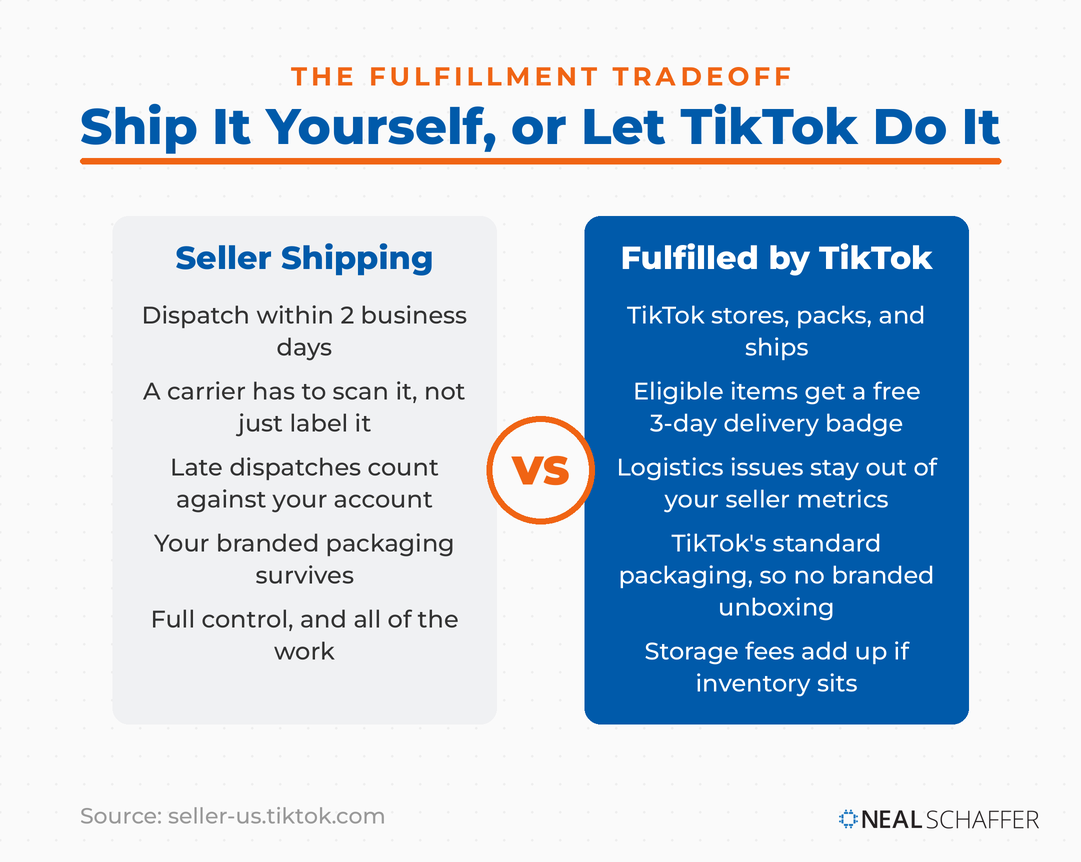
Before you decide on FBT, understand the baseline requirement that surprised me. If you fulfill orders yourself, TikTok expects regular orders to be dispatched within two business days of the order hitting “awaiting shipment,” meaning the package has to be scanned by a carrier, not just labeled. Miss that window too often and TikTok can throttle your account. For a solo author packing books at the kitchen table, that two-day clock is the whole ballgame.
The Digital Marketing Playbook for Small Teams
My latest book helps small businesses, entrepreneurs, and marketers bring search, email, and social together into one digital marketing strategy that actually compounds.
Drawing on my work as a Fractional CMO, Digital Threads turns complicated tactics into a clear, practical plan you can follow, whatever your budget or team size.
Grab your copy on Amazon and start weaving your own digital threads. Click the cover or the button below to get started.

This is where the Amazon FBA comparison becomes useful. On Amazon, FBA earns you the Prime badge and takes fulfillment off your plate. On TikTok Shop, FBT plays the same role: the free 3-day delivery badge is your Prime-style trust signal, and because FBT orders are exempt from the dispatch and delivery metrics, you stop worrying about the two-day clock. The tradeoff is control. FBT ships in TikTok’s standard packaging, so you lose the branded unboxing moment, and logistics analysts note that long-term storage fees add up if inventory sits too long.
If you want the fulfillment upside without handing everything to TikTok, a third-party logistics (3PL) partner is the middle path. A 3PL stores your inventory, packs it in your branded boxes, and ships against TikTok’s SLA, while you keep control across every channel you sell on. Those three options break down like this:
| Fulfillment option | Who handles it | Best for |
|---|---|---|
| Seller Shipping (DIY) | You pack and ship every order | Low volume, testing the channel, full branding control |
| Third-party logistics (3PL) | A partner warehouses and ships your inventory | Brands that want speed and branded packaging across channels |
| Fulfilled by TikTok (FBT) | TikTok stores, packs, and ships | High-velocity products that want the 3-day badge and metric protection |
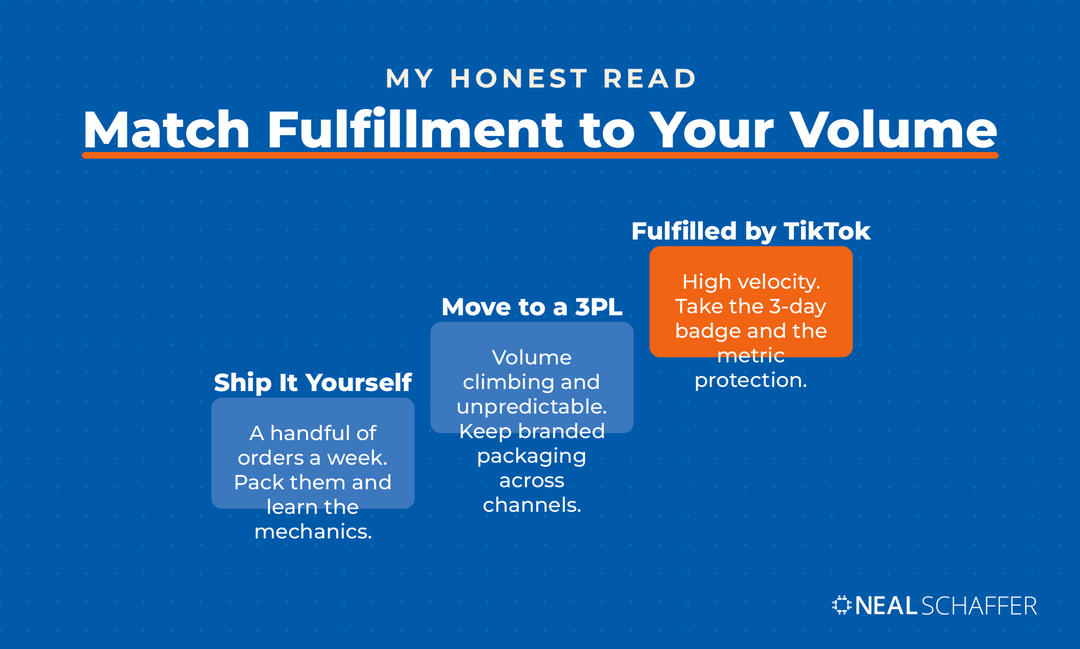
My honest read, having thought about this for my own books: if you’re testing the water with a handful of orders a week, ship them yourself and learn the mechanics. The moment volume becomes unpredictable (and on TikTok it can spike overnight), a 3PL or FBT stops being optional. The same logic shows up whenever I dig into how to make money with ecommerce: the fulfillment decision quietly determines your margins.
How Does the TikTok Shop Affiliate Program Work?
The TikTok Shop affiliate program lets creators earn a commission for promoting your products, and it’s the platform’s most important growth engine. You set a commission rate, creators grab a trackable link, and TikTok attributes the sale and pays out automatically. You pay only when a sale closes, unlike flat fees for posts. I have since written a full guide to the TikTok Shop Affiliate Program that covers the seller side and the creator side together, including the commission ranges sellers actually set and the reasons creators say yes to some programs and ignore others.
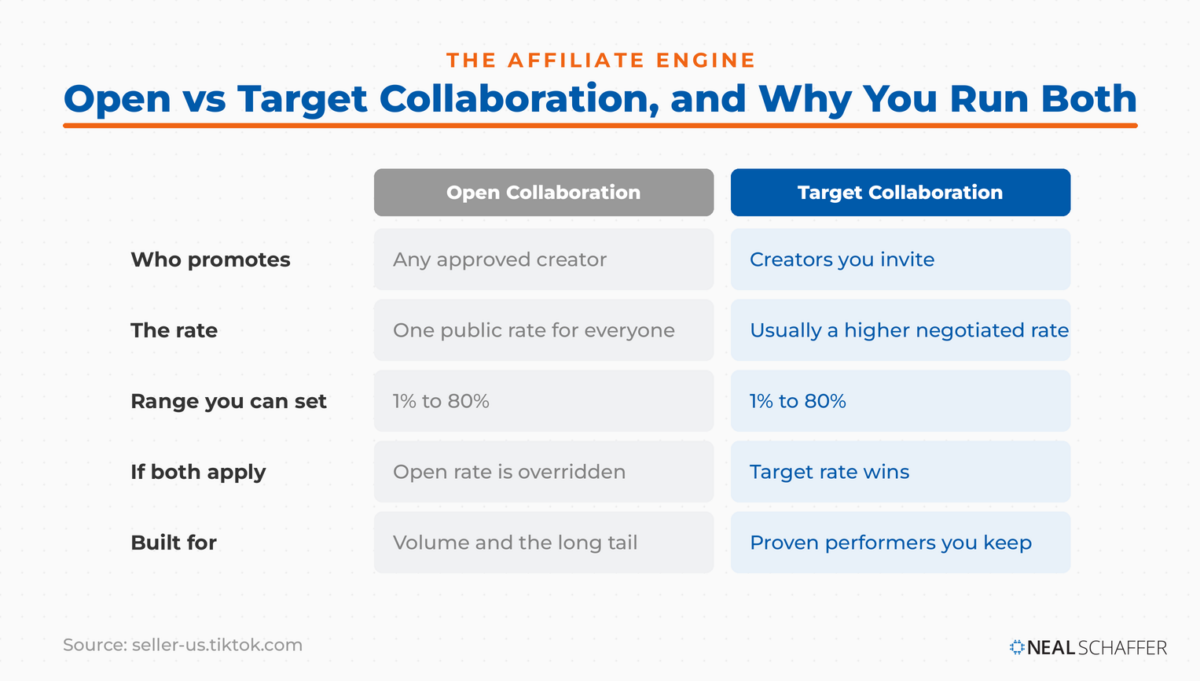
There are two ways to run it, and most winning brands run both. TikTok’s Seller Center supports Open Collaboration and Target Collaboration, with commissions you can set per product anywhere from 1% to 80%. Open Collaboration publishes one public rate that any approved creator can take, which is built for volume and the long tail. Target Collaboration is an invite, usually at a higher rate, that locks in specific creators you want. When a creator qualifies for both, the target rate wins, so you reserve your best economics for proven performers.
| Collaboration type | How it works | Use it for |
|---|---|---|
| Open Collaboration | One public commission rate; any approved creator can promote | Volume, discovery, and cold-start reach across many creators |
| Target Collaboration | You invite specific creators, often at a higher negotiated rate | Locking in high-fit, high-converting creators you want to keep |
The reason this matters so much is that TikTok Shop is a discovery engine, and creators are how you get discovered at scale. This is where the entire TikTok ecosystem starts working for you inside one platform: your product, hundreds of creators promoting it, and TikTok handling attribution and payout. If you’ve done any TikTok influencer marketing, the muscle memory transfers, though the economics are cleaner because you pay on results. It’s worth understanding the difference between influencer marketing and affiliate marketing, because TikTok Shop blends the two: creators bring influence, and the affiliate link brings measurable attribution.
Two tactical notes from watching brands do this well. Free samples are one of the strongest recruitment tools, because a creator who has the product in hand makes better content. And the creators who convert best are often not the biggest accounts. A micro-creator who genuinely uses your product frequently outperforms a mega-account reading a brief, which is why smart brands recruit UGC creators relentlessly and give them room to be authentic. Those creator videos do double duty once you start spending, because TikTok Shop Ads can treat an affiliate’s post as eligible creative alongside your own, and my guide to TikTok advertising walks through how that works.
What Are Brands Actually Doing to Win on TikTok Shop?
The brands winning on TikTok Shop share one pattern: relentless, authentic content paired with consistent LIVE selling, usually amplified by a creator affiliate army. They run the Shop like a show, often daily, with the founder front and center. Set-and-forget listings don’t work here.
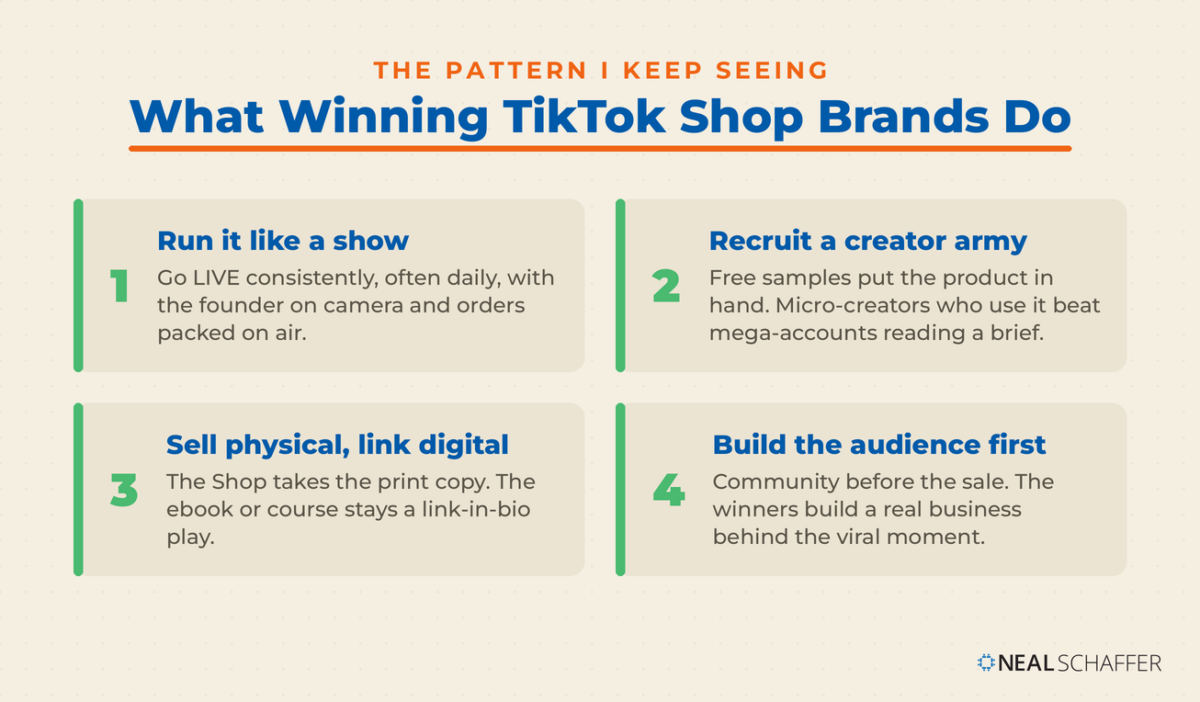
The clearest U.S. example is Canvas Beauty, founded by Stormi Steele in Huntsville, Alabama. Steele became the first creator to hit $1 million in sales in a single TikTok livestream, streaming for hours from her own warehouse and packing orders on camera. She kept going. On Black Friday she grossed more than $3 million in a day and sold over 100,000 products, with $2.1 million of it coming from a single 12-hour “mega live.” What sells is a founder people trust, showing up consistently and being herself. Polish is beside the point.
Stormi Steele, founder and CEO of Canvas Beauty, put it to Black Enterprise this way: “Live selling is going to change and reshape how we consume and understand e-commerce.”
The UK’s Made by Mitchell tells the same story from a different market. The beauty brand went live daily for hours, and its momentum got so strong that TikTok itself asked the brand to host a livestream with a $500,000 goal, which it doubled in 12 hours. Founder Mitchell Halliday is adamant that community has to come before chasing the sale, and that mindset shows up in how the brand runs its LIVEs. These brands build an audience that happens to buy, and the store rides along.
I dug into this pattern with e-commerce operator Neil Twa when I explored building brands across Amazon and TikTok on my podcast, and the throughline was consistent: the platform is a discovery incubator, and the brands that win build a real business behind the virality rather than chasing a single viral moment. The fundamentals underneath all of this show up in ecommerce marketing, which is what keeps a viral spike from becoming a one-hit wonder. And because TikTok rewards riding cultural moments, watching TikTok trends the way authors rode #BookTok is part of the job.
Frequently Asked Questions
Not through standard checkout in the U.S. TikTok Shop prohibits standalone digital products unless you’re invited into a separate Virtual Goods category. Most creators sell the physical version through the Shop and link to an external storefront for the digital one.
Regular orders must be dispatched within two business days of entering “awaiting shipment,” and the package has to be scanned by a carrier, not just labeled. Miss the window too often and TikTok can restrict your account, unless you use Fulfilled by TikTok, which is exempt from that metric.
It’s the closest equivalent. You send inventory to TikTok’s network, TikTok stores, packs, and ships it, and eligible products get a free 3-day delivery badge similar in spirit to Amazon’s Prime badge. The tradeoff is standardized packaging and storage fees over time.
No. You set a commission rate, creators promote with a trackable link, and you pay only on completed sales. You can offer free samples to recruit creators, but the commission itself is pay-for-performance.
There’s no listing fee to open a shop. TikTok takes a referral fee on sales, and you’ll have product, shipping, and affiliate commission costs. The biggest early investment is content: the videos and LIVE sessions that actually drive the sales.
Ready to Turn TikTok Shop Into a Real Channel?
If you take one thing from my failed book experiment, take this: TikTok Shop is a content channel with a checkout attached, not a passive storefront. The brands that win decide what they can actually sell, pick a fulfillment path that fits their volume, and commit to content before they judge results.
Decide what you can list (physical, not digital), set a competitive affiliate commission, recruit creators, and give it 90 days of real effort rather than a week. If you want to go deeper on the monetization side, how to make money on TikTok connects the Shop to the platform’s other income streams. And if you’d like help building TikTok Shop into a coordinated strategy alongside your other channels, download a free preview of Digital Threads or get in touch about Fractional CMO services and we’ll map it to your business.