Editorial Note: I may earn a commission when you visit links that appear on my website.
AI Search Engine Optimization: What 12 Months of My Own AI Referral Data Actually Shows
Search is shifting, and you already know it. Google sends fewer clicks than it did two years ago, and some of that demand has moved into ChatGPT, Gemini, Perplexity and Claude. Every marketer I talk to is watching the same thing happen to their own numbers.
What is harder to find is what the shift looks like from the inside. So I pulled twelve months of my own data across roughly 700 published posts: every AI referral, page by page, against every other channel I have.
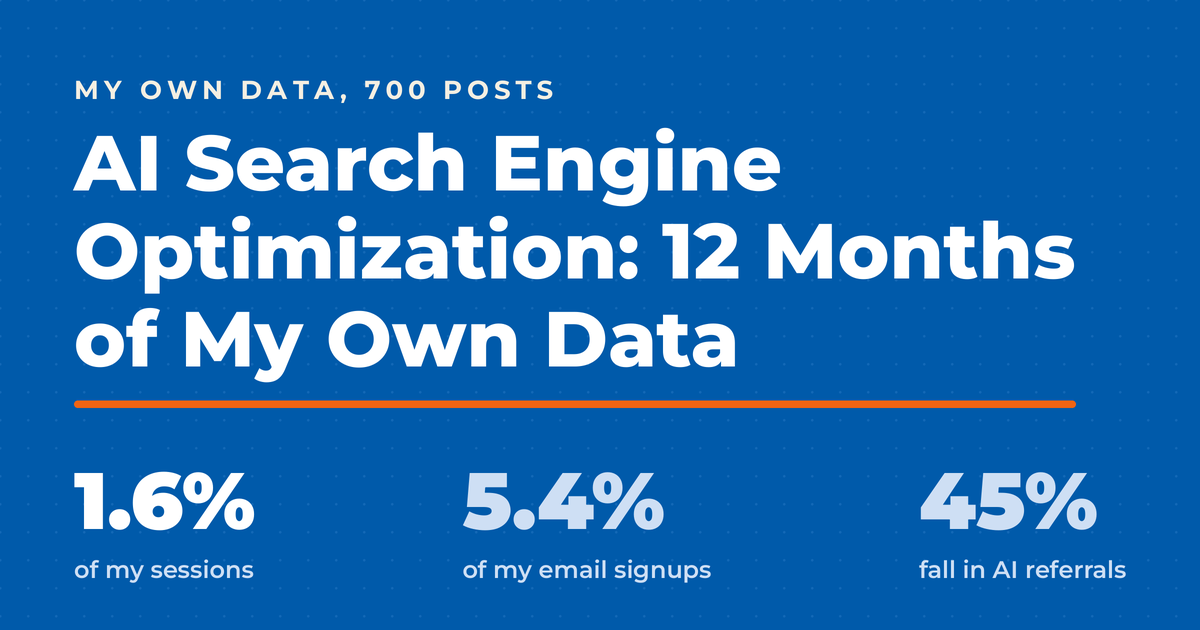
Two things surprised me. My AI traffic went down over the year rather than up, by about 45%. Which is exactly what SEO has always felt like. You are competing for those citations against everyone else in your space, and the engines keep rewriting how they retrieve, so getting cited today guarantees you nothing tomorrow. The second surprise is the useful one. Those visits delivered just 1.6% of my sessions but 5.4% of my email signups, converting at roughly five times the rate of organic search.
That combination is the whole argument of this post. Chase AI search for traffic volume and you will be disappointed. Judge it on what those visitors actually do and it earns real investment. Below is what my numbers show and what I changed across my archive because of them.
This is written for the person who owns the outcome: a solo consultant, a marketing lead at a small company, an operator who publishes. If you run an enterprise content program with an agency and a six-figure tooling budget, some of what follows will not map to your situation, and I will say where.
One clarification before anything else, because this phrase gets used two completely different ways. Some people mean using AI tools to do their SEO work faster. Others mean getting found by AI engines when someone asks ChatGPT or Gemini a question. This post is about the second meaning only. If you came for the first, I wrote about using AI for SEO tasks in a separate post.
I teach social media marketing at Rutgers Business School, I have written six books including the digital-first digital marketing playbook Digital Threads, and I have hosted Your Digital Marketing Coach for more than 400 episodes. I also work as a Fractional CMO with companies facing this exact problem. For the last 18 months I have been rebuilding my own 700-post archive category by category, measuring each one before and after. The numbers below come out of that work.
Key Takeaways
✅ AI search engine optimization, as this post uses the term, means being found by AI engines rather than using AI to do SEO work
✅ AEO, GEO and AI SEO describe the same underlying work, and Google’s published position is that all of it is still SEO
✅ On my own 700-post site, AI referral volume fell about 45% over twelve months, so the trend there is down rather than up
✅ ChatGPT referrals to my site fell 69% year over year while Claude referrals rose more than eightfold
✅ AI sent just 1.6% of my sessions but 5.4% of my email signups, converting at roughly five times the rate of organic search
✅ Firsthand experience is the one signal an agency or a model cannot manufacture, which is a structural advantage for operators and entrepreneurs over enterprises
What Is AI Search Engine Optimization?
AI search engine optimization is the practice of structuring content so AI systems retrieve it, trust it, and cite it when they generate answers. It spans Google’s AI Overviews and AI Mode along with standalone assistants like ChatGPT, Gemini, Claude and Perplexity. The goal is being referenced inside the answer rather than being invisible to the searcher.
The naming is a mess, and that mess is not your fault. Wikipedia’s entry on generative engine optimization notes that no consensus definition separating these terms existed in the academic literature as of early 2026, and that practitioners use them interchangeably. AI SEO, GEO, AEO, LLMO, AIO. Same underlying work, different labels.
The confusion that actually costs money is the other one. “AI search engine optimization” also describes pointing AI tools at your keyword research and content briefs. Both meanings are legitimate. They are just different jobs, and conflating them is how people end up buying a tool subscription when what they needed was a content strategy.
In Digital Threads I made the case that a search engine is anywhere people find you, which is why that book treats YouTube, TikTok and even Amazon as search engines. Large language models are simply the newest entry on that list. If you already think about discoverability that way, what an AI search engine is will feel less like a new discipline and more like a new surface.
Which raises the question everyone asks next, usually with some irritation. If this is all just search, why does the industry keep inventing new acronyms for it?
GEO vs SEO: Where Does AEO Fit In?
AEO sits inside the same discipline rather than beside it. Answer engine optimization means getting extracted as a direct answer. Generative engine optimization means getting cited inside a synthesized one. SEO is what earns you the right to either. Google’s documentation on generative AI search names all three and treats them as one activity.
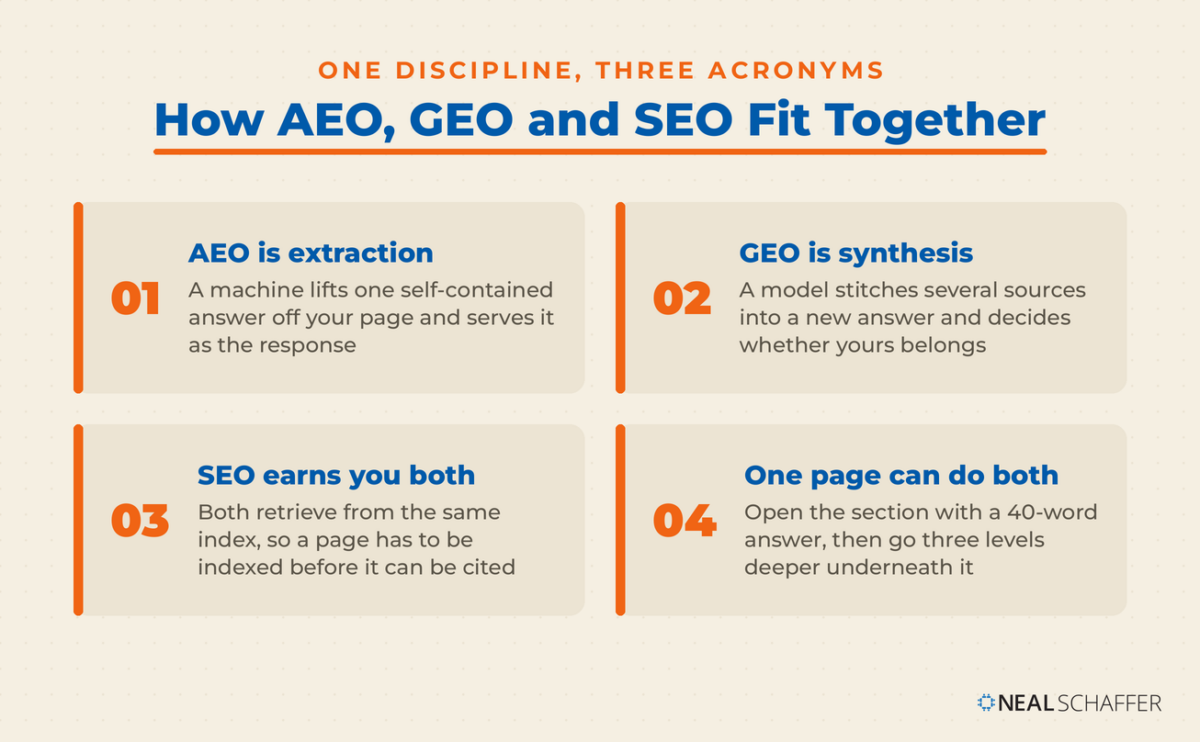
The distinction that does matter is mechanical, and it does change what a page needs to do. AEO is about extraction. A machine pulls one specific piece of information off your page and serves it as the response, which rewards a tight, self-contained answer sitting right under the question. GEO is about synthesis. A model stitches several sources into a new answer and decides whether yours belongs in it, which rewards depth, original data and citation-worthiness.
You need both, and the same page can do both. A section that opens with a clean forty-word answer and then goes three levels deeper is built for extraction at the top and synthesis underneath. I took that split apart against three months of my own Google AI impression data in a full comparison of AEO vs GEO.
That framing is not mine alone. Google names both acronyms in the documentation linked above and says plainly that optimizing for generative AI search is optimizing for the search experience, and thus still SEO. The same page lists tactics you can ignore for Google Search: LLMS.txt files, chunking content into fragments, rewriting pages specifically for AI systems, and chasing inauthentic brand mentions.
I devoted a full episode of my podcast Your Digital Marketing Coach to exactly this question, AEO against GEO, and landed in the same place. As I put it there:
“AEO and GEO are really two sides of the same coin. They are part of the same playbook. The underlying optimization principles overlap significantly.”
That episode went out in December 2025, five months before Google published the documentation above. I am not claiming a prediction. I am claiming that watching how these systems actually behave gets you to the right answer earlier than waiting for a platform to confirm it.
Is Your Digital Marketing All Over the Place?
My latest book helps small businesses, entrepreneurs, and marketers bring search, email, and social together into one digital marketing strategy that actually compounds.
Drawing on my work as a Fractional CMO, Digital Threads turns complicated tactics into a clear, practical plan you can follow, whatever your budget or team size.
Grab your copy on Amazon and start weaving your own digital threads. Click the cover or the button below to get started.

The academic evidence on which techniques move the needle is more useful than either acronym. The KDD 2024 paper that coined generative engine optimization as a term tested nine content modifications across 10,000 queries. Adding citations, quotations from credible sources, and statistics boosted source visibility by over 40%. Keyword stuffing produced little to no improvement. The same study measured a 115.1% visibility lift for sources sitting fifth in the search results that added citations, while the top-ranked sources in the same test actually lost visibility.
Read that twice if you run a small site. Citing your sources helped the pages that were behind and did nothing for the pages already in front, which is close to the opposite of how ranking usually rewards authority. It is the rare technique where being smaller is not a handicap.
That is the theory, and it is genuinely encouraging. Then I went and measured what all of it was actually worth on my own site, and the first number I found was not encouraging at all.
Why AI Search Traffic Looks Smaller Than Everyone Says
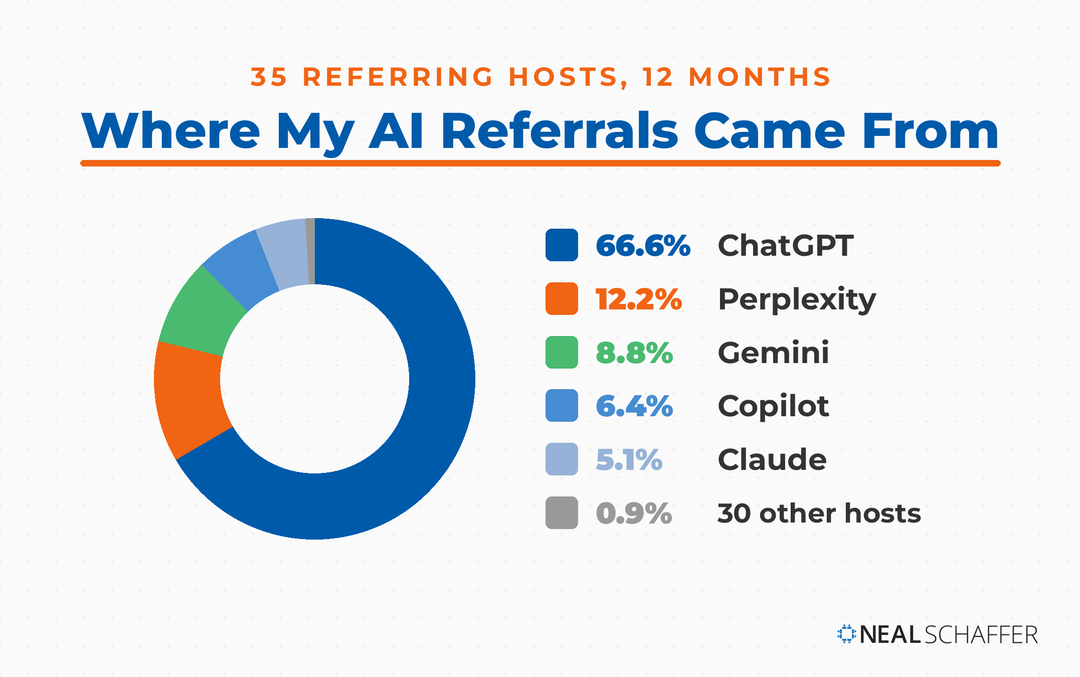
I tracked every AI-assistant page view to my site between August 2025 and July 2026, at page level, across 35 distinct referring hosts. Spread across an archive that size, the per-post average is a trickle. Real and measurable, and nowhere close to a primary channel by volume.
Here is the full distribution:
| AI source | Share of my AI referrals |
|---|---|
| chatgpt.com | 66.6% |
| perplexity | 12.2% |
| gemini.google.com | 8.8% |
| copilot (all hosts) | 6.4% |
| claude.ai | 5.1% |
| All 30 other AI-related hosts combined | 0.9% |
Now the part nobody puts in a webinar. Sessions and share of total site sessions, by month:
| Month | AI share of all sessions |
|---|---|
| Aug 2025 | 2.79% |
| Oct 2025 | 3.24% |
| Dec 2025 | 1.84% |
| Feb 2026 | 1.44% |
| Apr 2026 | 1.44% |
| Jun 2026 | 0.66% |
| Jul 2026 | 1.03% |
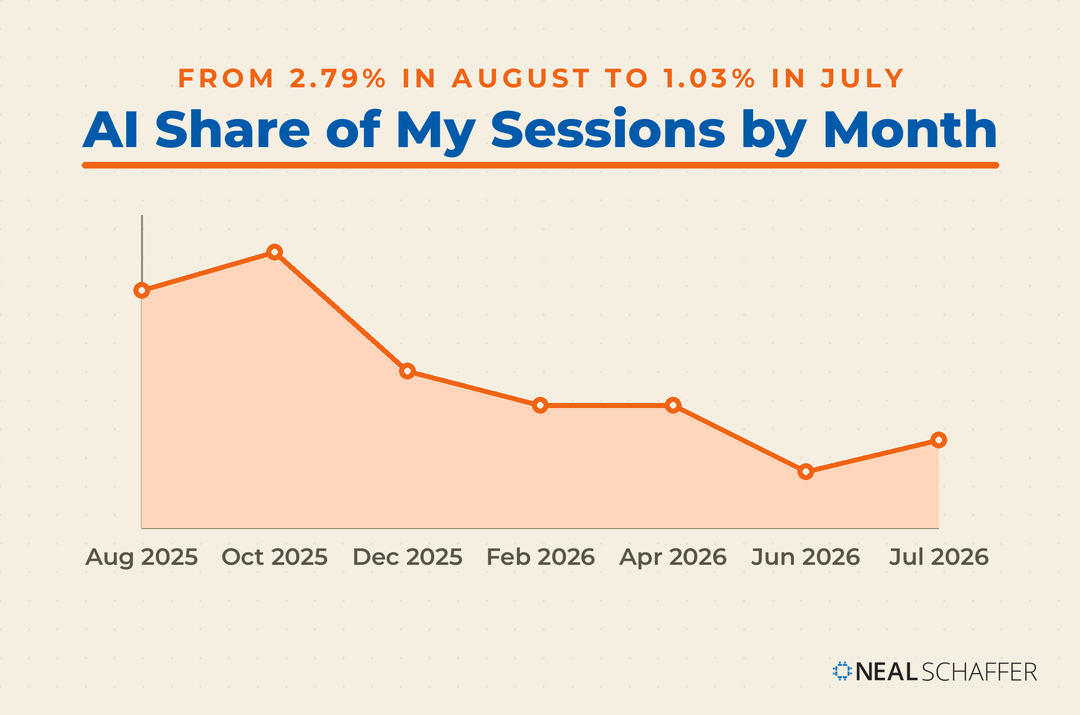
Down roughly 45% in absolute sessions and 63% in share, and those two numbers are telling different stories. Total sessions to the site rose about 48% across the same window, so the share collapse is mostly my other channels growing rather than AI shrinking. The volume decline is real. The share decline overstates it. And no, neither is a tagging artifact. Google Analytics changed how it labels this traffic partway through the year, which I get into below, but I counted by hostname so the change is captured on both sides of it.
Let me be careful about what this proves. It is one site in one niche, and my Google traffic moved sharply during the same window, so these numbers sit inside a noisier picture than I would like. What it does establish is that the growth story you keep hearing is not universal.
It also should not read as a verdict on anybody’s work, mine included. Visibility inside an LLM behaves like a ranking, not like an asset you own. Other sites are competing for the same citations, the models retrain, and the retrieval logic changes underneath you without an announcement or a core update post to read. A page that got pulled into answers in October can quietly stop being pulled in by February. That is the same bargain traditional SEO has always offered, just with less transparency and a faster clock.
Cloudflare’s network-wide analysis points the same direction. Their team compared how often AI platforms crawl sites against how often they send visitors back. The finding was that the trend continues to be more crawls and fewer referrals. They put the historical comparison plainly: legacy search crawlers scanned your content a couple of times or less for each visitor they sent. That exchange has stopped being reciprocal.
The click math explains why. Pew Research Center tracked real browsing behavior and found that users clicked a traditional search result in 8% of visits when an AI summary was present, against 15% when it was not. Only 1% clicked a link inside the summary itself. Ahrefs reached a harsher figure from a different angle, finding across 300,000 keywords that an AI Overview now correlates with a 58% lower average clickthrough rate for the top-ranking page. The answer arrives without the visit.
So much for the aggregate. It gets considerably more interesting once you split the number by which assistant sent the visit.
Which AI Assistants Actually Send Traffic In 2026?
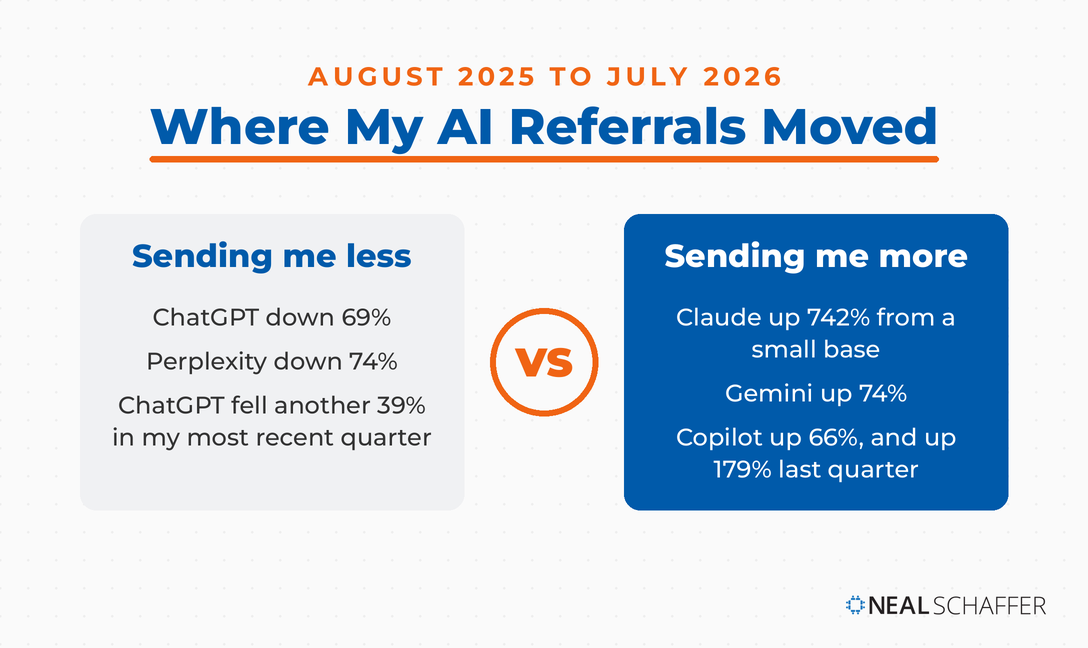
ChatGPT still leads my AI referrals in absolute volume, but the lead is collapsing fast. Comparing August 2025 against July 2026, ChatGPT sessions to my site fell 69% and Perplexity fell 74%. Gemini, Copilot and Claude all grew over the same period, with Claude up more than eightfold from a very small base.
| Host | Change, Aug 2025 to Jul 2026 |
|---|---|
| chatgpt.com | -69% |
| perplexity | -74% |
| gemini | +74% |
| copilot | +66% |
| claude.ai | +742% |
That divergence surprised me. It also matches what an independent panel found. Similarweb reports ChatGPT’s share of worldwide generative AI web traffic falling from roughly 76% in June 2025 to about 53% by May 2026, with Claude climbing from barely 2% to close to 9%. Two very different measurement methods, one small site and one global panel, landing on the same redistribution.
The split is widening rather than settling. Comparing my most recent quarter against the one before it, ChatGPT referrals fell another 39% while Claude grew 118% and Copilot grew 179%. Across all platforms my AI total barely moved, so this is redistribution rather than growth, and my AI share of sessions actually slipped because the rest of the site grew faster.
Here is the labeling change I mentioned earlier, because it would be easy to get this badly wrong in your own reporting. Google Analytics introduced an ai-assistant medium in June 2026. Those rows show zero traffic before that date and healthy traffic after, so read on their own they look like explosive growth across every AI platform at once. They are a relabeling of traffic you were already getting. I rolled each platform’s numbers across every label it appears under, which is the only way to get a comparison that means anything.
None of this means you should optimize differently for each assistant. The work that earns a citation is the same everywhere, which is exactly what Google’s documentation says. What the mix changes is your measurement and your risk. Track only ChatGPT and you are watching half the audience. Concentrate your visibility in one assistant and you are a single model update away from losing it.
Where the traffic lands moved too. On May 7, 2026, ChatGPT started surfacing brand links more prominently inside its answers, and Similarweb found that the share of its referrals arriving on a brand homepage jumped from roughly 26 to 32% up to around 60%, and stayed there. So a chunk of what looks like unattributed direct traffic in your analytics is AI-driven discovery arriving at your front door.
The volume is small, then, and spread across more platforms than it used to be. Which left me with the question I actually cared about. Was any of it worth having?
Is AI Search Traffic Worth More Per Visit?
Yes, on my site, by a wide margin. AI assistants delivered just 1.6% of my sessions over the last twelve months but 5.4% of my email signups. That is a conversion rate roughly five times organic search and more than double Google organic alone. Low volume, disproportionate value.
I ran this the only way it can be run honestly, by attributing conversions to the session source that produced them rather than to the page they landed on. My signups fire on a confirmation page, so counting by page path shows every blog post at zero. Here is what came back, expressed as the share of sessions from each source that ended in a signup:
| Traffic source | Share of sessions ending in a signup |
|---|---|
| Email list | 1.68% |
| LinkedIn referral | 1.35% |
| AI assistants (all) | 0.56% |
| Social (all networks) | 0.21% |
| Google organic | 0.24% |
| Bing organic | 0.06% |
| All organic search combined | 0.12% |
| Site-wide average | 0.17% |
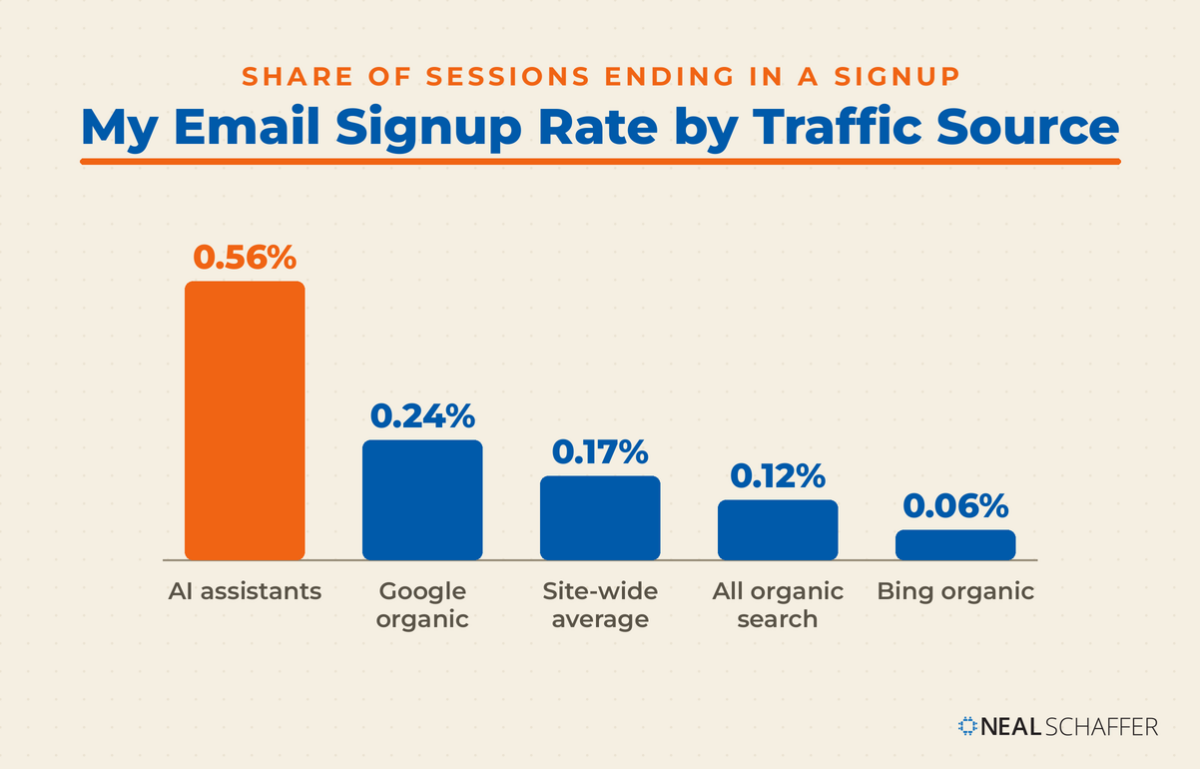
Two things jump out. AI-referred visitors convert at nearly five times the rate of organic search overall, and at more than twice the rate of Google organic on its own. And Bing, which supplies the single largest slice of my sessions, converts at a third of Google’s rate and a tenth of AI’s. Volume and value are almost inverted across my channels.
Now the caveat, because it is a real one. The AI conversion count behind that rate is small in absolute terms, and small numerators make percentages jumpy. I ran the comparison against organic search anyway and the gap is far too large to be noise, but I would not bet a budget on the ordering of individual assistants in my own data, where each contributed only a handful of conversions.
The honest read is that AI search is a small channel carrying visitors who arrive further along in their thinking. Somebody asked an assistant a question, got an answer that referenced me, and clicked anyway. That is a different person from someone scrolling a results page. My own numbers say that person is worth roughly three times my site average, which is why I have stopped judging this channel on session counts and started judging it on what the sessions do.
Citation carries value even when the click never happens, which is the part that keeps me invested. Seer Interactive’s analysis of AI Overview performance found that brands see 35% more organic clicks and 91% more paid clicks on queries where they are cited than on queries where they are not. Their team is admirably direct about the limit of that finding: they cannot prove citation causes the lift rather than authority causing both.
That finding is what changed my workflow rather than just my reporting. The rest of this post is the work itself.
AI Search Optimization in Practice: The 10 Tactics I Use on Every Post
AI search optimization is the execution layer, and these ten tactics are what I apply to every post. Write answers that stand alone. Source every number. Structure pages so a retrieval system can lift a clean chunk. Build topical depth so a model links your name to a subject. Almost all of it is work you should be doing anyway.
Here are the ten I would start with, in the order I would tackle them. Every one comes out of rebuilding my own archive, not out of anybody’s checklist.
- Answer the question immediately, then answer it again in every section. My openings now deliver the finding in the first hundred words instead of building to it, and every major section starts with a self-contained paragraph of 40 to 60 words that answers its own heading. A model extracting an answer will not scroll to find one, and neither will a reader.
- Question-shaped headings. H2s and H3s phrased the way people ask, which also serves on-page SEO fundamentals that predate any of this.
- A summary block near the top. Five or six one-line takeaways, each a complete claim that survives being lifted on its own. This is the single most quoted block on my posts, and writing it is also the fastest way to find out whether the post has a point.
- An FAQ built from questions people actually ask. Not invented questions padding the word count. Real ones, from clients, from search suggestions, from the messages in my inbox, each answered in two or three sentences that stand alone without the article around them.
- A sourced number in every claim slot. If I cannot trace a figure to a primary source, the sentence comes out rather than getting softened.
- Tables and lists wherever they aid comprehension. Retrieval systems pull structured chunks more reliably than dense prose. Real alt text and captions on your images count here too, since those are ordinary text a retrieval system reads, while the words inside the picture itself are not.
- Internal links inside the prose, never in a callout box. I deleted every related-links callout box on my site and moved those links into the sentences where the topic actually comes up, with anchor text naming the destination topic rather than its format. Retrieval systems extract passages, so a link sitting inside a passage travels with it and its anchor text tells the model what the linked page is about, which is the argument I make in full about internal linking. A link parked in a box beneath the section never enters the passage at all. Research diagnosing why pages go uncited found that 43% of topically relevant pages receive no citation under baseline conditions, and that roughly nine in ten of those failures are semantic or presentational rather than technical.
- Name the entities you want to be associated with. Models build associations from what appears alongside what, which is why the opening of this post names me, Rutgers Business School, Digital Threads and Your Digital Marketing Coach instead of saying I teach somewhere, wrote some books and host a podcast. Same principle everywhere else: write “Google Search Console” rather than “the search console,” name your company, your products and the tools you actually work with, and keep those names identical across your site so they resolve to one thing rather than several. Google’s guidance is blunt that manufacturing mentions you have not earned does not work, so name only what you genuinely use.
- Say who you are before the reader has to ask. Credentials, current role and relevant track record belong in the opening, not in an author box at the bottom of the page. It is the first thing a skeptical human looks for, and it is plain text that a retrieval system reads like any other.
- First-person specifics. Original data, tools I pay for, results that went sideways. Nothing a model could have produced from common knowledge.
None of this is exotic. Solid technical SEO, well-organized SEO content, and patient work on long-tail keywords still form the foundation. What changed is the payoff structure, not the playbook.
Every one of those is in the post you are reading, which you are welcome to check as you go.
Nine of those ten are mechanical, and a competent freelancer could finish them in an afternoon. The last one decides whether any of the others matter.
Why Firsthand Experience Is the Hardest Signal to Fake
Because you cannot outsource it. Google’s guidance draws a line between commodity content assembled from common knowledge and non-commodity content built on real expertise or experience, and says the second is what moves visibility over the long run. Experience is the one input an agency, a freelancer or a model cannot manufacture for you.
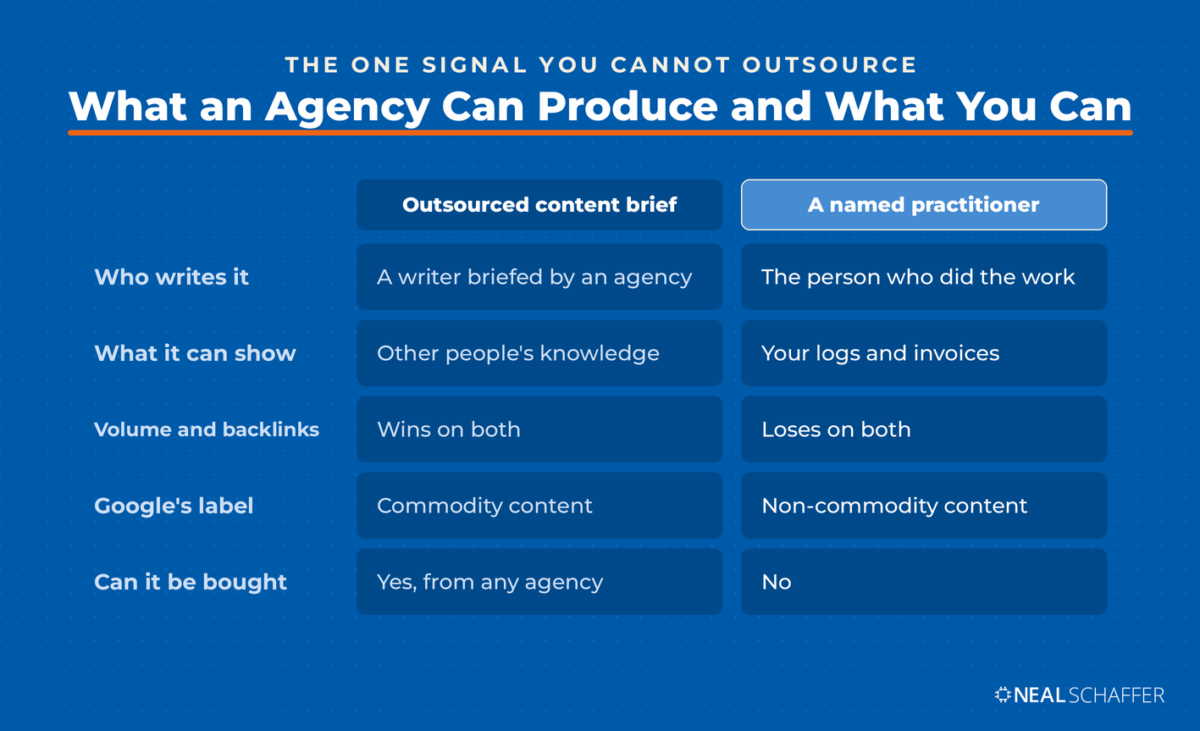
That makes it the most important item on the list above, and it is not a close call. Everything else in this post is available to anyone willing to read the documentation. This is the only part your competitors cannot buy.
A large company with a content budget can out-produce you on volume, out-rank you on backlinks and out-spend you on tooling. What it usually cannot do is put a named practitioner with scars on the page. The brief goes to an agency, the agency assigns a writer, the writer researches what already exists online, and the output is by definition a summary of other people’s knowledge. That is the exact definition of commodity content, and it is the thing Google’s own documentation tells you will not carry you.
Meanwhile a solo consultant, a small agency owner or an operator who blogs has the one asset that cannot be procured. You did the work. You have the logs, the invoices, the client that churned, the tool you cancelled.
The practical question is how to get that experience onto the page, because most people who have it still write like they don’t. Six things I look for in my own drafts, beyond the credentials line every post should already carry:
- A number nobody else has. Your analytics, your test results, your pricing, your churn. One proprietary figure outweighs ten borrowed statistics.
- Named tools, including the ones you dropped. Listing what you pay for and what you cancelled says more than any feature comparison, because only a user knows which ones did not survive contact with real work.
- The thing that went wrong. A post that only reports wins reads like marketing. The failure is the credibility.
- Dates and places. “In February” and “on a client’s ecommerce site” beat “recently” and “in some cases” every time.
- The question a real person actually asked you. Client questions are better keyword research than keyword tools, because they come with context a tool cannot see.
- A byline that survives scrutiny. Author bio, credentials, and a track record someone can check.
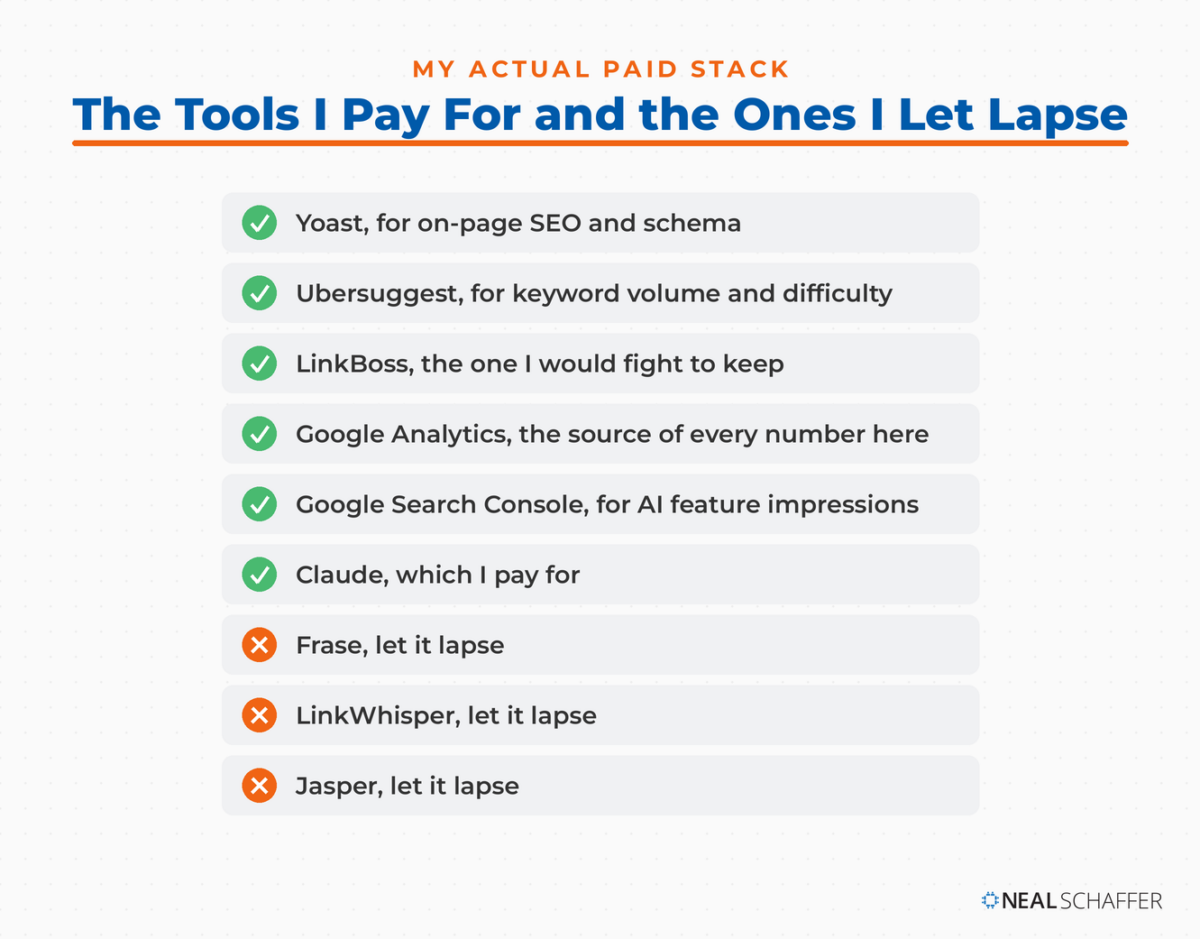
You don’t need to invest in expensive tools to do this, either. My own paid stack is unglamorous, for whatever that is worth as an example: Yoast, Ubersuggest, LinkBoss, Google Analytics, Google Search Console, and Claude. I used Frase, LinkWhisper and Jasper in the past and let all three lapse. LinkBoss is the one most people have never heard of, and it is the one I would fight to keep, because I believe internal link structure turns out to have influence as to whether a page gets retrieved at all.
None of that is an AI tactic. It is what makes writing worth reading, which is the whole point Google keeps making in different words.
There is a harder version of this question waiting underneath it. Not how you write a post, but which posts deserve to exist at all.
Which Content Should You Stop Writing?
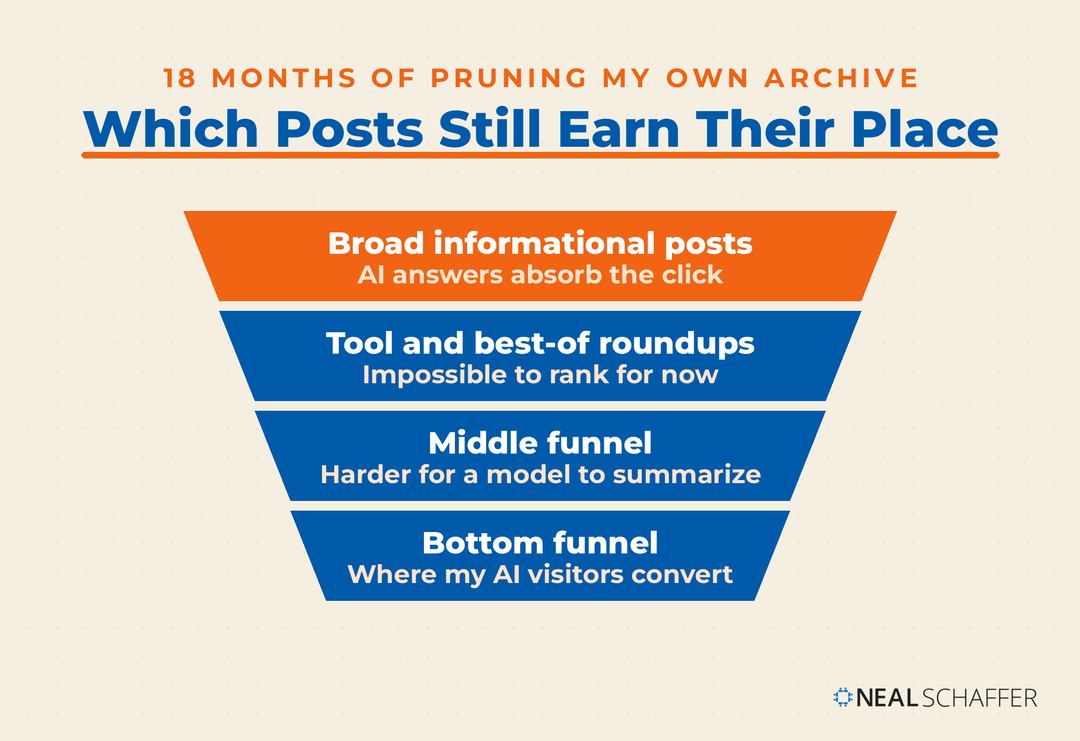
Start at the top of your funnel. Broad informational posts are where AI answers land hardest and where you have the least firsthand experience to add. Middle and bottom funnel content is harder for a model to summarize away, easier to ground in real work, and reaches people closer to a decision.
Some history, because I have skin in this one. A good part of how my blog grew was tool coverage. Not affiliate best-of lists, but genuine reporting on emerging social media marketing technology more than a decade ago, when almost nobody else was writing about it. I cared enough to co-found a conference devoted entirely to the category, the Social Tools Summit, which ran twice in Boston and twice in the Bay Area across 2014 and 2015. Reporting on what I found inside those tools has been part of my DNA for as long as I have been publishing.
And it is now, for practical purposes, impossible to rank for the queries those posts used to own. Not harder. Impossible. Search the best tools in almost any category and the top organic results are mostly the vendors’ own pages, where they used to be third-party roundups like mine. The helpful content update and everything after it changed which pages Google decides to serve at all. On top of that, an AI answer resolves “best X tools” before anyone scrolls. A post whose only job was listing the options has nothing left to do.
That forced a question I did not enjoy asking. What was that content actually doing for my business and for my readers? On honest inspection, a lot of it was doing very little of either. It aggregated information available in twenty other places, went stale within months, and attracted people who wanted a list rather than help.
The shift is that it is less about the tools now and more about what you do with them. People ask me about concepts, tactics and strategy. They rarely ask which product to buy, and when they do, an assistant answers faster than I can. So the tool content I keep is the content grounded in products I actually pay for and use. The rest has been coming off my site for eighteen months, category by category.
Two reasons this connects to everything above. Broad informational queries are exactly where AI answers absorb the click, which the click data further up makes plain. They are also the queries where you have the least experience to contribute, because a roundup is by definition a summary of other people’s work. Middle and bottom funnel content inverts both problems. It resists summarizing, it is where your real experience lives, and it meets people nearer a decision, which is precisely where my own conversion numbers say AI visitors already are.
If you run a blog with more than a few dozen posts, this is the uncomfortable question worth scheduling time for. Which of these posts still serve the business and the reader, and which are only occupying a URL? I have found no way to answer it except post by post.
Answering that honestly means looking at what your own numbers say rather than what you assumed they would say. Mine said something I did not expect.
What Most AI Search Optimization Advice Gets Wrong
I expected AI referrals to land on the pages I had worked hardest on, which is what most advice implies. They didn’t. My blog has fifteen categories, so if AI referrals were spread evenly across them, SEO would take about seven percent of all of them. The SEO posts I actively maintain took 1.25%.
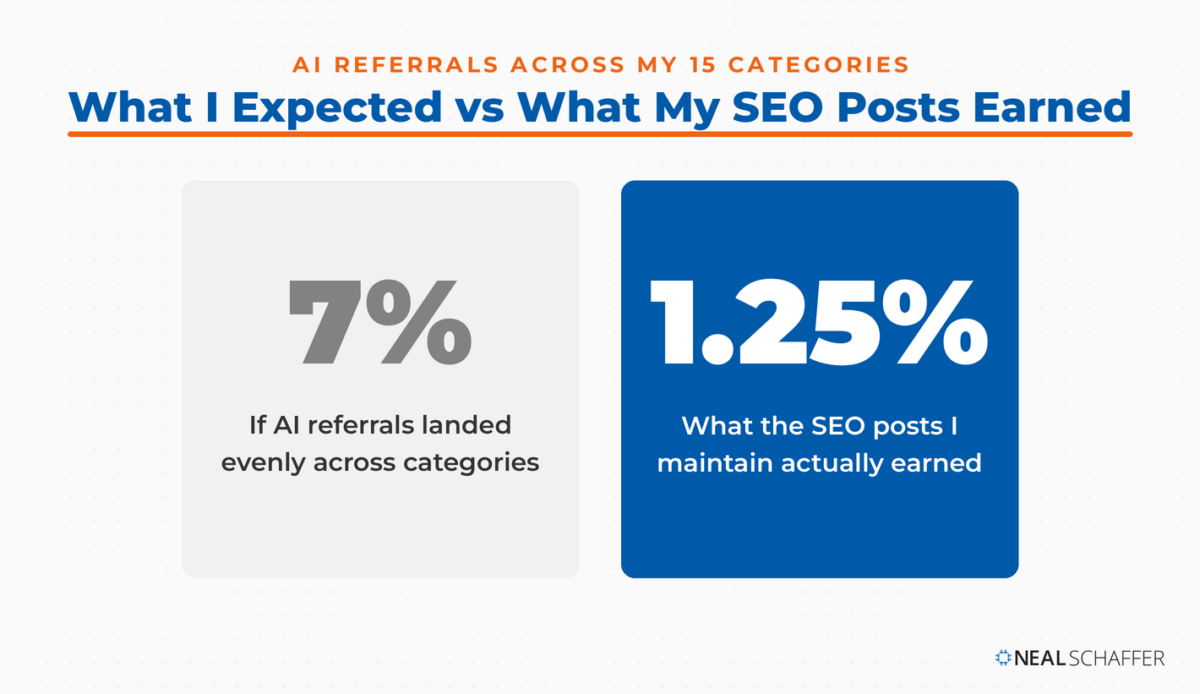
The category about discoverability was the one nobody found. That stung, and it got worse on inspection. The SEO pages earning the most AI referrals were ones I had never invested in: a post on SEO for lawyers, my SEO statistics page, and a post on SEO agencies. Each of them out-earned the pages I had deliberately built up.
Models cite specificity. A narrow post answering a narrow question outperformed my broader, better-optimized pages, which lines up exactly with what the GEO researchers found about statistics and citations beating keyword optimization.
Frequently Asked Questions About AI Search Engine Optimization
Is AI search engine optimization different from SEO?
Not meaningfully, according to Google, whose documentation on generative AI features states that optimizing for generative AI search is still SEO. Those features retrieve from the same index that powers regular results, so a page has to be indexed and snippet-eligible before it can be cited at all. Your SEO strategy is the prerequisite, not the alternative.
Do I need an llms.txt file to be found by AI?
Not for Google Search. Google’s documentation says its Search systems do not use LLMS.txt or similar files, and that maintaining one will neither help nor hurt visibility there. Other systems do read them, so publishing one is harmless but should not be expected to move anything.
How do I measure AI search visibility?
Start with impressions rather than sessions, because the click is now the exception. Google Search Console’s generative AI performance report shows impressions, pages, countries and devices for AI Overviews and AI Mode, and no clicks at all. For assistants outside Google, count referrals by hostname in your analytics rather than trusting a channel grouping, since platform labels change without warning.
Does publishing AI-assisted content hurt my AI search visibility?
Not on its own. Google’s guidance on generative AI content says the policy it may run afoul of is scaled content abuse, which targets pages mass-produced to manipulate rankings rather than the tool used to write them, which is what I found when I dug into whether Google penalizes AI content. The origin of the words matters far less than whether they are worth reading.
Do backlinks still matter for AI search visibility?
Yes, but not the way they matter to Google. A model reading your page cannot see who links to it, so backlinks help only by lifting you into the pool of results the ranking systems assemble before the model ever reads anything. What a model does see is text, which is why a mention of your brand without a link now does work that used to require one, and why digital PR is where I would put the next dollar.
Put These AI Search Optimization Steps to Work
Start with the honest framing. AI search is a citation surface rather than a traffic channel, and the visits it does send are worth several times your site average. Report it that way and you stop chasing a volume number that is not coming back.
Then work in order, because the order matters more than the checklist does. Decide which of your posts still earn their place, and stop maintaining the ones that only ever aggregated what was already published. On the ones you keep, add what nobody can copy: a number from your own data, a tool you actually pay for, a result that went sideways.
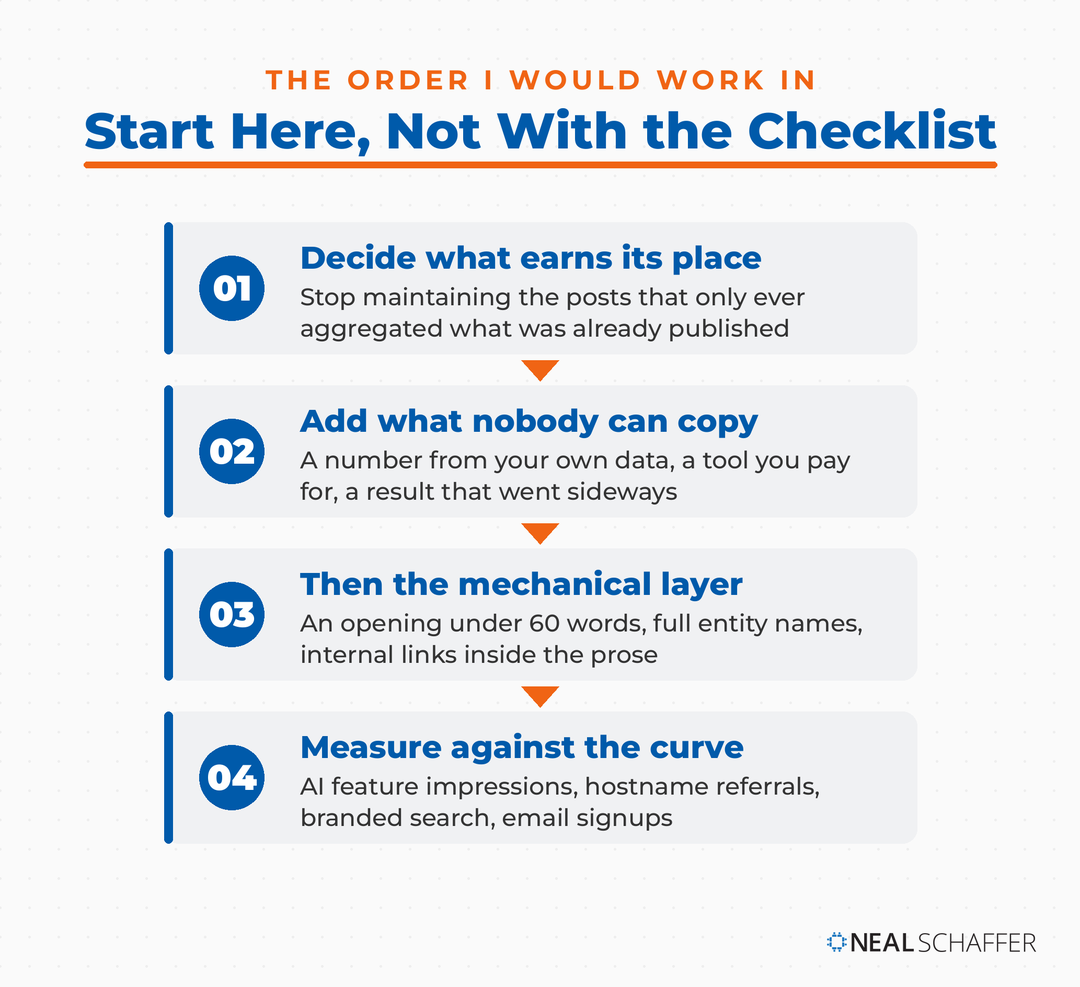
Only then does the mechanical layer pay off. An opening that answers its own heading in under sixty words. Entity names written out in full. Internal links sitting inside your prose rather than in a box underneath it.
Then measure it properly. Set your baseline in Search Console’s generative AI performance report and read it in sixty days against your site-wide curve, not against the page’s own history. My scoreboard has four lines on it now: AI-feature impressions, hostname-level AI referrals, branded search volume, and email signups.
You do not need to buy an AI visibility platform to start. Write down ten questions a customer would ask before hiring you, run them monthly in ChatGPT, Gemini, Claude and Perplexity, and log who showed up instead of you. Check what you already pay for first. Ubersuggest, for one, now has an AI Search Visibility report that runs multiple prompts per topic across models like ChatGPT and Gemini and shows how often your brand turns up against competitors. Site-wide swings move every page at once, and judging one post against its own prior period during one of those stretches will have you crediting or blaming work that had nothing to do with it.
If you want to see the tooling side of this, I keep a running list of the AI SEO tools I actually pay for. And if you would rather build this into a coordinated plan across every channel, that is the work I do as a Fractional CMO. You can also join my newsletter and get what I am testing as I test it.
Actionable advice for your digital / content / influencer / social media marketing.
Join 13,000+ smart professionals who subscribe to my regular updates.