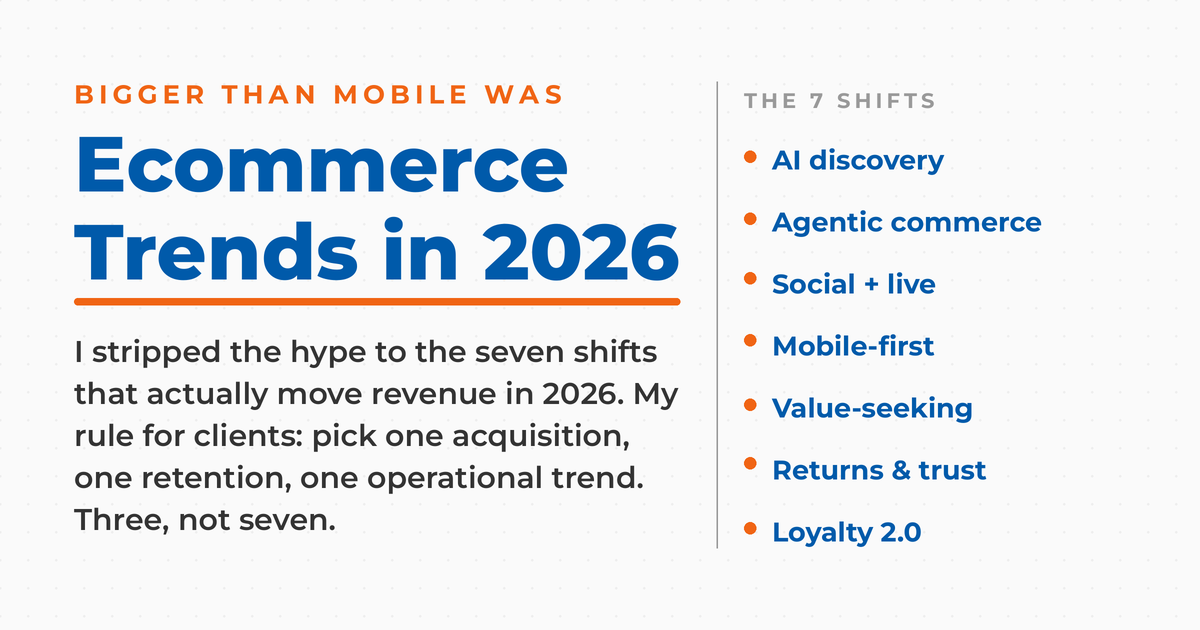

The shift happening in ecommerce right now is bigger than the move to mobile was fifteen years ago.
I don’t say that lightly. When mobile took over, the change was about a screen size and accessibility. What’s happening today is a change in how people find, evaluate, and buy products in the first place. Last holiday season, generative AI tools sent 693% more traffic to U.S. retail sites than they did a year earlier per Adobe Analytics data, and that wasn’t a fluke spike. It’s the new front door to your store.
I’ve been writing and consulting on digital marketing for over fifteen years. As the author of Digital Threads, my modern playbook for small businesses and entrepreneurs, host of the Your Digital Marketing Coach podcast, and a Fractional CMO who also works with ecommerce brands, I see the same question all the time: “Which trends actually matter, and which are noise?”
This isn’t another roundup of every shiny ecommerce trend you’ve already read about somewhere else. I’ve stripped the list down to the seven shifts that I believe will actually move the needle for marketers and brand operators in 2026, and for each one I’ve included the question you should be asking your team this quarter.
Key Takeaways
✅ AI shopping has crossed the tipping point: Salesforce’s Connected Shoppers Report shows 39% of consumers and 54% of Gen Z now use AI for product discovery, which means optimizing for AI is no longer optional.
✅ Agentic commerce is creeping into real transactions, not just research, with AI and agents driving 20% of global orders, or $262 billion in sales, during the most recent holiday season per Salesforce’s data.
✅ Social and livestream commerce now drive both discovery and conversion, with McKinsey research showing companies report livestream conversion rates approaching 30%, up to 10 times higher than conventional ecommerce.
✅ The value-seeking consumer is permanent, not temporary: McKinsey’s holiday consumer research estimated that three-quarters of US consumers traded down in at least one category in early 2025.
✅ Returns are the new profitability battleground, and AI is part of the answer: Adobe research shows 68% of shoppers using AI for online shopping say they’re less likely to return their purchases.
What Are the Most Important Ecommerce Trends in 2026?
The most important ecommerce trends in 2026 are AI-driven discovery, agentic commerce, social and livestream selling, mobile-first design, value-seeking consumer behavior, return-rate management, and loyalty programs that move beyond points. Together they reflect a single shift: shoppers expect personalized, frictionless, trust-rich experiences across every touchpoint, and brands that don’t deliver lose them quickly.
Before I go deeper into each one, here’s a quick overview of where to focus your attention.
| Trend | Why It Matters | What to Do First |
|---|---|---|
| AI-driven discovery | Front-door traffic is shifting from Google to AI assistants | Audit how your product pages render to LLMs |
| Agentic commerce | AI is starting to transact, not just research | Make your product feeds machine-readable and clean |
| Social + livestream | Where Gen Z and Millennials discover products | Pick one platform and commit, don’t spray |
| Mobile-first | The majority of sessions and a growing share of purchases | Test your checkout on a $200 Android, not your iPhone |
| Value-seeking consumers | Cross-category trade-down is the default | Lead with value framing, not status framing |
| Returns and trust | A 20%+ return rate eats your margin alive | Build trust signals into the product page |
| Loyalty beyond points | Acquisition costs keep rising; retention is cheaper | Reward behavior, not just spending |
How Is AI Reshaping Ecommerce Discovery in 2026?
AI is reshaping ecommerce discovery by replacing the search bar with a conversation. Shoppers increasingly start their journey inside ChatGPT, Gemini, Claude, or a built-in AI assistant rather than typing keywords into Google, and they expect product recommendations that understand context, not just match terms. For brands, classic SEO no longer fully covers where buyers are looking.
The data here is striking. As cited above, Salesforce’s research shows 39% of shoppers and 54% of Gen Z are using AI for product discovery, with Gen Z 10 times more likely than baby boomers to do so frequently. And those AI-referred shoppers are not just browsing. The same Adobe analysis cited in the Key Takeaways found that AI referrals converted 31% better than other traffic sources during the 2025 holiday season, while AI-driven revenue per visit climbed 254% year over year.
Here’s what this means in practice: when a shopper asks “what’s a good waterproof daypack under $80,” an AI assistant doesn’t return ten links. It returns two or three product recommendations that match the intent. If your product page is built for keyword matching but doesn’t read clearly to a language model, you’re invisible at exactly the moment of consideration.
As Caila Schwartz, Director of Industry Insights at Salesforce, put it:
“The best-performing content anticipates what a shopper is trying to solve, not just what they’re searching for.”
This is why I’ve started treating answer engine optimization as a peer to traditional SEO for ecommerce, not an afterthought. The next step is making sure your category and product content reads cleanly to AI systems: structured data, plain-language descriptions of what the product solves, and FAQs that mirror the questions shoppers actually ask out loud. I cover the deeper playbook in my work on AI in ecommerce, but the headline is simple: build for both Google and the LLMs, because the next dollar of growth is increasingly coming from the second one.
What to do this quarter: Pick two or three of your top-selling products. Open ChatGPT or Gemini and ask the kind of question a real shopper would ask, “what’s a good [product category] under $ [price],” without naming your brand. See whether your product shows up in the answer. If it doesn’t, that’s your starting point.
What Is Agentic Commerce, and Should You Care Yet?
Agentic commerce is when an AI agent makes a purchase on behalf of a human, not just researches it. The shopper says “reorder my coffee under $25 with the fastest shipping” and the agent handles the rest. It’s still early, but the shift is already showing up in real transaction data.
As noted in the Key Takeaways, Salesforce’s State of Marketing 2026 report found that AI and agents drove 20% of global orders, or $262 billion in sales, during the most recent holiday season. That’s not “the future.” That’s last quarter.
The skeptical reaction is fair. Most consumers aren’t yet letting AI buy things fully autonomously. But here’s the part marketers are missing: the agent doesn’t have to complete the whole purchase to change your business. Even when it only narrows the consideration set down to two or three options, the brands that don’t make that shortlist are out of the running before a human ever weighs in. That dynamic bites hardest in B2B, where buying committees already work from a shortlist, and the B2B ecommerce examples worth studying are the ones whose product data earns a place on it without a salesperson in the room.
There’s a quieter implication for your operations too. Agents read structured product data far better than they read marketing copy. If your catalog has missing attributes, inconsistent variant naming, or descriptions that read like they were written for SEO in 2018, you’re handing wins to competitors with cleaner data. This is the unglamorous work I find ecommerce brands resist most, even though it’s exactly where the lift sits. Everything I cover in my post on ecommerce KPIs becomes more valuable when your underlying data is in shape, because agents will use those same data points to make recommendations.
What to do this quarter: Audit your product feed the way an AI agent would read it. Missing fields. Vague descriptions. Inconsistent units. Fix those first.
Why Are Social and Livestream Commerce Becoming the New Mall?
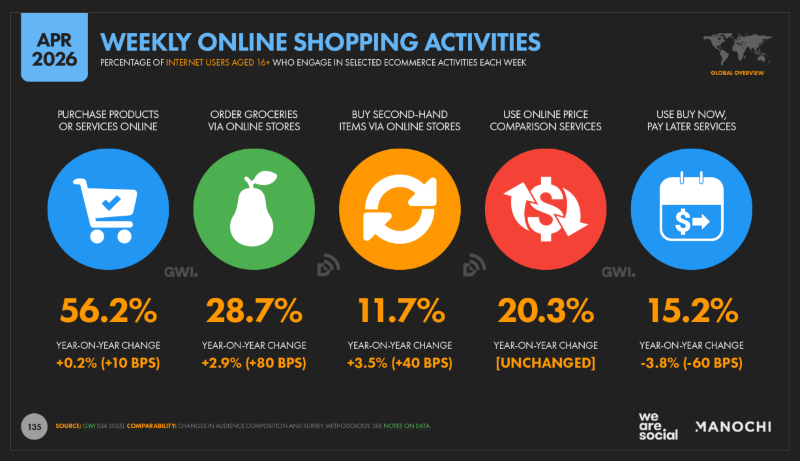
Social and livestream commerce are becoming the new mall because they collapse three steps into one: discovery, social proof, and purchase happen inside the same scroll. As cited in the Key Takeaways, McKinsey’s research shows companies running livestream events report conversion rates approaching 30%, roughly ten times higher than traditional ecommerce. That gap is why this matters. The growth backs it up. EMARKETER’s livestream commerce coverage reports US livestream commerce grew nearly 50% in 2025 to $14.64 billion with buyer counts jumping 21.5% year over year, and DataReportal’s Global Digital Overview, citing GWI survey data, shows 56.2% of internet users aged 16 and older now buy something online every week.
I want to be careful with the hype here. Most brands I work with as a Fractional CMO don’t need to be live-streaming three nights a week on TikTok Shop. What they do need is to recognize that for younger buyers, the product discovery that used to happen in a mall, on Pinterest, or via a Google search is increasingly happening in short-form video and creator-led content.
The practical move is platform discipline. You probably can’t run a great presence on TikTok Shop, Instagram Shopping, YouTube Shopping, and Pinterest at the same time. Pick the one where your audience already lives, get good at it, and only expand once you have a working playbook. I built my own creator-partnership approach around exactly this principle: pick fewer channels, go deeper.
One Strategy to Connect All Your Marketing
My latest book helps small businesses, entrepreneurs, and marketers bring search, email, and social together into one digital marketing strategy that actually compounds.
Drawing on my work as a Fractional CMO, Digital Threads turns complicated tactics into a clear, practical plan you can follow, whatever your budget or team size.
Grab your copy on Amazon and start weaving your own digital threads. Click the cover or the button below to get started.

If you’re a Shopify merchant, Shopify Collabs makes the creator side of social commerce easier than it was even two years ago, but the platform doesn’t substitute for a clear point of view about why a creator should care about your product.
What to do this quarter: Watch one full hour of livestream commerce in your category. Note what hooks viewers in the first ten seconds. That’s your starting template. From there go in-house or begin collaborating with influencers who regularly livestream.
How Mobile-First Stopped Being Optional
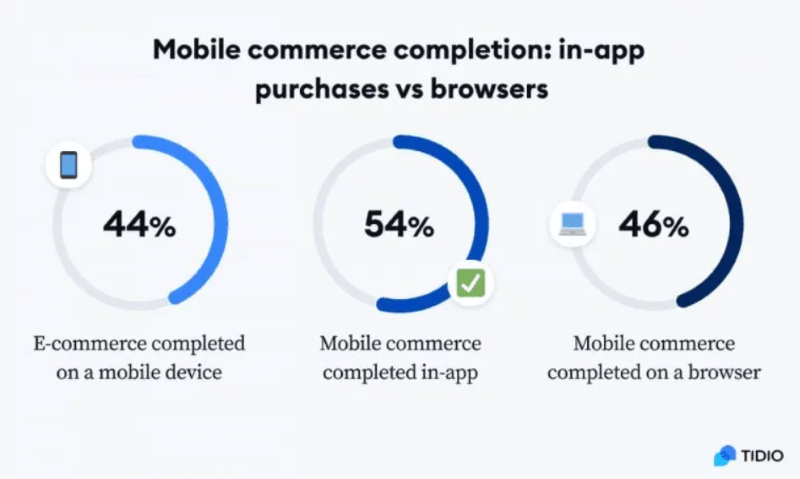
Mobile-first stopped being optional because mobile is now the default device for both browsing and buying. Adobe’s Cyber Monday data showed mobile share crossed 60% on Thanksgiving for the first time in 2025, hitting 61.6%. Most ecommerce brands I audit still treat mobile as a scaled-down desktop site rather than designing for thumbs first.
This isn’t a design rant. It’s a conversion rant.
Imagine this: your desktop site looks great, your mobile site is technically responsive, and your marketing team tests on the latest iPhone connected to fast Wi-Fi. Then you look at your analytics and realize a real chunk of your buyers are on three-year-old Android devices with painfully slow page-load times, trying to tap a tiny “add to cart” button hidden below five social proof modules.
If you’re serious about mobile, three things matter more than the rest:
- Speed: a checkout that loads in 1.5 seconds versus 4 seconds is a real revenue gap, not a vanity metric.
- Thumb zone: keep your primary CTA within natural thumb reach, the bottom third of the screen, where one-handed shoppers can tap without stretching or shifting their grip.
- One-tap checkout: Shop Pay, Apple Pay, Google Pay aren’t features anymore, they’re table stakes.
The good news is that the same fundamentals that improve mobile experience also lift desktop conversion. Better page speed, cleaner forms, fewer popups: these are mobile fixes that compound across devices.
What to do this quarter: Borrow a friend’s three-year-old Android. Try to buy something on your own site. Time how long it takes. Then fix the worst friction first.
Why the Value-Seeking Consumer Is Here to Stay
The value-seeking consumer is here to stay because what looked like a temporary inflation reaction has hardened into permanent shopping behavior. McKinsey’s holiday research, cited in the Key Takeaways, shows three-quarters of consumers reported trading down in at least one category in early 2025, with cross-category trade-downs becoming more common than within-category swaps.
This isn’t just a low-income story. It cuts across income brackets. For ecommerce marketers, the implication is uncomfortable: brand-only positioning isn’t enough. The shoppers most willing to spend on you are also the most willing to leave you for a private-label or secondhand alternative if the value math stops working.
This is also why re-commerce, the resale and secondhand market, keeps growing. Publicis Sapient found that over 44% of UK consumers are buying more secondhand items than they did a year ago, while another 57% say their re-commerce shopping behavior has stayed consistent. That’s roughly the entire market either growing into or staying with secondhand.
Three practical implications for your marketing:
The first is to stop hiding price. If you have a strong value story, lead with it. The second is to lean harder into bundles, subscriptions, and member pricing, the formats that let value-seekers feel smart without feeling cheap. The third is to take a hard look at your loyalty program, because for value-seekers, that’s where the math tips in your favor or against you.
In the various ecommerce email marketing sequences I’ve seen, the highest-performing flows are the ones that explicitly help the buyer feel like they’re winning, not the ones that emphasize aspiration.
What to do this quarter: Rewrite your homepage hero with value front and center. If “save 20% on your first subscription” out-converts your current message, you’ve learned something.
Why Returns and Trust Are the New Margin Battleground
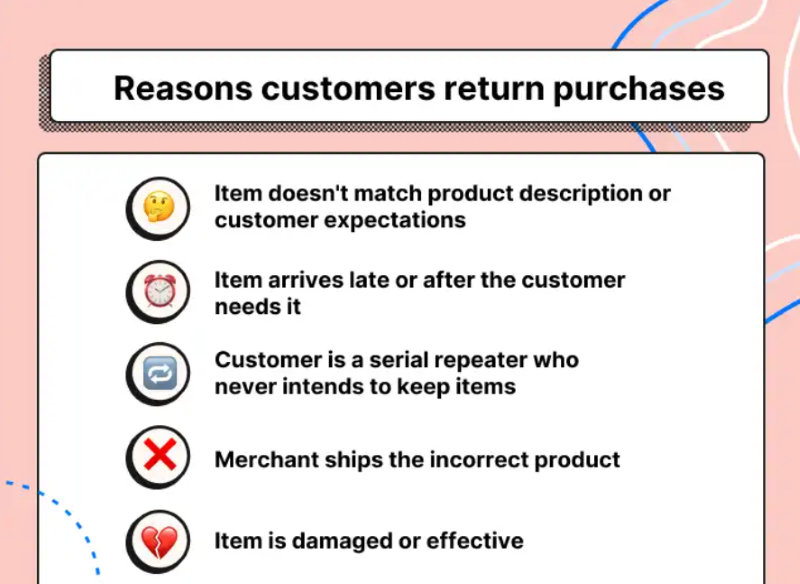
Returns and trust are the new margin battleground because rising return rates are quietly eating ecommerce profitability, and the solutions live on the marketing side, not the operations side. The NRF projected a 19.3% return rate for ecommerce in 2025. You can move this number with better content, better fit guidance, and clearer product pages.
The Adobe holiday data already cited in the Key Takeaways tells the rest of the story: 65% of consumers using AI for online shopping report being more confident in their purchase, and 68% report being less likely to return the product after using AI for it. Read that twice. AI isn’t just driving traffic and conversion. It’s driving better-fit purchases, which means lower returns, and which also means more retained margin.
The connection between trust and returns is direct. When buyers don’t know what they’re getting, they bracket (order three sizes, return two) or cancel. When the product page anticipates the questions they’d ask in-store (“does this run small,” “is this dishwasher safe”), they buy with confidence and keep what they buy.
The brands that invest in honest, specific product content (not stock-photo gallery walls but real images, real fit notes, real ingredient lists) will see better return profiles than competitors with prettier but less informative pages. Strong ecommerce photography and authentic user-generated content are two of the most cost-effective return-rate fixes I recommend, because they tackle the root cause: shoppers ordering things that don’t match what arrives. Whatever ecommerce tools you’re paying for matter less than this fundamental discipline.
What to do this quarter: Pull your top five returned SKUs and read the return reason notes. For each one, ask what specific detail (a size note, a material close-up, a fit comparison, an ingredient warning) would have prevented that return. Add it to the product page.
How Will Loyalty Evolve Beyond Points in 2026?
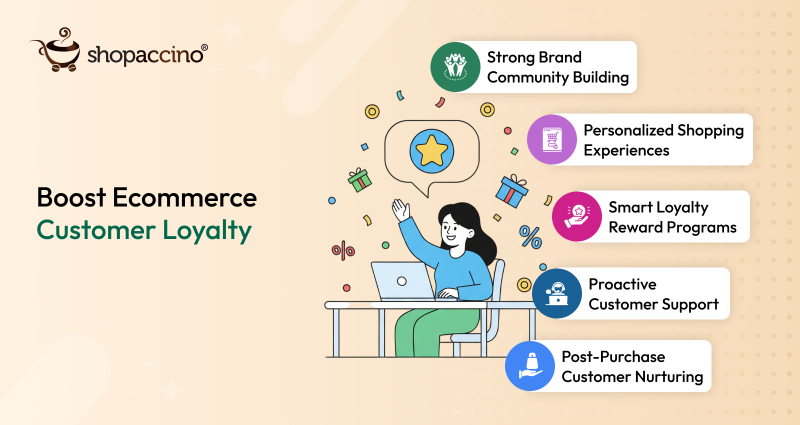
Loyalty in 2026 will evolve beyond points because customers are no longer impressed by “spend $1, earn 1 point” math, and brands can’t afford the acquisition costs anymore. SAP Emarsys’s Customer Loyalty Index 2025 shows true loyalty dropped from 34% to 29% in a single year, which means the bar for keeping a customer is rising fast.
The brands I see winning here are doing two things differently. First, they’re rewarding behavior, not just spending. Reviews, referrals, social shares, repeat visits: these are the actions that compound. Second, they’re treating their best customers like community members, not point-balance holders. Early access, founder updates, in-person or virtual events, recognition.
This connects directly to what I cover throughout Digital Threads: the brands that win in a digital-first economy are the ones that treat customers as collaborators, not transactions. That framework hasn’t aged. If anything, it’s gotten more relevant as acquisition channels get more expensive and AI-mediated discovery makes brand affinity harder to build at the top of the funnel.
For larger ecommerce brands selling on marketplaces, this also extends to your Amazon marketing strategy, where the platform owns the relationship by default and you have to work harder to build a customer connection that survives them moving between channels. The competitive context is intense: Store Leads tracks roughly 2.83 million live Shopify stores growing at 11% year over year, and Capital One Shopping’s research puts US ecommerce at $299.6 billion in Q3 2025 alone. The loyalty math gets harder as the field gets more crowded.
What to do this quarter: Ask your top 20 customers (by lifetime value) what would make them recommend you to a friend. The answer is rarely “more points.”
Which Ecommerce Trends Are Overhyped in 2026?
The most overhyped ecommerce trends in 2026 are headless commerce for small brands, full-store AR/VR experiences, voice commerce, and any “metaverse” pitch. These are real technologies with real edge cases, but for the typical small or mid-sized ecommerce brand, they’re distractions from the work that actually moves revenue.
I’ll be blunt because someone needs to be.
Headless commerce is genuinely useful for enterprise stores with complex catalog needs and engineering teams in place. For a brand doing under $20M, it’s almost always a solution looking for a problem. You don’t need a headless build. You need better product photography, faster page loads on the platform you’re already using, and an actual email retention strategy.
AR try-ons work in narrow categories: eyewear, furniture, lipstick, and a handful of others where the format genuinely reduces purchase risk. Outside those niches, they’re an expensive feature that nobody uses.
Voice commerce has been “the next big thing” for almost a decade. It’s still niche, still mostly used for re-ordering staples, and still not where I’d allocate scarce dev hours.
The “metaverse” was a 2022 fever dream that quietly disappeared from earnings calls. If a vendor pitches you on it in 2026, smile and walk away.
Where should that energy go instead? Boring, durable wins:
- A site speed audit and fix.
- A real conversion rate optimization process driven by ecommerce analytics you actually look at every week.
- Better product copy informed by how your customers describe the problem in their own words.
- A retention sequence that runs without you.
These are unsexy. They also reliably make money.
Your Quick-Action Checklist for 2026
If you only have five hours this quarter to act on what’s in this post, spend them here:
| Hour | Action | Outcome |
|---|---|---|
| 1 | Audit one product page through ChatGPT or Gemini | See your store the way an AI shopper does |
| 2 | Try to buy something on your site from a slow Android | Find the real mobile friction |
| 3 | Watch a live shopping stream in your category | Build a creator-content brief from it |
| 4 | Pull your top 5 return reasons | Identify content gaps on product pages |
| 5 | Email your top 20 customers with one question | Hear what loyalty actually means to them |
Most ecommerce brands I work with already have the budget. They just don’t have the prioritization. This list flips that.
Once you’ve worked through the five hours, the next question is what to actually commit to for the quarter. The framework I recommend for my Fractional CMO clients is simple: pick one acquisition trend, one retention trend, and one operational trend. Three total. Not seven. Not “all of them.”
| Bucket | Pick from these 2026 trends | What it should produce |
|---|---|---|
| Acquisition | AI/AEO content optimization, social commerce video, creator partnerships | Lower-cost first-time buyers |
| Retention | Loyalty redesign, behavior-triggered email and SMS, post-purchase upsells | Higher repeat purchase rate, lower CAC payback |
| Operational | Returns process redesign, mobile site speed, product feed cleanup | Higher contribution margin per order |
The brands I’ve watched succeed in 2026 aren’t the ones with the most ambitious trend list. They’re the ones who picked a small set of priorities and outworked their competitors on execution.
For broader strategy across the funnel, the questions in this post are deliberately upstream of the tactical work I cover in my post on ecommerce marketing, and my ecommerce statistics reference post is where you’ll find more of the underlying data points if you want to build out a board deck. For category-by-category sales tracking, eMarketer’s ecommerce hub and Statista’s online shopping overview are the two I recommend to size up a new client’s market.
Frequently Asked Questions
The biggest ecommerce trend in 2026 is the shift of product discovery from traditional search to AI assistants. Adobe data shows AI-driven traffic to retail sites grew dramatically during the 2025 holiday season, and that traffic now converts better than other channels. Brands that don’t adapt their content to be AI-readable will lose top-of-funnel reach.
AI is changing ecommerce in three ways: it’s the new front door for discovery, it’s starting to make purchase decisions through agents, and it’s improving conversion rates for shoppers who use it. The same Adobe research found AI-referred shoppers spend 45% more time on retail sites and view 13% more pages, signaling stronger intent than typical visitors.
Social commerce is worth investing in for small brands, but only on one platform at a time. The data shows livestream commerce can convert at up to 10 times the rate of standard ecommerce, but only when brands invest in creator partnerships, regular cadence, and platform-native content. Spreading thin across four platforms wastes more money than it earns.
Marketers should ignore the trend predictions that read like vendor wish lists rather than consumer behavior shifts. Headless commerce for small brands, blockchain product passports, and full virtual reality showrooms each have niche use cases, but they’re not where most brands should focus first. Master AI-readable content, mobile checkout, and retention before chasing the speculative tech.
Ready to Turn These Ecommerce Trends Into Action?
Reading about trends is easy. Acting on them is where most brands stall. If I had to bet on which of these seven shifts will make or break ecommerce brands in 2026, I’d bet on the first one (AI-driven discovery) and the last one (loyalty beyond points). One determines whether new buyers find you. The other determines whether they come back.
If you want help thinking through how these trends apply to your specific business, my Fractional CMO services work with brands building digital-first strategies that align acquisition, retention, and brand. For entrepreneurs and creators who want a community of operators thinking about this together, my Digital First Group Coaching Community is where I have these conversations weekly. And if you’d rather get the underlying playbook in one place, you can grab a free preview of Digital Threads, which lays out the framework I use with my own clients.
Pick one trend from this post. Schedule one hour next week to act on it. That’s how the brands ahead of you are pulling away.