Editorial Note: I may earn a commission when you visit links that appear on my website.
Welcome Email: How to Write One That Turns New Subscribers into Loyal Fans (with Examples)
You just got a new email subscriber. They filled out your form, clicked the button, and basically raised their hand and said, “I’m interested in what you’ve got.”
So what happens next?
For too many businesses, the answer is: nothing. Or worse, a bland, generic “Thanks for subscribing” message that reads like it was written by a robot in 2011 (or a generic ChatGPT response in 2026). And that’s a massive missed opportunity, because the welcome email is the single highest-performing email you will ever send.
According to GetResponse’s email benchmark data, welcome emails achieve an average open rate of 83.6%, making them the highest-performing automated email type. Compare that to the average marketing email open rate of 30% to 40%, and the gap is staggering. Your new subscribers are paying attention right now, in this exact moment, more than they ever will again.
As someone who has been helping businesses build their email marketing strategies for years, and as the author of Digital Threads and host of the Your Digital Marketing Coach podcast, I can tell you from experience: the welcome email is where most businesses either build a relationship or lose a subscriber. And most are losing.
Here’s what I want you to walk away with today: a clear, practical framework for writing welcome emails that actually work, whether you’re running an ecommerce store, a service business, or building a personal brand.
Key Takeaways
✅ Welcome emails get dramatically higher open and click rates than any other email type, so skipping them means leaving your best engagement window on the table.
✅ A welcome email series of 3 to 5 emails outperforms a single welcome message, generating up to 51% more revenue according to Mailchimp’s research.
✅ Your first welcome email should be sent immediately after signup, not hours or days later, when subscriber interest is at its peak.
✅ Every welcome email needs one clear call to action, not five competing links fighting for attention.

✅ Personalization goes beyond first names: segment by how subscribers joined your list and tailor the welcome experience accordingly.
✅ Testing subject lines, timing, and content within your welcome series is one of the highest-ROI optimization activities in all of email marketing.
What Is a Welcome Email and Why Does It Matter So Much?
A welcome email is the very first message that a new subscriber receives after joining your email list. It could be triggered by a newsletter signup, a lead magnet download, a first purchase, or a free trial registration. Think of it as your digital handshake, the moment where you set the tone for the entire relationship.
Here’s why it matters more than most marketers realize: your new subscriber’s attention and interest will never be higher than in the minutes after they sign up. They just took an action. They’re curious. They’re engaged. And if you don’t capitalize on that window, you’re essentially leaving your front door wide open and walking away.
The data backs this up across the board. Omnisend’s 2026 ecommerce report found that the average welcome email open rate is 34.79% with a click-to-conversion rate of 58.26%. That second number is the one that should grab you: more than half the people who click through a welcome email go on to convert.
| Metric | Welcome Email | Regular Campaign |
|---|---|---|
| Open Rate | 50-83% | 35-43% |
| Click-Through Rate | 5x higher | Baseline |
| Revenue Per Email | $2.87 (automated) | $0.18 (broadcast) |
And it goes deeper than just one email. According to EmailToolTester’s research, 74% of new subscribers actually expect to receive a welcome email when they join a list. Skip it, and you’re breaking an expectation before the relationship even starts.
I think about it like this: imagine someone walks into your store for the first time and you just ignore them. No greeting, no eye contact, no acknowledgment. They’d probably leave. That’s exactly what happens when you skip the welcome email.
What Should You Include in Your Welcome Email?
Not every welcome email needs to look the same, but the best ones share a few common elements. Here’s what to include, ordered by priority.
A Clear, Compelling Subject Line
Your subject line is doing all the heavy lifting to get that email opened. Keep it short (6 to 10 words works best), make it clear, and if you promised something at signup, reference it immediately. Something like “Your 15% off code is inside” or “Welcome! Here’s what to expect” beats a generic “Thanks for subscribing” every time.
Research from Campaign Monitor shows that personalized subject lines (ones that include the subscriber’s name, for example) can increase open rates by 26%. But don’t overthink this: clarity always beats cleverness. If your subject line is confusing, it doesn’t matter how creative it is.
For a deeper look at what makes subject lines work, check out my guide on email subject lines.
Deliver on Your Promise
If someone signed up for a discount code, a free guide, or access to a resource, put that front and center. Not buried at the bottom. Not hidden behind three paragraphs about your company history. Right at the top.
This sounds obvious, but you’d be surprised how many welcome emails bury the lead. Your subscriber signed up for a specific reason. Acknowledge that reason immediately and deliver on it. Trust is built in the first interaction, and nothing breaks trust faster than making someone hunt for what you promised them.
Set Expectations
Tell subscribers what they’ll receive from you and how often. Will you email weekly? Twice a month? Will they get product updates, educational content, special offers? Being upfront about frequency and content type reduces unsubscribes later because people know what they signed up for.
According to Braze’s welcome email research, the most effective welcome emails are the ones where the subject line, preview text, and opening line all align, so subscribers get exactly what they expected when they open.
One Strategy to Connect All Your Marketing
My latest book helps small businesses, entrepreneurs, and marketers bring search, email, and social together into one digital marketing strategy that actually compounds.
Drawing on my work as a Fractional CMO, Digital Threads turns complicated tactics into a clear, practical plan you can follow, whatever your budget or team size.
Grab your copy on Amazon and start weaving your own digital threads. Click the cover or the button below to get started.

One Clear Call to Action
This is where most businesses go wrong. They stuff their welcome email with five different links, three product categories, a social media follow request, and a survey. The result? Decision paralysis. The subscriber clicks nothing.
The best welcome emails have one job. One CTA. Maybe it’s “Shop now with your discount.” Maybe it’s “Download your free guide.” Maybe it’s “Reply and tell me your biggest challenge.” Whatever it is, make it unmissable and make it singular.
A Human Touch
People connect with people, not logos. Consider including a personal note from the founder, a brief origin story, or even just a casual, conversational tone that doesn’t feel like it came from a corporate communications department. This is your chance to show personality.
Andy Crestodina, CMO of Orbit Media, calls the welcome series “both smart marketing and common courtesy,” noting that open and click-through rates are often double any other email you send. — ActiveCampaign
Should You Send a Single Welcome Email or a Welcome Email Series?
Here’s where I see a lot of businesses leaving money on the table. A single welcome email is better than nothing, absolutely. But a welcome email series, a sequence of 3 to 5 automated emails sent over the course of a week or two, consistently outperforms.
Mailchimp’s case study data shows that sending a series of welcome emails generates an average of 51% more revenue than a single welcome message. The logic is straightforward: you can’t build a relationship, establish trust, educate a subscriber, and drive a conversion all in one email. A series gives you room to do each of those things well.
If you’re already using email marketing automation, setting up a welcome series is one of the simplest, highest-impact automations you can build. It’s essentially a form of drip marketing, where each email has a specific purpose and moves the subscriber closer to becoming a customer.
How Many Emails Should Be in Your Welcome Series?
Most email marketing experts recommend 3 to 5 emails. Klaviyo’s documentation suggests a standard 3-email welcome series sent over the course of a week as a starting point. Questline Digital’s data confirms that going beyond five emails tends to result in lower open rates for later sends.
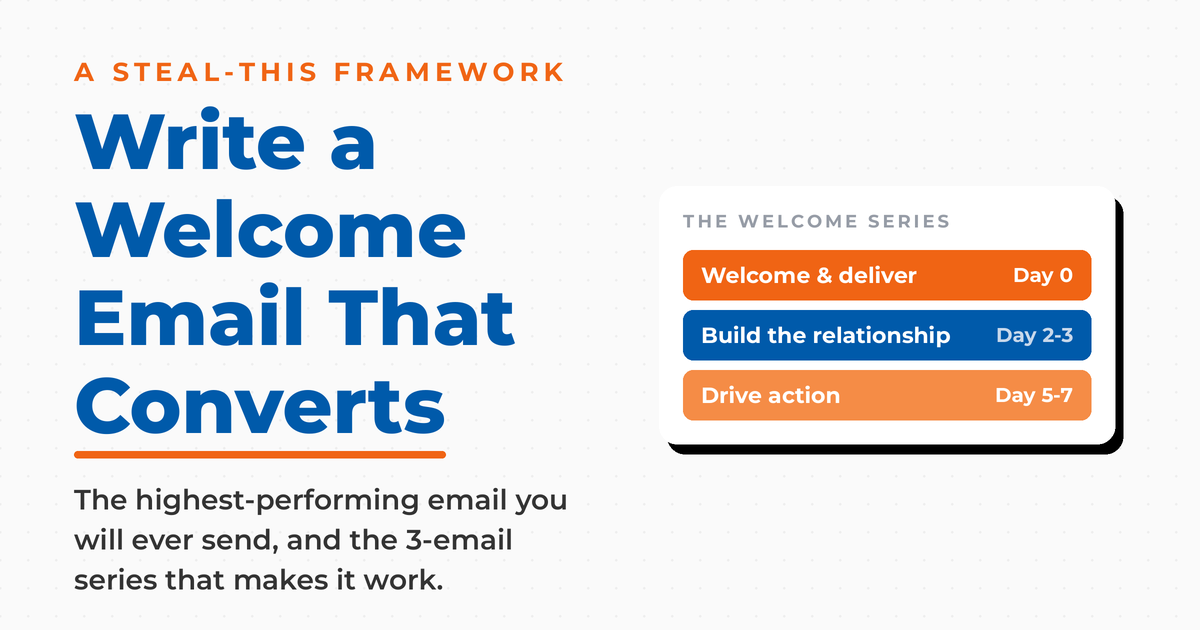
I recommend starting with three emails and expanding from there based on your results. Here’s a framework you can steal:
| Timing | Purpose | Content Focus | |
|---|---|---|---|
| Email 1 | Immediately | Welcome and deliver | Say hello, deliver the promised incentive or resource, set expectations |
| Email 2 | 2-3 days later | Build the relationship | Share your story, highlight best content, or ask a question |
| Email 3 | 5-7 days after signup | Drive action | Showcase bestsellers, invite to community, or remind about unused offer |
| Email 4 (optional) | 7-10 days | Social proof | Share testimonials, case studies, or user success stories |
| Email 5 (optional) | 10-14 days | Re-engage | Final reminder of incentive, or invite feedback |
The timing between emails matters. You want to stay present without becoming annoying. Every 2 to 3 days is the sweet spot for most audiences. And your first email should always go out immediately, not 24 hours later. That moment of peak interest fades fast.
How Do You Write Welcome Emails for Different Business Types?
This is something most guides miss entirely. A welcome email for an ecommerce brand looks very different from one sent by a consultant or a B2B SaaS company. Here’s how to adapt the framework.
Ecommerce Welcome Emails
For online stores, the welcome email is often tied to a first-purchase incentive (a discount code, free shipping, etc.). Your job is to get that first transaction done while simultaneously introducing the brand.
What works: lead with the incentive, showcase 3 to 4 bestselling products, include social proof (reviews or user photos), and create a sense of urgency around the offer. If you’re in ecommerce, my guide on ecommerce email marketing goes much deeper on this.
Service Business and Consultant Welcome Emails
For service providers, coaches, and consultants, the goal isn’t usually an immediate purchase. It’s building enough trust that the subscriber eventually books a call, signs up for a program, or refers you to someone who needs your help.
What works: share your best educational content, tell the story of why you do what you do, and position yourself as a trusted advisor rather than a salesperson. I’ve found that sharing a single, high-value resource (your best blog post, a short video, a PDF guide) outperforms trying to cram your entire service menu into one email.
B2B Welcome Emails
For B2B companies, the welcome email often serves as the beginning of a longer nurture sequence. Your subscriber might be months away from a purchasing decision, so the goal is education and relationship building.
What works: deliver the content asset they signed up for, introduce the company’s point of view on the industry (not a product pitch), and offer a next step that’s low commitment, like subscribing to your newsletter or joining an upcoming webinar.
Newsletter or Blog Welcome Emails
If someone subscribed to your newsletter or blog, they want content, not a hard sell. Your welcome email should introduce what they can expect, when they’ll hear from you, and give them a taste of your best work.
I do this for my own newsletter at newsletter.nealschaffer.com: the welcome email thanks them, tells them what to expect, and links to a few of my most popular posts. Simple, but it works.
What Are the Biggest Welcome Email Mistakes to Avoid?
After reviewing hundreds of welcome emails (both from clients and from brands I subscribe to myself), here are the mistakes I see over and over.
Waiting Too Long to Send
If your welcome email arrives 24 hours after signup, you’ve already lost most of the magic. The subscriber has moved on, forgotten why they signed up, and your email lands in an inbox full of other things competing for attention. Send it immediately. Every major email marketing tool supports instant automated triggers for this exact reason.
Being Too Salesy Too Soon
Your welcome email is not the place for a hard sell (unless you specifically promised a discount at signup, in which case, deliver it). This is the handshake. The introduction. If you jump straight to “Buy now!” without building any relationship first, you’ll see high unsubscribe rates and low engagement going forward.
Forgetting Mobile Optimization
More than half of all emails are opened on mobile devices. If your welcome email isn’t mobile-friendly, with readable text, tappable buttons, and images that load quickly, you’re creating friction at the worst possible moment. Check out my guide on email marketing design for practical tips on making your emails look great everywhere.
Including Too Many Calls to Action
I mentioned this earlier, but it bears repeating: one CTA per email. Not three. Not five. One. The more options you give someone, the less likely they are to act on any of them. This principle from email copywriting applies even more strongly to welcome emails, where the subscriber is still figuring out who you are.
Not Segmenting Your Welcome Experience
Someone who downloaded a free guide about Instagram marketing and someone who signed up for a product demo should not receive the same welcome email. If you have the data to segment (and most signup forms can collect enough), use it. The more relevant your welcome message is to the specific reason someone joined your list, the better your results will be.
How Do You Measure Welcome Email Performance?
You can’t improve what you don’t measure. Here are the metrics that actually matter for welcome emails.
Open rate is the obvious starting point, but keep in mind that Apple’s Mail Privacy Protection continues to inflate this number. According to MailerLite’s 2025 benchmark report, the average email open rate across all industries has climbed to 43.46%, partly due to privacy changes that automatically pre-load tracking pixels. Use open rate directionally, not as gospel truth.
Click-through rate (CTR) is more reliable. It tells you whether people are actually engaging with your content and taking the actions you want them to take. A good welcome email CTR should significantly exceed your regular campaign CTR.
Click-to-open rate (CTOR) is even better for measuring content quality. It tells you: of the people who opened, how many clicked? This isolates the effectiveness of your email content from the performance of your subject line.
Conversion rate is the ultimate measure. Whether your goal is a purchase, a download, a booking, or a reply, track how many welcome email recipients complete that action.
Unsubscribe rate after the welcome sequence tells you whether you’re setting the right expectations. A high early unsubscribe rate often means your welcome email promised something different from what subscribers are actually receiving.
For a comprehensive look at all the metrics you should be tracking, my post on improving your email open rate covers both the benchmarks and the practical tactics.
Which Tools Make It Easy to Set Up a Welcome Email Series?
You don’t need an enterprise marketing platform to build an effective welcome series. Most modern email marketing software includes automation builders that make this straightforward.
Here are the platforms I recommend based on my experience working with small and mid-sized businesses:
Klaviyo is the go-to for ecommerce brands. It comes with pre-built welcome series flows and deep integration with Shopify, WooCommerce, and other ecommerce platforms. The behavioral targeting is especially strong.
Mailchimp remains a solid choice for businesses just getting started. Its automation builder is intuitive, and the free tier includes basic automation features that are sufficient for a simple welcome series.
ConvertKit (now Kit) is my recommendation for creators, bloggers, and coaches. The visual automation builder makes it easy to create branching welcome sequences based on subscriber behavior.
ActiveCampaign is powerful for businesses that need advanced segmentation and CRM integration. If you’re running a more sophisticated email marketing campaign with multiple segments and conditional logic, this is where it shines.
| Platform | Best For | Automation | Free Tier |
|---|---|---|---|
| Klaviyo | Ecommerce | Advanced flows | Up to 250 contacts |
| Mailchimp | Getting started | Basic automation | Up to 500 contacts |
| ConvertKit (Kit) | Creators/coaches | Visual builder | Up to 10,000 contacts |
| ActiveCampaign | B2B/segmentation | Advanced + CRM | 14-day trial |
The tool matters less than the strategy. Pick one, set up your welcome series, and start testing. You can always switch platforms later.
How Do You Optimize Your Welcome Emails Over Time?
Setting up your welcome series isn’t a one-and-done project. The businesses that get the best results treat it as a living system that gets refined over time. Here’s what to test:
Subject lines are the easiest and highest-impact thing to A/B test. Try variations that lead with curiosity versus clarity, personalized versus generic, or emoji versus no emoji. Even small subject line improvements can meaningfully lift open rates.
Send timing for emails 2 through 5 in your series. Try spacing them 2 days apart versus 3 days apart. Some audiences prefer more frequent contact during the onboarding phase; others feel overwhelmed.
CTA placement and design. Test a button CTA versus a text link. Test it at the top of the email versus the bottom. Test different copy on the button itself.
Content approach. In your second email, test an educational approach (sharing your best content) against a social proof approach (testimonials and reviews). See which drives more engagement and downstream conversions.
Series length. If you started with 3 emails, try adding a 4th and measure whether it improves or hurts overall sequence performance.
The key insight is this: your welcome series is talking to every single new subscriber. Small improvements compound over time because they affect every person who joins your list from that point forward. A 10% improvement in your welcome series conversion rate is a 10% improvement that keeps paying dividends.
For more on email marketing best practices including optimization tactics that apply beyond welcome emails, I’ve put together a comprehensive guide.
Got everything I need. Here’s the replacement section — swap out the current “Welcome Email Examples Worth Studying” section with this:
7 Welcome Email Examples Worth Studying (and What Makes Each One Work)
Let’s look at real welcome emails from brands that get it right. Each takes a different approach, so you can find the model that best fits your business.
1. Glossier: The Brand Manifesto

Glossier’s welcome email reads less like a marketing message and more like a brand statement. It opens with a collage of real customers using their products, followed by a brief, story-driven introduction to the company’s philosophy. The design is minimalist (white background, pink and blue accents) and totally cohesive with their brand aesthetic. There’s a product showcase at the bottom, but it doesn’t feel pushy because the email has already done the work of making you feel like you’re joining a community, not just a mailing list.
Why it works: For brands where identity is the product (beauty, lifestyle, fashion), leading with who you are instead of what you sell builds emotional connection first. Glossier isn’t trying to close a sale in this email. They’re trying to make you a fan.
2. Duolingo: The One-Job Email
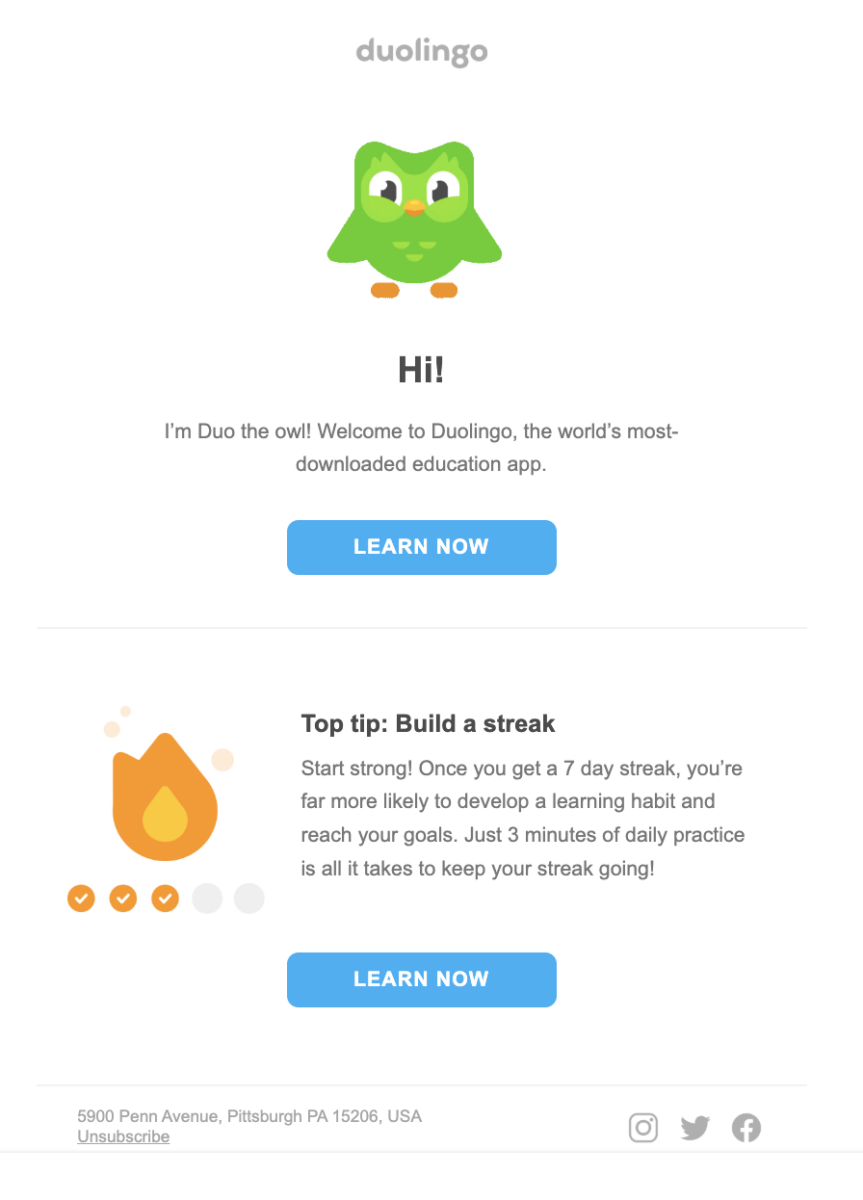
Duolingo keeps it remarkably short. The welcome email introduces Duo the owl (their mascot, who you’ll see constantly in the app and future emails), shares one actionable tip (build a 7-day streak to form a habit), and includes a single CTA to start your first lesson. That’s it.
Why it works: For apps and SaaS products, the welcome email’s only job is activation: get the user back into the product. Duolingo doesn’t try to explain every feature. They give you one goal (the streak), one reason it matters (habit formation backed by research), and one button to push. This is especially smart for products where the “aha moment” happens inside the product, not inside the email.
3. Slack: The Setup Guide
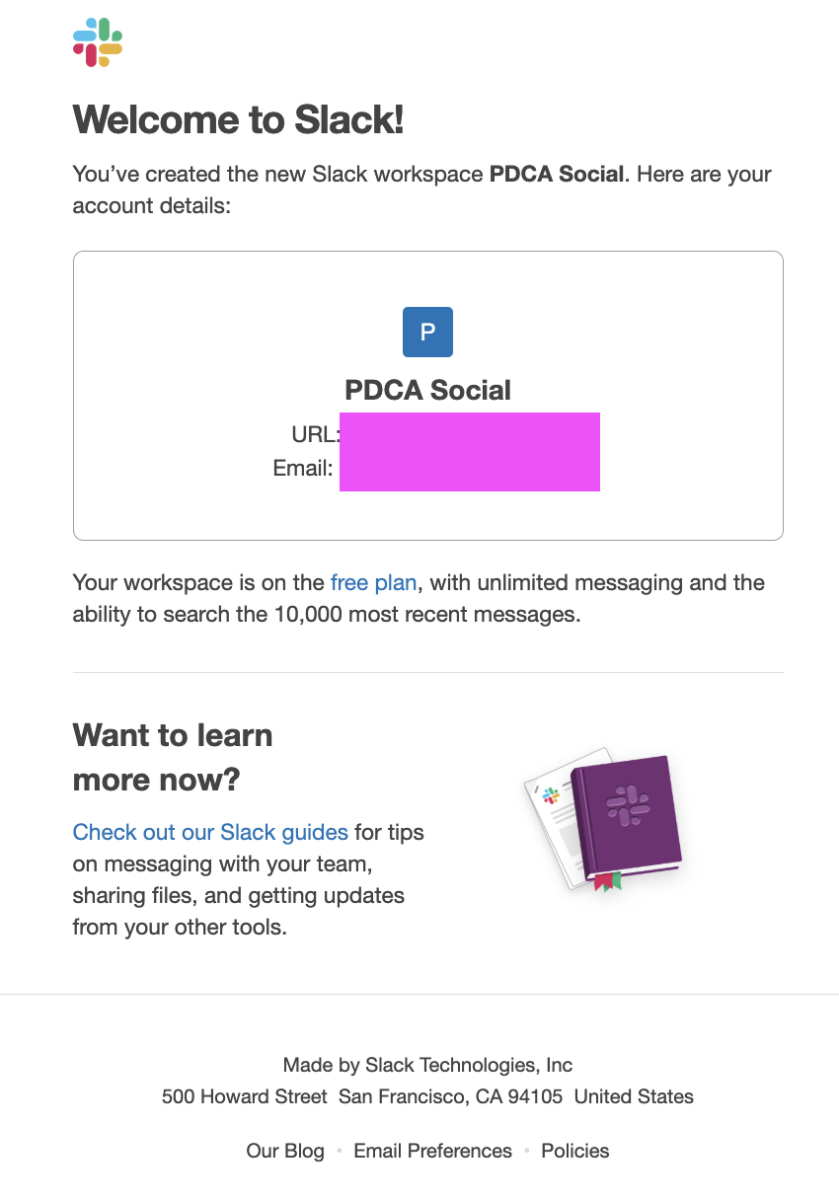
Slack’s welcome series walks new workspace admins through setup step by step: inviting teammates, integrating tools, learning keyboard shortcuts. Each email in the series focuses on one specific action. The first email personalizes around the workspace name the user created, which is a subtle but effective detail.
Why it works: For B2B products with any level of complexity, a welcome series that mirrors the actual setup process reduces friction and increases activation. Slack understands that a user who doesn’t invite teammates in the first few days probably won’t stick around, so that’s exactly what the emails push toward.
4. Brooklinen: The Warm Handshake with a Discount
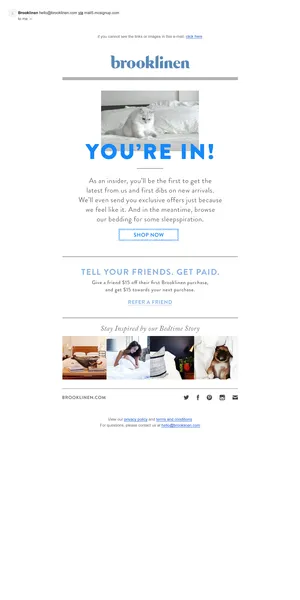
Brooklinen’s welcome email greets new subscribers by name, shares a brief mission statement about what the brand stands for (comfort, quality, fair pricing), and delivers a first-purchase discount. The design is clean, the tone is warm, and it immediately makes you feel like you’ve found “your” bedding brand.
Why it works: For ecommerce, the welcome email is often where the first purchase happens. Brooklinen pairs the incentive (discount) with just enough brand story to make you feel good about spending. They don’t overwhelm with product catalog links. The single CTA tied to the discount keeps the path to purchase clear. If you’re running an ecommerce email marketing program, this is a solid model to study.
5. Descript: The Checklist
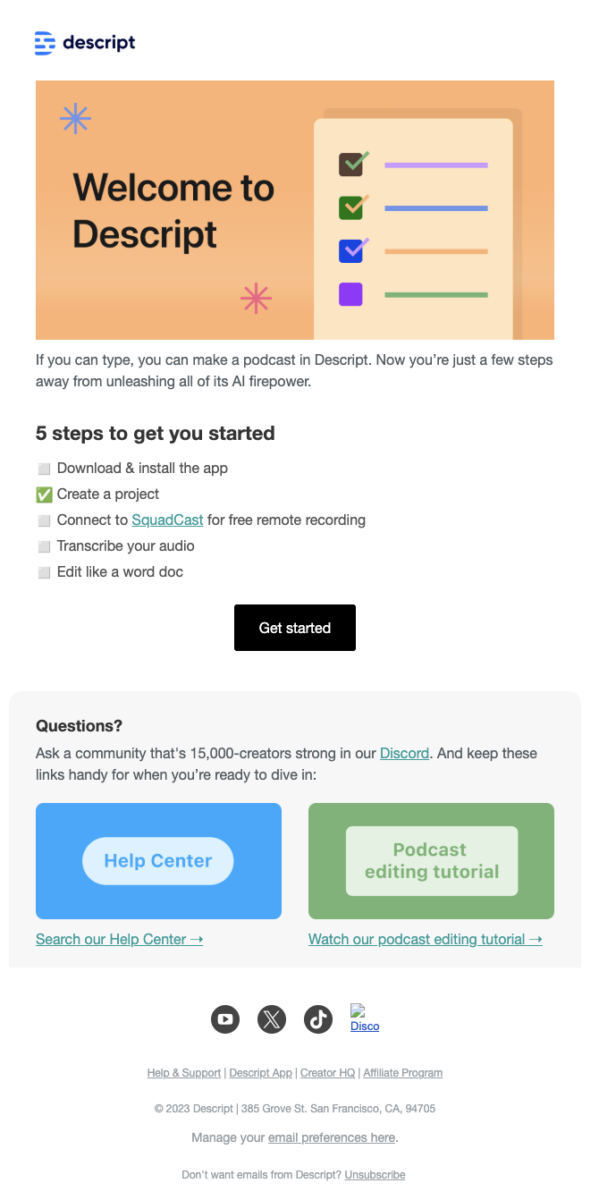
Descript opens with a friendly graphic, then presents a simple 5-step checklist to get started with the product. Below the checklist: one “Get started” CTA. And if you get stuck, they invite you to join their 15,000-member Discord community, which doubles as social proof.
Why it works: Checklists create a sense of progress and reduce overwhelm. For products with a learning curve, framing onboarding as “5 quick steps” feels manageable. The Discord invitation is clever because it solves two problems at once: support and community belonging.
6. Sephora: The Community Play
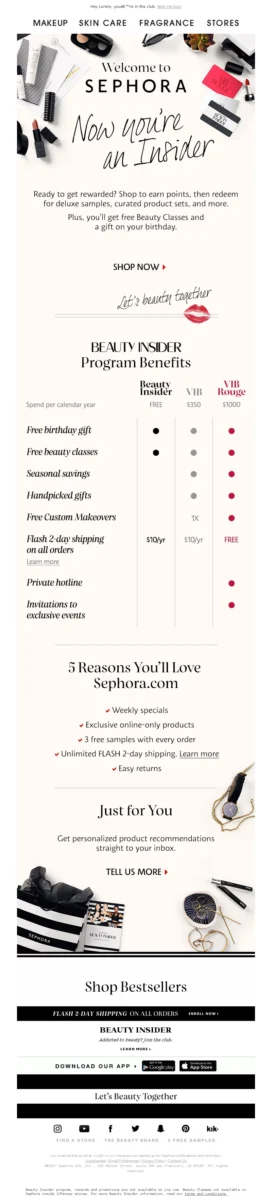
Sephora’s welcome email leads with “Welcome to the family” and positions the subscriber as a “Beauty Insider,” which is actually the name of their loyalty program. The language of belonging (family, insider, community) makes the subscriber feel like they’ve joined something exclusive rather than just another email list.
Why it works: For brands with loyalty programs, the welcome email is the perfect place to onboard subscribers into the rewards ecosystem. Sephora uses the welcome moment to frame the relationship as membership rather than marketing, which increases long-term retention.
7. ActiveCampaign: The Trial Expectation-Setter
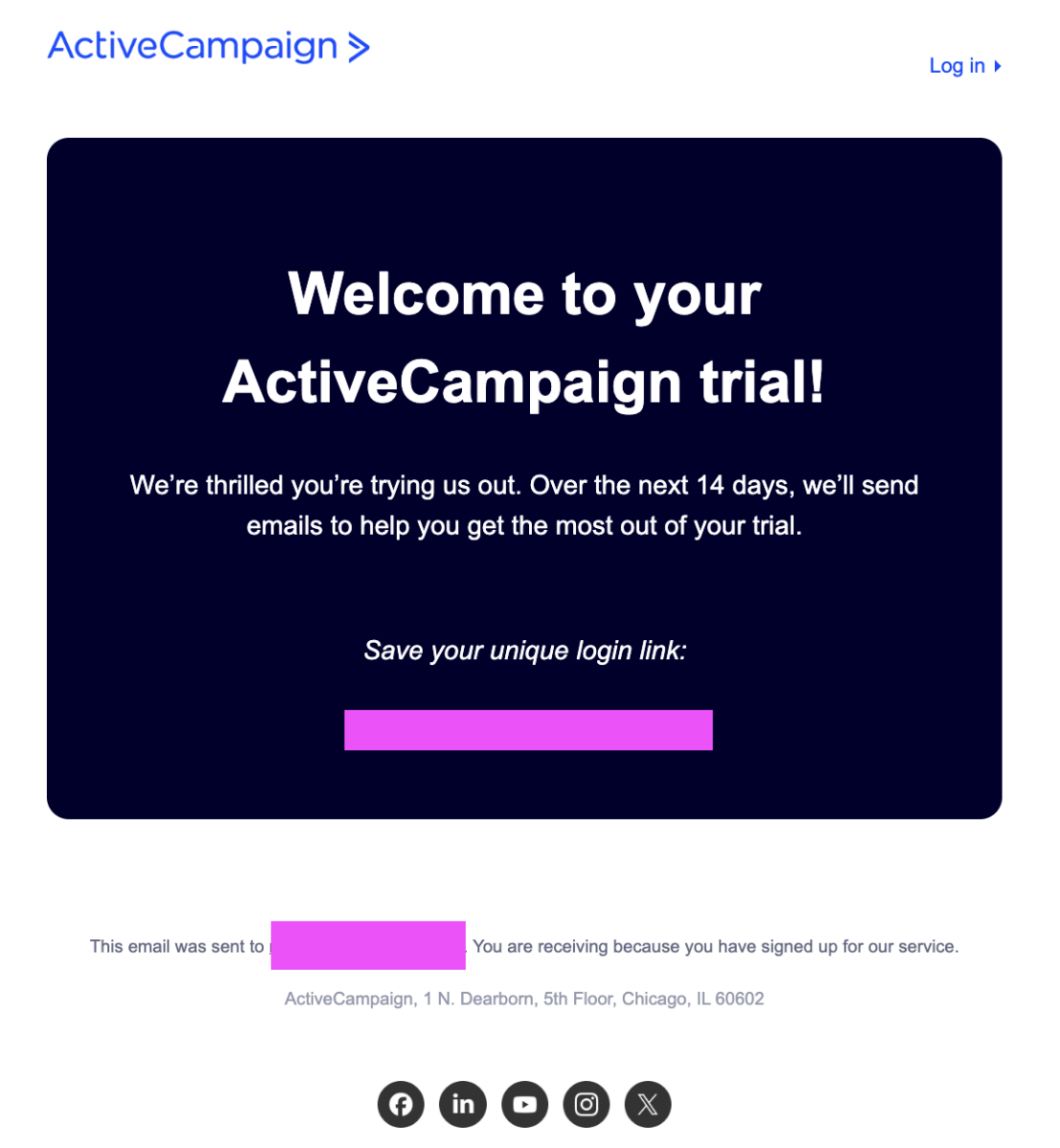
ActiveCampaign’s welcome email does two things in about 50 words: it thanks you for starting a trial and tells you exactly what’s coming next (“Over the next 14 days, we’ll send emails to help you get the most out of your trial”). It also gives you your personalized login link so you can bookmark it immediately. That’s the entire email. No feature tour, no overwhelming list of resources, no hard sell.
Why it works: For SaaS products with free trials, the welcome email’s job is to set expectations and reduce the chance of abandonment. ActiveCampaign does this by being transparent about the email series ahead, which actually increases the likelihood that you’ll open those follow-up emails when they arrive. It’s the welcome email equivalent of a host saying “make yourself at home, here’s the Wi-Fi password, and I’ll check in on you tomorrow.” If you’re building your own welcome series with email marketing automation, this “less is more” approach is a smart starting template.
What All These Examples Have in Common
Despite their differences in style and industry, every one of these welcome emails shares three traits: they deliver on whatever the signup promised, they have a single primary CTA (not five competing ones), and they sound like they were written by a human who cares about the reader’s experience. That’s the formula.
For more inspiration, check out my full collection of email marketing campaign examples.
Frequently Asked Questions About Welcome Emails
How quickly should I send my welcome email after someone subscribes?
Immediately. The best practice is to trigger your welcome email the moment someone confirms their subscription. Every hour you delay, engagement drops. Most email platforms support instant automated sending, so there’s no technical reason to wait.
Can I include a sales offer in my welcome email?
Yes, but only if it was part of the signup promise (like a discount code for new subscribers). If someone signed up for educational content and you hit them with a product pitch, it feels like a bait-and-switch. Match the offer to the expectation you set at signup.
What’s a good open rate for a welcome email in 2026?
Welcome email open rates vary widely by industry, from around 35% to over 80%, depending on the source and segment. The more useful benchmark is how your welcome email open rate compares to your regular campaign open rate. It should be significantly higher. If it’s not, your subject line or timing likely needs work.
Should I use plain text or designed HTML for welcome emails?
It depends on your brand and audience. Ecommerce brands typically benefit from designed HTML with product images. Service businesses and personal brands often get better engagement from plain-text or lightly formatted emails that feel like a personal message. Test both and let the data decide.
How do I handle welcome emails for subscribers who join through different forms or lead magnets?
Segment them. If you have multiple signup points (a newsletter form, a lead magnet download, a webinar registration), create tailored welcome sequences for each entry point. The welcome email should feel like a natural continuation of whatever the subscriber just did, not a generic broadcast.
Start Building Your Welcome Email Series Today
If you take one thing from this post, make it this: your welcome email is not optional. It’s not a nice-to-have. It’s the highest-performing, highest-ROI email you will ever send, and every day you go without one (or stick with a boring, generic one) is a day you’re losing potential customers.
Here’s what I’d do right now:
Open your email marketing platform and check whether you have a welcome email set up. If you don’t, create one today using the framework in this post. If you do, review it against the best practices here and identify one thing to improve.
Then build it out into a series. Start with three emails. Set the timing. Write the copy. Launch it. You can optimize later, but you can’t optimize what doesn’t exist.
And if you want hands-on help building your entire email marketing strategy from the ground up, not just welcome emails, but the full system, I work with businesses as a fractional CMO to build exactly this kind of infrastructure. You can also join my Digital First Group Coaching Community where I help entrepreneurs and creators implement these strategies step by step.
And if you want to keep learning, grab a free copy of my Email Marketing Guide for a comprehensive look at building your email program from scratch.
DIY your digital marketing with AI.
Practical advice on social, content, influencer, and search marketing, plus the AI tools that make each one easier. Join thousands of founders and business owners who read it.