
Here’s the uncomfortable truth most marketing leadership articles won’t tell you: hiring a full-time CMO is one of the riskiest executive decisions you can make. The average CMO tenure is just 3.5 years according to Korn Ferry, shorter than any other C-suite role. Add in the $270,000-plus all-in cost, the six-month search, and the 18 months of lost momentum if the hire doesn’t work out, and it’s no wonder a different model has quietly exploded.
That model is the Fractional CMO. And if you’ve landed on this page, you’re probably trying to figure out whether it’s hype, a real solution, or something in between.
I’ll tell you upfront: I’ve been a Fractional CMO for several companies for almost a decade (before the term was even invented), I teach digital marketing to executives at Rutgers Business School and UCLA Extension, and I wrote Digital Threads partly because of the patterns I kept seeing across my Fractional CMO engagements. So I have a perspective. But I’ll also tell you when a Fractional CMO is the wrong answer for your situation, because it often is.
Key Takeaways
✅ A Fractional CMO is a senior marketing executive who works part-time or on retainer for multiple companies, typically delivering strategic leadership in 4-50 hours per month depending on scope and engagement type.
✅ US Fractional CMO retainers in 2026 typically range from roughly $1,500 to $18,000 per month, depending on scope, hours, and experience, compared to $270,000-$320,000+ all-in for a full-time hire.
✅ The fractional CMO market hit $1.27 billion in 2026 and is projected to reach $2.68 billion by 2031, with adoption up 245% in two years.
✅ The model works best for companies between roughly $2M and $50M in revenue who need strategic leadership but can’t absorb (or don’t yet need) a full-time executive.
✅ Fractional CMOs are not marketing agencies or freelance consultants: they embed as leadership, set strategy, build teams if necessary, manage agency relationships, and report directly to the CEO.
✅ The biggest risk isn’t cost or fit; it’s hiring someone whose engagement structure doesn’t match what your business actually needs.
What Is a Fractional CMO, Exactly?
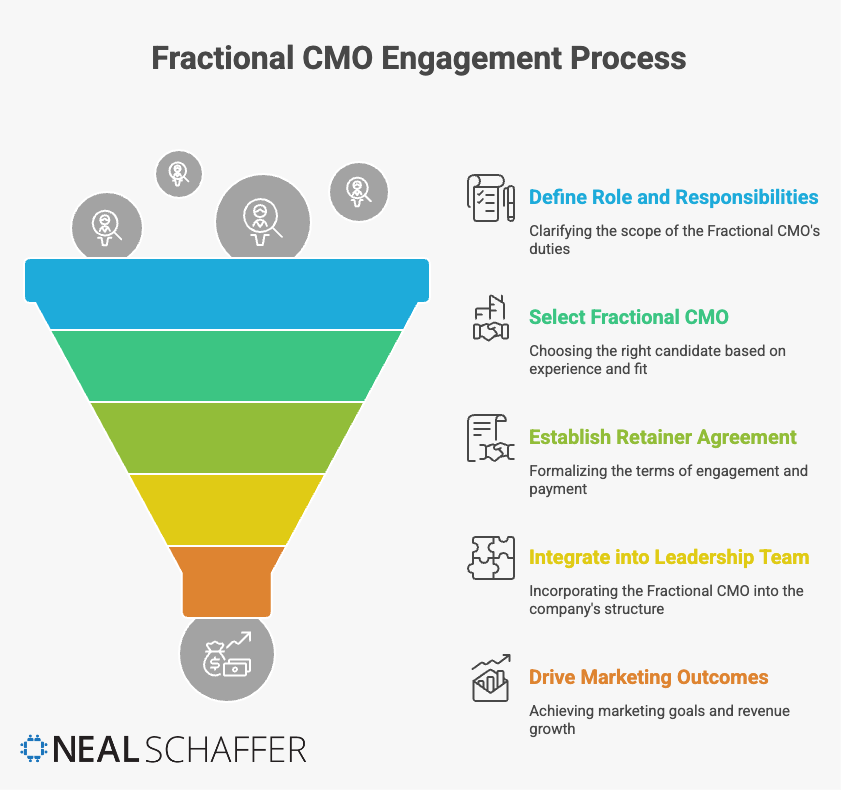
A Fractional CMO is an experienced, senior-level marketing executive who works for your company part-time, typically on a monthly retainer, while serving multiple clients simultaneously. They’re not an agency. They’re not a consultant who drops a deck and disappears. They step into your leadership team, own the marketing function, and report to you like a full-time CMO would, just for a fraction of the hours and a fraction of the cost. If you want the full picture of the role they step into, here’s what a CMO actually does day to day.

The distinction matters. A consultant advises. A freelancer executes a task. An agency runs campaigns. A Fractional CMO owns outcomes. They set the strategy, build the team, pick the agencies, choose the tech stack, and carry accountability for whether marketing actually drives revenue. That full scope has a name: it is marketing management, the discipline of planning, resourcing, and measuring the marketing function as a whole rather than running any single piece of it.
Think of it this way: if a full-time CMO is a marriage, a Fractional CMO is a committed long-term relationship where both parties have agreed to the structure. You get real leadership, real accountability, and real integration, without the benefits package, the equity dilution, or the commitment of a 5-day-a-week hire you might not be ready for.
The term “fractional” has spread across the entire C-suite now (Fractional CFO, CTO, COO, CHRO), but CMOs have become one of the most in-demand roles. According to data from the Frak Conference State of Fractional Industry Report, the number of fractional leadership professionals in the US doubled from 60,000 in 2022 to 120,000 in 2024. That’s not a trend. That’s a category.
Why Has the Fractional CMO Model Exploded?
A few things converged at once, and once you see them, the growth makes sense.
First, the economics of a full-time CMO got broken. According to Built In’s 2026 data, the average US CMO salary is $225,908, but once you add benefits, payroll taxes, equity, and executive search fees (typically 20-25% of first-year salary), the true annual cost lands between $270,000 and $320,000+. For a mid-market hire, total first-year costs can reach $600,000 to $1.2 million when you include relocation, travel budgets, administrative support, and onboarding.
Second, CMO tenure kept shrinking. When your average CMO lasts 3.5 years and the search takes 6 months, you’re essentially rebuilding your marketing leadership every three years. That’s expensive, disruptive, and slow.
Third, remote work destroyed the “you need to be in the office” argument. Once executives proved they could run functions remotely, splitting time across multiple companies became viable in a way it wasn’t in 2019. My own Fractional CMO business exploded during the pandemic for this very reason.
And fourth, AI changed what marketing leadership actually looks like. The best CMOs today are hybrid strategists, blending content strategy, SEO, AI workflows, paid media, brand, and data analytics. Finding one person who’s world-class at all of that, full-time, at a price you can afford? Nearly impossible. Renting someone who’s deep in all of it for 15 hours a week? Very possible.
What Does a Fractional CMO Actually Do?
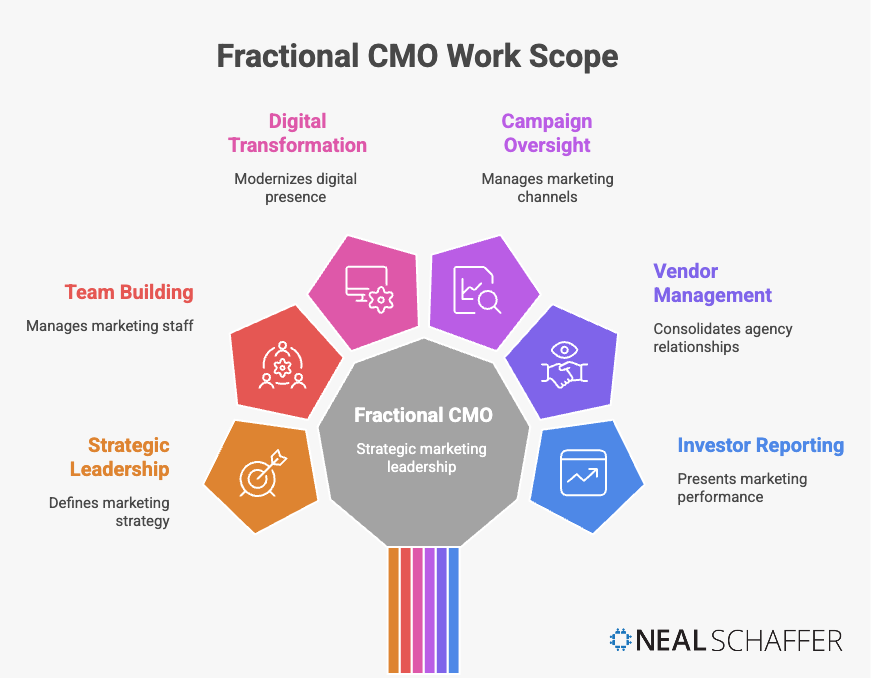
Here’s where a lot of confusion creeps in, because the scope varies by engagement. In my experience, most Fractional CMO engagements fall into one or more of these buckets:
Strategic leadership. Setting the marketing strategy, defining positioning, aligning marketing with revenue goals, and making sure the company isn’t just doing random acts of marketing. This is the foundation.
Team building and leadership. Hiring marketing staff, managing existing teams, coaching in-house talent, and deciding when to use agencies versus contractors versus employees. A good Fractional CMO often reduces your agency spend just by cleaning up who’s doing what.
Digital transformation. For traditional businesses, this often means rebuilding their SEO presence, fixing their email program, modernizing their content strategy, and integrating AI tools where they actually help. Drawing on what I cover in Digital Threads, this usually reveals that companies have 3-5x the digital assets they think they have, they’re just not using them.
Campaign and channel oversight. Picking the right channels, managing paid media spend, setting up analytics properly, and measuring what actually works.
Vendor and agency management. Most companies have too many agencies, poorly briefed, doing uncoordinated work. A Fractional CMO consolidates this.
Board and investor reporting. Especially for VC-backed and PE-backed companies, a Fractional CMO presents marketing performance to boards, helps with fundraising narratives, and translates marketing into business language the CFO and CEO actually care about.
Make LinkedIn Your Best Source of Clients
My latest book helps professionals, entrepreneurs, and business owners turn LinkedIn from a static profile into a real source of clients and growth.
Maximizing LinkedIn for Business Growth gives you clear, practical steps to build a profile that gets noticed and a network that actually sends business your way.
Grab your copy on Amazon and put it to work this week. Click the cover or the button below to get started.

The scope you need depends on where you are. A $3M revenue business with one marketing coordinator needs something very different from a $30M company with a 12-person marketing team and three agencies.
Fractional CMO vs. Full-Time CMO: The Real Comparison
Most comparison tables gloss over what actually matters. Here’s a more honest breakdown:
| Factor | Full-Time CMO | Fractional CMO |
|---|---|---|
| True annual cost | $270K-$1.2M+ | $20K-$220K |
| Time commitment | 40+ hours/week | 4-50 hours/month |
| Time to productive | 6-9 months | 30-45 days |
| Avg tenure | ~3.5 years | Often longer, 2-5 years common |
| Industry experience | Usually 1-2 industries | 10-30+ companies across industries |
| Execution focus | Often buried in meetings | Structured for strategic leverage |
| Flexibility | 12-24 month minimum commitment | 3-6 month typical minimum |
| Best for | $50M+ revenue, complex org | $2M-$50M revenue, scaling phase |
According to research cited by Averi.ai, companies using fractional CMOs report 67% cost savings, 89% better strategic flexibility, and 91% performance satisfaction ratings. Take the exact percentages with salt — they come largely from provider-reported data — but the direction is real: companies get senior leadership faster, at lower total cost, with more flexibility.
One thing full-time CMOs do better: deep cultural integration, full-time availability for crises, and long-term team relationships. If those matter more to you than cost and flexibility, a full-time hire is still the right call.
How Much Does a Fractional CMO Cost in 2026?
This is where people get confused, because the range is wide. Here’s what the current market actually looks like:
| Engagement Size | Monthly Retainer | Typical Hours | Best Fit |
|---|---|---|---|
| Light strategic advisory | $1,500-$3,000 | 4-8 hrs/mo | Early-stage startups, solopreneurs |
| Standard fractional | $3,000-$6,000 | 8-16 hrs/mo | $2M-$10M revenue companies |
| Growth-stage fractional | $6,000-$12,000 | 16-32 hrs/mo | $10M-$50M revenue, scaling teams |
| Embedded fractional | $10,000-$18,000+ | 32-50+ hrs/mo | PE-backed or pre-IPO companies |
According to data compiled by Fractionus, most US companies pay between $8,000 and $22,000 per month on a retainer basis, which saves 40-70% compared to a full-time hire at the same experience level.
One thing to watch: hourly rates (usually $200-$350/hour per CMOx) can look cheap until they aren’t. Retainers are almost always more predictable for both sides.
And a hidden cost people forget: a good Fractional CMO will recommend investments, in tools, in hires, in ad spend, that expand your total marketing budget. That’s the point. But don’t be surprised when the $8K/month retainer leads to a $30K/month total marketing spend. That’s usually a good sign.
When Should You Hire a Fractional CMO?
Not every business should hire one. I’ll be honest about that because I’ve turned down prospective clients when the fit wasn’t there.
A Fractional CMO makes sense when:
- You’re generating $2M-$50M in revenue and marketing is the bottleneck, not the product
- You have a marketing team (even just 1-2 people) but no one driving strategy
- You’re between full-time CMOs and need continuity
- You’re preparing for a fundraise, acquisition, or new market entry and need senior marketing leadership to get the story right
- You’re a founder who’s been running marketing yourself and you know you’re the bottleneck
- Your agencies are running uncoordinated campaigns and nobody’s holding them accountable
- You need a specific expertise (content-led growth, SEO, B2B demand gen, AI-enabled marketing) you don’t have in-house
A Fractional CMO is the wrong answer when:
- You have no marketing team and no budget for one — you need a doer, not a strategist
- Your product-market fit isn’t there yet (no amount of marketing fixes that)
- You want someone in the office five days a week for political or cultural reasons
- You need 60+ hours per week of marketing leadership (you need a full-time hire)
- You’re not willing to actually delegate marketing decisions
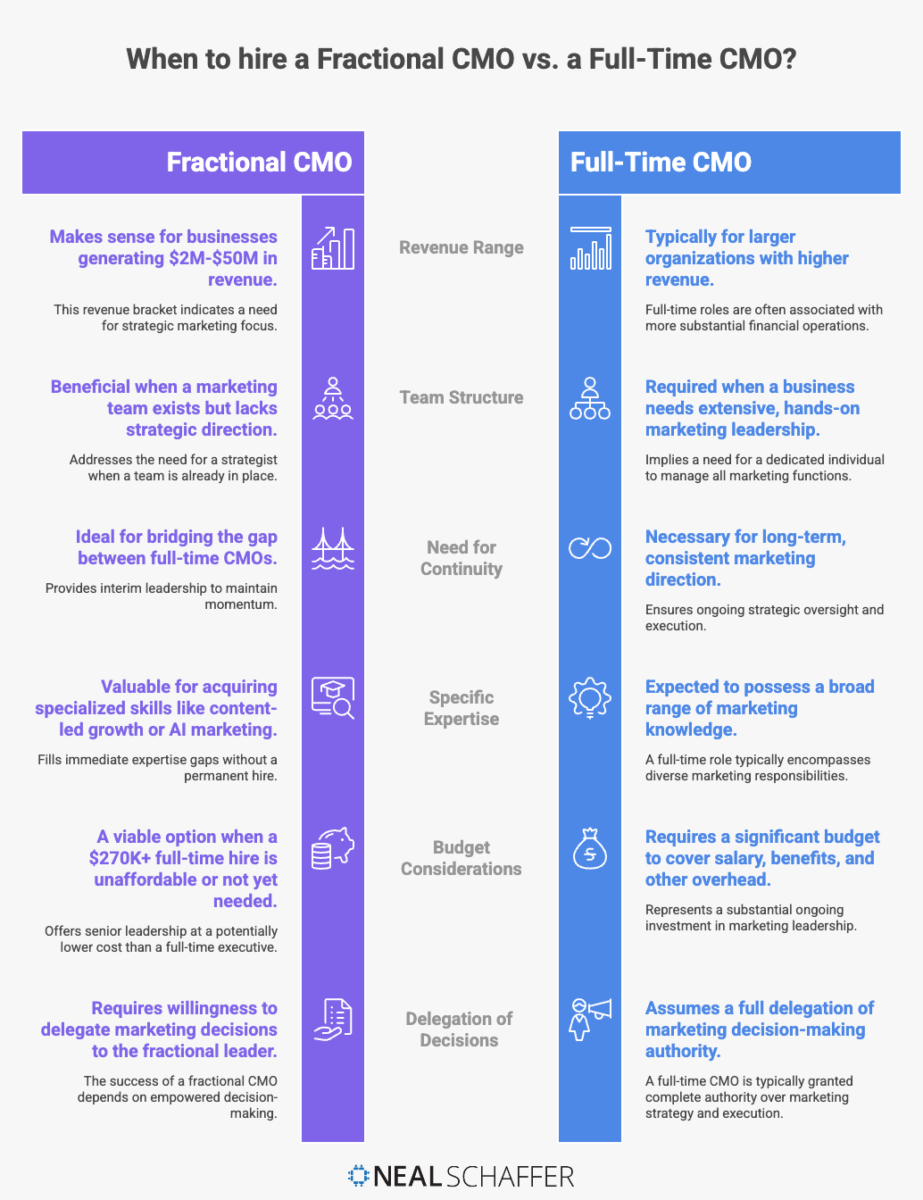
One framework I use with potential clients: if marketing is genuinely a top-three priority for the business and you can’t afford or don’t yet need a $270K+ full-time hire, a Fractional CMO probably makes sense. If marketing is priority five and you’re hoping one person will fix everything, no engagement model will work.
How to Choose the Right Fractional CMO
Here’s where most buyers get it wrong. They pick on price and “chemistry” and skip the questions that actually predict success.
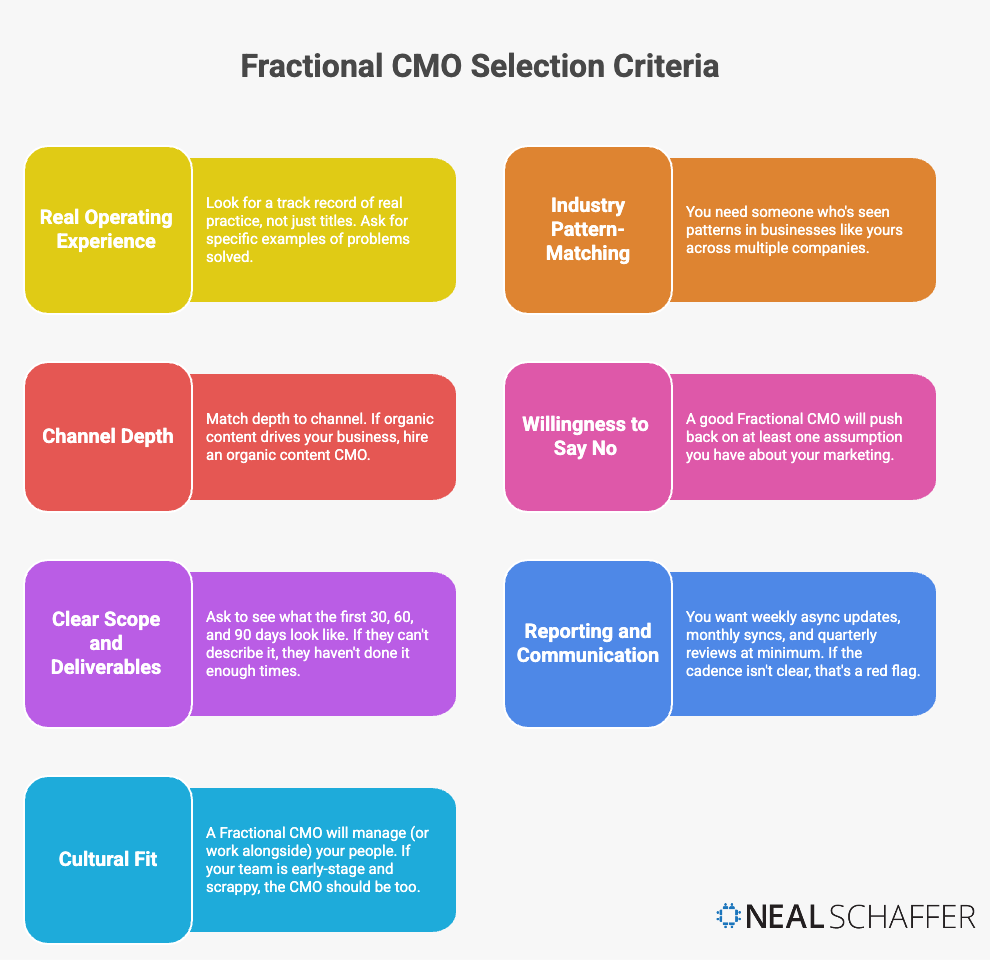
1. Real operating experience, not just titles
A lot of people call themselves “Fractional CMO” after one 3-month engagement. Look for someone with a track record of real practice, whether that’s senior marketing leadership roles, years of running their own consultancy, or both. Ask for specific examples of problems they’ve solved for past clients, even if exact revenue numbers are confidential. Ask how long those engagements lasted, and why they ended. Short engagements aren’t automatically a red flag: sometimes the client graduates because they’ve built the team and systems to run marketing themselves, which is a win. The warning sign is a pattern of short engagements that ended in disappointment. Ask references directly: would you hire this person again?
2. Industry pattern-matching, not just industry experience
You don’t necessarily need someone who’s worked in your exact industry. You need someone who’s seen patterns in businesses like yours (same business model, same stage, same go-to-market motion) across multiple companies. A B2B SaaS Fractional CMO who’s scaled 10 different SaaS companies is more valuable than one who’s spent 20 years at a single SaaS firm.
3. Depth in the channels that matter for YOU
If organic content and SEO drive your business, hiring a paid media Fractional CMO is a mismatch. If you’re selling to enterprise through events and outbound, a social-media-focused CMO won’t serve you well. Match depth to channel. If SEO is the only gap and your leadership is already in place, a specialist may fit better than a Fractional CMO, which is where SEO consulting comes in.
4. Willingness to say no
A Fractional CMO who agrees with everything you say isn’t doing their job. On a discovery call, a good one will push back on at least one assumption you have about your marketing. If they’re just nodding and flattering, keep looking.
5. Clear scope and deliverables
Ask to see what the first 30, 60, and 90 days look like. If they can’t describe it, they haven’t done it enough times. Check out my complete Fractional CMO services overview for an example of how scope should be framed.
6. How they handle reporting and communication
You want weekly async updates, monthly syncs, and quarterly reviews at minimum. If the cadence isn’t clear, that’s a red flag.
7. Cultural fit with your team
This one’s underrated. A Fractional CMO will manage (or work alongside) your people. If your team is early-stage and scrappy and the Fractional CMO is accustomed to six-person teams and six-figure budgets, there’s going to be friction.
What a Typical Fractional CMO Engagement Looks Like
In my own practice, engagements usually follow a similar arc. Your mileage may vary, but here’s the pattern:
Month 1: Diagnosis and discovery. Audit current state — marketing strategy, team, tech stack, agencies, analytics, content. Stakeholder interviews. Competitive analysis. Revenue model review. By the end of month one, I should know more about your marketing than you do. I know that sounds arrogant. It’s also the job.
Month 2: Strategy and roadmap. Define the marketing strategy, revenue contribution targets, channel mix, and 90-day priorities. Brief the team. Align with sales and product.
Months 3-6: Build and execute. This is where most of the real work happens. Hiring or reorganizing the team. Consolidating agencies. Launching or relaunching campaigns. Setting up proper analytics and attribution. Building marketing automation workflows and content engines.
Months 6-12: Optimize and scale. Now we’ve got a working system. We optimize what’s working, kill what isn’t, and scale the winners. This is also where I start planning the transition, either to a full-time hire or to a reduced-scope advisory engagement.
Month 12+: Optional. Many engagements continue indefinitely. Some companies use a Fractional CMO permanently because they never need full-time marketing leadership. Others bring in a full-time CMO and transition me to quarterly advisory. Both are fine.
Fractional CMO vs. Marketing Agency vs. Marketing Consultant
People conflate these three constantly. They’re different.
| Model | Works Like | Best For |
|---|---|---|
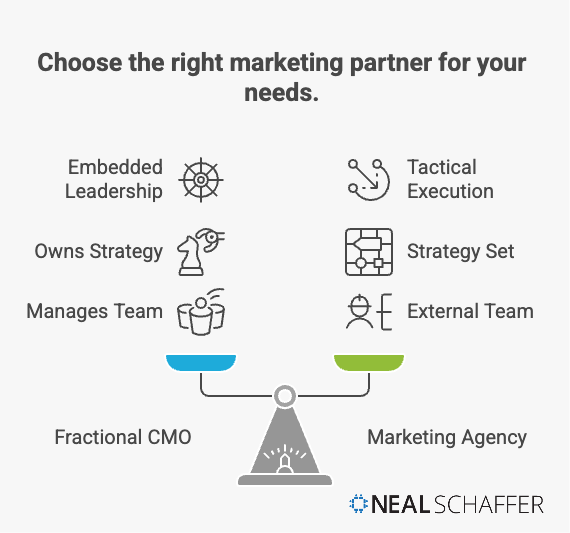
| Fractional CMO | Embedded leadership, owns strategy, manages team and agencies | Companies needing leadership, not just execution |
| Marketing agency | External team executing campaigns in specific channels | Companies with strategy set, need hands |
| Marketing consultant | Advisory, deliverables-based, no ongoing ownership | Companies needing a one-time plan or assessment |
The biggest mistake I see: companies hire an agency hoping for strategic leadership and wonder why they’re getting tactical execution. Agencies execute. Fractional CMOs lead. Consultants advise. Pick the right tool for what you actually need.
Expert Perspective on the Fractional Model
Here’s how Amy Bonsall, former IDEO and Old Navy executive turned fractional chief product officer, frames the value on HBR’s On Leadership podcast:
“If you’re leading a growing organization but can’t justify the cost of full-time executives, there’s another way.” — Amy Bonsall, former exec at IDEO and Old Navy, fractional chief product officer (via HBR’s On Leadership podcast)
Her broader point is that fractional leadership isn’t a downgrade from full-time. It’s a different structure that fits a specific stage of business, and it works best when both sides treat it as real leadership, not a discount consulting engagement.
That matches my experience exactly. The Fractional CMO engagements that fail are the ones where the CEO never really let go of marketing. The ones that succeed are the ones where the CEO treats the Fractional CMO like a real executive, gives them real authority, and holds them to real outcomes.
How AI Is Changing the Fractional CMO Role
I couldn’t write this piece in 2026 without addressing AI, because it’s fundamentally changed what a Fractional CMO can deliver.
Three years ago, a 15-hour-a-month Fractional CMO could set strategy and barely manage execution. Today, with AI-powered content workflows, AI marketing tools, and AI-assisted analytics, that same CMO can oversee significantly more output. The leverage ratio has changed.
But it cuts both ways. A good Fractional CMO in 2026 has to actually understand AI workflows, which platforms to use for what, where AI slop hurts your brand, and how to integrate AI tools with human judgment. Someone still running the 2019 playbook isn’t going to deliver 2026 results. When you’re evaluating Fractional CMOs, ask them directly how they’re using AI in their own practice and with other clients. If the answer is vague, keep looking.
Frequently Asked Questions
A consultant advises and delivers recommendations, usually on a project basis. A Fractional CMO embeds as leadership, owns the outcomes, manages teams and agencies, and carries ongoing accountability. Consultants leave you with a plan. Fractional CMOs stay to execute it.
Yes, if the engagement is structured correctly. The first 30-45 days of any good engagement are heavy on diagnosis and discovery. After that, the Fractional CMO is making senior decisions based on accumulated context, not guessing. The flip side: if they never spend that diagnostic time, the engagement will fail.
Most retainer engagements run 6-24 months, though the range is wider than that in both directions. Fractional engagements can sometimes outlast the 3.5-year average full-time CMO tenure because the structure is flexible enough to adjust scope rather than end the relationship. Some of my own engagements have run multiple years because the company either never needed a full-time hire or deliberately chose not to. On the other end, I also have clients who hire me for a focused 3-month trial and then feel confident enough to run with what we built. Both outcomes are success: the wrong framing is assuming longer always equals better.
No. While startups and growth-stage companies are the biggest category, mid-market companies ($10M-$50M revenue), family-owned businesses, nonprofits, and PE-backed portfolio companies all use the model. Some enterprises use Fractional CMOs for specific business units or new product launches.
It depends on what you need. Some clients hire me for a focused 3-month engagement to build a strategy, set up systems, and train their team — and then run with it confidently. That can work well if your goal is a specific, scoped deliverable and you have the internal capability to execute once the foundation is set. Where short engagements fall short is when you need ongoing strategic leadership and accountability, since the first 30-45 days are largely diagnostic and the compounding value tends to show up in months 3-12. If you’re unsure which bucket you’re in, start with a 3-month engagement and decide from there whether to extend. Most good Fractional CMOs offer this option.
Qualifications look different for Fractional CMOs than for full-time executives, so the evaluation criteria should too. A few things to look for: published work (books, articles, podcasts, speaking engagements) that demonstrates actual expertise over years, not just marketing bios. A clear track record of running their own practice or consultancy, which signals they’ve made this work as a sustainable business, not a gig between jobs. Specific examples of problems they’ve solved for clients, even if exact revenue numbers are confidential. Teaching or training experience at reputable institutions or organizations, which signals depth and the ability to communicate complex ideas. Client references willing to speak candidly about how the engagement actually went. What matters less than you’d think: whether they’ve held full-time senior marketing titles at big brands. Many of the best Fractional CMOs deliberately built consultancies instead of climbing corporate ladders, precisely because they wanted to serve multiple companies at once.
Ready to See If a Fractional CMO Is Right for Your Business?
If you’ve read this far, you probably fall into one of three buckets: you’re evaluating whether to hire a Fractional CMO, you’re wondering whether you are one, or you’re just trying to understand the category. In all three cases, the takeaway is the same: the Fractional CMO model has grown up. It’s no longer a creative workaround. It’s a legitimate way to access senior marketing leadership without the cost, risk, and commitment of a full-time executive hire.
If you think a Fractional CMO might be the right fit for your business, I’d genuinely love to talk. You can learn more about my Fractional CMO services or reach out directly to set up a conversation. And whether we end up working together or not, I’d recommend grabbing a free preview of Digital Threads, which walks through the exact digital marketing framework I use with my Fractional CMO clients. You can also subscribe to my weekly newsletter if you want weekly digital marketing insights.
The right marketing leadership, at the right stage, can genuinely change the trajectory of a business. The wrong model, or the wrong person in the right model, can set you back a year or more. Take the time to figure out which one you actually need. Then move fast.