
Search for YouTube influencers and you get the same twenty names back. MrBeast. PewDiePie. Emma Chamberlain. All genuinely enormous, and all of them almost certainly beyond the budget of your next campaign.
That list answers a curiosity question. It does not answer the question a brand walks in with. Which creator will talk about my product, to people who buy things like my product, at a price I can pay?
So the roster below is organized the way brands actually buy, by category rather than by follower count. Every name on it is large, because those are the names people are looking for when they search this. After it comes the part that decides whether the campaign works. How to find creators yourself, how to judge them on YouTube-specific evidence, and what a sponsorship actually costs.
I wrote The Age of Influence about how brands and creators work together, and I teach influencer marketing at UCLA Extension. I also run my own YouTube channel. So I have sat on both sides of this table, advising brands on channel selection as a Fractional CMO and being the person a brand emails about a video.
And YouTube is where I see the most money left on the table, because brands price it like Instagram and then wonder why the math never works.
Key Takeaways
✅ Subscriber count is probably the weakest number to price a YouTube sponsorship on. Average views across the last ten to fifteen videos tell you far more.
✅ A YouTube placement keeps earning long after an Instagram story expires, because video sits in search and suggested feeds for years.
✅ Sponsorships are priced on CPM against expected views, and Influencer Marketing Hub puts the common range at $15 to $30 per thousand views.
✅ YouTube’s paid-promotion checkbox and your FTC obligation are two separate jobs. The FTC says plainly that a platform’s own disclosure tool is not enough on its own.
✅ Shorts and long-form are different products with different briefs, different creative, and different pricing. Buy one deliberately rather than both by accident.
✅ Production cost and lead time make YouTube the wrong first channel for some brands, and knowing that in advance saves a quarter.
What Is a YouTube Influencer?
A YouTube influencer is a creator whose channel has built enough trust with a defined audience that a brand mention inside their video changes what viewers buy. The audience is what matters, not the size of it. A channel with fifteen thousand subscribers in a narrow category can outperform a channel with two million.
This is influencer marketing practised on a platform that behaves partly like a search engine, and that one difference reshapes the economics more than most brands expect.
The industry sorts creators into tiers by subscriber count, and those tiers are useful as a starting budget signal rather than as a quality signal. If you want the full ladder, I break down the bands and what each one is good for in my piece on influencer tiers.
What trips up brands new to the channel is treating tier as a proxy for fit. It is not. A micro influencer reviewing espresso machines is worth more to a coffee brand than a general lifestyle megastar, because the viewer arrived already thinking about espresso machines. Even a nano influencer can be the right answer in a category with almost nobody publishing in it.
One more framing point before the names. People use YouTube to look things up, the way they use Google, at least as often as they scroll it like a feed. That is why I have argued at length about whether YouTube counts as social media at all. That distinction shapes everything downstream, from how you find creators to how long a video keeps paying you back.
The Best YouTube Influencers by Category
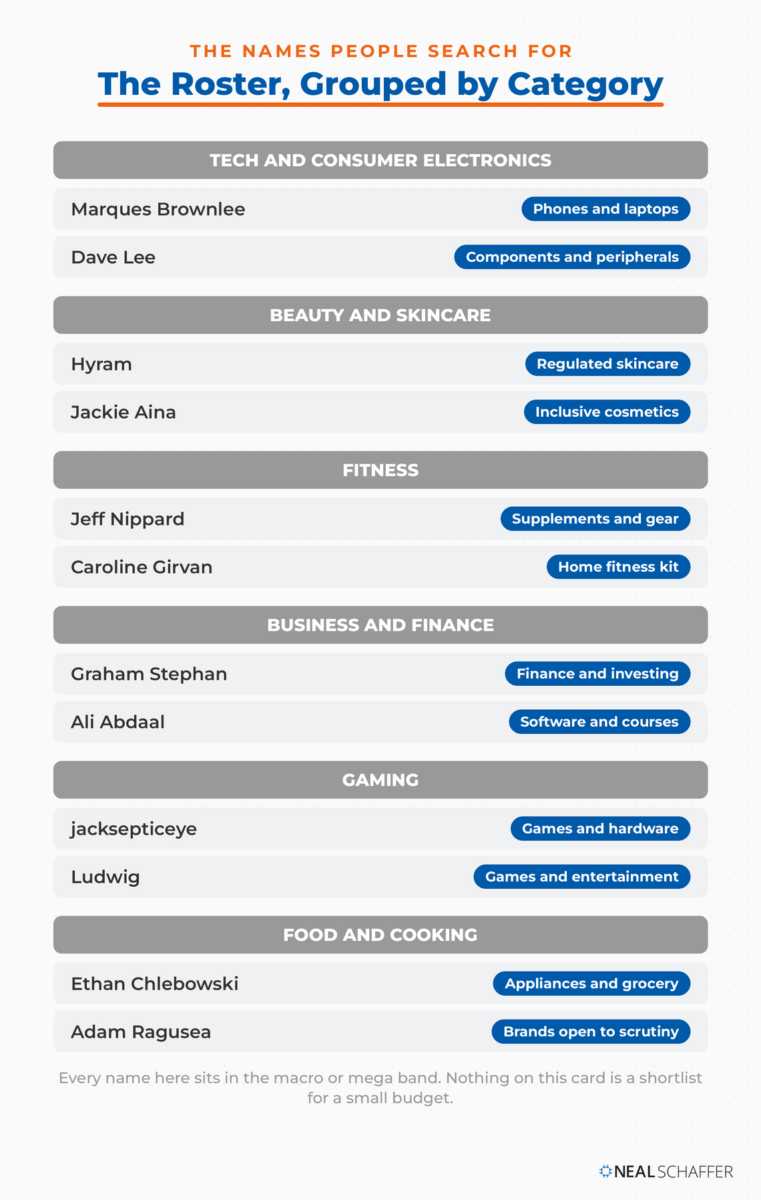
Below are twelve creators across six categories that brands buy in most often. I have deliberately left subscriber counts out. Those numbers move weekly, and any figure printed in an article is stale by the time you read it. Click through to the channel and read the count off the page before you build a budget around it.
Each entry names what the creator actually does and what kind of brand fits alongside them.
Read the list as a map of the categories rather than a shopping list. Almost every name here sits in the macro and mega bands. For most brands the money works harder several rungs down, with a micro influencer or even a nano influencer who owns a narrow subject. Use these creators to see what a category leader looks like, then go find the smaller version of them.
Tech and consumer electronics
Marques Brownlee is the reference point for the whole category, making high-production reviews of phones, laptops and consumer hardware. A placement here buys reach at scale and the category’s most trusted verdict in the same slot, and it is priced for both. Check his recent view averages before you build a budget.
Dave Lee makes what his channel describes as quality videos about useful tech, weighted toward laptops and gaming hardware. The coverage sits close to the buying decision, which suits component brands, peripherals and software with a hardware angle.
Beauty and skincare
Hyram built his channel on ingredient-level skincare explanation, and he states consistently that he is a skincare specialist rather than a dermatologist or licensed esthetician. That distinction matters in a category where an implied clinical claim creates regulatory exposure.
Jackie Aina makes beauty content centered on shade range and representation. She has worked with Sephora, e.l.f. Cosmetics and Anastasia Beverly Hills, according to her Wikipedia entry. Cosmetics brands with a genuine inclusivity story fit here; brands without one should not try.
Fitness
Jeff Nippard is a natural bodybuilder and powerlifter with a biochemistry degree who builds videos around published research. Supplement and equipment brands get a demanding audience that will read the study he cites.
Caroline Girvan is a certified personal trainer whose channel started in 2020 with, in her words, her dumbbells and her phone. Her audience trains at home, which makes her a natural fit for equipment, apparel and app brands.
Is Your Digital Marketing All Over the Place?
My latest book helps small businesses, entrepreneurs, and marketers bring search, email, and social together into one digital marketing strategy that actually compounds.
Drawing on my work as a Fractional CMO, Digital Threads turns complicated tactics into a clear, practical plan you can follow, whatever your budget or team size.
Grab your copy on Amazon and start weaving your own digital threads. Click the cover or the button below to get started.

Business and finance
Graham Stephan covers real estate, personal finance and investing news from the position of an actual real estate investor. Finance is one of the categories that commands rates above the general bands, so budget higher here than a generic CPM table suggests.
Ali Abdaal is a doctor turned entrepreneur covering productivity and building an independent business. Software, courses and tools aimed at solo operators land well with this audience.
Gaming
jacksepticeye makes let’s plays, comedy and vlogging for a mass gaming audience. Game publishers and hardware brands buy reach and enthusiasm here.
Ludwig built a variety channel on gaming and streaming plus original formats, including the Jeopardy-style Mogul Money game show he hosted through 2022. Formats like that are unusually flexible, which suits brands that want an integration built into a bit rather than a read. Check where he is publishing most before you buy, since his output has moved between platforms.
Food and cooking
Ethan Chlebowski teaches the how and the why behind cooking, from why salt matters to how browning works. Appliance, ingredient and grocery brands get an audience that wants the mechanism explained.
Adam Ragusea is a former public radio journalist and journalism professor who makes food videos mixing recipes with food science. His tone is skeptical, so brands willing to be examined do better than brands wanting a script read.
Few of those are the names the search results push at you. That is intentional, and it comes down to how YouTube itself works.
Why YouTube Influencer Marketing Works Differently From Instagram and TikTok
YouTube collaborations are long-form, evergreen and search-driven, which changes the creative, the pricing basis and the payback window. An Instagram story disappears in a day. A YouTube integration sits inside a video that keeps surfacing in search and suggested feeds for years, so the same fee buys a growing number of impressions.
In Digital Threads I set social content against search content on longevity. The half-life of a social post is the time it takes to collect half its total engagement. That is reckoned at an hour or two on X and Facebook, and a day or two on Instagram and LinkedIn. The median age of a top-ranking search result is put at somewhere between three and five years. YouTube videos sit between those two poles, which is what makes their longevity worth paying for.
YouTube agrees, and is building tooling around it. The platform is giving creators the ability to swap out a branded segment once a deal concludes, turning back catalogs into recurring revenue. That only makes sense on a platform where old videos keep being watched.
The audience math supports it too. Pew Research Center found that 84% of US adults ever use YouTube, against 50% for Instagram and 37% for TikTok. Close to half of American adults are on YouTube daily. There is more platform-level detail in my YouTube statistics.
| How they compare | YouTube | TikTok | |
|---|---|---|---|
| Content lifespan | Years, via search and suggested | Days for feed, hours for stories | Days to weeks, algorithm-dependent |
| Typical format | Dedicated video or 30-90 second integration | Reel, story, static post | Native short-form video |
| Cost basis | CPM against expected views | Follower count and engagement rate | Follower count and view rate |
| Best used for | Consideration, demos, explanation | Aesthetic proof, launch moments | Reach and trend participation |
| Lead time | Two to three months, production-heavy | Days to two weeks | Days |
None of that makes YouTube better than the alternatives. It makes YouTube a different instrument, and the brands I see struggle are the ones running an Instagram influencer marketing playbook on it. If speed and volume matter more than depth, TikTok influencers probably serve you better.
How Do You Find YouTube Influencers?
Start inside YouTube search rather than inside a database. Type the phrase your customer would search, then sort through whoever ranks for it. Build a spreadsheet of names, average views and posting frequency. Discovery tools help at scale, but the free method works and teaches you the category faster.
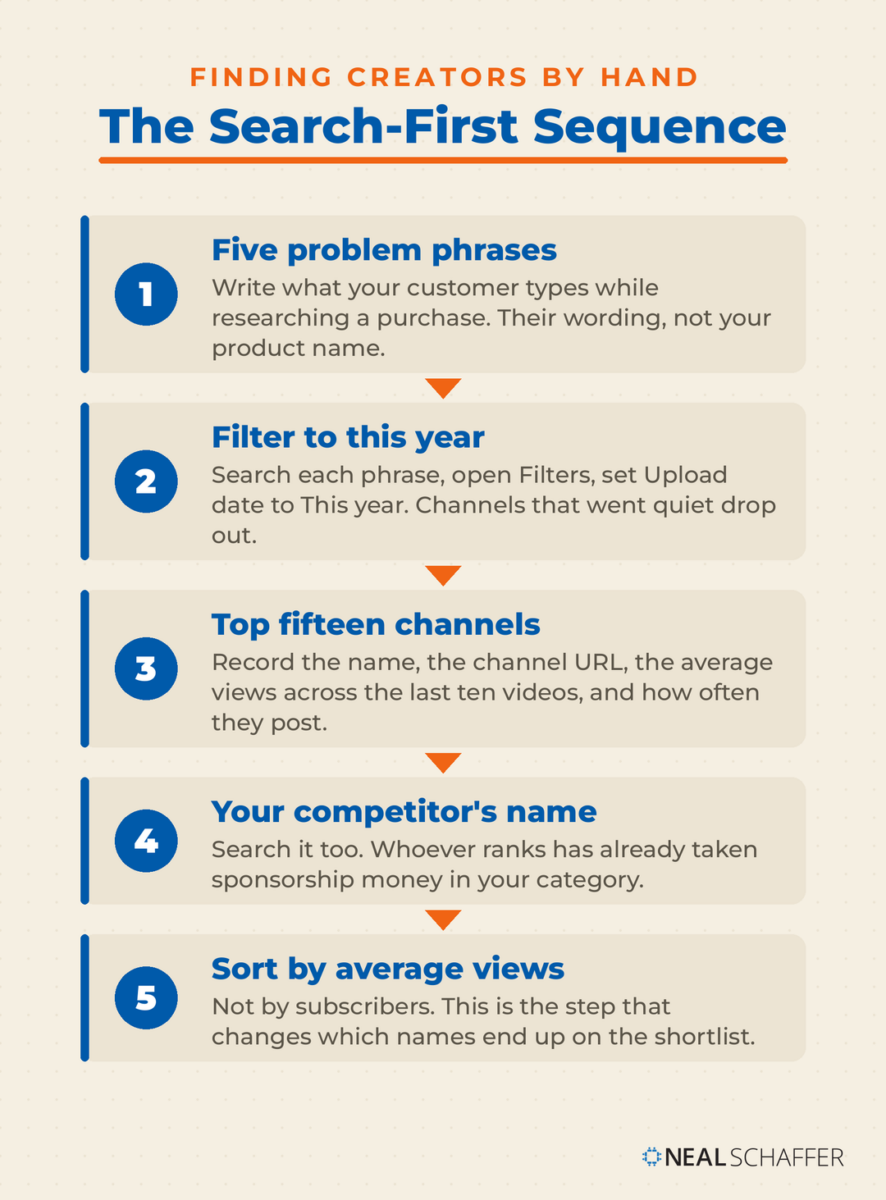
Here is the actual sequence I teach:
- Write down the five phrases your customer types when they are researching a purchase. Not your product name. The problem phrasing.
- Search each phrase on YouTube, click Filters, and under Upload date choose This year, so you see who is publishing now rather than a channel that went quiet years ago.
- Open the top fifteen channels. Record the name, the channel URL, the average view count across the last ten videos, and how often they post.
- Repeat with your competitor’s product name to see who has already taken sponsorship money in your category.
- Sort the sheet by average views, not subscribers.
On my podcast Your Digital Marketing Coach, in an episode drawn from my UCLA Extension influencer marketing class, I made the case for taking small creators seriously: “you really want to treat them as influencer royalty, even if they don’t have a million followers, because there just aren’t that many people that are talking about that subject online.”
If you would rather not build the list yourself, agencies do this as a service, and I keep a shortlist of influencer marketing agencies worth talking to. For a first campaign I would still run one round of manual searching first, because it teaches you what a strong channel in your category looks like. That is precisely the judgment you would otherwise be outsourcing.
That is the practical argument for the mid-tier. In a narrow category there are only so many people publishing, and the ones who are have disproportionate hold on the buyers you want. The same search-first logic drives my broader approach to finding influencers on any platform, and it doubles as YouTube SEO research for your own channel.
How Do You Vet a YouTube Influencer?
Judge a YouTube creator on view-to-subscriber ratio, comment quality, upload consistency, and audience retention. A channel with 200,000 subscribers averaging 8,000 views has an audience that stopped showing up. A channel with 40,000 subscribers averaging 60,000 views is being recommended to new people every week.
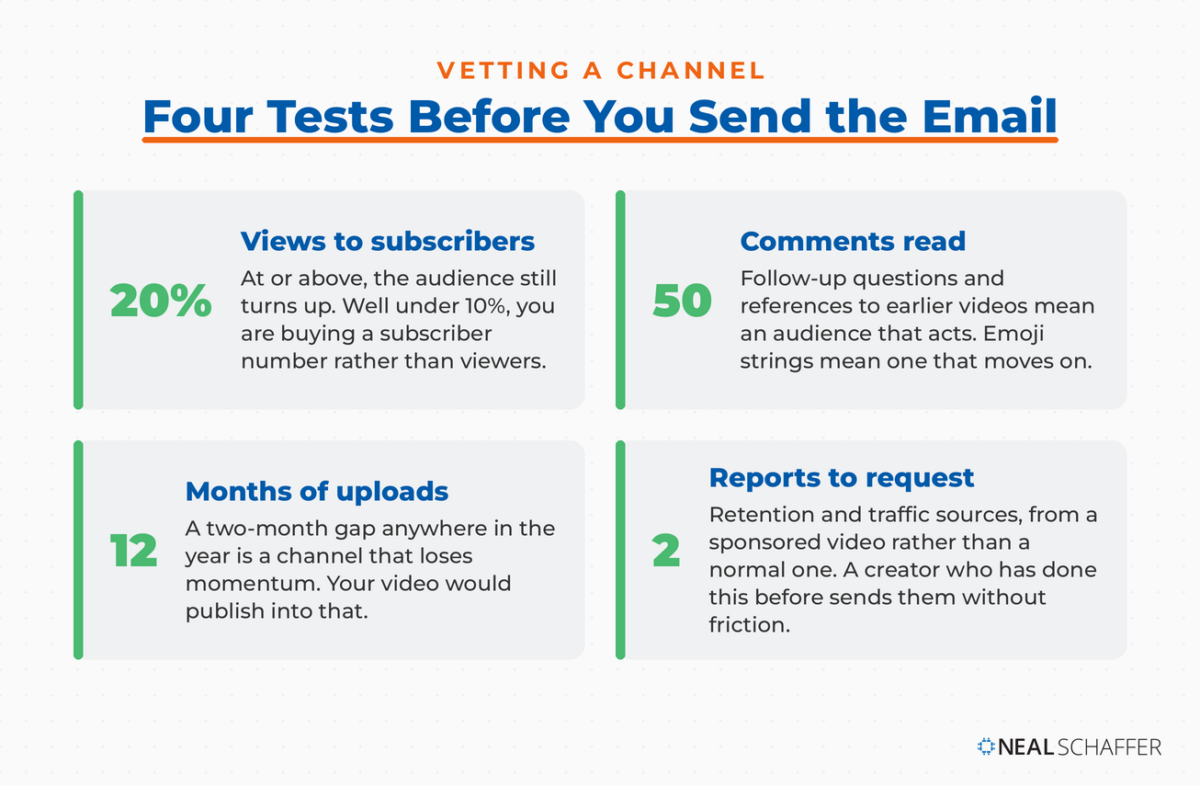
View-to-subscriber ratio. Divide average views on the last ten videos by subscriber count. Anything at or above roughly 20% suggests an active audience. Well below 10% suggests a channel coasting on a back catalog.
Comment quality. Read fifty comments. You are looking for people asking follow-up questions and referencing earlier videos. Generic praise and emoji strings tell you the audience is passive, and a passive audience does not click a link.
Upload consistency. Check the last twelve months on the Videos tab. Gaps of two months or more mean your video may land during a quiet stretch when the channel has lost momentum.
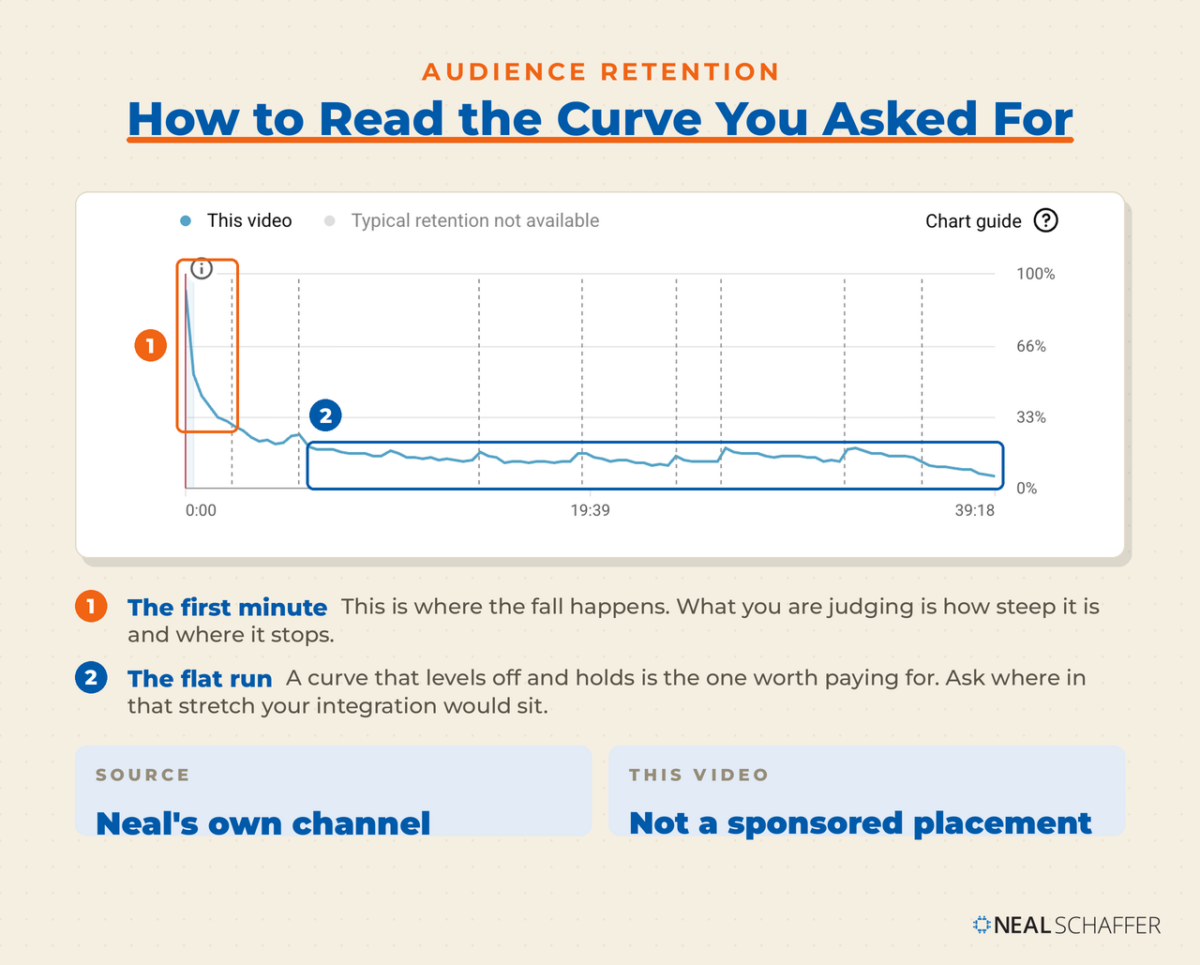
Audience retention. You cannot see this from outside, so ask for it. Request a screenshot of the retention graph and the traffic sources report from a recent sponsored video. A creator who has done this before will send it without friction.
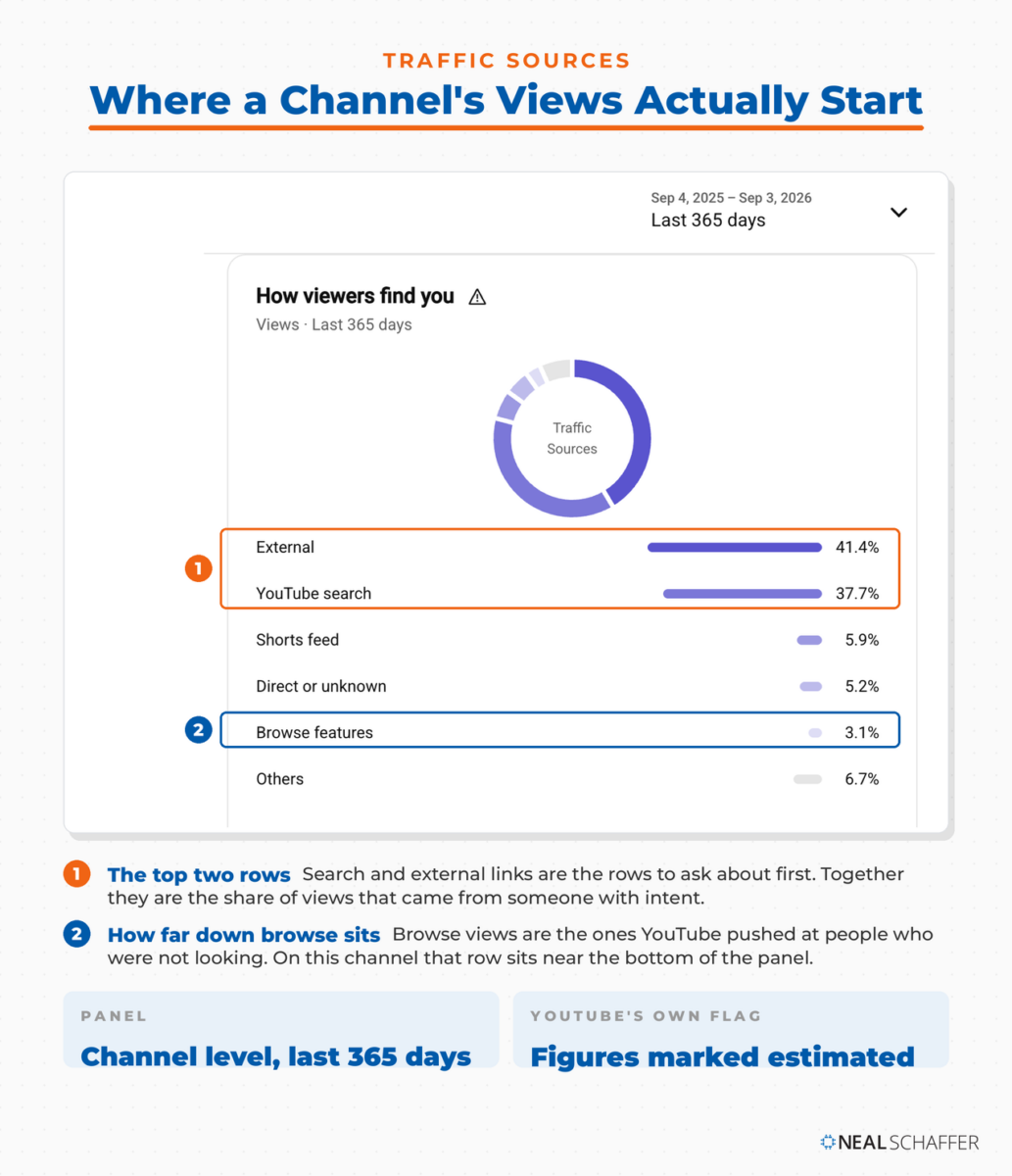
That last request is worth explaining. Traffic sources tell you what share of views arrived from YouTube search, from suggested video, from the browse feeds, and from links posted off the platform. On my own channel across the last year, YouTube search accounted for 37.7% of views and external links for 41.4%, while browse features came to 3.1%. Close to eight views in ten arrived from someone who either searched for something or followed a link to it. That is a different audience from one being served videos it did not go looking for. It is also the audience your integration keeps reaching for months after the video publishes. Ask for the same breakdown from any creator you are considering.
One caution on the numbers you will be quoted. YouTube counts an impression only when a thumbnail sits on screen for more than a second with at least half of it visible. External embeds are not counted at all. So impressions and views are not interchangeable, and a media kit leading with impressions is describing thumbnail exposure rather than people who watched.
How Much Do YouTube Influencers Cost?
YouTube sponsorships are priced on CPM against expected views rather than on subscriber count. Influencer Marketing Hub reports that sponsorship CPMs commonly land between $15 and $30. Targeting 500,000 views at a $20 CPM works out to roughly $10,000, before licensing or cross-platform add-ons.
Tier benchmarks give you a sanity check on a quote. These ranges come from the same source, and they are a starting reference rather than a rate card.
| Creator tier | Subscribers | Typical rate per sponsored video |
|---|---|---|
| Nano | 1K to 10K | $20 to $200+ |
| Micro | 10K to 100K | $200 to $1,000+ |
| Mid-tier | 100K to 500K | $1,000 to $10,000+ |
| Macro | 500K to 1M | $10,000 to $20,000+ |
| Mega | 1M+ | $20,000 to $50,000+ |
Treat any published range as a starting point rather than a fact, because the published ranges disagree with each other. Modash’s benchmarks show CPM climbing with channel size rather than sitting in one flat band, which is a different shape entirely.
| Channel size | Typical CPM for an integration |
|---|---|
| 1M+ subscribers | $30 to $60+ |
| 500K to 1M subscribers | $20 to $50 |
| 100K to 500K subscribers | $10 to $30 |
| Under 100K subscribers | Under $10 to $15 |
That gap matters most when you are pricing a mid-tier creator against a mega one. The two benchmark sets would have you paying very different amounts for the same audience.
So do not walk into a negotiation quoting a number you read somewhere. Take the creator’s average views across their last ten videos, multiply by the CPM you are willing to pay, and treat that as your opening position. Then collect three real quotes, since those quotes are the only figures that actually describe your category.
What Moves a Quote Up or Down
Two factors move a quote well outside those bands. Category is the first: finance, software and business channels command more because the customers they send you are worth more. Audience geography is the second, since a US and UK audience is worth more to most advertisers than a globally distributed one.
Deliverable type moves it too. A dedicated video built entirely around your product costs more than an integration. It replaces the creator’s regular upload, which carries a real opportunity cost for the channel.
Usage Rights and the Other Line Items
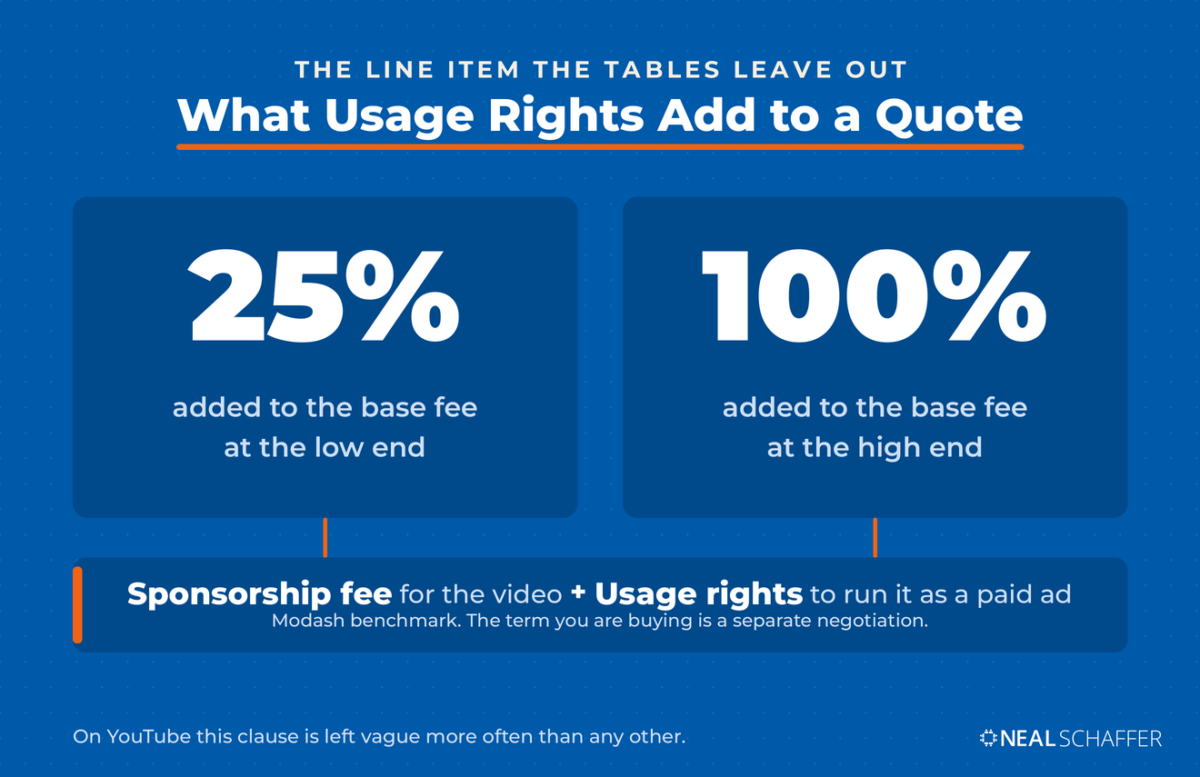
Before you agree to anything, work out what you are buying beyond the video itself. Usage rights for paid ads, script approval, custom thumbnails and cross-posting are all separate line items. Modash puts usage rights alone at 25% to 100% of the base fee, which is enough to reshape a budget if you find out late. I keep a running list of what belongs in an influencer rate card and what belongs in the influencer contract. On YouTube, the usage rights clause gets left vague more often than any other, and disputed later more often too.
For broader category context, my influencer marketing statistics page tracks the spend and performance benchmarks I update through the year.
Price also depends on which of YouTube’s two formats you are actually buying, and those two are further apart than most briefs assume.
Shorts or Long-Form: Which Collaboration Are You Buying?
Shorts and long-form are separate products. A Short is a vertical clip competing in an infinite scroll, and YouTube reports Shorts now average 200 billion daily views. A long-form integration is 30 to 90 seconds inside a video someone chose to watch, which buys attention rather than reach.
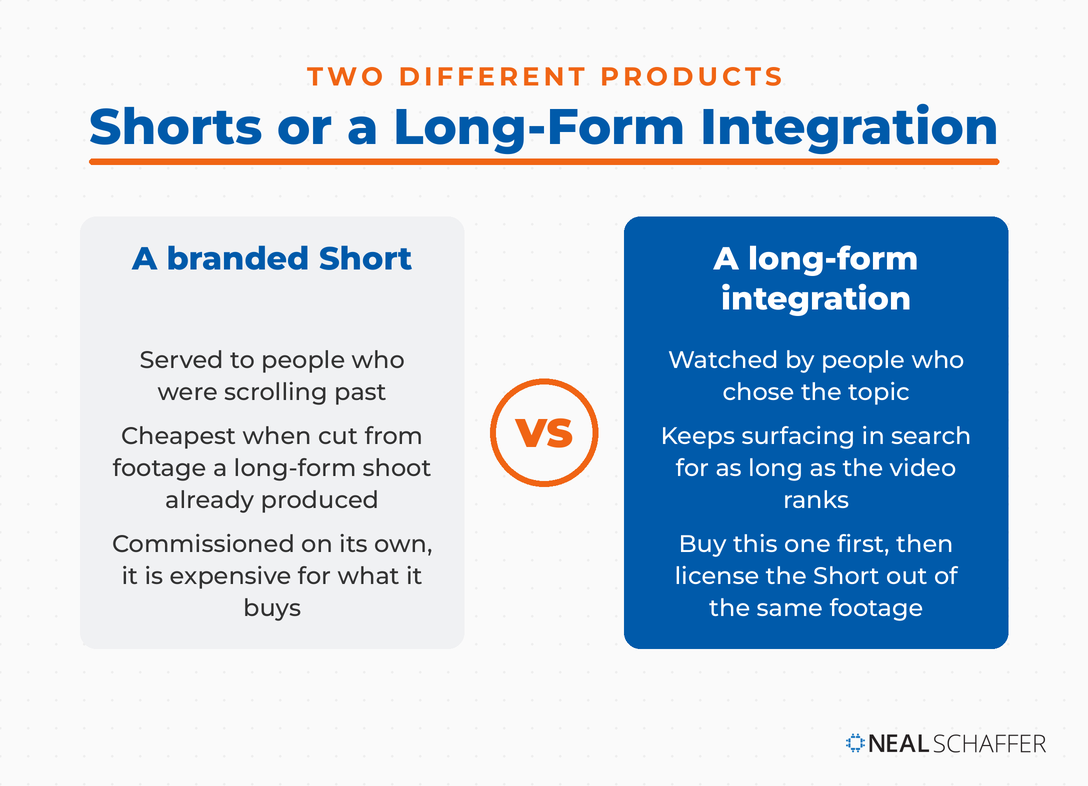
Awareness, product reveals and anything visual enough to land in a few seconds all suit Shorts. The supply is enormous: Alphabet said on its first-quarter 2026 earnings call that more than 10 million channels were publishing Shorts each day as of March.
Long-form suits consideration. If your product needs demonstrating, comparing or explaining, the integration inside a fifteen-minute video does work a Short cannot. It also carries the searchability that makes the placement keep paying.
My recommendation, and I would argue it holds for most brands rather than all: buy the long-form integration first. Then license the same creator to cut a Short from it. You get the compounding asset and the reach hit from one production cycle. That sequencing matters because the Short is cheap to derive from existing footage and expensive to commission standalone.
Whichever format you choose, the same disclosure rules apply to both, and this is where campaigns get brands into genuine trouble.
How Do FTC Rules Work on YouTube?
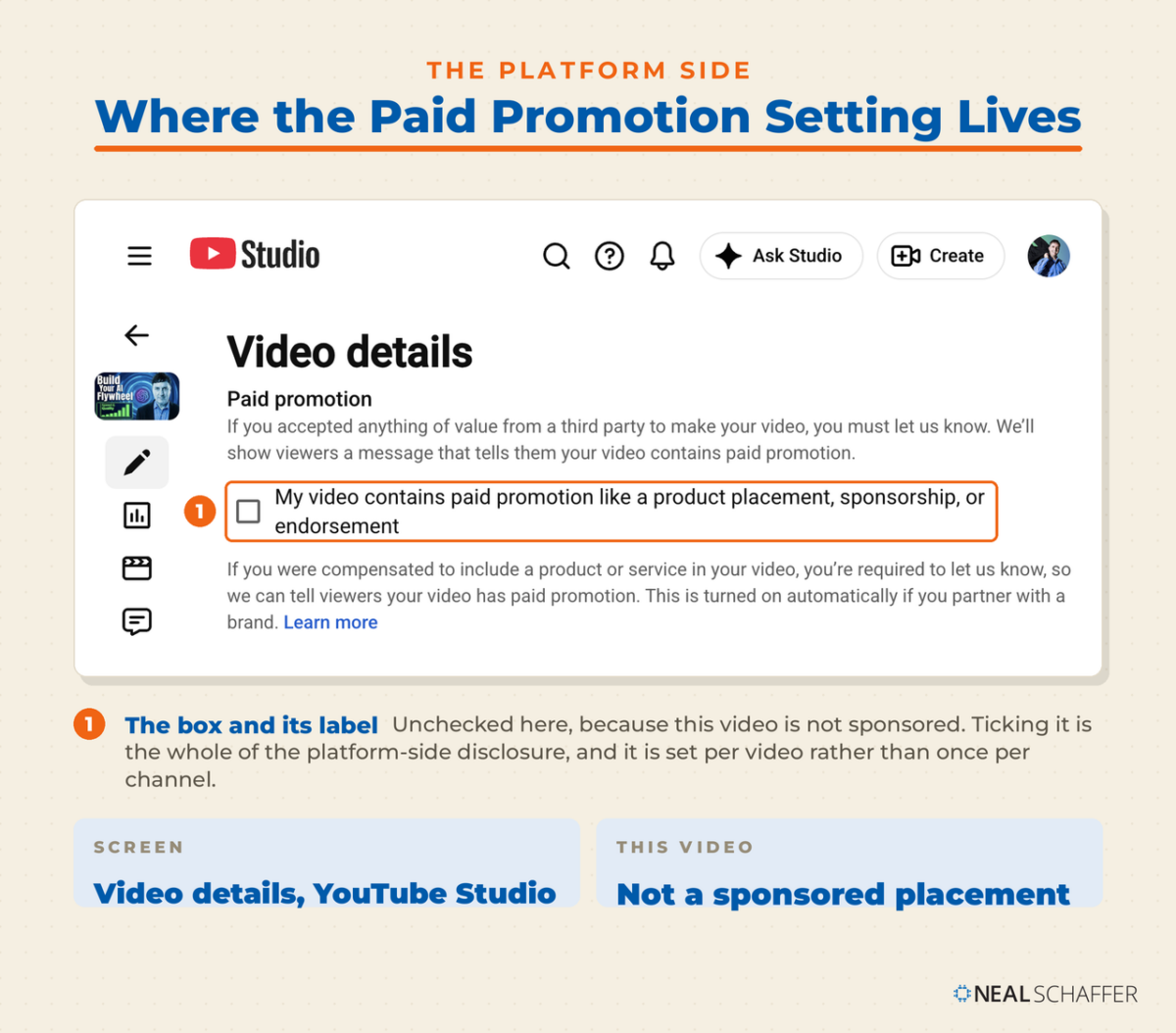
YouTube sponsorships need two separate disclosures. The creator checks YouTube’s paid-promotion box, which triggers an automatic on-screen notice. Separately, the creator must satisfy the FTC. The FTC states directly that a platform’s own disclosure tool should not be assumed good enough on its own.
The platform side is mechanical. In YouTube Studio, the creator opens Content and clicks the video. Then More options, then the box labeled “My video contains paid promotion like a product placement, sponsorship, or endorsement,” then Save. YouTube then shows viewers a disclosure message for ten seconds at the start of the video.
The FTC side is editorial, and it has three requirements that matter for video specifically:
- The disclosure goes in the video, not only in the description. The FTC is explicit that a description-only disclosure is insufficient.
- Say it out loud and put it on screen, because some viewers watch muted and others skip past superimposed text.
- On a live stream, repeat it periodically so viewers who join late still get it.
Language matters too. “Ad,” “sponsored” and “Thanks to Acme brand for the free product” all work. “Sp,” “spon,” “collab” and a bare “thanks” do not, because the FTC treats them as too vague or confusing for an ordinary viewer.
Put the specific wording in the contract rather than trusting the creator’s habits, and specify the timestamp by which it must appear. There is more on my FTC influencer guidelines page, and the disclosure clause belongs in every brief regardless of creator seniority.
Who Should Not Use YouTube Influencer Marketing?
In my experience advising brands on channel selection, YouTube is probably the wrong first channel for a business that needs results this quarter, sells something requiring no explanation, or cannot fund more than a single video. Production runs months, and one video rarely reads as a result internally.
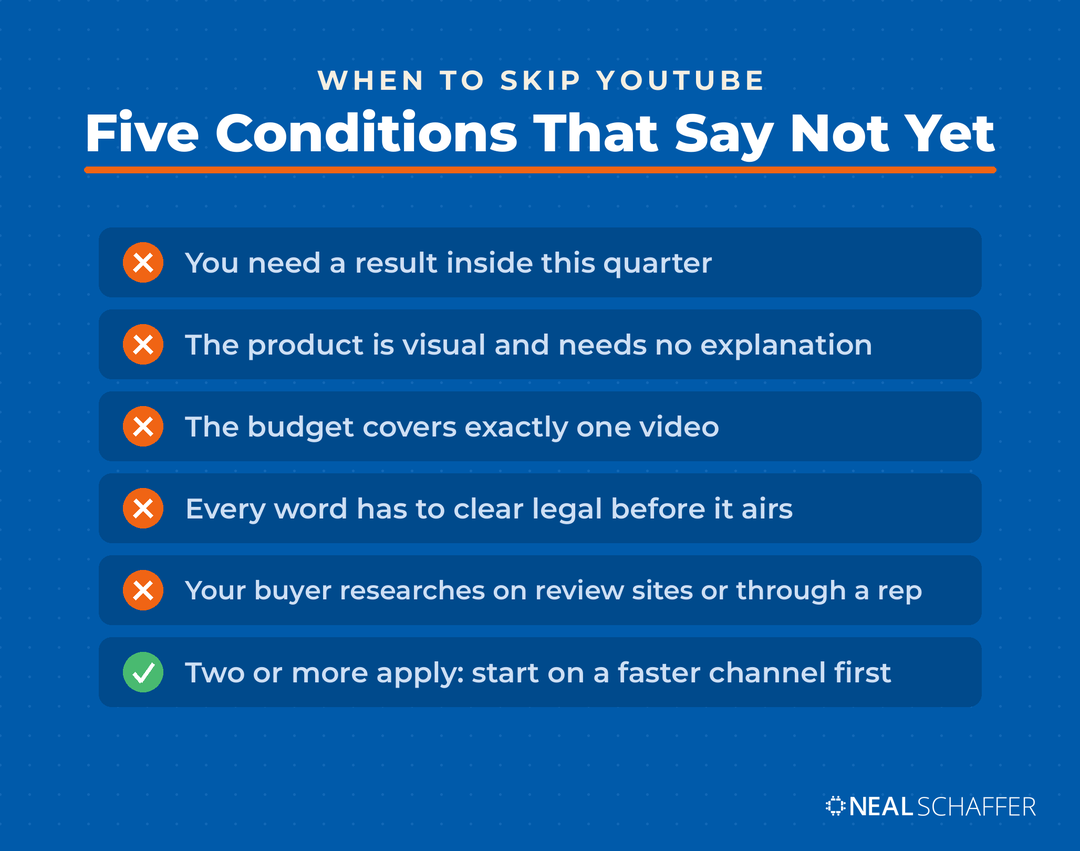
Skip it, at least for now, if any of these describe you:
- You need results this quarter. I would budget two to three months from first contact to published video. That covers researching the creator, reaching out, agreeing terms, recording, giving feedback on a cut, and publishing. It can land sooner, and planning for sooner is how campaigns slip. Paid search moves faster.
- Your product is purely visual and instantly obvious. A candle, a t-shirt, a phone case. The value of a fifteen-minute demonstration is close to zero, and Instagram or TikTok delivers the same message cheaper.
- You can only afford one video. Single placements are difficult to read. If your budget covers one mid-tier video and nothing else, spend it on three micro creators instead and get comparable data.
- You cannot give up creative control. A creator has influence because they understand how to make engaging videos and what their audience actually cares about. Handing them your script ignores the one thing you are paying for. Let them work out the integration themselves and the creator keeps their audience’s trust while your message still lands. If your legal team needs to approve every word, the channel will fight you.
- Your buyer is not on the platform in a research mindset. Some categories get researched entirely on review sites or through a sales rep. No amount of video changes that.
If two or more of those apply, the answer is not to force it. Build the influencer marketing campaign on a faster channel first. Get a result you can point to internally, then come back to YouTube once you have budget for a sustained run.
Frequently Asked Questions
There is no floor. The number that matters is average views on recent videos. As the Influencer Marketing Hub benchmarks cited above note, brands often prioritize recent view counts over total subscribers when valuing a sponsorship. A 15,000-subscriber channel averaging 25,000 views is a better buy than a 300,000-subscriber channel averaging 9,000.
Both models exist. Flat fees per video are the most common and the easiest to budget. CPM and cost-per-view models tie payment to performance, which suits awareness campaigns where you have a view target. Ask for both quotes and compare them against the creator’s actual average views.
Only if you licensed it. Usage rights are a separate negotiation from the sponsorship fee, and repurposing a video into paid media without that clause is a contract problem. Settle the term, the channels and the territories before the video is filmed.
It can be, if you work with micro and nano creators in a narrow category. The economics only break down when a small brand tries to buy a macro creator. Start with three small creators, measure, and scale toward the one that performed.
Longer production cycles, higher creative investment, and a much longer payback window. YouTube generated more than $60 billion in revenue in 2025, ahead of Netflix’s $45.18 billion. That tells you how much viewing has moved there. Content that keeps being watched keeps carrying your integration.
Ready to Put YouTube Creators to Work?
Start with the search step rather than the shortlist. Spend an afternoon typing your customer’s questions into YouTube. Record who ranks, then sort the sheet by average views. That single exercise will tell you more about your category than any database subscription, and it costs nothing.
Then pick three mid-tier creators and buy one integration each rather than one large placement. Three data points show you which audience actually converts. Your second round of buying gets far smarter as a result.
Get the disclosure language and the usage rights into the contract before filming starts. Both are cheap to agree up front and expensive to argue about after publication.
If you want the wider performance picture on video before you commit budget, my video marketing statistics page is where I keep the benchmarks current. When you are ready to contact your shortlist, start with how to reach out to influencers. Then decide what to ask for from the range of influencer collaborations available.
And if you would rather have someone build the channel strategy alongside your other marketing, that is what I do as a Fractional CMO. If you are a creator or small team wanting to work through it with peers, my Digital First Mastermind is where those conversations happen every week.
Free Preview of My Definitive Book on Influencer Marketing
We respect your privacy. Unsubscribe at anytime.