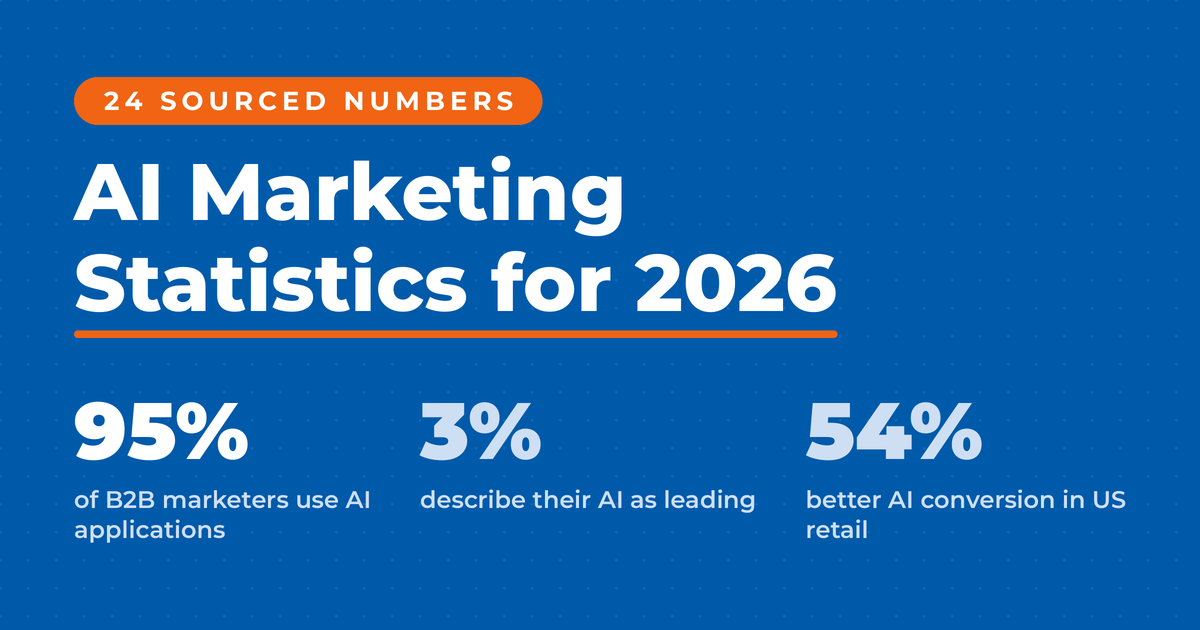

Ninety-five percent of B2B marketing teams now use AI-powered marketing applications, which means adoption stopped being the interesting question a while ago. What matters in 2026 is whether any of it moves a number your CFO cares about. I work as an Adobe Express Ambassador, a Fractional CMO, and the host of the Your Digital Marketing Coach podcast. Most of my week sits in the gap between what teams have installed and what they can show for it.
Every number below is from a named study published in 2025 or 2026. Together they answer the six questions I hear most from marketing leaders. How many teams really use this. What they use it for. How much they spend. Whether it pays. How buyers are finding brands through AI now. And whether AI traffic converts.
Key Takeaways
✅ Adoption has stopped being a strategy. Nineteen in twenty B2B marketing teams already run AI somewhere, so a plan that says “adopt AI” describes the starting line rather than a destination.
✅ Speed improved. Results improved much less. Marketers report big gains in productivity from AI-assisted content and far smaller gains in whether that content performs.
✅ Budget is moving faster than readiness. CMOs are putting roughly a sixth of marketing budget into AI while most say their own processes cannot scale it yet.
✅ Half of US adults use chatbots, and six in ten read AI summaries in search. Your buyer meets an AI layer before they meet your website.
✅ AI traffic flipped from the worst-converting channel to one of the strongest. In US retail it now converts better and is worth more per visit than non-AI traffic.
✅ The web is filling up with AI-written pages, which makes anything you can prove firsthand more valuable than anything a model can assemble.
How many marketing teams are actually using AI in 2026?
Almost all of them. Ninety-five percent of B2B marketers say their organization uses AI-powered marketing applications, and nearly nine in ten organizations overall report regular AI use in at least one business function. Depth is the real divide: most teams sit in early or developing stages rather than running AI at scale.
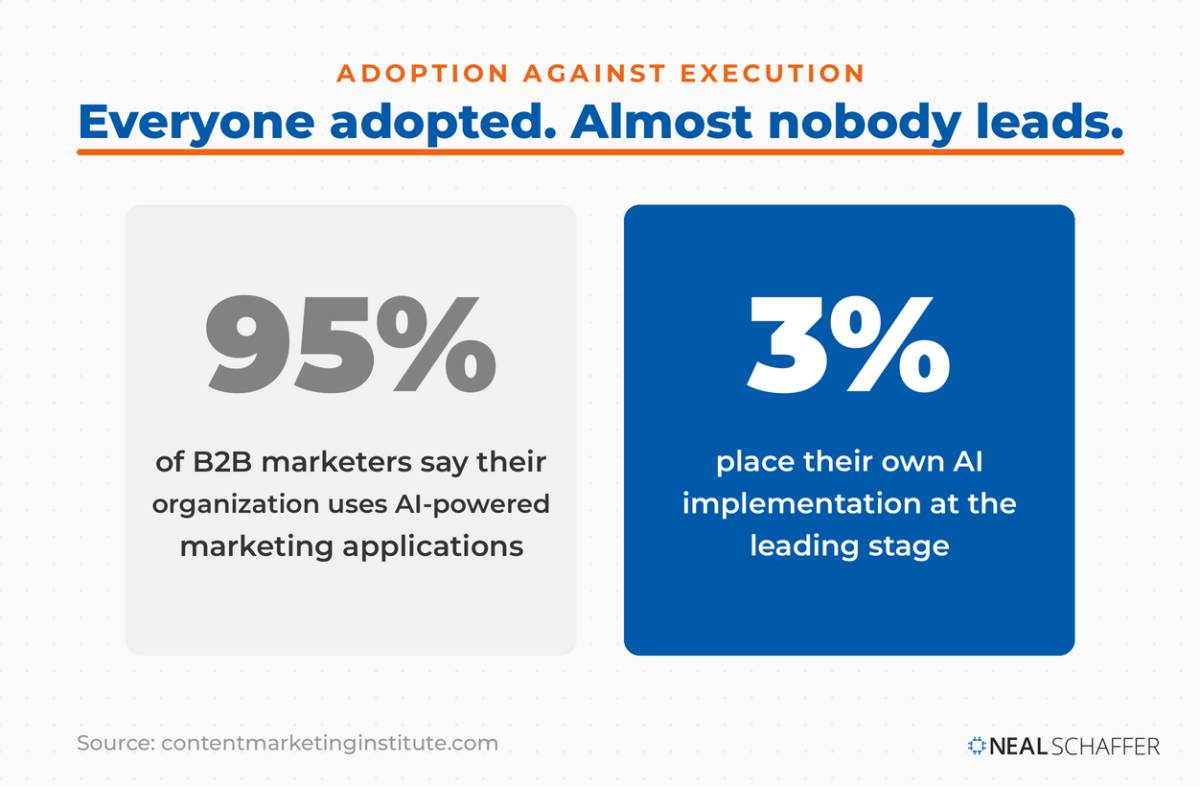
1. 95% of B2B marketers say their organization uses AI-powered marketing applications
Ninety-five percent of B2B marketers report that their organizations use AI-powered marketing applications, according to the Content Marketing Institute’s 2026 B2B research with MarketingProfs. That survey drew 1,015 B2B marketers and was fielded between June 24 and August 14, 2025.
What this means for you: take “adopt AI” off the annual plan. Everyone adopted. The competitive question now is what you do that a rival with identical subscriptions cannot copy. That starts with treating AI marketing as a set of specific workflows rather than a tool purchase.
2. Only 3% of B2B marketers describe their AI implementation as leading
Three percent of B2B marketers place their AI implementation at the leading stage and another 5% at advanced, in the same Content Marketing Institute survey for 2026. Nearly seven in ten sit at developing or exploratory.
What this means for you: this is the gap worth attacking. Being in the top tenth of your category on AI execution is achievable in a year, and it does not require a bigger budget than the team next door. It requires picking two or three workflows and running them properly instead of buying nine tools and piloting all of them.
3. 44% of organizations now have AI scaling across the enterprise, up from 38%
Forty-four percent of organizations report AI scaling across the enterprise, up from 38% a year earlier, according to McKinsey’s State of AI survey published August 25, 2026. The share using AI in three or more business functions rose from 51% to 56%.
What this means for you: if marketing is the only function in your company running AI, you are about to be out of step with IT, sales and service. Get into the room where the enterprise decisions are being made early, because the data plumbing those teams build is the same plumbing your personalization and reporting will depend on.
4. Four in ten companies are already doing generative engine optimization
Generative engine optimization, the practice of getting your content into AI-generated answers, is in use at four in ten companies, according to the 2026 CMO Survey reported by Duke University’s Fuqua School of Business in March 2026. The survey polled 308 marketing leaders, 97% of them VP level or higher.
What this means for you: this capability did not exist in earlier editions of the survey and is already at four in ten companies. The window where it counts as a differentiator is closing. Start with how AEO and GEO differ, then audit which of your pages get cited in AI answers today.
Be careful which pages you audit, though. I ran the bare question “what is generative engine optimization” through ChatGPT signed out in August 2026 and got a long, structured answer with no sources at all. Asking the same question and adding “please cite your sources” returned two research papers and Google’s own documentation. No marketing site appeared either way.
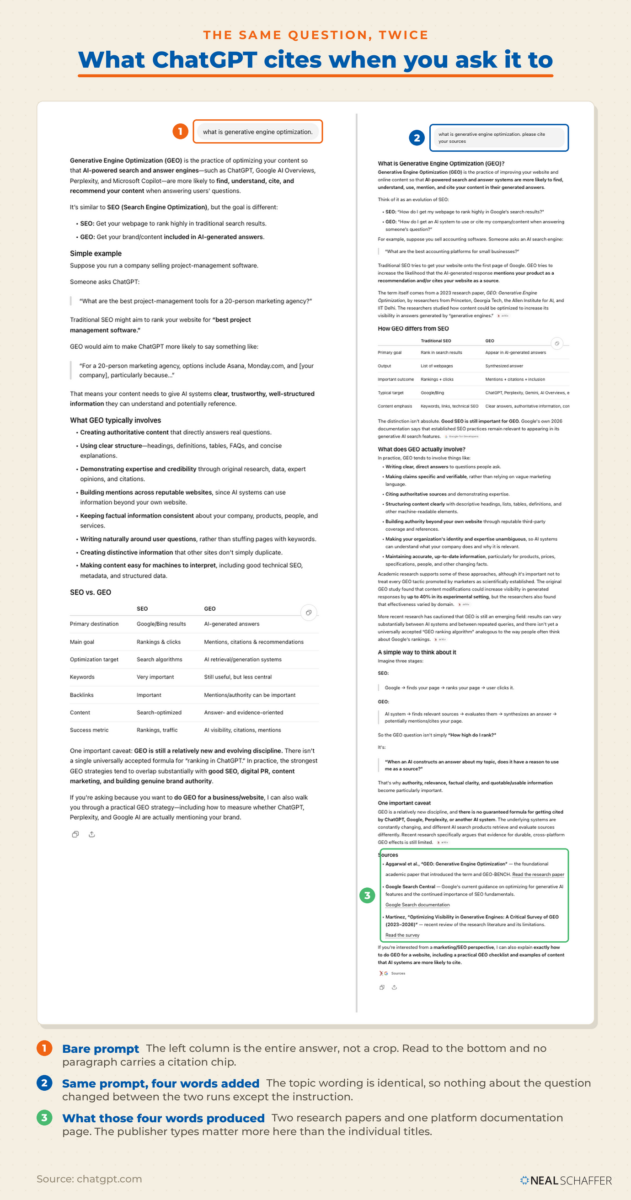
So a definitional page in your category may have nothing to win. The model already knows the definition and has no reason to go looking. Point your citation-seeking pages at questions where the answer changes: current numbers, comparisons, pricing, dates.
That covers how many teams are in. The more useful question is what they are actually doing with it.
What are marketing teams actually using AI to do?
Mostly writing. Content creation tools lead B2B AI adoption at 89%, while the applications that touch revenue prediction and targeting sit near the bottom at 12%. Chatbots are the most widely scaled AI tool across all business functions, and agents remain an experiment for most marketing teams rather than production infrastructure.
5. 89% of B2B marketers use AI for written content, and 12% use it for predictive analytics
Content creation tools for generating or optimizing marketing copy lead AI adoption at 89%, while predictive analytics and targeting tools sit at 12%, in Content Marketing Institute’s 2026 B2B survey. Creative asset tools follow at 53%, SEO tools at 41%, social media tools at 38% and email tools at 36%.
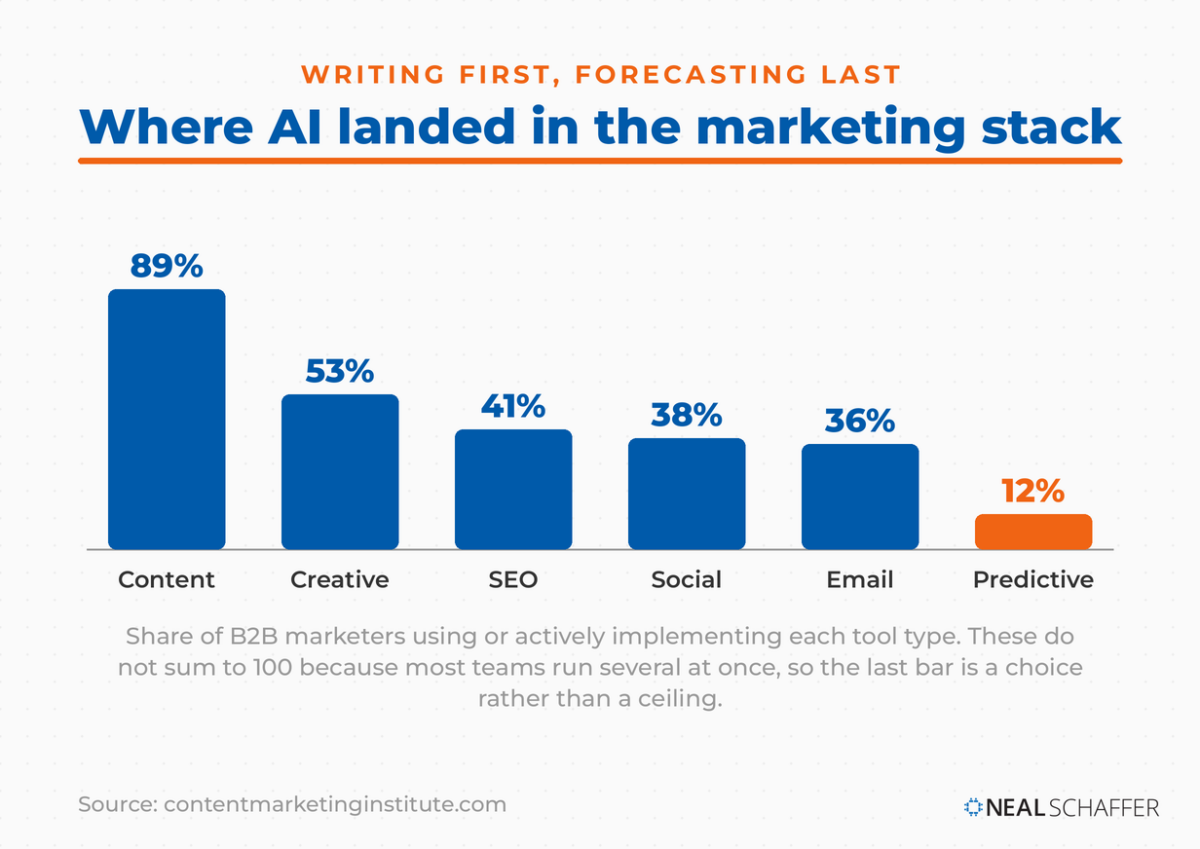
What this means for you: the adoption curve went where the friction was lowest, not where the money is. Forecasting, segmentation and targeting are where AI compounds, and almost nobody is there yet. If you want an edge that a competitor cannot buy in an afternoon, start there rather than adding another AI-generated content workflow.
6. Chatbots are the most widely scaled AI tool at 47%
Forty-seven percent of respondents say their organizations are scaling AI chatbots across the enterprise, while about two in ten report the same for AI agents, per McKinsey’s 2026 State of AI survey. That survey ran from May 4 to June 8, 2026 and drew 1,719 participants across 97 nations.
What this means for you: the gap between chatbot scaling and agent scaling is your planning horizon. Chatbots are a solved buying decision. AI agents still need scoped tasks, clean data access and someone accountable for what they publish. Pick one narrow workflow and prove it before anyone writes “agentic” on a slide.
The Digital Marketing Playbook for Small Teams
My latest book helps small businesses, entrepreneurs, and marketers bring search, email, and social together into one digital marketing strategy that actually compounds.
Drawing on my work as a Fractional CMO, Digital Threads turns complicated tactics into a clear, practical plan you can follow, whatever your budget or team size.
Grab your copy on Amazon and start weaving your own digital threads. Click the cover or the button below to get started.

7. 70% of CMOs call AI leadership critical for 2026, and 70% say their processes are not ready
Seventy percent of CMOs consider becoming an AI leader a critical goal for 2026, and 70% also acknowledge that their internal marketing processes are not mature enough to implement and scale AI, according to Gartner’s 2026 CMO Spend Survey. Only 30% report mature or fully developed AI readiness.
What this means for you: two identical percentages, one for ambition and one for unreadiness, describe 2026 marketing about as well as anything can. Before you approve another tool, write down the process it plugs into and who owns it. That exercise separates the teams that get value from the teams that get invoices. It is also a large part of what a CMO does right now.
Ambition without readiness usually shows up in the budget first, so that is where to look next.
How much of a marketing budget goes to AI in 2026?
Roughly a sixth. CMOs allocate an average of 15.3% of marketing budgets to AI initiatives, and the organizations that describe themselves as AI-ready allocate 21.3%. AI tools top the 2026 B2B investment list at 45%, while spending on the people who operate those tools sits at the bottom.
8. CMOs are putting 15.3% of marketing budgets into AI
Marketing leaders allocate an average of 15.3% of marketing budgets to AI initiatives, per Gartner’s 2026 CMO Spend Survey, conducted January through March 2026 among 401 CMOs and marketing leaders in North America, the United Kingdom and Europe. Overall marketing budgets stayed close to flat at 7.8% of company revenue.
What this means for you: a sixth of a flat budget is a reallocation, not an increase. Something got cut to pay for this. Name that something out loud in your planning meeting, because an unnamed trade-off tends to come back as a missed target in Q3. If you are still assembling the stack, be ruthless about which AI marketing tools actually earn a line item.
9. The most AI-ready marketing organizations put 21.3% of budget into AI
Marketing organizations that report mature or fully developed AI readiness allocate 21.3% of their budgets to AI, against the 15.3% survey average, Gartner found in 2026. Those organizations also report marketing budgets at 8.9% of company revenue, above the 7.8% average.
Worth noting that the two big benchmark surveys disagree on the denominator. Gartner puts marketing budget at 7.8% of company revenue for 2026, while Duke’s CMO Survey puts it at 9.0%. Different samples, different definitions, so treat either as a range rather than a figure.
What this means for you: the ready teams spend more on AI and hold more budget overall. That order suggests spending follows credibility rather than creating it. So earn the credibility first. Ship one AI-enabled workflow with a measured before-and-after, then ask for the bigger number.
10. 45% of B2B marketers name AI tools their top 2026 investment, and people finish last at 9%
AI-powered marketing tools top the 2026 investment list at 45%, while human resources such as salaries, training and development sits last at 9%, in Content Marketing Institute’s 2026 B2B research. Events and experiential marketing came second at 33%, owned media third at 32%.
| Investment area | Share planning to increase in 2026 |
|---|---|
| AI-powered marketing tools | 45% |
| Events and experiential marketing | 33% |
| Owned media (site, blog, email) | 32% |
| Paid media | 25% |
| Content personalization | 24% |
| Tech infrastructure | 21% |
| Human resources | 9% |
Source: Content Marketing Institute and MarketingProfs, B2B Content and Marketing Trends: Insights for 2026, 2026.
What this means for you: buying tools for a team you will not train is how you stay in the developing tier described earlier. Pair every tool purchase with a named person, a training block and a workflow they own. Training on a tool you already pay for just might beat a new subscription.
11. Marketing training budgets have fallen to 3.8% of marketing spend
Training budgets have declined to 3.8% of marketing spend and headcount growth has dropped by half since last year, according to the 2026 CMO Survey. Duke reports that the most cited capability shortfall is a lack of people, time and budget rather than a missing skill.
What this means for you: your team is being asked to run new technology with less training and fewer people. Budget an hour a week per person for structured practice and protect it like a client meeting. Start people on free AI tools so the learning curve costs time rather than money, then upgrade only what proves useful.
The spending is settled. Whether it returns anything is a separate question, and the two surveys disagree less than you might hope.
Is AI actually paying off for marketing teams?
Unevenly. Individuals report large productivity gains and organizations report almost none at the profit line. Eighty percent of people say AI improved their own productivity, while 37% of organizations attribute any EBIT contribution to it. Marketing-specific results follow the same shape: faster production, flat performance.
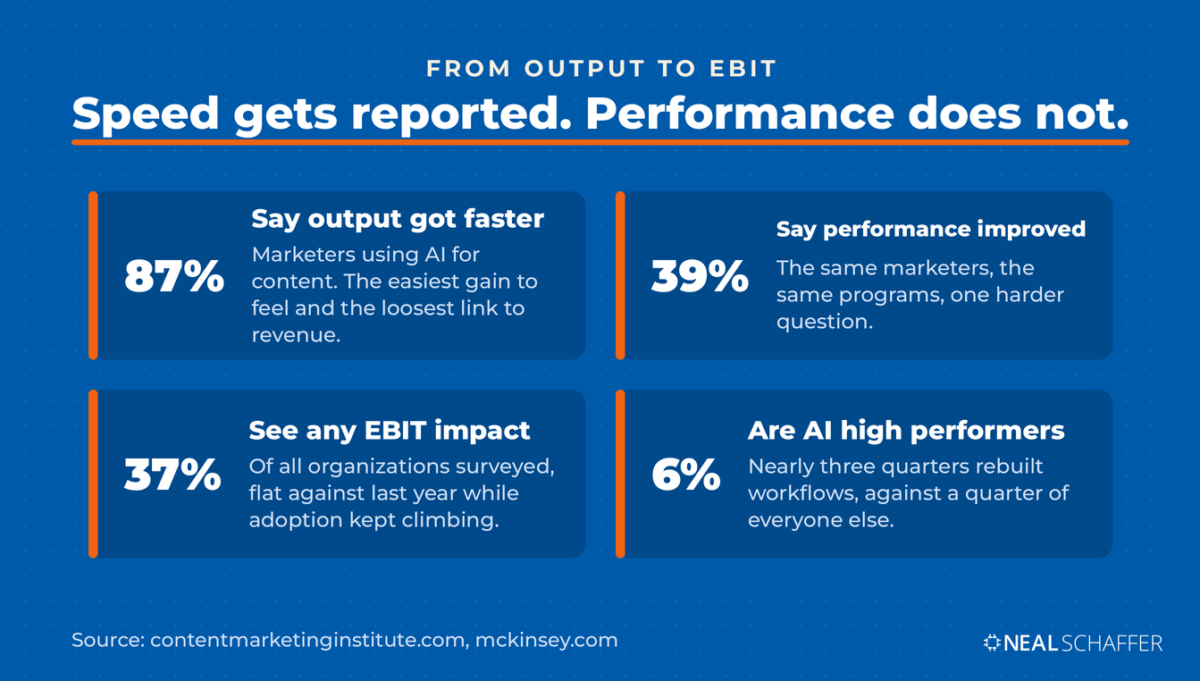
12. 87% of AI content users report higher productivity, but only 39% report better content performance
Among B2B marketers using AI for content creation, 87% say productivity improved and 80% say operational efficiency improved, while 39% say content performance improved, per Content Marketing Institute’s 2026 outlook. Twelve percent report that content quality decreased.
| What AI-assisted content changed | Improved | No change | Decreased |
|---|---|---|---|
| Productivity | 87% | 6% | 3% |
| Operational efficiency | 80% | 11% | 2% |
| Creative capabilities | 65% | 22% | 5% |
| Content quality | 58% | 21% | 12% |
| Content performance | 39% | 34% | 5% |
Source: Content Marketing Institute and MarketingProfs, B2B Content and Marketing Trends: Insights for 2026, 2026.
What this means for you: read that table from the bottom up, not the top down. Productivity is the easiest thing to feel and the least connected to revenue. Set your AI targets on the bottom two rows, quality and performance, and you will make different tooling decisions than a team optimizing for output volume.
13. 80% of people say AI improved their productivity while 37% of organizations report any EBIT impact
Eight in ten respondents say AI has improved their individual productivity and about half say it helps them make better decisions, yet 37% report that AI has contributed to their organization’s EBIT, essentially unchanged from a year earlier, according to McKinsey.
What this means for you: individual time saved is not company money earned unless somebody redeploys the time. If your writers finish drafts twice as fast and the extra hours go into more drafts, you have bought volume. Decide in advance what the recovered hours are for, and make that decision part of your AI in digital marketing plan rather than an afterthought.
14. AI high performers are still 6% of organizations
Organizations that attribute at least 5% of EBIT to AI and describe its impact as significant account for 6% of respondents, unchanged from 2025, in McKinsey’s 2026 survey. Nearly three-quarters of them report fundamentally redesigning workflows, up from 55% a year earlier.
On a recent episode of my podcast Your Digital Marketing Coach, I put it this way: “AI has solved the execution problem, but execution without strategy just means you produce more of the wrong thing faster.”
What this means for you: the differentiator among the 6% is workflow redesign, not model choice. Inserting AI into the process you already run gets you a faster version of the same result. Rebuilding the process around what AI is genuinely good at gets you a different result, and that belongs in your digital marketing strategy rather than in a tools review.
15. No marketing technology capability scores above 5 on a 7-point performance scale
Across a wide range of marketing technology activities, no capability scores above 5 on a 7-point performance scale, and performance has not improved over two years, Duke’s Fuqua School of Business reported in March 2026. The limiting factors named were budget, integration, bandwidth and talent.
What this means for you: none of those four limits gets fixed by a model upgrade. Pick the one that hurts most in your team, write a single sentence describing what “fixed” looks like, and spend the next quarter on that instead of on evaluations. In Digital Threads I made the case that AI helps most in the planning stage of content work. Planning is exactly where integration and bandwidth problems show up first.
Inside the company, the picture is mixed. Outside it, buyer behavior has moved much faster.
How are buyers finding brands through AI now?
Through chatbots and AI summaries, at scale. About half of US adults use AI chatbots and six in ten read the AI summary at the top of search results. Bain estimates that heavy reliance on zero-click answers has already cut organic web traffic by 15% to 25%, which changes what a ranking is worth.
16. 49% of US adults now use AI chatbots, up from 33% in 2024
About half of US adults report using AI chatbots such as ChatGPT, Gemini or Copilot, up from a third in 2024, according to Pew Research Center. Pew surveyed 5,119 US adults from February 17 to 23, 2026, and 24% report daily use.
What this means for you: half your market is now asking a chatbot questions you used to answer with a blog post. That does not make the blog post worthless. It makes the blog post a training input and a citation target rather than a landing page, which is a different writing job with different formatting rules.
17. 44% of US adults use ChatGPT, and Gemini is second at 24%
Forty-four percent of US adults say they ever use ChatGPT, up from 34% a year earlier, per Pew Research Center’s February 2026 survey. Gemini follows at 24%, Copilot at 17%, Meta AI at 14%, Grok at 8% and Claude at 6%.
| Chatbot | Share of US adults who ever use it |
|---|---|
| ChatGPT | 44% |
| Gemini | 24% |
| Copilot | 17% |
| Meta AI | 14% |
| Grok | 8% |
| Claude | 6% |
| Character.ai | 3% |
Source: Pew Research Center, Americans and AI 2026, June 2026.
What this means for you: this is a distribution list, so treat it like one. Run your five most commercially important prompts through the top three platforms once a month and write down whether you appear. Ten minutes of that beats an hour of theory about how models rank sources.
18. 60% of US adults read the AI summary at the top of search results
Six in ten US adults say they read AI summaries at the top of a search engine result, while three in ten say they do not, Pew Research Center found in 2026. Another 10% were not sure.
What this means for you: your first impression is now a paragraph you did not write. Give the summary something easy to lift by putting a direct, self-contained answer in the first 60 words under every heading. That habit does more for your visibility in an AI search engine than another 500 words of preamble.
On a query where the answer does change, the citations arrive. Searching “ai marketing statistics 2026” on Google in August 2026 returned an AI Overview citing three statistics roundups, from Adobe, Omnibound and Loopex Digital. The organic results directly beneath it led with McKinsey and Stanford HAI.
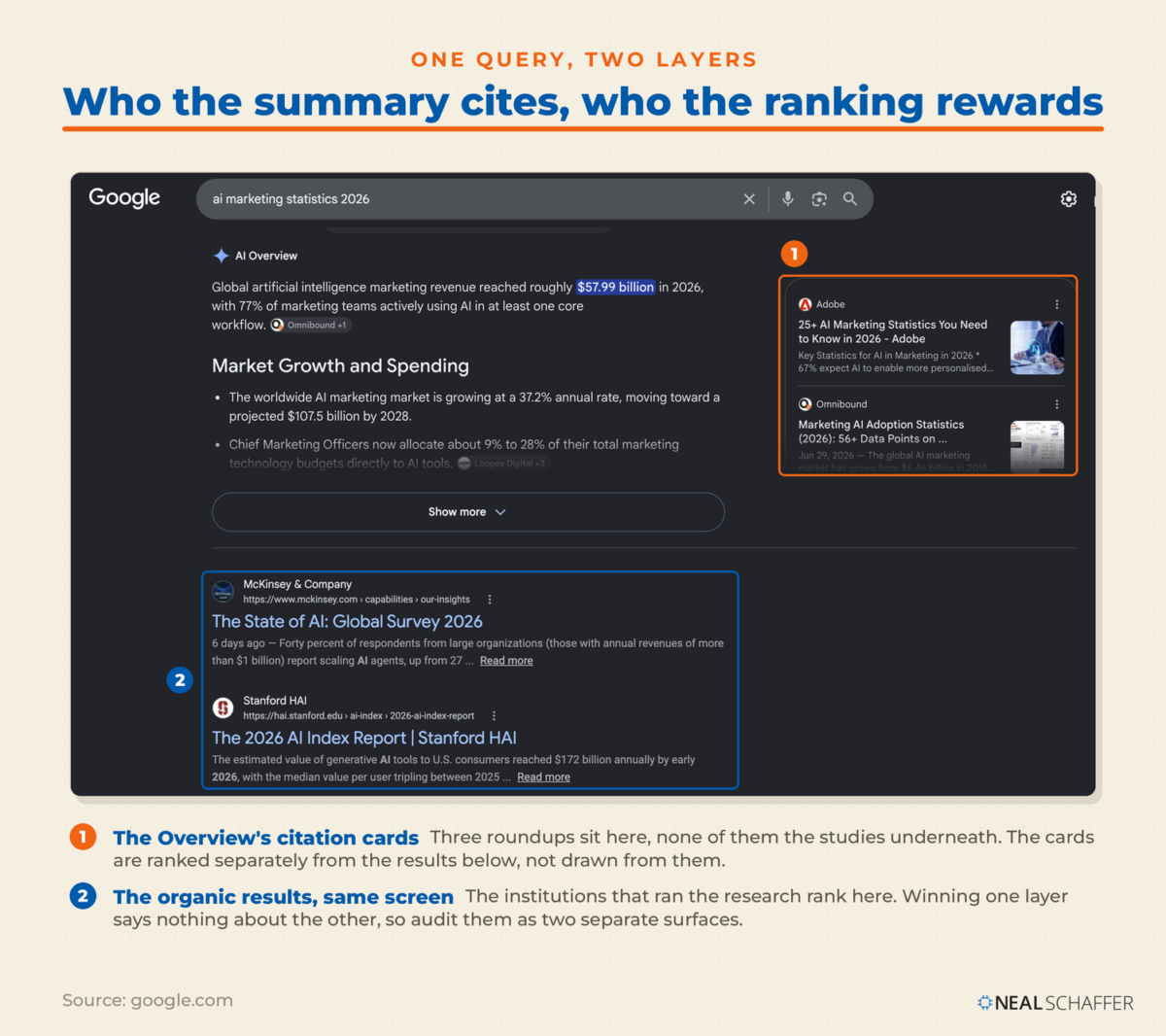
That split is worth sitting with. On this query the ranking layer rewarded the institutions producing the research, while the summary layer cited the pages assembling it. If you want into the second layer, assemble well and source properly rather than publishing another definition.
19. About 80% of consumers lean on zero-click answers for at least 40% of their searches
About 80% of consumers rely on zero-click results in at least 40% of their searches, which Bain estimates reduces organic web traffic by 15% to 25% (February 2025). Bain also found that about 60% of searches end without the user moving to another site.
What this means for you: build your forecast on a smaller click number and a bigger impression number, and tell your CFO now rather than in the quarterly review. Reporting a 20% traffic decline as a failure, when the whole category moved, is how good programs get cut for the wrong reason.
Fewer clicks sounds like bad news. The conversion data says something more complicated.
Does AI traffic actually convert?
Better than it used to, and in retail better than everything else. Adobe’s May 2026 data shows AI-referred traffic to US retail sites converting 54% better than non-AI sources, with each visit worth 53% more. Twelve months earlier the same channel was the weakest performer on both measures.
20. AI traffic to US retail sites converted 54% better than non-AI sources in May 2026
Traffic arriving at US retail sites from AI sources converted 54% better than non-AI sources in May 2026, according to Adobe Analytics, a reversal from a year earlier when those conversion rates were nearly half as high. Adobe’s retail figures draw on more than one trillion visits to US retail sites.
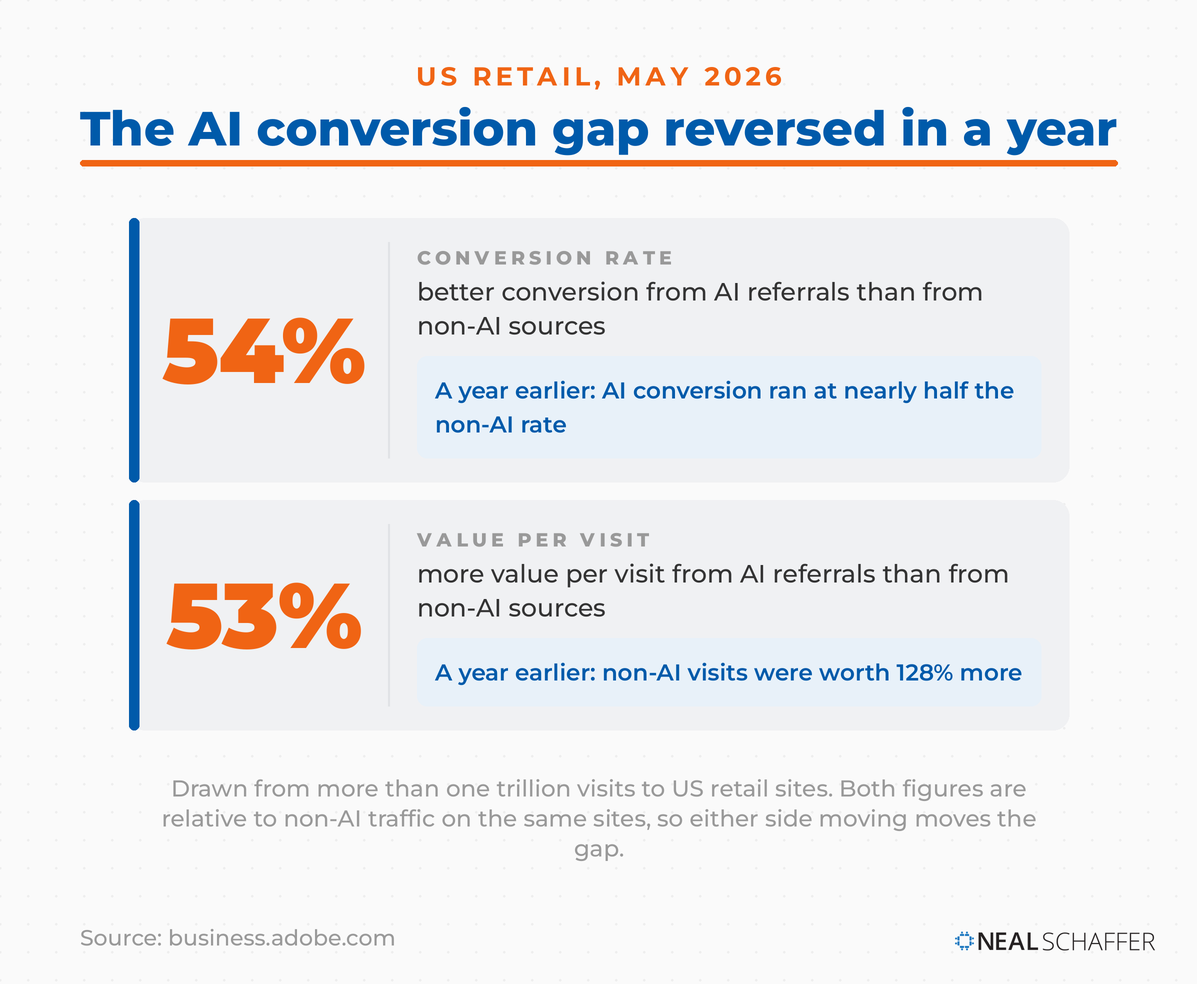
What this means for you: if you wrote off AI referrals in 2025 on the grounds that they browsed and left, that judgment has expired. Go and check your own numbers rather than trusting a retail benchmark.
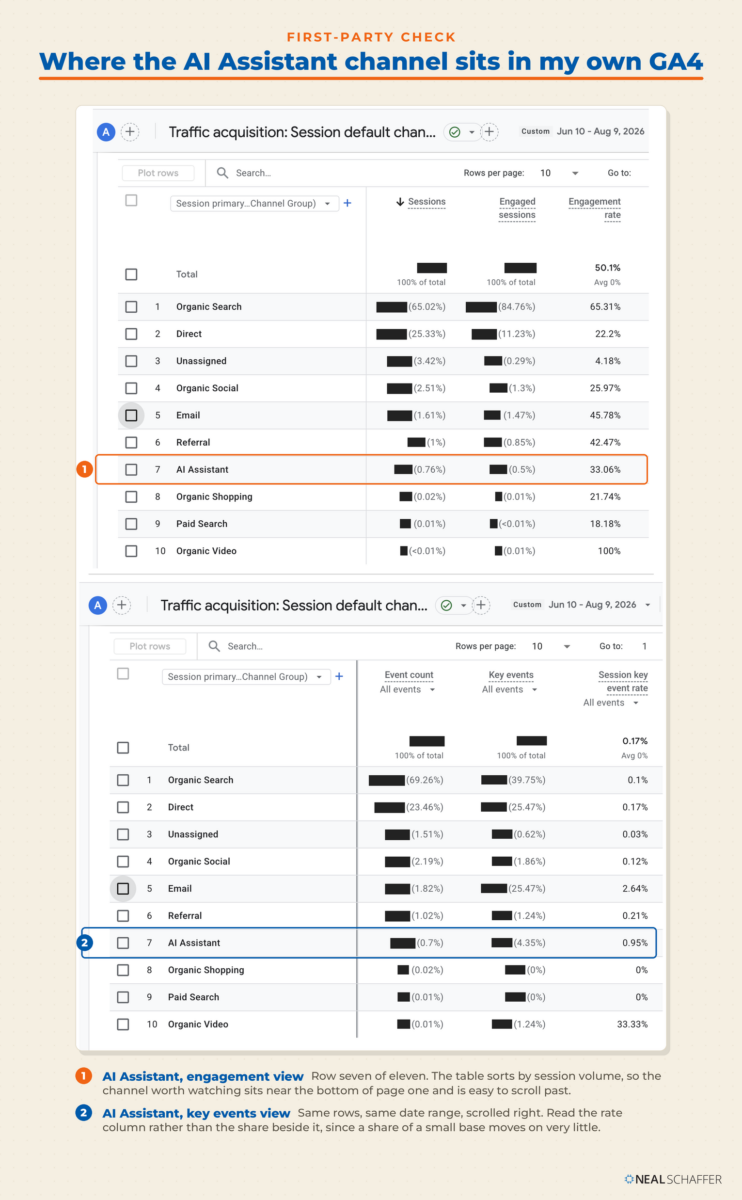
One trap before you do. GA4’s AI Assistant channel group starts reporting on the day Google switches it on for your property, not on the day AI traffic started arriving. On my own site that date was June 10, 2026. Any chart drawn from that channel group climbs from zero on that date for reporting reasons rather than behavioral ones.
Build the real history from referral sources instead:
- Go to Explore and open a blank exploration.
- Set the visualization to the table icon, then drag Session source into Rows and Sessions and Key events into Values.
- Add a filter of Session source matches regex, with the pattern `chatgpt|perplexity|copilot|gemini|claude|openai`.
- Drag the start date back as far as the property allows.
If that comes back short too, open Admin, then Data collection and modification, then Data retention. GA4 ships with a two-month default that Explore obeys and Reports does not.
21. AI visits to US retail sites are now worth 53% more than non-AI visits
AI visits to US retail sites are worth 53% more than non-AI visits, up from 37% in March 2026, Adobe reported in June 2026. Twelve months earlier, non-AI visits were worth 128% more. AI-referred shoppers also spend 53% longer per visit and view 23% more pages.
What this means for you: a channel that swings that far in twelve months deserves a monthly review rather than an annual one. Be careful about carrying the value figure across to your own business, though. Adobe is measuring retail carts, so a site with no transactions has no way to test it.
On my own site I can check the conversion half and not the value half. Over the two months from June 10 to August 9, 2026, AI Assistant delivered 0.76% of sessions and 4.35% of key events, a session key event rate of 0.95% against 0.1% for organic search. That points the same direction as the retail data, on a base of conversions small enough that I would not build a forecast on it. For the wider channel context, my social media marketing statistics page sits alongside this one.
22. The average AI search visitor is worth 4.4 times a traditional organic search visitor
Based on conversion rate, the average AI search visitor is 4.4 times as valuable as the average traditional organic search visitor, according to Semrush’s AI search study published in July 2025. Semrush built that study on more than 500 high-value digital marketing and SEO topics.
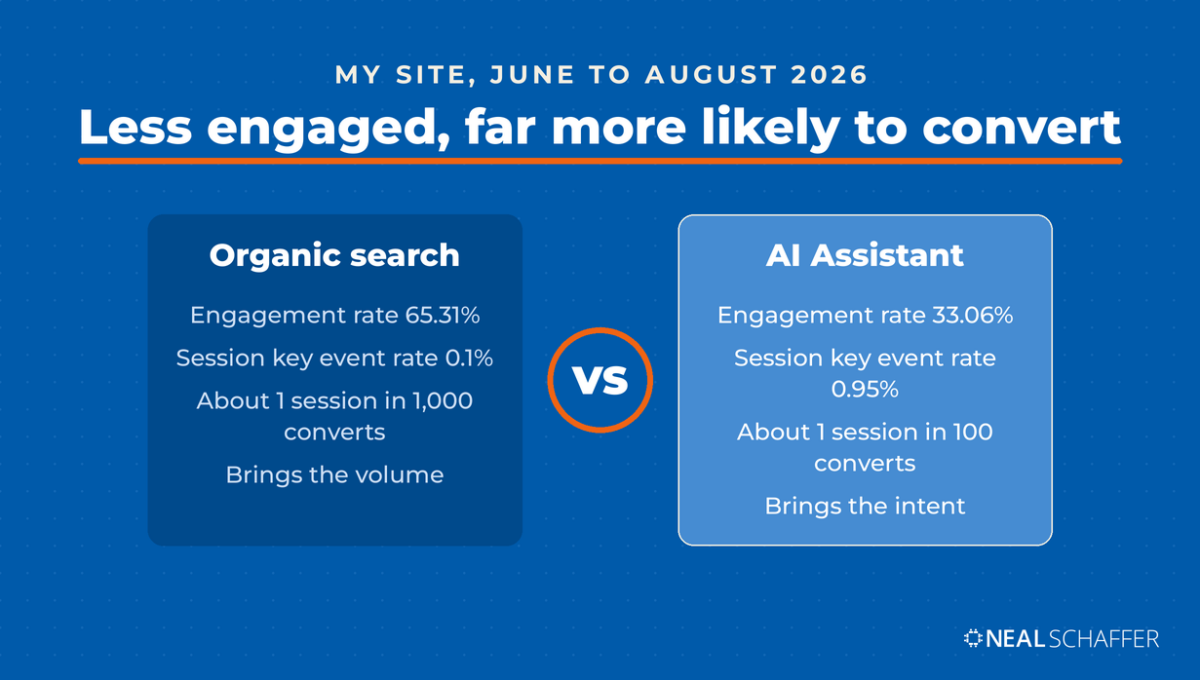
What this means for you: a visitor who arrives from an AI answer has already been given a shortlist, so they land closer to a decision. My own numbers show the shape you would expect from that. AI Assistant sessions engage less than organic search sessions, at a 33.06% engagement rate against 65.31%, while converting at a much higher rate.
Read those two together before you judge the channel on engagement alone. Someone who arrives pre-qualified does the one thing they came for and leaves. Write your comparison and pricing pages for a reader who has already done the research, and point your AI and SEO work at the specific questions that produce those shortlists.
Higher-value visitors are only half the picture. The supply side of content has changed too.
How much of the web is now written by AI?
More of it every month. Ten percent of a random sample of English-language webpages collected in July 2026 showed significant signs of AI authorship, and among pages published after ChatGPT’s release the share passes one third. The stylistic tells of machine writing are now measurably more common across the web.
23. One in ten webpages sampled in July 2026 shows signs of AI authorship
Ten percent of a random sample of 10,000 English-language webpages collected in July 2026 showed significant signs of AI authorship, per Pew Research Center’s analysis of 490,000 pages drawn from the Common Crawl archive. Filtered to pages published after ChatGPT launched, the share rises above a third.
What this means for you: the scarce thing is now anything a model cannot produce. Original screenshots, your own numbers, a client story with a date on it, a photograph you took. Those are the parts of a page that survive this shift, and they are also what keeps AI-written content ranking on Google rather than getting filtered out.
24. Em dashes appear about twice as often on the web as in 2023
Compared with a 2023 snapshot, em dashes now appear about twice as frequently across webpages, Oxford commas are up 63%, and AI-favored vocabulary such as “interplay” and “testament” has more than doubled, according to Pew Research Center. Negative parallelism has nearly tripled.
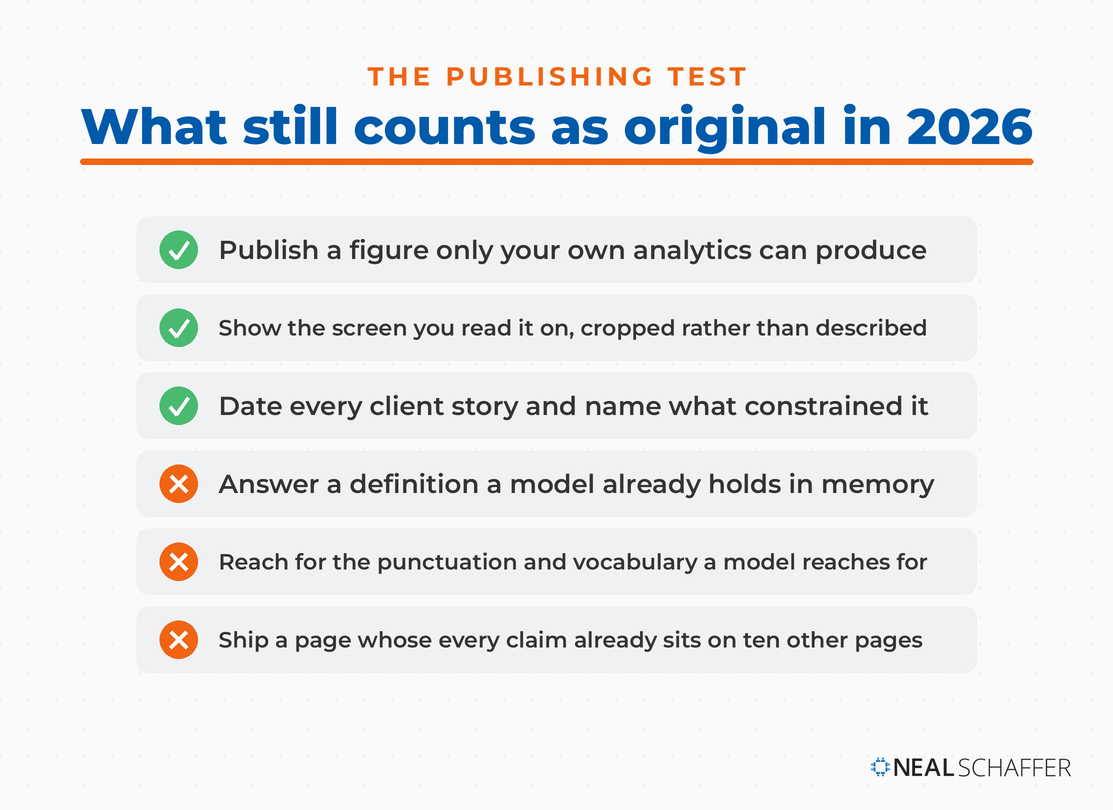
What this means for you: these patterns have become recognizable to readers, and a page covered in them reads as generic before anyone judges the substance. Keep a short list of words and punctuation your brand will not use, and run every draft against it. Then fold that check into your content audit so the older pages get cleaned up too.
Frequently Asked Questions
Ninety-five percent of B2B marketers say their organization uses AI-powered marketing applications, per the Content Marketing Institute figure cited above. Depth is where teams differ: only 3% describe their implementation as leading, and nearly seven in ten are still exploring or developing.
It depends what you measure. As the McKinsey and Content Marketing Institute figures above show, productivity gains are widespread while profit-line impact is not, and marketing-specific results follow the same pattern of faster production with flat performance. The organizations reporting real financial impact are the ones that redesigned workflows rather than inserting AI into existing ones.
The Gartner benchmark cited earlier puts the average at 15.3% of marketing budget, rising to 21.3% among organizations that describe themselves as AI-ready. I would treat those as reference points rather than targets, since spending more without process ownership just moves money from one line to another.
In the data above, yes. Semrush values the average AI search visitor at 4.4 times a traditional organic visitor by conversion rate, and Adobe’s retail figures show AI traffic converting better and generating more value per visit than non-AI sources. The likely reason is that these visitors arrive after an AI has already compared their options.
Nothing in this data supports a clean replacement story, though it does show pressure. Training budgets have fallen to 3.8% of marketing spend and headcount growth has halved, as noted above. That pattern reads less like replacement and more like the same work landing on fewer people with less preparation.
Generative engine optimization is the practice of structuring and publishing content so AI systems cite it when generating answers. As the CMO Survey figure above shows, four in ten companies already do it, which makes it a fast-moving practice rather than an emerging one.
Put These AI Marketing Numbers to Work
Pick three of these twenty-four and turn them into decisions this month. Most teams get more from that than from reading another fifty.
Start with the readiness gap. Write down the two AI workflows your team runs most often, name an owner for each, and describe what “working” looks like in one sentence with a number in it.
Then check your visibility. Run your five most commercially important prompts through ChatGPT, Gemini and Copilot, and record whether you appear. Repeat monthly and you will have a trend line before your competitors have a baseline.
Finally, separate AI sources from direct traffic in your analytics so you can see the conversion story on your own site rather than in somebody else’s retail data.
If search is where you feel this shift hardest, the SEO statistics I keep updated are the companion set to this one. For the strategic frame behind all of it, download a free preview of Digital Threads, which lays out how the search, email and social threads connect. And if you want senior help turning these numbers into a plan your CFO will fund, that is exactly what my Fractional CMO services exist to do.