
TikTok Shop did roughly $15.82 billion in US sales in 2025, up 108% in a single year, and it now accounts for about 18% of all US social commerce, according to EMARKETER. You can see the platform’s wider growth in the latest TikTok statistics. Behind almost all of that sales number sits one mechanism most people barely understand: creators promoting other people’s products for a cut of the sale. That mechanism is the TikTok Shop Affiliate Program.
I’ve spent years on both sides of this. I teach a class at UCLA Extension called Personal Branding: How to Become an Influencer, I wrote The Age of Influence about the creator economy, and as a fractional CMO I help ecommerce brands build creator strategies. So this post is written for two readers at once. If you’re a creator, I want you to understand whether this is worth your time and how to earn from it without torching the trust you’ve built. If you run a business with a TikTok Shop, I want you to see the affiliate program for what it actually is: a sales force you don’t have to hire.
Both of you are in the right place. Let’s get into it.
Key Takeaways
✅ The TikTok Shop Affiliate Program lets creators earn a commission when their videos or livestreams drive a sale, with the rate set by the seller anywhere from 1% to 80% of the order, per TikTok’s Seller Center.
✅ The “you need 5,000 followers” belief is wrong for the US. You can apply as an Affiliate Creator at 1,000 followers; 5,000 is the line where you leave the Creator Pilot Program and get full marketplace access, per TikTok’s Creator Eligibility Policy.
✅ Creators get paid on performance, not on follower count. A 1,200-follower account that converts can out-earn a dormant account with 50,000 followers.
✅ For sellers, affiliates are the growth engine. Sacheu Beauty’s founder says more than 20,000 creators make up 90% of her sales on TikTok Shop.
✅ Authenticity is the whole game. The FTC requires creators to clearly disclose the affiliate relationship, and audiences reward the creators who only push products they’d actually use.
What Is the TikTok Shop Affiliate Program?
The TikTok Shop Affiliate Program is a commission marketplace inside TikTok that connects sellers who have products with creators who have audiences. A seller sets a commission on a product, a creator features it in a shoppable video, livestream, or profile showcase, and when a viewer buys, TikTok pays the creator a cut. No inventory, no shipping.
The economics are set by the seller, and the range is wide. TikTok lets sellers set any commission between 1% and 80% of the order, and the commission is calculated on the price the customer actually paid after discounts. Most everyday product categories land somewhere between 10% and 20%, with beauty and supplements at the higher end and electronics near the bottom.
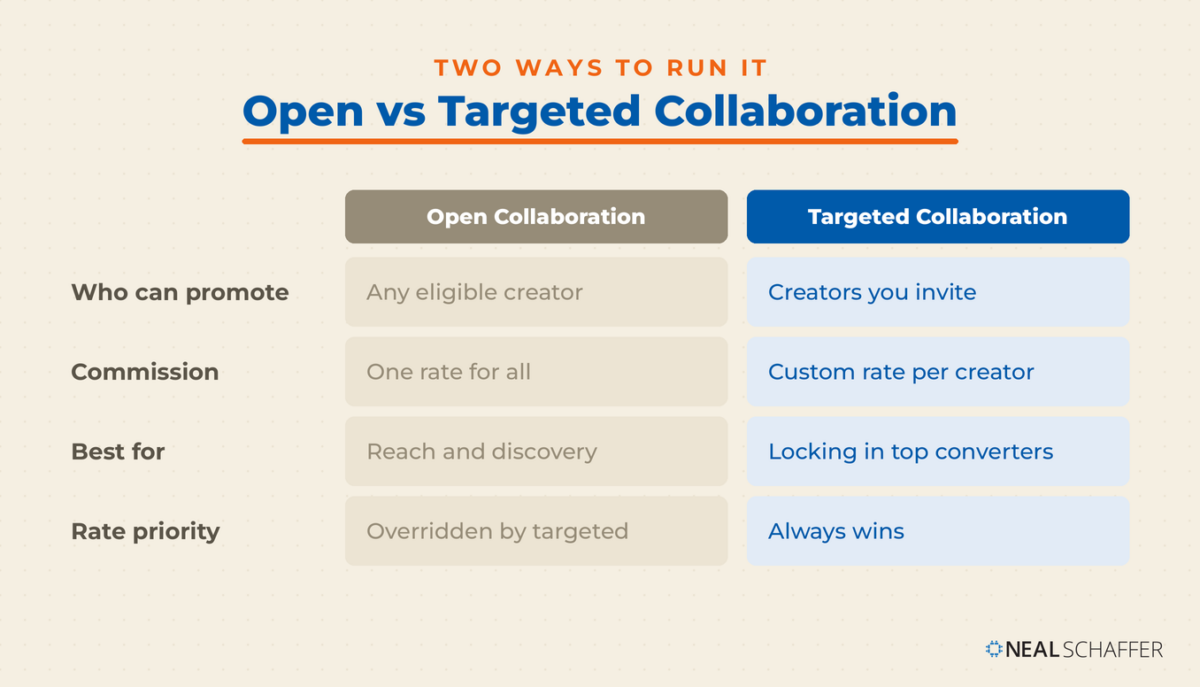
There are two ways a seller can run it. With Open Collaboration, any eligible creator can find your product and promote it without asking. With Targeted Collaboration, the seller invites specific creators and can offer them a custom rate. A creator can be in both at once, but only earns one rate per product, and the targeted rate always wins. That last detail matters more than it sounds, and I’ll come back to it in the seller section.
How Many Followers Do You Need to Become a TikTok Shop Affiliate?
In the US, you can apply to become a TikTok Shop Affiliate Creator at 1,000 followers, not 5,000. You also need to be at least 18 and US-based. The widely repeated 5,000-follower number is real, but it’s the graduation line out of the Creator Pilot Program, not the entry gate. That distinction keeps a lot of small creators sidelined.
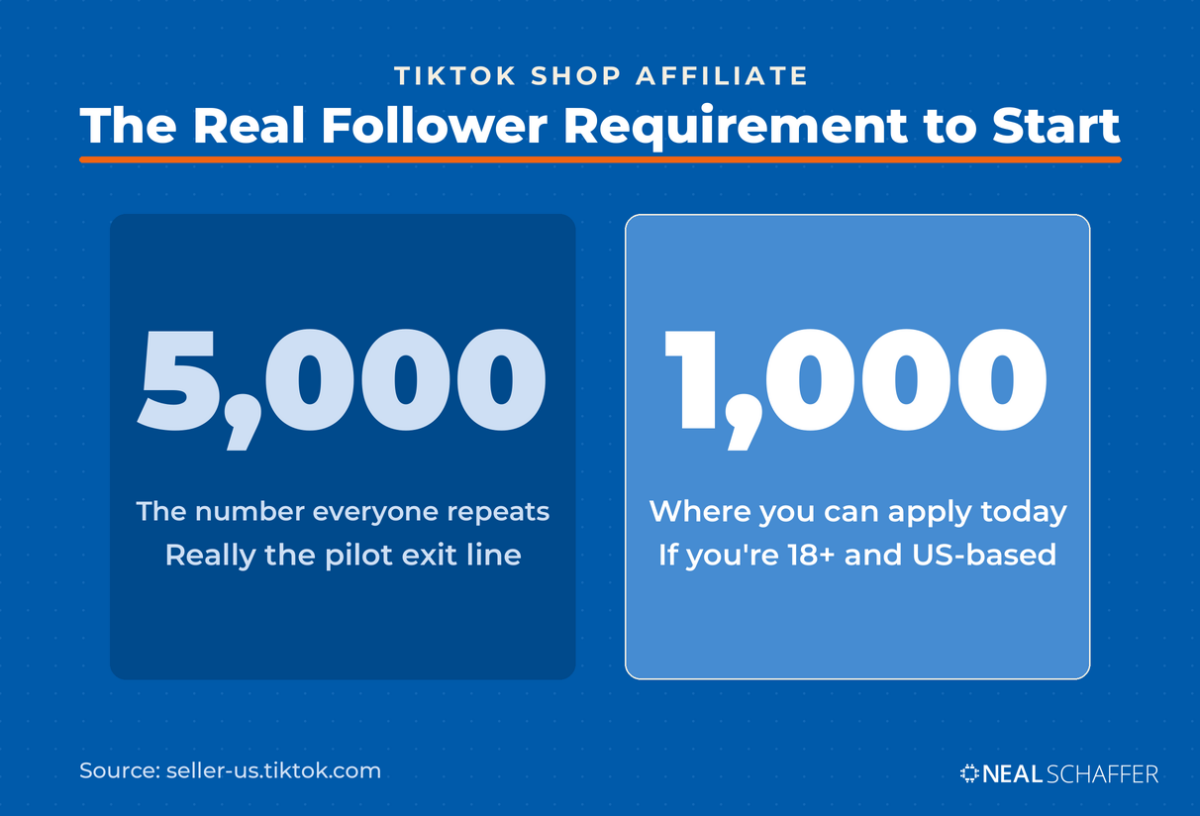
The mechanics work like this. If you apply with fewer than 5,000 followers, TikTok places you in a 30-day Creator Pilot Program with capped posting, so you can start promoting and earning right away, just with limits. Once you cross 5,000 followers, stay in the program at least 30 days, keep a clean account standing, and complete the required tasks, you graduate to full marketplace access and uncapped shoppable posting.
There’s also a third path. An Official Shop Creator is bound to a single seller’s shop and can promote only that shop’s products, with no follower minimum at all. The tradeoff: no access to the wider affiliate marketplace. In the US, the three creator types break down like this:
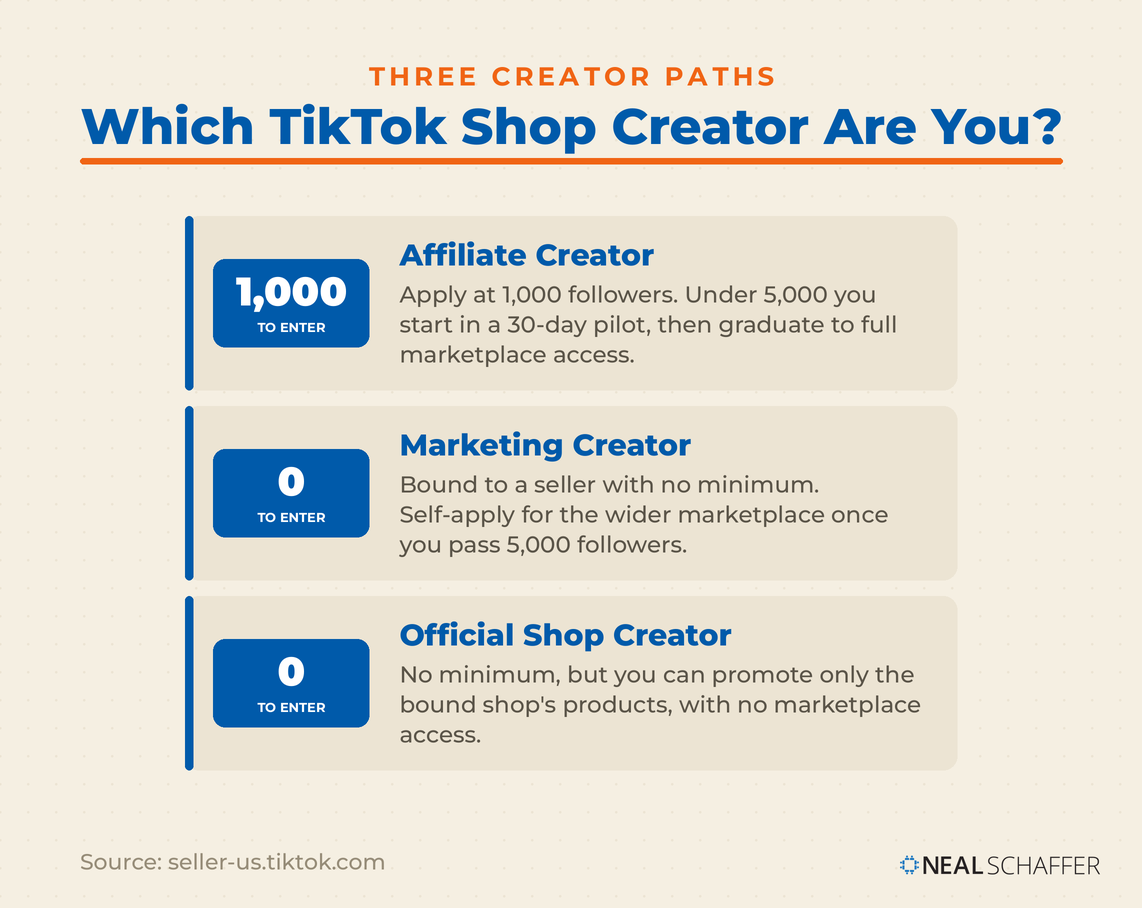
| Creator type | US follower minimum | What it gives you |
|---|---|---|
| Affiliate Creator | 1,000 to apply; 5,000 to graduate the Pilot Program | Browse and promote any product in the affiliate marketplace |
| Marketing Creator | Bound to a seller; 5,000 to self-apply for marketplace | Promote the bound shop plus the marketplace |
| Official Shop Creator | 0 | Promote only the bound shop’s products |
What matters most in all this: followers get you in the door, and after that they stop mattering. Your earnings come from what sells, not from your follower count. I’ve watched small, tightly-niched creators out-earn accounts ten times their size because their audience actually trusts what they recommend. The follower gate is one you clear once, so if you’re still building toward that first 1,000, keep posting consistently and you’ll get there.
How Do TikTok Shop Affiliates Get Paid?
TikTok Shop affiliates earn a commission on every sale their content drives, set as a percentage of the order by the seller. When a viewer buys through a creator’s tagged product in a video, livestream, or showcase, TikTok attributes the sale and calculates the commission on what the customer actually paid. Payout follows a settlement window that covers returns. That is a different mechanism from the platform’s other direct payout, the TikTok Creator Rewards Program, which pays on qualified views rather than on sales, and plenty of creators run both at once.
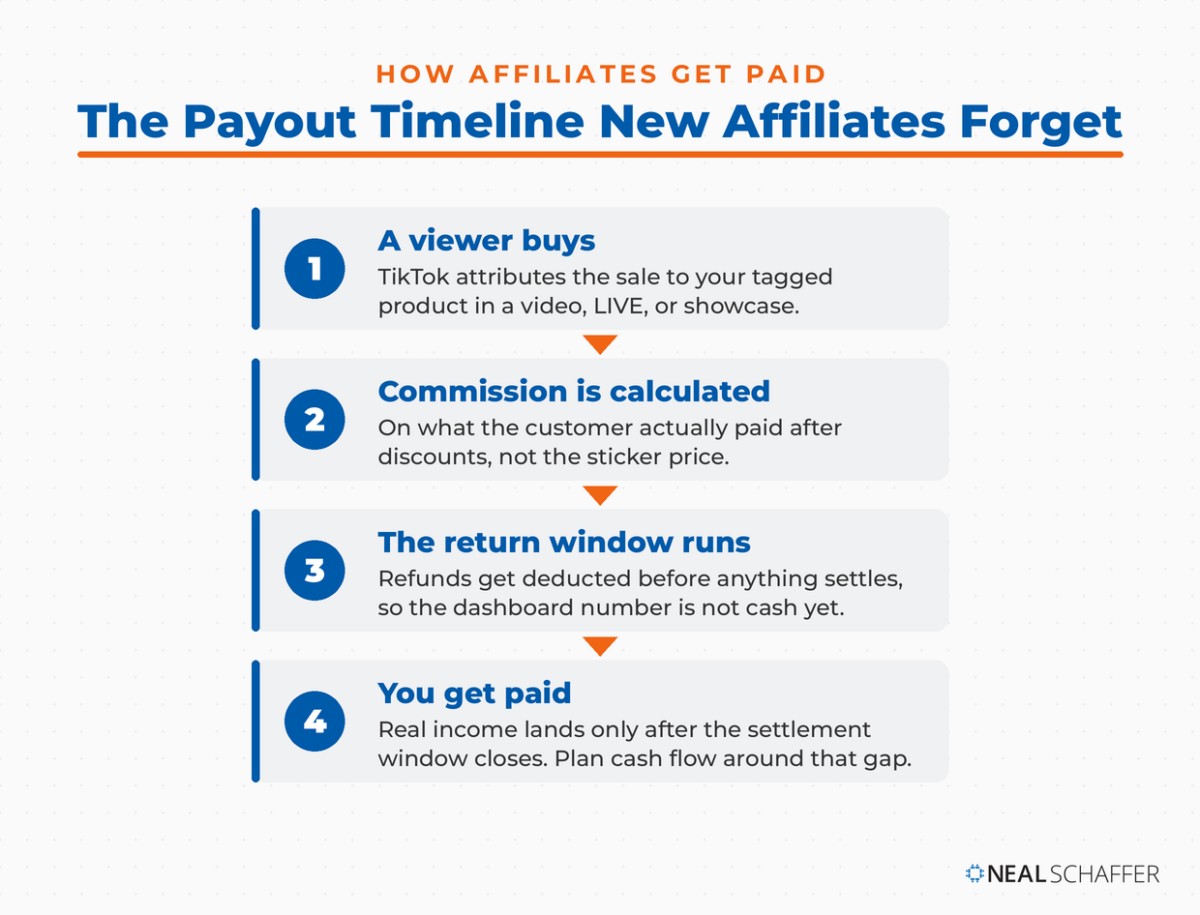
That settlement window is the part new affiliates forget. Returns and refunds get deducted before you’re paid, so a viral day doesn’t become real income until the return window closes. Plan your cash flow around that gap, not around the “earnings” number ticking up in your dashboard.
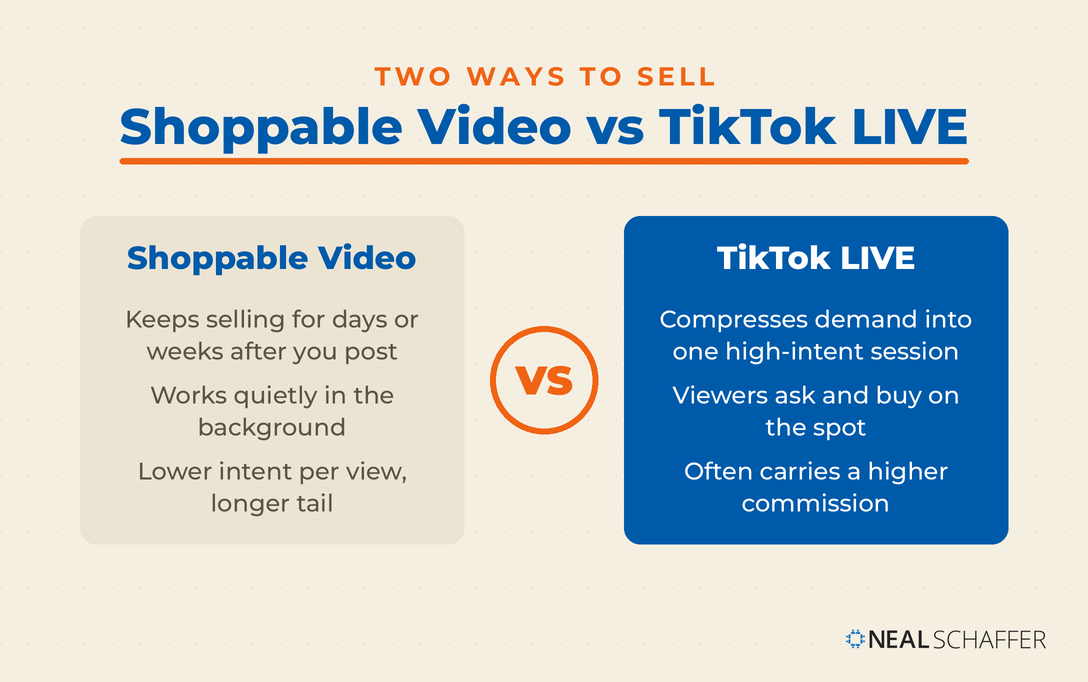
Format changes the math too. A shoppable video keeps working for days or weeks after you post it, quietly driving sales in the background. A livestream compresses demand into a single high-intent session, which is why sellers often set higher commissions for LIVE. Committing to a couple of TikTok LIVE sessions a week around your best-converting products is one of the fastest ways to scale affiliate income. The real-time format tends to convert better than a standard video, because viewers can ask questions and buy on the spot.
How Can Creators Maximize Earnings While Staying Authentic?
Creators maximize TikTok Shop earnings by treating product selection as the real job, not the content. Pick products you’d recommend, that fit your niche, that you can show on camera, and that carry a price where the commission is worth your time. A 20% rate on a $15 product is $3. On an $80 product, 15% is $12.
That’s the mechanical side. The part that actually protects your income is trust. Your audience is a subset of TikTok that chose to follow you for a reason, and the fastest way to lose them is to start hawking anything with a commission attached. In The Age of Influence I make the case that influence is a relationship you build over time, closer to a marriage than a one-night stand, and affiliate income is downstream of that relationship. Push junk for a quick payout and you spend down the exact asset that makes you worth partnering with. I dug into this tension between monetization and authenticity in a solo episode of my podcast Your Digital Marketing Coach, pulling from that same UCLA Extension class.
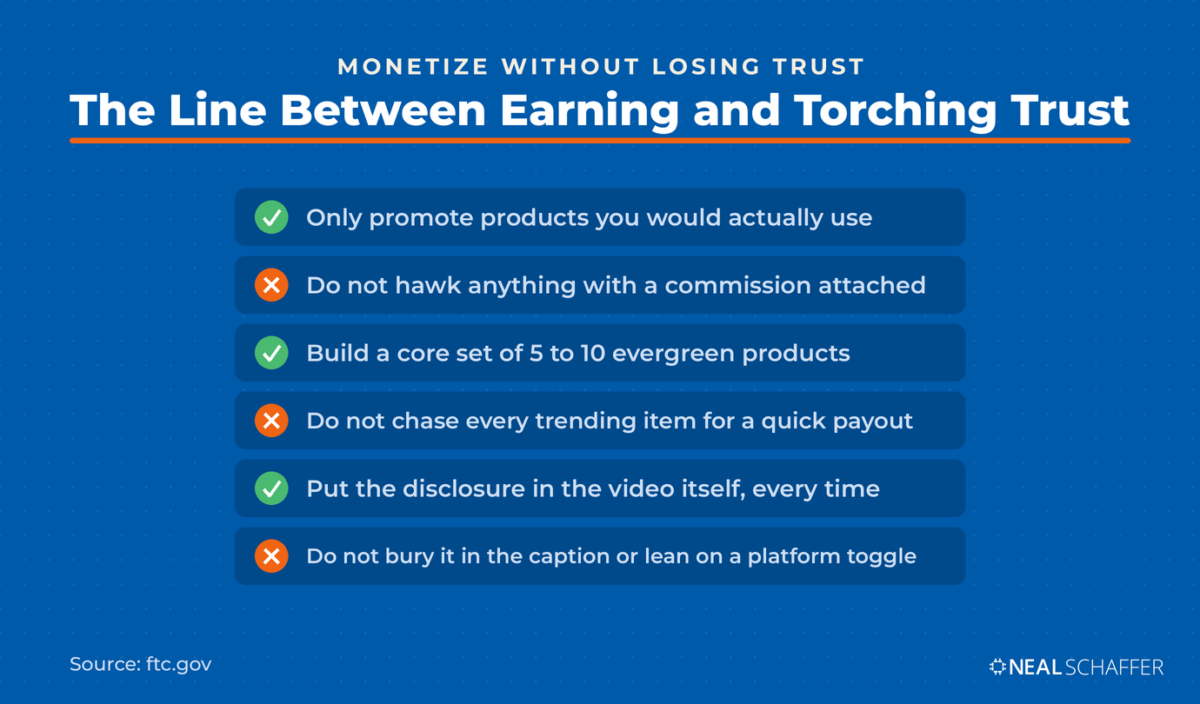
A few principles that keep the money and the trust intact:
- Only promote what you’d use. The best-converting affiliate content is a real review or demo, not an ad. If you wouldn’t recommend it to a friend, skip the commission.
- Build a core set of 5 to 10 evergreen products instead of chasing every trending item. Repeated, credible content around products you actually stand behind compounds.
- Disclose every time. This isn’t optional. A commission is a financial relationship, which the FTC treats as a “material connection” that must be clearly and conspicuously disclosed. In a video, the disclosure has to be in the video itself, not buried in the caption. In a livestream, repeat it periodically. A platform toggle alone doesn’t cut it. Disclosure also builds trust rather than breaking it, because it signals you’re being straight with your audience. For the fuller picture, see how the FTC’s disclosure rules apply to creators.
One more thing worth understanding: affiliate income and brand-deal income are different animals. The difference between influencer marketing and affiliate marketing comes down to who takes the risk. A flat-fee brand deal pays you for posting; affiliate pays you for selling. The smartest creators run both, and use how influencers make money as a menu rather than picking one lane.
Why TikTok Shop Sellers Should Treat Affiliates as a Built-In Sales Force
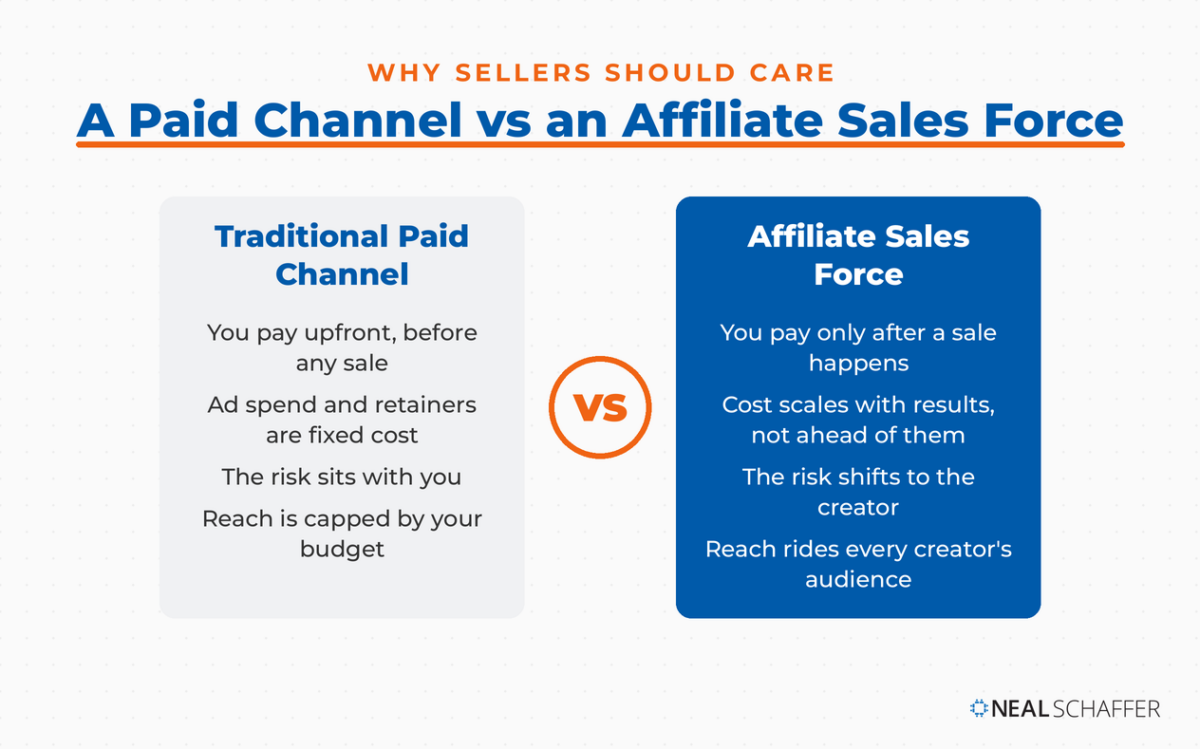
For sellers, the affiliate program is the most efficient growth channel TikTok Shop offers, because you only pay when a creator actually sells. There’s no upfront ad spend and no retainer. You set a commission, creators produce the content and carry the reach, and your cost scales with results instead of preceding them.
The proof is in how the top brands operate. On TikTok’s own seller site, Sacheu Beauty founder Sarah Cheung says the brand has connected with more than 20,000 creators who make up 90% of its sales. For that brand, the creator network is the channel, not a marketing add-on to it.
Tarte Cosmetics tells the same story from a different angle. When Tarte joined TikTok Shop during the 2023 beta, it chose an open affiliate strategy where any creator could link its products and earn a commission. Founder Maureen Kelly said the brand invested no money into establishing its TikTok Shop presence. In one 12-hour livestream, 70% of the shoppers were people who did not even follow Tarte, which shows how far creator content reaches beyond a brand’s own audience. Tarte also saw a triple-digit lift on featured products in wholesale retail, so the affiliate activity spilled over into channels off TikTok entirely. As Tarte CMO Sam Kitain told Glossy, “TikTok Shop is the first significant social commerce” the brand has seen in the US.
The LinkedIn Playbook for Real Business Growth
My latest book helps professionals, entrepreneurs, and business owners turn LinkedIn from a static profile into a real source of clients and growth.
Maximizing LinkedIn for Business Growth gives you clear, practical steps to build a profile that gets noticed and a network that actually sends business your way.
Grab your copy on Amazon and put it to work this week. Click the cover or the button below to get started.

There’s a live-selling angle here too. TikTok reported that during Black Friday to Cyber Monday 2025, sellers hosting livestreams saw 84% sales growth year over year across more than 760,000 sessions, and its creator affiliates posted nearly 10 million shoppable videos over the campaign. Your affiliate creators are the ones who post that content and host those streams for you.
How Should a Brand Set Up Its TikTok Shop Affiliate Program?
A brand sets up its affiliate program in the Seller Center by choosing between Open and Targeted Collaboration, setting commission rates, and recruiting creators. The fastest-scaling programs run both in parallel: Open for volume and discovery, Targeted to lock in your best creators at a higher rate. The targeted rate always overrides the open rate.
| Open Collaboration | Targeted Collaboration | |
|---|---|---|
| Who can promote | Any eligible creator, no approval needed | Specific creators you invite |
| Commission | One rate for all | Custom rate per creator |
| Best for | Reach and creator discovery | Locking in proven, high-converting creators |
| Rate priority | Overridden by any targeted rate on the same product | Always wins over the open rate |
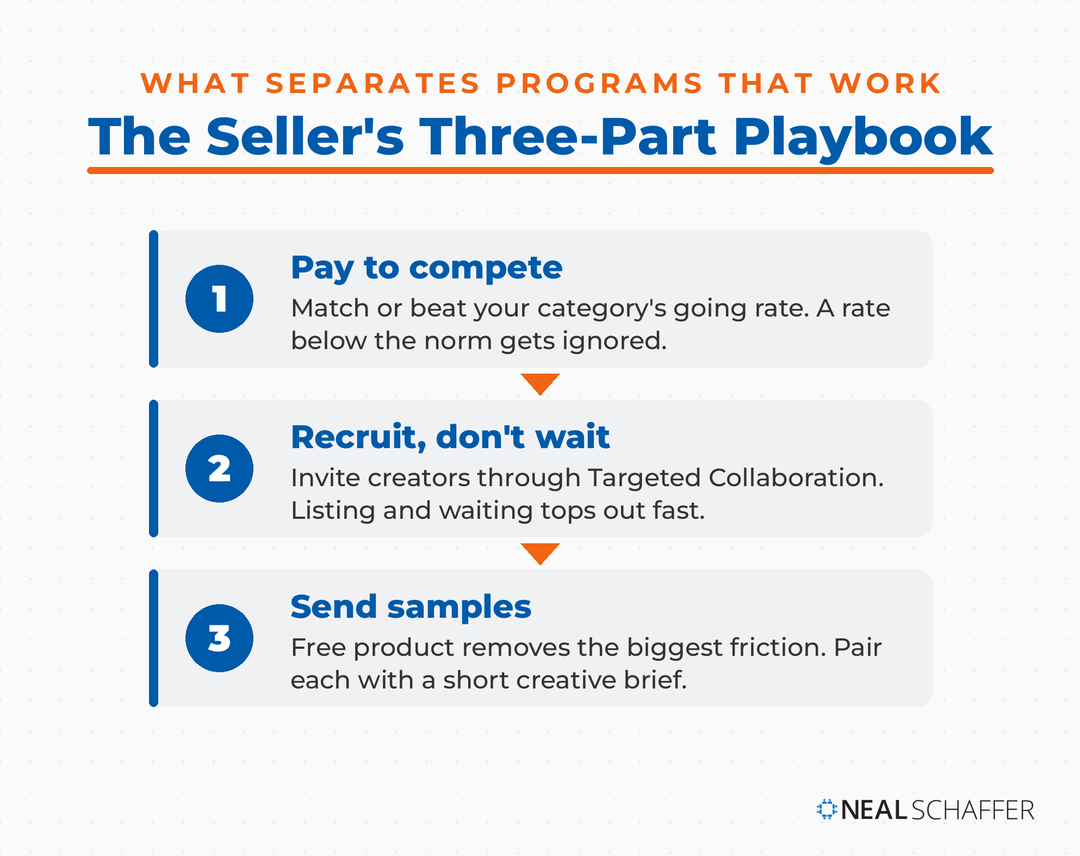
Three things separate programs that work from programs that stall:
- Pay a competitive rate. A rate below your category’s norm gets ignored. On a $35 beauty order, 12% is about $4 to the creator before TikTok’s cut, which quality creators won’t bother with. Look at what comparable products offer and match or beat it.
- Recruit, don’t just list. Publishing products into the Open plan and waiting is passive, and passive programs top out fast. The volume comes from proactively inviting creators through Targeted Collaboration. This is where the discipline of finding the right creators pays off, and where a lot of my TikTok influencer marketing advice applies directly.
- Send samples. Free product removes the biggest friction in creator recruitment. Pair every sample with a short brief: a couple of suggested hooks, the key points to hit, and the claims to avoid.
Micro-creators tend to outperform on engagement, so most successful programs are built on a wide network of smaller creators rather than a few big names. And because more creators posting means more content feeding the TikTok algorithm, volume itself becomes a discovery advantage. Treat your affiliate program as one plank of your broader ecommerce marketing, not a standalone experiment, and it compounds.
One caution that protects your brand: you’re responsible for what your affiliates claim. The FTC holds advertisers liable for their endorsers’ statements, so give creators claims they can actually back up, and expect them to disclose the relationship.
Frequently Asked Questions
In the US, yes. You can apply as an Affiliate Creator at 1,000 followers, provided you’re 18 or older and US-based. With fewer than 5,000 followers you start in a 30-day Creator Pilot Program with capped posting, and you graduate to full marketplace access at 5,000. Requirements differ by country, so check your region.
It varies enormously and skews toward the top. Earnings depend on your niche, how often you post, the products you pick, and how well your content converts, not on your follower count. A single video that reaches the right buyers can out-earn months of low-intent posting, so treat it as commission income tied to sales rather than a predictable salary.
Yes. There’s no cost for creators to apply or to promote products. Creators earn a commission on sales; sellers pay a separate platform referral fee on orders. You never pay to access the affiliate marketplace.
Set a competitive commission, then recruit proactively through Targeted Collaboration instead of waiting for the Open plan to fill up. Offer free samples with a short creative brief, and prioritize creators whose audience fits your product over creators with the biggest follower counts.
A brand deal is a flat fee for posting, paid whether or not anything sells. The affiliate program pays a commission only when a sale happens. Affiliate shifts the risk to the creator and rewards conversion, which is why brands can run it with no upfront spend.
Start Earning or Recruiting on TikTok Shop
The opportunity here is real on both sides. If you’re a creator, apply, pick products you’d stand behind, disclose the relationship, and let conversion drive your income. If you’re a seller, stop treating the affiliate program as a side experiment and build it like the sales channel it is: competitive rates, proactive recruiting, and samples in creators’ hands.
Whichever side you’re on, the deeper you understand the money, the better you’ll do. My rundown of the many ways to make money on TikTok is a good next stop for creators mapping out their income streams. If you’re a brand that wants a creator strategy built and run properly, that’s exactly what I do as a fractional CMO. And if you want the strategic thinking behind creator partnerships that actually last, grab a free preview of The Age of Influence or join the entrepreneurs and marketers in my Digital First Mastermind.