Editorial Note: No agency paid for its place on this list. Agencies can sponsor my Clutch directory, which I share revenue from, and that raises their visibility in the pool I select from. Selection here is mine and based on the criteria below.
15 Best Ecommerce Marketing Agencies for Growing Online Brands in 2026
You are about to spend somewhere between $3,000 and $30,000 a month on an ecommerce marketing agency. And almost every page you have read while researching that decision was written by someone who wants the money.
That is the problem with this search. Search “ecommerce marketing agency” and you get vendors selling themselves, or directories selling placements. Nobody in that results page is sitting on your side of the table.
I am. I work as a Fractional CMO for B2B and ecommerce brands, which means I am usually the person in the room reviewing agency proposals, not the person writing them. I have also written six books on digital marketing, including Digital Threads, and I teach marketing to executives at Rutgers Business School and UCLA Extension. You can learn more about my background if you want the full picture.
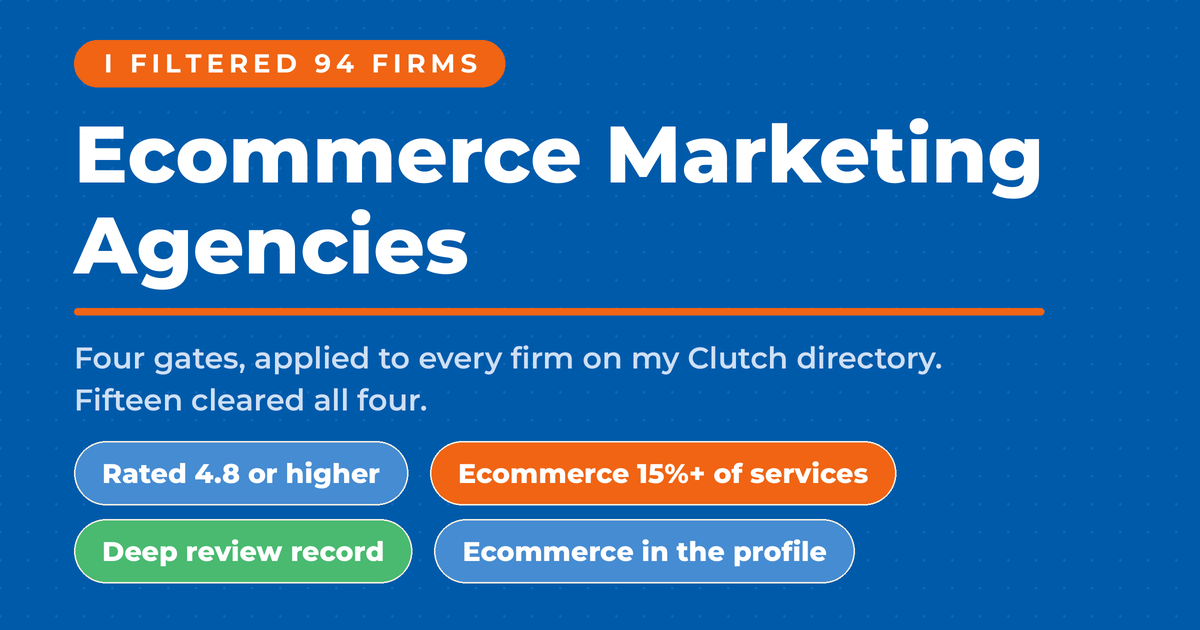
I have no agency to sell you. What I do have is a directory built with Clutch, Neal Schaffer’s Growth-Focused Ecommerce Marketing Agencies, which currently lists 94 firms filtered on ecommerce marketing as a service. Below I narrow those 94 down to 15 and show you exactly how I did it. I also name the big firms that did not make the cut, then walk you through evaluating any of them without getting talked into a retainer you do not need.
Key Takeaways
✅ Ecommerce now accounts for 16.9% of all US retail sales and is growing more than twice as fast as retail overall, so the agency market chasing that spend has never been more crowded.
✅ Review volume measures how long a firm has been on Clutch, not how much ecommerce work it does. Service percentages are the number that tells you whether you are hiring a specialist.
✅ Service percentages on a Clutch profile are the single most useful number for telling a marketing agency apart from a development shop wearing a marketing label.
✅ Paying an agency for more traffic before you fix your checkout is the expensive order of operations, because most abandoned carts leave for reasons you can fix yourself.
✅ Email and SMS automation drives a wildly disproportionate share of ecommerce revenue, which makes it the first thing worth building in-house rather than renting forever.
✅ If your real problem is that nobody internally can judge whether an agency is doing good work, the fix is a strategist rather than another vendor.
What Does an Ecommerce Marketing Agency Actually Do?
An ecommerce marketing agency is a service firm that drives revenue for online stores through paid media, SEO, email and SMS, marketplace optimization, and conversion work. The good ones tie every activity to revenue, average order value, and customer lifetime value rather than to impressions, rankings, or follower counts.
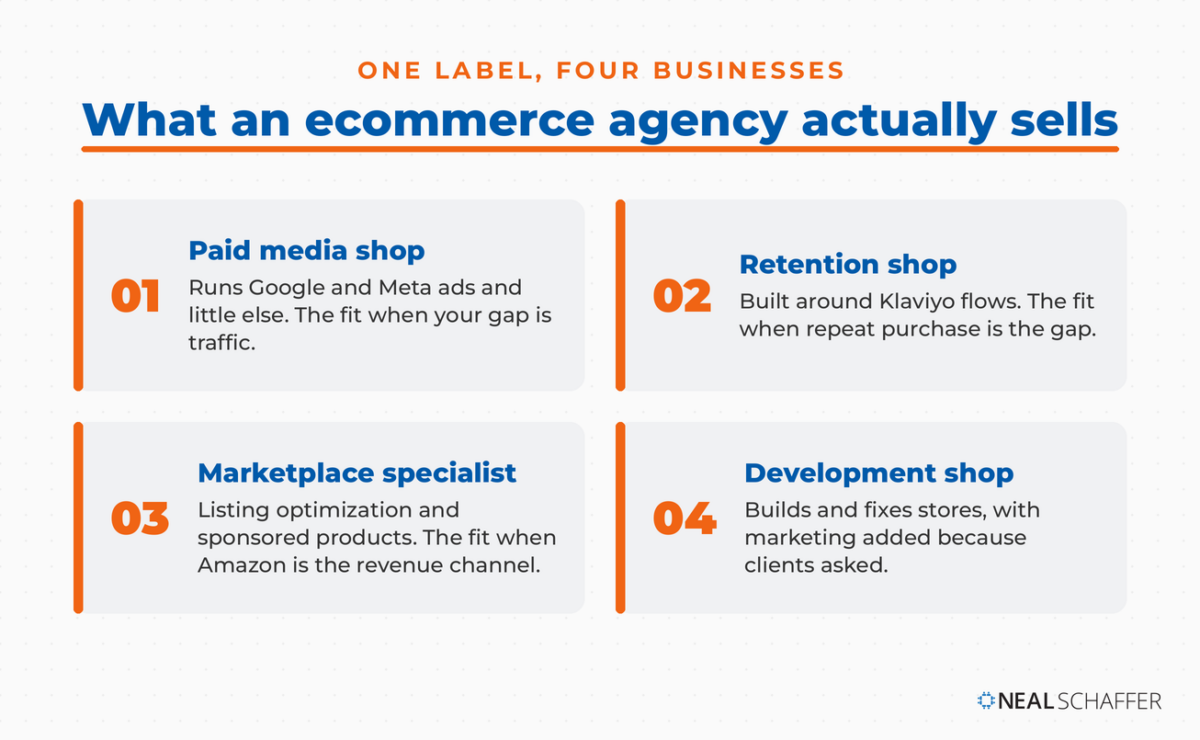
That definition sounds obvious until you start taking sales calls. In practice the label covers at least four different businesses. Some firms are paid media shops that run Google and Meta ads and little else. Some are retention shops built around Klaviyo flows. Some are Amazon specialists. And some are development companies that added a marketing line item because clients kept asking.
None of those is wrong. Hiring the wrong one for your bottleneck is what costs money. A brand with a traffic problem and a brand with a repeat-purchase problem need entirely different partners, even though both will be pitched the same “full-funnel growth” deck.
The label can also send you to the wrong category entirely. If your gap is publishing volume rather than store performance, content marketing agencies are the better search. If it is organic visibility across a large catalog, SEO agencies go deeper than a generalist will.
Two more categories sit next door. Automation and data plumbing point toward AI marketing agencies, and a mandate spanning every channel at once usually belongs with digital marketing agencies rather than an ecommerce specialist.
Market context matters too. That 16.9% retail share works out to $326.7 billion in a single quarter, and the Census Bureau put ecommerce growth at 9.8% year over year against 3.9% for retail overall. Money is flooding toward online selling, and agency supply has expanded to meet it.
Which is why the filter you use to shortlist matters more than the shortlist itself.
Why This List Is Different
Most “best ecommerce marketing agency” lists are pay-to-play rankings, surface-level summaries scraped from agency websites, or pieces written by agencies that quietly feature themselves. This one starts from verified Clutch review data, applies a published set of gates, and shows you which well-known firms sit inside them and which sit outside.
The incentive problem is worth stating plainly. A directory earns money from placements. An agency earns money from retainers. Both have a reason to put the biggest logo in front of you, and neither has a reason to tell you that firm is wrong for your bottleneck.
I sit on the other side of that table. As a Fractional CMO I review agency proposals for a living, and I have watched brands sign six-figure retainers with capable firms that were simply the wrong specialist. That is the failure this list is built to prevent.
Which means the filter has to be visible, so you can disagree with it.
Criteria for Selection
Every firm below cleared four gates applied to all 94 companies on the directory: a verified client rating of 4.8 or higher, meaningful review volume, ecommerce marketing as a substantial share of services rather than a footnote, and a company description that names ecommerce explicitly. Firms clearing all four were then ranked by review count.
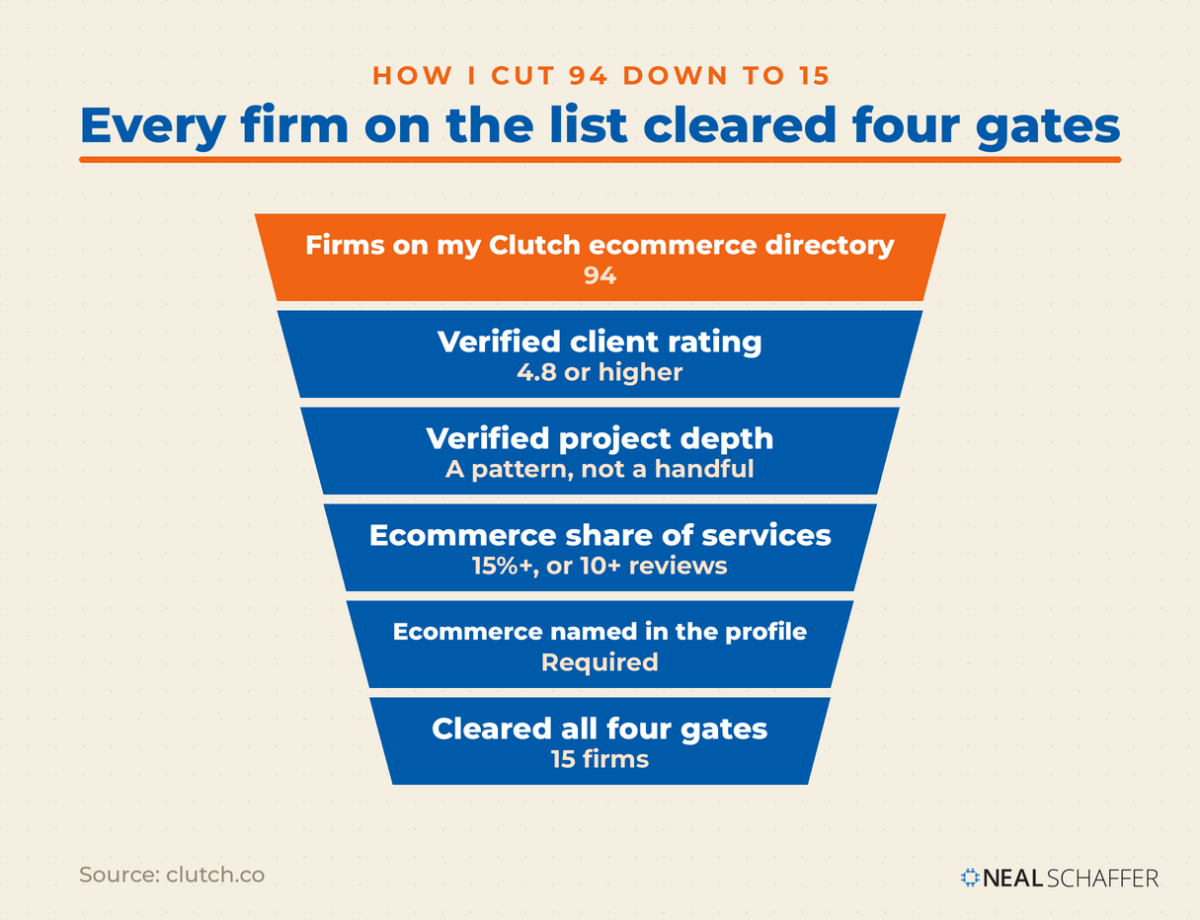
- Listed on my curated Clutch ecommerce marketing directory, filtered on ecommerce marketing as a service (94 companies at time of writing)
- Verified client rating of 4.8 or higher out of 5
- Enough verified projects to show a pattern rather than a handful of reviews
- Ecommerce marketing at 15% or more of services, or 10 or more reviews that specifically cite ecommerce marketing work
- Ecommerce named explicitly in the company’s own profile description, not inferred from its service list
- Ordered by verified review volume, highest first. That ordering is a proxy for how many ecommerce engagements a firm has completed, not a quality ranking. Number 15 is not worse than number 1.
- Ratings, review counts, and service percentages reflect the directory as of August 2026 and update monthly, so verify before you shortlist
| Gate | What I required | Why it matters to you |
|---|---|---|
| Client rating | 4.8 or higher out of 5 | Below that, satisfaction gets inconsistent across engagements |
| Review volume | Enough verified projects to see a pattern, not a handful | Three glowing reviews prove nothing about how a firm handles month nine |
| Ecommerce service share | 15% or more of services, or 10+ reviews specifically citing ecommerce marketing | Separates specialists from generalists who tick the box |
| Company description | Ecommerce named explicitly in the profile summary | A firm that does not describe itself as an ecommerce partner probably is not one |
The third gate does more work than it sounds like. Plenty of excellent generalist agencies list ecommerce marketing at 10% of services and describe themselves as full-service digital shops. Many are best in class at what they concentrate on. They are simply concentrating somewhere other than ecommerce, and that is worth knowing before the first call.
One firm reached that gate on the alternate path. Sequence Commerce lists ecommerce marketing at 10% of services, below the threshold, but carries 11 reviews that specifically cite ecommerce marketing work. That volume of category-specific delivery is what the alternate path exists to recognize.
Apply those gates yourself and you should land close to where I did.
The Digital Marketing Playbook for Small Teams
My latest book helps small businesses, entrepreneurs, and marketers bring search, email, and social together into one digital marketing strategy that actually compounds.
Drawing on my work as a Fractional CMO, Digital Threads turns complicated tactics into a clear, practical plan you can follow, whatever your budget or team size.
Grab your copy on Amazon and start weaving your own digital threads. Click the cover or the button below to get started.

The 15 Best Ecommerce Marketing Agencies for 2026
These 15 firms cleared every gate above and are ordered by verified review volume, highest first. That ordering is deliberate. Among agencies that already clear a quality bar, the depth of the review record is the most honest proxy for how many ecommerce engagements a firm has actually completed.
1) PageTraffic
PageTraffic carries the largest verified review record on my directory among firms that clear the ecommerce filter, at 115 reviews and a 4.9 rating. The service mix leans heavily on SEO at 40%, with ecommerce marketing at 15% and pay-per-click at 15%, which tells you where the center of gravity sits.
For an ecommerce brand, that profile fits a specific situation: you have a store that works, and your problem is organic visibility rather than paid efficiency. If you have already read up on Shopify SEO and concluded you need help executing rather than learning, this is the shape of firm to talk to.
- Location: New Delhi, India
- Ecommerce marketing share: 15% of services
- Minimum project: $1,000, with rates under $25 per hour
- Best for: Brands whose bottleneck is organic search rather than ad performance
2) EvenDigit
EvenDigit sits at 105 reviews and 4.9, with a broader spread than PageTraffic: 30% pay-per-click, 20% ecommerce marketing, 20% SEO, 20% social, and 10% email. That is a genuinely full-funnel mix rather than one discipline with extras bolted on.
Clients repeatedly cite conversion improvements from paid search restructuring. The firm positions itself around traffic and conversions through online advertising, which is a narrower and more testable claim than most agencies make about themselves.
- Location: Indore, India
- Ecommerce marketing share: 20% of services
- Minimum project: $1,000, with rates under $25 per hour
- Best for: Cost-sensitive brands that want several channels under one roof
3) Sequence Commerce
Sequence Commerce is the Amazon specialist on this list, and it is the largest firm here at 250 to 999 employees with a perfect 5.0 across 68 reviews. Ecommerce marketing shows as 10% of services, but 11 separate reviews cite ecommerce marketing work specifically, nine of them at five stars.
The work described in those reviews is listing optimization, A+ content, keyword work, and sponsored product management. If your growth question is really a marketplace question, this is a different animal from a Meta ads shop, and worth understanding alongside your own Amazon marketing approach.
- Location: Brampton, Canada
- Ecommerce marketing share: 10% of services, backed by 11 ecommerce-specific reviews
- Minimum project: $5,000, with rates of $50 to $99 per hour
- Best for: Brands where Amazon is the primary revenue channel
4) Elogic Commerce
Elogic Commerce holds a 5.0 rating across 60 reviews and was reviewed 16 times in the past six months, all at five stars, which is the most active recent record on this list. Ecommerce marketing is 15% of services and ecommerce development is 55%.
Read that split carefully, because it defines the fit. This is a platform partner first, strong on Shopify Plus and Adobe Commerce migrations and complex integrations. Clients report outcomes like reduced order processing and fewer checkout errors. Hire them when your marketing is being held back by your platform, not by your campaigns.
- Location: Tallinn, Estonia
- Ecommerce marketing share: 15% of services, alongside 55% ecommerce development
- Minimum project: $25,000, with rates of $50 to $99 per hour
- Best for: Mid-market brands facing a replatform or a messy B2B integration
5) UAWC Agency
UAWC has the cleanest ecommerce-specific record here: a 5.0 rating overall, and 10 out of 10 reviews mentioning ecommerce marketing rated five stars, with two of those arriving in the past six months. Ecommerce marketing is 25% of services and pay-per-click is 45%.
The described work is Google and Meta campaign management with an emphasis on return on ad spend. For a brand that already knows its ecommerce conversion rate and needs paid acquisition to hit a target efficiency, this is a tightly scoped partner rather than a full-service one.
- Location: Kyiv, Ukraine
- Ecommerce marketing share: 25% of services
- Minimum project: $1,000, with rates of $50 to $99 per hour
- Best for: DTC brands scaling paid social and search against a ROAS target
If Meta is the only channel in question, weigh this against my list of Facebook advertising agencies. Those are firms where paid social is the whole business rather than one line item.
6) FJ Solutions
FJ Solutions carries 39 reviews at 4.9, with ecommerce marketing at 20% and ecommerce development at 50%. Like Elogic, it straddles build and market, but at a much lower entry point and with a US base.
Reviews describe Shopify and Magento optimization work leading to higher conversion rates and better retention, plus recent ecommerce marketing engagements as fresh as March 2026. The consistent theme in client feedback is project management discipline: weekly priorities, proactive check-ins, early flags when timelines shift.
- Location: Miami, Florida
- Ecommerce marketing share: 20% of services, alongside 50% ecommerce development
- Minimum project: $1,000, with rates of $50 to $99 per hour
- Best for: Smaller brands that need store work and marketing from one team
7) Strike Digital
Strike Digital devotes 50% of its services to ecommerce marketing, the highest concentration of any firm on this list, with email at 20%, pay-per-click at 20%, and social at 10%. It holds a 4.9 rating across 36 reviews and has completed projects in 12 countries.
If you want a partner whose entire business is ecommerce rather than a division of one, this is where I would start. Four of the reviews cite ecommerce marketing directly, three of those at five stars, and the client base skews toward retail and fashion.
- Location: Dublin, Ireland
- Ecommerce marketing share: 50% of services, the highest on this list
- Minimum project: $10,000, with rates of $150 to $199 per hour
- Best for: Brands that want a specialist rather than a generalist with an ecommerce team
8) VIDEN Growth
VIDEN Growth pairs 30% ecommerce marketing with 35% social and 30% pay-per-click across 36 reviews at 4.9. Four reviews mention ecommerce marketing, all five stars, and the firm was reviewed twice in the past six months at five stars each.
Client feedback consistently describes Google and Meta ads work with detailed reporting and a clear explanation of process. That sounds minor until you have sat through a quarterly review with an agency that cannot explain its own dashboard.
- Location: Miami, Florida
- Ecommerce marketing share: 30% of services
- Minimum project: $1,000, with rates of $50 to $99 per hour
- Best for: Brands that want paid media plus organic social from a single team
9) 94n Digital
94n Digital holds a 5.0 rating across 34 reviews, with ecommerce marketing at 15% and pay-per-click at 35%. The firm describes itself around Amazon and Meta ads management, which is an unusual and useful pairing.
Clients report results like a fourfold year-over-year increase in ecommerce sales, and return on ad spend moving from 1.3 to 3.5. Treat those as directional rather than typical, but the pattern across reviews is consistent enough to take seriously. Anyone weighing marketplace against owned-store priorities should also understand their own Amazon SEO position first.
- Location: Riga, Latvia
- Ecommerce marketing share: 15% of services
- Minimum project: $5,000, with rates of $100 to $149 per hour
- Best for: Brands splitting budget between Amazon and Meta
10) One 10 Media
One 10 Media is the smallest firm on this list at 2 to 9 people, and one of the most focused. The mix is 50% email marketing and 40% ecommerce marketing, with a 4.9 rating across 29 reviews. Three reviews cite ecommerce marketing, all at five stars.
The reported results center on lifecycle email. One client described automated flow revenue climbing from 4% to 30% of total revenue, alongside a sharp drop in bounce rates. Small team, narrow scope, and clients who stay. That is a combination I like.
- Location: Medina, Ohio
- Ecommerce marketing share: 40% of services, alongside 50% email marketing
- Minimum project: $1,000, with rates of $150 to $199 per hour
- Best for: Brands whose fastest available win is retention email
11) LUMINA
LUMINA holds a 5.0 rating across 28 reviews, with 15% ecommerce marketing, 25% ecommerce development, and 25% custom software. Six reviews mention ecommerce marketing, every one of them five stars, which is the highest ecommerce-specific consistency on this list.
The profile does not list a headquarters city, and the project history concentrates in the United Arab Emirates and Lebanon with some US work. Rates start at $25 to $49 per hour, the lowest here. If you sell into the Middle East, that regional depth is worth more than a familiar zip code.
- Location: Not listed; project history concentrated in the UAE and Lebanon
- Ecommerce marketing share: 15% of services, alongside 25% ecommerce development
- Minimum project: $1,000, with rates of $25 to $49 per hour
- Best for: Brands building or marketing a store with a Middle East customer base
12) Acadia
Acadia is the largest US-headquartered firm on this list at 50 to 249 people, with a 4.8 rating across 27 reviews and 25% of services in ecommerce marketing. The mix adds 25% pay-per-click, 20% SEO, 15% social, 10% market research, and 5% video.
Industry feedback highlights skincare, consumer products, and Amazon visibility work, with clients citing organic growth, paid search optimization, and improved visibility on Amazon. Of the firms here, this is the one built to staff a program across several disciplines at once.
- Location: Atlanta, Georgia
- Ecommerce marketing share: 25% of services
- Minimum project: $5,000, with rates of $100 to $149 per hour
- Best for: Consumer brands wanting a larger US team across paid, organic, and research
13) First Pier
First Pier holds 4.9 across 23 reviews, with 15% ecommerce marketing and 45% ecommerce development. It is a Shopify-centric shop, and its project history is unusually local, with most engagements in Maine.
Clients describe the firm updating sites to Shopify, running SEO, and managing digital advertising, with two thirds citing sales growth. The recurring word in feedback is receptive, which in agency terms usually means they will actually implement what you ask instead of explaining why you asked wrong.
- Location: Portland, Maine
- Ecommerce marketing share: 15% of services, alongside 45% ecommerce development
- Minimum project: $10,000, with rates of $150 to $199 per hour
- Best for: Brands moving to Shopify who want the same team to market the result
14) Flowium
Flowium describes itself directly as an ecommerce marketing agency specializing in email, with 60% email marketing, 15% ecommerce marketing, 15% digital strategy, and 10% SMS across 23 reviews at 4.9. It is also one of the few firms here publishing fixed-price packages.
Those packages run $6,700, $13,500, and $18,500 depending on how many lifecycle flows you need built. Published pricing is rare in this category and it tells you something about how the firm sells. You can walk in knowing roughly what the number will be.
- Location: Staten Island, New York
- Ecommerce marketing share: 15% of services, alongside 60% email marketing
- Minimum project: $1,000, with rates of $100 to $149 per hour
- Best for: Brands that want lifecycle email built to a fixed scope and price
15) Midsummer Agency
Midsummer Agency rounds out the list with a 5.0 rating across 22 reviews, 20% ecommerce marketing, and 40% pay-per-click. The specialization is Google Ads management, including shopping feed optimization and retargeting against a target return on ad spend.
Client feedback is unusually specific about the working relationship rather than just the numbers, with repeated mentions of strategic input beyond the campaign scope. For a brand where Google Shopping is the main acquisition engine, that focus is an advantage rather than a limitation.
- Location: Cagliari, Italy
- Ecommerce marketing share: 20% of services
- Minimum project: $5,000, with rates of $50 to $99 per hour
- Best for: Brands running Google Shopping as their primary paid channel
Fifteen names is still too many to call. The table below is how I would narrow it to three.
How Do These Ecommerce Marketing Agencies Compare?
The fastest way to shortlist is to match your bottleneck to a firm’s service concentration, then filter on budget. Every agency below will tell you it can do all of it. The service percentages tell you what it actually does most days, and the minimum project size tells you whether you are a priority client or a rounding error.
| Agency | Primary strength | Ecommerce share | Reviews | Min project | Region |
|---|---|---|---|---|---|
| PageTraffic | SEO-led growth | 15% | 115 | $1,000+ | India |
| EvenDigit | Multi-channel performance | 20% | 105 | $1,000+ | India |
| Sequence Commerce | Amazon advertising | 10% | 68 | $5,000+ | Canada |
| Elogic Commerce | Platform and integration | 15% | 60 | $25,000+ | Estonia |
| UAWC Agency | Paid social and search | 25% | 51 | $1,000+ | Ukraine |
| FJ Solutions | Store build plus marketing | 20% | 39 | $1,000+ | US |
| Strike Digital | Ecommerce specialist | 50% | 36 | $10,000+ | Ireland |
| VIDEN Growth | Paid media plus social | 30% | 36 | $1,000+ | US |
| 94n Digital | Amazon and Meta ads | 15% | 34 | $5,000+ | Latvia |
| One 10 Media | Lifecycle email | 40% | 29 | $1,000+ | US |
| LUMINA | Build plus regional reach | 15% | 28 | $1,000+ | Middle East |
| Acadia | Full-funnel, larger team | 25% | 27 | $5,000+ | US |
| First Pier | Shopify migrations | 15% | 23 | $10,000+ | US |
| Flowium | Fixed-price email flows | 15% | 23 | $1,000+ | US |
| Midsummer Agency | Google Shopping | 20% | 22 | $5,000+ | Italy |
Notice how the minimum project column splits the field. Elogic at $25,000 and Strike at $10,000 are not competing for the same client as the firms starting at $1,000, regardless of how similar their service lists look.
Equally instructive is who is missing from that table.
Which Strong Agencies Sit Just Outside This List?
Several of the most-reviewed and highest-rated firms on the directory are not here, and in almost every case the reason is focus rather than quality. They are strong agencies whose center of gravity sits somewhere other than ecommerce marketing, which matters only because ecommerce marketing is what you came here to buy.
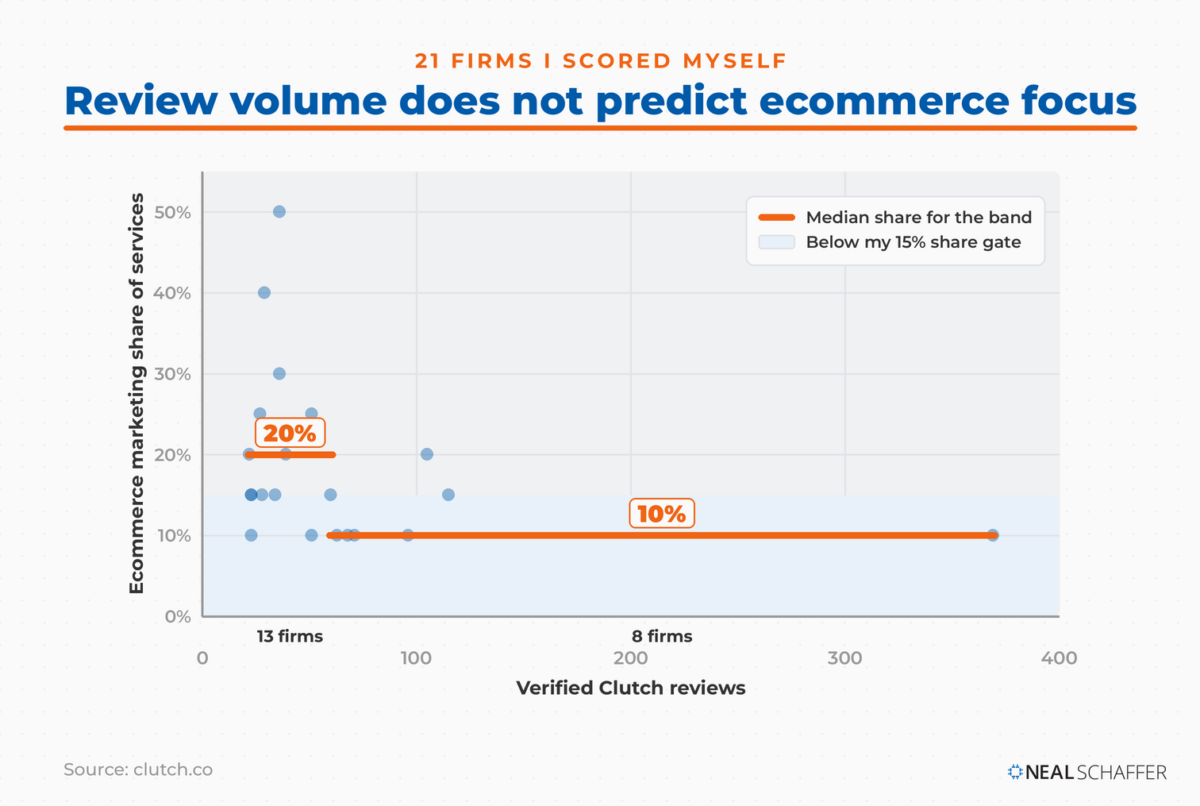
Disruptive Advertising is the clearest illustration. With 369 reviews it has more verified projects than any other firm on the directory, and a 4.8 rating to go with them. It is also a paid search shop at heart, with pay-per-click at 50% of services and ecommerce marketing at 10%. If PPC is your actual question, that concentration is an argument in its favor.
The same logic covers the rest. AdVenture Media runs 60% pay-per-click. Inbox Army is 70% email. efelle creative describes itself as a web development and design firm. Each is deep in its own discipline, and each would top a differently filtered list.
| Firm | Reviews | Rating | Where its focus sits |
|---|---|---|---|
| Disruptive Advertising | 369 | 4.8 | 50% pay-per-click, 10% ecommerce marketing |
| AdVenture Media | 96 | 4.9 | 60% pay-per-click, 10% ecommerce marketing |
| Inbox Army | 71 | 4.9 | 70% email marketing, 10% ecommerce marketing |
| efelle creative | 63 | 5.0 | Web design and development, 10% ecommerce marketing |
| Out Origin | 51 | 4.8 | Web development and local search, 10% ecommerce marketing |
| BlueTuskr | 23 | 4.7 | 30% SEO, 30% pay-per-click, 10% ecommerce marketing |
Worth saying plainly: any of these firms could be the right hire. Several would be my first call for the discipline they specialize in. The point is only that a directory sorted by review count hands you these names first, and review count measures tenure rather than ecommerce specialization.
So before you call any of them, there is a question worth answering internally.
What Should You Fix Before You Hire Anyone?
Most brands hire an ecommerce marketing agency to buy more traffic when their actual constraint is what happens to traffic after it arrives. Fixing conversion first changes the economics of every acquisition dollar you will spend afterward, and it is cheaper than a retainer. Diagnose the funnel before you fund the top of it.
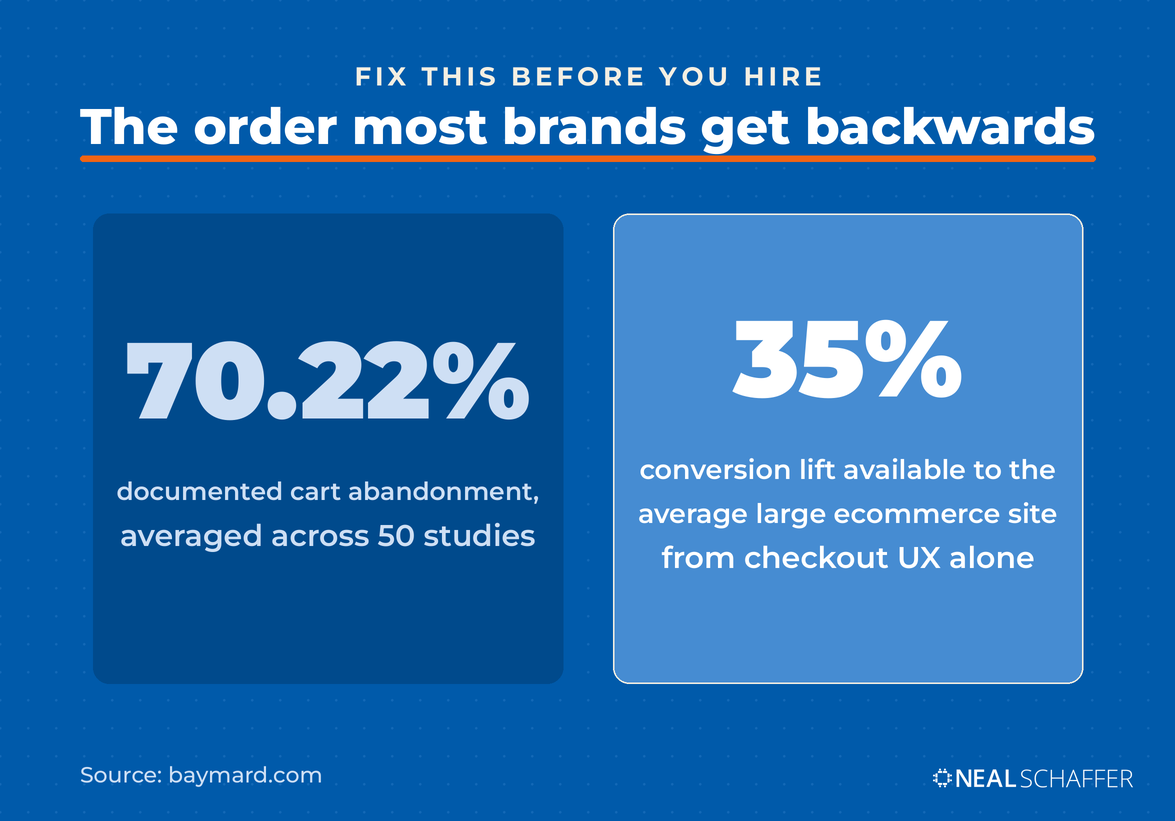
The numbers on this are not subtle. Baymard Institute puts the average documented cart abandonment rate at 70.22% across 50 separate studies. About 42% of those abandoners were only browsing. The rest left for fixable reasons, led by extra costs at checkout at 40%.
And the upside is quantified. And the upside is measured. Baymard’s checkout research puts the available gain at a 35% increase in conversion rate for the average large-scale ecommerce site. The average site still has 32 unique checkout improvements left to make.
Run the math on your own store before your first agency call. If a 35% conversion lift is sitting inside your checkout flow, doubling ad spend is the second-best move available to you. Knowing your baseline ecommerce KPIs and having a working ecommerce marketing strategy also changes the conversation with an agency, because you arrive with a brief instead of a wish.
Budget pressure makes this sequencing more urgent, not less. Gartner’s 2026 CMO Spend Survey of 401 marketing leaders found marketing budgets flat at 7.8% of company revenue, with 56% of CMOs saying they lack the budget to deliver their strategy.
Once you know what you are buying, the profiles themselves become readable.
How Do You Read a Clutch Profile Without Getting Fooled?
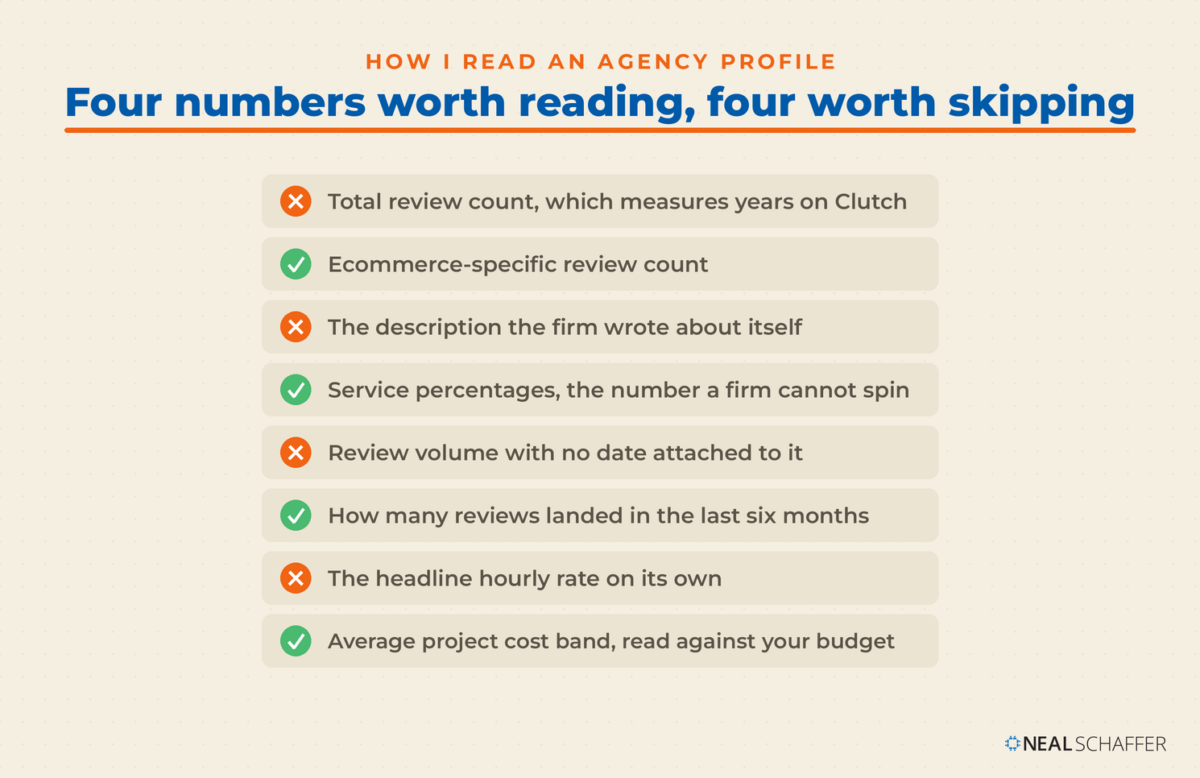
A Clutch profile carries four numbers that matter and a lot of copy that does not. Service percentages tell you what the firm really does. Review recency tells you whether the record is current. Ecommerce-specific review counts tell you whether the specialization is real. Project cost bands tell you whether you fit.
Start with service percentages, not the description
Every profile lists services as percentages of work. This is the number agencies cannot spin, and it is the fastest way to separate a marketing agency from a development shop with a marketing line item. A firm at 55% ecommerce development and 15% ecommerce marketing builds stores for a living.
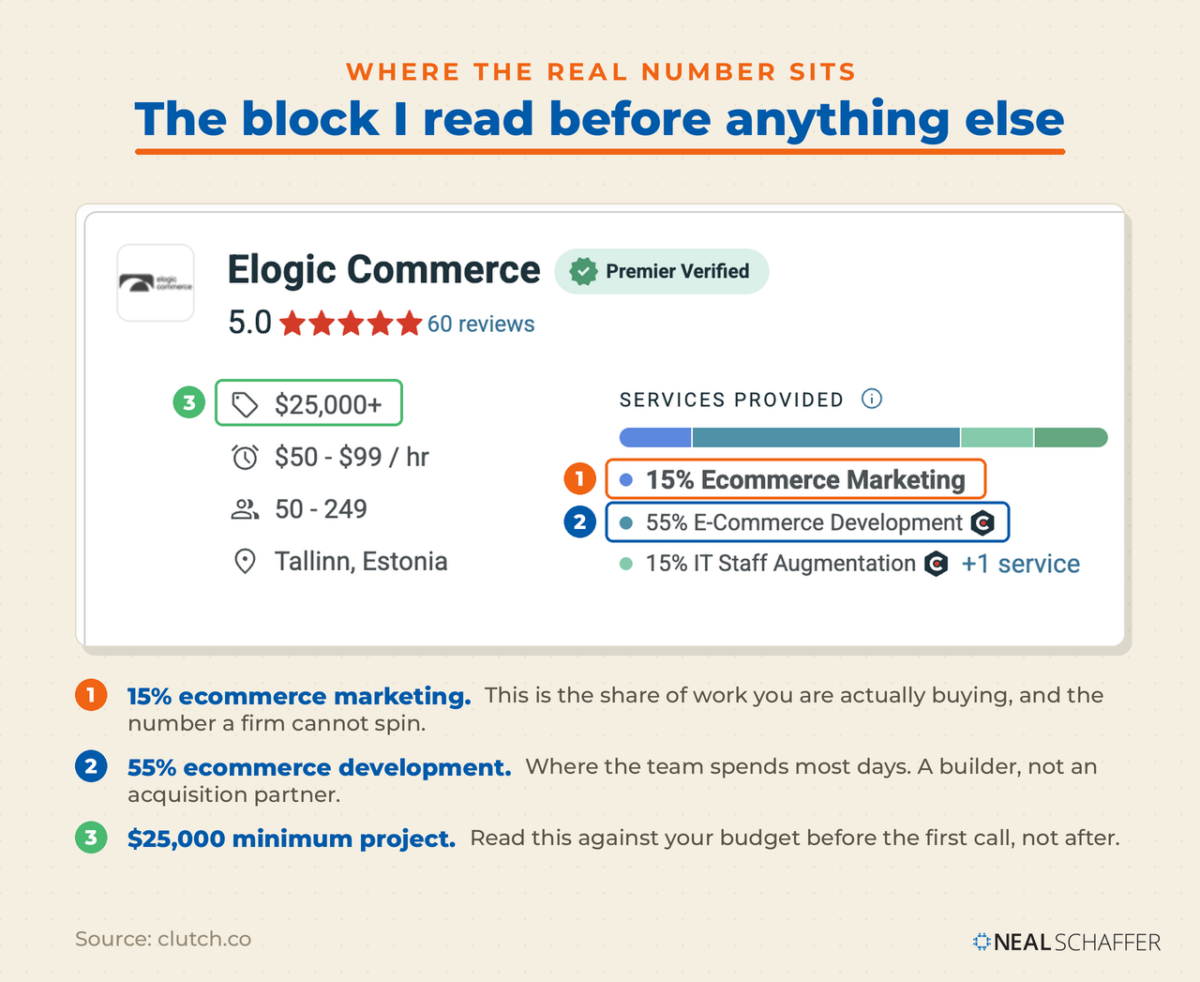
Neither is worse. They solve different problems. But if you hire the development-heavy firm to run acquisition, you have hired a team that does that work one week in seven.
Read the ecommerce-specific review count, not the total
Total review count measures how long a firm has been on Clutch. The ecommerce-specific count measures whether clients keep coming back for the thing you want to buy. That gap is exactly why a 369-review firm can be the wrong choice and a 51-review firm can be the right one.
Check recency, not just volume
A profile showing 60 reviews and 16 of them in the last six months is a live business. A profile showing 60 reviews with the most recent from 2022 is a track record, which is a different thing. Both numbers appear on the page.
Match the project cost band to your budget
Average project cost breakdowns are published on most profiles. If a firm’s engagements cluster in the $200,000 to $999,999 band and your budget is $4,000 a month, you will be the smallest client in the building. Some agencies handle that well. Most staff it accordingly.
That is how you evaluate the vendor. The harder question is what you should never hand over.
What Should You Keep In-House Instead of Outsourcing?
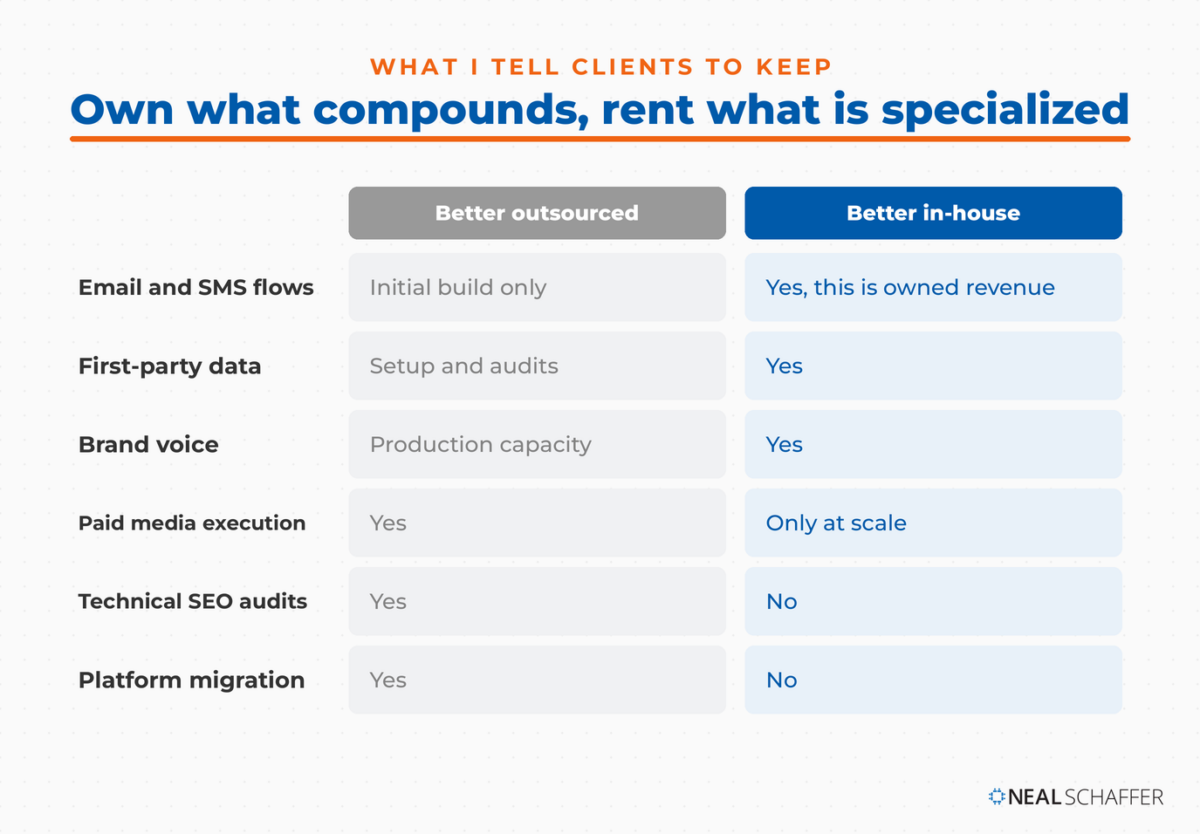
Keep the assets that compound and outsource the work that is genuinely specialized or genuinely seasonal. Email and SMS automation, first-party customer data, your analytics setup, and your brand voice should live with you. Paid media execution, technical SEO audits, and platform migrations are reasonable things to rent.
The retention case is the strongest. Klaviyo’s 2026 benchmarks, drawn from over 183,000 customers, show that automated flows generate nearly 41% of total email revenue from just 5.3% of sends, with revenue per recipient roughly 18 times higher than campaigns. That is an asset, and assets belong on your balance sheet.
There is a structural reason brands under-invest here. The 2026 CMO Survey from Duke’s Fuqua School of Business, Deloitte, and the American Marketing Association found that acquisition budgets run 25.96% larger than retention budgets on average, with 66.1% of companies spending more on acquisition than retention. Agencies are largely paid to solve acquisition problems, so that is the problem they will find.
The same survey reports that companies currently hand 33.59% of their digital marketing activities to external agencies and partners, and expect that share to sit at 34.27% two years out. Outsourcing a third is normal. Outsourcing the third that compounds is the mistake.
Brand voice is the clearest example. Production capacity is rentable, but the positioning underneath it is yours, and a full repositioning belongs with specialist branding agencies rather than a performance shop running your ads.
Creator content is the other common gap. Ecommerce shops will produce it, though the ones that do it best tend to be the influencer marketing agencies that maintain the creator relationships year round.
| Function | Better in-house | Better outsourced |
|---|---|---|
| Email and SMS flows | Yes, this is owned revenue | Initial build only |
| First-party data and analytics | Yes | Setup and audits |
| Brand voice and creative direction | Yes | Production capacity |
| Paid media execution | Only at scale | Yes |
| Technical SEO audits | No | Yes |
| Platform migration | No | Yes |
One more thing you should own outright is your reporting. Agencies once defended opaque campaign types on the grounds that the data did not exist. That excuse has expired. Google now publishes a channel performance report for Performance Max that breaks out impressions, clicks, conversions, conversion value, and cost by Search, Shopping, YouTube, Display, Discover, Gmail, and Maps. If an agency tells you the channel mix is unknowable, they have not opened the report.
There is one more option, and most brands never seriously price it out.
When Is a Fractional CMO a Better Fit Than an Agency?
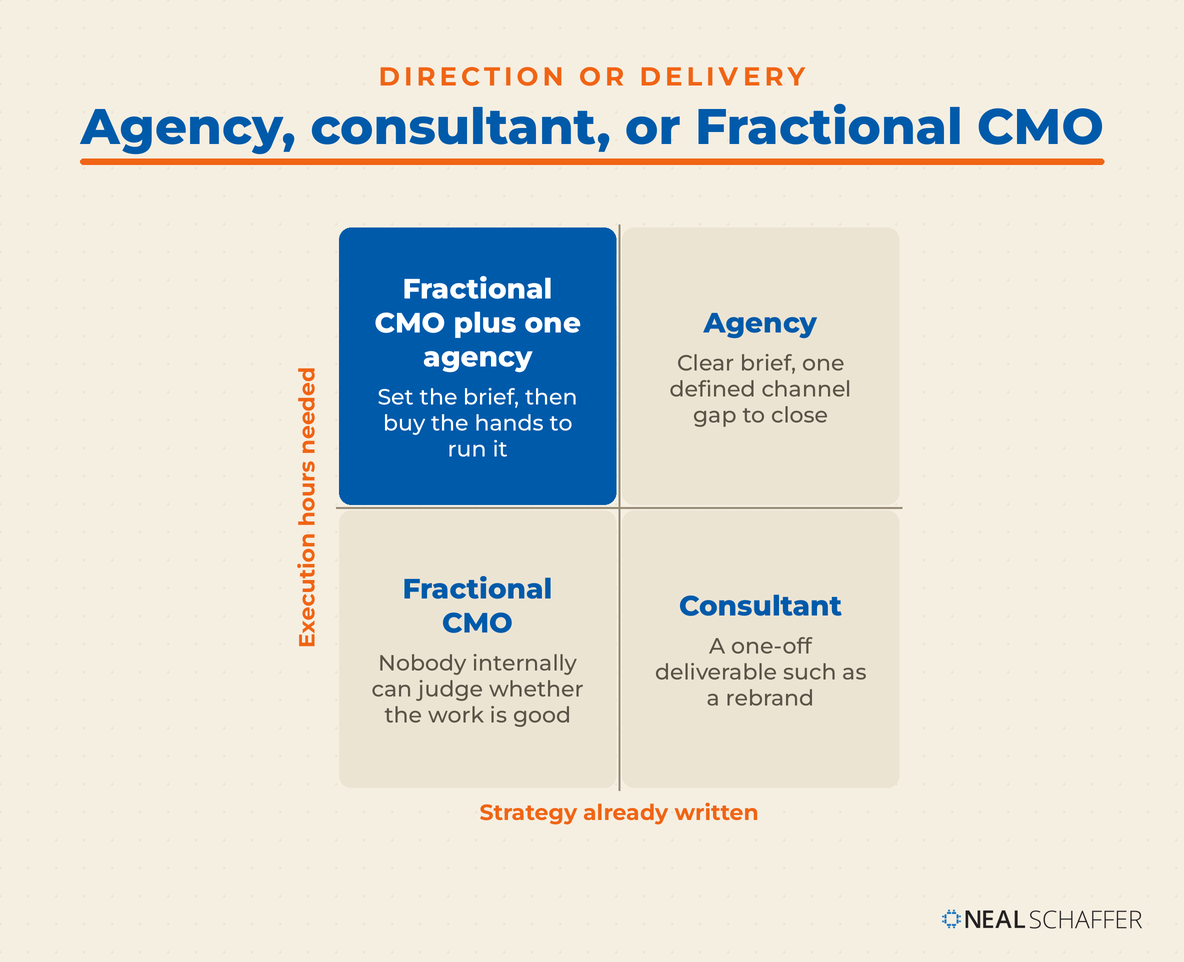
Hire a Fractional CMO when your problem is direction rather than delivery. If you cannot tell whether your current agency is doing good work, adding a second agency will not answer the question. A Fractional CMO owns strategy, sets the brief agencies execute against, and builds the internal capability so the knowledge stays with you.
On an episode of my podcast Your Digital Marketing Coach, I put my position plainly: “I have always thought that when a business hands over their marketing strategy to an agency, it is a conflict of interest.”
Not because agencies are dishonest. Because incentives are incentives. An agency that sells ad management will find an ads problem. That is not malice, it is the business model. The fix is simple: own the strategy, and make sure what the agency does is dictated by that strategy rather than the other way around.
| Option | What you get | What you do not get | Typical fit |
|---|---|---|---|
| Agency | Execution capacity and channel specialists | Strategic ownership, transferable knowledge | Clear brief, defined channel need |
| Consultant | A deliverable and a recommendation | Ongoing execution or accountability | One-off projects like a rebrand |
| Fractional CMO | Strategy, oversight, and team development | Deep hands-on channel execution | No senior marketing leadership in-house |
The honest version is that these combine well. Some of the best setups I have worked in pair a Fractional CMO who owns the strategy with a specialist agency that executes one channel exceptionally. For the longer argument behind that structure, start with what a Fractional CMO does.
Before you decide, a few questions come up on almost every call.
Frequently Asked Questions About Ecommerce Marketing Agencies
How much does an ecommerce marketing agency cost?
On my Clutch directory, minimum project sizes for the 15 firms above range from $1,000 to $25,000, with hourly rates from under $25 to $199. Monthly retainers for a small to mid-market brand commonly land between $3,000 and $15,000. Flowium and Hunter Digital Marketing, both on the directory, publish fixed-price ecommerce packages, which makes budgeting far easier.
Should I hire an ecommerce marketing agency or a development shop?
Check the service percentages on their profile. A firm at 50% or more in ecommerce development builds and fixes stores. A firm concentrated in ecommerce marketing, paid media, or email drives revenue to a store that already works. If your site converts poorly for technical reasons, start with the builder. If it converts fine but nobody sees it, start with the marketer.
What is a fair contract length for an ecommerce marketing agency?
Three months is enough to see whether the working relationship functions, and short enough that a bad fit is survivable. Push back on twelve-month commitments before any work has been delivered. Also confirm in writing that your ad accounts, pixels, email lists, and creative files belong to you and stay with you if the relationship ends.
How do I know if my agency is underperforming?
Ask for revenue, not activity. If reporting leads with impressions, rankings, or engagement rather than orders, average order value, and blended acquisition cost, the agency is measuring its own output rather than your outcome. Ask which channel drove which conversions, and expect a specific answer.
Do I still need an agency if I have good ecommerce tools?
Sometimes not. Plenty of brands running solid <a href=”https://nealschaffer.com/ecommerce-tools/”>ecommerce tools</a> need capacity or expertise for one channel rather than a full retainer. The question to answer is whether you lack execution hours, specialist skill, or strategic direction, because those three gaps have three different solutions.
Ready to Choose Your Ecommerce Marketing Agency?
Shortlist three firms from the table above whose service concentration matches your actual bottleneck. Then run all three through the same four questions. What will you own at the end? What does month nine look like? What went wrong on your last engagement, and how will you report revenue rather than activity?
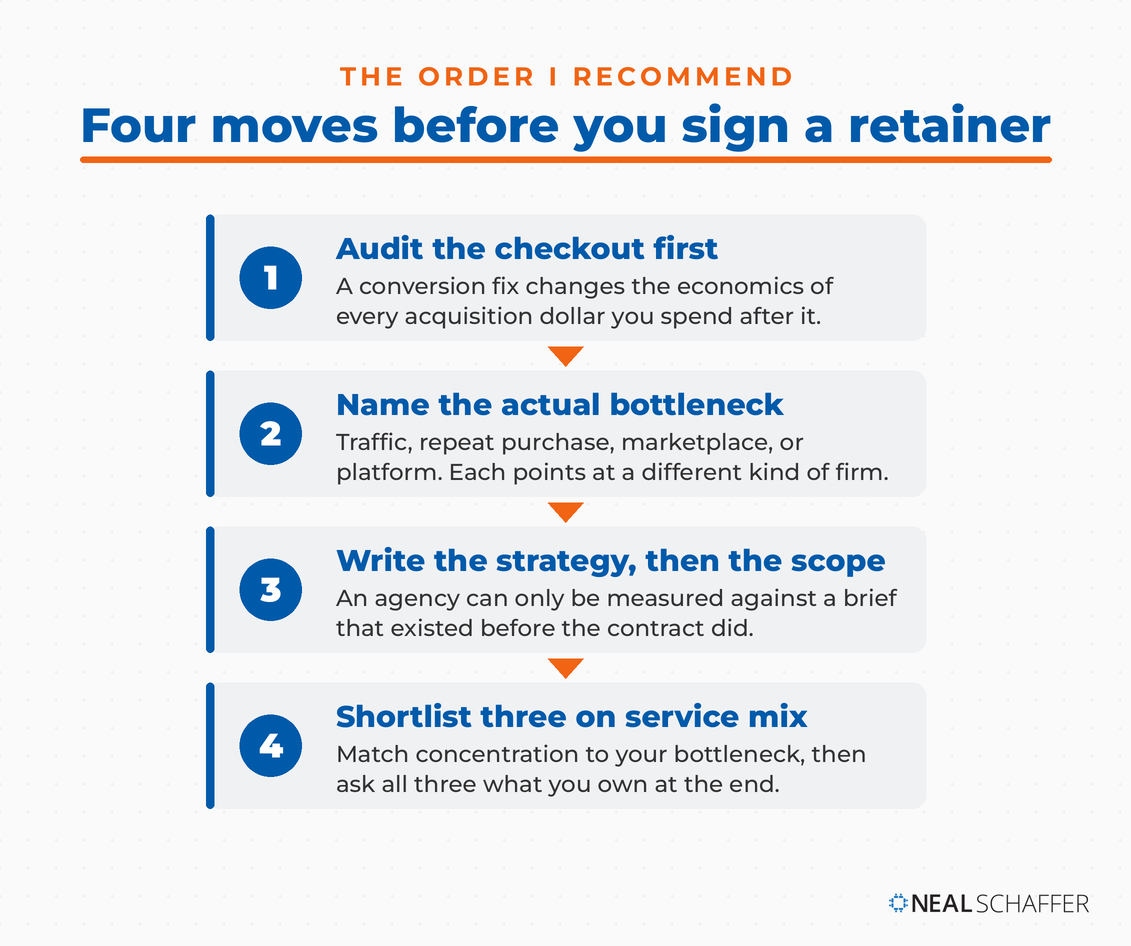
Do the conversion audit first. If your checkout is leaking, an agency will spend your budget filling a bucket with a hole in it, and both of you will be frustrated by quarter two.
Then set the strategy before you set the scope. Whether you write it internally, hire someone to write it, or work through it with me, the strategy has to exist before an agency can be measured against anything.
To see how these decisions connect across your whole channel mix, the latest social media marketing statistics are a useful reality check on where attention actually sits in 2026. For the fundamentals any agency should already be executing, start with ecommerce marketing.
For a deeper look at building a coordinated digital strategy across search, email, and social, grab a free preview of Digital Threads. Want help pressure-testing agency proposals and setting the brief? That is exactly what my Fractional CMO services are built for. Entrepreneurs working through this alone are welcome in my Digital First group coaching community.
Actionable advice for your digital / content / influencer / social media marketing.
Join 13,000+ smart professionals who subscribe to my regular updates.