
AI has officially crossed the line from “interesting experiment” to “board-level expectation.” But if you’re a founder, CMO, or marketing leader trying to hire an AI marketing agency, you’ve probably noticed a frustrating pattern:
Many agencies talk about AI like it’s a magic wand. Others are strong at building AI products but weak at connecting them to actual marketing outcomes (pipeline, CAC, LTV, retention). And too many “AI marketing” offers are just re-labeled automation setups with a chatbot bolted on. Right?
The real challenge isn’t finding people who can spell “LLM.” (It’s OK to laugh!) The challenge is finding a partner who can translate AI into measurable marketing results, without creating compliance issues, wrecking your brand voice, or locking you into a black box you can’t maintain.
I’ve been deep in this space for years now. As the author of Digital Threads, my latest book on modern digital marketing strategy, and as a Fractional CMO who regularly helps businesses evaluate and select agency partners, I’ve seen what separates genuine AI marketing capability from dressed-up automation. I also teach at Rutgers Business School and UCLA Extension, where I cover how AI is reshaping marketing execution in real time. I’ll be honest: Some companies waste money on “AI marketing” engagements that amounted to a few ChatGPT prompts and a Zapier workflow. This roundup is built to help you avoid that.
You’ll get a curated shortlist of 15 agencies that can support AI-driven marketing, from strategy and experimentation to data pipelines, AI-enabled personalization, martech integration, and production-grade deployment. Note that this list comes from my collaboration with the leader in B2B services marketplace, Clutch, and my dedicated directory “Neal Schaffer’s Leading AI Development Companies.” This is just one of many directories you can explore here.
Key Takeaways
✅ Not every AI marketing agency is the same: some build AI products, some automate marketing ops, and some focus on data infrastructure. Match the partner to your specific use case.
✅ The best AI marketing agencies tie their work to measurable business outcomes (pipeline, CAC, retention) rather than just showcasing technical demos.
✅ Before evaluating agencies, define what “AI marketing success” looks like for your organization, whether that’s faster content production, smarter personalization, or reduced customer acquisition costs.
✅ Always clarify ownership of code, prompts, fine-tuned models, and training data before signing any contract.
✅ AI marketing at scale is often a data and systems problem first, so agencies with strong engineering and integration capabilities tend to outperform pure “creative” shops.
✅ The AI marketing agency landscape is evolving fast in 2026. Agencies that combine product thinking with marketing fluency deliver the most durable results.
Why Is Choosing an AI Marketing Agency So Difficult in 2026?
Most “best agency” lists are either pay-to-play, based on hearsay, or written by someone who’s never had to defend marketing spend in a leadership meeting.
This one is designed differently:
Practitioner lens: Written from the perspective of someone who has to make AI initiatives actually work in-market (and survive scrutiny from finance, legal, and sales). I talk about this frequently on my Your Digital Marketing Coach podcast, where listeners regularly ask me how to separate real AI capability from marketing fluff.
Marketing outcomes first: Not “cool demos,” but practical capability to support acquisition, conversion, retention, content velocity, and measurement.
Variety of strengths: Not every company needs the same thing. Some need rapid prototyping, some need enterprise-grade delivery, and some need integration with existing stacks.
Here’s the thing: according to Gartner’s CMO Spend Survey, marketing budgets dropped to 7.7% of overall company revenue, the lowest level in a decade. That means every dollar you spend on an AI marketing agency needs to produce measurable returns. You can’t afford to hire a partner that delivers a slick proof-of-concept but no business impact.
And the market is moving fast. McKinsey’s State of AI report found that 72% of organizations had adopted AI in at least one business function, up from 55% just a year prior. That number has only grown heading into 2026, which means the competitive pressure to get AI marketing right is intensifying.
What Criteria Should You Use to Evaluate an AI Marketing Agency?
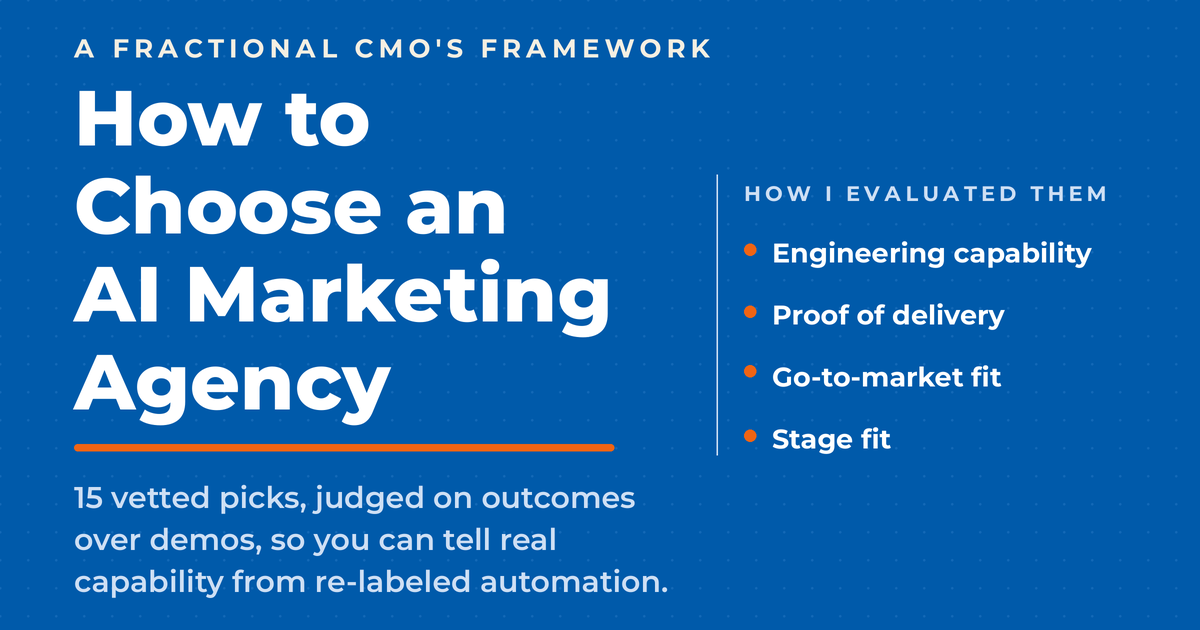
To make this list genuinely useful, agencies were evaluated on signals that tend to correlate with successful delivery. I’ve used variations of this framework when advising my own Fractional CMO clients, and it’s saved more than a few of them from expensive mistakes.
| Evaluation Criteria | What to Look For | Red Flag |
|---|---|---|
| AI positioning | Clear focus on AI, data, or marketing enablement | Vague “we do everything” messaging |
| Engineering capability | LLMs, MLOps, integrations, data workflows, cloud | Only using no-code tools with no custom build ability |
| Proof of delivery | Case studies, portfolio examples, credible third-party profiles | Only testimonials, no specifics |
| Go-to-market support | Activation, experimentation, analytics, personalization | Builds software but can’t connect to marketing KPIs |
| Communication maturity | Process clarity, discovery discipline, documentation | No defined process or discovery phase |
| Stage fit | Supports startup MVPs through enterprise modernization | One-size-fits-all pitch |
When I reviewed agencies for this list, I also cross-referenced profiles on platforms like Clutch and G2 to verify claims after confirming details on their websites. I’ll be honest, a number of agencies I initially considered got cut because their case studies were too thin or their “AI marketing” positioning was really just standard marketing automation with a new label or simply an opportunistic attempt to capture leads.
Top 15 AI Marketing Agency Options for 2026
1) BlueLabel
BlueLabel is best known as a product-minded digital agency that helps organizations design and build customer-facing experiences, often with emerging tech baked in. For marketing leaders, the advantage is straightforward: when AI is part of the roadmap, BlueLabel can tie it into the actual product or customer journey rather than running AI as a side experiment.
Where they tend to shine is the intersection of strategy, build, and iteration. That’s often what AI marketing needs in practice: pilot fast, validate impact, then productionize the workflows that improve conversion, retention, or sales enablement without creating a patchwork stack.
- Location: United States (New York presence; distributed delivery teams)
- Specialties: Product strategy, app/web development, AI-enabled digital experiences, UX/UI, prototyping
- Best For: Teams that want an AI-assisted customer experience built into their product or platform, especially when speed-to-market matters
2) Quytech
Quytech has a long-standing footprint in emerging technology development, including AI/ML, mobile apps, and custom software. For buyers looking for an AI marketing agency with build capability, they’re often considered for projects where the AI component is tangible: recommendation engines, automation workflows, predictive features, or AI-enabled marketplaces.
Their appeal is breadth. They can support a wide range of implementations, which is helpful if your marketing roadmap includes multiple AI use cases (content workflows, lead scoring, personalization, customer insights) and you want one technical partner to execute. If you’re also exploring AI marketing tools that might work alongside a development partner, that breadth becomes even more valuable.
- Location: India (with global delivery for US/UK/AU clients)
- Specialties: AI/ML development, mobile/web apps, automation, chatbot and assistant builds
- Best For: Startups and mid-market companies that need AI product development supporting acquisition or monetization goals
3) Neoteric
Neoteric is frequently positioned as an AI-focused software partner, with an emphasis on helping companies turn AI concepts into working systems. In marketing contexts, that often translates into building the infrastructure behind AI-enabled targeting, segmentation, or automation, especially when off-the-shelf tools don’t fit (or when data is messy and distributed).
I find Neoteric a compelling fit for organizations that want to move beyond “prompt hacks” and instead develop reliable AI solutions that can be maintained, measured, and improved. If your leadership team is asking for real governance, data quality, explainability, and risk management, this type of partner can matter. This is especially relevant as concerns around AI detection and content authenticity continue growing.
- Location: Poland (serving international clients)
- Specialties: Custom AI development, data engineering support, ML/LLM solutions, product discovery and prototyping
- Best For: Marketing and product leaders who need AI solutions built responsibly with an eye on long-term maintainability
4) Edvantis
Edvantis is known for software engineering and team augmentation, often supporting companies that need consistent delivery capacity rather than a one-off project team. For AI marketing initiatives, this matters because AI is rarely a single deliverable; it’s a sequence of experiments, integrations, and refinements over time.
If you’re building AI-enhanced marketing capabilities in-house (say, integrating CDPs, instrumenting event data, deploying model-driven personalization, or building internal content tooling), Edvantis can be relevant as an execution partner that supports your team’s roadmap.
- Location: US presence with significant delivery operations in Eastern Europe
- Specialties: Dedicated engineering teams, custom software, data-driven development, long-term delivery support
- Best For: Organizations that already have strategy leadership but need dependable technical delivery to implement AI-driven marketing infrastructure
5) fxis.ai
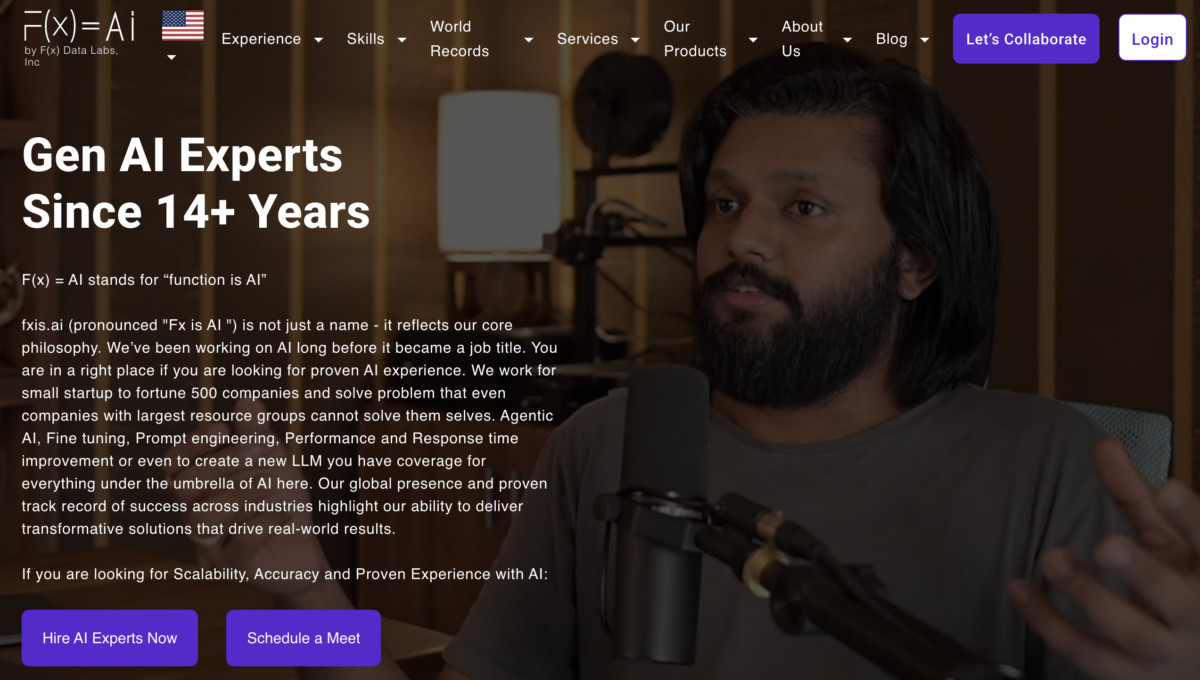
fxis.ai is positioned as an AI-first partner, typically focused on building and deploying AI systems rather than offering generic marketing services. In the AI marketing agency conversation, they tend to be most useful when “AI marketing” means custom intelligence: automating research, improving lead qualification, building domain-specific assistants, or creating AI layers on top of existing business processes.
Teams that get the most value from an AI-first firm are those who have clear internal workflows and want AI to reduce cycle time, improve decision quality, or unlock personalization without ballooning headcount. Think about how many hours your team spends on tasks that an AI text generator or AI writer could accelerate, and then imagine a custom-built version tailored to your exact processes.
- Location: Global (AI-first firms often operate with distributed teams)
- Specialties: AI/LLM solutions, agent workflows, automation, custom AI applications, deployment support
- Best For: Teams aiming to build proprietary AI workflows that create a durable execution advantage
6) NineTwoThree AI Studio
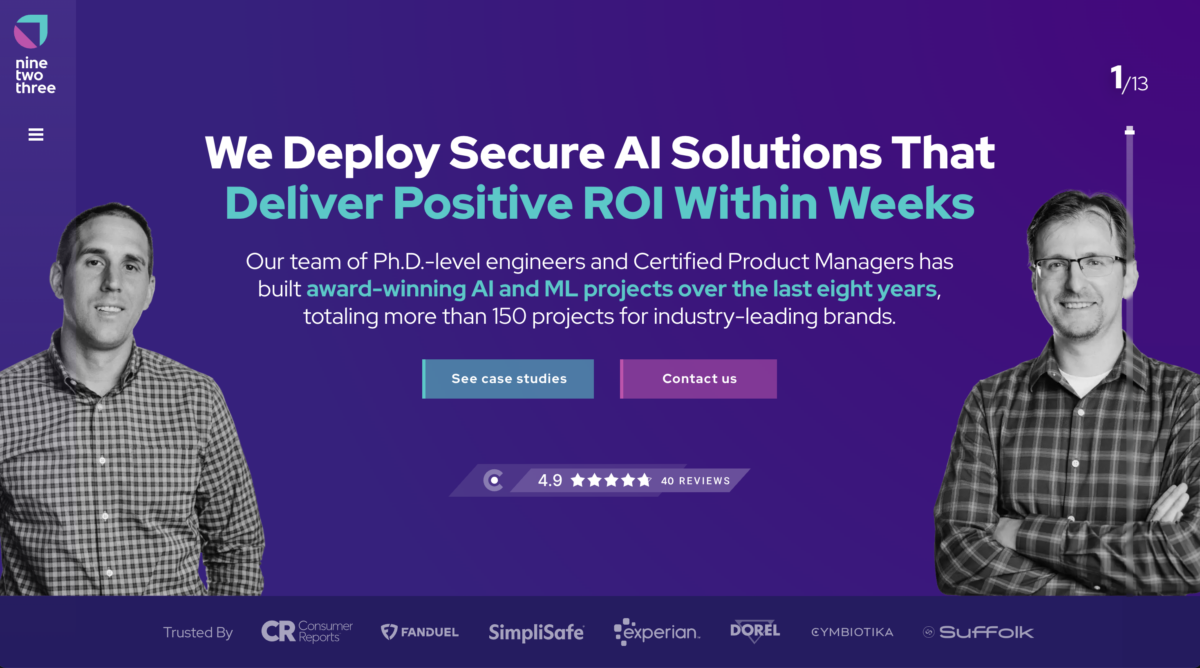
NineTwoThree AI Studio is widely recognized as a specialist in applied AI, often building AI products, copilots, and machine learning solutions. For marketing leaders, their value shows up when you want to create differentiated customer experiences powered by AI: onboarding intelligence, recommendation systems, conversational interfaces, or predictive insights that feed growth.
Instead of selling “AI marketing” as a service bundle, studios like this typically engage around specific, high-leverage AI use cases. That can be a better fit if you already have a marketing function that runs campaigns well, but you need AI product capabilities to unlock the next stage of growth.
- Location: United States (Boston area; serves global clients)
- Specialties: AI product development, LLM app development, machine learning, prototyping to production
- Best For: Companies building AI-driven features that directly impact activation, retention, or monetization
7) Osedea
Osedea is a digital product agency with a strong reputation for product thinking, combining UX, engineering, and modern technology delivery. In an AI marketing context, that product DNA matters: the best AI initiatives often require redesigning journeys, interfaces, and decision points so AI outputs are actually used (and trusted) by customers or internal teams.
Osedea can be a fit when you want AI to enhance the customer experience without sacrificing clarity. That includes AI-assisted onboarding, personalization frameworks, experimentation tooling, or internal marketing platforms. If you’ve ever worked with AI chatbots that felt clunky or disconnected from the brand experience, you’ll appreciate why product-first thinking matters here.
- Location: Canada (Montreal)
- Specialties: Digital product design and development, UX/UI, AI-enabled product experiences
- Best For: Teams that want AI woven into digital experiences with a high standard for design and product usability
8) HatchWorks AI
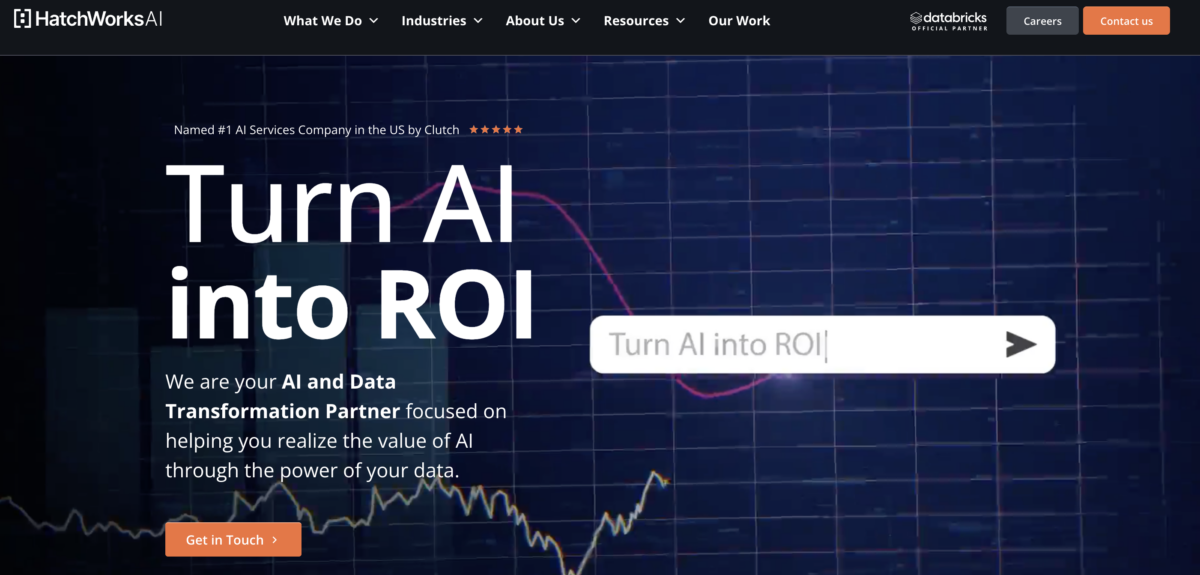
HatchWorks AI is positioned around applied AI and data, often helping organizations operationalize AI through strategy, engineering, and enablement. For buyers looking for an AI marketing agency that can connect AI to measurable outcomes, HatchWorks can be valuable because they typically approach AI as a business transformation tool, not a novelty.
They tend to be relevant when the work spans multiple layers: identifying high-ROI use cases (like churn reduction or lead scoring), building the data foundation, and integrating the solution into tools teams already use (CRM, marketing automation, analytics). Salesforce’s 2025 State of Marketing report found that high-performing marketing teams are 2.5x more likely to use AI for predictive analytics, which is exactly the kind of work HatchWorks specializes in.
- Location: United States (with nearshore/LatAm delivery)
- Specialties: AI strategy and implementation, data engineering, ML/LLM applications
- Best For: Organizations that want a pragmatic AI roadmap that marketing can actually execute and measure
9) 3 SIDED CUBE
3 SIDED CUBE is known for building digital products with mission-driven organizations, often focusing on measurable real-world impact. In an AI marketing agency roundup, they’re an interesting inclusion because they bring strong product delivery, often in environments where trust, accessibility, and user outcomes matter.
AI marketing isn’t only about selling more. Sometimes it’s about improving engagement, education, adoption, and retention in communities that require careful communication. I genuinely respect agencies that think about AI’s ethical implications. As AI in social media becomes more pervasive, the question of responsible deployment is becoming a board-level conversation for many brands.
- Location: United Kingdom (with international delivery)
- Specialties: Digital product development, UX, data-driven platforms, responsible technology delivery
- Best For: Purpose-led brands and organizations where trust and user experience are non-negotiable
10) EB Pearls
EB Pearls is a digital agency known for building apps and digital platforms, frequently supporting startups and growth-stage businesses. In AI marketing terms, that means they can be useful when AI needs to be embedded into a mobile or web experience: personalization, intelligent onboarding, or automated customer support connected to conversion goals.
They’re often considered by teams that want a single partner who can design, build, and iterate quickly, especially when product improvements and marketing performance are tightly coupled.
- Location: Australia (Sydney) with global delivery capability
- Specialties: Mobile/web development, product design, MVP builds, AI-enabled app features
- Best For: Growth-stage companies needing AI-enhanced app experiences tied to signups, purchases, or retention
11) BEON.tech
BEON.tech is commonly known for providing high-quality engineering talent and delivery teams, often with a nearshore model. For AI marketing initiatives, this can be a smart route when you already have marketing strategy leadership but need technical horsepower to implement AI workflows across the stack.
Examples include building internal tools for content operations, integrating LLM-based assistants into sales enablement, deploying personalization services, or supporting data pipelines that power segmentation and lifecycle campaigns. And honestly? This model can be more cost-effective than hiring a full-service AI marketing agency if you already know what you want built.
- Location: Latin America-focused delivery; serves US and global clients
- Specialties: Engineering team augmentation, AI-capable development teams, product delivery support
- Best For: Teams with strong internal marketing leadership that want to scale AI implementation without hiring full-time immediately
12) Orases
Orases has a well-established reputation in custom software development and is often associated with advanced solutions including AI/ML. As an AI marketing agency partner, they’re most relevant when marketing goals require custom software: intelligent portals, AI-assisted customer tools, sophisticated lead management systems, or proprietary data products.
Where Orases can stand out is in helping organizations that want to own their capability. Instead of relying entirely on third-party marketing tools, you can build differentiated systems that fit your workflows, data structure, and competitive strategy. I’m a big believer in this approach for companies at a certain scale, owning your AI marketing tools stack can become a genuine competitive moat.
- Location: United States (Maryland)
- Specialties: Custom software development, AI/ML solutions, web platforms, system modernization
- Best For: Mid-market and enterprise teams that want custom AI-backed systems supporting marketing and revenue operations
13) CodeNinja
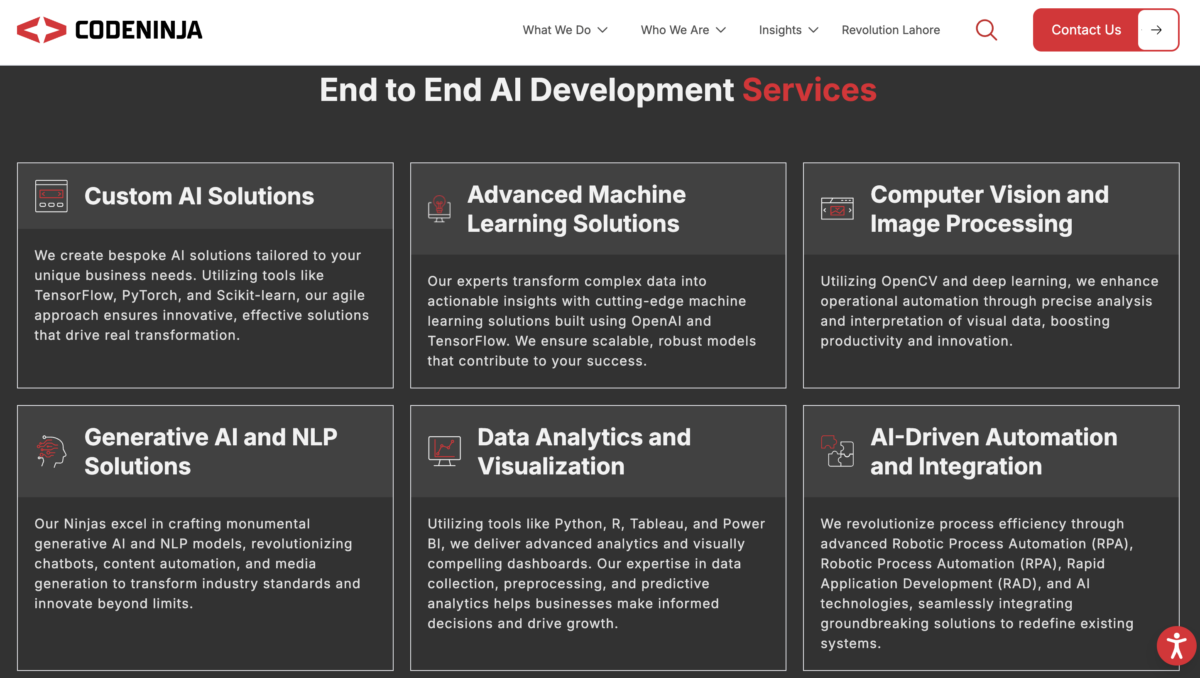
CodeNinja is a technology services firm often associated with product development, engineering teams, and digital transformation. In an AI marketing context, that typically means they can help execute builds and integrations that make AI operational, connecting models to real workflows like lead routing, content pipelines, customer support, and analytics.
For marketing leaders, CodeNinja can be a fit when AI is part of a broader modernization program: rebuilding systems, improving data flow, or launching new digital experiences where marketing, product, and engineering must move together.
- Location: Global delivery (operations spanning US, Middle East, and South Asia)
- Specialties: Product engineering, AI and automation development, systems integration
- Best For: Organizations running multi-workstream initiatives where AI, data, and customer experience need to ship together
14) Uinno
Uinno is a product engineering company that helps businesses design, build, and scale digital products, often acting as an embedded partner for teams that need senior execution across strategy, UX, and development. In the context of an AI marketing agency search, Uinno is a strong match when “AI marketing” really means shipping AI-enabled product and platform capabilities that improve acquisition, activation, retention, or sales efficiency.
What makes Uinno useful for marketing leaders is their product-centric delivery: they can support everything from discovery and rapid prototyping to building production-ready features like AI-powered onboarding flows, personalization layers, intelligent search, or internal copilots for content and revenue teams. If you’ve already been experimenting with AI marketing tools but need someone to turn those experiments into reliable, integrated product features, that’s where a partner like Uinno fits.
- Location: Europe-based delivery with global client support (commonly operating as a distributed team)
- Specialties: Product discovery, UX/UI, web/mobile development, AI/LLM-enabled applications, automation, CRM/analytics integrations
- Best For: Startups and mid-market companies that want an embedded product and engineering partner to implement AI-enhanced experiences and internal marketing enablement tools
15) Six Feet Up
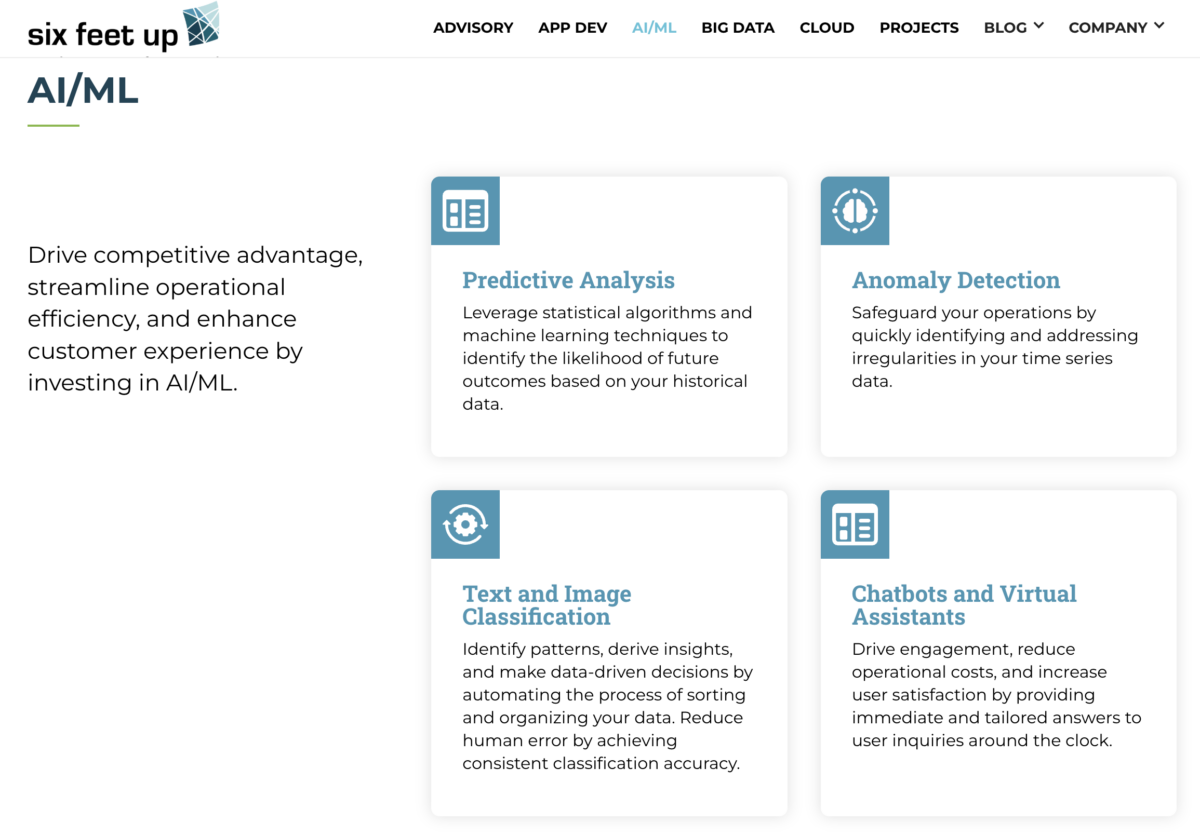
Six Feet Up is a US-based digital consultancy best known for deep expertise in Python, cloud infrastructure, and content-centric platforms, along with custom application development. For teams evaluating an AI marketing agency, Six Feet Up is a compelling option when your AI goals depend on solid technical foundations: secure hosting, scalable back ends, clean content architecture, and integrations that let marketing teams actually use AI day-to-day.
Instead of positioning as a traditional campaign shop, Six Feet Up tends to fit organizations that need to modernize or extend a web platform (or internal content systems) so AI can be applied responsibly. Think AI-assisted content operations, intelligent search across owned content, automated tagging and governance, or private LLM experiences connected to a controlled knowledge base. If your marketing org is constrained by an aging CMS or messy content libraries, and you’ve been exploring tools like AI writers or AI text generators but can’t plug them into your existing infrastructure, this is where a partner like Six Feet Up can make AI practical.
- Location: United States (Indiana; serves clients nationally and globally)
- Specialties: Python development, cloud/DevOps, CMS and content platforms, custom web apps, AI/LLM enablement for content systems, security and performance optimization
- Best For: Organizations that need AI-enabled content workflows or intelligent content experiences, and want a technically strong partner to modernize the platform underneath
How Do These AI Marketing Agencies Compare?
Here’s a quick-reference comparison to help you narrow your shortlist based on what matters most to your situation:
| Agency | Primary Strength | Best Stage Fit | Region |
|---|---|---|---|
| BlueLabel | Product + AI experiences | Startup to mid-market | US |
| Quytech | Breadth of AI/ML builds | Startup to mid-market | India (global delivery) |
| Neoteric | Custom AI development | Mid-market to enterprise | Poland |
| Edvantis | Team augmentation + engineering | Enterprise | US / Eastern Europe |
| fxis.ai | AI-first systems | Mid-market | Global |
| NineTwoThree AI Studio | Applied AI products | Startup to enterprise | US |
| Osedea | Product design + AI UX | Mid-market | Canada |
| HatchWorks AI | AI strategy + data | Mid-market to enterprise | US / LatAm |
| 3 SIDED CUBE | Mission-driven AI products | Mid-market | UK |
| EB Pearls | App + growth-stage AI | Startup | Australia |
| BEON.tech | Nearshore AI engineering | Mid-market | Latin America |
| Orases | Custom AI software | Mid-market to enterprise | US |
| CodeNinja | Cross-functional AI delivery | Enterprise | Global |
| Uinno | Product engineering + AI delivery | Startup to mid-market | Europe (global delivery) |
| Six Feet Up | Content platform + AI infrastructure | Mid-market to enterprise | US |
How Should You Choose the Right AI Marketing Agency?
Hiring the right AI marketing agency isn’t about finding the one with the best buzzwords. It’s about matching your business reality to an agency’s strengths. I’ve helped dozens of companies through this process as a Fractional CMO, and the mistakes I see repeat themselves with alarming consistency.
Get Specific About the Outcome (Not the Tool)
Before you evaluate partners, define what “AI marketing success” means in your organization:
- Increase qualified pipeline by X%?
- Reduce CAC by improving targeting and conversion?
- Improve retention with smarter lifecycle messaging?
- Cut content cycle time while preserving quality and brand voice?
- Improve sales enablement (faster proposals, better call coaching, smarter account research)?
If you can’t articulate the outcome, you’ll default to buying “AI capability,” and you’ll struggle to measure ROI.
Match the Agency Specialty to Your AI Use Case
“AI marketing” can mean very different projects. Here’s how I typically frame the alignment:
| Your AI Marketing Need | Look For This in an Agency |
|---|---|
| AI embedded in product experience (personalization, recommendations) | Product + engineering strength |
| Marketing operations automation (content workflows, agent systems) | AI workflow builders and integration specialists |
| Data foundation work (event tracking, identity resolution, CDP/CRM) | Data engineering and enterprise integration maturity |
| Content production at scale | AI content tools expertise + brand governance |
| Experimentation and iteration | Rapid prototyping + disciplined measurement approach |
If you’re specifically exploring how AI can accelerate content production, you might also want to evaluate standalone AI tools alongside agency partnerships. Sometimes the answer is a combination.
Evaluate Proof the Right Way
On discovery calls, ask for:
- A walkthrough of a similar engagement (what was built, timeline, what changed after launch)
- How they measured success (leading indicators plus business outcomes)
- What went wrong and how they handled it
That last question is the most revealing. If an agency can’t tell you about something that went sideways, they either haven’t done enough work or they’re not being honest. Both are red flags.
Don’t Skip the Uncomfortable Contract Questions
AI projects create new assets: prompts, fine-tuned models, datasets, workflows, and internal tools. Clarify these before signing:
- Who owns code, prompts, and training data artifacts?
- What happens if you end the relationship?
- Are there platform fees, licensing dependencies, or usage-based costs?
- What are the security and privacy practices (especially with customer data)?
- What documentation and handoff is included?
I’ve seen companies get locked into arrangements where the agency owned the fine-tuned model trained on the company’s own data. Don’t let that happen to you.
Questions to Ask on Your First Call
Use these to quickly separate real capability from marketing theater (I literally keep this list in my notes app for client calls):
- “What are the top 3 AI marketing use cases you’ve implemented that produced measurable business outcomes?”
- “How do you decide whether a solution should be custom-built vs. implemented using existing tools?”
- “What data do you need from us in the first 30 days to make progress?”
- “How do you handle evaluation and QA for AI outputs (accuracy, safety, brand voice, compliance)?”
- “Who will actually be on the account day-to-day, and what are their roles?”
- “What does success reporting look like weekly and monthly?”
- “What do we own at the end of the project?”
What About Using AI Tools Alongside an Agency?
Here’s something I don’t see discussed enough: you don’t always need a full agency engagement. Sometimes the smartest move is combining internal AI tool adoption with targeted agency support for the complex builds.
For example, your content team might handle day-to-day production using AI writers and AI caption generators, while an agency builds the custom recommendation engine or data pipeline that powers your personalization strategy. That hybrid approach can be more cost-effective and gives your team real ownership of the AI capabilities over time.
I’ve also found that teams using free AI tools to experiment internally before engaging an agency tend to write better briefs, ask sharper questions, and ultimately get more from the agency relationship. You don’t need to be an AI engineer, but understanding the basics of what AI video generators, AI image generators, or AI transcription tools can do will help you evaluate agency proposals much more critically.
According to Deloitte’s 2025 Global Human Capital Trends report, organizations where internal teams have basic AI literacy achieve 3x higher ROI from external AI partnerships compared to those that fully outsource without internal understanding.
And don’t overlook the revenue angle. If you’re a creator or entrepreneur exploring how to make money with AI, understanding the agency landscape helps you decide whether to build, buy, or partner, a decision that can dramatically affect your margins.
How Is the AI Marketing Agency Landscape Evolving in 2026?
The AI marketing agency space is shifting rapidly. A few trends I’m tracking right now:
Specialization is winning over generalization. Agencies that try to be everything (SEO, social, PPC, AND AI) are losing to focused AI-first shops.
The “AI wrapper” agencies are being exposed. These days a lot of agencies slapped an AI label on basic automation. Buyers are getting smarter. If an agency can’t show you what happens under the hood, move on. This is similar to the challenge in content marketing where you need an AI plagiarism checker to verify originality: surface-level appearances aren’t enough.
Data engineering capability is becoming table stakes. According to MIT Sloan Management Review’s 2025 AI research, the number one barrier to AI marketing success isn’t the model, it’s dirty data. Agencies that can help you fix your data foundation alongside deploying AI are worth their weight in gold.
Content authenticity is a growing concern. As AI-generated content floods the internet, brands need agencies that understand how to humanize AI text and maintain authentic brand voice. The agencies on this list that combine AI capability with strong UX and brand thinking are well-positioned for this challenge.
AI search is changing how agencies prove value. With AI search engines like Perplexity, Google’s AI Overviews, and ChatGPT search reshaping how buyers find information, the agencies that understand both traditional marketing and AI-native distribution have a real edge.
Frequently Asked Questions About AI Marketing Agencies
An AI marketing agency applies artificial intelligence to marketing functions like content creation, personalization, customer segmentation, lead scoring, marketing automation, and predictive analytics. The best ones connect AI capabilities to specific business outcomes (reduced CAC, higher conversion rates, improved retention) rather than just deploying technology for its own sake.
Costs vary widely depending on scope. Custom AI proects can rage from $50,000 to $200,000+.
It depends on your timeline, budget, and existing talent. If you need results within 3-6 months and lack AI engineering talent internally, an agency is the faster path. For long-term competitive advantage, many companies start with an agency partnership and gradually build internal capabilities. The hybrid approach (agency for complex builds, internal team for day-to-day AI tool usage) tends to work best for mid-market companies.
Look for specific case studies with measurable outcomes, not just client logos. Ask for technical details about their AI implementation approach. Verify their team includes actual AI/ML engineers, not just marketers using off-the-shelf tools. Check third-party review platforms, and always request references from similar-sized companies in adjacent industries.
Focus on outcomes, ownership, and accountability. Ask what measurable results they’ve achieved for similar clients, who owns the code and models they create, what happens to your data after the engagement ends, and how they handle AI quality assurance (including accuracy, bias, and brand voice compliance). The answers to “what went wrong in your last engagement” and “what do we own when this is over” will tell you more than any pitch deck.
Ready to Find Your AI Marketing Agency Partner?
These 15 companies are a strong starting shortlist, especially if you’re serious about using AI to improve marketing performance through better experiences, smarter systems, and scalable execution. But the list is only useful if you match the right partner to your specific needs, budget, and AI maturity level.
Here’s my honest advice after years of helping companies make this decision: start by getting clear on the outcome you need, not the technology you think you want. Then use the evaluation framework in this article to pressure-test any agency before signing a contract. The questions you ask on that first call will save you more money than any amount of research.
If you want ongoing guidance on AI marketing strategy (including tool selection, agency evaluation, and implementation planning), join my Digital First Group Coaching Community where I work directly with entrepreneurs and marketing leaders navigating these decisions. For corporate teams that need hands-on help evaluating agencies, reviewing proposals, and setting realistic expectations, my Fractional CMO services are designed exactly for this. And if you want a broader foundation in how AI fits into modern digital marketing strategy, grab a free preview of my latest book Digital Threads, it covers this digital marketing landscape in depth.