


If you think social media marketing strategy for nonprofits is a lot of sound and fury signifying nothing, think again.
Ever hear the old advertising adage that folks need to see/hear something at least 7 times before they notice it? Our airspace is so congested these days I wouldn’t be surprised if folks today must be exposed to your nonprofit brand as many as 20 times before they take notice.
This means you need to avail yourself of multiple communication channels if you want a prospective donor to respond positively when your nonprofit fundraising appeal crosses their threshold. Even though the bulk of money is still raised offline, it’s no longer enough to simply be in the mail. Social media is the new nonprofit advertising. And a successful social media marketing strategy becomes the key to success.
And it’s not just because online giving is growing. Or because increasing numbers of supporters will first encounter you online.
Folks who are exposed to you through multiple points of contact give more and stay loyal longer.
Per fundraising expert Tina Cincotti, donors are more likely to give, and stick with you, if you connect to them through multiple points of contact. In fact, they give at least 20% more than those connected through only one channel.
You need the trifecta: (1) Mail, (2) Email, and (3) Social media.
Most nonprofits do mail and email well, or at least okay, but when it comes to social media the strategy becomes a bit haphazard. And why is that a problem?
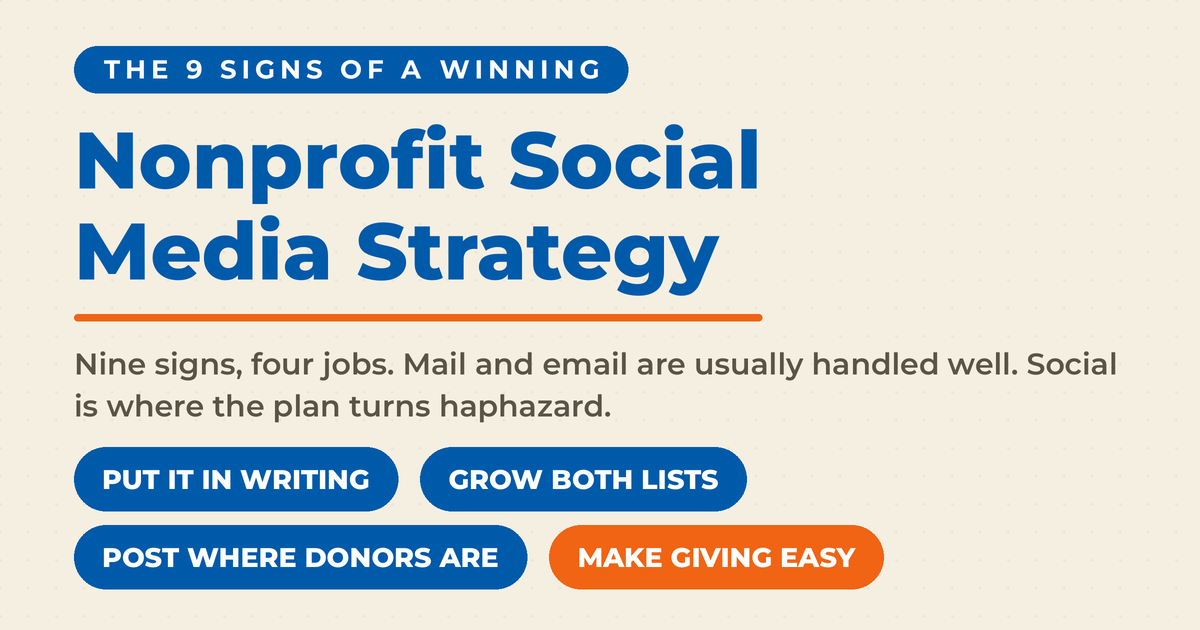
Email and social media are the two tools donors name most often when asked what moves them to give, at 33% for email and 29% for social media. So today I’m going to talk about nine things you can do to organize your social media strategy and integrate it with your mail and email communications. Much of this is inspired by Heather Mansfield’s excellent work on Nonprofit Tech for Good.
Key Takeaways
✅ Put the strategy in writing before you post anything. A written plan shows where mail, email and social media need to connect, what resources the work actually takes, and what leadership is being asked to approve.
✅ Grow the email list and the social following together. Each audience feeds the other, so every email should carry a bold call to follow and every social profile should give people a reason to subscribe.
✅ Build social media into giving campaigns rather than around them. A call to follow on the thank you page, and easy sharing of campaign messages, turn a single gift into a second and third point of contact.
✅ Written and visual content do different jobs, and a nonprofit needs both. Stories of donor impact give people a reason to care, while graphics, quote cards and an avatar that reads at thumbnail size give them something to recognize.
✅ Two networks done properly beat five done thinly. Choose platforms by where supporters already spend time, confirm it with platform demographics rather than assumption, and add a third only once the first two run steadily.
9 Signs You Have a Winning Nonprofit Social Media Strategy
1. You put your nonprofit social media strategy in writing

Writing a social media strategy for nonprofits down helps you:
- See where things must be integrated
- Ask the right questions
- Figure out what resources are needed
- Determine how you might acquire needed resources
- Persuade leadership of why the plan is needed
The best steps, in this order, are to get out of implementation mode and take a view from 30,000 feet. The same sequence sits behind any social media strategy, nonprofit or not:
- Conduct an online communications and fundraising audit (like a SWOT analysis). You can download a free template here.
- Create a strategic plan that plays on strengths and mitigates weaknesses
- Develop measurable objectives, assign responsibilities and include timelines
- Create a budget to support your plan, and get stakeholder buy-in
- Build systems to track and evaluate success
2. You actively build both your social media and email lists
Email is your most important social tool.
Social media is your next most important tool.
Build both lists!
- Build your email list with a prominently featured opt-ins on your home page and most viewed pages that offer an incentive to sign up.
- Convert email subscribers by adding big, bold calls to follow in your emails. “Follow us on Twitter.” “Follow us on Facebook.” “Connect with us on Instagram.” Include calls to follow on your thank you landing pages and in your email thank you’s.
- Convert social media followers to email subscribers. “Our next email update goes out tomorrow” with a screenshot of what they’ll get. Show them!
Mail raises more money than email, and email raises more money than social media. Social media earns its place by getting donors to the point of giving rather than by processing the gift.
You want to be everywhere today. Use the tool currently yielding the greatest return (mail), but also use the tools that are picking up steam every year (email and social media). If the email side is the weaker of the two, work through the mechanics of how to build an email list before you open another social account.
Merge the marketing tools for nonprofits. Run them together, so there’s synergy. Your goal? Enable your followers and subscribers to consistently see you telling stories of impact.
3. You integrate social media into online giving campaigns

Folks increasingly say that social media acts as the final reminder that triggers their giving. Especially with Millennials, but also increasingly with GenX and Boomers.
- Add a prominent call to follow on your Thank You landing page and follow-up email. “Follow our progress on Pinterest.” Make your message big and bold.
- Encourage sharing of your campaign messages. Peer to peer campaigns run on supporters posting their own progress, so make sharing a single tap from both the campaign page and the thank you page. Technology now empowers folks to take control and share what they’ve done. Empower them!
4. Your organization consistently shares written content
Social media without a content marketing strategy sucks. Post at least twice a month if you’re a small nonprofit. If you’re larger, aim for weekly blog posts, and let the length follow the subject rather than a word count target.
Tell success stories. Your donors’ victories!
- Photo essays showing impact.
- Campaign updates.
- And don’t forget to share useful tips and advice. How-to’s. Recommended reading. Top 10 lists.
- News folks can use.
Make sure everything has a call to action, as well as social sharing information.
5. You consistently create/share visual content

Text is not enough in a social media strategy for nonprofits. When you integrate visuals and text you get a bigger bang for your communications buck. Especially on social media, visual content gets clicked on and shared more frequently than text alone. Plan the visuals alongside the copy. A working visual marketing routine gives you graphics ready to go the day a campaign or a piece of news lands, instead of scrambling for an image after the fact.
Is LinkedIn Actually Bringing You Business?
My latest book helps professionals, entrepreneurs, and business owners turn LinkedIn from a static profile into a real source of clients and growth.
Maximizing LinkedIn for Business Growth gives you clear, practical steps to build a profile that gets noticed and a network that actually sends business your way.
Grab your copy on Amazon and put it to work this week. Click the cover or the button below to get started.

- Create specific social media graphics for year-end campaigns… giving day campaigns… breaking news (you can use free tools like Canva to help)
- Use quotes (you can make them pretty using free services like Quozio and com)
- Incorporate compelling statistics
Use these across multiple channels.
You’ll soon be able to tap on graphics and use a digital wallet (tap! Tap!), so creating these compelling visuals will become more and more important. They enable you to capitalize on your emotional appeal, and the power of striking while the iron is hot.
6. Your organization has a visually compelling avatar
This is like a logo and serves as your visual representation online.
The best ones are not your logo, because it likely wasn’t designed with social media in mind. Simply cropping a logo, resulting in unreadable text, will not create brand recognition for your cause. It can be some variation of your logo, however.
The best avatars are:
- Square
- Colorful
- Simple
- Well-designed
- Light on text
For examples of good avatars, check out:
- ACLU – Just the visual face of Lady Liberty from their logo
- Nature Conservancy — Just the visual stylistic green earth from their logo
- Goodwill International – Just the visual from their logo; includes the name in a square
- Save the Children – Variation on their logo with visual plus name of organization, arranged in a stacked square format
Use your avatar on every single online network to build a synergistic, identifiable brand across the social web.
7. You’re active on at least two social networks

This is probably the maximum for a small nonprofit. But try experimenting with a third one that can help you grow outside of your normal market (perhaps you want to appeal to a younger audience, or a more global audience).
It’s not sustainable to be on many at once, unless you have tons of staff and resources.
Plus your audience is paring down the number they use.
Facebook is most used.
Twitter and Instagram are next. But look at your audience and where they are.
Could be LinkedIn (professionals). Or leveraging Pinterest trends (woman; rural; suburban).
If you’re in multiple countries, other platforms will show up. WhatsApp. Line. Snapchat.
You can check the social media demographics of each platform and see how they match the supporters you are trying to reach.
You can also survey your audience to find out which platforms they use.
8. You don’t ignore your LinkedIn page
LinkedIn can be a terrific resource for nonprofits, but is often overlooked in most social media strategy for nonprofits.
Make sure you optimize your profile by filling everything out, updating it regularly (this alerts your followers to check you out) and even publishing articles on LinkedIn to establish yourself as a thought leader and create engagement.
Engagement on LinkedIn (click throughs) is higher than Facebook or Twitter.
9. You’re an early adopter of digital payments
According to Heather Mansfield, this is an area where “the fittest will survive and those that cannot compete will be weeded out.”
Check what your own donation form supports today, then give to your own organization on your phone and count the taps. Digital wallets and saved card checkout remove most of the friction that kills a mobile gift, and a QR code on printed material or an event screen hands someone the donation form without making them type anything.
Things worth checking:
- Whether your donation form accepts the digital wallets your supporters already use on their phones
- Whether a first-time gift can be completed in a few taps with no account to create
- Whether recurring giving sits on the same form rather than arriving as a separate ask
- Whether your event materials and printed pieces carry a QR code that lands on the donation form
- Whether the receipt email opens the next conversation rather than closing the transaction
Frequently Asked Questions About Social Media Strategy for Nonprofits
At minimum: goals tied to fundraising or awareness, the supporters you are trying to reach, the platforms where those people already spend time, who is responsible for posting and responding, and how success gets measured. Writing it down is what separates a strategy from a posting habit.
Two is enough for most small teams, with a third added only as an experiment when there is a specific audience to reach. Steady activity on two platforms does more for a nonprofit than four accounts nobody has time to answer.
Often enough to stay recognizable, which for most organizations means several posts a week on the platforms they have chosen and at least twice a month on the blog. Consistency matters more than volume, because a quiet account gives donors nothing to see on the day a campaign finally asks them for money.
Directly, it raises less than mail or email for most organizations. Its job is to act as the reminder that triggers a gift and to carry campaign messages through supporters’ own networks, which is why it works best integrated with the other two channels rather than measured on its own. The current social media marketing statistics are a useful reality check before you set targets for the year.
Putting Your Nonprofit Social Media Strategy to Work
Start with the two signs that cost nothing: write the strategy down, and pick the two networks your supporters already use. The rest of this list gets easier once those two decisions are made, because together they tell you what to post, who to talk to, and what to stop doing. Give it a quarter, then look at what changed in your email signups and your online gifts before you add anything new.
For a wider view of how social media fits with email, search and the rest of your digital marketing, take the free preview of Digital Threads. And if your organization needs someone to own the marketing plan rather than advise on it, Neal’s fractional CMO services are one way to fill that gap.
Author Bio
Claire Axelrad, J.D., CFRE is an expert on Social Media and Nonprofits. Claire was named Outstanding Fundraising Professional of the Year by the Association of Fundraising Professionals and brings 30 years frontline development experience to her work as principal of Clairification. A sought-after coach, Claire teaches the CFRE Fundraising Certification Course and frequently presents for The Foundation Center and 4GOOD. Claire writes this monthly column on Nonprofit Social Media plus regular columns for Nonprofit Pro and Guidestar. Clairification was named “Best Fundraising Blog of 2013” by FundRaising Success Magazine.



How we can make promotion within less money expenditure.And how we can make reach of our post wide. Please suggest me little more strategies.