
Let me start with what nobody else searching this query wants to hear: the Facebook Ads platform itself is not free. Every impression delivered through Meta Ads Manager runs through an auction, and that auction charges money. Anyone telling you otherwise is either selling something or hoping you won’t notice the asterisk.
That said, “facebook ads for free” can mean five different things, and a few of them have real answers. So before you waste another hour reading posts that route you toward Canva templates or vague “post organically!” advice, let me decode what you might actually be looking for.
I’ve been teaching paid social strategy to executives at Rutgers Business School for over a decade, and as a Fractional CMO I run paid campaigns across Meta for my own brand as well as clients in ecommerce. This post is what I’d tell any of those clients if they walked in and said, “Can I just run Facebook ads for free?”
The short version is no. The longer version, with the genuinely useful exceptions, is below.
Key Takeaways
✅ The Meta Ads platform is not free. Anyone running ads through Meta Ads Manager pays per impression or click. There is no “free tier” that runs alongside paid campaigns.
✅ Meta ad credits are real but small and unreliable. New advertisers occasionally receive promotional credits through Meta partner programs, hosting providers, or email offers. You cannot request them directly, and typical amounts are documented further down.
✅ Free Facebook research and creative tools exist. Meta Ad Library is a genuinely free competitive research database covering every active ad on the platform. AI ad copy generators and free design tools handle creative for $0.
✅ Organic Facebook reach can substitute for ads only at small scale. Pages, Marketplace, Groups, and Reels can drive real visibility, but the time investment to match what $500 in ads delivers is significant.
✅ What “free” really costs is time. Every legitimate free path requires hours per week to maintain. The honest math compares your hourly rate to your ad spend, and most small businesses break even faster on paid than on organic.
✅ Most “free Facebook ads” posts blur the line between ads and organic posts. The most common mistake in this category is calling a free Facebook post an “ad.” It isn’t. Knowing the difference matters for both expectations and outcomes.
Are Facebook Ads Really Free? The Honest Answer
Facebook ads delivered through Meta Ads Manager are not free. Every campaign runs through an auction-based bidding system that charges advertisers per impression, click, or conversion. The platform reaches over 3 billion monthly active users worldwide, and that audience scale is precisely why ad inventory has a market price.
The confusion comes from how loosely the word “ad” gets used in the Facebook ecosystem. A Facebook Page post is not an ad. A Marketplace listing is not an ad. An organic Reel is not an ad. These are all forms of free promotion on Facebook, and they have their place, but they are categorically different from paid advertising delivered through Ads Manager.
Why does the distinction matter? Because the expectations are completely different. A paid Facebook ad with a $50 daily budget can drive measurable traffic and conversions within 24 hours. A new Page post, on the other hand, typically reaches only a small fraction of existing followers organically, and growing those followers from zero takes months of consistent posting. When someone searches “facebook ads for free” expecting paid-ad results from organic effort, they’re disappointed every time.
Here’s the practitioner reality: there are genuinely free things you can do on Facebook to grow a business, and there are a few narrow paths that touch the paid platform without you paying directly. The next sections cover both.
What Do People Actually Mean by “Facebook Ads for Free”?
Five different intents typically sit behind this search query, and each has a different real answer. The reason “facebook ads for free” returns such a fragmented set of results on Google is that publishers don’t agree on what the searcher wants. The table below shows what the query usually means in practice and what the legitimate response is for each.
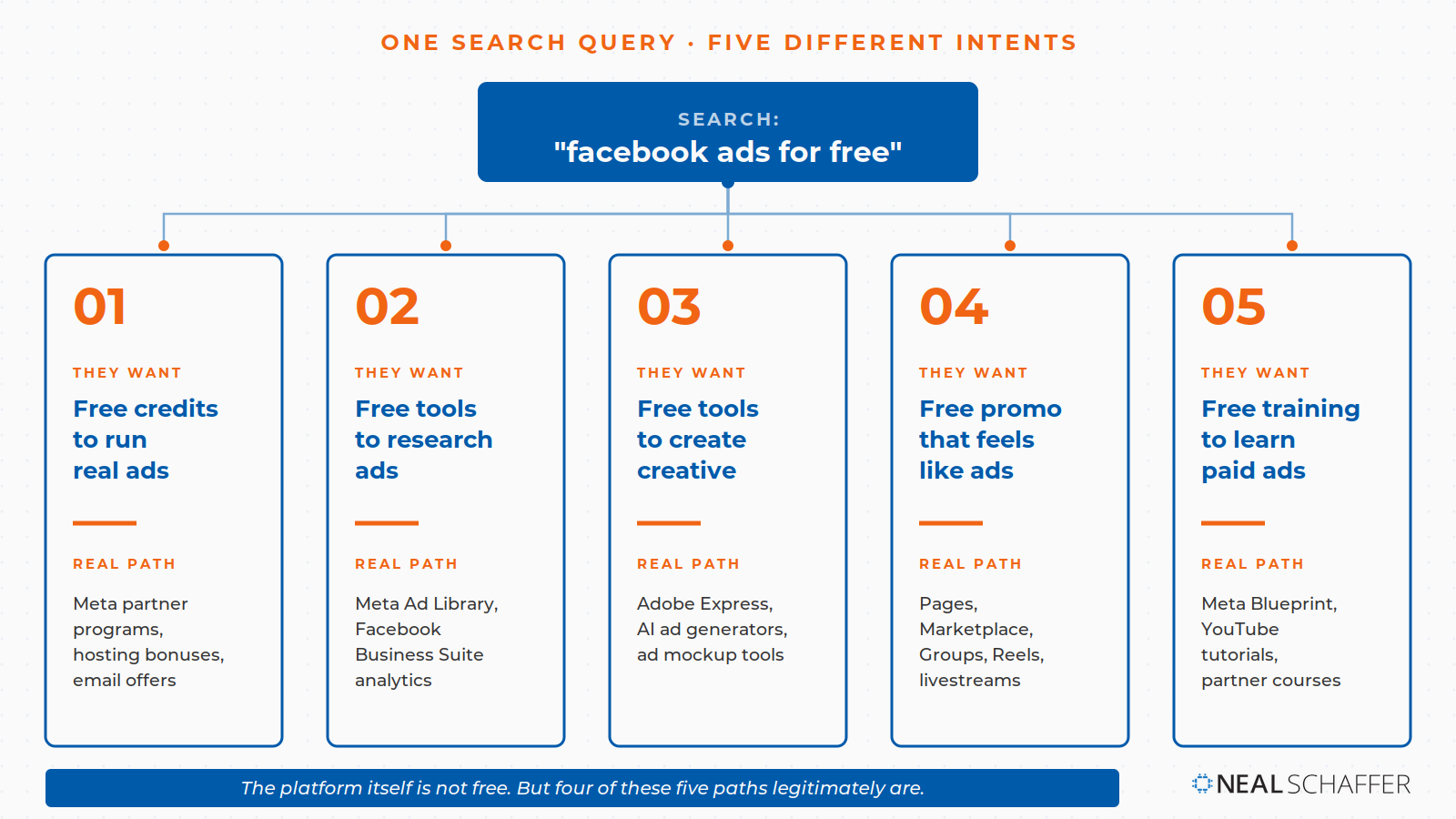
| What the searcher really wants | Legitimate path | Realistic limit |
|---|---|---|
| Free credits to run real ads | Meta partner programs, hosting bonuses, occasional in-product offers | $20 to $200 typical, larger amounts from partner integrations |
| Free tools to research ads | Meta Ad Library, Facebook Business Suite analytics | Unlimited, no account needed for Ad Library |
| Free tools to create ad creative | Adobe Express, AI ad copy generators, mockup tools | Unlimited, free tier sufficient for most |
| Free promotion that feels like ads | Pages, Marketplace, Groups, Reels, livestreams | Capped by your follower base and posting consistency |
| Free training to learn ads | Meta Blueprint, YouTube tutorials, partner courses | Unlimited |
Most “free Facebook ads” guides bundle intents three and four together and call it a day. That’s the gap. The five sections below give each intent the answer it actually deserves.
How Can I Get Free Facebook Ad Credits?
Free Facebook ad credits come from three sources: Meta promotional offers sent to new advertiser accounts, partner program credits bundled with paid third-party tools, and occasional in-product promotions in Ads Manager. You cannot request credits directly from Meta. Typical credit amounts range from $20 to $200, with larger credits available only through specific partner integrations.
This is the closest thing to a “free Facebook ad” that actually exists. Meta ad credits are non-cash balances applied to your ad spend before your primary payment method is charged. They expire if unused and cannot be transferred between accounts.
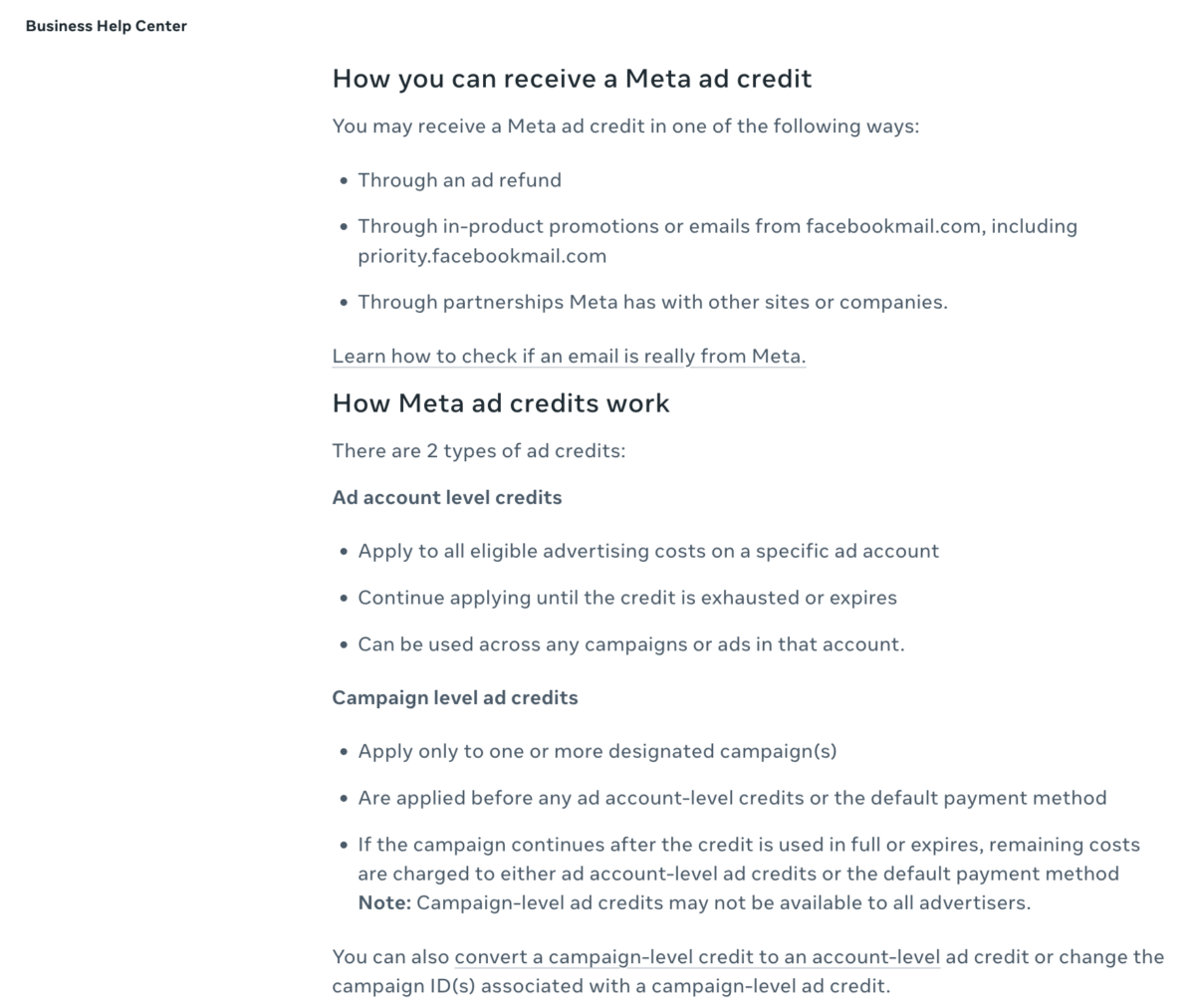
Per Meta’s own documentation, credits come in two flavors: ad account level credits that apply across all campaigns in an account, and campaign level credits that only apply to designated campaigns. Both types pull from the credit balance before charging your default payment method.
The three legitimate ways I’ve seen clients receive credits:
New-advertiser email offers. Meta sends promotional credits to brand-new Business Manager accounts within the first few weeks of setup. The offers appear in your @facebookmail.com inbox or as banners in Ads Manager itself. I’ve watched clients get $20, $30, and $50 credits this way. According to coverage from FounderPass on free ad credit availability, the consistency of these offers has dropped significantly compared to a few years ago, so don’t build a strategy around them.
Hosting and ecommerce platform bonuses. When you sign up for a Shopify, BigCommerce, or specific web hosting account, the welcome package sometimes includes Meta ad credits as a partner perk. Shopify’s own guidance on running Facebook ads with no budget confirms this pattern, though specific bonus amounts vary by partner and quarter.
Larger partner program credits. Meta runs partner programs for businesses adopting specific tools (Conversion API, Reels Ads, Advantage+ Shopping). Per analysis of current ad credit programs from Cropink, partner program credits can range from $200 to several thousand dollars, but they typically require minimum spend matching or integration commitments.
The honest reality: free Meta credits are real, but they’re more like coupons than a viable strategy. If you receive one, take it. If you’re planning a campaign, don’t assume one will arrive.
What Free Tools Can I Use for Facebook Ads?
Several genuinely free tools work with Facebook ads and organic posts: Meta Ad Library for competitive research, Adobe Express and AI generators for creative production, Facebook Creative Hub for previews, and Meta Business Suite for analytics. None require a paid Meta account or ongoing subscription. These tools handle the research, creative, and measurement layers that traditionally cost money.
Make Your Marketing Finally Work Together
My latest book helps small businesses, entrepreneurs, and marketers bring search, email, and social together into one digital marketing strategy that actually compounds.
Drawing on my work as a Fractional CMO, Digital Threads turns complicated tactics into a clear, practical plan you can follow, whatever your budget or team size.
Grab your copy on Amazon and start weaving your own digital threads. Click the cover or the button below to get started.

Meta Ad Library
Meta Ad Library is the single most valuable free tool in Facebook advertising. Every active ad on the platform appears there, searchable by advertiser name, country, and keyword. You can see exact ad copy, creative, run dates, and (for political and issue ads) spend ranges and audience reach.
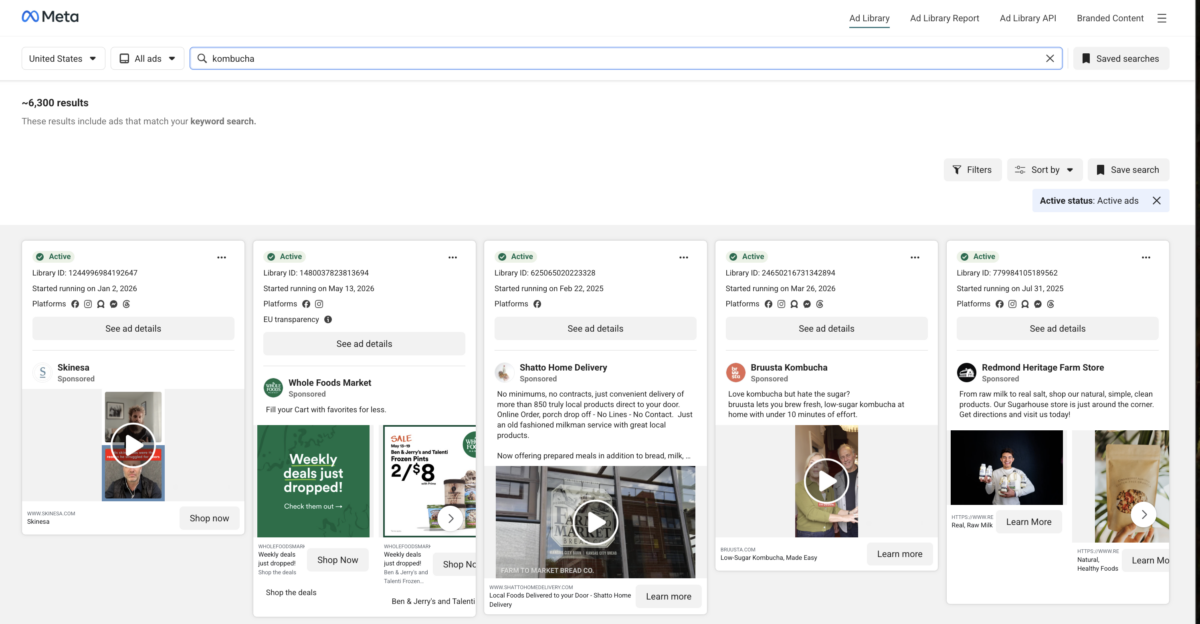
This is the tool I open first when starting any new Meta campaign. Before I write a single line of copy, I want to see what direct and adjacent competitors are running, how long their ads have been live (longevity is the best free signal of profitability), and what creative formats they’ve settled on. For the specific search filters and competitor analysis frameworks I rely on, see my post on researching Facebook competitor ads through Meta Ad Library.
It costs nothing. It requires no account. It just works.
Free Ad Creative Tools
For ad creative, you don’t need a paid Adobe Creative Cloud subscription or a professional designer. I work as an Adobe Express Brand Ambassador and use Adobe Express for most of my own Facebook ad and social creative; the free tier handles single-image ads, carousel cards, short video ads, and Reels-format vertical creative without watermarks. Adobe’s own template library for Facebook ad sizes covers every current placement spec.
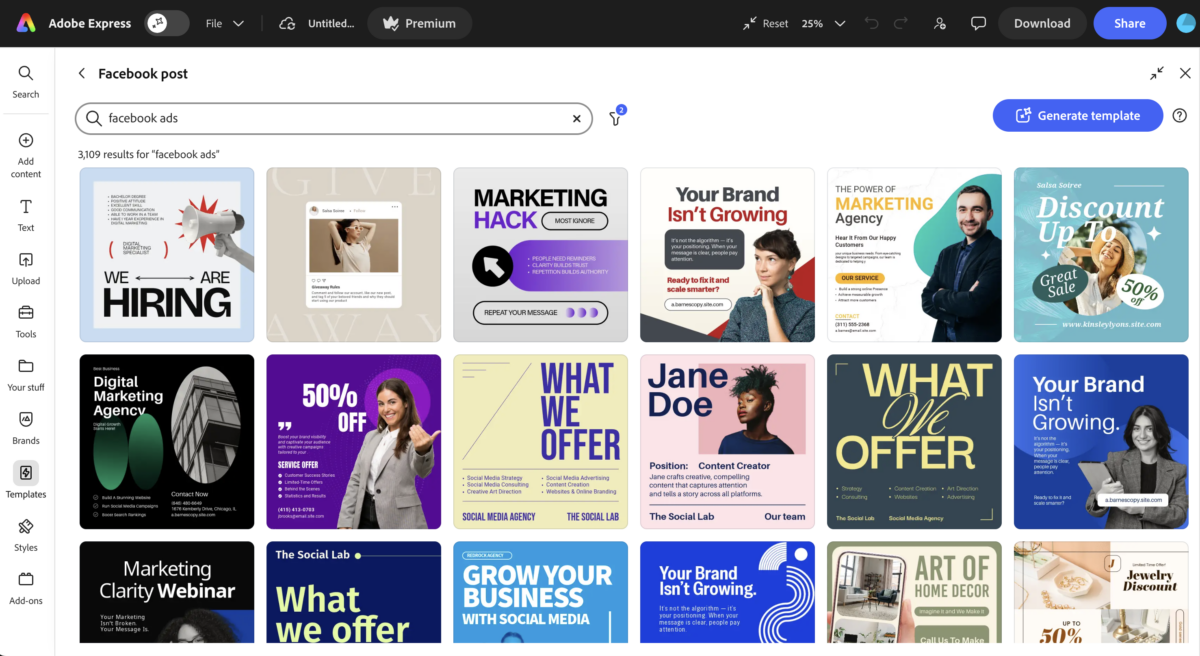
For copy, AI-driven ad generators have closed most of the gap with paid copywriting tools. The specific tools I trust and prompts I rely on appear in my post on AI Facebook post generators, which gets usable first drafts in under 90 seconds.
For ad previews before you spend a single dollar on impressions, Facebook ad mockup tools let you see exactly how your creative will render in news feed, Stories, and Reels placements. Facebook’s own Creative Hub is the most reliable option since the rendering is native.
Facebook Business Suite Analytics
For free measurement, Meta Business Suite includes audience insights, post performance data, and page-level analytics at no cost. The interface is messier than I’d like, but the data is identical to what paid third-party tools surface. If you can read a CSV export, you don’t need a $99/month analytics subscription to run Facebook for a small business.
Can I Promote My Business on Facebook for Free?
Yes, organic Facebook promotion through Pages, Marketplace, Groups, livestreams, and Reels is genuinely free and can drive measurable business results. The constraint is scale: organic reach is limited to a small percentage of your follower base per post, and growing a follower base from zero takes consistent posting over months. Organic works best as a long-term brand-building layer, not a fast-conversion channel.
The framework I use with Fractional CMO clients separates “free promotion” into three tiers based on time investment and realistic outcomes. The table below maps the most common organic paths.
| Free promotion path | Time investment per week | Realistic outcome |
|---|---|---|
| Optimized Facebook Page with consistent posting | 3 to 5 hours | Brand awareness, customer service channel, basic SEO signal |
| Facebook Marketplace listings | 1 to 2 hours per product | Local sales, lead capture for service businesses |
| Active participation in 3 to 5 Facebook Groups | 4 to 6 hours | Authority building, niche lead generation |
| Weekly Facebook Live or Reels content | 6 to 10 hours | Engaged following, content repurposing across platforms |
| Comment engagement and Messenger response | 5 to 8 hours | Conversion lift from warm leads |
A few specifics worth calling out.
Facebook Pages are your foundation. A well-optimized Page is the first thing any prospect checks before buying. The setup specifics appear in how to create a Facebook Business Page, but the short version is: complete every field, use the right CTA button, post consistently, and respond to messages within a day. None of this costs money. All of it compounds.
Facebook Marketplace is underused by service businesses. Most marketers think of Marketplace as a Craigslist replacement, but Meta reports that one in four young adult daily active users in the US and Canada visit Marketplace every day — that’s massive built-in audience attention with explicit shopping intent. The local filter surfaces you to people in your service radius. The visibility is free, the friction is low, and most of your local competition isn’t there.
Facebook Groups remain the strongest organic surface on the platform. How to create a Facebook Group is one approach (run your own), but participating actively in existing Groups your customers already inhabit is often a faster win. According to Sprout Social’s Facebook usage research, Groups continue to generate engagement rates that meaningfully exceed Page posts.
Boosting a post is not free advertising, despite what it looks like. When you click “Boost Post” on an existing Facebook Page post, you’re running an ad. It just hides behind a friendlier interface. The comparison between boosting versus running Facebook ads directly matters because boosted posts are usually the least efficient way to spend an ad budget, even though they feel like the easiest.
Engagement matters more than reach. Posts with comments, shares, and reactions get re-shown by the algorithm; posts that get viewed and ignored disappear. The specific Facebook engagement post formats that consistently outperform are question-based prompts, polls, and contrarian opinions. If you’re going to invest 3 to 5 hours a week in Page content, those formats deliver more than image carousels of your products.
What Most “Free Facebook Ads” Guides Get Wrong
Most posts ranking for “facebook ads for free” make the same three mistakes. They conflate organic posts with ads, they overstate the availability of free ad credits, and they don’t account for the time cost of free strategies. The result is content that technically answers the query but leaves readers with an unrealistic picture of what’s possible without a budget.
Here’s what I see in nearly every competing post on this topic:
Mistake one: calling organic posts “ads.” Page posts, Marketplace listings, and Group participation are organic promotion, not advertising. The mechanics, distribution model, and outcome profile are entirely different. When a guide promises “12 ways to run Facebook ads for free” and then lists “create a Facebook Business Page” as item one, that’s a category error. It misleads new advertisers into thinking organic effort will deliver paid-ad results.
Mistake two: treating ad credits as a reliable strategy. Meta credits exist, but they’re sporadic and small. Businesses that plan around hypothetical credits consistently underinvest in the channels actually driving their growth. Building a marketing plan around “I’ll just use free credits” sets up failure. Credits are nice when they appear; they’re never a substitute for an actual ad budget.
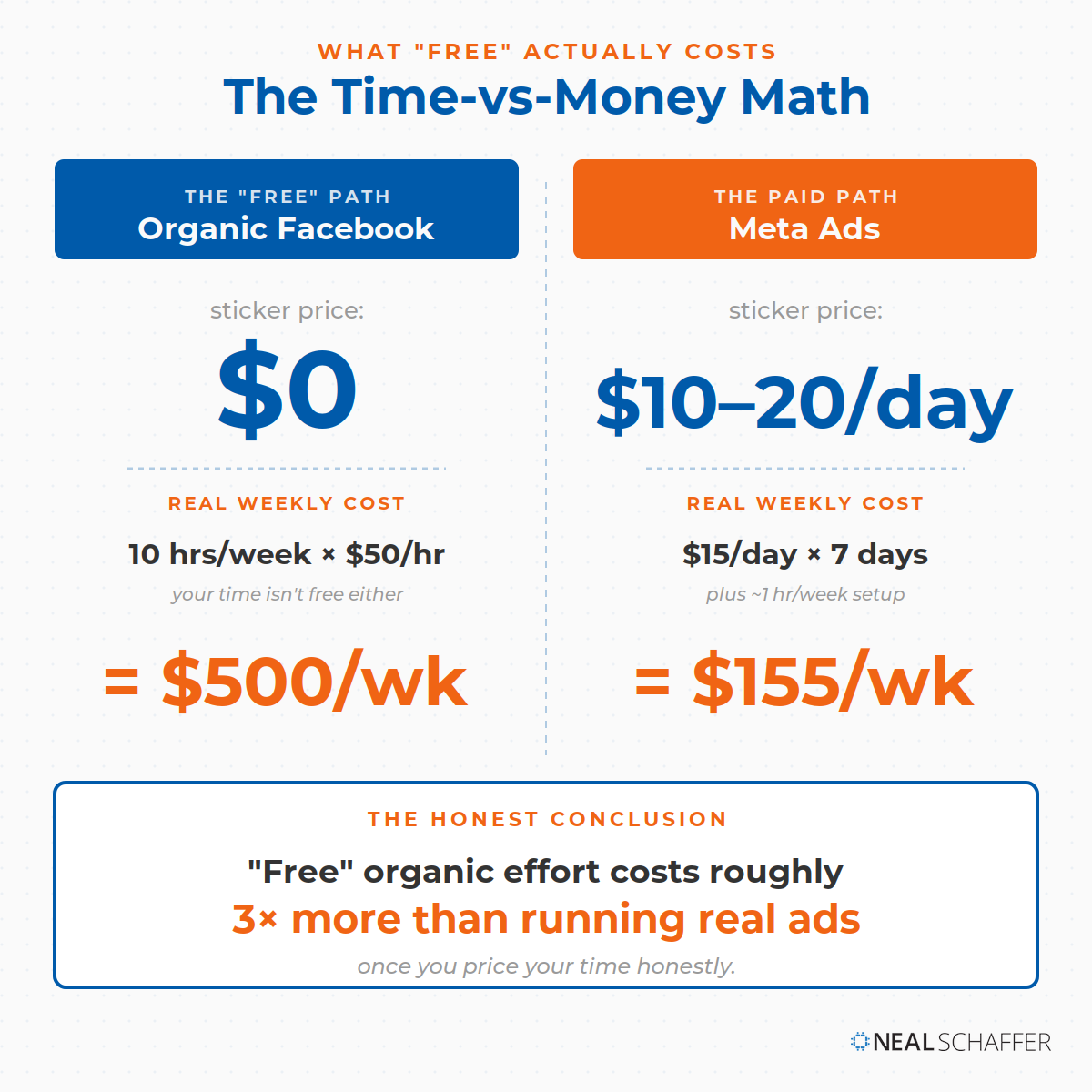
Mistake three: ignoring the time math. Every “free” strategy on Facebook has a labor cost. If you spend 10 hours a week on organic content and your time is worth $50 an hour, that’s $500 a week in opportunity cost. WordStream’s industry benchmark data shows Facebook CPC averages around $1.72 across industries, which means that same $500 buys you roughly 290 targeted clicks. Free is rarely free when you account for the hours.
The honest framing I give clients is: organic Facebook is your brand layer, paid Facebook is your growth lever, and free tools support both. Confusing the categories costs more than the budget you’re trying to save. If search is the other growth lever you are weighing, here is how Facebook Ads vs Google Ads compare on cost and targeting.
When Should You Switch from Free to Paid?
The right time to start paying for Facebook ads is when organic reach has plateaued and you have a validated offer that converts. Specifically: when organic posts drive engagement but not enough sales, when you have a clear customer profile, and when you can spend $300 to $500 over two weeks without needing immediate ROI.
This is the conversation I have repeatedly with Fractional CMO clients who’ve tried to grind organic for too long. In Digital Threads I wrote about the relationship between organic and paid this way:
“Whenever your organic efforts fall short, you always have the option to turn on the water to speed up your efforts with paid media. But your efforts will be even more successful when you first have all your digital bases covered.” – Neal Schaffer, Digital Threads
The water-spigot analogy works because it captures the right sequencing. Organic comes first, paid comes second, and paid amplifies what’s already working rather than substituting for foundational work you skipped.
The other piece worth getting right: paid Facebook ads are not as expensive as new advertisers fear. Realistic budget ranges appear in how much Facebook advertising actually costs, and the short version is that $10 to $20 a day is enough to test most B2C offers and gather meaningful data within two weeks. That’s $140 to $280 over a fortnight, which is less than many small businesses spend on a single round of content creation. Keep your tool stack free at that budget, because the paid platforms in my roundup of AI tools for Facebook Ads only earn their subscription once monthly spend is large enough that trimming a percentage of the waste covers the fee.
If you’re still on the fence about whether ads are worth running at all, whether Facebook advertising actually works for small business covers the ROI cases where it does and the ones where it doesn’t.
FAQ
No, not through Meta Ads Manager. The platform charges for every impression delivered. You can promote your business on Facebook for free using Pages, Groups, Marketplace, Reels, and livestreams, but those are organic posts, not ads. The only way to run a true Facebook ad without paying directly is to use a promotional credit from Meta or a partner.
Typical new-advertiser credits range from $20 to $200 when they appear. Larger amounts are usually tied to specific partner programs or higher-spend commitments. Credits cannot be requested directly. They arrive through email offers, in-product banners in Ads Manager, or as bundled bonuses with hosting and ecommerce platform signups.
Yes, with worse targeting controls. When you click “Boost Post” on a Facebook Page post, you’re creating a paid ad that runs through the same auction as any Ads Manager campaign. The difference is that the Boost interface limits which objectives, audiences, and placements you can configure. For more control over your budget and targeting, run the campaign directly in Ads Manager.
Organic posts appear in the feeds of people who already follow your Page (or who follow people who engage with your post). Reach is limited by your follower base and the algorithm. Ads are paid placements delivered to audiences you specify through Meta’s advertising targeting options, with reach limited only by your budget and bid.
For most small businesses, yes. Free ad creation tools (Adobe Express, AI ad copy generators, mockup previewers) handle 80% of what a designer or copywriter would do for early-stage ad creative. The remaining 20% is testing and iteration, which requires paid ad spend regardless of whether the creative cost money to produce.
Start with Free, Scale with Paid
The path that actually works for small businesses is to use every legitimate free tool, run organic content as your brand foundation, claim any Meta credits that come your way, and treat paid Facebook ads as the growth lever you flip when organic plateaus. The honest math says $10 to $20 a day in ad spend will outperform 10 hours a week of organic effort for most businesses with a validated offer.
If you’re building out your Facebook strategy from scratch and want to understand the full set of organic and paid levers, the latest Facebook statistics for 2026 are the data foundation worth bookmarking. And if you’d like help building a coordinated Facebook strategy that integrates organic, paid, and creative production, download a free preview of Digital Threads or get in touch about Fractional CMO services and I can walk through your specific situation.
For more on Facebook strategy, browse the full Facebook Marketing category covering ad strategy, organic tactics, and tool selection.