
These days, Facebook has made it nearly impossible for businesses to avoid paid advertising. After all, the organic feed is largely excluding content from commercial pages. Unfortunately, this means that it’s tempting for businesses to abandon Facebook completely, rather than give in to the commercial pressures.
However, this may not be a good idea. Facebook still has one of the two largest advertising audiences anywhere: DataReportal put its reported ad reach at 2.39 billion users in April 2026, second only to YouTube. Meta owns Instagram as well, so the same campaign structure reaches both audiences. By taking your business elsewhere, you stand to lose a huge pool of potential customers.
With that said, it’s easy to get off track when formulating your Facebook ads strategy. Simply putting out ads and hoping for the best isn’t advantageous. Instead, it can be a waste of money. Luckily, there are plenty of strategies that you can employ which can be highly successful. Let’s look at a few.
Key Takeaways
✅ Choose your campaign objective before anything else. Facebook gates features behind the objective you pick, so the wrong choice quietly limits what the campaign is allowed to do.
✅ Narrow the audience before you raise the budget. Purchase behavior and life event targeting reach buyers that a broad audience buries, and audience exclusions do as much work as inclusions.
✅ Get retargeting running before you scale cold traffic. Custom Audiences built from Pixel visits and video views reach people who already know you, and Lookalike audiences extend that same signal to new prospects.
✅ Creative decides whether good targeting was worth paying for. Design for a phone screen first, and show people using the product rather than the product sitting on its own.
✅ Most of my client campaigns come down to a few objectives. Traffic and sales account for the bulk of the work I do for clients, with video-view campaigns close behind.
Campaign Objectives
Before you even start choosing an audience or creating content for advertising, it’s important to know why you are running your campaign. This will help you determine the scope of the campaign, in addition to how much budget you’ll need and what kind of content to choose. Knowing your ultimate goal will also make it easier to choose what features you need.
1) Choose your campaign objective wisely
Facebook has spent time making ads manager easier for you to use. But if you don’t choose the right objective, you will be unable to access important features due to the presets that Facebook creates for each objective. Remember, even though Facebook is making it harder to use the organic feed traffic, they still want you to succeed. Combine your Facebook ads strategy with their built-in tools.
Right now, Facebook gives you six campaign objectives in Ads Manager:
- Awareness – Show your ad to the people most likely to remember it. Use this when recall matters more than a click, or when your appeal is broad enough that being seen is the point.
- Traffic – Send people to a destination such as your website, an app, or a Messenger thread. This is the workhorse objective for professional services sites, bloggers, and anyone whose next step happens off Facebook.
- Engagement – Get more messages, video views, post engagement, or event responses. Use it when you want activity around a launch or a community rather than a click through to your site.
- Leads – Collect contact details through an instant form, a call, or a message thread. Especially useful for B2B and professional services brands.
- App promotion – Get people to install your app or take an action inside it. Only relevant if you have an app to promote.
- Sales – Reach the people most likely to buy. It works properly only once you have a conversion event defined in Ads Manager, which makes it the most advanced of the six.
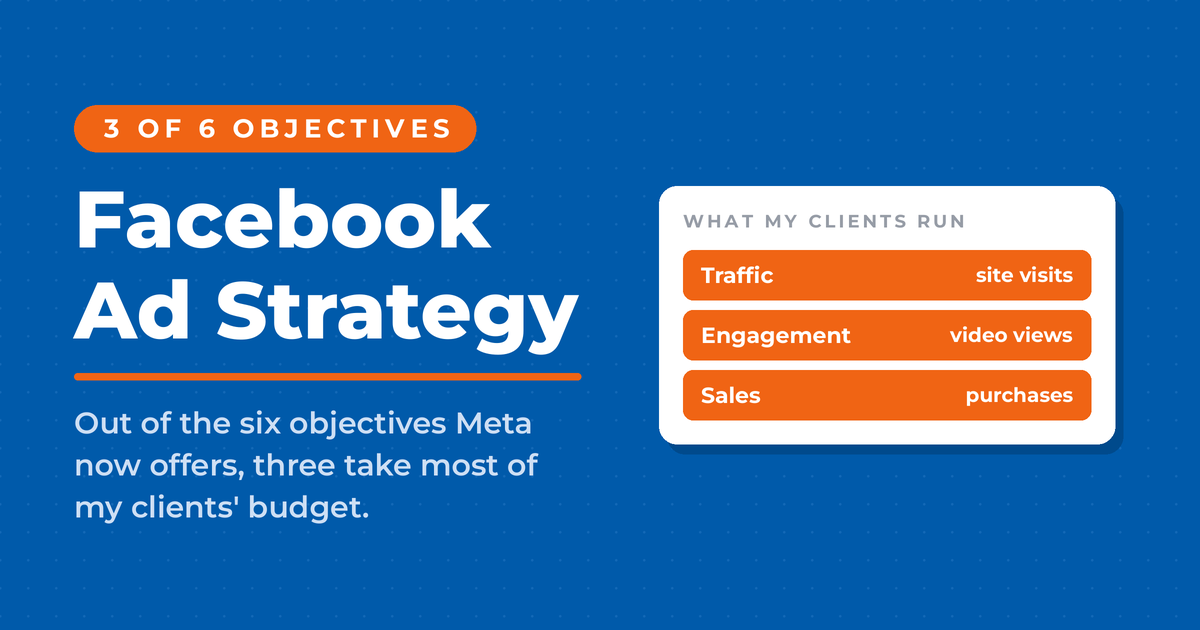
While every company will be different, from my own experience of working with clients, three of the six take most of the budget:
- Traffic, measured on cost per click. My clients pay Facebook to send people to their website, which works especially well for professional services sites, bloggers, and similar.
- Video views. You pay against views rather than against reach, so a video nobody watches costs you very little.
- Sales, measured on cost per conversion. You pay against the conversions the campaign produces, which is why it needs a conversion event defined before it can optimize against anything.
Audiences
Any proper Facebook ads strategy understands the target audience. While it’s sometimes appropriate to send ads out to a wider audience, in most cases you want to tailor your advertising for particular consumer subsets. These can be people that buy-in certain places, or fit any demographic imaginable.
2) Target Purchasers
If you want to attract people to spend money with you, it makes sense that you target people who have displayed purchasing behavior on Facebook. Open Detailed Targeting, click Browse, and open Behaviors. Two branches there are worth your time:
- Purchase behavior, which groups people by what they have actually bought, including purchases made through links on Facebook and purchases the Meta Pixel recorded on other sites.
- Digital activities, which groups people by how they use Meta’s own products, including its payment and shopping surfaces.
3) Target Life Events
One of the coolest things about Facebook is all of the information that people share on their platforms. As a marketer, one of the best ways to tap into this is to leverage Facebook Ads. As part of your Facebook ads strategy, use this info to create campaigns that celebrate and are attractive to those who are experiencing one of the below life events:
- Anniversary: This could be a wedding, engagement, or other similar milestone.
- Birthday: Either for the targeted consumer or someone in their circle, like a spouse or child.
- New Job: Because who doesn’t get new stuff with that new paycheck? It could be something they need, or a treat for themselves.
- New Relationship: When people have a new partner, they often want to express their feelings with cards or gifts, for example.
- Recently Moved: A new home often means a ton of new stuff, from furniture down to storage bins or curtains.
One word of caution, though: No one likes creepy ads that look like you know more about them than they would like. So be aware of that in your ad copy and make it look like the targeting is as natural as possible. Otherwise, you may end up having the campaign backfire.
4) Fine Tune Target Audiences by Narrowing Them
Facebook allows you to choose audiences and equally exclude audiences. Use this to further fine-tune your ideal audience as part of your Facebook ads strategy. For instance, people that have children come in a variety of demographics. If you are selling high-end toys, then posting an ad to parents who are low-income is less likely to get the desired result. Instead, you’d target the higher-income professionals.
5) Leverage Custom Audiences to Retarget
- Retarget web visitors through the Meta Pixel. This is an addition to your website that enables you to buy ads that remind people of your products and services. Some people find them intrusive, but retargeting reaches an audience that already knows you, which is why it usually outperforms cold traffic.
- Retarget engagers of your page engagement (if you have any) or video views. I’d especially recommend this if you’re running a community page, or if boosting traffic is critical to your overall success.
6) Place Faith in the Facebook Algorithm with Lookalike Audiences
Facebook allows you to create a Lookalike audience from any saved or custom audience in your Facebook ads strategy. Use this to your advantage by placing trust in the Facebook Algorithm that it will help you find new customers who are very similar to your current ones. Think of this as the “more of same” approach, such as what you’d see on sites like Amazon for product selection.
Ad Creatives must be creative
How well do you remember the bland ad that doesn’t have much to say? Or that repeats the same old tropes over and over again? Chances are, not very well. While branded taglines or mottoes are expected, you need to ensure that the advertising content is worthwhile to consumers. Otherwise, you won’t be able to get maximum value out of your Facebook ads strategy.
7) Understand your competition using Facebook Ad Library
Leverage Facebook Ad Library to understand your competition and perhaps be inspired. Perusing these sample ads will help you see what other people in your industry are putting out. And, you never know when an advertiser in any industry has a cool idea you’d like to adapt.
8) Think Mobile First in Your Campaign
Most people develop ads on a desktop, but your target users are probably going to see it on a mobile device. Make sure your creative is crystal clear and check how it displays on a phone before deploying. As smartphones and tablets become ubiquitous, you need those ads to look great on any device type, and the safest assumption is that the first view of your ad is a small one.
9) Speak to pain points/emotions
Most of us buy things because of a real or perceived need. This could be basic, such as a new pair of shoes to replace old ones or more luxury-focused like a vacation or piece of jewelry. No matter the reason someone is considering a purchase, the ads that work speak to the feeling behind the need rather than to the specification. Which is to say, if people are attached to your product they’re more likely to buy it.
10) Consider coupons
This suggestion may feel like “that’s what everyone else does,” but there’s a good reason why advertisers do it: it works. Not only do coupons convince people to buy, they also make the purchase feel like a win rather than a cost. Who doesn’t like a good bargain?
11) Show images of people using your product (instead of your product) – or better yet leverage influencer content
Influencer content can be a lot of fun, especially if they do giveaways, contests, or online events. But all kinds of influencer marketing are effective, and Facebook ads are a great way to increase the bang for your buck. Think of ads as a megaphone for the influencer’s message. Especially if you’re working with a micro-influencer, this can be quite valuable.
12) Always test different ad formats: Use video or carousel ads
Static images? Videos? Carousel ads? You won’t know what performs the best until you try the various formats and get some data. Fortunately, this is relatively easy with a combination of Facebook analytics, cookies, and website analytics. You could even throw in some discount codes for good measure. Over time, you’ll see what works well for you. Armed with that information, your ROI should go up. It helps to know the full menu before you start testing, so I walk through all twelve Facebook ad types with their specs and the campaign objective each one suits.
The LinkedIn Playbook for Real Business Growth
My latest book helps professionals, entrepreneurs, and business owners turn LinkedIn from a static profile into a real source of clients and growth.
Maximizing LinkedIn for Business Growth gives you clear, practical steps to build a profile that gets noticed and a network that actually sends business your way.
Grab your copy on Amazon and put it to work this week. Click the cover or the button below to get started.

13) Use campaign budget optimization
To automate the optimization of not just your ads but also ad sets across your campaign for the best results, you should be using Advantage+ campaign budget, which Meta used to call campaign budget optimization. This is smarter than sitting with a calculator and doing guesswork on how much something is going to cost. Plus, it’s a lot less risky if you have a tight budget. Just as consumers love coupon codes and a “good deal,” so do brands (and bean counters). Since this tool is so easy to use, you NEED to try it out.
Additional Advice
Most of the tips above focus on forming and implementing an effective Facebook ads strategy, which sits inside your wider Facebook marketing plan. Here are a couple of other thoughts that can help you be successful, especially in the long term. In particular, they are relevant for multiple campaigns.
14) Create Ad Funnels to engage potential customers at each stage of the funnel with relevant ads
If some Facebook users have never heard of your product, some are aware of it but not customers, and some are customers, consider using Facebook for 3 different campaigns. These should be optimized for people wherever they are in your funnel with the intention of bringing them to the next step. Of course, you should always remember to turn existing customers into brand advocates. A Facebook Group gives those advocates somewhere to gather, and my guide to growing a Facebook Group with ads covers how to run membership as its own campaign.
15) Facebook Ads are a Never-Ending A/B Test
You always need to do A/B tests and consider Facebook Ads part of a grand experiment to always strive for the best results. Not only will your audience change over time, but so do consumer tastes and attitudes. World events, politics, and even ordinary trends will alter what people respond positively or negatively to. What worked for you last quarter is a hypothesis this quarter, not a settled answer.
Frequently Asked Questions About Facebook Ads Strategy
Start with one objective, one narrow audience, and a small daily budget you are willing to lose while you learn. Small businesses waste money by running several campaigns at once before they know which audience responds, so prove one combination works and then scale that single winner. My guide to Facebook for small business covers how that first campaign fits into everything else you do on the platform.
Choose the objective that matches the action you want, not the one that looks cheapest. Traffic works for professional services sites and blogs, conversions works once you have a conversion event defined in Ads Manager, and awareness makes sense only when you genuinely need reach rather than response. The objective also determines which optimization features Facebook makes available to you.
Enough to gather data, which usually means a small daily budget running long enough for the algorithm to exit its learning phase rather than a large one-week burst. Budget is less about the total number than about giving each ad set enough consistent spend to be optimized. I break the variables down in my guide to Facebook ads cost.
Yes, and for most businesses they are now the primary way to reach a Facebook audience at any scale. Organic reach for business pages keeps shrinking, which means paid distribution is doing work the news feed used to do for free. The current Facebook statistics show how much audience is still there to reach.
Install the Meta Pixel, let it collect visitor data, then build a Custom Audience from that traffic and run a separate campaign against it. Retargeting audiences convert differently from cold audiences, so give them their own creative and their own offer rather than recycling the ads that brought people in. My guide to Facebook ads retargeting walks through the setup.
Usually the problem is the creative or the audience rather than the budget. Check whether the ad is readable on a phone, whether the audience is broad enough to exit the learning phase, and whether the objective matches the action you are measuring. If nothing is being delivered at all, my post on a Facebook ad not delivering covers the usual causes.
Putting Your Facebook Ads Strategy to Work
Having a proper Facebook ads strategy is vital for getting the best ROI, especially in an era where business Facebook pages don’t get much access to the organic feed. Fortunately, with effective ads management, you can reach customers more efficiently than ever. Best of all, because Meta owns both Facebook and Instagram, you can plan and manage campaigns across both platforms from one place. If you would rather hand that management to a specialist than build it in house, I have vetted a shortlist of Facebook ad agencies with a visible track record in paid social.