

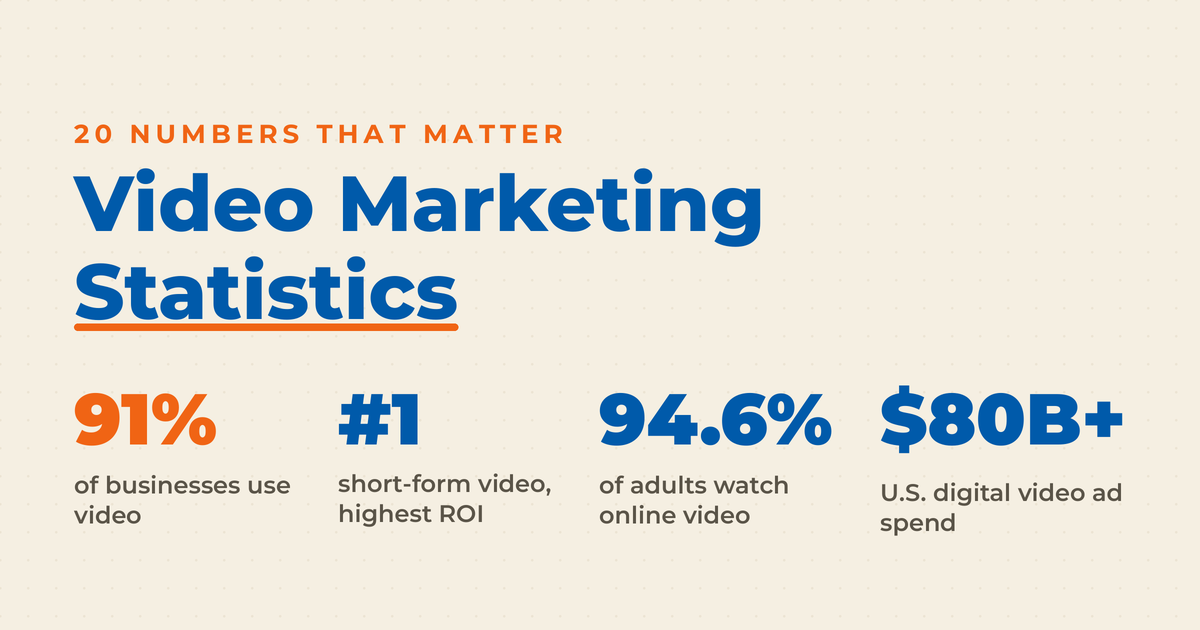

In 2026, 91% of businesses use video as a marketing tool, and the content formats marketers rank highest for return on investment are all video. That makes video less a question of whether and more a question of how. After years advising companies as a Fractional CMO, the pattern I see most is teams treating video as a someday project when the market has already moved on without them.
The 20 numbers below show where video marketing stands in 2026, each traced to the primary source behind it. They cover adoption, ROI, how much people watch, what wins on which platform, how long videos should run, and where the ad money is going.
Key Takeaways
✅ Video is standard, not optional. 91% of businesses use video in 2026, and the formats marketers rank highest for ROI are all video.
✅ Short-form leads on return, not just reach. Marketers rank short-form video the highest-ROI media format, with 48.6% putting it in their top three.
✅ Watching video is nearly universal. 94.6% of online adults saw online video over the past month, and it led all weekly media use worldwide.
✅ Platform changes what wins. Format preference shifts by platform, so the same video does not perform the same on YouTube, X, and LinkedIn.
✅ Length is a value decision. Videos under a minute hold the highest engagement rate, but genuinely useful longer videos still earn watch time.
✅ The money is following the audience. U.S. digital video ad spend is set to pass $80 billion in 2026, and streaming now takes nearly half of U.S. TV viewing.
How many businesses use video marketing in 2026?
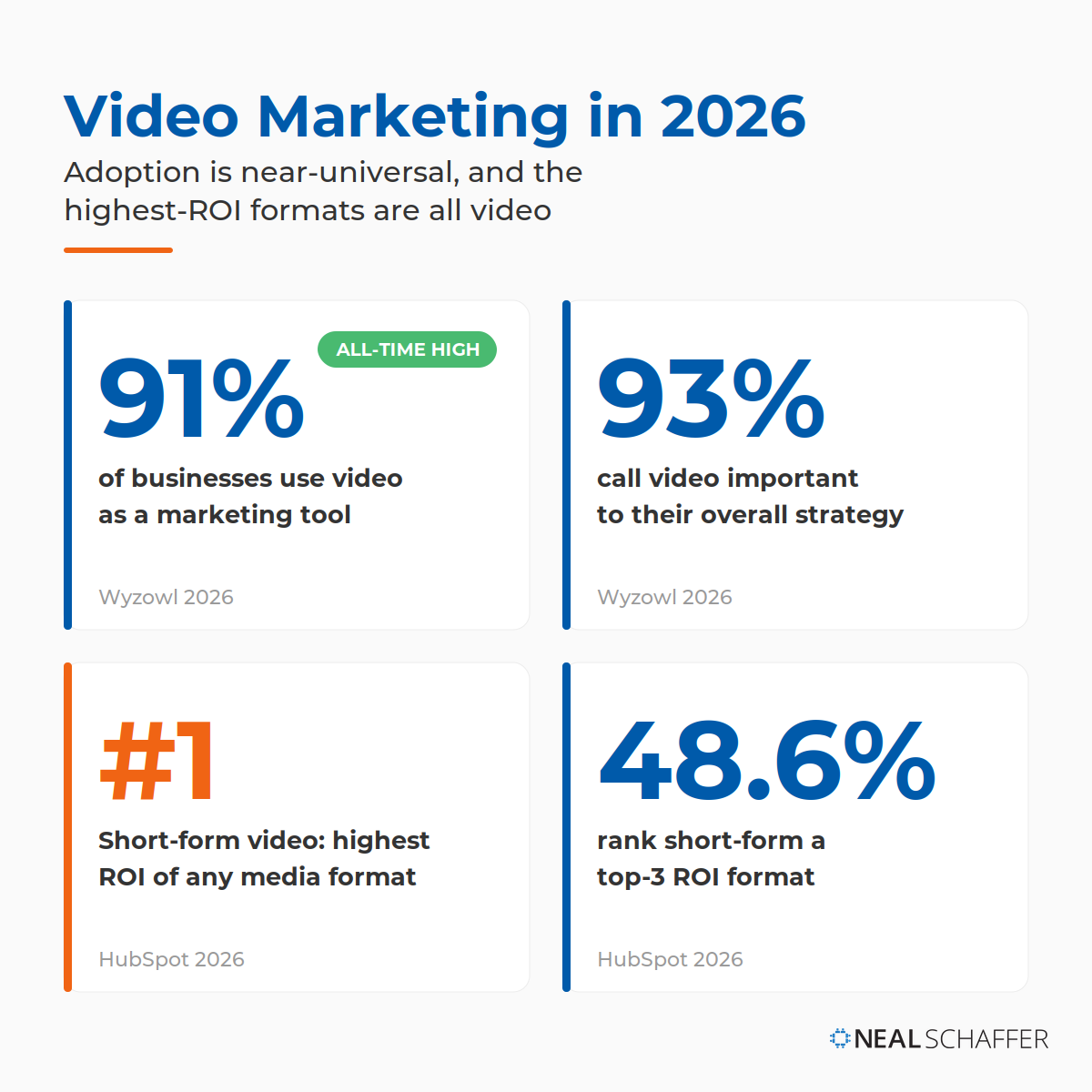
Yes, video is now standard. In 2026, 91% of businesses use video as a marketing tool, an all-time high, and marketers rank short-form video as the highest-ROI media format they produce. The question has shifted from whether to use video to how to produce it well enough to earn that return.
| Video marketing in 2026 | Figure |
|---|---|
| Businesses using video | 91% |
| Marketers calling video important to strategy | 93% |
| Short-form video ROI rank | Highest of any media format |
| Marketers ranking short-form a top-3 ROI format | 48.6% |
Sources: Wyzowl 2026; HubSpot State of Marketing 2026.

1. 91% of businesses use video as a marketing tool in 2026
Wyzowl’s 2026 research puts the figure back at an all-time high, recovering after a small dip in a prior survey. Adoption has hovered near nine in ten for years now, which tells you video stopped being an experiment a long time ago. When this many companies are already publishing, being absent is the anomaly that costs you, not the investment.
What this means for you: the competitive question has shifted from whether to use video to whether yours is good enough to stand out in a feed where almost every competitor is already there.
2. 93% of video marketers consider video important to their strategy
Wyzowl’s 2026 State of Video Marketing survey records near-universal agreement on video’s value, a conviction that has stayed high year after year rather than cresting and fading like a trend. The marketers closest to the results are the most convinced, which is usually a signal worth trusting.
What this means for you: if the people running video keep saying it works, treat skepticism as the riskier position. The doubt that keeps video at the bottom of the plan is the expensive mistake.
3. Short-form video is the highest-ROI format, with 48.6% ranking it top three
HubSpot’s State of Marketing Report ranks short-form the top-performing media format of 2026, ahead of every other type marketers produce. That is the number that should move budget. Reach and views are easy to chase, but ROI is what justifies next quarter’s spend, and short-form is where marketers say the return actually shows up.
What this means for you: if you are deciding where to put limited production hours, start with short-form video and build it into a habit your team can keep rather than a one-off.
How much video are people watching in 2026?
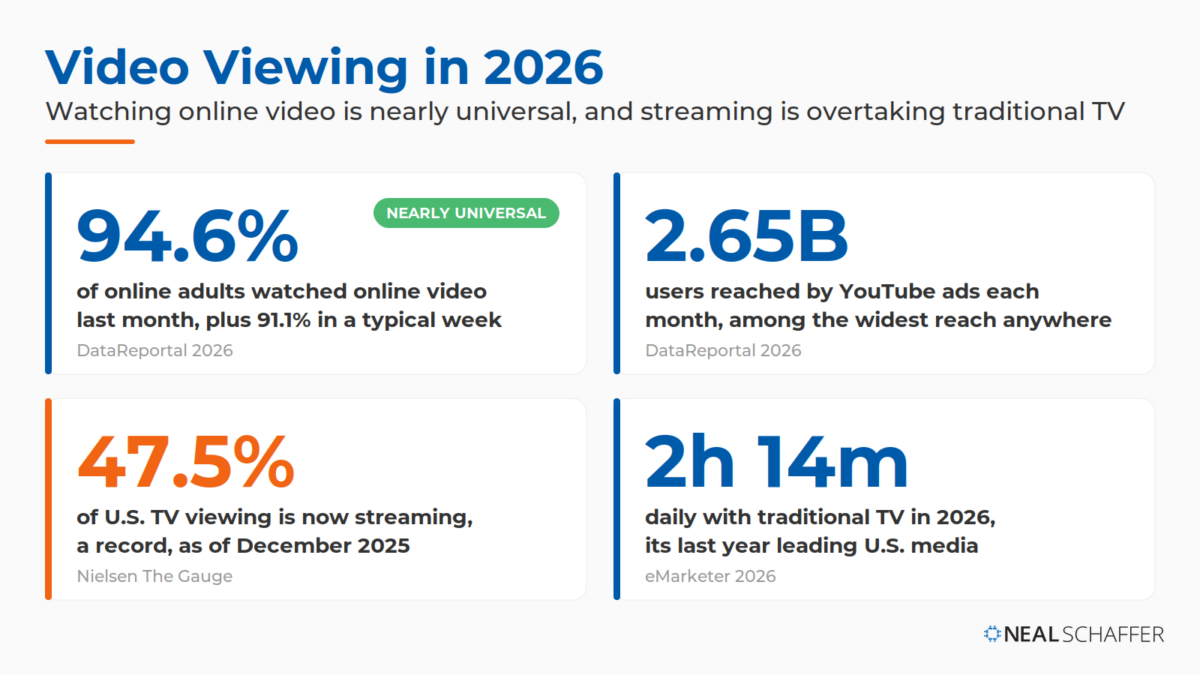
Almost everyone. In 2026, online video reached 94.6% of online adults over the prior month and topped weekly media use worldwide. Time is shifting fast: 2026 is the last year traditional TV leads U.S. media activity before digital video overtakes it, and streaming has already taken nearly half of all U.S. television viewing.
4. Online video reached 94.6% of online adults in the past month
DataReportal’s Digital 2026 Global Overview found 91.1% tuned in during a typical week, more than any other media activity it tracks. Watching video is effectively universal among people who are online at all, which removes the old worry about whether your audience will watch.
What this means for you: the barrier is no longer attention to the medium, it is attention to your video specifically. You are competing for time, not introducing people to a format they have never used.
5. US adults will spend just 2 hours 14 minutes a day with traditional TV in 2026
eMarketer calls 2026 the last year linear TV leads US media use before digital video overtakes it for good. The decline is gradual but one-directional, and the audience that left did not stop watching, it moved to YouTube, streaming, and social feeds.
What this means for you: a plan that still assumes TV is where the eyes are is chasing an audience that already relocated. The reach you used to buy on a TV schedule now lives on the platforms in this report.
6. YouTube’s ads reach about 2.65 billion users a month
DataReportal puts that among the widest reach of any platform in 2026, which is why YouTube anchors most serious video strategies. Reach at that scale concentrates on a handful of platforms, and this is the biggest of them.
What this means for you: with reach this wide, YouTube is the closest thing to a default for broad video distribution, so for most brands the question is how to use it well rather than whether to be there. There is more on its audience in these YouTube statistics, and it is worth settling the is YouTube social media question early, because the answer changes where this content lives in your plan.
7. Streaming captured a record 47.5% of US TV viewing in December 2025
Nielsen’s The Gauge logged it as an all-time high for streaming’s share of the television screen, the clearest sign yet that the living-room audience and the online-video audience are converging. The TV set is increasingly just another screen for the same on-demand, ad-supported video people watch everywhere else.
What this means for you: connected TV is no longer a separate, niche buy. The same video creative and the same logic that work on YouTube increasingly apply to the biggest screen in the house.
The LinkedIn Playbook for Real Business Growth
My latest book helps professionals, entrepreneurs, and business owners turn LinkedIn from a static profile into a real source of clients and growth.
Maximizing LinkedIn for Business Growth gives you clear, practical steps to build a profile that gets noticed and a network that actually sends business your way.
Grab your copy on Amazon and put it to work this week. Click the cover or the button below to get started.

Why does short-form video perform best?
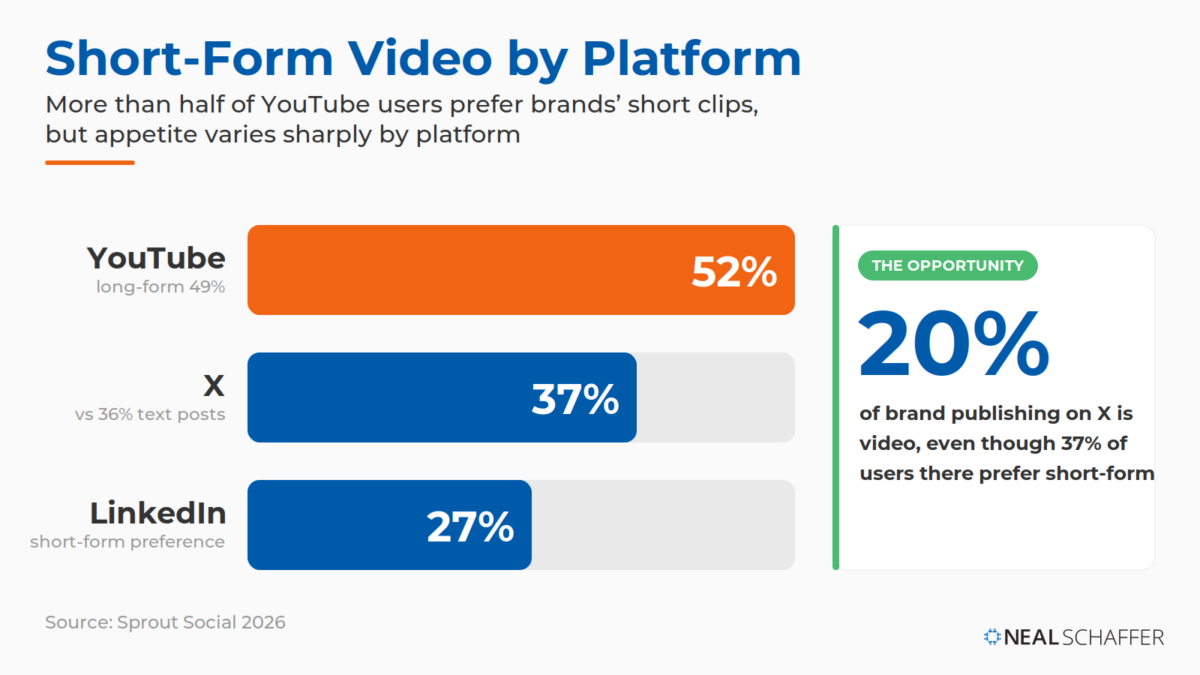
Short-form video performs best because it matches how people watch and because marketers see it pay back, posting the highest ROI of any format. Appetite varies by platform: more than half of YouTube users prefer brands’ short clips, while preference is narrower on X and lower on LinkedIn. The same clip does not land the same everywhere, so format choice is per-platform.
| Platform | Share most likely to engage with brands’ short-form video (2026) |
|---|---|
| YouTube | 52% (long-form close behind at 49%) |
| X | 37% (ahead of text posts at 36%) |
| 27% |
Source: Sprout Social 2026.
8. 52% of YouTube users are most likely to engage with brands’ short videos
Sprout Social puts X at 37% and LinkedIn at 27% on the same measure in 2026, with long-form close behind short-form on YouTube at 49%. Short-form leads, but the gap between formats shifts by platform, so the same clip does not land the same way on each.
What this means for you: match the format to the platform instead of assuming short-form wins everywhere. On YouTube, long-form sits just behind short at 49%, so it is worth keeping in the mix, while brand-video appetite runs lower on X and LinkedIn. If you produce in-house, an online video editor makes it realistic to cut one shoot into the different formats each platform rewards.m, so the same clip does not land the same way on each.
9. Video is just 20% of brand publishing on X
Sprout Social’s 2026 video data shows that gap even though 37% of users there are most likely to engage with short-form video. Demand is outrunning supply on the platform, which is exactly the kind of imbalance that rewards brands willing to show up before everyone else does.
What this means for you: everyone is producing far more video than a year ago, so volume alone no longer sets you apart, and a lot of good video disappears after a few days in the feed. Treating video as part of search rather than separate from it is how that work keeps paying off, which is the point of video marketing SEO.
How long should a marketing video be?
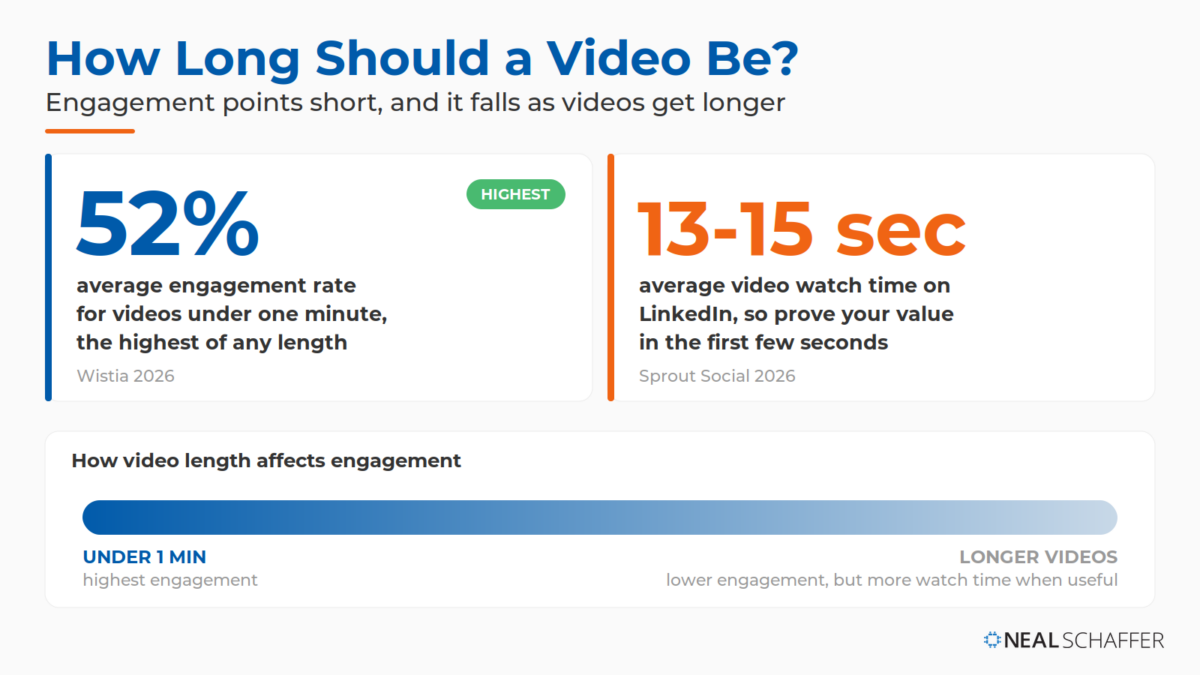
There is no single right length, but engagement points to a clear starting point. Videos under one minute hold a 52% average engagement rate, the highest of any length, meaning viewers typically watch about half. Engagement falls as videos get longer, though longer videos still earn more watch time when the content is useful, so length is a decision about value.
10. Videos under one minute hold a 52% average engagement rate
Videos under a minute average a 52% engagement rate, the highest of any length in Wistia’s analysis of video length, meaning viewers typically watch about half of a sub-minute video. Engagement falls steadily as videos get longer, though genuinely useful longer videos still earn more total watch time, so length is a value decision rather than a fixed rule.
What this means for you: keep it short unless every extra minute is genuinely useful. This is where YouTube Shorts help, because they force the discipline of saying something useful immediately, which is good practice even for your longer content.
11. The average video watch time on LinkedIn is just 13 to 15 seconds
Sprout Social reports that narrow window in 2026, which tells you the first few seconds decide everything on the platform. On a feed where attention is measured in seconds, a slow open is the same as no view at all, no matter how strong the rest of the video is.
What this means for you: front-load the value. Lead with the point, the hook, or the payoff, and treat the opening two seconds as the most important production decision you make.
What types of video are marketers making, and where do they share them?
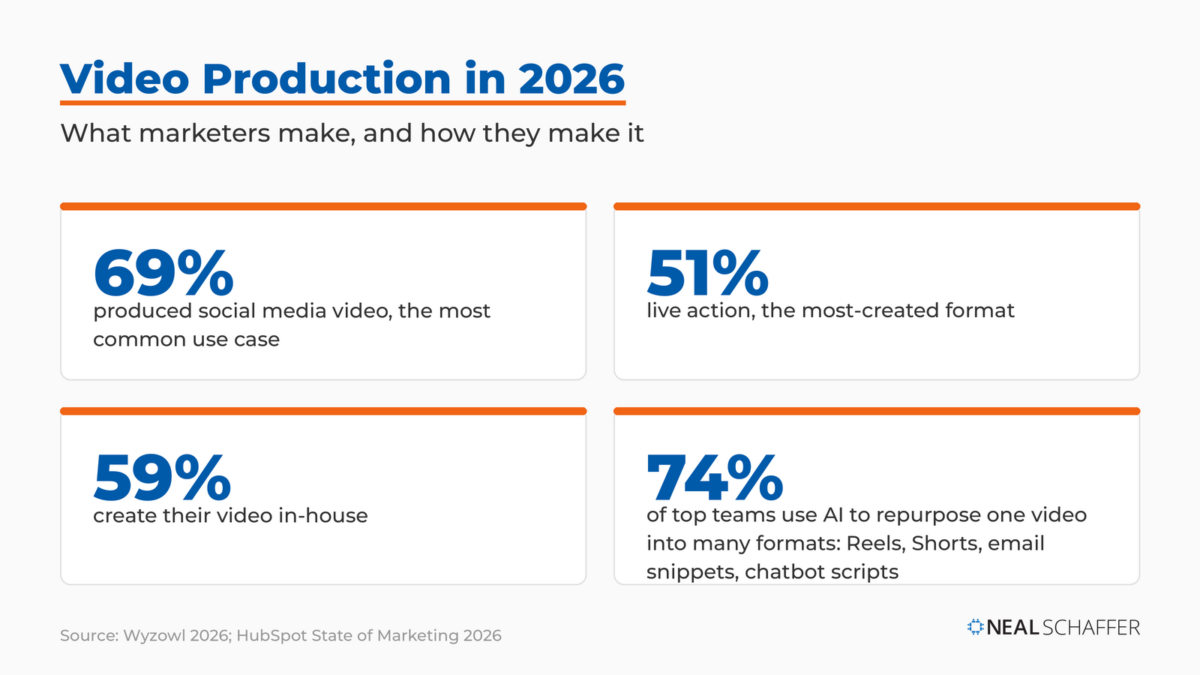
Social media video leads. In 2026, 69% of video marketers produced social media videos, the most common use case, and live action remains the most-created format. Teams are making more video on flat budgets. B2B teams increasingly make LinkedIn their first place to publish. And AI now handles much of the repetitive production work that used to need a full team.
| Most-created video formats (2026) | Share of video marketers |
|---|---|
| Live action | 51% |
| Animated | 23% |
| Screen recorded | 19% |
Source: Wyzowl 2026.
12. 69% of video marketers created social media videos in 2026
Wyzowl’s 2026 study makes social video the most popular use case by a wide margin, with live action the most-produced format at 51%. The center of gravity has moved from polished one-off productions toward the steady, social-first output that feeds always-on channels.
What this means for you: if you can only resource one kind of video, social-first live action is where the most marketers are putting their effort, and the format that travels across the most platforms with the least reworking.
13. 59% of video marketers create their video in-house
Wyzowl reports 10% use outside vendors and 32% a mix, a balance that has tilted steadily toward in-house as cameras, editing, and AI tools got cheaper and easier. Production that used to require an agency now fits inside a marketing team.
What this means for you: you almost certainly have more in-house capability than you think. The barrier to consistent video is rarely budget anymore, it is having a repeatable process and someone who owns it.
14. 74% of top-performing teams use AI to turn one video into formats for every channel
HubSpot’s State of Marketing 2026 report found that 74% of top-performing teams use AI to repurpose a single video into Reels, Shorts, email snippets, and chatbot scripts. The same teams treat their channels as one connected system rather than separate silos, which is why squeezing more out of each asset pays off.
What this means for you: AI earns its keep on the unglamorous middle of production, taking one good shoot and stretching it across every platform you publish on. Pointed at that grunt work, it is what makes a realistic, sustainable video cadence possible for a small team.
15. 8 in 10 B2B teams name LinkedIn their primary place to share video
Wistia’s State of Video Report puts LinkedIn ahead of YouTube as the first place B2B teams publish video in 2026, a notable shift for a platform that was text-and-image first for most of its life. For B2B audiences, the professional context now outweighs YouTube’s raw reach.
What this means for you: if you sell to businesses, LinkedIn deserves first consideration for video, not an afterthought repost. Plan the cut for that feed first, then adapt it elsewhere.
16. 76% of companies make at least one video a month
Wistia’s 2026 State of Video Report, which surveyed more than 900 professionals across industries, found monthly and weekly cadences are now the norm as teams settle into a sustainable rhythm. Companies produced more video in 2025 than in prior years, yet only 40% plan to spend more this year while 46% are holding budgets flat. Output is rising faster than budgets, which is what in-house teams and AI tools make possible.
What this means for you: everyone is producing far more video than a year ago, so volume alone no longer sets you apart, and a lot of good video disappears after a few days in the feed. Treating video as part of search rather than separate from it is how that work keeps paying off, which is the point of video marketing SEO.
How big is the video advertising market in 2026?
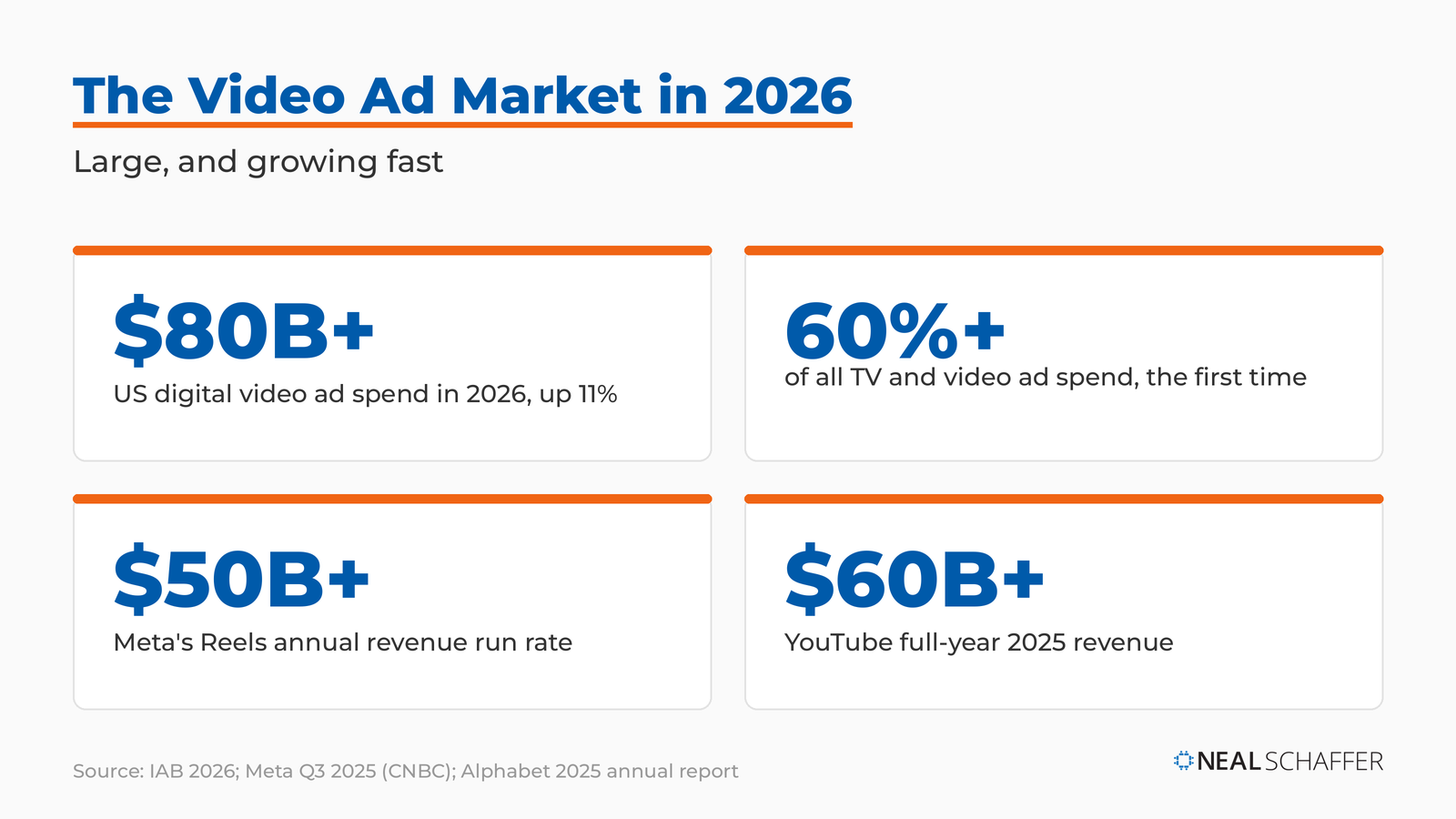
It is large and growing fast. US digital video ad spend is projected to surpass $80 billion in 2026, more than 60% of all TV and video ad spend for the first time. Social video is now the fastest-growing slice. Individual platforms show the scale, from Meta’s Reels passing a $50 billion run rate to YouTube clearing $60 billion in yearly revenue.
| U.S. digital video ad market (2026) | Figure |
|---|---|
| Total digital video ad spend | More than $80 billion (up 11%) |
| Share of total TV/video ad spend | More than 60% (first time) |
| Meta’s Reels annual revenue run rate | More than $50 billion |
| YouTube full-year revenue (2025) | More than $60 billion |
Sources: IAB 2026; Meta Q3 2025 earnings (via CNBC); Alphabet 2025 annual report.
17. US digital video ad spend is projected to surpass $80 billion in 2026
The IAB has it growing faster than the overall ad market, which is the clearest possible signal of where advertiser confidence sits. Budgets follow attention, and attention moved to video years ago, so the spend is now catching up to where the audience already went.
What this means for you: the money validates the medium, but it also means more competition for the same eyeballs. Rising spend rewards brands that treat video as a measured, ROI-driven channel rather than a vanity exercise.
18. Digital video will exceed 60% of all US TV and video ad spend for the first time in 2026
The IAB’s 2026 video ad report marks it as a genuine tipping point, with digital video now taking the majority of every dollar spent across TV and video combined. Inside that shift, social video is growing faster than connected TV for the first time, which tells you where the new money is heading.
What this means for you: a plan that still treats digital video as the challenger and linear TV as the default is a year behind the budgets. The majority position flipped, and your media mix should reflect it.
19. Meta’s Reels reached an annual revenue run rate above $50 billion
Meta CEO Mark Zuckerberg said on the company’s third-quarter 2025 earnings call that Reels had passed an annual revenue run rate of more than $50 billion, as CNBC reported. Reels is Meta’s short-form video format across Facebook and Instagram. More than half of all Instagram ads ran on Reels in 2025, up from 35% the year before.
What this means for you: the fastest-growing money in digital video is flowing into short-form. If you are already making vertical clips for organic reach, you are creating in the exact format advertisers are backing hardest. That format deserves real budget and real measurement, not an afterthought.
20. YouTube’s revenue surpassed $60 billion for full-year 2025
Alphabet’s 2025 annual report broke out YouTube’s annual revenue for the first time, combining ads and subscriptions to clear $60 billion. That single disclosure shows how central video has become to the company’s story, and it puts YouTube ahead of Netflix’s full-year revenue.
What this means for you: the creator side of that same economy starts from these numbers, which is the foundation for understanding how much YouTubers make and why the creator partnerships in your plan keep getting more expensive.
Frequently asked questions
Yes. 91% of businesses use video, an all-time high, and marketers rank short-form video as the highest-ROI media format they produce. Adoption is high, but the ROI ranking is the reason it should drive budget decisions rather than sit at the bottom of the list.
It depends on the goal. Short-form video has the highest average engagement rate and is the most-used, highest-ROI format marketers report. Long-form earns more total watch time when the content is genuinely useful, so most businesses should start with short-form for reach and add long-form where depth creates value.
Start under a minute. Videos under one minute hold the highest average engagement rate, and engagement falls as length grows. Go longer only when every extra minute is useful, and prove your value in the first few seconds regardless of length.
Start where your audience already engages with video. YouTube has the widest reach and strong short-form engagement, but format preference shifts by platform, so test rather than assume. YouTube users lean toward short-form, X users narrowly prefer video over text, and LinkedIn engagement with short-form is lower but climbing.
Put These Video Marketing Statistics to Work
REPLACE: The 2026 data points one way. Video is the default, short-form leads on return, watching is nearly universal, and the winning move is matching format and length to each platform instead of posting the same clip everywhere. None of that needs a big budget. It needs a plan and the discipline to keep going. The same patterns show up across the wider field of social media marketing statistics. If you want help building video into a marketing system that ties back to revenue, I work with companies as a Fractional CMO on exactly this kind of strategy. If you would rather build it yourself, the free preview of Digital Threads lays out how video fits alongside the rest of your digital marketing.





This is great information Neal. Thank you. One thing – I don’t think TV get enough credit for driving traffic to find these video’s on other platforms. That’s been the case since the Internet came to be. I’d love to know your thoughts on this as I don’t believe broadcast or cable TV will be going away, and a very important criteria often overlooked is quality control – brands need to be hyper cautious of the content (other than their own website or social pages) where their video shows up. It’s the wild west and there’s a ton of questionable content you would not want to be associated with. TV has rules and supposed to enforce truth in advertising.
Hey Brad, indeed, TV is still around and is still a place for video marketing. My post is about video marketing, both organic and paid, and not just paid. For paid video advertising, TV is still where companies are spending money, but video ads on YouTube as well as social media are definitely catching up. It is up to the social media sites to put those quality controls in place, and I know that YouTube has been focusing on this over the last few years…
Great tips! Thanks for sharing, Neal. We should try these video marketing strategies especially in this time of the pandemic.
Indeed Katrina! This is a great time for both content development and engaging with others to build relationships because we never have enough time to do so. Please stay safe out there!
Much more to agree! You too, Neal. Stay safe and healthy!