Editorial Note: I may earn a commission when you visit links that appear on my website.
How to Start a Podcast in 2026: A Marketer’s AI-Powered Playbook for Building Authority and Pipeline
After more than 400 episodes of Your Digital Marketing Coach, I can tell you the single most underrated reason to start a podcast in 2026: it is the most efficient business development tool I have ever used. Yes, you get a content library. Yes, you build authority. But the real magic is sitting across from prospects, future collaborators, and influencers, and getting a 30-minute conversation that no cold email or LinkedIn connection request could ever buy you.
Most “how to start a podcast” guides treat this as a creative hobby. They walk you through microphones and hosting plans and assume the goal is downloads or someday getting a sponsorship that will pay pennies compared to the time you invested. This guide is different. I am writing it as a marketer for marketers, consultants, agency owners, fractional executives, B2B operators, and any entrepreneur who wants their content to do real business work. And because I have been podcasting long enough to remember when AI had nothing to offer this medium, every step below includes the AI workflow I would actually use if I were starting over today.
For context on how much has changed, here is a video I made years ago using a hosting provider that no longer exists. The mechanics of starting a podcast in 2026 are completely different, and I will explain why throughout this guide. I’m Neal Schaffer, and everything below reflects what I have personally tested over years of running an interview-heavy business podcast, not theory pulled from other people’s guides.
Key Takeaways
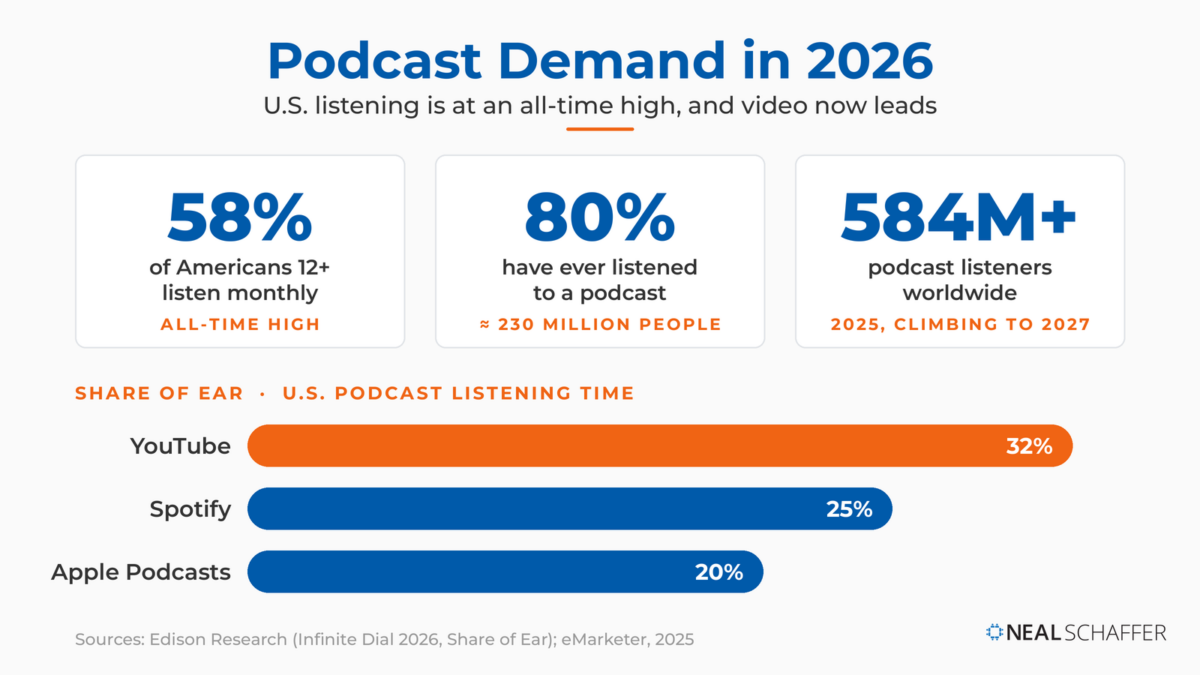
✅ Podcasting in 2026 is at peak demand. According to Edison Research’s Infinite Dial 2026, 58% of Americans 12 and older are now monthly podcast listeners, an all-time high, and 80% have ever listened to a podcast.
✅ The marketer’s case beats the creator’s case. A podcast that helps you meet 50 ideal-client guests in a year is worth more than one with 10,000 anonymous monthly downloads.
✅ AI changes the calculus at every stage. Concept testing, scripting, recording cleanup, editing, transcription, show notes, repurposing, and translation are all faster and cheaper than they were two years ago.
✅ YouTube now dominates the listening surface. Edison’s Share of Ear data shows 32% of U.S. podcast listening time happens on YouTube, ahead of Spotify (25%) and Apple Podcasts (20%). Plan video from day one.
✅ One episode should produce a week of content. A repurposing workflow turns each interview into a blog post, an email, multiple short clips, and a LinkedIn thread, which is how a podcast pays for itself in attention.
Why Start a Podcast in 2026?
A podcast is the most strategically flexible content asset a business owner can build in 2026. It compounds authority through evergreen audio, generates relationships at scale through guests, feeds your other channels through repurposing, and creates a permanent record of your thinking that AI search engines can cite. Demand is at record highs and AI has collapsed the production cost.
The demand side is clear. Edison Research’s Infinite Dial 2026 reports that 80% of Americans 12+ (about 230 million people) have ever listened to or watched a podcast, with 58% now listening monthly. The broader podcast industry statistics I track show the same trend globally, with eMarketer projections putting worldwide listenership above 584 million in 2025 and climbing through 2027.

But the supply-side reality matters too. The barrier to entry is the lowest it has ever been because AI has collapsed the production cost. Tasks that used to require a producer, an audio engineer, and a social media manager (cleaning up audio, generating show notes, cutting clips, writing promotional copy, transcribing for SEO) can now be handled by one person with the right tools. The number of marketers who could profitably run a podcast in 2024 was small. In 2026, that number is anyone with strategic clarity and 90 minutes a week.
What makes a podcast unique among content formats is that it is the only one where the act of producing content also produces the relationships that drive your business. When I made 100 guest appearances during the launch of The Age of Influence, every appearance was a relationship investment as much as a marketing one. When you run your own show, that dynamic compounds in the other direction. Every guest is a conversation with someone you wanted to meet anyway, and now you have a recorded asset that thanks them publicly.
What Do You Need to Start a Podcast?
At the most basic level, you need a clear concept, a USB microphone, recording software, an audio editor, podcast hosting, and a distribution plan. Upfront cost can be under $200 if you already own a computer and headphones. Harder to put on a shopping list: sustaining material and a workflow that does not eat more time than the podcast returns.
Here is the lean starter stack I would recommend to any marketer launching in 2026:
| Category | Tool | Cost | Notes |
|---|---|---|---|
| Microphone | Samson Q2U or Shure MV7 (the one I use) | $70–$290 | USB. Plug-and-play. Good enough for years. |
| Recording (remote) | Riverside or Zoom | Free–$24/mo | Records each guest locally. Built-in AI cleanup. |
| Editing | Riverside or Descript | Free–$24/mo | Edits audio by editing the transcript. Massive time saver. |
| Hosting | Buzzsprout | Free–$15/mo | What I use. Auto-transcripts included on paid plans; CoHost AI is a paid add-on for show notes and chapters. |
| Cover art | Adobe Express | Free–$10/mo | Templates plus AI image generation. |
| Show notes & repurposing | ChatGPT or Claude | Free–$20/mo | Drafts show notes, episode descriptions, social posts. |
That table is the entire starter stack. You do not need a $400 microphone, a sound-treated room, or a video studio to start. You can add those later if the podcast earns the investment. I actually started my own podcast speaking into my iPhone using the Voice Memos app, then “upgraded” to a $50 Sony IC recorder. I only invested in a better mic after a hundred episodes, once I had seen the ROI. That said, if I were doing it again, I would start with a minimum-quality mic like the Samson I recommend above.
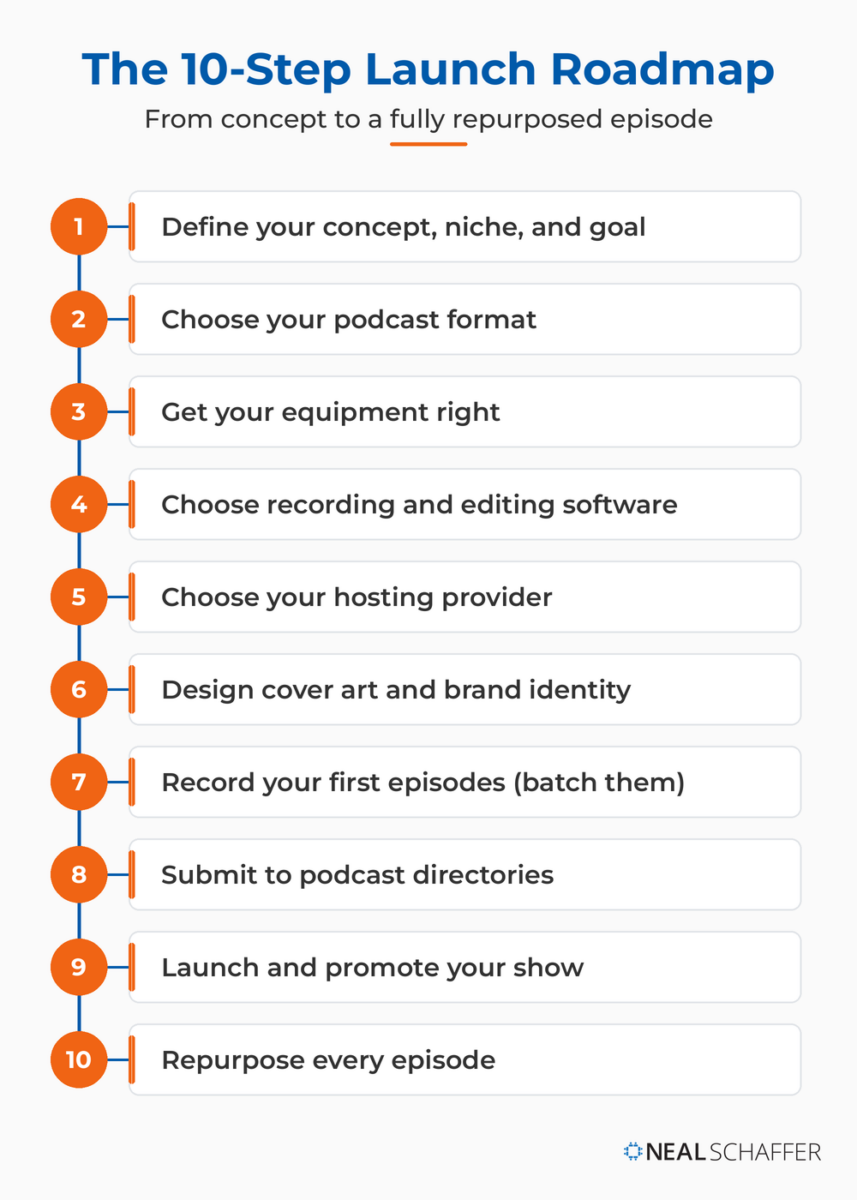
Step 1: Define Your Podcast Concept, Niche, and Goal
Before you buy a single piece of equipment, get the concept right. The most common reason new podcasts fail is not technical, it is strategic. The host picks a topic too broad to attract a specific audience, or specific enough but only loosely related to the business they are trying to build. Spend at least a week on this step.
Three questions to answer before anything else:
- What is the show actually for? Lead generation, authority building, recruiting, learning, or community? The right format and growth strategy depend on the answer. If your goal is meeting prospects, an interview show works best. If your goal is positioning yourself as a thought leader, a solo or co-hosted show may be stronger.
- Who is the listener you would be embarrassed not to serve? Pick one person. Make them specific. “Marketing directors at $20M-$100M B2B SaaS companies” is a real listener. “Anyone in marketing” is not.
- What is the conversation only you can host? Your niche should sit at the intersection of three things: what you know better than anyone, what your ideal listener urgently wants to learn, and what your guests will actually agree to talk about on the record.
Where AI helps in Step 1: Run your draft concept through ChatGPT or Claude with a prompt like “Act as a podcast strategist. Here is my proposed concept and target listener. Identify the top three risks that this show will fail to attract its ideal audience, and suggest three sharper niche cuts I should consider.” The AI will not pick the winner for you, but it will surface positioning weaknesses you would not catch on your own. Then use a tool like AnswerThePublic or Perplexity to research what questions your target audience is actually asking, and shape your first season around those questions.
For naming, write 30 candidates yourself first, then ask ChatGPT to generate 30 more in the same spirit, then test the top five against domain and trademark availability. Do not skip the trademark check. Names that are clever but legally fraught will haunt you in year two.
Step 2: Choose Your Podcast Format
Your format determines almost everything else: how long episodes take to produce, whether you need remote-recording software, what the guest pipeline looks like, and how repurposable each episode is. For business podcasters, format is also a strategic choice. Interview shows generate relationships. Solo shows compound personal authority. The right answer depends on what business outcomes you want.
For business podcasts, four formats dominate:
| Format | Best for | Production burden | Relationship value |
|---|---|---|---|
| Solo | Thought leadership, expertise positioning | Low (no scheduling) | Low |
| Interview | Lead generation, networking, learning | Medium (scheduling) | Very high |
| Co-hosted | Brand building with a partner | Medium (alignment) | Medium |
| Hybrid (mix of solo + interview) | Most marketers’ sweet spot | Medium | High |
I run a hybrid, and I alternate religiously: solo, then interview, then solo, then interview. The interview episodes are where the relationship and learning compound. The solo episodes are where I share my latest thinking on fast-moving topics like AI and even develop chapters for upcoming books, like my recent solo episode on the long-long-tail and AI-assisted content. That mix gives you the relationship benefit of interviews and the authority benefit of clear personal point-of-view content.
Episode length should be whatever serves the listener, not whatever fits a template. Buzzsprout’s platform data shows the 20-to-40-minute range is the most common bucket at 31%, with 40-to-60 minutes another common choice at 20%. My own episodes typically run 20 (solo) to 40 (interview) minutes. Anything over an hour requires either an exceptional guest or genuinely deep material to justify the listener’s time investment.
Publishing frequency is a commitment to yourself. Weekly and biweekly are the two most common cadences among Buzzsprout’s hosted shows, and weekly is the right default for marketers because it creates enough content velocity to fuel repurposing. Anything less frequent than monthly is almost impossible to grow because new listeners cannot build a habit around your show.
Where AI helps in Step 2: Use ChatGPT to draft your first 12-episode lineup based on your concept and target listener. Ask it to map each episode to a stage of the buyer’s journey for your business. Then use Claude or ChatGPT to generate guest dossiers for your dream first ten interviews, including their recent talks, books, and likely angles they have not covered elsewhere. This research used to take hours per guest. With AI, it takes five minutes and the prep quality is often better than what I could produce manually.
The LinkedIn Playbook for Real Business Growth
My latest book helps professionals, entrepreneurs, and business owners turn LinkedIn from a static profile into a real source of clients and growth.
Maximizing LinkedIn for Business Growth gives you clear, practical steps to build a profile that gets noticed and a network that actually sends business your way.
Grab your copy on Amazon and put it to work this week. Click the cover or the button below to get started.

Step 3: Get Your Equipment Right (Without Overspending)
The single most common new-podcaster mistake is overspending on equipment. The second most common is underspending on the microphone. The right answer is to invest in the microphone, treat the room well enough to remove obvious problems, and let AI handle the rest.
For a one-person setup, the Samson Q2U at around $70 is the recommendation I give every new podcaster. It used to be the Audio-Technica ATR2100x-USB, until that mic was discontinued. It is a dynamic USB microphone, which means it picks up your voice cleanly without picking up the air conditioner, the dog, or your spouse on a Zoom call in the next room. If you have room in the budget, the Shure MV7 (around $290) is the next step up and offers both USB and XLR connections so you have a clear upgrade path. This is the one I currently use.
For headphones, you have more freedom than most guides suggest. I do not use them at all. They are optional, especially for solo recording. If you do want a pair, any closed-back set works, and their real value is catching audio problems live, like a guest’s audio leaking back into your mic on a remote interview. You are not mixing a record.
Room treatment matters more than people realize and costs less than equipment. Record in the smallest room you have, ideally with carpet, with a closet of hanging clothes nearby to absorb reflections. A treated office closet often sounds better than a professionally treated studio when done thoughtfully. I use my home office, which is not the smallest room in the house, but it is carpeted and gives me access to natural light for video. Closing all the doors prevents any echoes.
This is where AI changes the calculus most dramatically. In 2020, recording in an untreated room meant your podcast sounded amateur. In 2026, Adobe Podcast Enhance and Descript’s Studio Sound feature can clean up an imperfect recording so effectively that the listener cannot tell whether you recorded in a $5,000 studio or your laundry room. This does not eliminate the need for a good microphone (AI cannot rescue audio with no signal-to-noise ratio to begin with), but it dramatically lowers the bar for room quality.
Where AI helps in Step 3: Record a one-minute test in your intended recording location, run it through Adobe Podcast Enhance, and listen. If the cleaned audio sounds professional, you are done with room treatment. If it still sounds bad, the problem is bigger than AI can fix, and you need to either treat the space more aggressively or find a better room.
Step 4: Choose Your Recording and Editing Software
For remote interviews, you need software that records each participant locally and then uploads the files. This avoids the audio quality loss that comes from recording the live call (where compressed network audio is what gets captured). For solo recordings, you need an audio editor that lets a non-engineer produce professional-sounding episodes quickly. AI has reshaped both categories.
Three options dominate for business podcasters in 2026:
Riverside.fm records audio and video locally for every participant and includes Magic Audio for one-click cleanup. The video quality is high enough to publish straight to YouTube, which matters more than ever given that one in three U.S. podcast listeners now use YouTube as their primary listening platform. The pricing starts around $19 per month. I am currently a very happy Riverside user.
Adobe Podcast records locally with browser-based simplicity and is included with Adobe Express (Full disclosure: I am an Adobe Express Brand Ambassador, but Adobe Podcast would be in this list regardless. The transcript-based editor and Enhance tool are genuinely best-in-class.) Generous free plan, premium starts around $10 per month.
Descript Rooms (formerly Squadcast) is built on top of Descript’s industry-leading transcript-based editor. If you intend to edit heavily, Descript Rooms is the obvious choice because the recording and editing surface are unified. Starts around $12 per month.
Zoom is the format guests are most familiar with, and it works in a pinch if you turn on “original sound” and record separate tracks. But the audio quality ceiling is lower than the three above, so I would only use Zoom when a guest insists. That being said, if you already pay for Zoom, it is a great way to get started without spending on anything new.
For editing, the core innovation to understand is transcript-based editing: you edit audio by editing the auto-generated transcript. Delete the word “um” from the transcript, and it disappears from the audio. This changes editing from a specialized skill into something a non-technical marketer can do in about 20 minutes per episode. The same tools also handle filler-word removal, audio enhancement that makes a modest mic sound studio-grade, eye-contact correction for video, and a fix-by-transcript feature that lets you correct a stumble without re-recording.
In full transparency, I hire a podcast editor off Upwork to do the heavy lifting for me. But if you have more time than money, you can do this yourself. I have used both Riverside and Descript, which run on the same transcript-based editing technology, and I recommend either one. And if you record your episodes in Riverside, there is no need to subscribe to a separate tool for editing, since it does both.
Where AI helps in Step 4: Beyond the AI features baked into Riverside, Adobe Podcast, and Descript, use ChatGPT or Claude to write your post-recording edit notes. After listening once at 1.5x, paste the auto-generated transcript into your AI of choice with a prompt like “Identify the three weakest 60-second segments in this transcript and explain what makes them weak. Then identify the two strongest segments to consider as social clips.” This used to be an editor’s job and now takes five minutes. Riverside also has an automated feature called Magic Clips that surfaces suggested clips using its own AI, and dedicated clipping tools like Opus Clip do the same job as well.
Step 5: Choose Your Podcast Hosting Provider
A podcast host is a service that stores your audio files, generates the RSS feed that all directories read, and delivers your show to Apple Podcasts, Spotify, Amazon Music, YouTube, and the rest. You cannot publish without one. The right host matters more for a marketer than a hobbyist, because the AI features in modern hosts save real time weekly.
I host my show on Buzzsprout and have for several years. (Yes, I am an affiliate, but I am also a genuinely satisfied, happy, paying customer.) Buzzsprout reports more than 115,000 active podcasters and over 400,000 shows launched since 2009, which speaks to its stability. I recommend it for marketers specifically for three reasons. First, its IAB-certified analytics are the kind you can actually report to a client or boss. Second, it is easy to use. Years ago I had to hire someone on Upwork just to teach me Libsyn’s interface. That is how complicated it was, and it is a big part of why I moved to Buzzsprout. The publishing flow here is simple enough to teach a virtual assistant in an hour. Third, it handles the operational work that trips up new podcasters, like inserting ads and submitting your show to all the major directories.
Buzzsprout includes automatic transcripts on its paid plans and offers CoHost AI as a paid add-on for show notes and chapters. Either way, if you already use your own LLM, you will get better results, because you can train your own model to sound like you and a built-in tool cannot.
For comparison, my podcast hosting post ranks 15 platforms in depth. Beyond Buzzsprout, strong options include Captivate, Libsyn, and Podbean. The short version: pick one with transparent pricing, IAB-certified analytics, AI-assisted show notes and transcripts (to provide you an automated option), and reliable distribution to all major directories. Avoid free hosts that own your audience data or restrict your ability to migrate.
The migration story matters more than people realize. I have switched hosting providers in the past, including the one I used in the older video I mentioned earlier and Libsyn before that. Migration is technically straightforward if your host gives you the RSS feed and lets you redirect properly, but if you start with a host that does not, you are stuck or you lose your subscribers. Read the migration policy before you sign up, not after.
Where AI helps in Step 5: Most modern podcast hosts now include built-in AI for show notes, transcripts, episode titles, and chapter markers. The piece you truly need from the host is the transcript. For everything downstream, I recommend running that transcript through your own LLM, like ChatGPT or Claude, instead of leaning on the host’s built-in tools. You can prompt your own model to match your voice and your audience, which a generic built-in feature cannot do. Paste in the transcript and ask for show notes, a few title options, and chapter markers, and you have turned an hour of writing into a few minutes. If your host does not include transcripts on your plan, there are free podcast transcript generators that will produce one for you before you ever get to the prompting stage.
Step 6: Design Your Cover Art and Brand Identity
Your podcast cover art is the first thing prospective listeners see in Apple Podcasts, Spotify, and YouTube. It needs to be legible at the size of a postage stamp and distinctive against thousands of competitors. Cover art also signals production quality before anyone listens, which means amateurish art kills click-through rates regardless of how good your content is.
Three rules:
Make your title readable at thumbnail size. Open Apple Podcasts on your phone and look at how small the cover art renders. If your title is not legible at that size, redesign it.
Use a color combination that stands out in your category. Browse the top 20 podcasts in your category. If they are all dark blue and white, do not also be dark blue and white. Pick something that breaks the pattern.
Include your face or a single bold visual concept. Faces work because humans are wired to find them. A single bold concept works because abstraction is harder to remember.
I use Adobe Express for podcast art, social graphics, and promotional images because the templates speed up consistent branding and the AI image generation is now genuinely useful for backgrounds and accent visuals. Canva is a competent alternative if you already use it. For one-off premium work, 99designs runs design contests where you get multiple concepts to choose from for a flat fee. I have actually used Fiverr to hire a professional to create my current podcast cover art, in addition to using 99designs for a previous iteration of Your Digital Marketing Coach.
The technical specs you need: 3000×3000 pixels minimum (Apple Podcasts requires this), under 500 KB, JPG or PNG, RGB color space (not CMYK), and sRGB color profile.
Where AI helps in Step 6: Use an AI image generator to brainstorm five to ten concept directions before you commit to one. Run prompts like “podcast cover art for a business interview show, bold typography, navy and orange color palette, photo of a male host in his 40s” through your generator of choice and pick the direction that resonates. Then move into Adobe Express or Canva for the actual production, because AI-generated text is still unreliable and you need pixel-perfect control over the title.
Step 7: Record Your First Episodes (Batch Them)
The single best piece of tactical advice I can give a new podcaster is to record your first three to five episodes before launching publicly. Batching solves three problems at once: it gives Apple Podcasts something to feature in New & Noteworthy, it lets you settle in before listeners judge you, and it builds a buffer for the week something breaks.
For solo episodes, here is the workflow I use:
- Outline first, script second. Use ChatGPT or Claude to outline the episode based on a one-paragraph concept description, then tighten the outline by hand. Avoid scripting word-for-word: a fully scripted episode tends to sound recited rather than conversational, and listeners can hear the difference. If you do want to try using an AI script, use it as a diving board for your thoughts to jump from and evolve.
- Capture the hook in the first 60 seconds. The hook is the single most important part of any episode because it is where listeners decide whether to stay. State the problem, promise the payoff, and tell them why this episode is worth their attention.
- Record in single takes when possible. Editing breaks flow. If you stumble badly, pause, clap, and restart the sentence; the clap creates a visual marker for you or your editor to find later. Just like you want to write a messy first draft when writing a book, record a messy podcast episode and edit later!
For interviews, the prep matters more than the recording. I actually have my guests fill out an intake form when they schedule their recording, where they give me a suggested episode title, three actionable takeaways, and five questions I can ask them. This does two things for me: it lets me vet in advance that their topic will be relevant to my audience, and it gives me takeaways I can use to guide the conversation naturally. Beyond what the guest provides, do your own homework. Show up having read some of their recent work, having listened to at least one interview they have done elsewhere, and prepared with one question nobody else has asked them. That last part is what separates a forgettable interview from one your guest will share with their network.
Where AI helps in Step 7: Generate first-draft outlines with ChatGPT or Claude, build guest dossiers with Perplexity, and use AI to suggest one or two unexpected questions for each interview based on the guest’s public material. After recording, run the transcript through your AI of choice with a prompt like “Identify three quote-worthy moments from this transcript that would make strong 60-second social clips, and write the social post for each.” This single step replaces what used to be a content strategist’s full afternoon.
Step 8: Submit to Podcast Directories
Once your first episodes are uploaded to your host, submit your podcast to every major directory. Buzzsprout and most modern hosts make this nearly one-click, but you still claim your show on each platform. Directory priority has shifted hard in the last two years, because YouTube is no longer optional for podcasters who want to be found.
The directories that matter, in priority order:
- YouTube. Edison’s Share of Ear data shows that 32% of U.S. podcast listening time now happens on YouTube. If you are not on YouTube as either a video podcast or a static-image audio upload, you are missing a third of your potential audience. This is the single biggest change in podcast distribution since 2023.
- Apple Podcasts. Still the largest single discovery platform for listeners who consume podcasts as podcasts (rather than via video). Apple’s category rankings and editorial features can drive meaningful early growth.
- Spotify. 25% of podcast listening time per Edison’s Share of Ear. Spotify also has the strongest cross-promotion mechanics for music listeners discovering podcasts.
- Amazon Music and Audible. Smaller but growing, and submission is essentially free.
- Pocket Casts, Overcast, Podcast Addict. The power-listener apps. Small audiences in aggregate but high-engagement listeners.
The directory you cannot ignore in 2026 is YouTube. Even if you do not record video, upload your audio with a static cover image. Add chapter markers (most hosts will export these from your audio chapters). Write a YouTube-optimized title and description that differs slightly from your audio podcast description because YouTube’s discovery system rewards different signals.
Where AI helps in Step 8: How much you optimize depends on format. For an audio-only show, the same title and description work across every directory, so there is no need to rewrite them platform by platform. For a video show, each platform is worth a dedicated pass, since YouTube, Apple, and Spotify all surface video differently, and YouTube in particular functions as its own search and discovery engine. I have started uploading my video episodes to YouTube and now use AI to optimize the thumbnail, title, and description for that platform. ChatGPT can turn your master show notes into a platform-ready title and a search-friendly description with timestamps in a single prompt.
Step 9: Launch and Promote Your Show
A launch is a moment in time, not a strategy. The strategy is what you do every week for the first six months. The most common launch mistake is treating launch day as the event and then going quiet. The second is paying for ads before you know whether the show resonates. Both are fixable.
For the launch itself, the biggest mistake I see is treating it as a single-day event. Stretch the launch across two weeks. Tease the show one week before with a trailer episode. Drop three to five episodes on launch day so listeners have something to binge. Then publish on your regular cadence from week two onward.
Promote the launch on every channel where you have an audience: your email list (highest-converting), LinkedIn (if you are B2B), TikTok, Instagram, and Facebook (if you are B2C), and your own website. Do not pay for ads in the first 90 days; you do not yet know whether the show resonates, and you cannot retain listeners who are not naturally interested.
The ongoing growth strategy that has worked best for me is what I call “guests as growth.” Every interview guest is a distribution partner. If you have a good conversation, they will share the episode with their audience. The math here is more powerful than most podcasters realize. If your average guest has 5,000 LinkedIn followers and 30% of episodes get a meaningful guest share, you are reaching 1,500 new ears per episode with no ad spend. Over a year of weekly episodes, that compounds significantly.
The marketer’s advantage here is that you can be deliberate about guest selection. Pick guests who are upstream of your ideal client, peers your ideal client follows, or vendors and consultants who serve your ideal client. Each is a different theory about how the relationship turns into business outcomes, but all three put you in front of audiences your competitors do not have access to.
Step 10: Repurpose Every Episode (This Is Where Marketers Win)
If you do one thing differently, do this: treat every episode as raw material for a week of multi-channel content, not the finished output. A 30-minute interview that becomes a blog post, an email, five clips, and a LinkedIn thread does five times the work of audio alone. This is the lever that makes podcasting pay.
A single 30-minute interview can produce:
- One full blog post (1500–2500 words) built from the transcript
- One email newsletter summarizing the episode’s main insight
- Three to five short-form video clips for LinkedIn, Instagram, TikTok, or YouTube Shorts
- A LinkedIn post highlighting one specific insight
- A Twitter/X thread with the most quote-worthy moments
- One quote card for static visual platforms
- Cross-promotional content for the guest to share
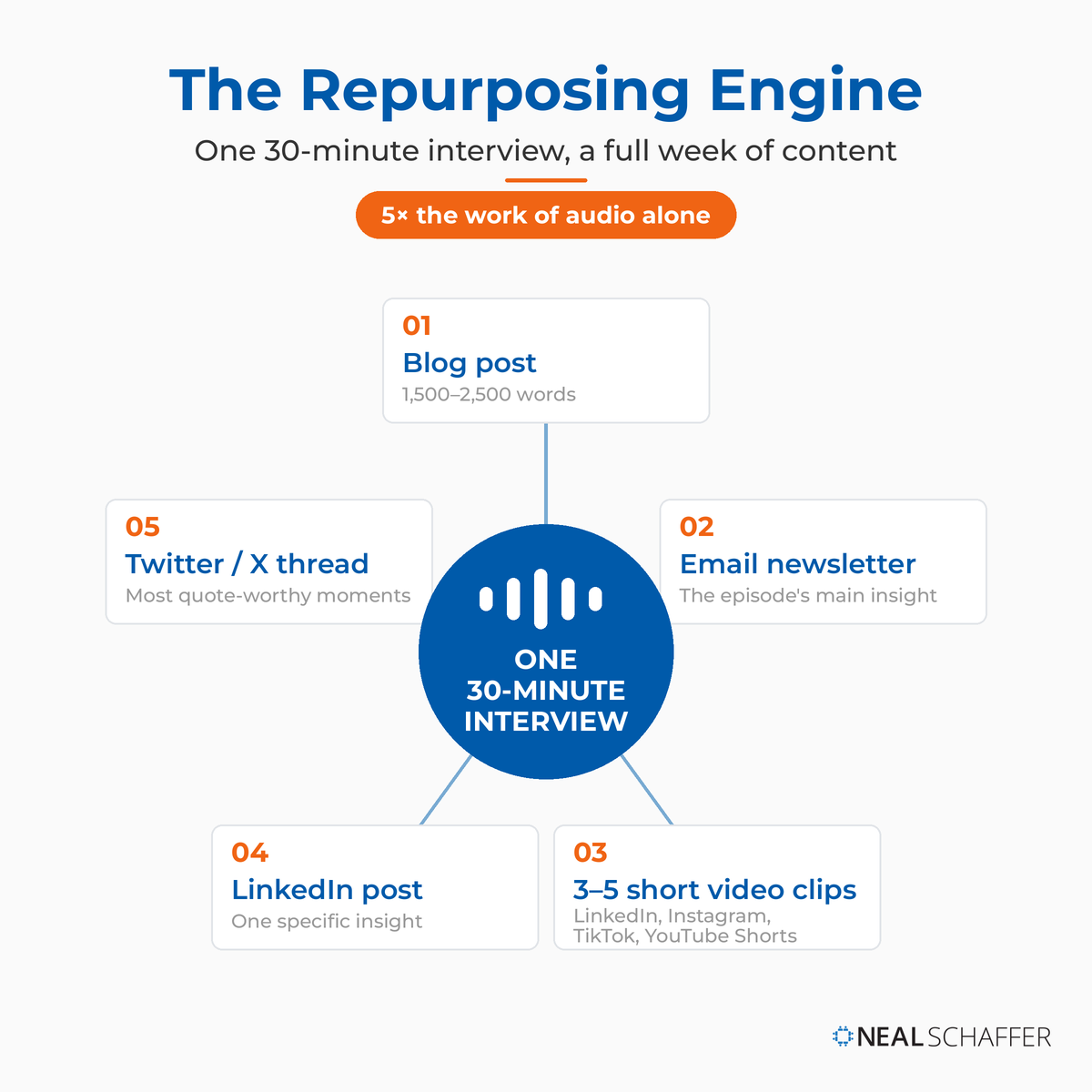
This is the math that makes podcasting pay for itself even if your download numbers never get impressive. Each piece of derived content does its own job in its own channel, and the original episode anchors all of them.
The one caution: repurposing is not copy-paste. Amy Woods, founder of Content 10x, told me on my podcast that “repurposing isn’t just reposting. It’s not just cutting and pasting. You can’t just create one thing for all the platforms. You’ve got to be respectful of the platforms, and why people are there, and create platform-specific content.” The goal is to reshape the episode’s ideas for how people actually use each channel, not to dump the same clip everywhere.
Right now my own weekly workflow looks like this:
- Record in Riverside. The recording exports an automatic transcript.
- Send the audio to my podcast editor for the final file.
- Feed the transcript into a Claude project I have refined over time. It produces the written deliverables I need: show notes plus the social and email content.
- Hand the video to a separate VA who edits it and creates the social video clips.
- Upload the video to YouTube so it publishes the same day as the audio episode.
- Generate captions for the social videos from their transcripts, then schedule the posts in my social media dashboard.
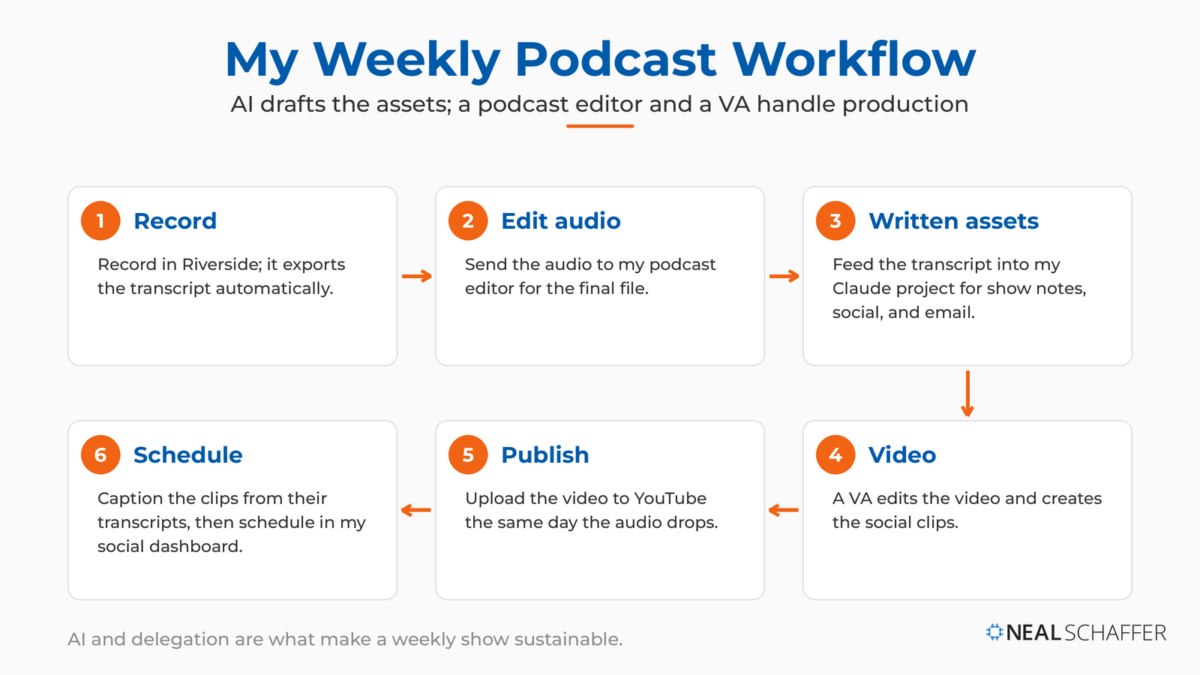
The specific tools matter less than the structure: AI drafts the written assets, a podcast editor and a VA handle the audio and video production, and the recording itself stays with me. That mix of AI and delegation is what makes a weekly show sustainable for a busy marketer.
Where AI helps in Step 10: AI is what makes the repurposing math work at scale. Without AI-generated first drafts, the marginal cost of repurposing exceeds the marginal value for most marketers. With AI, the math flips and a podcast becomes the most efficient content production engine you can build.
How to Measure a Marketer’s Podcast (Beyond Downloads)
Download counts are the vanity metric of podcasting. They matter (sponsors care, and they signal audience size), but they are not the metrics a marketer should optimize for. The right metrics are business outcomes: guest conversations that become deals, listener-to-lead conversions, branded search volume, and whether AI search engines surface your show notes when buyers research your category.
The metrics worth tracking:
| Metric | What it tells you | How to measure |
|---|---|---|
| Guest relationship value | How often a guest interview leads to business value, whether a deal, a collaboration, or a future opportunity | CRM tagging on guest follow-ups |
| Listener-to-lead conversion | Whether your audience converts into your owned list | Trackable URLs or promo codes in episodes, plus list growth attribution by episode |
| Branded search volume | Whether the podcast is building name recognition | Google Search Console, Ubersuggest |
| AI citations and referrals | Whether AI search engines cite your episodes and send you traffic | Manual checks in ChatGPT, Perplexity, and Google AI Overview, plus referral traffic in Google Analytics |
That last row matters more every quarter. As more buyers research vendors through AI assistants, having your show notes and transcripts indexed and citable becomes a real distribution channel. But the referral traffic those AI tools send only shows up in Google Analytics if you have a podcast website for it to land on. There are two ways to get one. The first is to publish each episode as a post on your own website, with the show notes and transcript included. The second is to use a dedicated podcast site: a subdomain powered by an automated tool like Beamly, or a host like Captivate that builds the website for you. My own show notes and transcripts live on a Beamly-powered subdomain, which is what makes the episodes citable and the traffic trackable. Transcripts are AI search food in 2026, and AI and SEO have effectively merged into a single discipline.
The revenue question sits underneath every one of these metrics, so it is worth answering on this page rather than sending you somewhere else for it. And if you want to see what success looks like on the directory side, I recently looked at the best podcast ranking tools for monitoring how your show performs against competitors.
So How Do You Actually Make Money From a Podcast?
Direct revenue on a business podcast arrives in close to the reverse of the order most guides teach, and knowing that in advance saves you a couple of years of chasing the wrong stream.
I have been podcasting since 2013, through the show’s earlier lives as Social Business Unplugged, then Maximize Your Social, then Maximize Your Social Influence, before it settled into Your Digital Marketing Coach. I would not call it my biggest money maker. It is a small money-making asset whose real return shows up in the work around it rather than in anything the audio earns on its own.
Here is the order I would plan for:
- Your own services. A single consulting or coaching client sourced from the show can outearn months of ad revenue, and it works from your first episode rather than after you clear some audience threshold.
- Your own products. Books, courses, and paid communities convert well to listeners because the audio has already done the trust-building a sales page normally has to do cold.
- Affiliate revenue. Recommending tools you genuinely use is the lowest-effort stream to start, and it scales with how specific your niche is rather than with how large it is.
- Listener support and memberships. Smaller shows often do better here than larger ones, because engagement matters more than reach.
- Sponsorships and ad networks. These come last for most business podcasters, not first. Ad networks apply audience minimums, the rates are priced against downloads, and by the time you clear the bar the four streams above are usually earning more for less work.
The mechanism connecting all five is your email list. A listener who never joins it is a download. A listener who does is someone you can reach again on purpose. If your show has no path from episode to inbox, none of the streams above compound, which is why building an email list is the first infrastructure decision to make rather than the last.
The Marketer’s Edge: Five Things a Podcast Does That Other Content Cannot
After running my show for years and interviewing a plethora of marketers, consultants, and business owners about their own podcasts, five business benefits show up consistently. None rely on a large audience. All of them are about what the act of producing the podcast does for your business, separate from what listeners do after they hit play.
1. You get 30 (and sometimes more) minutes with people who would never give you that time otherwise. A cold email asking for a 30-minute coffee gets ignored. A podcast invitation gets accepted. The relationship that develops over a recorded conversation is qualitatively different from anything cold outreach can produce.
2. Your guest becomes a distribution partner. Roughly a third of my guests share the episode meaningfully with their audience, which means each episode reaches new ears without paid amplification.
3. Your authority compounds in places you do not control. Search engines, AI assistants, and recommendation algorithms surface podcast content over time. The episode I published 18 months ago is still being cited and downloaded because podcasts have longer half-lives than social media content.
4. You build a library of evergreen marketing assets. I have produced more than 400 episodes, and the back catalog continues to generate downloads, email subscribers, and the occasional inbound business inquiry. No single Instagram post does that.
5. You learn faster than your competitors. Hosting an interview show means you are getting the best minds in your space to teach you for free, in exchange for exposure on your platform. The compound effect on your own expertise over five years of weekly interviews is enormous.
If you want to see what an established marketing podcast actually sounds like, I share my picks for the best marketing podcasts in 2026, including the criteria I use to evaluate which shows are worth my own listening time. And if you are specifically interested in podcasting on YouTube versus traditional audio platforms, my podcasting on YouTube post is a useful next read.
Frequently Asked Questions
How much does it cost to start a podcast in 2026?
You can launch for under $200 with a Samson Q2U microphone, free recording software (Adobe Podcast, Audacity, or even Garage Band), free hosting on Buzzsprout’s free plan, and AI tools you already use. As you grow, expect to spend $30 to $60 per month on hosting, editing, and AI tools combined, and upwards of $100 to $400 a month if you outsource some or all of your work.
How long should podcast episodes be?
Long enough to deliver value, short enough to respect the listener’s time. Buzzsprout’s platform data shows 20 to 40 minutes is the most common bucket. A majority of my own episodes run 20 to 40 minutes. Interviews can run longer if the guest justifies it, but never pad an episode to hit an arbitrary length.
How often should I publish?
Weekly is the right default. It is frequent enough to build listener habit and create content velocity for repurposing, and infrequent enough to be sustainable. Biweekly works if interview scheduling is your bottleneck. Anything less than monthly makes growth almost impossible.
Do I need to be on YouTube?
Yes. Edison’s Share of Ear data places 32% of U.S. podcast listening time on YouTube, ahead of Spotify and Apple Podcasts. Even if you do not produce video, upload audio with a static cover to YouTube. Skipping YouTube in 2026 means voluntarily ignoring a third of your potential audience.
Can AI replace a podcast host?
No, and you should be skeptical of anyone selling that idea. AI voice generation has improved dramatically (tools like ElevenLabs are genuinely impressive), but the value of a podcast is the host’s perspective, voice, and relationship with the guest. Listeners can tell when content is machine-generated, and the trust premium of a real human voice is exactly what podcasts uniquely provide. Use AI to handle production tasks; do not use it to be the host.
How long until a podcast generates real business results?
It might take three to six months for meaningful business results to show up, with serious compounding effects by month twelve. The first 90 days are about finding your voice, building the workflow, and establishing the guest pipeline. Be patient. Podcasts reward consistency over years, not weeks.
What is the best podcast hosting platform?
I use and recommend Buzzsprout because of the combination of IAB-certified analytics, easy ad insertion and directory submission, and a publishing flow simple enough to delegate. Libsyn and Captivate are also strong choices. Avoid free hosts that lock your audience data or restrict migration.
Do I need to write a podcast script?
Depends on format. Solo episodes benefit from a script or detailed outline because there is no guest to carry the conversation. Interview episodes should not be scripted because spontaneity is what makes interviews valuable; use a question list instead. My post on podcast scripting approaches is a useful next read for both formats.
How do I get podcast guests?
The single most effective tactic I know is researching guests deeply before reaching out and showing them in the invitation that you have actually engaged with their work. A specific, prepared invitation gets accepted at a much higher rate than a templated one. Use AI tools like Perplexity to build guest dossiers quickly, then write the invitation yourself. You can also use a service like Podmatch to find guests.
Conclusion: Start Now, Optimize Later
The biggest mistake new podcasters make is waiting until the setup is perfect. The mic, the room, the cover art, the launch plan, the equipment list. None of it matters if you never publish.
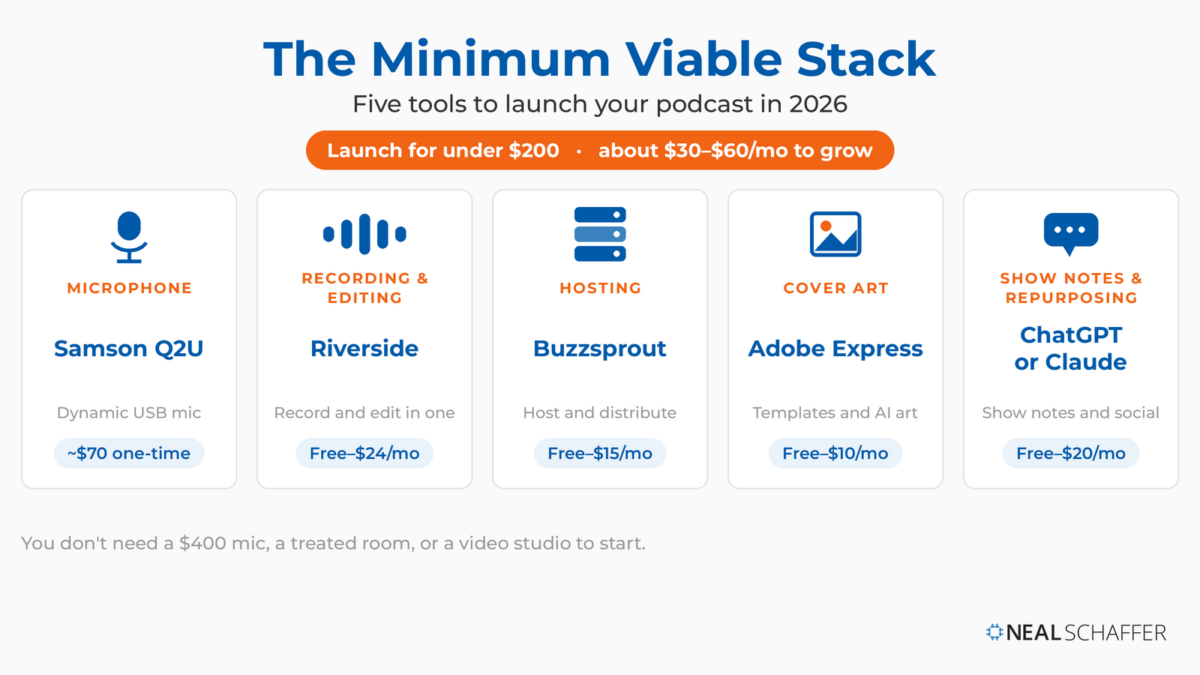
Start with the minimum viable stack: a Samson Q2U, Riverside for recording and editing, Buzzsprout for hosting, Adobe Express for cover art, and ChatGPT or Claude for show notes and repurposing. Record your first three episodes this month. Launch in the next 60 days. Optimize from real listener feedback, not from a checklist.
If you are running a business and you have not yet built a podcast, you are leaving the most efficient business development tool of the last decade on the table. The strategy in Digital Threads applies directly: build a Library of Content that compounds, weave the threads together across channels, and let AI scale what scaling people cannot. A podcast is the highest-fidelity thread you can weave.
For a deeper grounding in the strategic framework I use to integrate podcasting with the rest of a digital marketing program, Digital Threads is the book. If you want to follow my thinking week by week, the podcast itself is at podcast.nealschaffer.com. It is exactly what you would expect: a marketer interviewing the people I want to learn from. And once your show is running, the revenue section above lays out the order the money actually tends to arrive in.
And if you are weighing whether to start at all, my honest answer is yes, but only if you commit to consistency for at least a year. Anything less is a hobby. A year of weekly episodes is a real business asset.
Actionable advice for your digital / content / influencer / social media marketing.
Join 13,000+ smart professionals who subscribe to my regular updates.