Big Brand Tactics for Small Business Success
Get a free preview of Digital Threads, the award-winning playbook that connects search, email, and social media into one system.
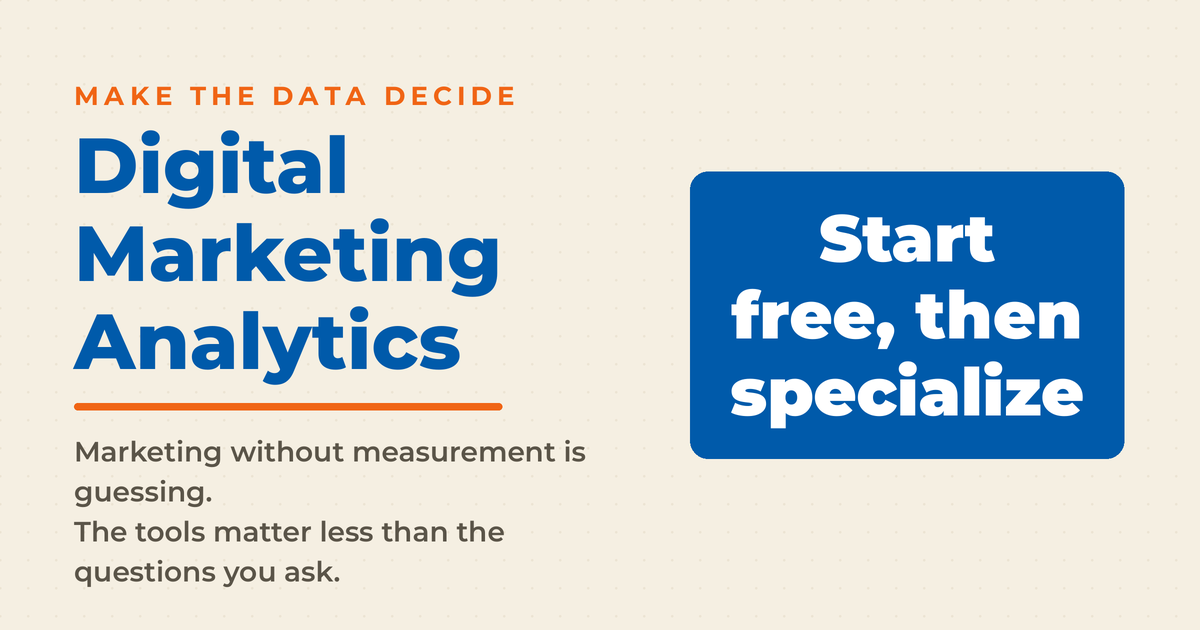
Every click, every share, every conversion tells a story—but are you listening to what your data is saying?
Making marketing decisions without proper analytics is like throwing darts in the dark—you might hit something, but you’re probably wasting a lot of resources along the way.
✅ Digital marketing analytics means collecting data across your website, social, email, and paid channels, then using it to decide where your next dollar and hour should go.
✅ Start with the free tools. Google Analytics 4 and Google Search Console cover most of what a small business needs before you pay for anything, and my guide to marketing analytics tools covers what to add after that.
✅ Track four families of metrics rather than forty individual ones: traffic, engagement, conversion, and ROI. A dashboard with fifty numbers on it rarely produces a decision.
✅ Your numbers are only as trustworthy as your setup. Missing tracking code, untagged campaigns, and duplicate properties will hand you confident data that is wrong.
✅ Analytics pays off only when it changes what you do. Pick one metric per quarter, set a baseline, and put a review date on the calendar.
Digital marketing analytics is the process of collecting, analyzing, and interpreting data from various digital marketing channels to improve marketing performance and make informed decisions. It’s the compass that guides your marketing strategy, helping you understand what works, what doesn’t, and where to invest your resources. It is also what lets you hold digital channels up against traditional ones on the same terms, which I work through in digital vs. traditional marketing metrics.
Only 22% of companies say they are satisfied with their current marketing analytics capabilities. Most businesses are collecting the data. Far fewer are getting decisions out of it, which is where the competitive opening sits.
Here’s what proper analytics can help you achieve:
🔑 Key Takeaway: Digital marketing analytics transforms raw data into actionable insights, helping you make smarter marketing decisions and improve your ROI.


Digital marketing analytics encompasses several key areas:
1. Website Analytics: Understanding user behavior on your website, including traffic sources, page performance, and conversion paths.
2. Social Media Analytics: Tracking engagement, reach, and conversions across social platforms. Dive deeper into social media measurement in my comprehensive social media analytics guide.
3. Campaign Analytics: Measuring the success of specific marketing campaigns and initiatives. Explore my digital marketing tools guide for the best campaign tracking solutions.
4. Customer Journey Analytics: Following the path customers take from first touch to conversion. Those touchpoints line up with the stages of your marketing funnel, which gives you a frame for spotting where people drop off..

Understanding which metrics to track is crucial for effective digital marketing analytics. Let’s break down the essential metrics that can make or break your marketing success.
These fundamental metrics help you understand how users interact with your website:
Pro Tip: Don’t just collect data – look for patterns. A high bounce rate on your blog posts might indicate a mismatch between your content and user intent.
Conversion metrics directly tie to your business goals. Here are the key ones to monitor:
| Metric | Formula | Why It Matters |
| Conversion Rate | Conversion Rate = (Number of Conversions / Total Visitors) × 100 | Shows how effectively your site turns visitors into customers |
| Click-Through Rate (CTR) | CTR = (Clicks / Impressions) × 100 | Indicates the effectiveness of your ads and links |
93% of marketers use Facebook to promote their business, making it crucial to track social media metrics from it and other popular social networks effectively.
That being said, social media performance requires its own set of metrics. Here are some key social metrics to track:
Share of voice only becomes a decision once you set it against the share of sales you actually hold. I break down that comparison in share of voice vs. share of market. Learn more about maximizing your social media impact in my guide to measuring social media ROI.
Return on Investment (ROI) metrics help justify your marketing spend:
1. Cost Per Acquisition (CPA)
2. Customer Lifetime Value (CLV)
My latest book helps small businesses, entrepreneurs, and marketers bring search, email, and social together into one digital marketing strategy that actually compounds.
Drawing on my work as a Fractional CMO, Digital Threads turns complicated tactics into a clear, practical plan you can follow, whatever your budget or team size.
Grab your copy on Amazon and start weaving your own digital threads. Click the cover or the button below to get started.

🎯 Action Item: Start by tracking these core metrics for one month to establish your baseline, then set realistic improvement goals based on your findings.

Having the right analytics tools in your arsenal is crucial for making data-driven decisions. Let’s explore the most effective tools for tracking and analyzing your digital marketing efforts.
1. Google Analytics 4 (GA4)
Learn more about maximizing these tools in my guide to Google SEO tools.
Different platforms require different analytics approaches. Here are some examples for selected popular social media platforms:
| Platform | Native Analytics | Recommended Tools |
| Meta Business Suite | Meta Business Suite | |
| Instagram Insights | Instagram Analytics Tools | |
| LinkedIn Analytics | LinkedIn Analytics Guide |
44% of marketers report having high-quality data on their target audience, highlighting the importance of using proper analytics tools.
Consider these specialized tools for specific needs:
1. Heat Mapping Tools
2. SEO Analytics
3. Social Media Management with Analytics
For a holistic view of your marketing performance, consider these integration tools:
💡 Pro Tip: Start with the essential free tools like GA4 and Search Console, then gradually add specialized tools as your needs grow and budget allows.
Even the best analytics tools are only as good as the data they collect. Let’s explore common challenges and how to overcome them to ensure your marketing decisions are based on reliable data.

Data governance is a top priority for 60% of businesses, and for good reason. Governance is what keeps your data accurate, secure, and actually reachable when you need it. Skip it and every report you build sits on a shaky foundation.
Key challenges you might face include:
Follow these best practices to maintain high-quality data:
1. Regular Audits
2. Data Validation
Privacy issues are becoming increasingly important in today’s digital world. Make sure you adhere to these essential considerations and requirements for data collection:
⚠️ Important: Always prioritize user privacy and data protection while collecting analytics data. This builds trust and ensures compliance with regulations.
Successful analytics implementation requires a strategic approach. Let’s break down the process into manageable steps and best practices to ensure you’re getting the most value from your data.
Before diving into implementation, establish your analytics strategy framework, which can be simplified as follows:
1. Define Clear Objectives
2. Develop a Measurement Plan
🎯 Strategy Tip: Start small and scale up. Begin with core metrics that directly tie to your business goals, then expand as you become more comfortable with the data.
Given that roughly one in five companies is satisfied with its analytics, the advantage goes to whoever actually finishes the implementation. Most teams stall after installing the tracking code. The follow-through is the differentiator.
Follow these best practices:
1. Technical Setup
2. Data Collection
Turn your data into actionable insights through reporting and analyzing:
Regular Reporting
Analysis Framework
💡 Pro Tip: Create a simple decision-making framework that helps you consistently turn data into action.
Stay ahead by staying up-to-date with emerging trends and instilling a culture of kaizen improvement as follows:
1. Emerging Trends
2. Continuous Improvement
For more insights on staying current, check out my guide to marketing technology trends.
It is the practice of collecting data from your website, social profiles, email, and ads, then reading that data to decide what to do next. The collecting part is the easy half. The value comes from the decision you make afterward.
Web analytics looks at one property, usually your website, and tells you what people did once they arrived. For most businesses that half of the picture runs on Google Analytics 4, and a beginner’s guide to GA4 covers what the platform actually measures and how its event model works. Digital marketing analytics covers every channel that sends people there and connects the spend on each channel to the outcome. Web analytics is one input into the larger picture.
Google Analytics 4 and Google Search Console, both free, and the native analytics inside whichever social platforms you actually post to. Add a paid layer only when you have a question the free tools cannot answer, which is usually cross-channel attribution or automated reporting. I break down the paid options in my guide to social media analytics tools.
Weekly for anything with money running through it, such as paid campaigns, and monthly for organic performance. Quarterly is when you compare against your baseline and change your digital marketing strategy. Checking organic numbers daily produces anxiety, not insight.
Every platform counts using its own rules for what a session, a view, and a conversion are, and each one credits itself for conversions it touched. Treat the gap as normal and pick one source as your reporting standard. What matters is that you measure the same way every month.
Digital marketing analytics isn’t just about collecting data—it’s about making smarter, more informed decisions that drive real business results.
By implementing the right tools, maintaining data quality, and following proper implementation procedures, you can transform your marketing efforts from guesswork into a data-driven strategy that delivers measurable results.
🚀 Next Steps: Begin by auditing your current analytics setup, identifying gaps, and creating a plan to implement the strategies discussed in this guide.
Ready to take your digital marketing analytics to the next level? Explore my comprehensive digital marketing tools buyer’s guide for more insights and recommendations.

We respect your privacy. Unsubscribe at anytime.
Practical advice on social, content, influencer, and search marketing, plus the AI tools that make each one easier. Join thousands of founders and business owners who read it.