
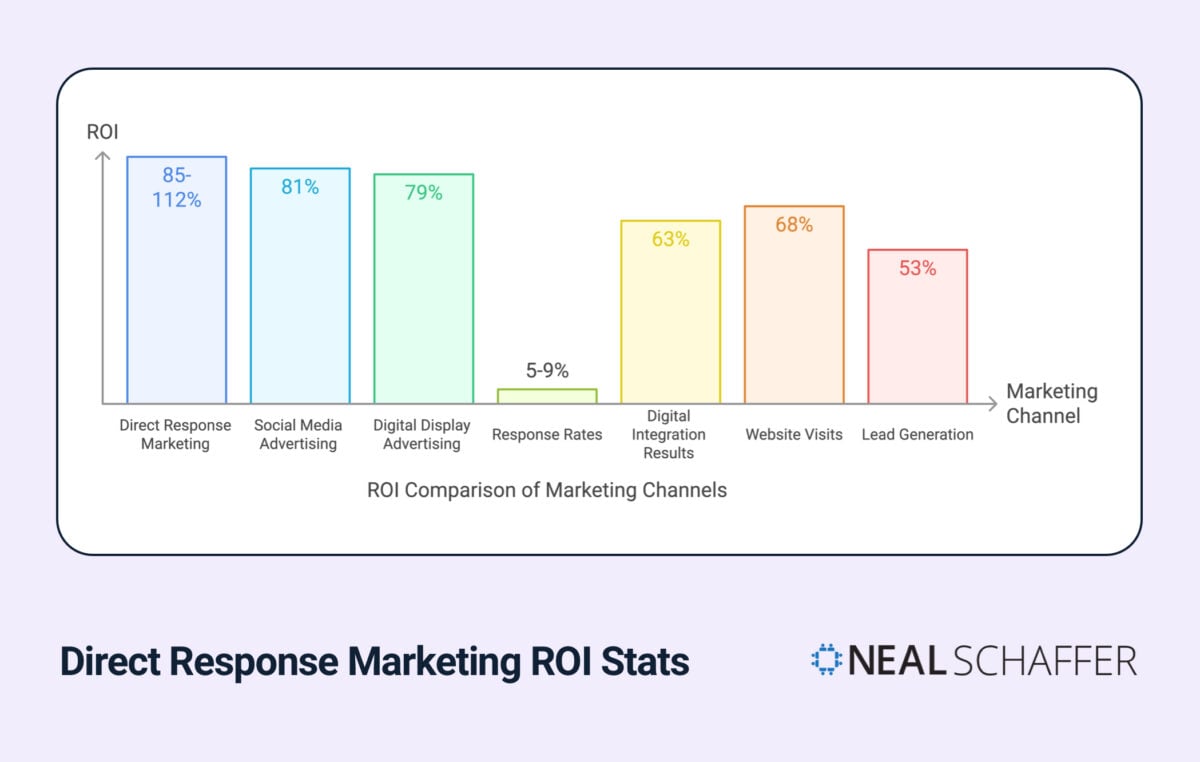
Direct response marketing delivers an impressive ROI of 85-112%, outperforming traditional marketing channels including social media advertising (81%) and digital display advertising (79%). This marketing approach focuses on generating immediate, measurable responses from your target audience, making it an essential strategy for businesses seeking tangible results from their marketing investments.
Direct response marketing combines strategic messaging with clear calls-to-action, prompting customers to take specific steps – whether making a purchase, signing up for a newsletter, or requesting information. Unlike traditional marketing that focuses on brand awareness over time, this approach delivers measurable results you can track and optimize for maximum return on investment.
This guide explores seven proven strategies that drive instant ROI through direct response marketing, backed by data and practical implementation steps. You’ll discover how to create compelling campaigns that generate immediate action while building lasting customer relationships.
Key Takeaways
✅ Direct response marketing asks for one specific action. Every campaign is built around a single measurable response (a purchase, a signup, a call) rather than brand awareness accumulated over time.
✅ The ROI case is strong: 85-112% return, ahead of social media advertising (81%) and digital display advertising (79%), because every dollar ties back to a tracked response.
✅ Response rates run 5 to 9 times higher than other advertising channels when the offer, the urgency, and the call-to-action all point in the same direction.
✅ Personalization is the single biggest input. 97% of marketers report higher response rates from personalized campaigns, and personalization can lift response by up to 135%.
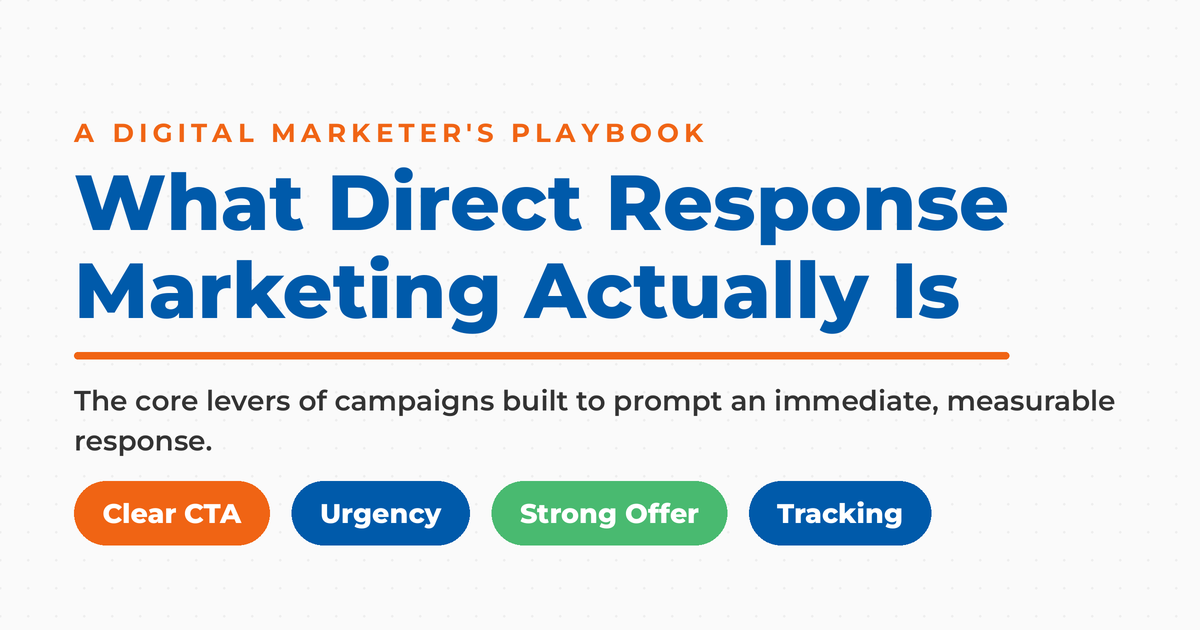
✅ Five components have to be present: a specific call-to-action, real urgency, a compelling offer, an easy response mechanism, and tracking that ties the response back to the campaign.
✅ What you cannot measure, you cannot optimize. Response rate, cost per acquisition, ROAS, conversion rate, and customer lifetime value are the five numbers worth watching from day one.
What is Direct Response Marketing?
Direct response marketing creates immediate, measurable connections between businesses and their target audience. This marketing approach generates response rates 5 to 9 times higher than other advertising channels. By focusing on driving specific actions, businesses can track their marketing effectiveness and optimize their campaigns in real-time.

Core Components
Successful direct response marketing campaigns share several essential elements that drive their effectiveness. These components work together to create compelling messages that prompt immediate action from your target audience.
- Specific Call-to-Action: Clear instructions telling audiences exactly what to do next
- Sense of Urgency: Time-sensitive offers or limited availability messaging
- Compelling Offer: Value proposition that resonates with target audience needs
- Response Mechanism: Easy ways for customers to take the desired action
- Tracking Capabilities: Methods to measure campaign performance and ROI
Key Benefits for Businesses
Direct response marketing offers significant advantages over traditional marketing approaches through its focus on measurable results and immediate action. This approach aligns perfectly with modern digital marketing analytics practices, allowing businesses to optimize their marketing spend effectively.
The primary benefits include:
- Immediate, measurable results from marketing efforts
- Clear ROI tracking and performance measurement
- Ability to test and optimize campaigns in real-time
- Direct connection between marketing spend and results
- Enhanced customer data collection and insights
Traditional vs Direct Response Marketing
While traditional marketing focuses on building brand awareness over time, direct response marketing drives immediate, measurable actions. This fundamental difference affects everything from campaign design to measurement approaches.
| Aspect | Traditional Marketing | Direct Response Marketing |
|---|---|---|
| Primary Goal | Brand awareness and recognition | Immediate customer action |
| Measurement | Long-term brand metrics | Immediate response rates and ROI |
| Timeline | Extended exposure period | Immediate results |
| Message Focus | Brand story and image | Specific offer and action steps |
Understanding these fundamental differences helps businesses integrate content marketing strategy with direct response techniques for maximum impact. This combination creates powerful campaigns that drive both immediate results and long-term brand value.
The ROI Advantage of Direct Response Marketing
Direct response marketing’s power lies in its ability to generate measurable returns on marketing investments. When digital strategies integrate with direct response techniques, response rates increase by 63%, while website visits jump by 68% and lead generation improves by 53%. These impressive metrics demonstrate why businesses increasingly adopt this approach for their marketing technology strategies.
Measurable Results and Analytics
Direct response marketing excels in providing clear, trackable metrics that demonstrate campaign effectiveness. This data-driven approach allows businesses to make informed decisions about their marketing investments and optimize their strategies for maximum impact.
Key metrics to track include:
- Response rates across different channels
- Cost per acquisition (CPA)
- Return on ad spend (ROAS)
- Conversion rates by campaign
- Customer lifetime value (CLV)
Cost-Effectiveness Analysis
Understanding the true cost-effectiveness of direct response marketing requires analyzing both immediate returns and long-term value. By implementing proper digital marketing analytics, businesses can track their marketing performance across multiple channels and campaigns.
Cost-effectiveness factors include:
- Initial campaign investment
- Response handling costs
- Customer acquisition expenses
- Lifetime customer value
- Campaign optimization costs
Performance Metrics That Matter
Successful direct response marketing relies on tracking and analyzing the right performance indicators. These metrics help optimize campaigns and improve ROI over time through strategic content optimization.
| Metric | Purpose | Impact on ROI |
|---|---|---|
| Response Rate | Measures campaign effectiveness | Direct indicator of success |
| Conversion Rate | Tracks action completion | Shows revenue potential |
| Average Order Value | Measures transaction size | Impacts overall profitability |
| Customer Acquisition Cost | Calculates investment per customer | Determines campaign efficiency |
By focusing on these key performance metrics, businesses can create more effective campaigns that generate higher returns while building valuable customer relationships through targeted content marketing strategies.
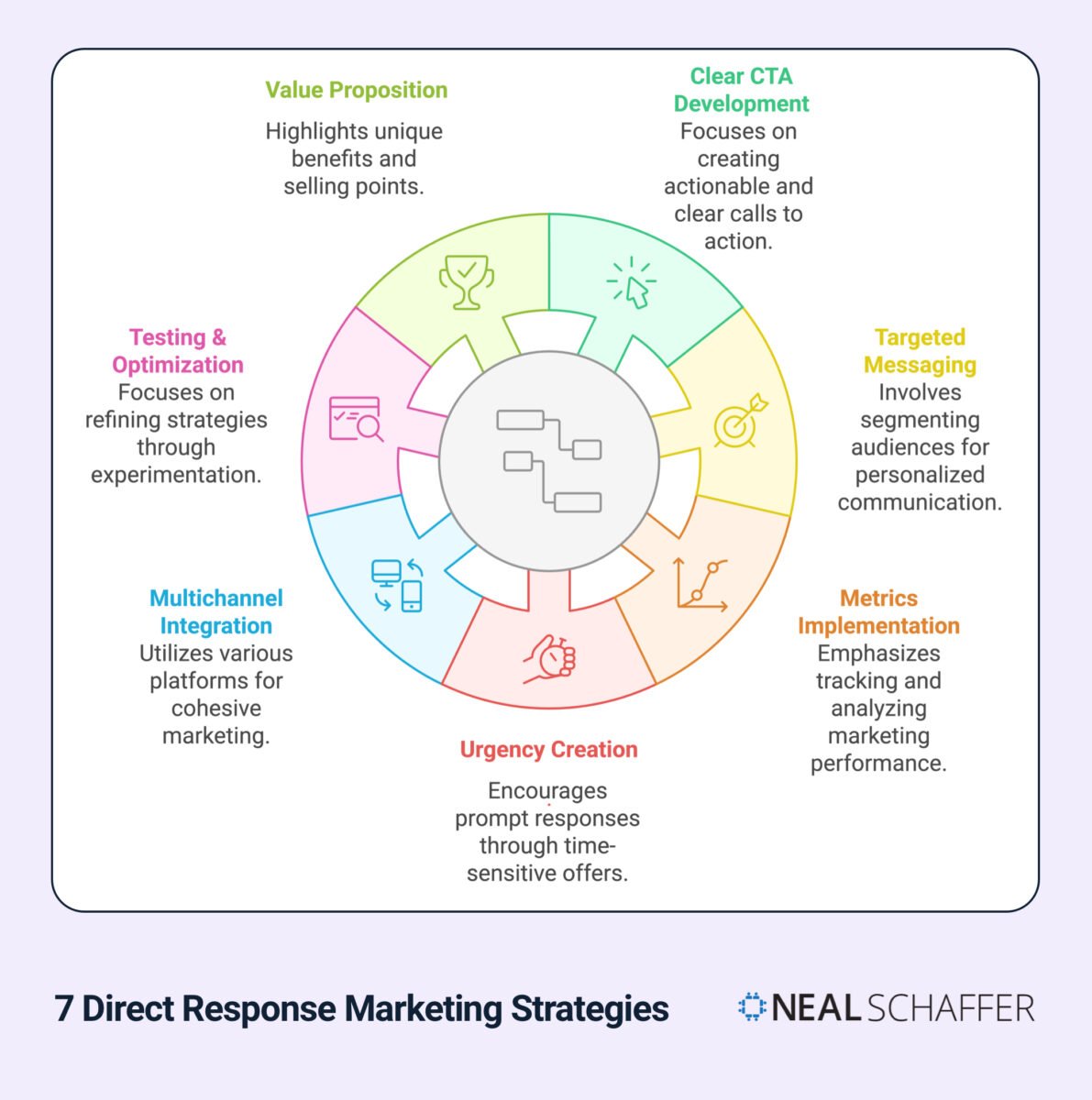
7 Proven Direct Response Marketing Strategies
Implementing effective direct response marketing requires a systematic approach focused on driving immediate action. With 97% of marketers reporting higher response rates through personalized campaigns, these strategies provide a framework for creating successful campaigns that generate measurable results.
1. Clear Call-to-Action (CTA) Development
Effective CTAs drive immediate action by telling your audience exactly what to do next. Your call-to-action should be prominent, specific, and compelling enough to motivate immediate response.
Key elements of successful CTAs include:
The Digital Marketing Playbook for Small Teams
My latest book helps small businesses, entrepreneurs, and marketers bring search, email, and social together into one digital marketing strategy that actually compounds.
Drawing on my work as a Fractional CMO, Digital Threads turns complicated tactics into a clear, practical plan you can follow, whatever your budget or team size.
Grab your copy on Amazon and start weaving your own digital threads. Click the cover or the button below to get started.

- Action-oriented language that creates urgency
- Clear value proposition for taking action
- Simple, straightforward instructions
- Prominent placement within marketing materials
- Multiple response options (phone, email, website)
2. Targeted and Personalized Messaging
Personalization transforms generic marketing messages into relevant, engaging communications that resonate with your target audience. The same content personalization thinking that drives blog and website engagement applies here, only with a response mechanism attached. In email specifically, the subject line is the first thing worth segmenting and testing, because nothing else in the campaign matters if the message never gets opened.
Essential personalization elements include:
- Customer segmentation based on behavior and preferences
- Customized offers for different audience segments
- Personalized greeting and content
- Relevant examples and use cases
- Tailored timing and delivery methods
3. Measurable Metrics Implementation
Implementing robust tracking systems ensures you can measure and optimize campaign performance. This approach integrates seamlessly with marketing technology trends to provide actionable insights.
Critical metrics to implement:
- Response tracking codes
- Conversion tracking pixels
- A/B testing parameters
- ROI calculation formulas
- Customer journey tracking
4. Creating Urgency in Campaigns
Urgency motivates immediate action by creating a compelling reason to respond now rather than later. This strategy must be implemented authentically to maintain credibility with your audience.
Effective urgency tactics include:
- Limited-time offers
- Exclusive access periods
- Quantity limitations
- Early-bird incentives
- Sequential deadline reminders
5. Multichannel Approach Integration
A multichannel strategy puts your message in front of audiences on the channels they actually use, instead of betting the whole campaign on one. Start with the digital marketing platforms your audience already lives on, then run the same offer across them with channel-appropriate creative. Email tends to do the heaviest lifting, which is why a documented email marketing strategy sits underneath most direct response programs that actually work.
Key channels to consider:
- Email marketing campaigns
- Social media advertising
- Direct mail initiatives
- SMS marketing
- Retargeting campaigns
6. Continuous Testing and Optimization
Regular testing and optimization ensure your campaigns maintain peak performance over time. This process involves systematic evaluation and refinement of all campaign elements.
Testing priorities include:
- Offer variations
- CTA placement and wording
- Message timing
- Creative elements
- Channel effectiveness
7. Strong Value Proposition Creation
A compelling value proposition clearly communicates why your audience should take immediate action. This element builds on effective content marketing principles to drive engagement.
Value proposition components:
- Clear benefit statement
- Problem-solution framework
- Unique selling points
- Risk reversal elements
- Social proof integration
Implementing Direct Response Marketing
Successful implementation of direct response marketing requires a strategic approach that combines multiple channels and techniques. Companies that integrate digital strategies with traditional direct response methods see a 28% increase in conversion rates. This section provides practical guidance for launching effective campaigns.
Getting Started
Beginning your direct response marketing journey requires careful planning and systematic execution. This process aligns with proven digital marketing strategy principles while focusing on immediate response generation.
Essential implementation steps:
Audience Analysis
- Define target demographic profiles
- Identify key pain points
- Map customer journey stages
- Determine preferred communication channels
Campaign Planning
- Set specific campaign objectives
- Create compelling offers
- Design response mechanisms
- Establish success metrics
Content Development
- Craft persuasive messages
- Design creative elements
- Develop testing variations
- Create follow-up sequences
Common Challenges and Solutions
Understanding potential obstacles and their solutions helps ensure successful campaign implementation. These challenges often align with broader content marketing KPIs and measurement issues.
| Challenge | Impact | Solution |
|---|---|---|
| Low Response Rates | Reduced campaign effectiveness | Improve targeting and offer relevance |
| Tracking Issues | Incomplete performance data | Implement comprehensive analytics |
| Message Saturation | Decreased engagement | Optimize frequency and timing |
| Channel Integration | Fragmented customer experience | Create unified messaging strategy |
Best Practices for Success
Following established best practices helps maximize campaign effectiveness while avoiding common pitfalls. These practices integrate with successful content marketing strategies to deliver optimal results.
Key success factors include:
Data Management
- Regular database cleaning
- Segmentation maintenance
- Response tracking protocols
- Privacy compliance measures
Campaign Optimization
- Regular performance reviews
- A/B testing programs
- Channel effectiveness analysis
- ROI optimization strategies
Customer Experience
- Response handling procedures
- Follow-up sequences
- Customer feedback loops
- Service level standards
Implementing these practices while maintaining focus on digital marketing analytics ensures your direct response campaigns deliver consistent, measurable results. Regular review and refinement of these elements help maintain campaign effectiveness over time.
Measuring Success in Direct Response Marketing
Effective measurement of direct response marketing success requires comprehensive tracking and analysis. Consider that direct mail campaigns achieve open rates of 80-90%, significantly outperforming email’s 20-30% open rate. Understanding these metrics helps optimize campaign performance across all channels.
Key Performance Indicators
Tracking the right KPIs ensures you can accurately measure campaign effectiveness and make data-driven decisions. These metrics align with broader marketing technology trends while focusing on direct response outcomes.
| KPI Category | Metrics to Track | Target Range |
|---|---|---|
| Response Metrics | – Open rates – Click-through rates – Response rates | Industry benchmark +20% |
| Conversion Metrics | – Conversion rate – Cost per conversion – Revenue per conversion | Previous campaign +10% |
| Financial Metrics | – ROI – ROAS – Customer lifetime value | 2x campaign cost minimum |
Tracking Tools and Technologies
Implementing the right tracking tools ensures accurate measurement of campaign performance. These tools integrate with your existing digital marketing analytics infrastructure to provide comprehensive insights.
Essential tracking elements include:
Analytics Platforms
- Campaign tracking software
- CRM integration tools
- Response attribution systems
- Multi-channel tracking solutions
Response Mechanisms
- Unique tracking codes
- Landing page analytics
- Call tracking numbers
- QR code response tracking
Optimization Techniques
Continuous optimization ensures your campaigns maintain peak performance over time. This process aligns with effective content optimization strategies while focusing on direct response metrics.
Key optimization areas include:
Message Refinement
- A/B testing headlines
- Offer optimization
- Call-to-action improvements
- Creative element testing
Audience Targeting
- Segment performance analysis
- Response pattern identification
- Demographic refinement
- Behavior-based targeting
Channel Performance
- Channel attribution analysis
- Cost per channel optimization
- Cross-channel integration
- Timing optimization
Regular analysis of these metrics through performance measurement tools helps identify opportunities for improvement and ensures your direct response campaigns continue to deliver strong returns on investment.
Frequently Asked Questions
Direct response marketing is advertising designed to get one specific, measurable action from the person who sees it, right now. Instead of building awareness that pays off later, every ad carries an offer, a deadline, and a way to respond, so you can trace revenue back to the exact campaign that produced it.
Brand marketing builds recognition and preference over an extended exposure period, while direct response marketing drives an immediate action you can count. Brand campaigns are measured with long-term brand metrics; direct response campaigns are measured with response rates and ROI within days. Most businesses need both, but only one of them will show up in this quarter’s numbers.
Common examples include limited-time email offers, social media ads with a lead form, retargeting campaigns, SMS promotions, direct mail with a coupon code, and any TV or radio spot that ends with a phone number or URL. The format matters less than the structure: an offer, a reason to act now, and a trackable response mechanism.
Track response rate, conversion rate, cost per acquisition, return on ad spend, and customer lifetime value, and tie each one back to a specific campaign with unique codes, dedicated landing pages, and tracking pixels. If a campaign cannot be attributed to a response, it is not direct response marketing, it is brand advertising with a call-to-action stapled on.
Yes, and the measurement case is stronger than ever. Personalized campaigns produce higher response rates for 97% of marketers, and blending digital techniques with direct response raises response rates by 63%, website visits by 68%, and lead generation by 53%. The channels keep changing; the offer-urgency-CTA structure does not.
Ready to Run Campaigns That Actually Ask for the Sale?
Direct response marketing works because it forces a decision. You put a real offer in front of a defined audience, you give them a reason to act now instead of later, you give them one obvious way to respond, and then you count what came back. Do not try to rebuild your entire marketing program around it. Pick one segment, one offer, one tracked response mechanism, run it for a month, and let the numbers tell you what deserves more budget.
The campaigns that hold up over time are the ones plugged into something bigger, which is where a documented digital marketing strategy earns its keep: it tells you which offers to make, to whom, and on which channels, so your direct response work compounds instead of resetting every quarter. If you would rather have someone build that with you, take a look at my Fractional CMO services, or just reach out and tell me what you are trying to sell.