Editorial Note: I may earn a commission when you visit links that appear on my website.
What Is Growth Hacking? A Strategic Guide for Marketers and Business Owners
Ever since Sean Ellis coined the term “growth hacker” back in 2010, and especially after Ryan Holiday’s book Growth Hacker Marketing brought the concept mainstream, marketers everywhere have been trying to figure out how to apply these strategies to their own businesses. But what exactly is growth hacking? And more importantly, can it work for companies beyond Silicon Valley startups?
That’s exactly what I’m breaking down here.
Having worked as a Fractional CMO for multiple companies and consulted with hundreds of businesses on their digital marketing strategies over the course of my 15+ year career, I’ve seen firsthand which growth tactics actually move the needle and which ones are just hype. I’ve also taught digital marketing at universities including Rutgers Business School and UCLA Extension, written six books on marketing, and host the Your Digital Marketing Coach podcast where I regularly discuss these concepts with fellow practitioners.
Here’s what I can tell you: Growth hacking isn’t just for tech startups with VC funding. The principles work for any business willing to approach marketing with a test-and-learn mentality.
Key Takeaways
✅ Growth hacking combines marketing, product development, and data analytics to find scalable growth opportunities through rapid experimentation.
✅ Sean Ellis coined the term in 2010, defining a growth hacker as someone whose “true north is growth.”
✅ Famous examples include Dropbox (3900% growth from their referral program) and Airbnb’s Craigslist integration.
✅ The approach differs from traditional marketing by focusing on speed, data, and the full customer lifecycle rather than just acquisition.
✅ Any business can apply growth hacking principles by building a testing culture and measuring everything.
What Is Growth Hacking?
Growth hacking is a marketing approach that prioritizes rapid experimentation, data analysis, and creative problem-solving to achieve scalable business growth. Unlike traditional marketing, which often relies on big budgets and long campaign cycles, growth hacking focuses on finding clever, cost-effective ways to acquire and retain customers fast.

Sean Ellis, who invented the term while working at Dropbox, defined a growth hacker as “a person whose true north is growth.” That simple statement captures everything you need to know about the mindset: every decision, every experiment, every strategy ties back to one question: will this help us grow?
The concept took off because startups needed it. Traditional marketing playbooks designed for established companies with big budgets didn’t work for bootstrapped founders trying to compete against giants. Growth hacking gave them a framework.
How Growth Hacking Differs from Traditional Marketing
| Aspect | Traditional Marketing | Growth Hacking |
|---|---|---|
| Focus | Brand awareness, broad reach | Measurable growth metrics, conversions |
| Timeline | Long campaign cycles | Rapid experiments (days/weeks) |
| Budget | Often substantial | Optimized for minimal spend |
| Approach | Separate channels/siloes | Integrated product + marketing |
| Measurement | Impressions, reach | Acquisition cost, retention, revenue |
| Mindset | Campaign-based | Continuous testing |
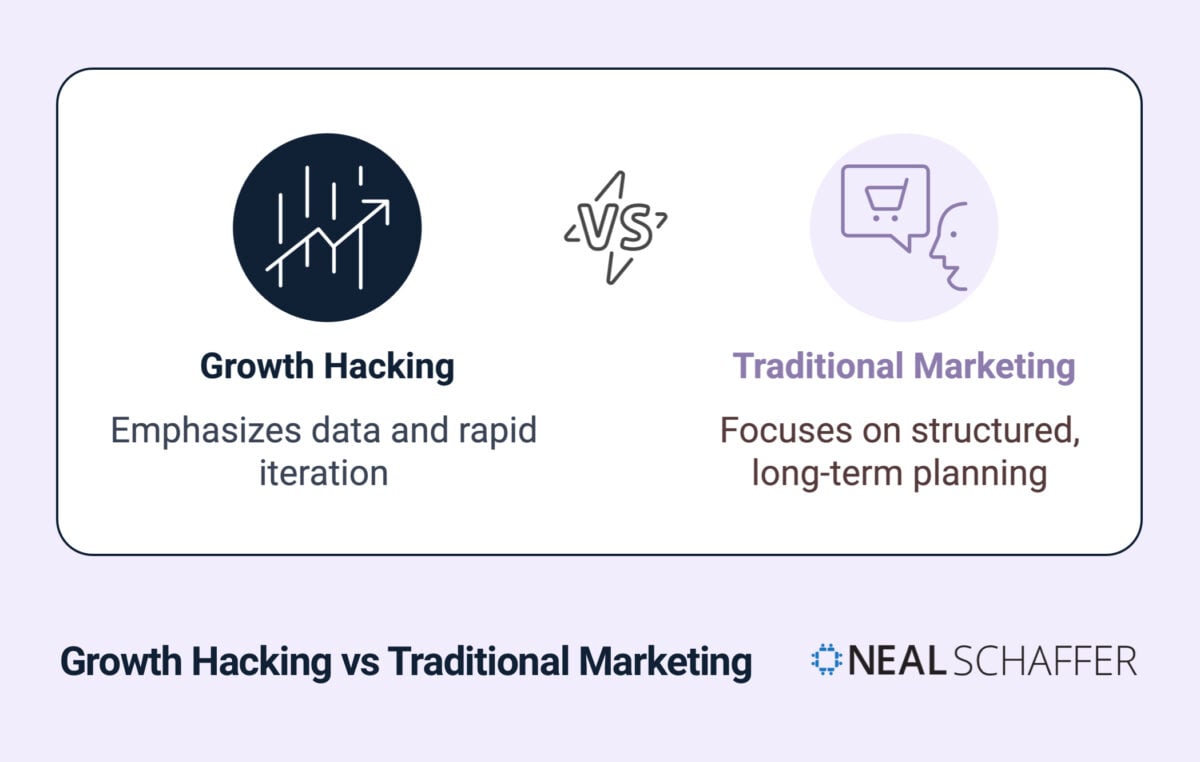
The key difference? Traditional marketers ask “How do we reach more people?” Growth hackers ask “How do we grow faster with what we have?” That same framing question is what separates the two disciplines people most often confuse in this space, which is why it helps to be clear on growth marketing vs. demand generation before you decide which team owns which number.
Why Does Growth Hacking Matter for Your Business?
Growth hacking matters because the numbers don’t lie. According to CB Insights research, 42% of startups fail because there’s no market need for their product, and another 29% run out of cash before finding sustainable growth. A growth hacking approach helps businesses validate demand quickly and find efficient paths to revenue before resources run out.
And this isn’t just relevant for startups. With only 2-3% of website visitors converting on average, even established businesses leave massive opportunities on the table. Small improvements in conversion rates, retention, or referrals compound into significant revenue gains.
Consider this stat from Bain & Company research published in Harvard Business Review: increasing customer retention rates by just 5% increases profits by 25% to 95%. That’s the power of growth thinking applied to the full customer lifecycle, not just acquisition.
What Are the Core Principles of Growth Hacking?
Three principles separate growth hackers from traditional marketers:
Data-Driven Decision Making
Every strategy needs measurement. Every tactic needs testing. I’ve written extensively about social media analytics and content marketing ROI because without data, you’re just guessing. Growth hackers don’t guess.
Rapid Experimentation
Speed matters more than perfection. Run small tests, analyze results quickly, double down on what works, kill what doesn’t. This is why A/B testing is fundamental to growth hacking. The faster you learn, the faster you grow.
Cost-Effective Scaling
Find the approaches that deliver maximum impact with minimal investment. This doesn’t mean cheap tactics. It means efficient ones. Sometimes that’s a viral referral program. Sometimes it’s SEO-optimized content that compounds over time. The goal is always ROI.
What Are the Four Pillars of Growth Hacking?
Before you start running experiments, you need a foundation. Growth hacking rests on four pillars that build on each other:
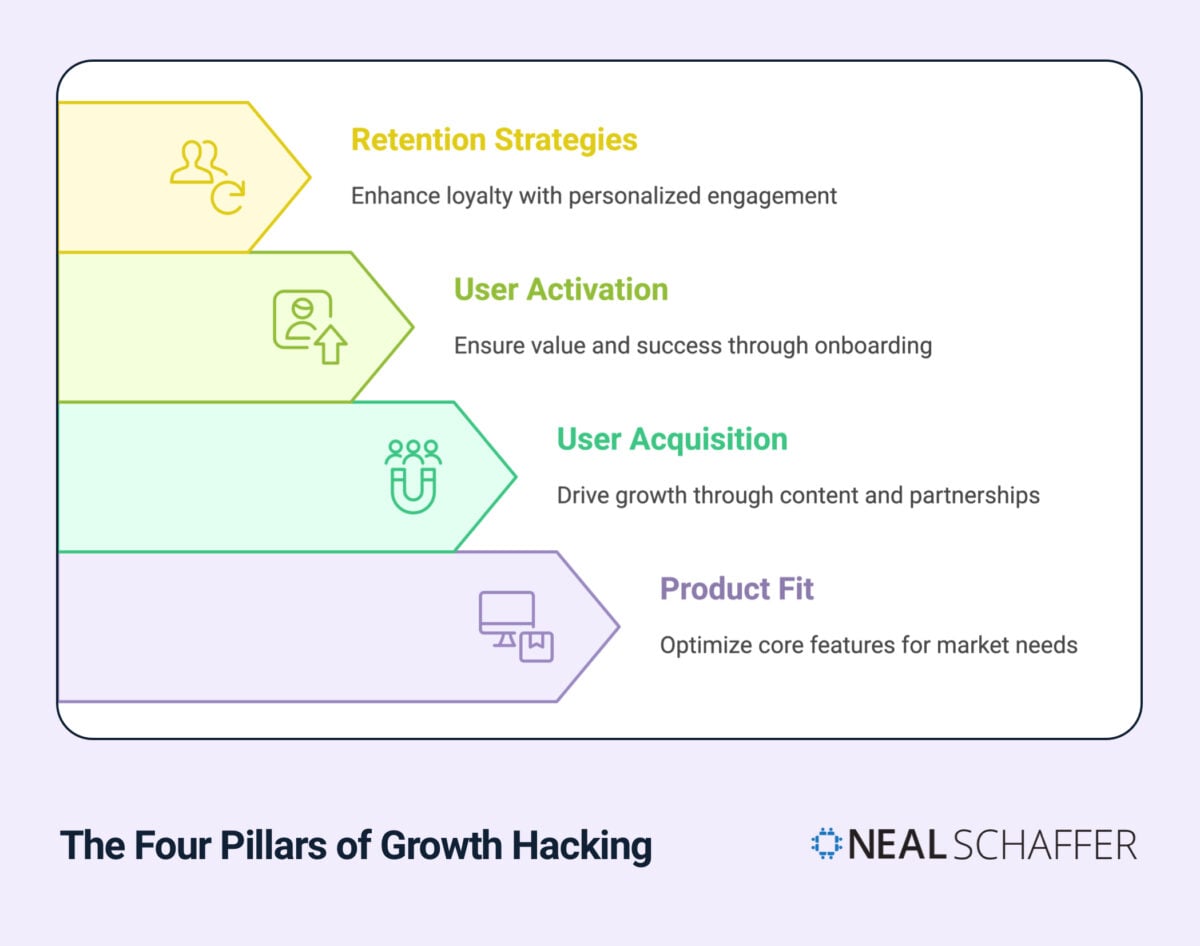
Product Fit comes first. If your product doesn’t solve a real problem for a specific audience, no amount of clever marketing will save you. This is why 42% of startups fail due to no market need.
Make Your Marketing Finally Work Together
My latest book helps small businesses, entrepreneurs, and marketers bring search, email, and social together into one digital marketing strategy that actually compounds.
Drawing on my work as a Fractional CMO, Digital Threads turns complicated tactics into a clear, practical plan you can follow, whatever your budget or team size.
Grab your copy on Amazon and start weaving your own digital threads. Click the cover or the button below to get started.

User Acquisition focuses on finding scalable channels to bring people in. Content, partnerships, paid ads, referrals.
User Activation ensures those new users actually experience value quickly. A great onboarding flow can make or break retention.
Retention Strategies keep customers coming back. Remember: a 5% increase in retention can boost profits by 25-95%.
Each pillar depends on the one below it. Skip product fit and you’re pouring water into a leaky bucket. The people who confirm that fit are almost always the first wave of buyers, which is why marketing to early adopters deserves a plan of its own rather than a line on the launch checklist.
What Are Famous Examples of Growth Hacking?
The best way to understand growth hacking is through real examples. Here are the classics every marketer should know:
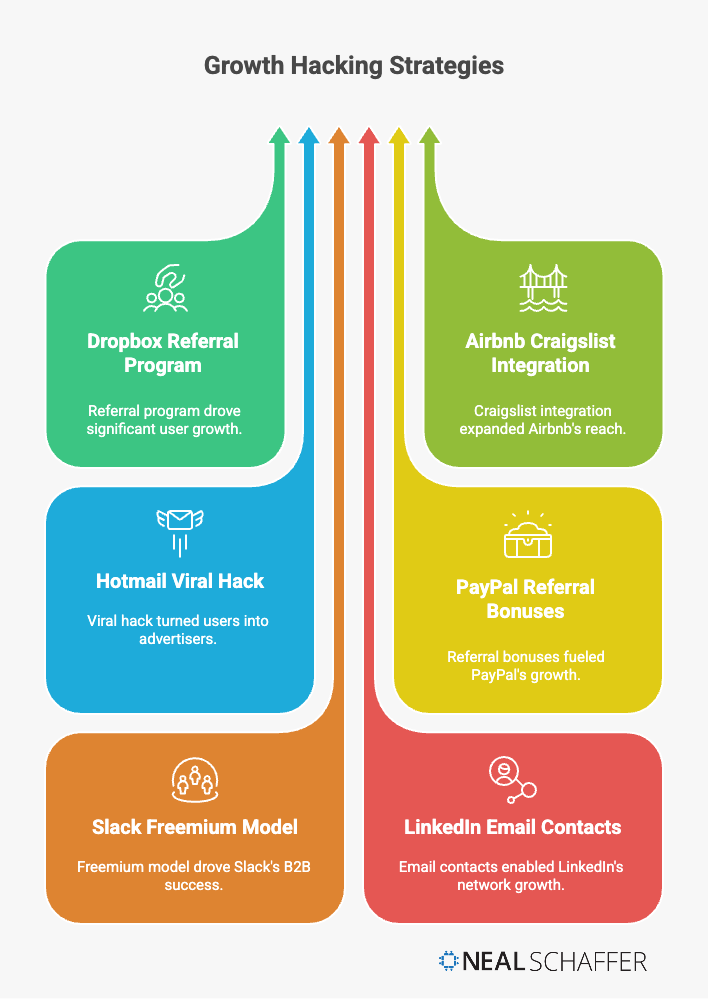
Dropbox: The Referral Program That Changed Everything
Dropbox achieved 3900% user growth in just 15 months through their referral program. The mechanism was simple: give existing users free storage for every friend they invite who signs up. Both parties got value.
Sean Ellis, who led this growth at Dropbox, found that almost one-third of users came from referrals. By building referrals directly into the product experience, they created a sustainable acquisition channel that scaled without proportional cost increases.
Airbnb: The Craigslist Integration
Airbnb’s early growth came from a clever (and controversial) integration with Craigslist. They allowed hosts to cross-post their listings to Craigslist, tapping into an existing audience of millions looking for accommodation. This wasn’t an official API. The team reverse-engineered the platform.
The lesson? Go where your users already are. Don’t wait for them to find you.
Hotmail: The Original Viral Hack
Before anyone called it “growth hacking,” Hotmail added a simple line to every outgoing email in 1996: “PS: I Love You. Get your free email at Hotmail.” This turned every user into an advertiser. The result? Millions of users and eventual acquisition by Microsoft.
More Growth Hacking Success Stories
| Company | Strategy | Result |
|---|---|---|
| PayPal | Referral bonuses ($10 per sign-up) | 7-10% daily growth rate |
| Slack | Freemium with organic word-of-mouth | Fastest-growing B2B SaaS in history |
| Email contacts import for invitations | Massive network effects | |
| Simplified photo sharing + cross-posting | 1 million users in 2 months |
How Do You Build a Growth Team?
Effective growth hacking requires the right people working together. Based on my experience as a Fractional CMO and what I’ve seen work across companies:
| Role | Responsibility | Key Skills |
|---|---|---|
| Growth Lead | Strategy, prioritization, team coordination | Cross-functional leadership, analytics |
| Product Developer | Technical implementation | Coding, product iteration |
| Data Analyst | Metrics, insights, experiment analysis | SQL, analytics tools, statistics |
| Marketing Specialist | Channel optimization, campaigns | Digital marketing, content, ads |
| UX Designer | Conversion optimization, user experience | Design thinking, user research |
Small businesses without dedicated teams can still apply growth hacking principles. Start by designating someone to own growth experiments, even if it’s 20% of their time. The key is having accountability for testing and learning.
What Are the Essential Growth Hacking Strategies?
Here’s where theory meets practice. These are the strategies I recommend to clients:
Viral Loops and Referral Programs
Build sharing into your product. Think about:
- Dual-sided incentives (both referrer and referee benefit)
- Social proof elements
- User-generated content campaigns
- Easy sharing mechanisms
Content-Driven Growth
Content marketing remains one of the most cost-effective growth channels. The compound returns on SEO-optimized content beat paid acquisition over time for most businesses.
Email and Automation
Email marketing has among the highest ROI of any marketing channel. Combined with automation, you can create personalized journeys that nurture leads and retain customers without manual effort.
The AARRR Framework (Pirate Metrics)
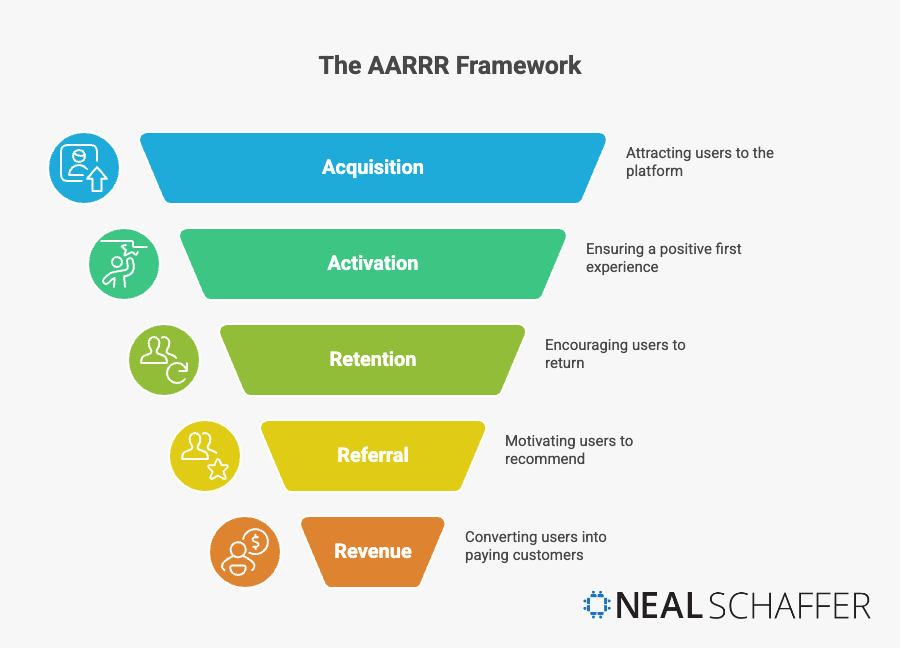
Growth hackers often use the AARRR funnel to organize their work:
| Stage | Metric | Focus |
|---|---|---|
| Acquisition | Where do users come from? | Channel optimization, CAC |
| Activation | Do they have a good first experience? | Onboarding, time-to-value |
| Retention | Do they come back? | Engagement, churn reduction |
| Referral | Do they tell others? | Viral mechanics, NPS |
| Revenue | Do they pay? | Monetization, LTV |
This framework helps you identify where you’re losing potential customers and where to focus your experiments.
What Tools Do Growth Hackers Use?
You don’t need expensive tools to start. But as you scale, these categories become important:
| Category | Purpose | Examples |
|---|---|---|
| Analytics | User behavior, funnel analysis | Google Analytics, Mixpanel, Amplitude |
| A/B Testing | Conversion optimization | Optimizely, VWO, Google Optimize |
| Email Automation | Nurture sequences, retention | Email marketing tools, ActiveCampaign |
| CRM | Customer data, pipeline tracking | HubSpot, Salesforce, Pipedrive |
| Social Listening | Market intelligence | Social media analytics tools |
| Heatmaps | UX optimization | Hotjar, Crazy Egg |
The tools matter less than the discipline of measuring everything and learning from the data.
How Do You Measure Growth Hacking Success?
Without measurement, you’re not growth hacking. You’re just marketing and hoping. Here are the metrics that matter:
Core Growth Metrics
| Metric | What It Measures | Why It Matters |
|---|---|---|
| Customer Acquisition Cost (CAC) | Cost to acquire one customer | Efficiency of acquisition channels |
| Lifetime Value (LTV) | Total revenue from a customer | Determines how much you can spend to acquire |
| LTV:CAC Ratio | Value vs. cost relationship | Should be 3:1 or higher for sustainability |
| Churn Rate | Percentage of customers leaving | Retention health indicator |
| Net Promoter Score (NPS) | Customer satisfaction | Referral potential |
| Conversion Rates | Funnel progression | Where you’re losing people |
The social media statistics and SEO statistics I’ve compiled can help benchmark your performance against industry standards.
Creating a Testing Framework
- Form a hypothesis: “Adding testimonials to our landing page will increase conversions by 15%”
- Design the test: A/B test with control and variant
- Set success criteria: Statistical significance, minimum sample size
- Run the experiment: Long enough to gather meaningful data
- Analyze results: Did it work? Why or why not?
- Iterate: Scale winners, learn from losers, test again
Can Any Business Use Growth Hacking?
Yes. But the tactics vary by business type.
- For B2B companies, growth hacking often focuses on LinkedIn strategies, content marketing, and sales process optimization. I’ve written extensively about how to use LinkedIn for business growth in my book Maximizing LinkedIn for Business Growth.
- For ecommerce, it might mean referral programs, abandoned cart optimization, and product videos.
- For local businesses, local SEO and reputation management become critical growth levers.
The principles stay the same: test quickly, measure everything, double down on what works.
Frequently Asked Questions About Growth Hacking
What is the difference between growth hacking and digital marketing?
Growth hacking is a subset of digital marketing focused specifically on rapid experimentation and scalable growth tactics. Digital marketing encompasses all online marketing activities, while growth hacking prioritizes speed, data, and efficient customer acquisition over brand building or awareness campaigns.
Is growth hacking only for startups?
No. While startups popularized growth hacking because they needed low-cost growth strategies, the principles apply to any business. Established companies use growth hacking to launch new products, enter new markets, or optimize underperforming funnels.
What skills do you need for growth hacking?
Growth hackers typically combine marketing knowledge, data analysis skills, and some technical ability. You need to understand user psychology, know how to interpret metrics, and often have enough coding or technical knowledge to implement and test ideas quickly.
How long does growth hacking take to show results?
Individual experiments can show results in days or weeks. Building sustainable growth systems takes months. The key is running many small experiments quickly rather than betting everything on one big campaign.
What’s the first step to start growth hacking?
Start by defining your one key metric (your “North Star”). Then map your customer journey and identify where you’re losing the most people. Design experiments to address those gaps. Measure everything.›

What’s Your Next Step?
Growth hacking isn’t magic. It’s a mindset combined with disciplined execution.
Start here:
- Pick one metric that matters most to your business right now
- Identify your biggest bottleneck in the customer journey
- Design three experiments to address it
- Run them, measure results, learn
If you want to go deeper on specific growth tactics, check out my posts on influencer marketing strategy, email marketing tips, and social media ROI. And subscribe to the Your Digital Marketing Coach podcast where I regularly discuss these concepts with practitioners who are doing this work every day.
The businesses that grow fastest aren’t necessarily the ones with the biggest budgets. They’re the ones that learn fastest. That’s what growth hacking is really about.
DIY your digital marketing with AI.
Practical advice on social, content, influencer, and search marketing, plus the AI tools that make each one easier. Join thousands of founders and business owners who read it.