
SEO writing has evolved far beyond sprinkling keywords into blog posts. In today’s search-driven world, great SEO writing means creating content that search engines—and large language models like ChatGPT—can understand and that people actually want to read.
Whether you’re a small business owner trying to compete with bigger brands or a marketer looking to increase organic traffic, mastering SEO writing is essential. In this guide, I’ll share not just the basics of SEO writing but also the strategies I’ve used with clients to help them attract the right audience, build authority, and turn website visitors into customers.
Key Takeaways
✅ Write for people first, keywords second. Search engines reward the page that answers the question better than the competition, not the one stuffed with the target phrase. Get the substance right, then work the keywords in.
✅ Match the search intent behind your keyword. A term can be informational, navigational, transactional, or commercial. Figure out which one your keyword serves before you write a single line, then shape the whole piece around it.
✅ Structure is a ranking signal, not decoration. One H1 with your keyword, H2s and H3s that map the logic, and short paragraphs that are easy to scan. Most visitors skim before they read, so build the page for skimming.
✅ The on-page basics still move the needle. Your meta title, meta description, alt text, internal links, and load speed each tell search engines what the page is and who it serves.
✅ Human experience is the part AI cannot copy. With AI Overviews and AI drafts everywhere, your stories, opinions, and firsthand examples are what separate your page from the machine-written version of it.
What is SEO Writing?
Before diving into the tactics to boost search engine optimization, it’s important to understand exactly what SEO writing means. This section will give you a simple definition and explain how search engine optimized writing blends search optimization with audience-focused content creation.
SEO writing is any writing designed to capture the attention of search engines to promote increased reach and high ranking on search engine result pages (SERPs). SEO writing targets search rankings directly.
Although search engine appeal can seem difficult to understand, search engines typically focus on two things: keyword optimization and high-quality, people-first writing. To rank highly in search results, from Google search to Bing, focus your attention on incorporating keywords that will show up in search terms and creating high-quality content.

Search engines are not people. Although people can appreciate a high-quality piece of content without a series of keywords embedded within, a search engine relies upon keywords to understand and subsequently promote your content. Generic content writing does not incorporate keywords, while search engine optimization content creation does. Copywriting is a third discipline, written to get an immediate action such as a purchase or a signup. I cover where copywriting and content writing split in its own post.
Why SEO Writing Matters for Your Business
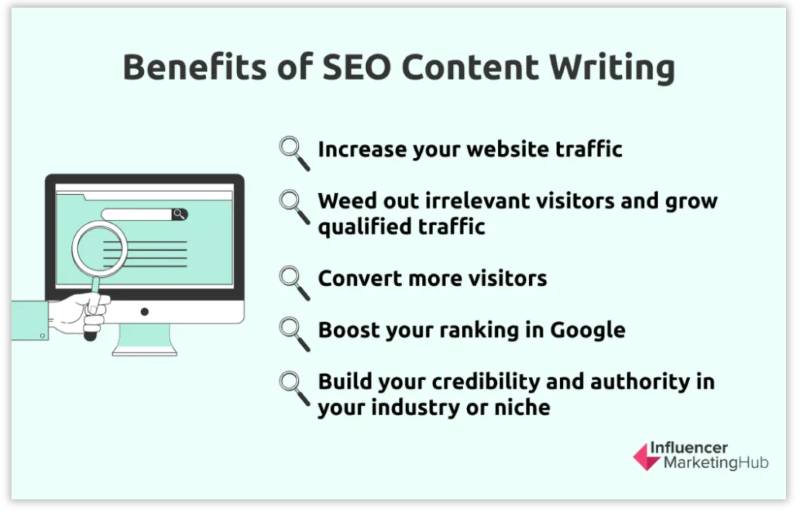
SEO writing isn’t just about ranking higher on Google. It truly is about building trust and driving results. Here, you’ll see why investing in SEO writing pays off in visibility, authority, and long-term business growth.
SEO writing impacts…
- Visibility. Ranking high in search results means bringing in consistent organic traffic. SEO content writing is one of the best ways to increase visibility.
- Authority. Authority is vital for content writers, as it builds trust with your audience and impacts ranking factors. Good search engine optimization content ultimately builds brand credibility.
- Conversions. SEO writing attracts people with intent which, in turn, leads to more leads and higher sales.
- Long-term ROI. SEO writing continues delivering results long after a single campaign has run, unlike paid ads. Web content can be evergreen and continually refer back using internal links, making its long-term ROI very real.
SEO writing matters for your business, because search engine results can drive or undermine your organic traffic.
The Fundamentals of SEO Writing
The basics of SEO writing form the foundation for everything else. By mastering keywords, structure, readability, and on-page optimization, you set your content up for search success.
Keyword Research Basics
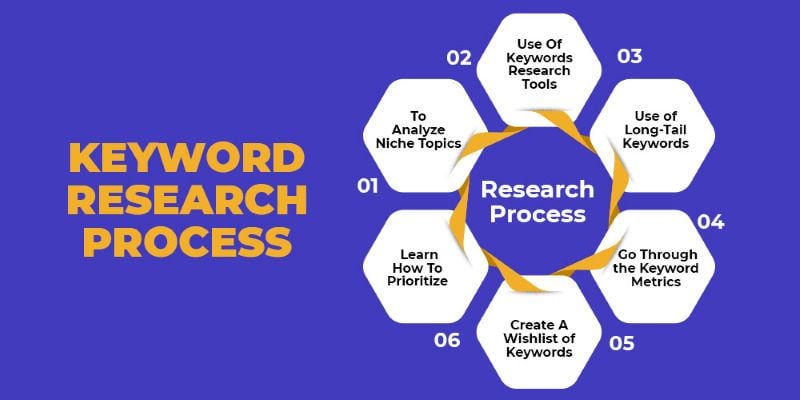
Head terms and long-tail keywords can be easy to confuse; both are vital within content for users to effectively find your work. Head terms are broader, larger-reaching terms, while long-tail keywords are more specific and niche-focused.
A combination of free and paid tools is considered ideal. Free tools can help with design, keyword research, and even optimization, while paid tools can further improve your scores on platforms like Google Search Console.
Keyword selection can be arrived at through research alone, but make sure that research includes user intent; business goals are important, but user intent will effectively inform how you phrase your keywords and improve search engine results.
Headings and Structure
Headings are a vital part of both search engine results and structure, as they effectively get across content ideas while informing search engines about the content of a page and the audience most likely to benefit from it.
H1 tags are the most important tags, while H2 show less important (but still valuable) ideas, and H3 tags rank lowest of all. All are a part of creating SEO-friendly content to help search engines organize your content, while improving the scannable nature of your content.
In an ideal world, your search traffic would focus whole-heartedly on your work, but audience attention spans and the vast amount of competition make it necessary to create content that can quickly and easily be scanned for information. Headings create a structure that makes scanning easy and straightforward.
On-Page Essentials
Meta titles and descriptions are used to point search engines to relevant content. A meta title is a title used to quickly and effectively describe a piece of content, while descriptions offer a space to include more keywords to give greater detail about a page or post.
Alt text is another place for your keywords to improve keyword density and help boost your place in search. When alt text is used properly and includes relevant keywords, an image search can also help bring your work up in SERPs.
Finally, make the most of your content by utilizing both internal and external linking strategies. Internal links can help build trust and perpetuate traffic, while external linking can help establish authority.
Readability and Flow
Readability is also important for ranking highly in search results. Short paragraphs and concise sentences get your point across without sacrificing white space and readability.
Is LinkedIn Actually Bringing You Business?
My latest book helps professionals, entrepreneurs, and business owners turn LinkedIn from a static profile into a real source of clients and growth.
Maximizing LinkedIn for Business Growth gives you clear, practical steps to build a profile that gets noticed and a network that actually sends business your way.
Grab your copy on Amazon and put it to work this week. Click the cover or the button below to get started.

Active voice will always grab and hold attention more than passive. Passive voice is distant and cold, while active voice provides clarity and a more direct line to your audience. Jargon, too, alienates your audience, and should be avoided when possible.
Writing for Search Intent and Humans
Search engines may deliver the traffic, but humans decide whether to stay and engage. This section will help you align your content with different types of search intent while keeping it reader-friendly.
The most common types of content include informational, navigational, transactional, and commercial intent. Intent matters because…
- Informational intent delivers information to audiences, and can include how-tos and narratives.
- Navigational intent includes content focused on delivering a specific page or area. This includes searches for local places, or even specific pages.
- Transactional intent is intent focused on making a purchase. Search engine optimization efforts for transactional intent will likely include reviews and comparisons.
- Commercial intent describes intent circling around identifying a specific product or service, or those that are beginning the purchasing process.
Mapping blog posts to user intent means tailoring your keywords to match the spirit of search results if not the letter of those results. To map your blog posts, identify the type of intent present behind a search query, and place keywords within the post to match that intent.
SEO writing does need to rank, but value is pivotal. Make sure that your SEO pieces are designed to both rank and solve common audience problems.
Advanced SEO Writing Strategies
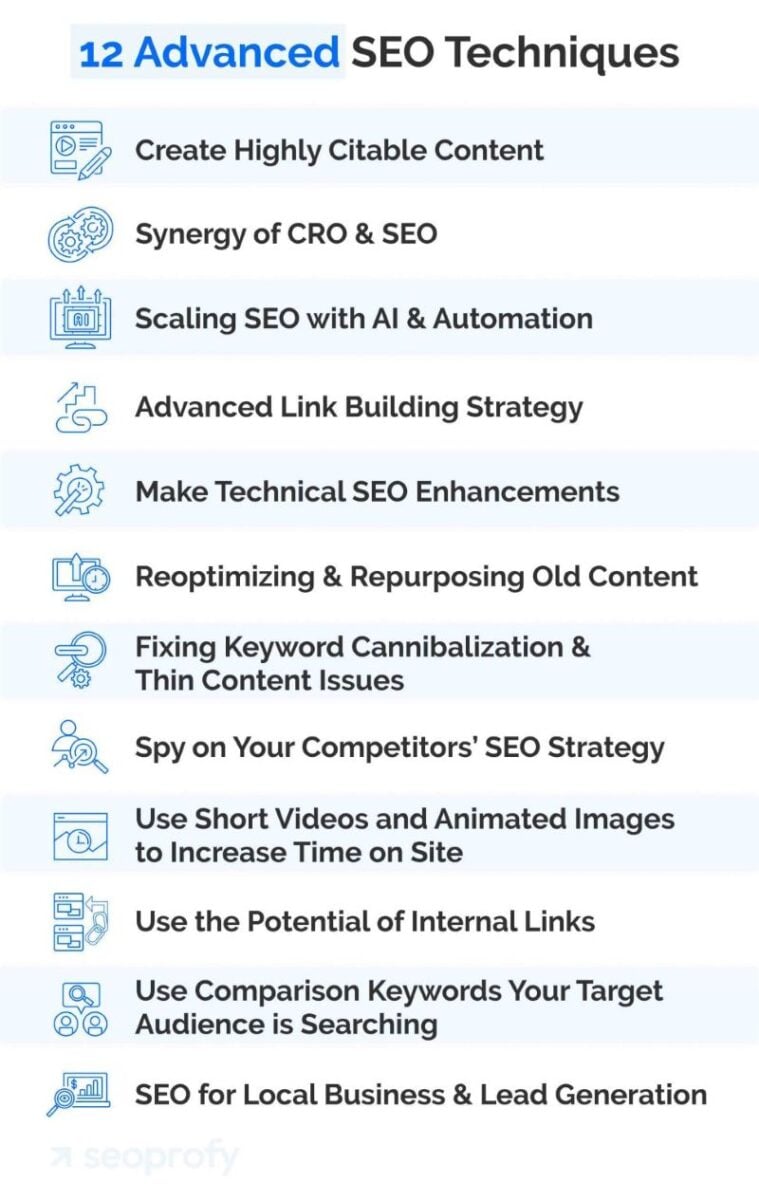
Once you’ve nailed the fundamentals, it’s time to level up. These advanced techniques—like optimizing for snippets, FAQs, and semantic keywords—can give your content a competitive edge.
Once you have a grasp on the basics, you can begin optimizing in more advanced and complicated avenues. Featured snippets and “people also ask” are two great ways to optimize content to show up in search results. Optimizing for these areas requires paying attention to search intent and meeting additional needs.
Historical optimization is another great way to level up your optimization. Old content can be refreshed to rank highly by updating keywords and reviewing search intent.
FAQs and schema markup can also be used to improve keyword density and show up in Google search results and other search pages. Identify other questions that can be answered and other problems that can be solved and include those in your content.
Once a solid keyword strategy is in place, and you have a grasp of search algorithms and how to support organic search traffic, you can move on to incorporating latent semantic indexing keywords, or keywords that support the main keyword without merely providing a synonym. Think keywords like “organic traffic” and “research tools” for a main topic of “SEO content.”
Content length and depth are also considerations to take into account. The length of your work and the depth it stretches to can inform search engines, as well. Rather than trying to always hit a certain word count, opt for high quality content–even if it means going over or under the “right” length.
The Future of SEO Writing in the Age of AI
With AI summaries and algorithm updates changing how search works, SEO writing is evolving fast. Future-proof your content by focusing on human expertise and unique insights.
As a quick Google search can attest, Google released an impactful Helpful Content Update to their search algorithms, which happened at around the same time AI overviews were introduced to search results. These overviews pull from multiple sources to answer questions, and inclusion in those answers can help increase exposure.
Human expertise and credibility will provide a unique perspective that AI alone cannot offer. Infuse your content with humanity, and you will get a leg up on content that has been developed entirely with AI. That credibility is what Google’s E-E-A-T framework is built to read, and I wrote up how long E-E-A-T improvements take to show up after working through it on my own library.
AI-proof content includes content that uses stories, insights, and personal examples to humanize your work and connect with your audience.
Common SEO Writing Mistakes to Avoid
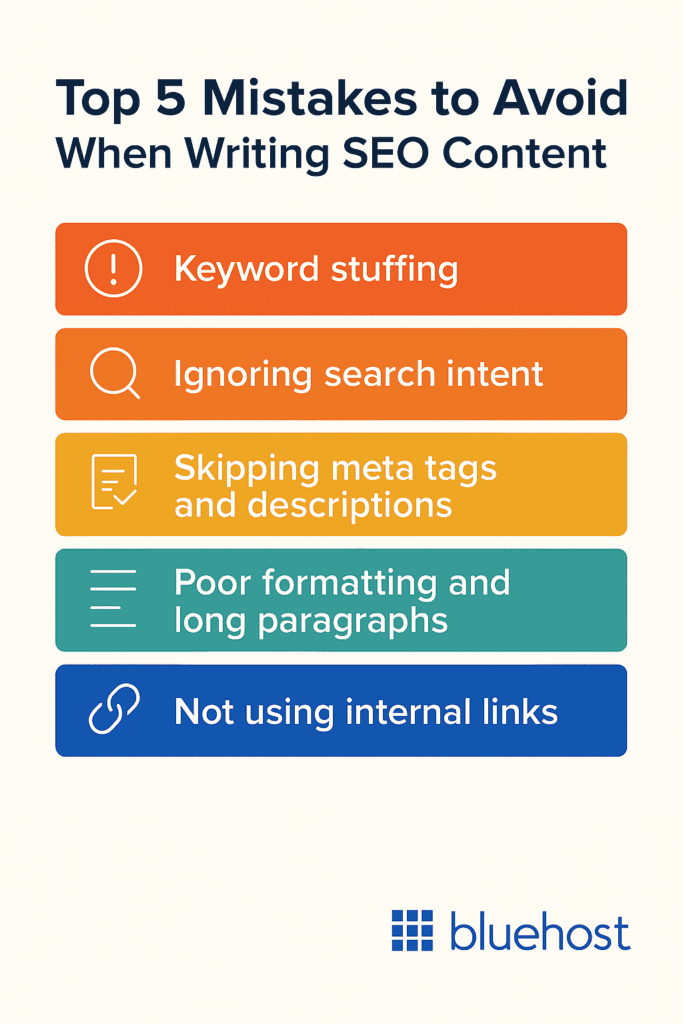
Even experienced writers fall into traps that can hurt rankings. I have identified the most common SEO writing mistakes and how to steer clear of them. They include:
- Keyword stuffing. Keyword density is important, but a high volume of keywords can actually detract from your rankings.
- Writing for algorithms instead of readers. Your audience should be your focal point. While algorithms matter, they change too often to make them your sole focus.
- Ignoring meta descriptions. Meta descriptions matter! Make the most of your meta descriptions by including your main keyword and identifying the purpose of the page in question.
- Forgetting CTAs and conversions. Calls to action and focused conversions will help drive your content and keep your audience engaged.
- Relying entirely on AI-generated content. AI content can be a useful jumping-off point, but should not be used to replace actual human writers. Whether you use AI for outlines, or as a basic framework within which to work, make sure that it is not the bulk of your work.
Practical SEO Writing Checklist
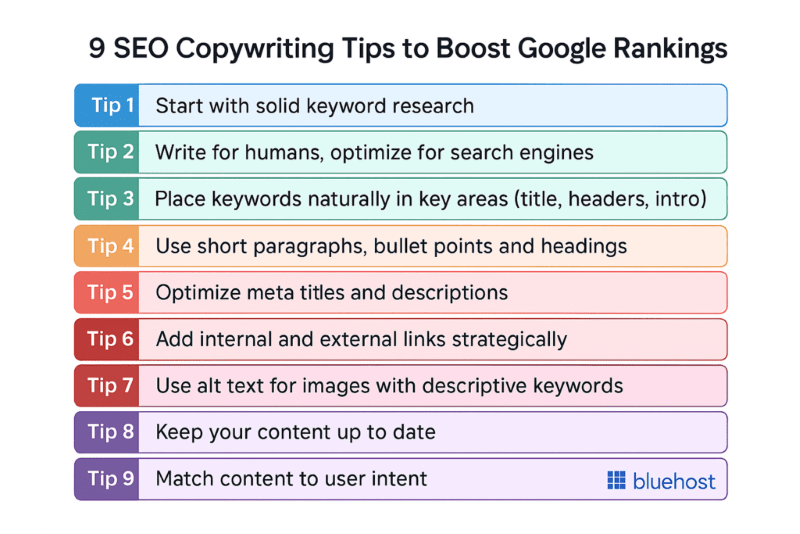
Sometimes you just need a quick guide to make sure nothing gets missed. Use this checklist to help you review your content before hitting publish to confirm it’s SEO-ready.
- Write one H1 with the target keyword. Your H1 is essentially your title and should be the main focus of any given piece.
- Use primary keywords in your intro and conclusion. Your intro and conclusion should introduce your point or purpose and wrap it up using your main keyword to provide structure and inform search.
- Place secondary keywords in H2/H3s. Secondary keywords act as a support for your main keyword, just as paragraphs act as a support for your overall piece of content.
- Optimize meta tags, alt text, and URLs. Optimizing these smaller aspects of your work ensures that Google and other search platforms can quickly and easily find you, categorize your work, and share it with your target audience.
- Add at least 2–3 internal links and 1–2 external links. Links help establish authority and build trust, so make sure to include them in your pieces.
- Ensure mobile readability and fast load speed. A vast number of your audience members will be searching on their phones. Make sure that your pages show up well on mobile.
- End with a strong CTA. Finally, give your audience something to do at the end of reading or visiting your site. A strong call to action encourages engagement and makes it more likely that your audience will complete a sale or come back for more.
Tools That Can Help (Optional but Useful)
The right tools can save time and sharpen your SEO writing. From free keyword research resources to advanced optimization platforms, these are worth knowing about.
- Free tools: Google Trends, Search Console, AnswerThePublic. These can be used without an upfront investment and can help inform your SEO practices.
- Paid tools: SEMrush, Ahrefs, Clearscope, Surfer SEO. Each of these tools can help take your optimization one step further, with insights regarding length, peripheral keywords, and more.
- Writing helpers: Grammarly, Hemingway, Yoast. Each of these tools can help refine your writing and improve the flow of your work.
Frequently Asked Questions About SEO Writing
SEO writing is content created to rank in search engines while still being genuinely useful to the people who read it. It pairs keyword research and on-page structure with clear, high-quality writing that answers a real question. The aim is to satisfy the search engine and the reader in the same piece.
Regular content writing focuses on the reader alone, while SEO writing also gives search engines the signals they need to understand and rank the page. That means targeting a keyword, matching search intent, and handling on-page elements like the meta title, headings, and internal links. The writing quality still has to be there; the SEO layer sits on top of it.
There is no ideal keyword count or density to hit, and chasing one leads to the keyword stuffing that can hurt your rankings. Start with real keyword research so you know your primary and secondary terms, then use the primary keyword in your H1, intro, and conclusion and place the secondary ones naturally in your H2s and H3s. After that, write for the reader and let related terms appear on their own.
AI content is fine as a starting point, but leaning on it for the whole article is a mistake. Google’s Helpful Content Update rewards firsthand experience and original insight, which is exactly what fully automated content lacks. Use AI for outlines or a rough draft, then add the stories, opinions, and examples only you can provide.
There is no magic word count. Cover the topic completely enough to answer the searcher’s question and the follow-up questions they are likely to have next, then stop. A focused 1,200-word piece that fully answers the query will outrank a padded 3,000-word article every time.
How Smart SEO Writing Grows Your Business
SEO writing is not just a checklist—it’s a long-term strategy that can make your website your most powerful marketing asset. By focusing on user intent, optimizing your content for search engines, and layering in your expertise, you can consistently attract the right audience, establish authority, and drive real business results.
If you commit to SEO writing as a core part of your content marketing strategy, you’ll find that it doesn’t just improve rankings—it transforms your website into a lead-generating machine. How are you getting started today?