


“LinkedIn LION” is one of the oldest topics I have ever written about, and somehow it still sends people to my site every month. Most of that traffic comes from Google, and a growing share now comes from AI assistants like ChatGPT and Perplexity that surface my older writing when someone asks what a LION is. That tells me the term still confuses people in 2026, more than fifteen years after it caught on.
So rather than leave a dated post to answer the question, I want to give you the honest version: what a LinkedIn LION is, where the idea came from, why the movement faded, and what I actually recommend today. I helped popularize the concept back in 2009, and I am also the person who later called for ending it, so you are getting the full arc from one source.
Key Takeaways
✅ A LinkedIn LION is a LinkedIn Open Networker. It describes someone who keeps their profile open to connection requests from people they have never met, often signaled by putting “LION” in their name or headline.
✅ The movement started around 2009, and I was one of its earliest evangelists. My first book, Windmill Networking, was built on the idea of open networking and included a dedicated chapter on LinkedIn LIONs.
✅ The label is largely obsolete now. Open networking became the default across social platforms, and the LION tag got co-opted by marketers harvesting connections, so it stopped signaling much of anything.
✅ More connections is not the goal. A smaller network of people you have a reason to know beats thousands of strangers, and that matters more now that fake and AI-generated profiles are everywhere.
✅ You can still network openly, just do it deliberately. Skip the label, vet who you let in, and lead with relationships rather than raw connection counts.
What Is a LinkedIn LION?
A LinkedIn LION is a LinkedIn Open Networker, someone who accepts connection requests from people they have never met instead of limiting their network to known contacts. Many of them signal it by adding “LION” or “L.I.O.N.” to their name or LinkedIn headline. The original goal was to grow reach and help bridge networks that would otherwise stay closed off from each other.
In the early days of the platform, declaring yourself a LION was a quick way to tell other users that you welcomed invitations, no prior relationship required. It was part identity, part networking strategy, and for a few years it was a real movement with its own groups and etiquette.
How the LinkedIn LION Movement Started
The LION movement grew out of LinkedIn’s early years, around 2009, when open networking was a fresh idea and the platform was still small. I was one of the first and most visible people writing about it. My first book, Windmill Networking: Understanding, Leveraging and Maximizing LinkedIn, was built on the concept of open networking and devoted an entire chapter to LinkedIn LIONs.
The thinking was simple. Back then LinkedIn was a young network, and most people only connected with colleagues they already knew. It is a very different platform today, as my LinkedIn statistics show. Open networkers were the ones willing to accept invitations from strangers, which helped otherwise siloed networks grow into each other. I coined the idea of “Windmill Networking” to describe building a wide network of trusted connections, helping others, and reaping the benefits over time. The “LION” label, generally credited to the early networker Christian Mayaud and his Lions’ Lair group, became the public badge for that approach. For a stretch, putting LION next to your name genuinely meant something.
How LinkedIn Treated LIONs
LinkedIn was never fully comfortable with open networking. It originally displayed only up to 500 connections on a profile, capped total connections at 30,000, and limited how many invitations you could send. The platform also gave people the “I Don’t Know” response, or IDK, as a way to decline invitations from strangers, and too many IDKs could get your account restricted.
Over the years, LinkedIn shifted to a more neutral stance. It allowed LinkedIn groups built around open networking to exist, and finding fellow LIONs became easier. But the connection cap and the invitation limits never really went away, which is a big part of why the strategy eventually stopped making sense.
Why the LinkedIn LION Movement Is Over
The LION movement faded for three reasons: open networking became normal everywhere, the label got hijacked by marketers, and LinkedIn itself started throttling the behavior. None of those is reversible, which is why I no longer recommend the label to anyone.
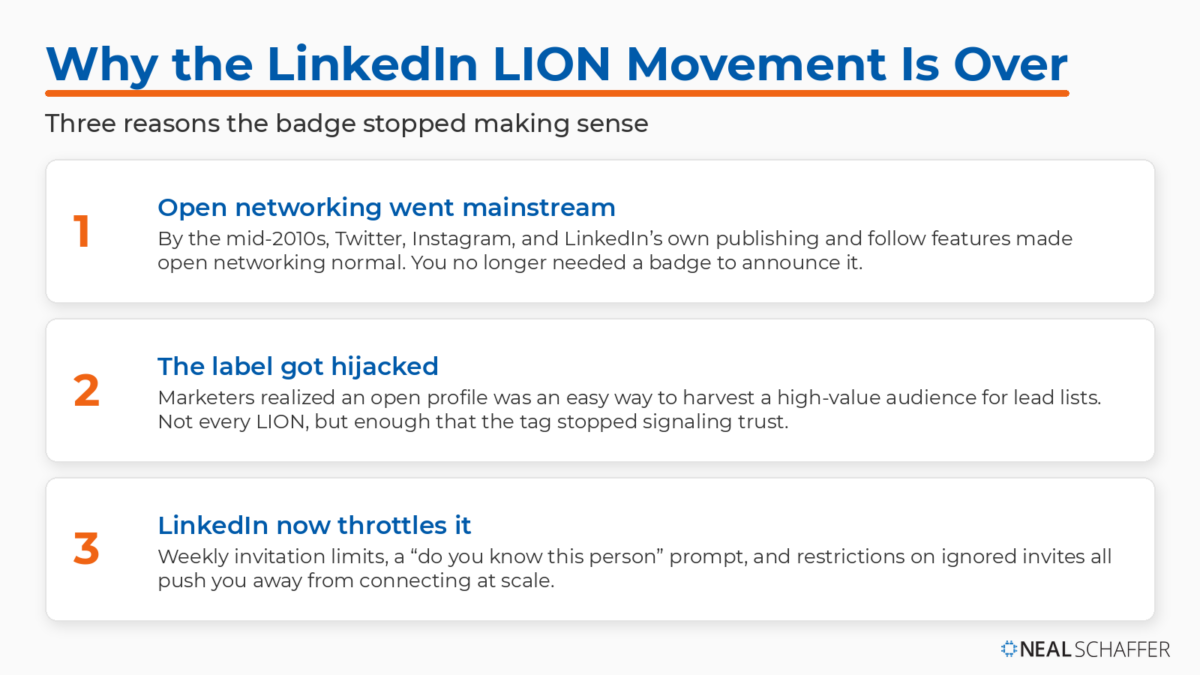
First, open networking went mainstream. By the mid-2010s, Twitter, Instagram, and LinkedIn’s own publishing and follow features made it normal to connect with and learn from people you had never met. You no longer needed a badge to announce that you were open to it. The whole social web worked that way.
Second, the label got hijacked. Marketers and spammers realized that an open networker’s profile was an easy way to reach a high-value professional audience and pull those connections into lead generation and email lists. Not every LION had ulterior motives, but enough did that the tag stopped signaling trust and started signaling caution. That is exactly why I publicly called for an end to the movement back then, even though I had helped build it.
Third, LinkedIn now actively discourages connecting at scale. There are weekly invitation limits, a “do you know this person” prompt on many requests, and restrictions if too many of your invites get ignored. If your account has already been hit, here is why LinkedIn restricts accounts that look too active. The platform itself nudges you away from the behavior that defined being a LION.
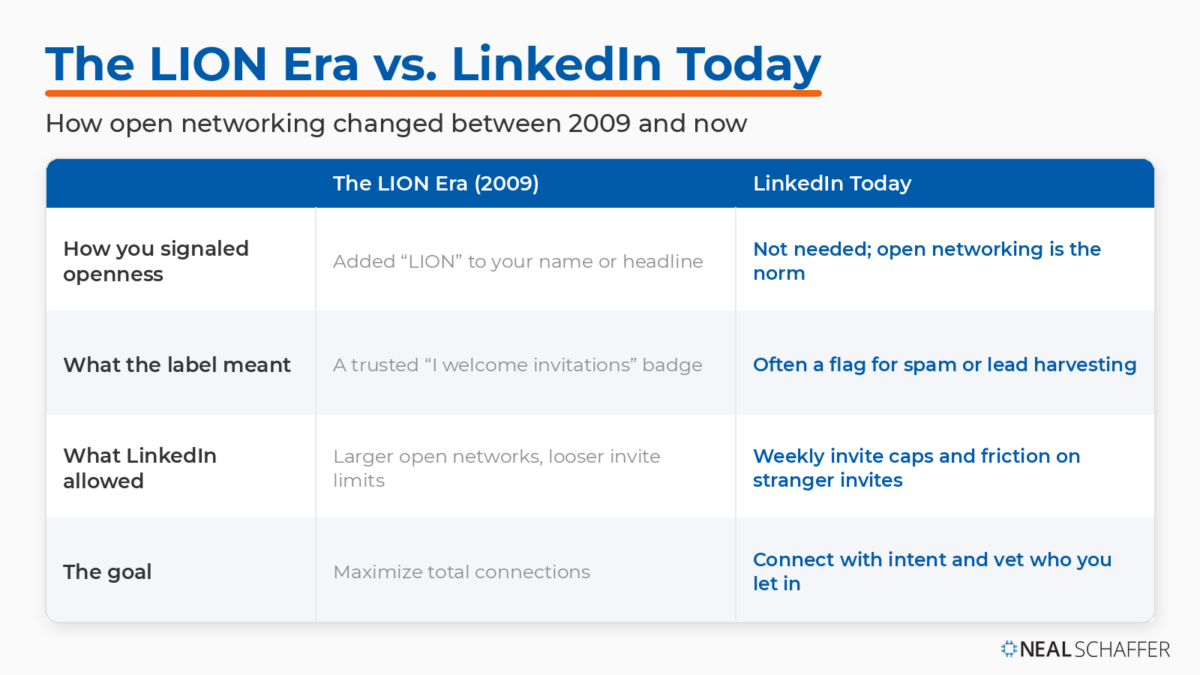
Here is the shift in one view:
| The LION era (around 2009) | LinkedIn today | |
|---|---|---|
| How you signaled openness | Added “LION” to your name or headline | Not needed; open networking is the norm |
| What the label meant | A trusted “I welcome invitations” badge | Often a flag for spam or lead harvesting |
| What LinkedIn allowed | Larger open networks, looser invite limits | Weekly invite caps and “do you know this person” friction |
| The goal | Maximize total connections | Connect with intent and vet who you let in |
More Connections Is Not the Goal
Chasing a bigger number was always the weakest part of the LION idea, and it ages worse every year. A focused network of people you actually have a reason to know is more useful than thousands of strangers, and vetting who you let in matters more now than it ever did.
The most common pushback I heard back when I wrote about LIONs is something I still agree with: every connection should have a purpose. Fifty meaningful connections will do more for you than five hundred random ones. And in 2026, with fake and AI-generated profiles common, accepting anyone is a real risk. A connection gets a closer look at your network and your activity, so it is worth checking a profile before you accept and removing connections that turn out to be spam. If you do want to find and verify specific people deliberately, LinkedIn’s search is a far better tool than waiting for open invitations.
What to Do Instead of Chasing LIONs
Skip the label and network with intent. My two long-standing recommendations still hold: do not accept LION-branded invitations without a personal note, and remove any open-networker branding from your own profile. Then focus on connecting with people you have a genuine reason to know.
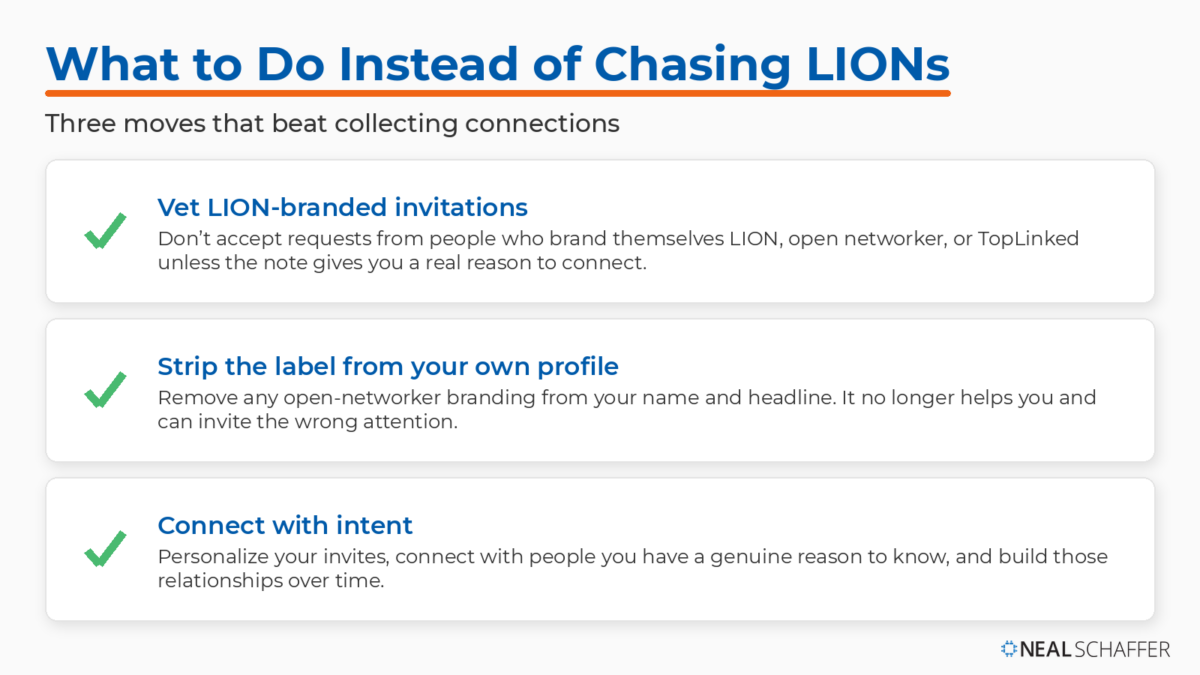
Here is what that looks like in practice. When you get an invitation from someone who labels themselves a LION, open networker, or TopLinked in their name or headline, do not accept it unless the message gives you a real reason to connect. And take that same branding off your own LinkedIn profile, because it no longer helps you and may invite the wrong attention. From there, personalize your invites, connect with purpose, and build relationships over time. If you are new to LinkedIn and trying to grow from zero, that deliberate approach beats collecting strangers, and it fits naturally into a broader LinkedIn marketing strategy.
If You Still Want to Network Like a LION
I have never turned on open networking as a philosophy. The Windmill Networking idea I wrote about still works. What changed is the execution. If you want to network the way the best LIONs once did, openly and generously but built for how LinkedIn works now, you can absolutely do that.
That is exactly what I teach in my book, Maximizing LinkedIn for Business Growth. It is the modern playbook for building a LinkedIn network that produces actual relationships and business, without the outdated label or the spammy tactics that gave open networking a bad name.
Frequently Asked Questions
LION stands for LinkedIn Open Networker. It describes a user who keeps their profile open to connection requests from people they have not met, and who often adds “LION” to their name or headline to signal it.
Make Your Marketing Finally Work Together
My latest book helps small businesses, entrepreneurs, and marketers bring search, email, and social together into one digital marketing strategy that actually compounds.
Drawing on my work as a Fractional CMO, Digital Threads turns complicated tactics into a clear, practical plan you can follow, whatever your budget or team size.
Grab your copy on Amazon and start weaving your own digital threads. Click the cover or the button below to get started.

Historically, you became a LION by accepting invitations from anyone and adding the label to your profile. Today I do not recommend the label at all. If your goal is a wider network, connect deliberately with people you have a reason to know instead.
No. The label is obsolete, it can attract spam and scam invitations, and LinkedIn now limits the open connecting that made it work. You can still network openly without ever calling yourself a LION.
Quality wins. A smaller network of people you actually know or have a clear reason to know is more valuable than a huge list of strangers, and it is safer given how many fake profiles exist now.
I would not. Building deliberately, with personalized invitations to people relevant to your goals, gives you a network that actually helps you, rather than a large but useless connection count.
Network Openly, but Skip the Label
The LinkedIn LION movement made sense in 2009. It does not anymore. Open networking won, which is exactly why the badge became unnecessary, and the people who hijacked it finished the job. If you remember nothing else: connect with intent, vet who you let in, and drop the label.
If you want to do open networking the right way for today’s LinkedIn, my book Maximizing LinkedIn for Business Growth walks through the entire approach step by step. And if you would rather keep learning here first, I share practical LinkedIn and digital marketing tactics in my newsletter.
For more on how I think about LinkedIn and where I speak and consult on it, here is more about me.


Hi Neal
It was a very informative article highlighting the significance of being connected with the top profiles.
I would be very glad to be connected with you, have a sent a personal message
Look forward to you as an inspiration
mdnc100 how did you get to 19,436 , linked in is limiting access at 4,000 so they stop you if you don’t purchase premium? I’m still learning how to maximize linked in before I begin connecting with others that I need to tailor my connections with to share my brand. etc..
I have now 19,436 connections
Hi Neal – Is there a specific LinkenIn Lions group or Super Connector grouop you recommend joining?
Nope Sharon! Personally, I think the “real” LION movement is unfortunately dead … it has been hijacked by others …
I have 24,662 connections most of which are members of my website http://www.semiwiki.com. I also feel the 30k limit is out of date. Has anybody lobbied to have it changed?
There have been people who have lobbied in the past – but in the grand scheme of things, is it that big of a problem?
Thanks for the valuable information
My pleasure!
I would rather establish relationships than collect connections. This is not a very good way to create a connection, with a single click and an non-edited message.
You are right – the connection is only the beginning of the relationship!
It’s important to note that LinkedIn has since imposed a restriction preventing anyone with over 30,000 to accept new connections. With the exception of Neal Schaeffer, pretty much everybody on this list now have well over 30,000 connections. So they won’t be able to accept new invitations (although they can still send them). Steven Burda is a case of his own. Not only he can’t accept new invitations but he also can’t send out new ones.
Hey Jonathan, thanks for commenting! Actually, when I wrote my first LinkedIn book back in 2009 that restriction was already in place, although many didn’t know about it. I prune my connections to keep them under 30,000. I don’t think it requires 30,000 connections to use LinkedIn effectively, and I certainly don’t think you need to connect with 30,000 open networkers! Every person that sends me an invite from reading this blog post I accept, and some people on this list have thanked me for the introductions. Although it has never been made public, I have heard from ONE person with 30,000+ connections that they were actually able to go over 30,000 if they were from people that they invited … however, there is an obvious limitations on number of invitations you can receive. In perspective, both Facebook and Google Plus only allow you to friend/circle 5,000 people, so 30,000 isn’t too bad, right? ;-)
Many people will tell you that you don’t even need 500 connections to use LinkedIn effectively. And they’re right. You’ll notice that many VPs, CEOs and other top executives have as little as 200-300 connections and sometimes less.
I personally have 1500 connections and that’s fine with me. Nevertheless, I still think LinkedIn could improve its customer service by doubling the limit of connections to 60,000, given that many users are unsatisfied with the 30,000 limit. The number of users has increased a lot since 2009 and LinkedIn should therefore update itself. But I do believe there should always be at least a limit imposed in order to keep some control on the site. So to summarize, the idea of a limit is not bad as long as LinkedIn is willing to revise its number every 3-5 years instead of sticking infinitely to the 30,000 rule.
How can I find an updated and longer list? Not all of the people listed in this post seem relevant to me. For example, why would I, an engineer, link to somebody who teaches recruiters? Writing a convincing invitation to connect is not a trivial task when you have nothing in common. I think it would be a better use of my time to go lower in the list to find more relevant contacts. So, is it possible to find a longer list that isn’t several years old? Thank you.
Hi Rich, unfortunately I have not revised this list nor is there a longer list available. My advice for you would be to do searches on LinkedIn and look for those with lots of mutual connections. That is a hint that they are open to new connections, and it also gives you a good way to “break the ice” with them since you know so many in common. Hope the advice helps!
Thanks for the suggestions, Neal.
Great list
Thanks!
This was a wonderful piece of information. I am connecting will all these guys. Thanks a million!
You’re very welcome! Good luck!
How can you connect with them when LinkedIn doesn’t allow to connect with people you don’t know?
It is true that LinkedIn doesn’t want you to connect with people you don’t know; however, some of us choose to be more open than others. The choice is yours!
Thanks for the feedback…and like your comment, “some of us choose to be more open than others. The choice is yours!”.
Neal,
Thanks for sharing this information. LinkedIN will continue to garner accolades for its ability to connect individuals, effectively build business networks and provide timely and essential information. Giving a quick background of the individuals you reference is much appreciated. Many thanks.
Kevin Bryce
http://www.kevinbryce.com
That’s why I tell everyone that LinkedIn is such a godsend. What did we all do before it existed?!?!?
Thanks for sharing these ideas Neal. Networking is such a vital part of any sales system, it is hard to believe that only 25 years ago we had to send all direct marketing out by hand. Imagine the cost of maintaining 100,000 list back then, thank goodness for progress. Wonderful tips. Thanks agian
Phil Polson
Thanks Saul…I'll have to put this list together for those great super connectors and networkers in Japan soon ;-)
Wow, another LinkedTwitterific moment. @goodpeople Jason reminded me to spend more time on your site, I put it off – only to find you listed me @osakasaul in your @NealSchaffer/japan-tweeple Thanks for that.
Thank you so much Allan! It's comments like yours that keep me blogging!
Hello Neal.What a priviledge is to view your website.It has the imformation about linkedin i was looking for.You have filled in an enormous imformation void which i was suffering from.Iam on your newsletter subscribers list,as well,will make connection on twitter&linkedin.Bravo Neal,you have broke it down in laymans terms for me and i now consider you to be a very valuable resource.
Thank you so much Allan! It's comments like yours that keep me blogging!
Hello Neal.What a priviledge is to view your website.It has the imformation about linkedin i was looking for.You have filled in an enormous imformation void which i was suffering from.Iam on your newsletter subscribers list,as well,will make connection on twitter&linkedin.Bravo Neal,you have broke it down in laymans terms for me and i now consider you to be a very valuable resource.
Awesome list, Neal. Lots of research and time you put into this information. And you freely pay it forward ! Nice. I am going to post a link to this on my free job coaching blog, http://www.the50over50project.wordpress.com. That way, those following my blog (“millions” less than you have) can learn about the value of (windmill) networking!
Paul David Madsen
America's Job Coach and author of “Laid Off & Loving It for 2010”
Hi Annette,
Thank you for sharing your experiences with us. I believe that you brought up two very serious issues here:
1) The way that LinkedIn always penalizes the person who is reported upon, not the potentially inappropriate reporter, is a big issue that I have seen a lot of misuse of recently. It doesn't take any people to have ones Question removed from LinkedIn Answers or even penalize someone's LinkedIn profile. LinkedIn really needs to start looking at those who report others and look into the validity of what they are saying. At the present it doesn't look like they are doing a good of this…
2) The LION issue is one of my own pet peeves, as there is no guarantee that a LION will accept your invitation. The only thing that LIONs should be agreeing to do is to never respond with an “IDK” or “I Don't Know” response. The LION movement is not governed by LinkedIn nor anyone else, so we really are at risk when we invite someone that we don't know, although inviting a LION is usually the safest and most effective way of growing your LinkedIn network.
I realize that my comments don't help your situation, but I do sympathize with what you are going through and hope things work out for the best.
– Neal
I don't believe in “good old boy” networks, anymore than playing political games. On linkedin when we invite individuals we are required to check how we know these people. When one checks worked together, and name the company we worked together with, and these people that play this good old boy network and click “I don't know” rather than “archive” isn't it LinkedIn's responsiblity to weed out the trash of liers since they can verify on these people's profiles that they are flat out lying? Instead they “ding” the sender of the invitation and lock down the account of the inviter stating they “exceeded” their limits of invitations.
If you took the time to verify both Ray Wagnon and David Bones (both reside in San Antonio, Tx) both worked at Inter-Tel (which is now a Mitel Corporation since Mitel bought out Inter-Tel) you would see the dates of their employment with this company is equal to or greater than mine. Yet you excuse them from their lies, and you advise me I am inviting people I don't know? This is absolutely absurd! If they want to play their games of deception and lies, this is their political scrutiny, not mine to be penalized for. I think its up to LinkedIn's customer service or whomever checks these invites to validate the liars within this network and put a hold on their account for wrongfully selecting I dont know rather than archive if they opted not to accept my invite. This is abuse of your policy, they should in my professional opinion wear the burdon of proof and be penalized, not I!
I have 631 outstanding invites, as a LION, it is not within my control as to when fellow LIONS log onto linkedIn and accept invites, or to control when they should. Again, being locked out by linkedIn rather than confirm these people are a part of a group named LION which in their own rules we are allowed to connect to other LIONS that are in a shared group.
So LinkedIn, please explain why you aren't playing by your own rules, rather than making new rules?
Futhermore, to tell me I have reached my level of invites, again, I have no control of when people log in and when they accept invites, being how my open invites are with fellow LIONS. I look forward to you bringing a solution to this negative experience I encounter since I use LinkedIn for business and this lock down is suffocating my professional growth.
Maybe we can tweet him for that ;-) Thanks for the update!
– Neal
Barack Obama's link doesn't work anymore. You have to have his actual email address, which I imagine is a fairly well-guarded secret. :)
Cheers, Bruce
If I can help, I will.
Diana and others –
Do reach out to me — and if I can help, I will.
– Steven Burda
http://whywebpr.com/burda
If I can help, I will.
Diana and others –
Do reach out to me — and if I can help, I will.
– Steven Burda
http://whywebpr.com/burda
Can I connect to you on LinkedIn?
Sure! But please personalize your invite so I know it’s you ;-)
Nice! I didn’t know there was even a ranking or list. The windmill Theory is pretty neat to know about – definitely this day and age’s tech trend.
Hey Dianne,
Thanks for stopping by! Windmill Networking is a concept that hopefully everyone will see value in. More details coming soon!
– Neal
Nice! I didn’t know there was even a ranking or list. The windmill Theory is pretty neat to know about – definitely this day and age’s tech trend.
Hey Dianne,
Thanks for stopping by! Windmill Networking is a concept that hopefully everyone will see value in. More details coming soon!
– Neal