
You added the author bio. You cited your sources. You rewrote the opening in first person so it no longer sounded like anyone could have written it. Three weeks later you checked Search Console, and nothing had moved.
That gap between doing the work and seeing the work is where most people give up on E-E-A-T. Not because the advice was wrong. Because nobody told them how long the proof takes, or that the thing being judged is bigger than the page they just fixed.
I have run this site since 2008, which means I have spent that long watching Google change its mind about what deserves to rank. Search is one of the three threads in Digital Threads, the book I wrote about search, email and social working as one system.
In my Fractional CMO work the recurring diagnosis is foundational. Clients arrive asking about one channel, and underneath it sits SEO treated as an afterthought, a dormant email list, and a posting calendar standing in for a content strategy. You can read more about my background if you want the long version.
This is written for one specific person: someone who owns the library they are trying to fix. Not the marketer publishing four posts a month. The person responsible for hundreds of existing URLs, working through them without a team. That person needs the definition, and they need a straight answer about the calendar.
One thing to set straight before we start: I do not sell SEO services, and I have no client case study to pitch you. What follows is a working log from my own site. I am partway through the process right now, so some of it is what Google says and some is what I found on my own pages. I will be clear about which is which.
Key Takeaways
✅ E-E-A-T stands for Experience, Expertise, Authoritativeness and Trustworthiness, and the four are not weighted equally.
✅ E-E-A-T is not a ranking factor. Google’s systems use a mix of signals that identify content with good E-E-A-T, which is a meaningfully different claim.
✅ Google assesses your site as a whole rather than the single page you rewrote, which is why a handful of rebuilt posts out of hundreds shows up as nothing.
✅ The 28-day comparison window everyone checks is probably the wrong instrument for this job. Plan on a quarter at minimum.
✅ The tool most people use to check their author schema structurally cannot display it, which sends people hunting for a problem that does not exist.
What does E-E-A-T mean in SEO?
E-E-A-T is the framework Google’s search quality raters use to judge content quality, standing for Experience, Expertise, Authoritativeness and Trustworthiness. Google added the second E, Experience, in December 2022 to account for first-hand involvement with a topic. Google puts trust at the center of the four, for reasons I get into just below.
People mix up the first two letters more than any other part of this. Expertise is what you know through study or professional training. Experience is whether you have actually done the thing. Google’s own example of missing experience, in the same revision noted above, is a restaurant review written by someone who never ate there.
Trust is not one of four equal parts. Google’s documentation on creating helpful, reliable, people-first content says trust is the most important, that the others contribute to it, and that content does not have to demonstrate all four. A page can be helpful mostly on experience. Another can be helpful mostly on expertise.
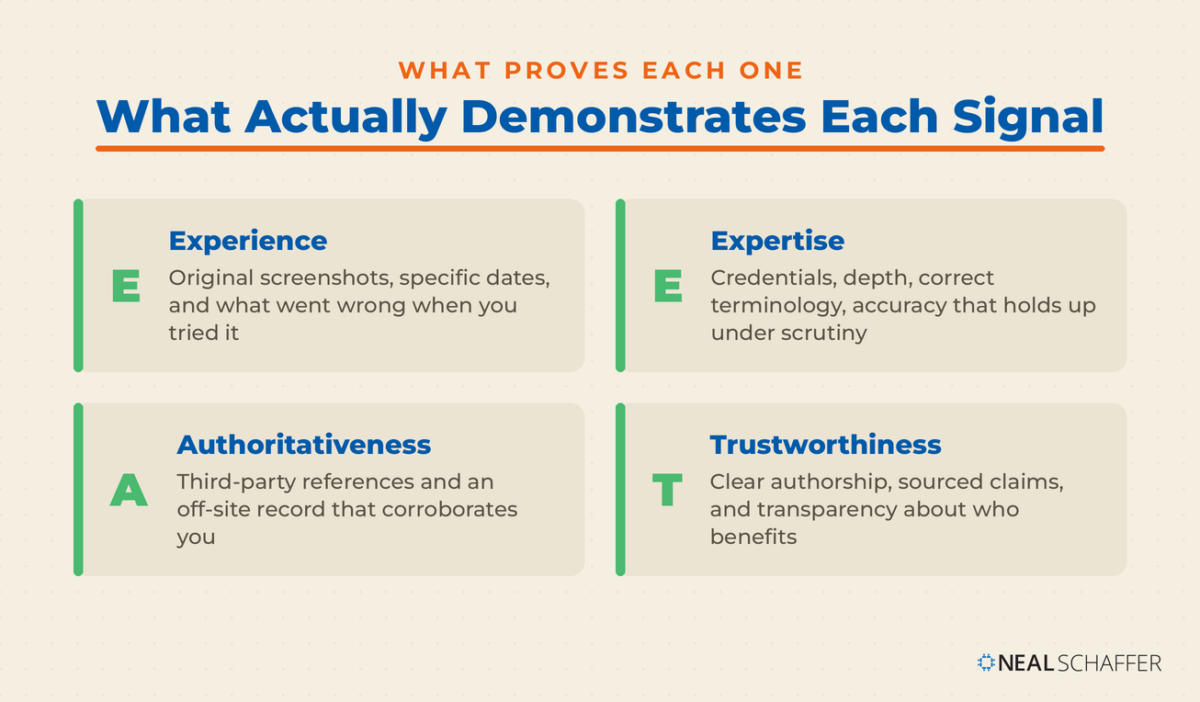
| Signal | The question it answers | What actually demonstrates it |
|---|---|---|
| Experience | Have you done this yourself? | Original screenshots, specific dates, what went wrong when you tried it |
| Expertise | Do you know this field? | Credentials, depth, correct use of terminology, accuracy under scrutiny |
| Authoritativeness | Do others treat you as a source? | Third-party references, citations, an off-site record that corroborates you |
| Trustworthiness | Can a reader rely on this page? | Clear authorship, sourced claims, accurate information, transparency about who benefits |
That table is the whole framework, and it is also where most guides stop. The interesting question is not what the letters mean. It is what Google does with them, which turns out to be less direct than the acronym suggests.
Is E-E-A-T a ranking factor?
No. E-E-A-T is not a ranking factor and no page receives an E-E-A-T score. Google’s documentation states that E-E-A-T itself is not a specific ranking factor, and that its systems use a mix of factors to identify content with good E-E-A-T. Rater data does not feed the ranking algorithms directly.
This confuses people because both things are true at once. There is no dial to turn. And the signals that correlate with strong E-E-A-T, like clear authorship and sourcing and accuracy, are the same signals the ranking systems do read. You cannot optimize the acronym. You can only build the thing it describes.
Google says weighting rises on what it labels Your Money or Your Life topics, the subjects where bad information can do real damage to someone’s health, finances or safety. A marketing blog is not one of those. You still have to clear the bar, but nobody is holding you to the standard a health or finance site gets held to. A law firm’s site sits much closer to that standard, since a page about an injury claim or a divorce can affect a reader’s finances directly. My guide to SEO for lawyers covers the reviews, citations and local directories that help a firm earn that trust.
So stop treating E-E-A-T as a task list with a completion date. From what I have seen working through my own library, it piles up slowly across a whole site rather than landing on the page you just fixed. Build it deliberately inside your broader SEO strategy rather than beside it as a separate project.
None of which tells you what any of this looks like once it hits an actual page. That part is easier to show than to define.
What does first-hand experience look like on a page?
First-hand experience on a page looks like details only someone who did the thing would have. Dates, specific interfaces, the step that did not work, the number you measured. The rater guidelines cited below tell raters to weigh what is visible on the page as evidence the creator can be trusted. The proof has to be readable rather than asserted.
That instruction is spelled out in the quality rater guidelines, as Lily Ray’s section-by-section read of the December 2022 revision sets out: raters are told to look for actual evidence on the page that the creator has done what they claim.
### The version that works
I will show you one of my own posts. My article on how to repost on TikTok opens with platform history rather than with me. The first paragraph pins down when Twitter shipped a real retweet button and when Instagram finally added an official repost feature, and each of those dates carries a live link to its source. Both facts are useful on their own, before I appear at all.
The credential arrives in the second paragraph, as an explanation for why the reader’s confusion is reasonable. I mention teaching social media at Rutgers Business School, the six books, the weekly podcast coverage of platform mechanics. That is a social media credential sitting on a social media post, and matching the credential to the subject is doing more work there than most people would guess. And then the sentence that does the actual work: I still had to go hunting for the repost button the first time I wanted to use it.
The Digital Marketing Playbook for Small Teams
My latest book helps small businesses, entrepreneurs, and marketers bring search, email, and social together into one digital marketing strategy that actually compounds.
Drawing on my work as a Fractional CMO, Digital Threads turns complicated tactics into a clear, practical plan you can follow, whatever your budget or team size.
Grab your copy on Amazon and start weaving your own digital threads. Click the cover or the button below to get started.

That last move is the part a competitor copying the technique would skip. A credential followed immediately by an admission of the same friction the reader is having registers with the reader like a real situation they can relate to. A credential standing alone reads as a credential dump. The order of these two placements just might matter more than the content itself.
### The version that does not
Now picture the same post opening with “if you’re reading this, you’re probably trying to figure out the best way to repost on TikTok.” Anybody could have written that sentence. It carries no dates and no evidence, and there is no person anywhere in it.
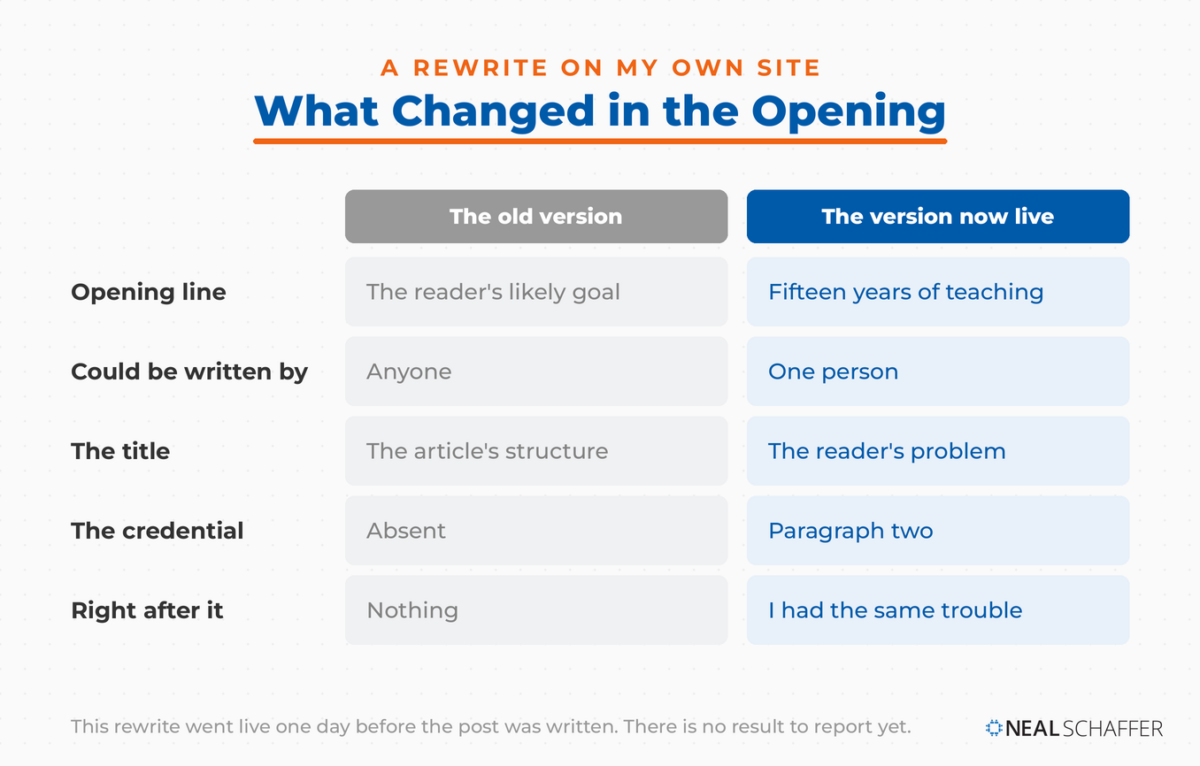
That is not a hypothetical. It is close to the opening I recently replaced on my post about how to network on LinkedIn. The old first line described what the reader was probably trying to do. The new one carries fifteen years of teaching the subject. The old title described the article’s structure, and the new one describes the reader’s problem.
I have no results to report from that rewrite. It went live one day before I wrote this. Anyone who tells you a single opening-paragraph rewrite moved their rankings within a week is almost certainly looking at a coincidence. The point of writing in this fashion is not about an immediate win. Which brings us to the part almost nobody publishes, and the part I want to spend some time on.
What most E-E-A-T guides get wrong about the timeline
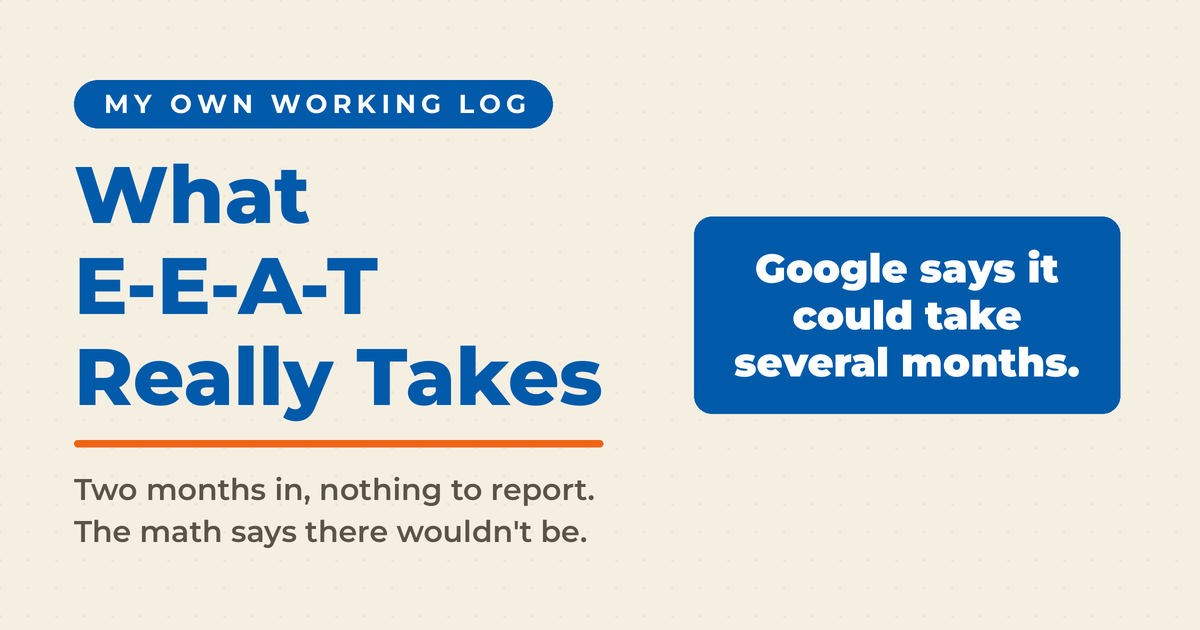
Most guides on this term treat E-E-A-T as a checklist you complete. The error is not in the items. It is the implied schedule. Google evaluates your site as a whole rather than the page you fixed, and its guidance on core updates says improvements can take several months to register. That makes most measurement attempts far too early.
### The arithmetic nobody publishes
Run the numbers on a real library. I republish roughly eight posts a month against a library of about 700. That is a multi-year pass, and I am about two months into it. Sixteen or so rebuilt posts against 700 is roughly two percent of the site.
The guidance noted above is explicit on this. Google’s systems need time to learn and confirm that the site as a whole is producing helpful content. If a few months pass with no effect, you may be waiting for the next core update. Two percent of a site cannot move a site-level assessment. The math forbids it.
So the 28-day window everyone checks is not merely impatient. I would argue it is the wrong instrument entirely. You will spend your first two quarters unable to prove your own strategy. Plan the work knowing that in advance, rather than discovering it in month three and quitting.
### Why I have not sped up
The obvious response to that arithmetic is to publish faster. I have deliberately not.
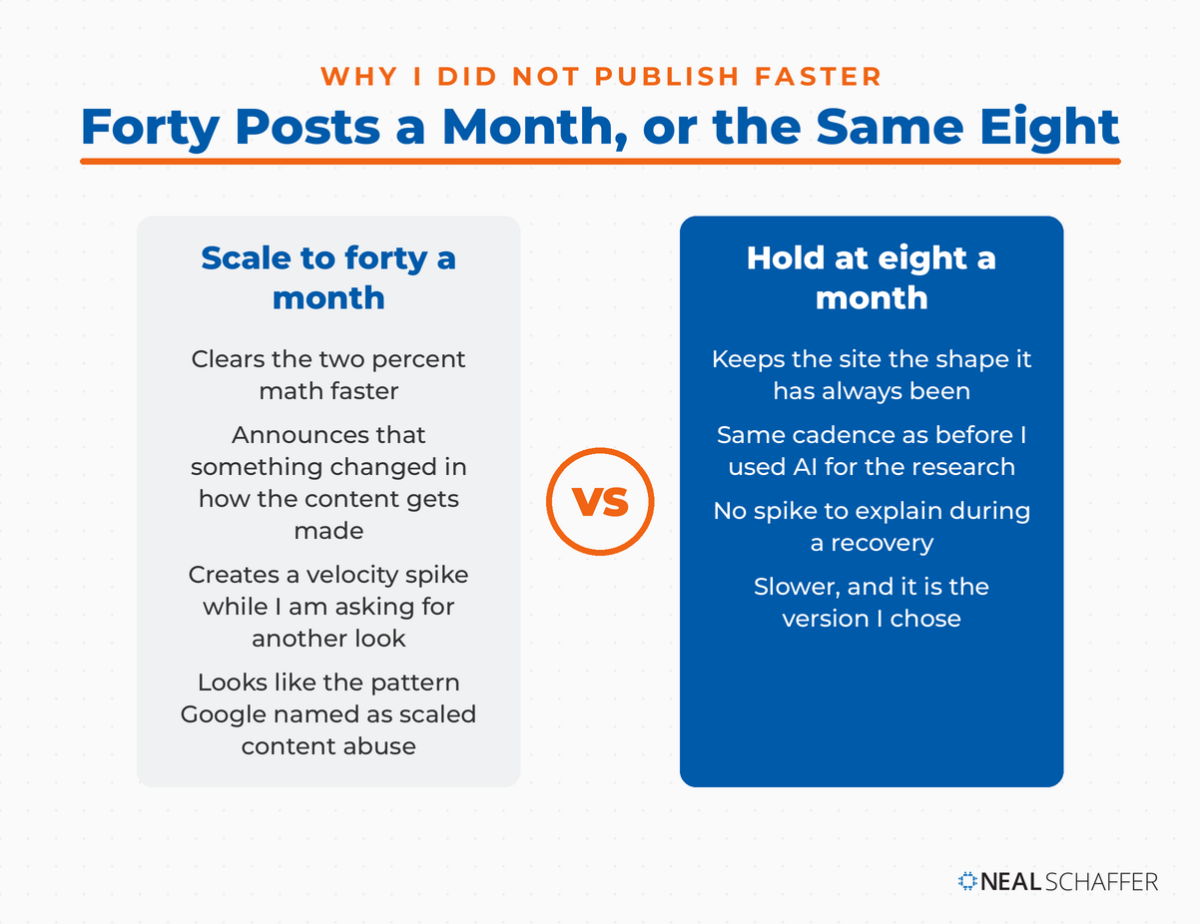
My cadence is the same eight or so posts a month it was before any of this started, and before I was using AI for the research behind it. That is a choice rather than a limit on what I could produce. I could publish a great deal more than I do.
What stops me is how a sudden jump would look from the outside. A site that has published eight posts a month for years and then abruptly starts publishing forty has announced to anyone paying attention that something changed in how the content gets made. When Google introduced its March 2024 spam policies it named scaled content abuse as one of three, meaning content produced at scale mainly to manipulate rankings.
Volume on its own is not the offence, and plenty of large sites publish daily without any trouble at all. But a velocity spike on a site that is already working its way out of a quality problem is a pattern I would rather not create while I am asking the same algorithm to take another look at me. I would rather take the slow version and keep the shape of the site recognisable as the one it has always been.
### What you can actually measure, and when
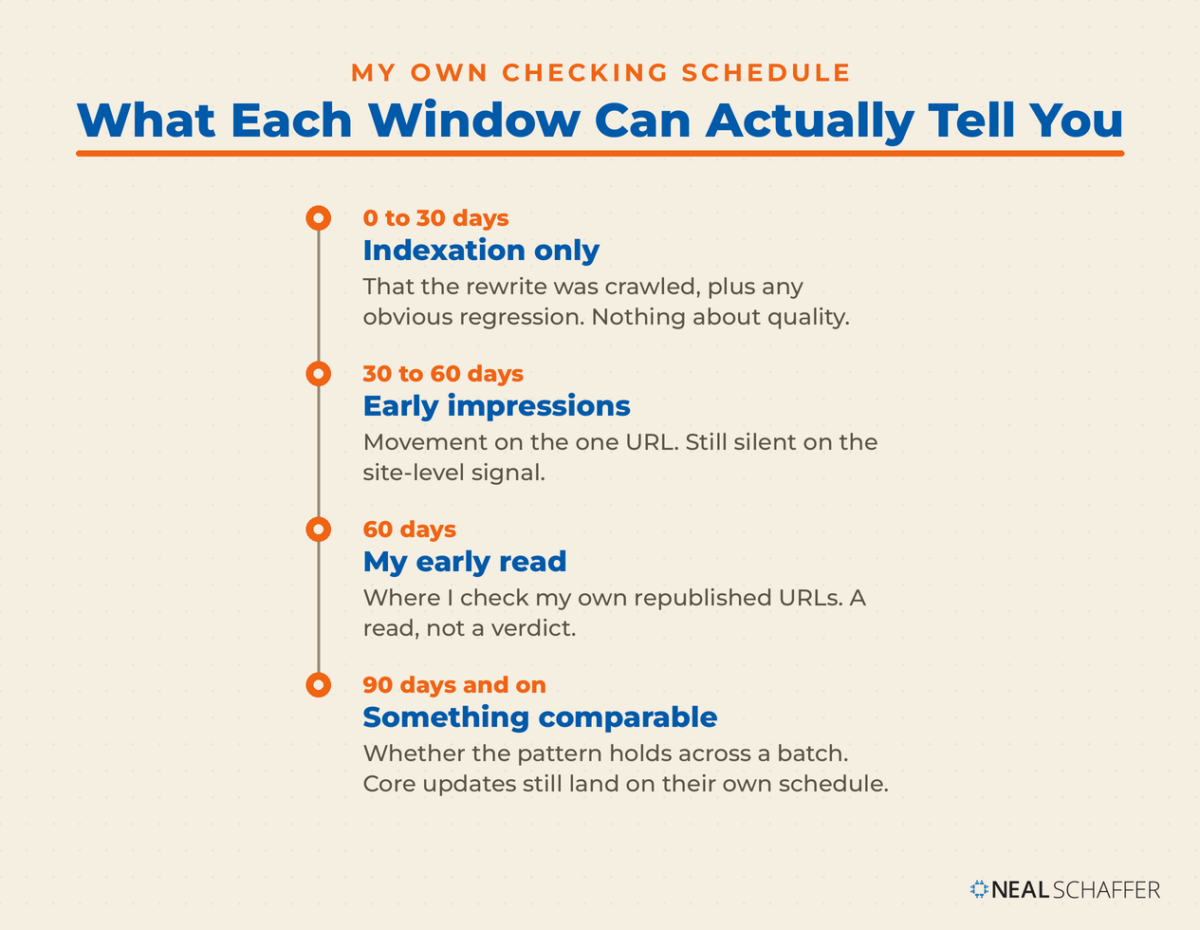
| Window | What you can actually read | What it cannot tell you |
|---|---|---|
| 0 to 30 days | Indexation, that the rewrite was crawled, obvious regressions | Anything about quality assessment |
| 30 to 60 days | Early impression movement on the specific URL | Whether the site-level signal changed |
| 60 to 90 days | Per-URL trend with enough data to compare against the prior period | Attribution, if you changed several things at once |
| 90 days and beyond | Whether the pattern holds across a batch of rebuilt URLs | Certainty, since core updates land on their own schedule |
I check my own republished URLs at 60 days. That is my working cadence, not a number Google publishes, so treat it as an early read rather than a verdict. Two months into a multi-year process, I have no recovery to report yet. A handful of lightly touched pages is too small a sample, with no control group, to claim anything from.
So while you wait, spend the time on things you can actually verify today. Your author markup is one of them, and it is where I wasted an afternoon on a problem that turned out not to exist.
Why your author schema looks broken when it is not
Your author schema probably is not broken. Three checks give three different answers about the same page, and only the raw markup settles it. The tool most people reach for cannot display Person schema at all, which sends them hunting a problem that does not exist. I ran this sequence on my own site and reached the wrong conclusion.
### The tool that cannot answer the question
I ran my own about page through Google’s Rich Results Test. One valid item: Breadcrumbs. No Person anywhere in the result. If you stopped there, you would conclude your author entity is invisible to Google.
That conclusion would be wrong. The Rich Results Test only evaluates the types Google renders as rich results, and Google publishes the list of types the test supports. Organization is on it. Profile page is on it. Person is not. A valid Person node is invisible to the tool by design, so it is not reporting an absence. It is reporting that it does not handle the question.
### The tool that shows a different absence
Next I ran the same URL through the Schema Markup Validator, which checks Schema.org syntax without Google’s feature-specific rules. Four items came back with zero errors and zero warnings: Organization, WPHeader, WebPage/AboutPage, and hatom.
Still no Person. But look closer: BreadcrumbList is not in that list either, and the Rich Results Test just proved breadcrumbs are on the page. The Schema.org documentation behind that tool describes its output as a summary of the extracted graph. A summary is not an inventory. Two tools, two different incomplete pictures, neither of them lying.
### Where the answer actually lives
My Yoast site representation has been set to Person, with my own user selected, the entire time. So at this point in the sequence the evidence looks like a plugin bug. It is not.
The resolution is in the raw JSON-LD: my publisher node is typed as both Person and Organization at once. Yoast documents this in its own developer specification, under known issues. A Person cannot be the publisher of an Article without Google’s tools flagging it as invalid. So Yoast merges Person with Organization into a hybrid type that accepts publisher properties. Yoast calls it an acknowledged workaround in writing.
A validator that prints one label picks Organization, and the Person disappears from the summary. Nothing is broken. This is worth knowing before you open a support ticket, which is roughly where I was headed.
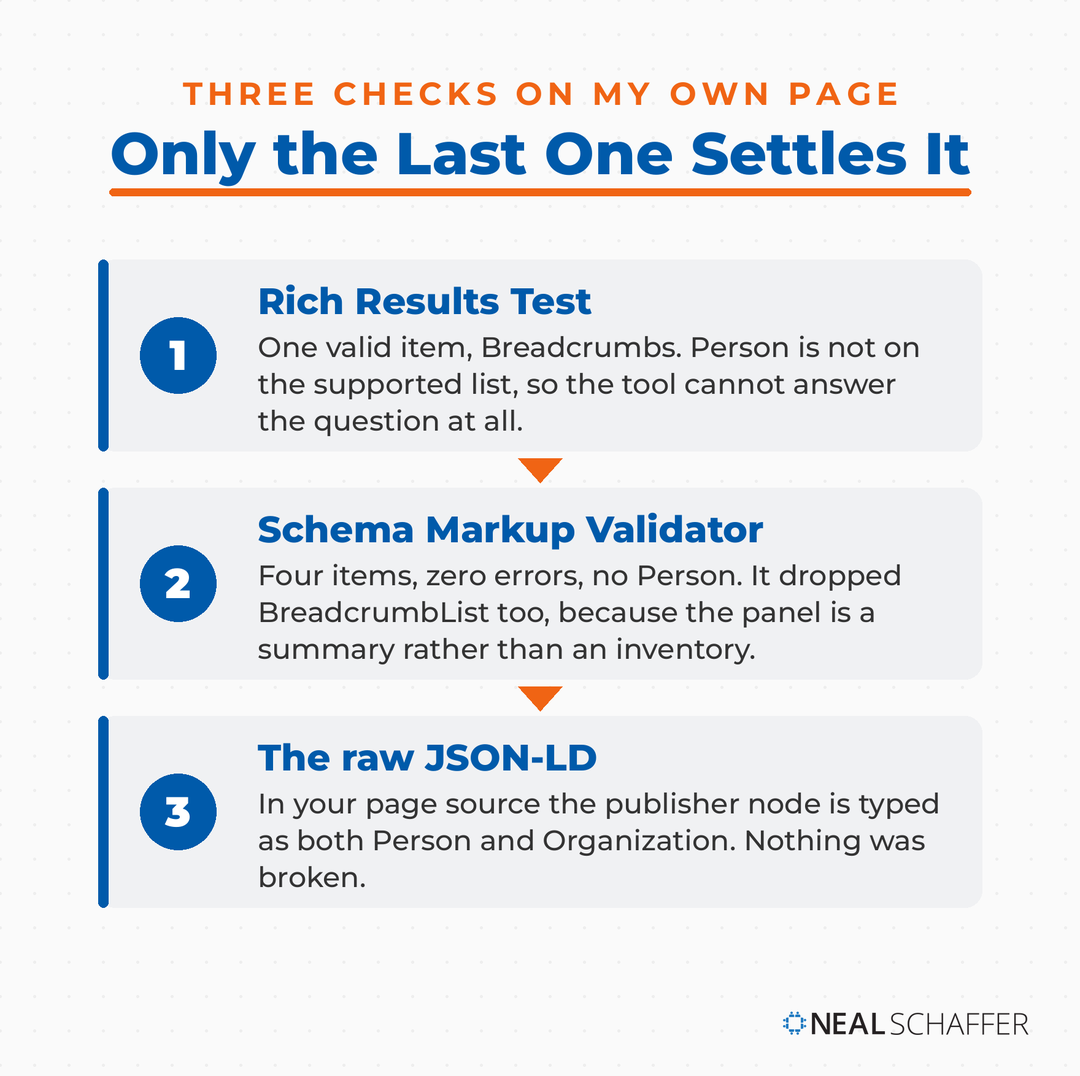
Put the three checks side by side and the sequence stops looking like a contradiction.
| Check | What it showed on my page | What it cannot tell you |
|---|---|---|
| Rich Results Test | One valid item, Breadcrumbs | Anything about Person, because that type is not on the supported list |
| Schema Markup Validator | Four items, zero errors, no Person and no BreadcrumbList either | The full inventory, because the panel is a summary of the graph |
| Raw JSON-LD in your page source | A publisher node typed as both Person and Organization | Nothing. This is the version that settles it |
### What to check instead
Read the raw markup rather than either summary. The whole check takes about five minutes, and you do not need a tool for it.
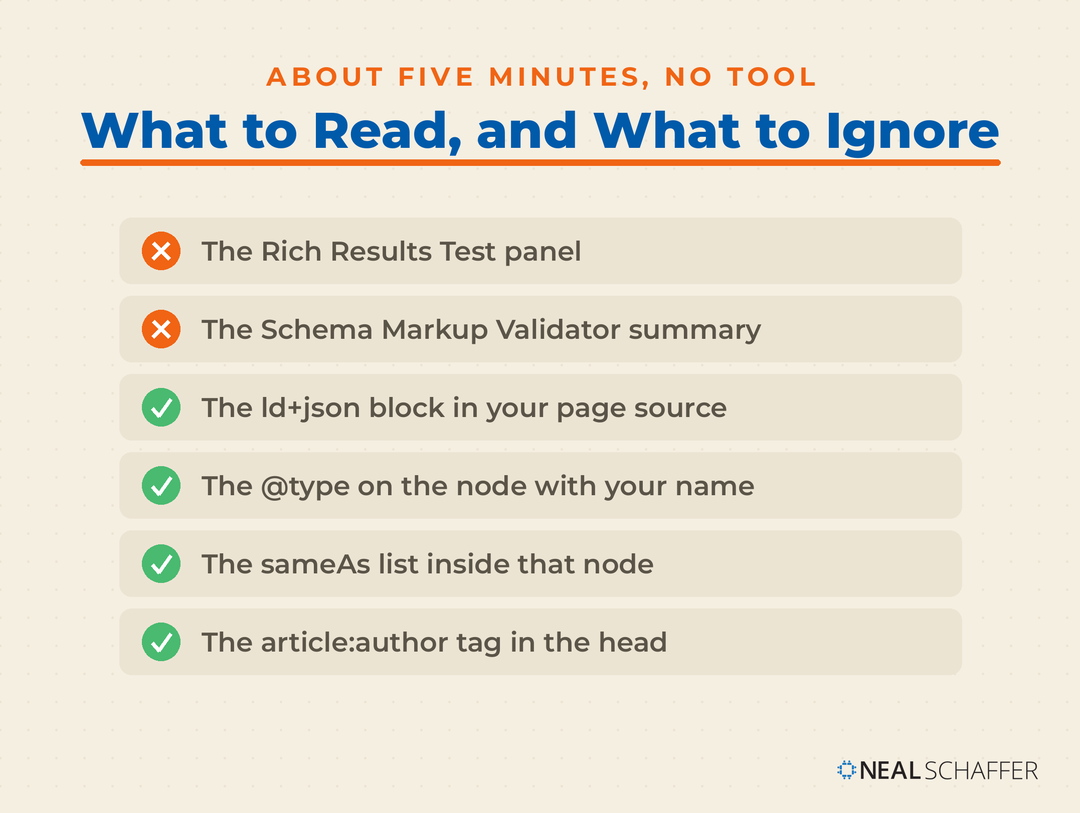
- Open one of your blog posts in a browser and view the page source. In Chrome that is Ctrl+U on Windows or Option+Command+U on a Mac.
- Search that source for `application/ld+json`. That block is what your SEO plugin actually publishes, and it is the only version that settles anything.
- Find the node carrying your name, then look at its `@type`. If it reads `[“Person”,”Organization”]` you have the hybrid described above, and nothing is wrong.
- In that same node, find `sameAs`. It is a list of URLs, and those are the profiles you are telling search engines belong to you.
- Search the source separately for `article:author`. That is a meta tag in the head rather than part of the graph, so the validators above will not show it to you at all.
Two things are worth acting on once you can see them.
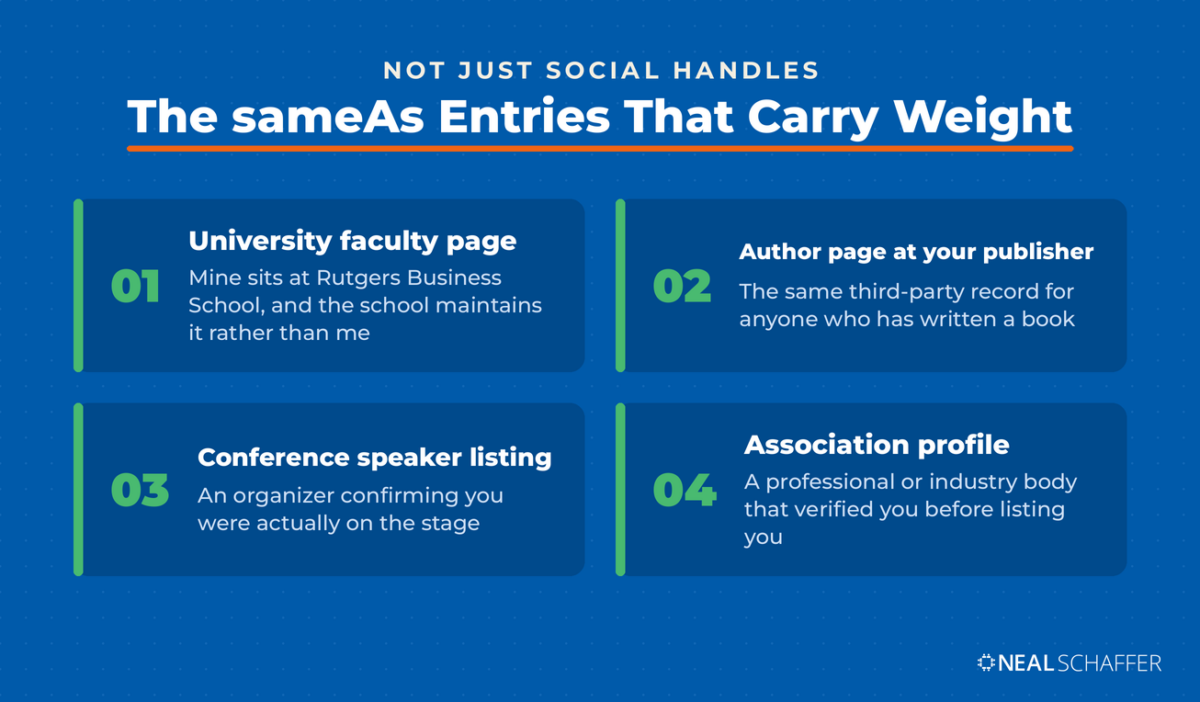
The sameAs list. Yoast defines it as declared social and authoritative profiles of the person, and most people fill it entirely with social handles. Anyone can open a social account in your name, so those entries prove very little. What carries weight is a record somebody else maintains about you: a university faculty page, an author page at your publisher, a conference speaker listing, a professional association profile. If you have any of those and they are missing from the list, add them in your plugin’s social profile settings.
The article:author tag. Mine points at my Facebook business Page rather than a personal profile, which means the tag names a company as the author of something I wrote. Neither of these blocks anything, and both belong with the rest of your technical SEO housekeeping.
Fixing your markup is worth an afternoon. Deciding what goes on the page is the work that actually takes years.
How do you build E-E-A-T when you are the only person on the site?
Build it by making the person visible and the claims checkable. A one-person site has an advantage a content mill cannot copy: a real named human with a verifiable record. The work is putting that record where both readers and machines can find it, then applying it to every page rather than to your about page alone.
I put the sourcing half of this bluntly on a recent episode of my podcast Your Digital Marketing Coach: “If you are going to say something, you better be linking to something and it better be an authoritative source.” That habit is the cheapest E-E-A-T improvement available to you.
### The habits that do the work
The rest is ordinary discipline applied consistently:
- Put a real byline on every post and link it to a real about page.
- Open with something only you could have written, then earn the credential rather than leading with it.
- Cite the primary source, not the roundup that quoted the primary source.
- Name the tools you actually use, including the ones you pay for.
- Say what did not work. Nothing signals first-hand involvement like a specific failure.
- Fix the bios that live on other people’s sites, from your university profile to your speaker listings, so they match what you claim on your own.
### Which pages to fix first
None of that is new advice. What turns it from a checklist into a strategy is deciding which pages get the treatment first, and in what order. That is a content audit question before it is a writing question.
Work category by category rather than by whichever post annoys you most this week, and rank the categories before you start. I score mine on five things:
- Which categories already rank best, because you are defending and extending a position rather than building one from nothing.
- Which bring the most traffic, since a percentage gain on a big category beats a doubling on a small one.
- Which bring the most leads, which is rarely the same answer as traffic.
- Which sit closest to the product or service you most want to sell.
- Which you have the most standing in, because that is where first-hand experience is easiest to write and most believable to read.
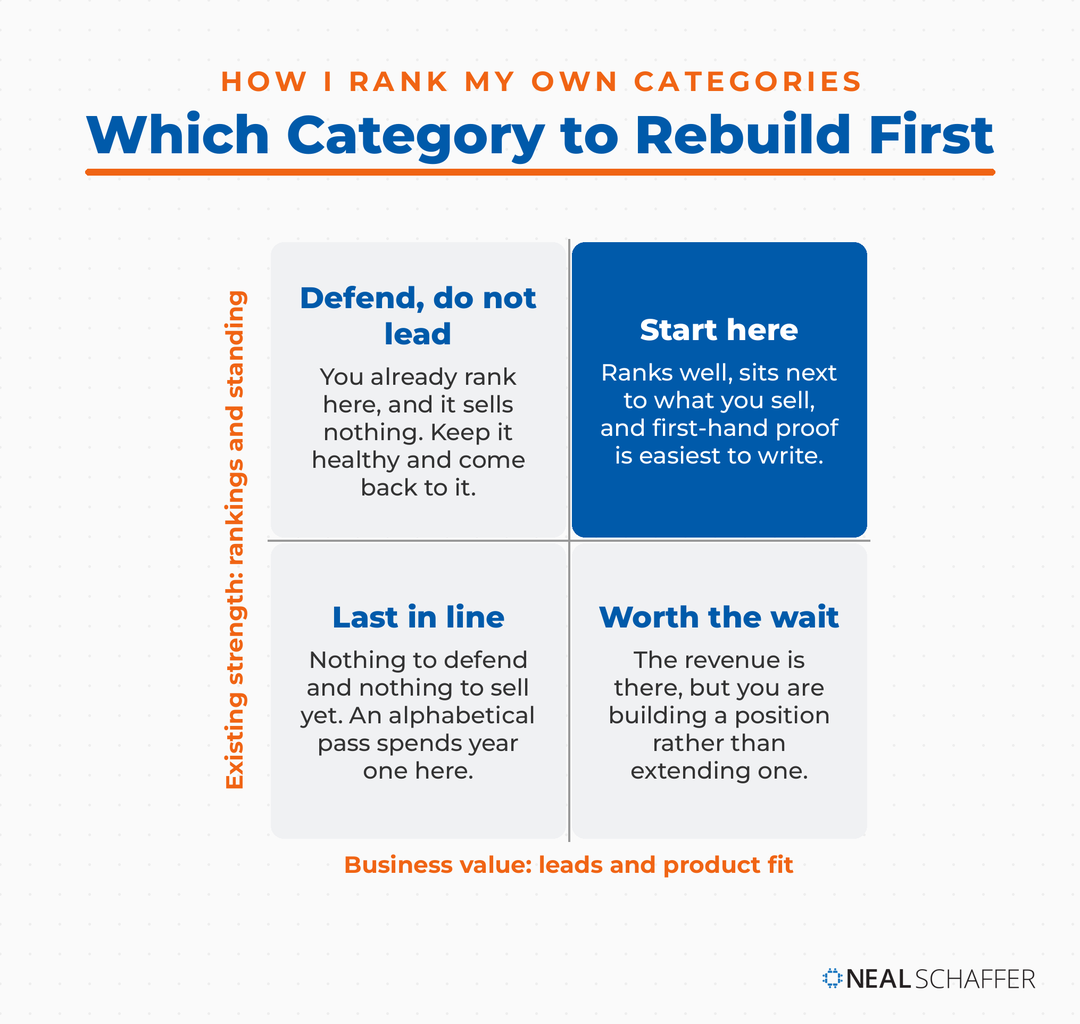
Then start at the top of that ranking and work down. The point of the order is speed of return: a multi-year pass through a large library is a long time to wait for a signal, and the categories that matter most to the business should be the ones producing evidence first. Doing it alphabetically, or by whatever is bothering you this week, buries your best chance of an early read somewhere in year two.
### How I use AI on this
One caution on AI-assisted drafting. Google’s position is about content quality rather than production method, a question I take up in whether AI content can rank. But experience is the one signal a model cannot generate for you, because it does not have any.
Google also asks creators to be open about how their content gets made, so here is my answer. I use AI as a research and audit partner. It reads across hundreds of my own posts, finds patterns I would miss by hand, and checks my schema output against the documentation. It has taught me more about technical SEO this year than the decade before it did. The screenshots, the mistakes and every judgment call are mine.
Frequently Asked Questions
They are related but distinct. E-E-A-T is the framework raters use to evaluate content quality. Helpful content started life as a separate ranking signal, and with the <a href=”https://developers.google.com/search/blog/2024/03/core-update-spam-policies”>March 2024 core update</a> Google folded it into its core ranking systems, saying there is no longer one signal doing that job. The two overlap enough that improving one usually improves the other.
Longer than you want. Google’s <a href=”https://developers.google.com/search/docs/appearance/core-updates”>core update guidance</a> says some changes register within days while others take several months, and that you may end up waiting for the next core update. Give it a full quarter before you read anything into your data, and longer if you are working through a large library.
I have not seen evidence that Person markup is itself a ranking factor, and Google has never described it as one. What it does is help search engines and AI systems work out who you are as an entity, which is a different and slower kind of benefit. Add it because entity clarity is worth having, not because you expect a position change.
On specific topics, yes. Experience is the letter where an individual practitioner can genuinely beat a large publisher, because you have done the thing and their freelancer has not. That advantage disappears the moment you write about something you have only read about.
Not for most topics. The rater guidelines noted earlier draw a distinction between everyday experience and formal expertise, and treat first-hand experience as legitimate on its own for many subjects. For YMYL topics the expectations are considerably higher.
Start With the Pages You Can Actually Prove
Pick one category and work it end to end. Rewrite the openings so they could only have been written by you, fix the sourcing so every claim points somewhere real, and write down the date you did it. That last step sounds like the least important one, and it just might be the one that saves you later.
Without a date you have no baseline to measure against, which is how people end up guessing about their own results six months on.
Then leave it alone. Check at 60 days for an early read and at 90 for something you can compare. Resist the urge to change five things at once, because you will lose the ability to tell which one mattered.
Do that across enough of your library and the site-level picture eventually changes. That is how it has gone for me so far, and it moves a lot slower than any checklist would have you believe.
For the wider mechanics of how this fits together, start with how to do SEO. The current SEO statistics are worth a bookmark for benchmarking. And if you would rather work through it with help, take a look at my Digital First Mastermind, or get in touch about Fractional CMO services.