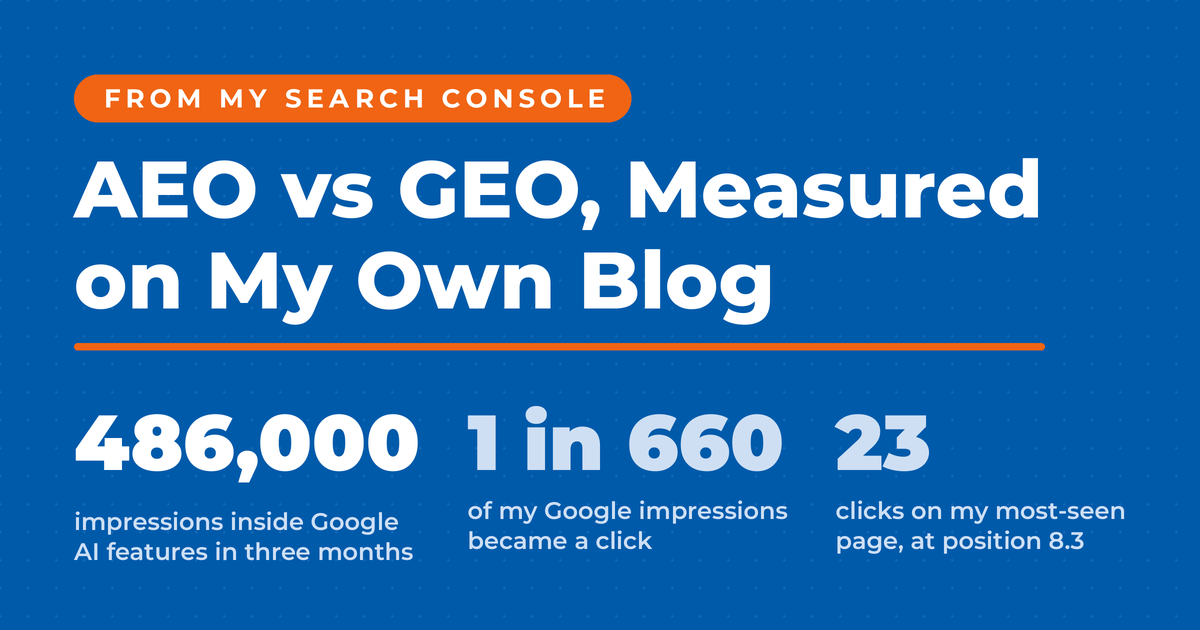

Google showed my site inside its AI features 486,000 times in the last three months. Some of those became visits. Google counted every one of those clicks, then filed them in with my ordinary organic traffic and left nothing marking which was which.
That missing label is why the industry ended up arguing about acronyms instead. One of these disciplines is about being the answer. The other is about being inside the answer. Both send you real traffic. Only one sends traffic you can point at, and it is not the one Google built the report for.
Which makes the naming fight the least useful question on the table. The one worth asking is what you judge this work on, and the answer was never going to be inside that report. It sits further down, in whether more of the right people arrive and do something once they get there. Nobody has ever banked an impression, and if you run a small business, being mentioned is not a business model.
I run a blog with roughly 700 posts across fifteen categories, and I have spent the last eighteen months rebuilding it category by category, measuring before and after. I work as a Fractional CMO, teach social media marketing at Rutgers Business School, and wrote Digital Threads about building a digital-first marketing strategy on a small budget. The numbers below are mine, including the embarrassing one.
This is written for someone who owns the outcome and has to decide where the next ten hours go. If you are choosing between an AEO agency and a GEO agency, I am going to save you a retainer.
Key Takeaways
✅ AEO is about extraction, getting a machine to lift your answer; GEO is about synthesis, getting a model to fold your page into an answer it composes
✅ Google’s published position is that both are still SEO, and its AI features run off the same index that ordinary search does
✅ Google’s generative AI report in Search Console shows impressions only, and clicks from AI Overviews land unlabelled in your ordinary organic totals
✅ My site earned 486,000 impressions inside Google’s AI features over three months, on a curve that roughly quadrupled from May to August
✅ My site converts roughly one Google impression in 660 into a click, and a page-one post of mine earns 23 clicks from 468,000 impressions
✅ The split that matters is not the acronym; it is whether a given page needs to be liftable, citable, or both
What Is the Difference Between AEO and GEO?
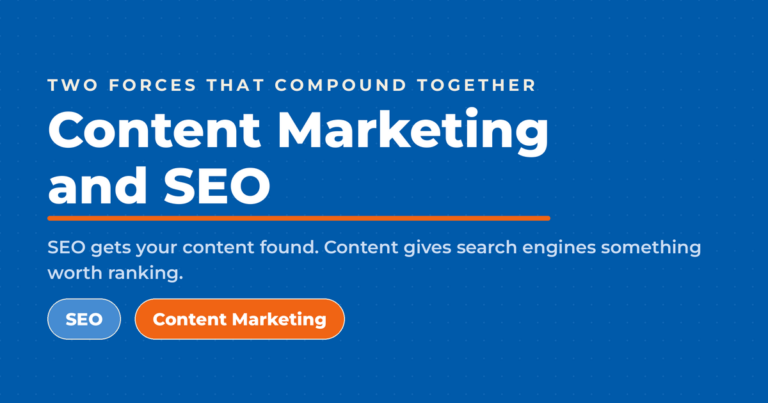
Answer engine optimization is the practice of structuring a page so a machine can lift one specific piece of it and serve that piece as the answer. Generative engine optimization is the practice of making a page credible and distinctive enough that a model composes its answer partly out of yours, and cites you for it. Extraction against synthesis.
Both labels are contested, which I get to below. The mechanical distinction is the part that survives the argument.
AEO is the older idea. It grew out of featured snippets, People Also Ask, knowledge panels, and voice assistants, and it rewards a tight self-contained answer sitting directly under the question. Forty to sixty words. No throat-clearing. The machine takes it whole or takes somebody else’s.
GEO is what happens when the engine stops lifting and starts writing. A model pulls from several sources at once, builds a response none of them contains, and decides whether yours belongs in it. That rewards depth, original data, and claims specific enough to be worth referencing.
Take a question I get asked constantly, which is how often a small business should publish. An extraction surface wants one liftable block. It scans for a sentence answering the question outright, takes it whole, and shows it with your name attached. Open that section with three paragraphs of context before the number and it takes somebody else’s sentence instead.
A synthesis surface does something else entirely with the same page. It reads several sources and notices yours is the only one carrying a cadence measured from a real content library rather than a general recommendation. Then it composes an answer leaning on your figure while quoting nobody exactly. You get named because you had something the others did not.
Same page, same question, two different tests. One asks whether your answer is easy to remove. The other asks whether your answer is worth keeping.
| AEO | GEO | |
|---|---|---|
| Mechanism | Extraction | Synthesis |
| Typical surface | Featured snippets, People Also Ask, voice results | ChatGPT, Gemini, Claude, Perplexity, AI Overviews |
| What the page must do | Contain a liftable answer | Contain something worth referencing |
| Rewarded by | Brevity and structure | Depth and originality |
| Fails when | The answer is buried | The page only restates common knowledge |
| Measured in | Impressions in Search Console, clicks folded into organic | Sessions by named source, plus citation tracking |
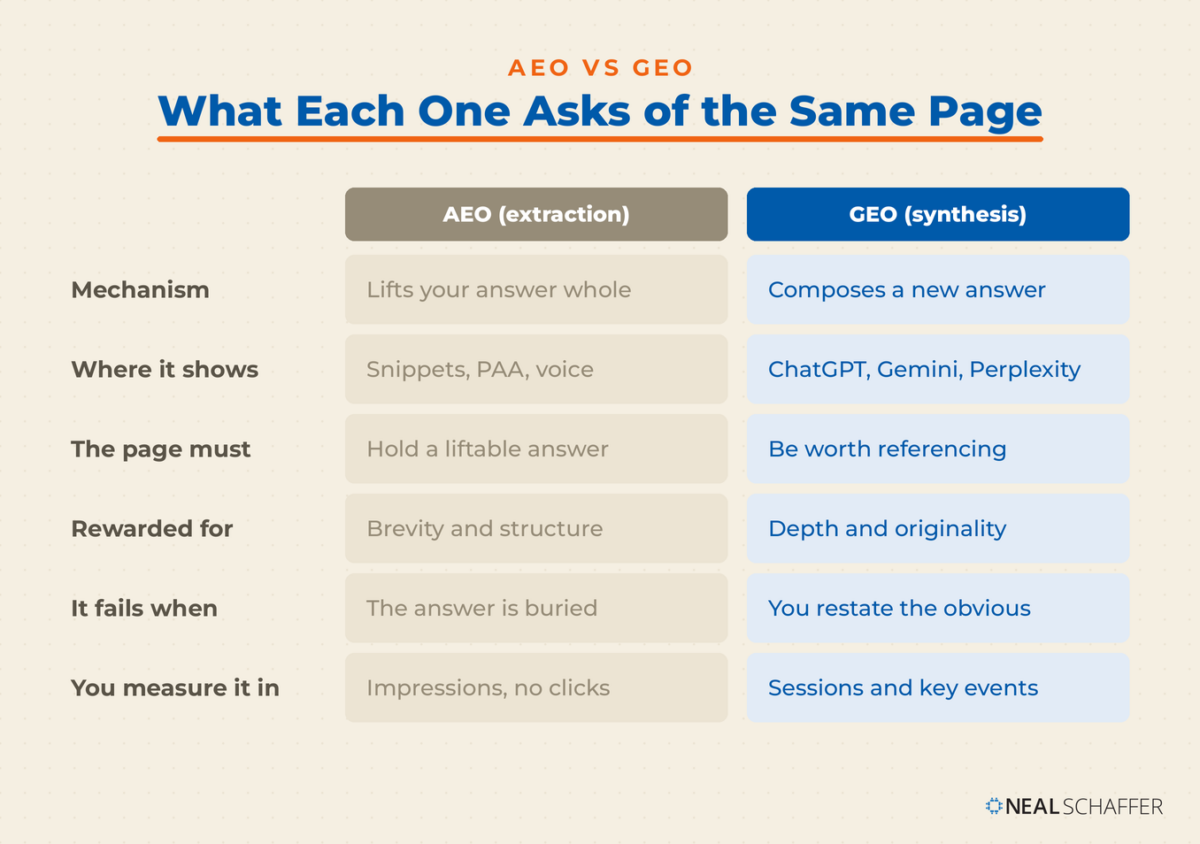
The last row is where the advice usually goes quiet, and I come back to it later with my own numbers. It decides which half of this you can justify to a client.
Which one applies to you is not a preference. It is decided by how your audience asks the question. If people reach you through short factual queries with a single correct answer, you are living on extraction surfaces and AEO is most of your job. If they reach you through comparisons, recommendations and open-ended research, you are living inside synthesis and the depth of the page decides everything.
Most businesses sit on both, unevenly. Mine leans synthesis, because almost nobody arrives at a marketing blog through a question with one right answer. A plumber leans extraction, because a great deal of their demand is exactly that.
Are AEO and GEO Actually Different Disciplines?
No, not in any way that changes your workflow. The industry cannot agree on the labels, Google says both are still SEO, and the underlying work overlaps almost completely. The distinction is real as a description of two mechanisms. It is not real as a reason to run two programs or hire two vendors.
The disagreement is funny once you line it up. Google’s own documentation names both acronyms and treats optimizing for generative AI search as optimizing for the search experience, which puts all of it under SEO. Wikipedia’s entry notes that no consensus definition separating these terms existed in the academic literature as of early 2026, and that practitioners use them interchangeably.
Then there are the vendors, who have opinions. Graphite, AthenaHQ and Surfer ran a three-way public debate on what to call this and landed nowhere. Graphite argued for AEO, because answers are what models return. AthenaHQ argued for GEO, because engines now book and transact rather than merely answer. Surfer argued for AI SEO, because search is what people actually do.
Profound takes a fourth position, arguing that the two are one strategy and that GEO is a bad name because the acronym already belongs to geography. HubSpot takes a fifth, using AEO as the umbrella term with generative work sitting inside it.
Is LinkedIn Actually Bringing You Business?
My latest book helps professionals, entrepreneurs, and business owners turn LinkedIn from a static profile into a real source of clients and growth.
Maximizing LinkedIn for Business Growth gives you clear, practical steps to build a profile that gets noticed and a network that actually sends business your way.
Grab your copy on Amazon and put it to work this week. Click the cover or the button below to get started.

My favorite detail from the Graphite piece is that they asked three AI models to settle it. ChatGPT picked GEO, Perplexity picked AI SEO, and Gemini picked AEO. Three engines, three answers, on a question about how to optimize for engines.
On a recent episode of my podcast Your Digital Marketing Coach I argued that these are two sides of the same coin and that you do both rather than choosing. I still think that, and Google’s documentation arrived months later saying something close to it. None of which tells you what to write, though. That part splits more cleanly than the terminology does.
How Do You Optimize for AEO vs GEO?
Write the answer first and the evidence second, on the same page. AEO rewards a self-contained forty to sixty word answer directly under a question-shaped heading. GEO rewards what sits beneath it: original data, named sources, specific claims. One page can do both, and the sequence is what makes it work.
| AEO tactics | GEO tactics | |
|---|---|---|
| Headings | Phrased as the question is asked | Phrased to cover a subtopic fully |
| Opening of each section | 40 to 60 words, standalone | Sets up the evidence that follows |
| Formatting | Lists, tables, short paragraphs | Depth, context, worked examples |
| Evidence | Enough to be credible | Original, sourced, hard to find elsewhere |
| Entity work | Consistent naming | Consistent naming plus off-site reinforcement |
| Failure mode | Answer buried too deep | Nothing a model could not write itself |
That is the contrast. The sequence for a single page runs like this.
- Write the heading the way the question gets asked. Pew found AI summaries on 8% of one and two word searches against 60% of question-word queries, which is the long-tail keyword case again.
- Put a standalone answer directly under it, in forty to sixty words. No setup first. A machine takes your opening block or takes somebody else’s.
- Follow it with something only you could have written. The paper that coined GEO found citations, quotations and statistics lifted visibility by over 40%.
- Break the body into liftable units. Retrieval pulls passages rather than pages, so lists, tables and short paragraphs each travel on their own.
- Put internal links inside the sentences where the topic comes up. A link parked in a callout below never travels with the lifted passage, which is the heart of internal linking and shapes SEO content and on page SEO too.
- Name things identically everywhere, on your site and off it. Wording that shifts between pages gives a model less to attach a citation to.
- Confirm the page is indexed and snippet-eligible. Google requires both before a page can appear in AI features, so this is a technical SEO question before a content one.
Steps one through four are the AEO half and take an afternoon per post. Steps three and six are where GEO is won, and they take a great deal longer.
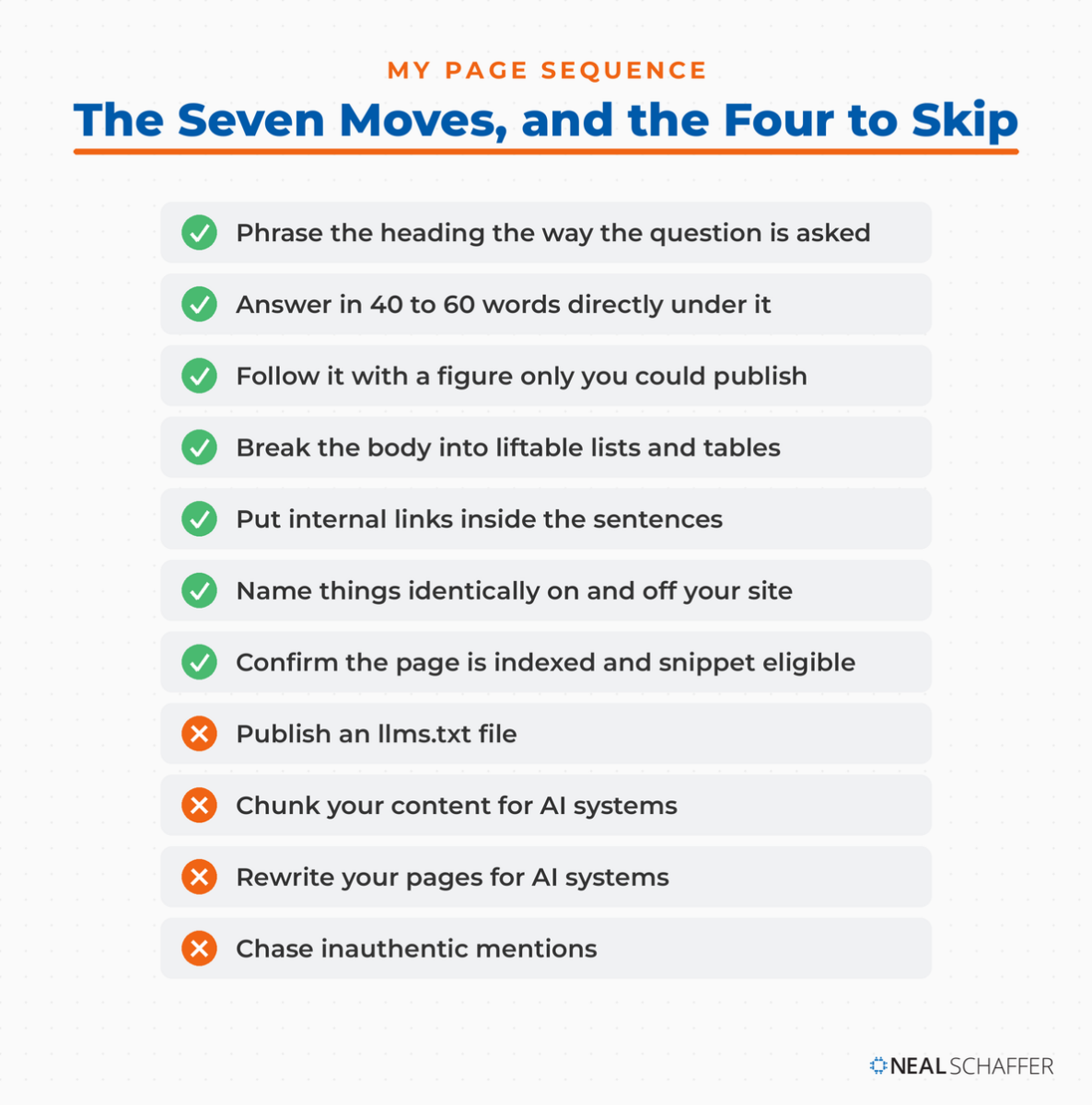
Skip what Google says to skip. Its documentation names llms.txt files, content chunking, rewriting pages for AI systems, and chasing inauthentic mentions. Several AEO and GEO packages sell exactly those four things. I walked through each one, along with what Google tells you to do instead, in my post on answer engine optimization.
Local businesses tilt harder toward AEO. Keep your Google Business Profile current and your name, address and phone identical across every listing, which is ordinary local SEO doing a new job.
That covers what to change. Whether it worked is the harder half.
What Does AEO Look Like in Your Own Search Console?
It looks like a rising line you cannot safely interpret. Google’s generative AI performance report shows impressions, pages, countries, devices and dates for AI Overviews and AI Mode. No clicks, no CTR, no position, no queries. Read the fine print before you celebrate the number.
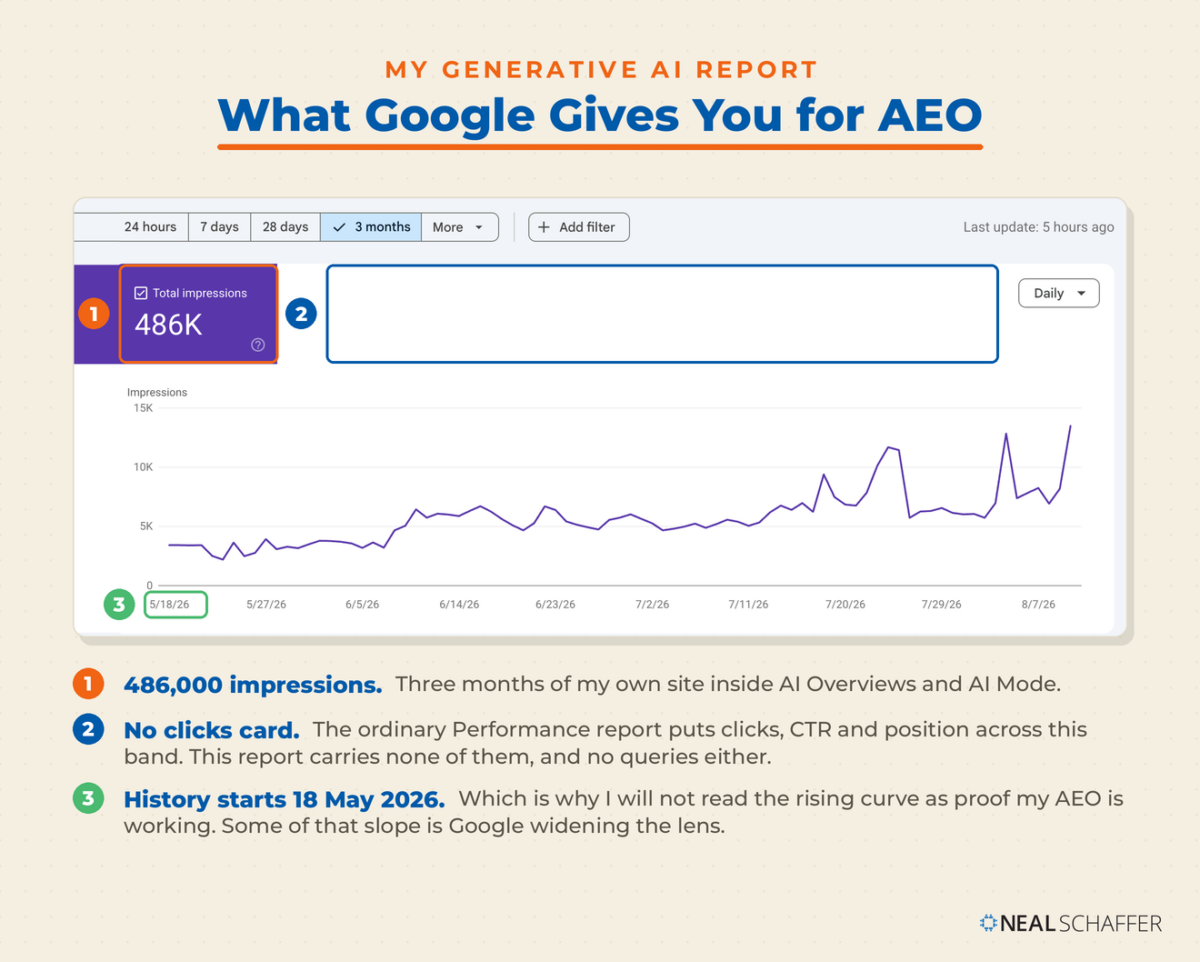
Two details defuse most of the excitement. The report draws from the same Web search type as your main Performance report. These impressions are a subset of totals you already had, rather than volume you just gained. And a click inside an AI Overview does count. It lands in the overall Performance report instead of this one, filed among ordinary organic traffic with nothing distinguishing it.
Google’s own framing tells you how to read the report. Their announcement describes it as a dedicated view of your impressions, and stops there. Not performance. Not traffic. Visibility. Read literally, Google is handing site owners a brand exposure metric and openly declining to attach it to an outcome. That is a more honest position than most of the platforms selling AEO services against it.
My own curve started around 3,000 daily impressions in mid May and has been touching 13,000 in early August. I am not going to tell you that means my AEO is working, because the report’s data history only begins on 18 May 2026 and the rollout was incremental. Some unknown share of that slope is Google widening the lens rather than my site earning more.
Which leaves the question you should be asking about the metric itself. An impression is worth a probability that somebody remembers you, unpriced and unproven. Hold that thought, because a different industry has already spent forty years arguing about it.
What we do know comes from outside Google. Ahrefs analyzed 300,000 keywords and found that an AI Overview correlates with a 58% lower average clickthrough rate for the top-ranking page, up from 34.5% in their previous study. Position two lost about half its clicks in the same analysis. Even position ten dropped nearly 20%.
So the impressions rise and the clicks fall, and Google reports the first number and withholds the second. I said this would happen, roughly, before I had the data. On that same podcast episode I put it this way:
“For AEO specifically, if we are successful in this, we should be seeing increased impressions, which hopefully over time will lead to increased clicks.”
I was half right. The impressions came. Whether they brought anybody with them is not a question Search Console can answer, so the next place to look is analytics.
Can You Track AI Traffic in Google Analytics?
Partly, and the split is the opposite of what most people assume. Visits from Gemini, ChatGPT and similar assistants arrive as referrals and now land in a dedicated GA4 channel with no setup required. Visits from AI Overviews and AI Mode do not, because those clicks happen on google.com and arrive labelled as ordinary organic search.
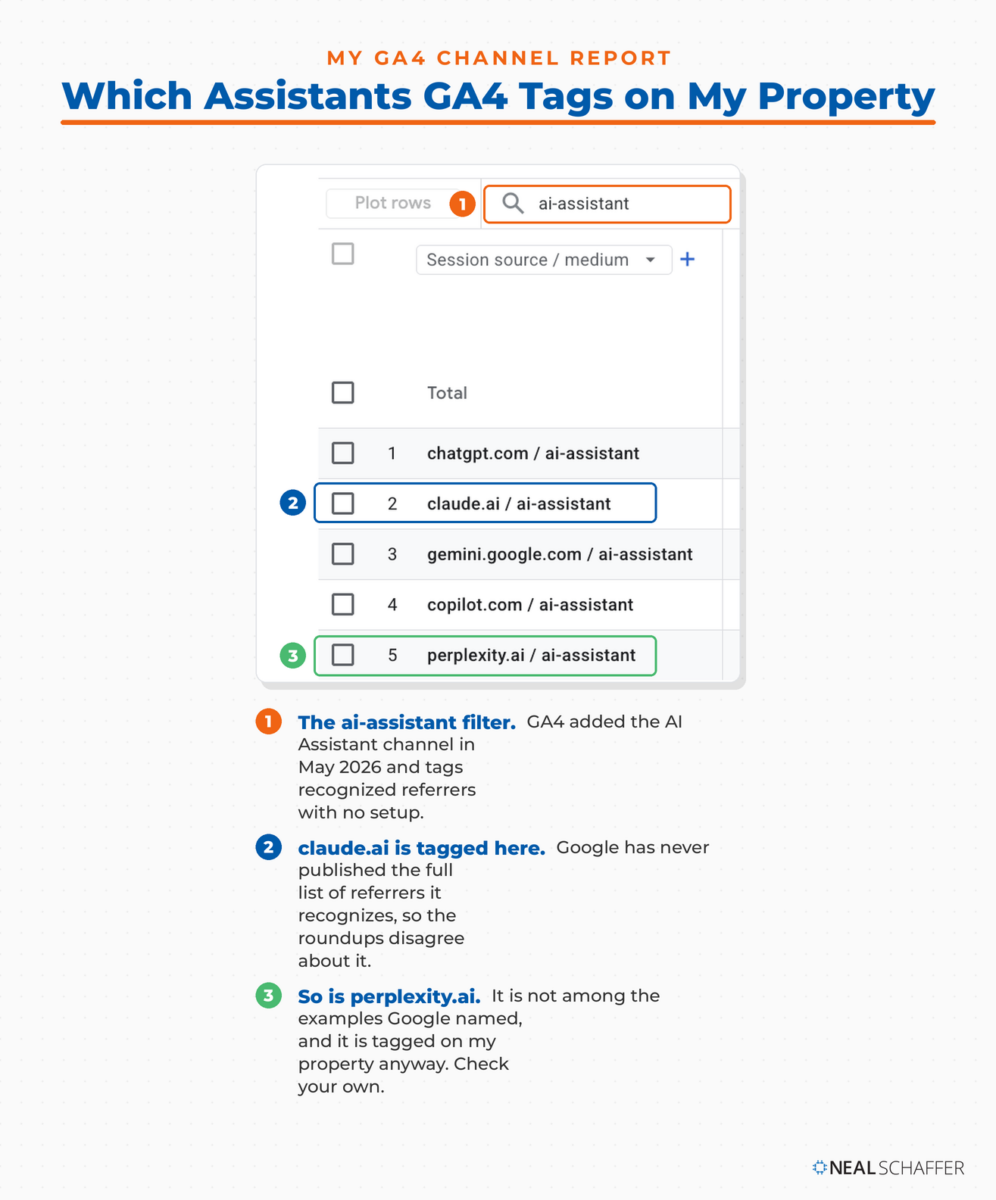
Google added a native AI Assistant default channel group to GA4 in May 2026. Recognized assistant referrers get a medium of `ai-assistant` and a campaign of `(ai-assistant)`, automatically. Google names ChatGPT, Gemini and Claude as examples, and has never published the full list of referrers it recognizes.
Two things are worth knowing before you report the number to anyone. The classification is not retroactive, so it reshapes reporting from the day it starts and leaves your history alone. And because Google gave three examples instead of a list, nobody outside Google knows the actual coverage. Several write-ups fill that gap by asserting a definitive roster, and they disagree with each other. Perplexity is the one most often written off as still landing in plain Referral. It shows up in my own export tagged ai-assistant, alongside Copilot. Check your own property rather than trusting the write-ups, this one included.
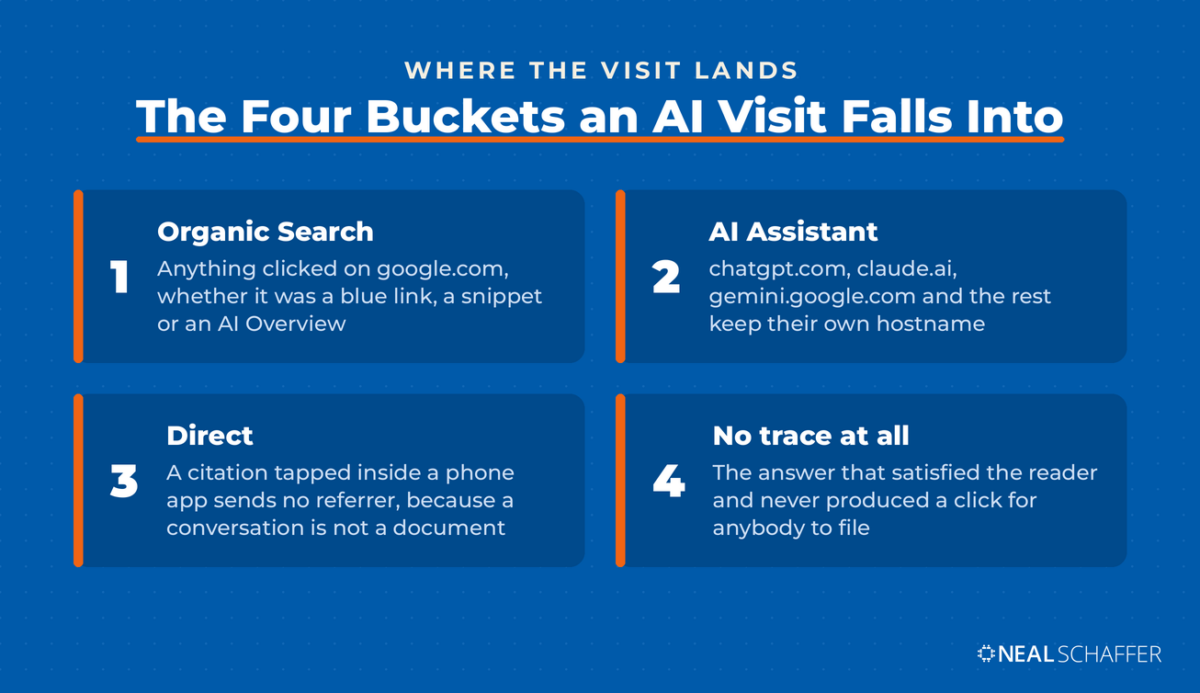
The dividing line is not AEO against GEO. It is which host the visitor was on when they clicked. Anything on google.com collapses into organic search, whether it was a blue link, a featured snippet or an AI Overview. Anything on an assistant’s own hostname keeps its identity.
Gemini trips people up because the word names two products. The app at gemini.google.com is a separate host and gets classified like any other assistant. Gemini the model powering an AI Overview lives inside google.com and is invisible.
There is a fourth bucket. The referrer header is sent by a document, answering which page you were on when you followed the link. Tap a citation inside a phone app and the conversation is not a page, it is native interface. No document, no referrer, so GA4 files the visit under Direct. Nothing was stripped. There was never anything to send, and no setting fixes it.
You will see confident percentages quoted for how often this happens. I went looking for the source and found vendor blogs citing each other. Treat your AI channel as a floor rather than a count.
GEO, the half nobody gives you a report for, is the half you can actually tie to sessions and conversions. AEO, the half Google built a dedicated report for, is the half you cannot. The measurement is inverted against the reporting.
Since I can measure that half, here is what it says. Across the last twenty-eight days the AI Assistant channel accounted for well under one percent of my sessions. It sat at almost exactly the same share in the twenty-eight days before. Flat, small, and stubbornly consistent, which is not the trajectory the discourse would lead you to expect.
What those visitors did is the part worth watching. They produced roughly four and a half percent of my key events in each period, out of under one percent of sessions. The same over-index turned up twice, independently, which is the only reason I will mention it.
I am not dressing that up as a conversion multiple. The underlying key event counts are in low single digits, so two signups either way would swing the ratio hard. Anyone quoting a precise AI conversion multiple off a site this size is quoting noise.
Which brings me back to the clicks. A small AI channel would not worry me much if the rest of the picture were healthy. It is not.
What Happens When AEO Works and Nobody Clicks?
You get a very large number sitting next to a small one. Across twelve months my site earned roughly one click for every 660 impressions in Google Search, which Search Console rounds to a clickthrough rate of two tenths of one percent. That ratio is the zero-click problem stated in a single line.
One caveat I have to give you, because it cuts against my own argument. My average position across that period was 35.9, which is page three and beyond. A great many of those impressions were never going to earn a click whether an AI answer sat above them or not. A site-wide ratio flatters the case, and anybody quoting one at you without mentioning their average position is selling something.
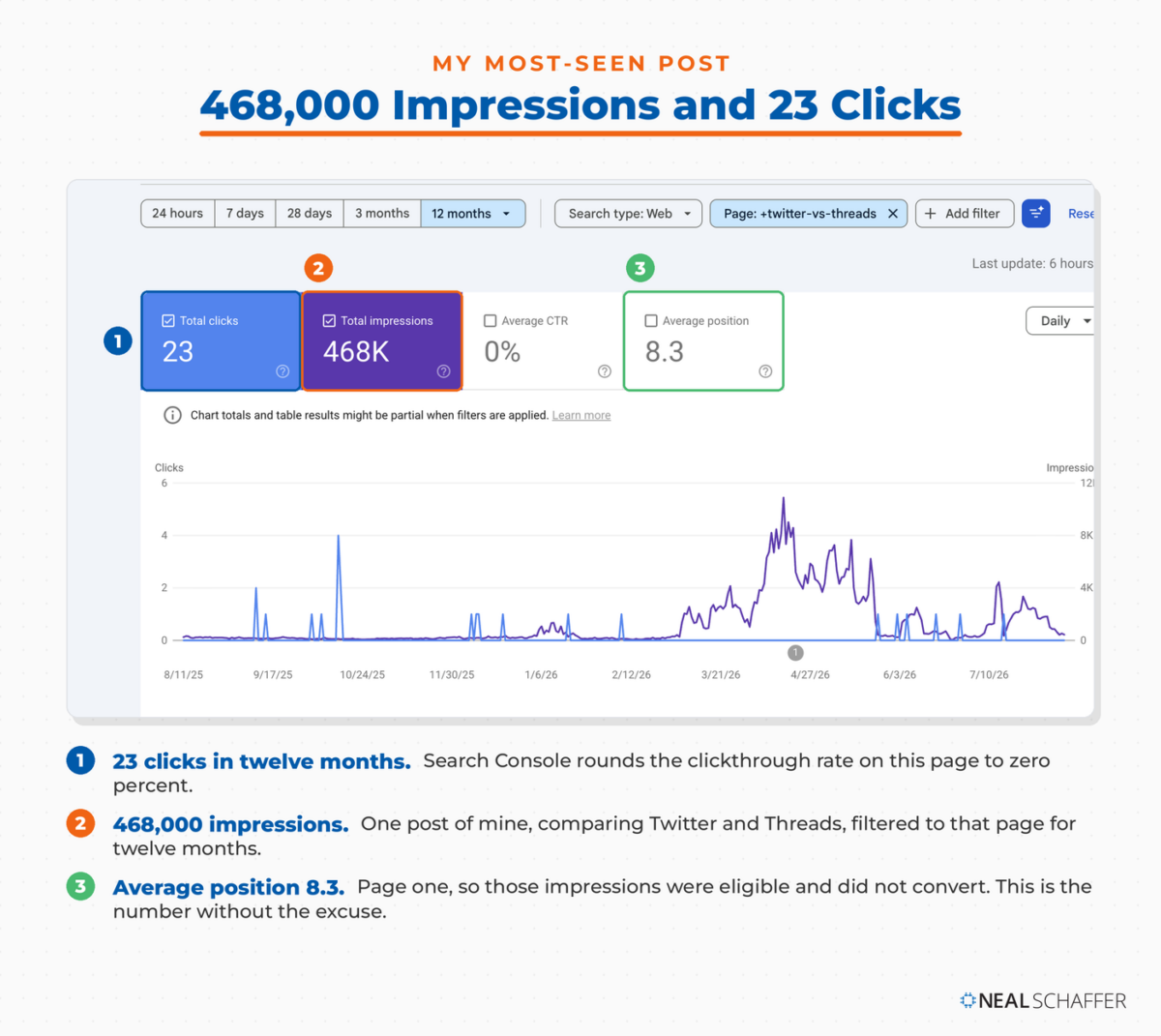
My worst single page is a post comparing Twitter and Threads. Over twelve months it collected 468,000 impressions and 23 clicks, at an average position of 8.3. Search Console rounds the clickthrough rate on that page to zero percent.
That is the number without the excuse. Position 8.3 is page one, so those impressions were eligible and did not convert. A page can be extraordinarily visible and commercially inert at once, and no ranking report tells you which one you have. That post does everything AEO advice says to do. It gets read on the results page and abandoned there.
While pulling those figures I found something worth passing on, and you can reproduce it on your own site this afternoon. Filter Search Console to a single page, twelve months, then compare that page’s total clicks against the sum of every query row Google discloses for it. On the page I tested, the query rows accounted for 60% of the clicks. The other 40% arrived on searches Google will not name, and they never appear in the export at all.
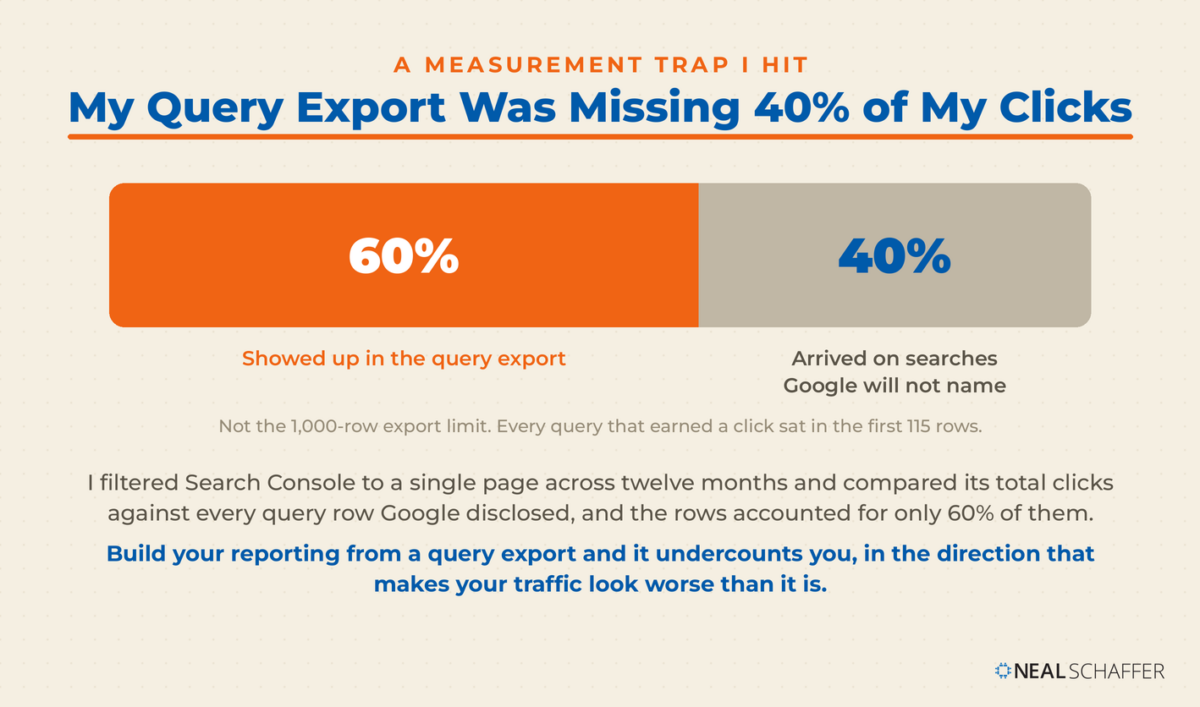
That is not the thousand-row export limit doing it. The file is sorted by clicks, and every query that earned one sat in the first 115 rows, followed by 885 rows of zeroes. The cut-off never came near a clicked query. Google anonymizes rare search terms, and when it does it removes the row and takes the clicks with it. The more your demand sits in the long tail, the more of your own performance is missing from the file you are using to judge it. Most people build AI-search reports from exactly that view, which means the report undercounts them in the direction that makes things look worse.
The independent research says this is not just me. Pew Research tracked the browsing behavior of 900 US adults across 68,879 searches. When an AI summary appeared, users clicked a traditional search result in 8% of visits, against 15% when it did not. Clicks on links inside the summary itself ran at 1%. Seer Interactive, tracking 3,119 queries across 42 organizations, watched organic CTR on AI Overview queries fall from 1.76% to 0.61%.
Which raises a question I had to answer before I could plan anything: if the click is gone, what is the impression actually buying?
Are We Going Back to How PR Was Measured Before the Internet?
Yes, in the measurement sense, and the parallel is close enough to be uncomfortable. Before the web, agencies counted press clippings and multiplied circulation to report impressions, because nobody could trace a magazine mention to a sale. Attribution was an invention of the internet rather than a permanent feature of marketing.
If you were working in marketing before 2000, you remember the clip book. A thick binder of physical cuttings, with a circulation-derived impression total on the summary page. Beside it, a dollar figure called advertising value equivalency, estimating what the same space would have cost to buy. Nobody could tell you what it sold.
The part that should stop any SEO cold is what the PR industry did next. AMEC’s Barcelona Declaration of Measurement Principles, adopted in 2010, states in Principle 4 that overall clip counts and general impressions are usually meaningless. Principle 5 rejects advertising value equivalency as a way to value public relations at all.
Sixteen years later, Google shipped us a report containing nothing but general impressions. That is the answer to what an AEO impression is worth, and it is not a satisfying one. It is worth a probability of being remembered, which is the same thing a clip was worth, priced with the same confidence.
The metric is not worthless. But we have been handed the exact instrument another discipline spent decades learning to distrust, and we are at the stage of holding it up proudly.
The structural problem underneath is the real one. SEO grew up on an unbroken chain. A ranking produced a click, a click produced a session, and a session produced a conversion. Every dashboard and every retainer justification assumes that chain holds.
Digital PR never had that chain and built a working practice anyway. It earns coverage, tracks mentions and share of voice, and reads business outcomes indirectly through brand search and direct traffic. That is now the more useful model for anyone optimizing for AI answers, because the mention is replacing the link as the unit of value.
Which is why link building is quietly turning into something closer to being talked about. An unlinked mention carries weight with models that never followed the link in the first place. If you have been treating PR as a social media function rather than a search one, that separation is about to cost you.
AMEC has already noticed, opening a GEO Hub and publishing GEO principles for their members. The PR measurement body is moving into search from one direction while search moves into PR measurement from the other.
| Pre-internet PR | Search era | AI answer era | |
|---|---|---|---|
| Headline metric | Clip counts and circulation impressions | Clicks and sessions | Impressions with no clicks |
| Attribution | None | Close to complete | Partial at best |
| Value proxy | Advertising value equivalency | Conversion tracking | Citation and share of voice |
| Known weakness | Impressions say nothing about effect | Last click flatters the wrong channel | Nobody agrees what a citation is worth |
| Discipline that owns it | Public relations | SEO | Still being argued over |
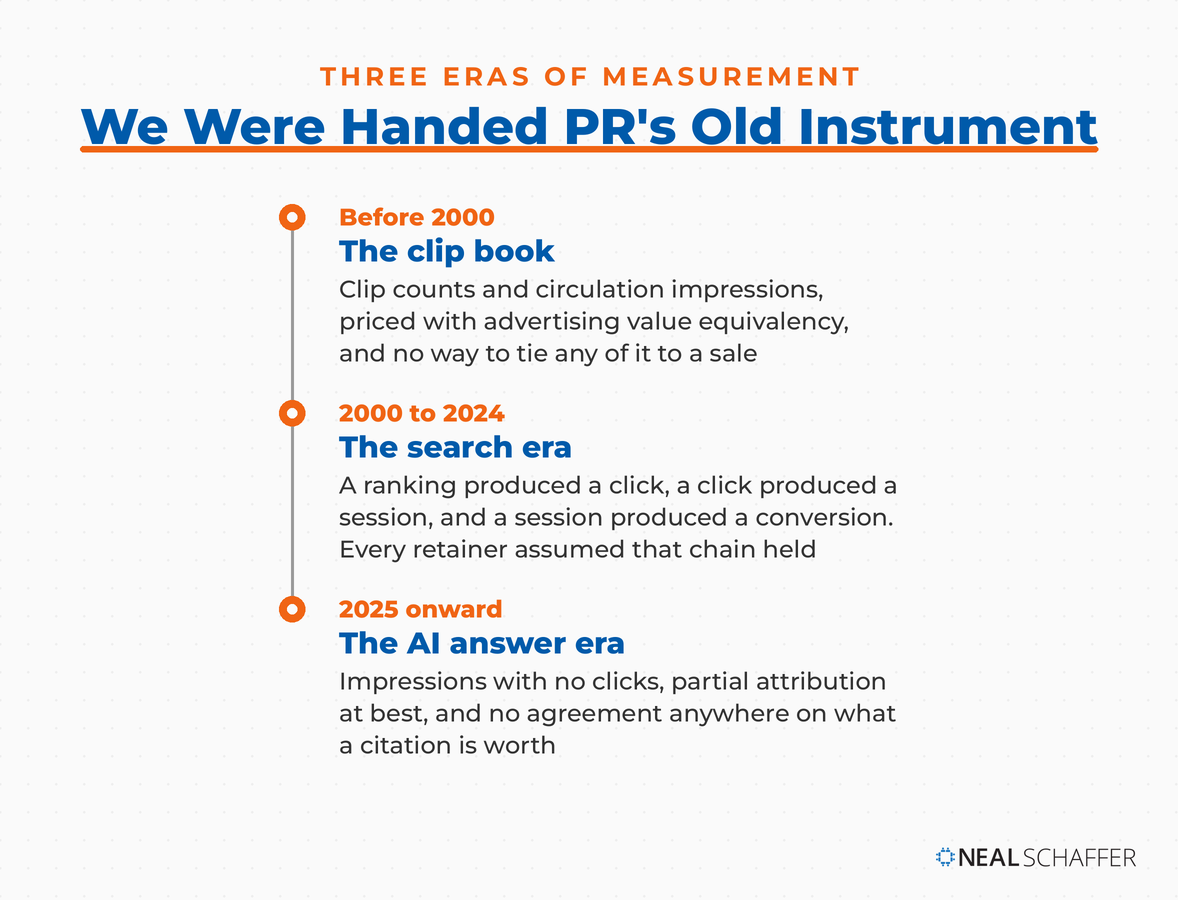
So steal PR’s answer rather than inventing one. Watch brand awareness signals across a quarter instead of clicks across a week. Branded search volume and direct traffic are the closest things we have to the tracking surveys PR has been running for forty years.
That settles what to measure. It leaves open what to do first, which is the question I actually get asked.
Which Should You Work On First?
AEO first, and only because it is cheaper to fix. Restructuring a page so its answer sits at the top is an afternoon of work per post. Producing evidence nobody else has is a research project. Do the cheap one across your library, then spend the expensive one on the pages that matter commercially.
Now the question underneath the whole argument. If this works, does it actually put more people on your site? Yes. That is worth saying plainly, because a post this careful about attribution can read as though nothing counts. Winning an extraction surface earns clicks, they land in organic, and the traffic is real even though you cannot label it. Getting cited by an assistant earns visits you can label. Both ends produce visitors.
What neither produces on its own is a business. Impressions are a leading indicator at best, and a leading indicator you cannot deposit. The value shows up further down. It lands in branded search, and in the person who saw your name inside an answer and looked you up a month later. Eventually it lands in somebody arriving already knowing who you are.
That distinction matters more the smaller you are. A brand with a media budget can treat exposure as an end in itself and wait years for it to compound. If you are running a business on your own name, you need the next step to happen. Judge this work on enquiries, signups and sales, not on how often a machine mentions you.
Discovery has been fragmenting across surfaces since long before these acronyms existed, which is the trend behind my running collection of social media marketing statistics. AI answers are the newest surface on that list rather than a break from it.
Seer’s data supports that being cited is worth something concrete. Brands cited inside an AI Overview earn 35% more organic clicks and 91% more paid clicks than uncited brands on the same queries. Their team is careful to say they cannot prove citation causes the lift rather than authority causing both, and that caveat is worth keeping.
The GEO half is where the durable advantage sits, and it is the half a competitor cannot buy. Anyone can hire a writer to restructure headings. Nobody can hire a writer to have run your business, made your mistakes, or exported your analytics. I judged the referral side of this against twelve months of my own data. What those visitors turned out to be worth is a separate story about AI search engine optimization.
Which leaves the questions people ask me every week.
Frequently Asked Questions About AEO vs GEO
Neither, and the framing is the problem. Google treats both as SEO, and the same page can serve both surfaces. Fix your answer structure first because it is faster, then invest in original evidence because that is what a competitor cannot replicate.
No. Search Console’s generative AI report covers the Google side at no cost, and a monthly manual check across ChatGPT, Gemini, Claude and Perplexity covers the rest. Buy an AI visibility platform when you have exhausted the free measurement, not before.
Yes, in my experience. Noindex removes a page from Google, which ends its eligibility for AI Overviews, but independent assistants crawl the page directly and are unaffected. Check how your own noindex is implemented before relying on this.
Track impressions in the generative AI report as your baseline, then watch branded search volume and direct traffic over the following sixty days. Pull your click figures from the page-level Performance report rather than a query export. On the page I tested, the query rows accounted for only 60% of its clicks, because Google anonymizes rare search terms and removes those rows entirely.
Largely, yes. Your SEO strategy remains the prerequisite, because a page has to be indexed and snippet-eligible before any AI surface can use it. What changed is the payoff structure, not the playbook.
Start With the Cheapest Fix You Have
Pull your generative AI report in Search Console today and write down the total. That single number is your AEO baseline, and every judgment you make over the next quarter depends on having it. Do this before you change a single heading, because once you start editing you lose the ability to attribute anything to anything.
Then take your twenty most important posts and move the answer to the top of every section. Forty to sixty words, directly under a heading phrased the way somebody would ask it. This is the part you can finish this month.
After that, go back through the same twenty and add one thing to each that nobody else could have written. A number from your own analytics. A tool you pay for and one you cancelled. A project that went sideways. That is the part that keeps working when the acronyms change again.
Come back in sixty days and read impressions, branded search and email signups together rather than chasing clicks that are not coming back. If you want to see which tools I actually pay for to do this work, I keep a running list of the AI SEO tools I use.
And if you would rather have someone build this into a plan across search, email and social at once, that is the work I do as a Fractional CMO. You can also join my newsletter and get what I am testing while I am still testing it.