Discover the Influencers Your Business Already Has
Get the first chapter of The Age of Influence free, and learn how to work with influencers of every size.
Somebody is already recommending your brand this week. A customer told a friend. An employee mentioned where they work. A partner sent a referral without being asked. None of it showed up in your analytics, and none of it was your idea.
A brand ambassador program is what happens when you stop letting that go to waste. It takes the advocacy you already have and gives it structure, recognition, and a reason to keep going.
That matters because recommendations still beat every other channel you can buy. According to Nielsen’s 2021 Trust in Advertising study of more than 40,000 consumers, 88% of global respondents trust recommendations from people they know above any other channel.
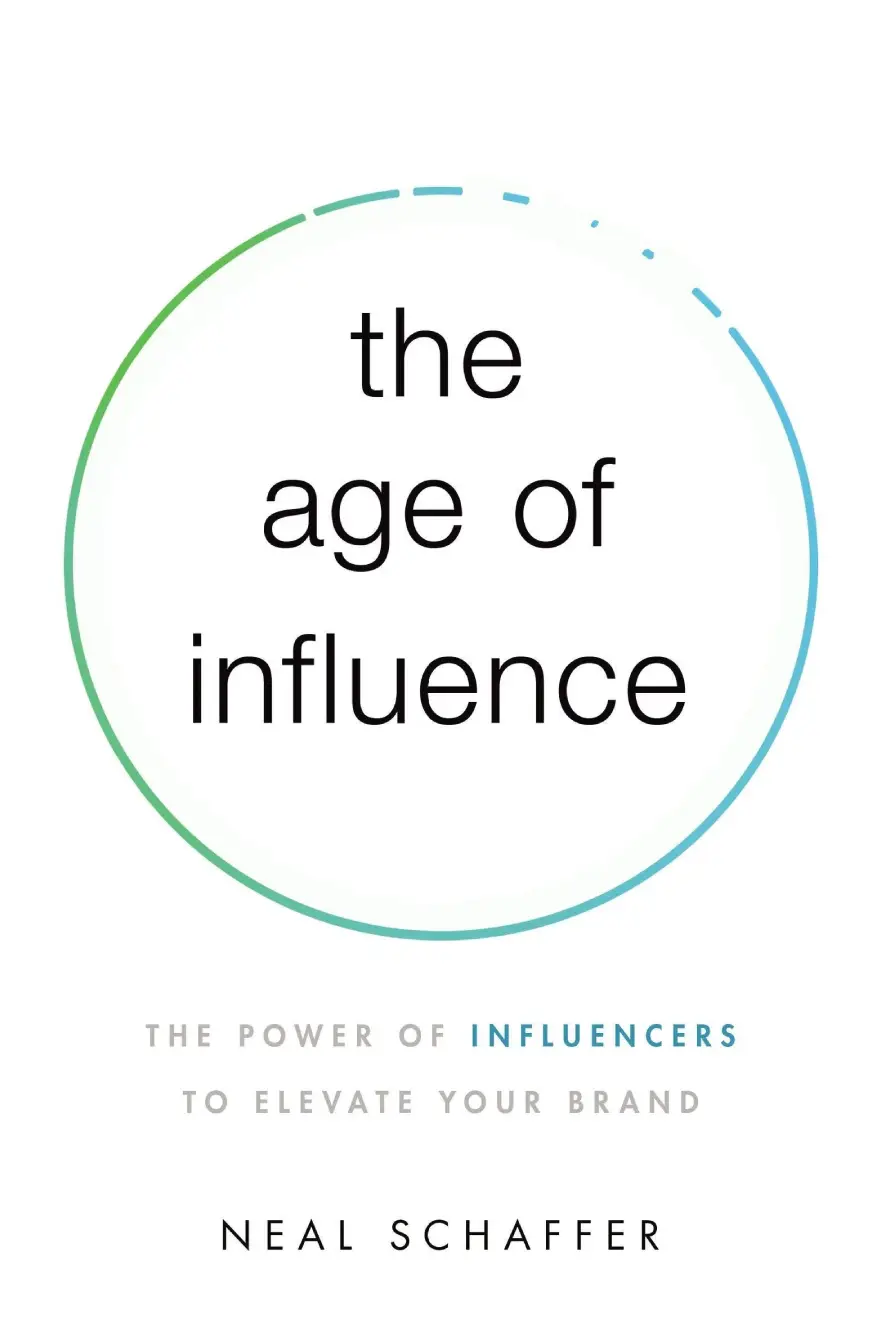
I wrote a book about this. The Age of Influence came out of the same idea I teach in my influencer marketing course at UCLA Extension. Your strongest advocates are usually the people closest to you. Most brands look outside anyway. I have spent years advising companies on this as a Fractional CMO.
I have also been on the other side of it. I am an Adobe Express Brand Ambassador, which means I get paid by Adobe to create content about a product I use. That disclosure is the point. I know what these programs feel like from inside, including the parts that are harder than the vendor guides admit.
✅ A brand ambassador program formalizes advocacy from people who already have affinity for your brand, which is what separates it from paying strangers to post.
✅ Word of mouth from people your audience knows remains the most trusted marketing channel, so your job is to organize it rather than manufacture it.
✅ An ambassador program is how you scale the relationships you built sourcing user-generated content. You cannot develop brand ambassadors without customers, which is why the order matters.
✅ FTC disclosure applies to ambassadors on every post, including employees, and the word “ambassador” on its own is not a sufficient disclosure.
✅ If nobody is advocating for you yet, an ambassador program will not create advocates. A referral or affiliate program is the better first move.
A brand ambassador program is an ongoing arrangement in which people who already have affinity for a brand agree to represent it publicly, usually in exchange for recognition, product, access, or modest compensation rather than campaign fees. The relationship runs continuously instead of ending when a single piece of content publishes.
The word “ongoing” carries that definition. A campaign has a start date and an end date. An ambassador relationship has an onboarding and, eventually, an offboarding.
In *The Age of Influence* I describe ambassadors as branded influencers: people whose connection to your company came first and whose audience came second. That order is the whole distinction. You are not renting attention. You are formalizing a relationship that already exists.
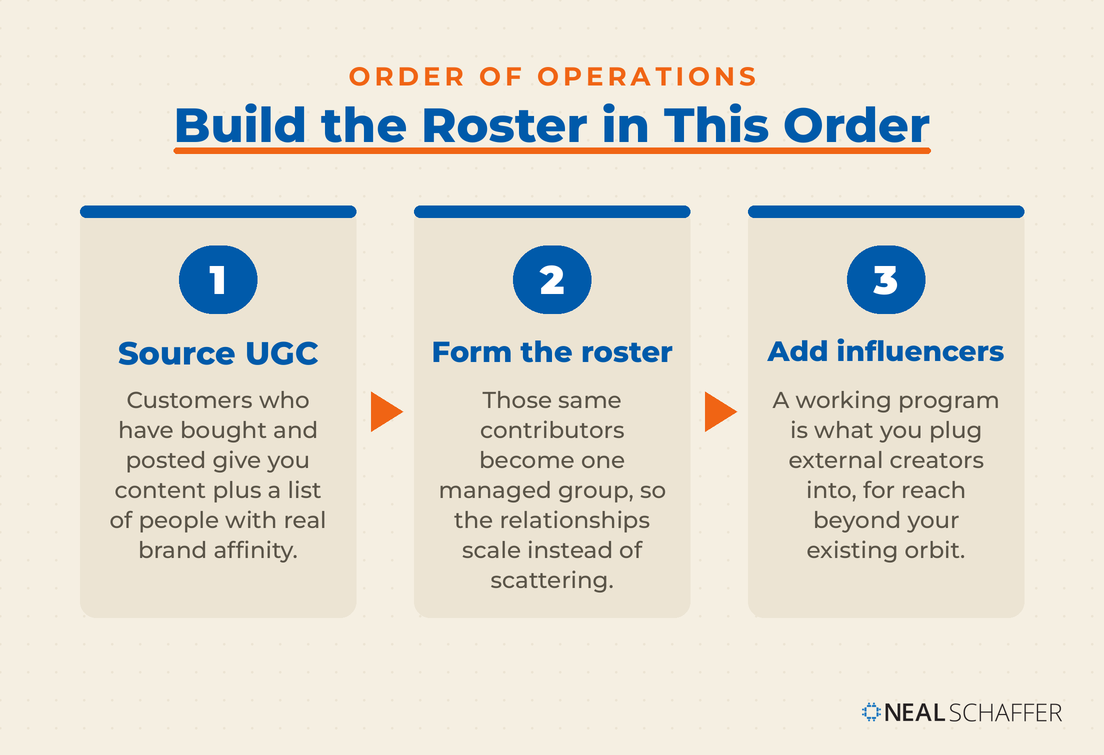
In *Digital Threads* I put the program later in the sequence on purpose. First you source user-generated content from customers and fans. Then you gather those same contributors into an ambassador program so the relationships scale instead of scattering. Only then do you approach external influencers.
That sequence is not a preference. You cannot automate a list without a list, and you cannot develop brand ambassadors without customers.
| Stage | What you need first | What it produces |
|---|---|---|
| Source user-generated content | Customers who have bought and posted | Content, plus a list of people with brand affinity |
| Build the ambassador program | Those UGC contributors | Scaled, ongoing advocacy from one managed group |
| Approach external influencers | A working program to plug them into | Reach beyond your existing orbit |
Which is why the first question is never “who should we recruit,” but “who is already talking about us.”
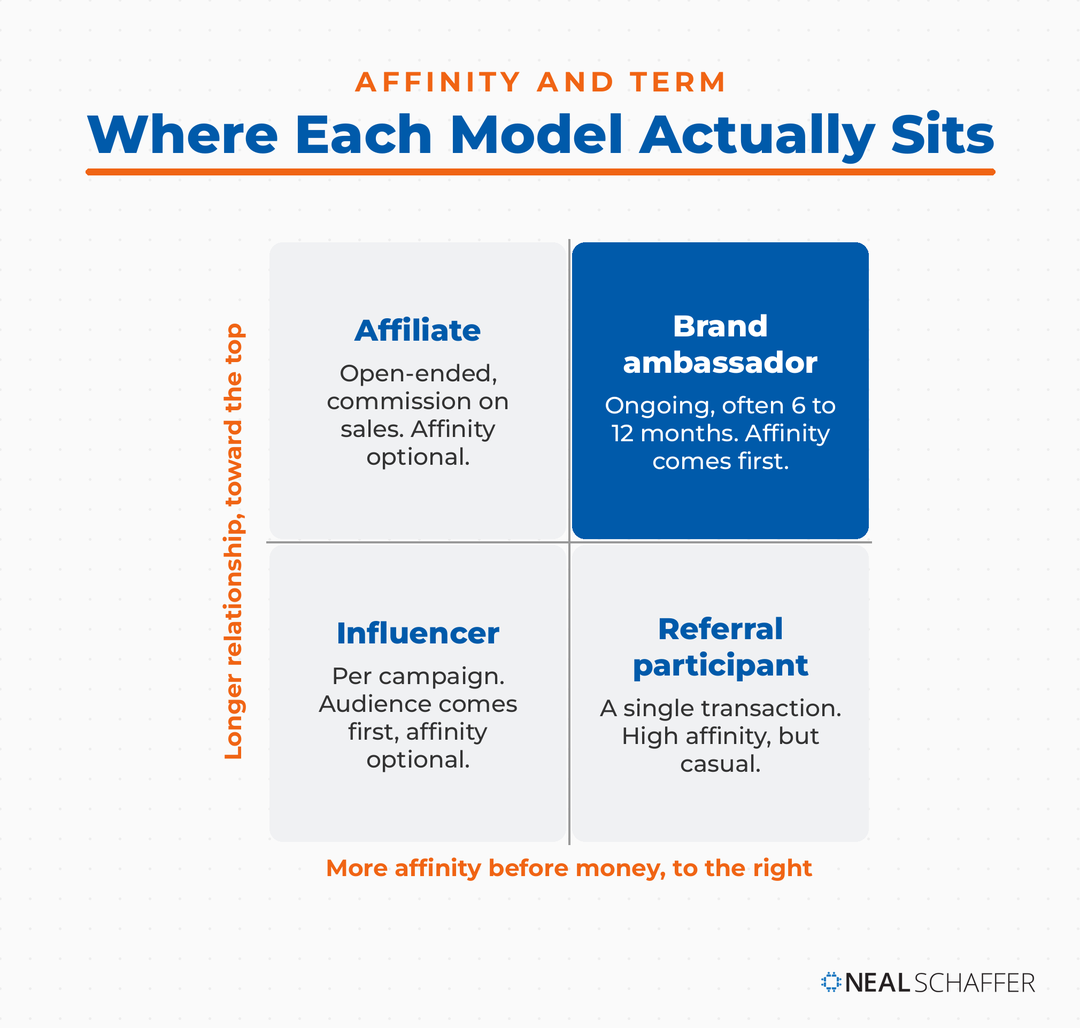
Ambassadors, influencers, affiliates, and referral participants differ on one variable above all others: how much affinity the person had for your brand before money or product entered the picture. Ambassadors start with affinity and add structure. Influencers start with audience. Affiliates start with commission. Referral participants start with a single transaction.
Getting this wrong is the most expensive mistake in this category, because each model needs a different agreement, a different reward, and a different measurement approach.
| Brand ambassador | Influencer | Affiliate | Referral participant | |
|---|---|---|---|---|
| Affinity required | High, and it comes first | Optional | Optional | High, but casual |
| Term length | Ongoing, often 6 to 12 months | Per campaign | Open-ended | Single transaction |
| Compensation | Product, access, recognition, sometimes a fee | Campaign fee | Commission on sales | One-time reward |
| Control over content | Guidelines, rarely approval | Brief and often approval | None | None |
| Disclosure needed | Yes, every post | Yes, every post | Yes, at the link | Usually yes |
| Best use | Sustained credibility and content volume | Reach into a new audience | Bottom-funnel sales | Acquisition from existing customers |
A person can occupy more than one row. Plenty of ambassadors also earn commission, which makes them ambassadors and affiliates at once, and the agreement has to say so. If you are weighing the two models against each other, the differences between influencer marketing and affiliate marketing are worth sorting out before you write anything down.
There is also a boundary worth naming inside my own work. An influencer program is the always-on machinery for recruiting, contracting, and paying external creators who owe you nothing but a deliverable. This post is about the other thing: building a roster out of people who were already on your side. Both sit inside influencer marketing as a discipline, both can run at once, and in most companies they should.
So where do those people actually come from?
Ambassadors come from four places, and every one of them sits inside your existing orbit: customers, followers, employees, and partners. This is the affinity framework I laid out in *The Age of Influence*. Brands almost always reach outside first, which is backwards, because the people with the most credibility about your product are the ones already using it.
Your customers are the obvious pool and the one most brands underuse. They have bought the thing, they have an opinion, and their recommendation carries weight precisely because nobody paid them to form it.
Look for repeat purchasers who post publicly. Not the biggest accounts. The consistent ones.
Followers who engage constantly but have never bought anything are the second pool. They are often aspirational buyers, which makes their enthusiasm real even when their receipts are thin.
My latest book helps professionals, entrepreneurs, and business owners turn LinkedIn from a static profile into a real source of clients and growth.
Maximizing LinkedIn for Business Growth gives you clear, practical steps to build a profile that gets noticed and a network that actually sends business your way.
Grab your copy on Amazon and put it to work this week. Click the cover or the button below to get started.

Employees are the pool nearly everyone ignores. They have the deepest product knowledge in the building and networks that barely overlap with your brand’s. This one gets its own section below.
Partners, resellers, distributors, and ecosystem vendors round out the four. In B2B this group is frequently the strongest of the four, and almost nobody formalizes it.
Of those four, one is consistently the most trusted and the most neglected, so let me take it on its own.
Employees make unusually credible ambassadors because audiences trust people over institutions. The 2026 Edelman Trust Barometer, which surveyed nearly 34,000 respondents across 28 countries, found “My Employer” trusted by 78% of employees, 14 points ahead of business generally at 64%. The people inside your company start from a position of credibility your brand account does not have.
The catch is that most employee advocacy programs ask the wrong thing. They send pre-approved posts and hope people share them. Almost nobody wants to spam their friends with a corporate announcement.
Buffer took a different route with a company-wide initiative it calls Team of Creators. Rather than asking its team to share company posts, Buffer set out to help all 70 employees build their own creator practice. The support was a Slack channel, a Notion resource hub, and optional workshops. Sabreen Haziq, who built and runs the program, wrote that the bet rests on a belief that “being creators ourselves will continue to set Buffer up for long-term success.”
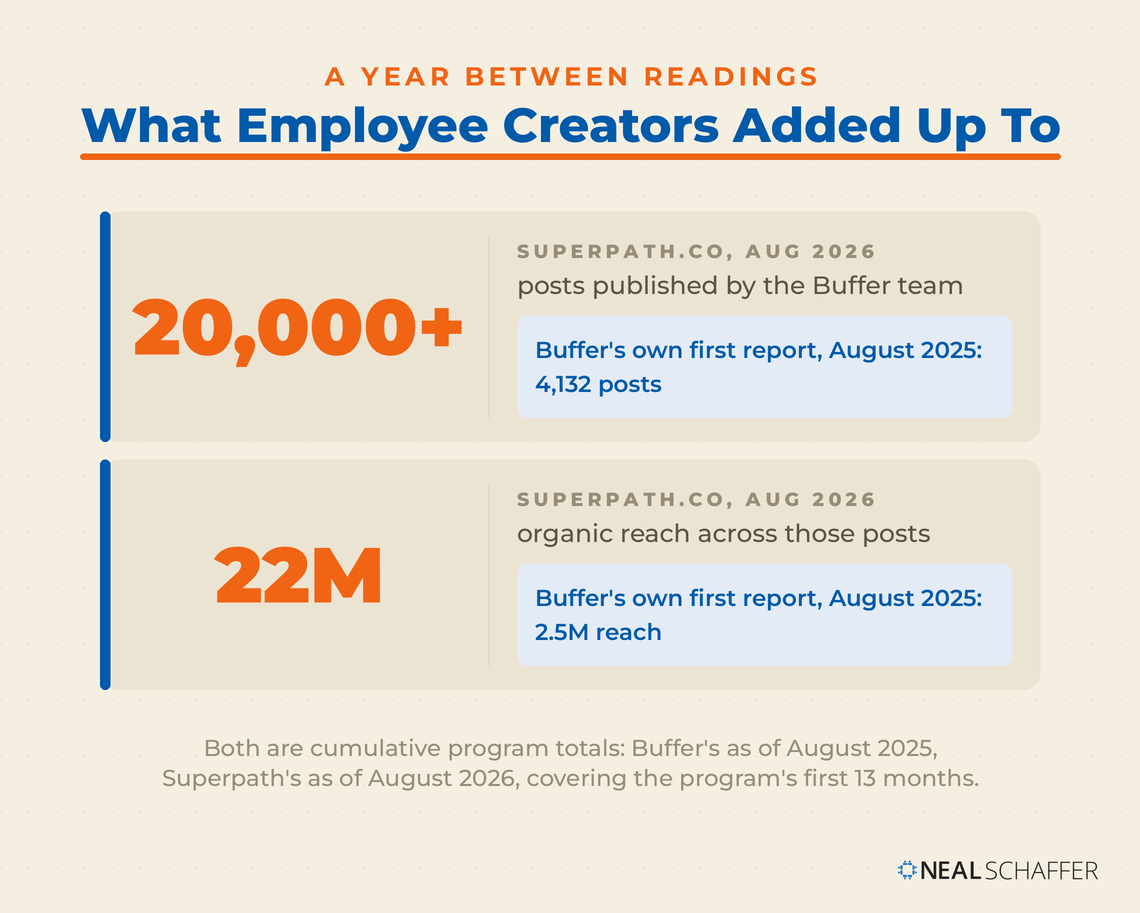
The results are worth reading in sequence, because they show what advocacy does over time rather than at launch. In August 2025, Buffer published its first numbers: 90% of the team participating, 4,132 total posts, and roughly 2.5 million total reach. A year later, Haziq put the running total past 20,000 posts and 22 million in organic reach, with no quota, no scoring, and nothing tied to compensation. Asked what she offers people instead, she said “the incentive is your own growth as a creator.”
I broke that case study down on my podcast *Your Digital Marketing Coach*, because it reframes what an employee ambassador even is:
> “Instead of seeing employees as potential brand ambassadors who can share your company content, start seeing them as potential creators who can build their own audiences while authentically representing what your company stands for.” (Your Digital Marketing Coach)
You do not need 70 people to try this. Start with three to five who already post comfortably, give them a shared channel and a short resource doc, and add to it as questions come up.
Two cautions before you start. Participation has to stay optional, and it has to go past HR and legal first, because employment agreements and social policies vary enormously. And employees carry a disclosure obligation that I cover further down.
Now, assuming you know which pool you are drawing from, how do you find the specific people?
You find ambassadors by auditing advocacy that already exists rather than by opening applications. Applications attract people who want free product, and they reward whoever writes the most enthusiastic paragraph. Audits find the people who already tagged you, reviewed you, or defended you without being asked to.
Here is how to run that audit in an afternoon:
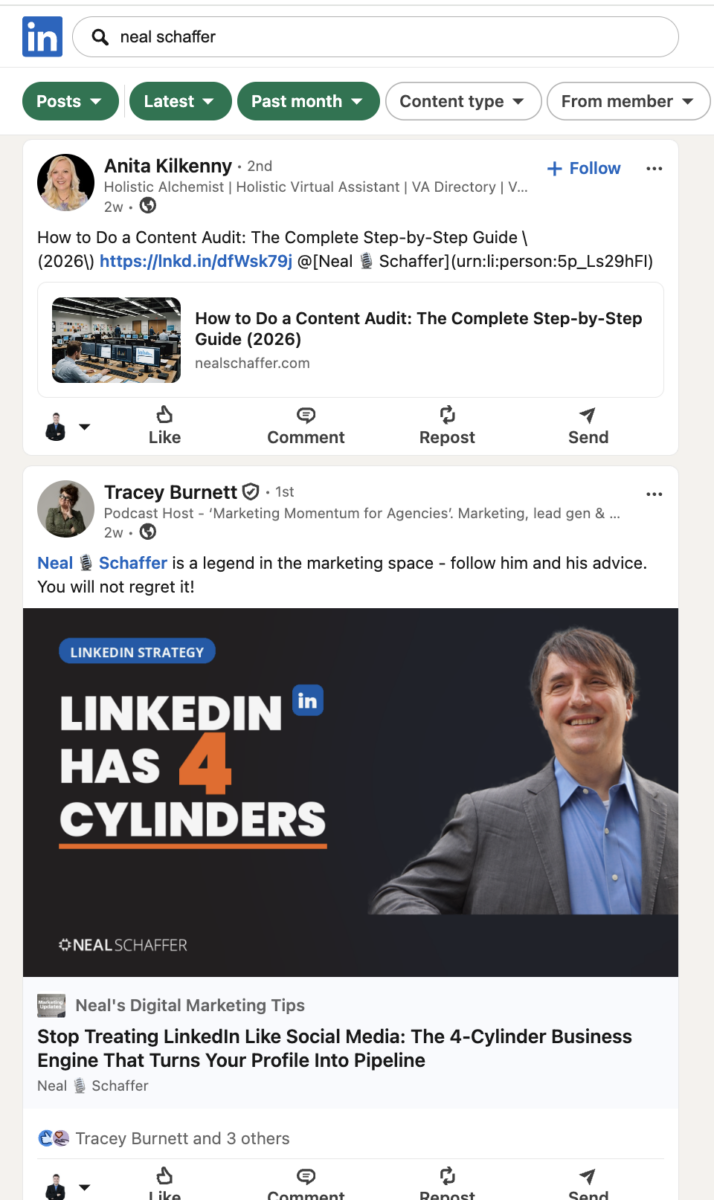
The reason to work in that order matters. Start from observed behavior and you are selecting on demonstrated enthusiasm, which no amount of recruiting can manufacture. Start from follower counts and you are selecting on reach, then hoping enthusiasm follows. That is how ambassador rosters end up looking like underpaid influencer rosters.
Most of your shortlist will be small accounts, and that is correct. The economics behind micro influencers and nano influencers are why ambassador programs work at modest budgets. The broader influencer tiers framework sets expectations for what each size delivers.
With a shortlist in hand, the next job is turning it into a program rather than a group chat.
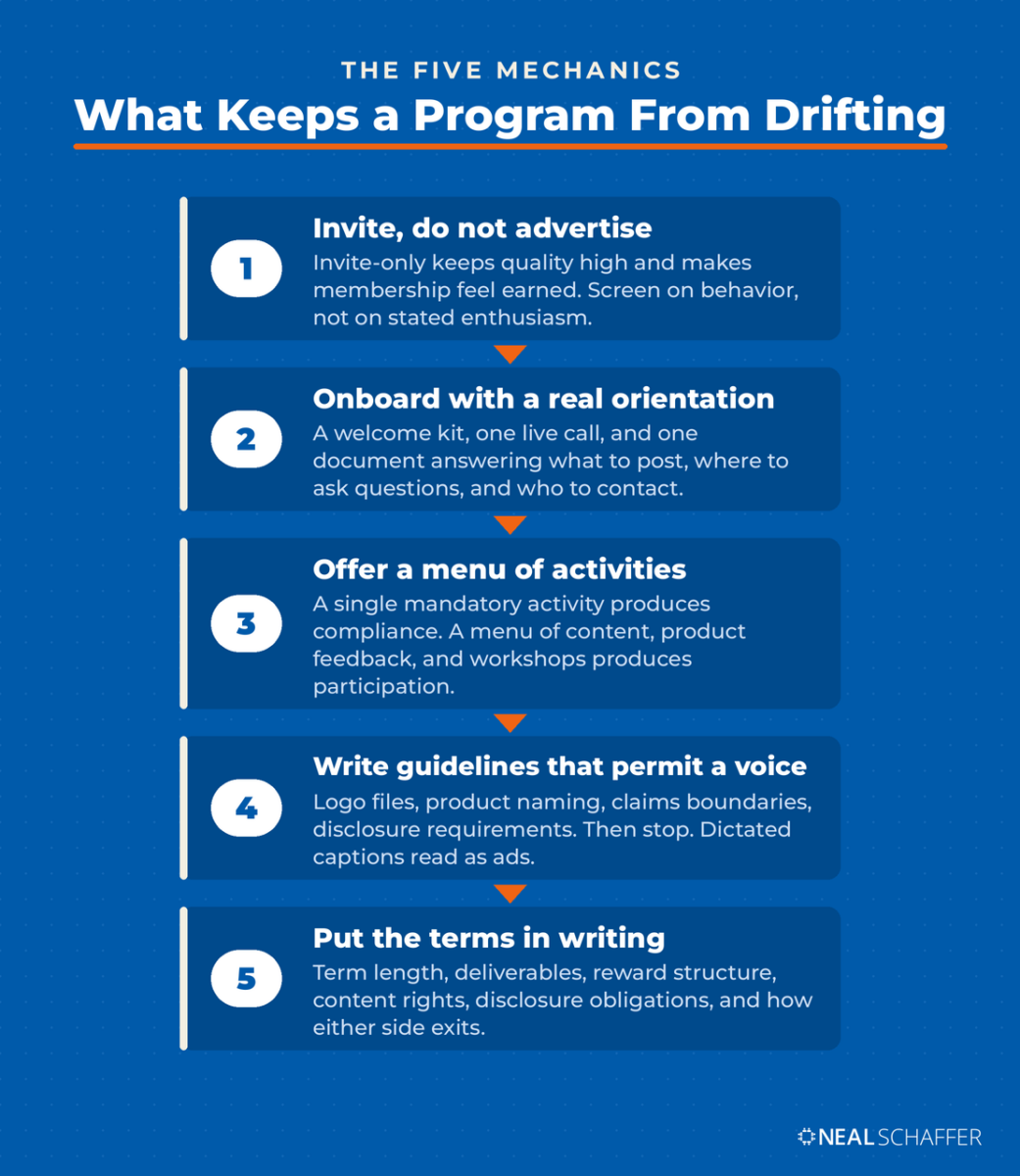
Running an ambassador program comes down to five mechanics: how people get in, how they get oriented, what they are asked to do, what rules they follow, and what they sign. Skip any one of them and the program drifts into an informal gifting list within about a quarter.
Invite-only keeps quality high and makes membership feel earned. If you do run an open application, keep it short and screen on existing behavior rather than on stated enthusiasm.
Watch how you word the call. When Adobe recruited for the Express program, it described the kind of person it wanted: entrepreneurs, small business owners, chamber of commerce directors, and online community leaders who like helping other people learn new skills and tools. It led with what members would get. It did not open with a demand that you promote the product. Attracting like-minded people is what lets the community hold together without constant intervention from you.
Send a welcome kit, run one live call, and give people a single document that answers what to post, where to ask questions, and who to contact. Adobe runs an online ambassador hub for exactly this reason. What makes it work is that the team updates it constantly and lets ambassadors pick activities that suit their own style, ambitions, and availability. The menu runs from publishing content about new features, to giving feedback to product managers, to hosting workshops.
Copy the menu structure. A single mandatory activity produces compliance. A menu produces participation.
Vagueness kills these programs. Give a concrete cadence and a concrete format. Adobe publishes its expectation openly. Ambassadors across all three tiers participate in at least one paid challenge per month, published to their largest channel. Membership depends on keeping that up. As an ambassador, I can tell you a clear monthly bar is far easier to meet than an open-ended “post when inspired.”
Give ambassadors your logo files, your product naming, your claims boundaries, and your disclosure requirements. Then stop. If you dictate captions you will get content that sounds like an ad, which defeats the reason you recruited these people.
Term length, deliverables, reward structure, content rights, disclosure obligations, and how either side exits. The same discipline that goes into an influencer contract applies here, scaled down.
One more thing I have watched sink otherwise sound programs. Nothing damages an ambassador relationship faster than the sense of being used, and when that sets in people simply leave. With employees that can mean quitting. With everyone else it can mean going to your competitor.
None of that answers the question ambassadors care about most, which is what they get.
Ambassador compensation is usually a mix: free product, exclusive access, public recognition, and sometimes commission or a fee. What holds the relationship together is rarely the money. Ambassadors are loyal fans, and as I put it in *Digital Threads*, while there is often an incentive attached to their advocacy, they cannot necessarily be bought.
George Clooney is the clearest illustration of that. In *Digital Threads* I trace his long Nespresso relationship, which extends past the commercials to a seat on the brand’s sustainability advisory board, and the more lucrative offer he turned down from a company whose values did not line up with his. Money mattered less than the fit.
| Reward type | Works well when | Watch out for |
|---|---|---|
| Free product | Product has real retail value and repeat use | Low-cost items read as insulting after month two |
| Exclusive access | You ship often and can offer early looks | Access with no substance behind it wears off fast |
| Recognition | Ambassadors care about their own brand growth | Recognition alone rarely sustains a year |
| Commission | There is a trackable purchase path | Turns the relationship transactional |
| Flat fee or stipend | You are asking for a fixed monthly deliverable | Budget has to survive next year’s planning cycle |
| Points for prizes | You want participation across many small activities | Points are a material connection and must be disclosed |
Cash makes sense when you are asking for a specific deliverable on a specific schedule, which is a job. Cash makes less sense when the ask is “keep being yourself,” because paying for authenticity tends to change it. My own preference is a stipend tied to a defined monthly commitment, plus product and access on top.
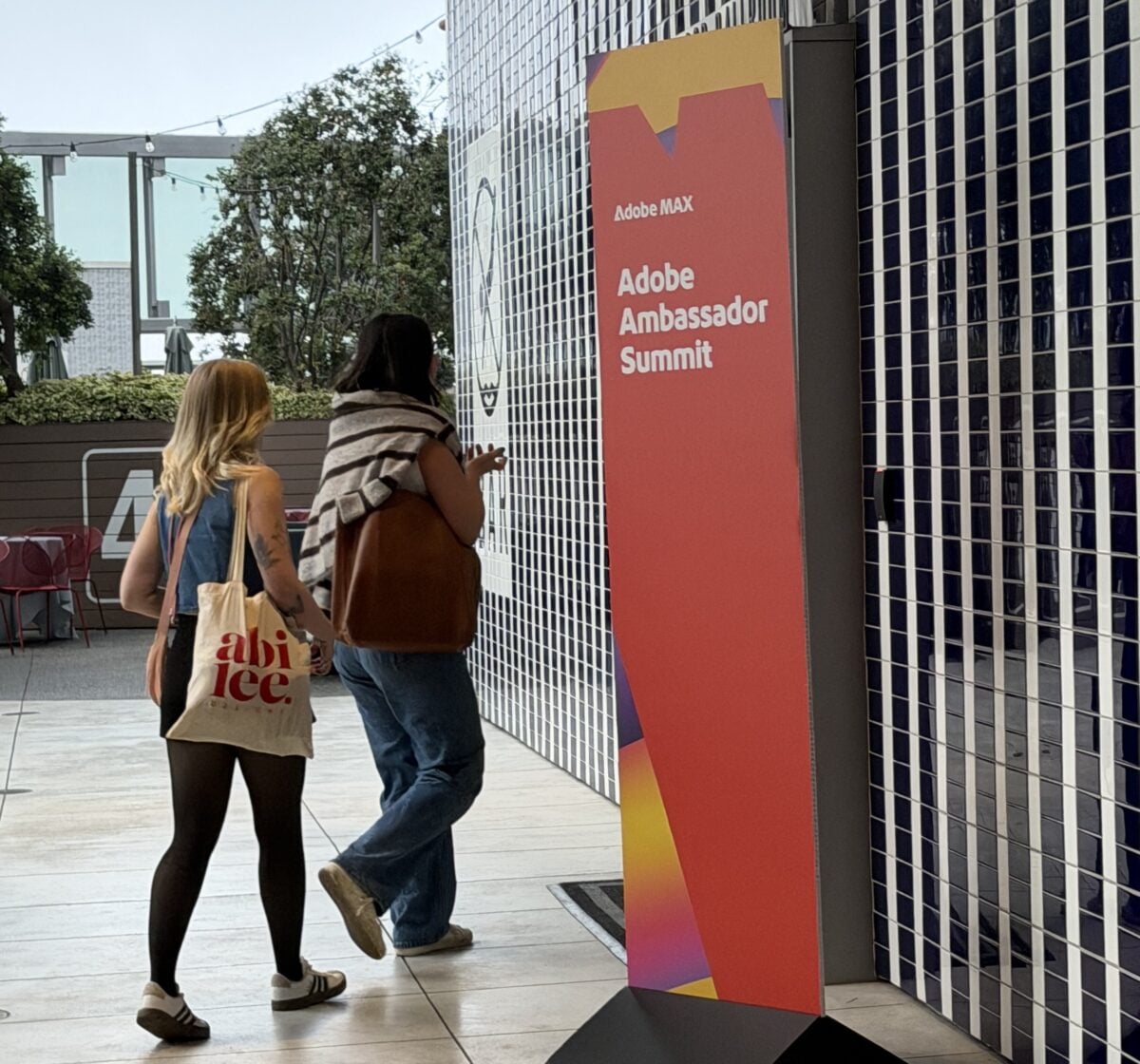
Adobe runs the points model alongside paid activity, and points convert into swag, gift cards, and products made by other ambassadors. The reward I actually care about is none of those. It is the annual Adobe MAX conference, which sets aside a day for the Adobe Ambassador Summit, where ambassadors meet each other, get product updates, and see fellow ambassadors on stage teaching. I was in that ballroom in Los Angeles on October 27, 2025. Flying dozens of people in is not a cheap line item, and it is the single thing that made me feel invested in the product rather than contracted to it.

If you cannot afford an event, the transferable part is cheaper than it looks: give ambassadors a reason to meet each other. What binds people to a program is usually the other members.
One thing to settle early: ask your accountant how cash, gift cards, and free product get treated before you finalize the reward structure, because the answer can change which reward you should pick.
And whatever you choose, it triggers a disclosure obligation, which is where most programs get sloppy.
FTC disclosure applies to ambassadors on every single post, not once at the start of the relationship. The FTC’s endorsement guidance states that if you have an ongoing relationship with a brand, you should still disclose it even when you buy the brand’s product yourself. Ongoing relationships create ongoing obligations.
The definition of a material connection is broader than most brands assume. Under 16 CFR Part 255, material connections include free or discounted products, early access to a product, and even the possibility of winning a prize. The regulation gives an example of a points-based program where participants exchange points for concert tickets or electronics, and says those incentives should be disclosed.
Read that alongside the reward table above. Early access is a material connection. A points leaderboard is a material connection. Neither feels like payment, and both require disclosure.
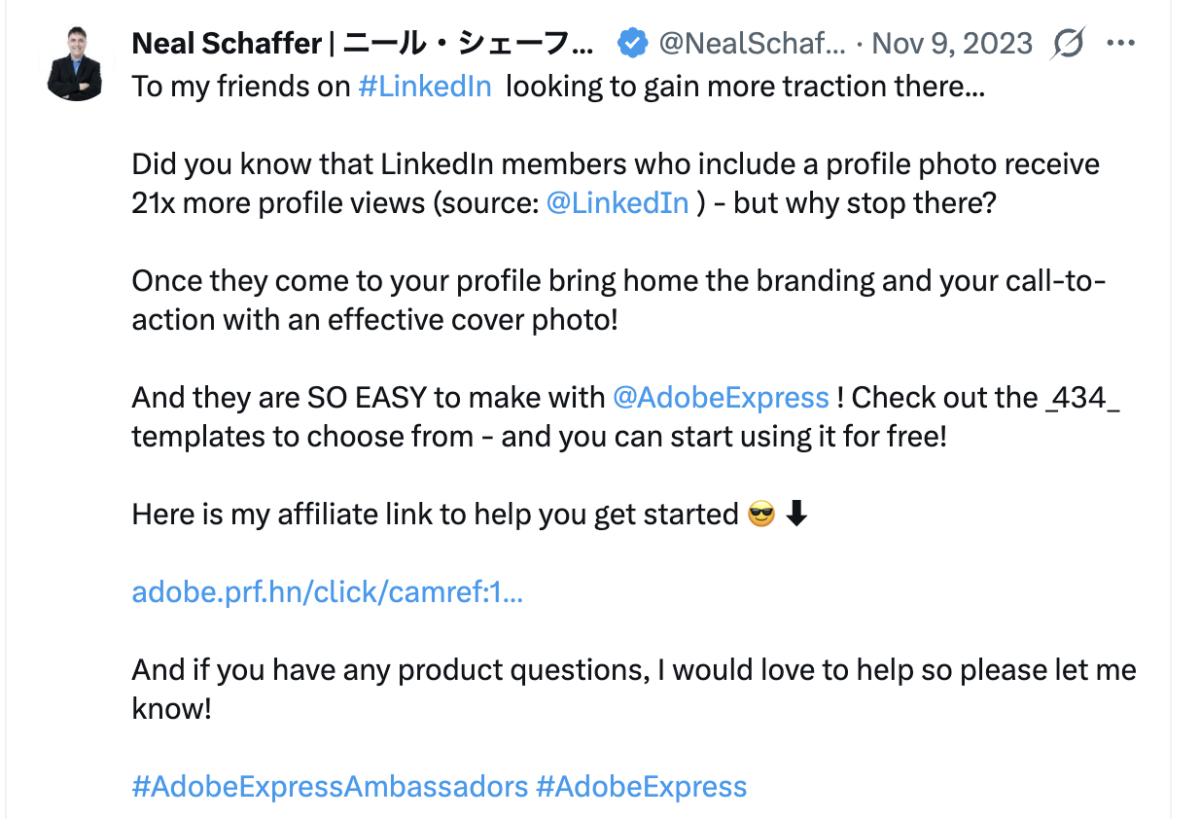
The wording matters too. FTC staff guidance says “#ambassador” or “partner” on its own is ambiguous and confusing, and that a construction like “#XYZ_Ambassador” is likelier to be understood. Put the brand name in the disclosure.
Employees have their own version of this. FTC staff guidance is explicit that listing your employer on your profile page is not enough, because people reading a post in their feed never see the profile. Employees should disclose the relationship in the post itself.
The obligation runs both directions. Brands are expected to tell endorsers what to say and how to disclose, monitor whether they are doing it, and act when they are not. If you want the full picture before you draft your program rules, work through the FTC influencer guidelines in detail.
Compliance sorted, the harder question is proving any of it worked.
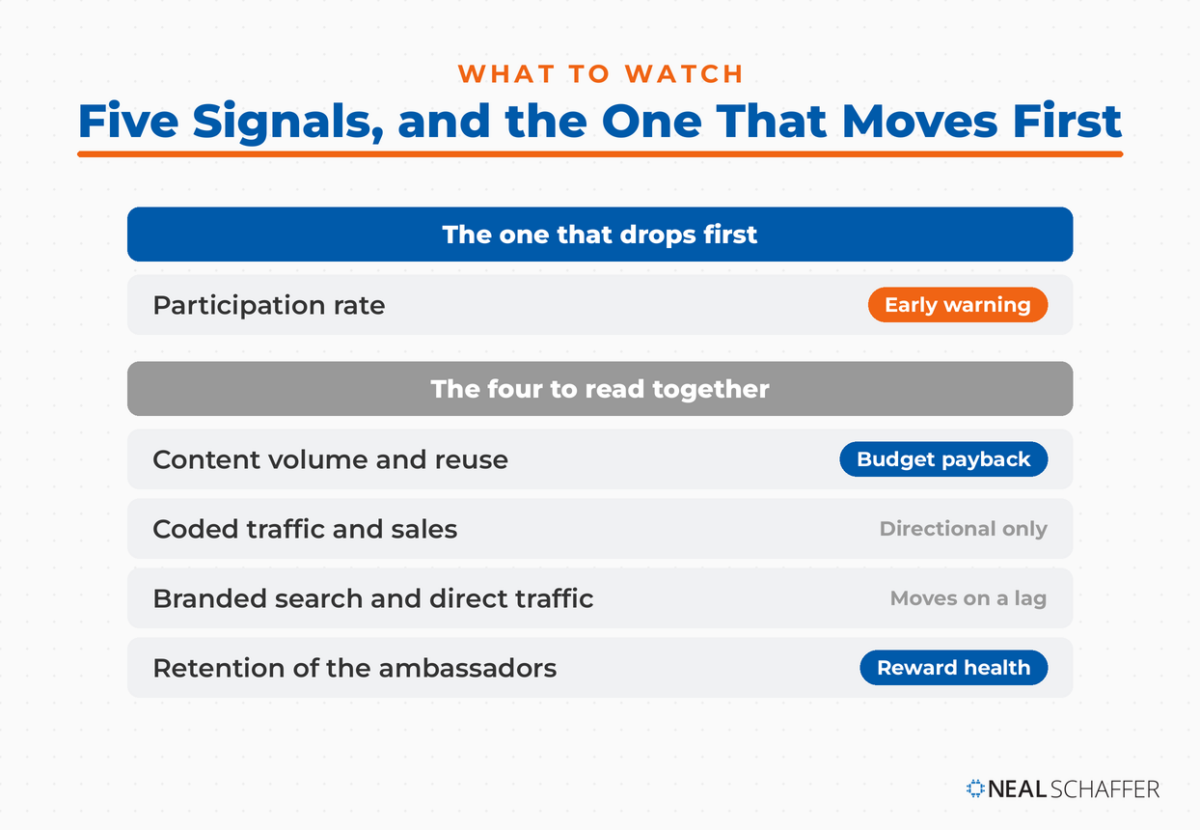
Ambassador programs resist clean attribution because the most valuable thing they produce, a trusted recommendation, usually travels through conversation rather than through a link. So measure a portfolio of signals instead of chasing one number, and accept that some of the value will stay invisible.
Five things worth tracking:
For a sense of what a mature program returns, look at Caraway Home. I wrote up their story in *Digital Threads*. They launched just before the pandemic and found that influencers and customers were already posting about them organically. In 2020 they invited 35 of those people into an ambassador program, giving each a discount link to buy with and an affiliate link to share. Three years later a four-person team had onboarded 3,500 ambassadors, paid out $350,000 in affiliate commissions in 2022, and the program accounted for 13 percent of company revenue, not far behind the 20 percent attributed to paid media.
Note the starting number. Thirty-five people who were already talking about them.
There is also a research finding here that changes how you think about the roster. In a follow-up study published in the *Journal of Marketing Research*, Van den Bulte and colleagues found that referred customers churn less only while the person who referred them stays. The relationship, not the transaction, is what holds the customer. Losing an ambassador probably costs you more than the content they would have made.
The value case is worth making properly for the same reason. In a study of roughly 10,000 bank customers published in the *Journal of Marketing*, Schmitt, Skiera, and Van den Bulte found referred customers were worth at least 16% more than comparable non-referred customers. Advocacy-driven acquisition brings in better customers, not merely cheaper ones.
That brings up the question every vendor guide avoids.
From what I have seen, an ambassador program is the wrong first move for a good number of the businesses that ask me about one. It needs existing advocacy, a named owner, and patience measured in quarters. Miss any of those and you build something that quietly dies.
Skip it, at least for now, if:
Every software vendor ranking for this topic sells an ambassador platform. None of them has a business reason to tell you a referral program might fit better. I sell no such platform, so I will say it plainly. For most small businesses I advise, a referral program is the better first move, and the ambassador program comes later, once there is something to formalize.
If gifting is your entry point instead, send product to a handful of the kinds of creators you will find among brands that work with micro influencers. It is a lower-commitment way to learn who actually likes what you make.
Start with five to fifteen. That is small enough to give everyone individual attention in the first quarter, which is when the relationships are set, and large enough to survive a few people going quiet.
Yes, even unpaid ones. The agreement should cover term, expected activity, rewards, content usage rights, disclosure obligations, and how either party ends it. Free product still creates a material connection, so put the disclosure language in writing.
An advocate recommends you without any arrangement. An ambassador is an advocate you have formalized, with an agreement, a reward, and expectations on both sides. Every ambassador should start as an advocate.
They can, and many programs work that way. Participation has to stay optional and clear HR first. Employees also disclose the employment relationship in each post, because profile-level information is not enough.
Six to twelve months is a reasonable starting term, with renewal by mutual agreement. Shorter than six months and the relationship never compounds. Longer than a year without a check-in and you end up carrying people who stopped posting.
Start with the audit, not the application form. Spend an afternoon reading back through your unpaid brand mentions, going back far enough to find them. Cross-check them against your reviews and your support inbox. Build a shortlist of ten to twenty people who already said something nice without being asked.
Then pick five. Write a one-page agreement, decide what they get and what you expect monthly, and get the disclosure language right before the first post goes out.
Give it two quarters before you judge it. Participation rate is the number to watch in the meantime, because it moves before anything else does.
If you want the full framework behind this, including the sixteen ways to collaborate with influencers and the buy-versus-build decision, download a free preview of The Age of Influence. For a sense of where advocacy sits in the wider market, the latest influencer marketing statistics and the creator economy statistics are both worth a look. And if you would like help building this into a coordinated program alongside your other channels, that is exactly what I do as a Fractional CMO.
We respect your privacy. Unsubscribe at anytime.
Practical advice on social, content, influencer, and search marketing, plus the AI tools that make each one easier. Join thousands of founders and business owners who read it.