
Social media marketing is arguably the most misunderstood discipline in digital marketing right now.
Half the articles online will tell you it’s just “posting on Facebook and Instagram.” The other half will tell you it’s dead, AI killed it, and you should give up. Neither is right. Both are lazy.
I’ve been helping businesses with their social media marketing strategy since 2010, when I launched my consultancy and shortly thereafter published one of the first books on the topic, Maximize Your Social. Since then, I’ve spoken on social media across four continents and a dozen countries, taught it at Rutgers Business School and UCLA Extension, and written a total of six books on social, digital, LinkedIn, and influencer marketing, including my recent modern digital marketing playbook, Digital Threads. What I can tell you with confidence: social media marketing in 2026 isn’t dead. It has fundamentally changed, and the businesses still using 2019’s playbook are the ones feeling like it’s dead.
This guide is the one I wish existed when people ask me, “So what actually is social media marketing, and how do I do it without wasting my time?” Let’s get into it.
Key Takeaways
✅ Social media marketing is a distribution strategy, not a content strategy. Your content has to earn attention. Social is where you compete for it.
✅ Organic and paid are two sides of the same coin in 2026. According to LinkedIn’s marketing research, prospects exposed to both are 61% more likely to convert. One without the other is a half-strategy.
✅ Platform selection beats platform coverage. The average user now hops between nearly seven networks per month, but you can’t afford to be mediocre on all of them. Pick one or two. Win those.
✅ Algorithms reward engagement signals, not follower counts. Watch time, saves, shares, and sends matter more than likes in 2026.
✅ Social search is the underrated shift of the year. TikTok, Instagram, and YouTube now drive over 60% of product discovery, surpassing Google. Your content has to be findable, not just postable.
✅ Measurement is where most businesses lose confidence in social. If you’re still reporting follower count to leadership, you’re setting yourself up to fail.
What Is Social Media Marketing?
Social media marketing is the practice of using social networks like Instagram, LinkedIn, TikTok, Facebook, YouTube, and X to build an audience, distribute content, engage with customers, and drive measurable business outcomes. It combines organic content, paid advertising, community engagement, and influencer partnerships to move people from strangers to buyers.
That’s the textbook definition. But here’s the definition that matters in practice: social media marketing is how your brand earns attention in the places your customers are already spending hours every day.
According to DataReportal’s 2026 Global Overview, there are approximately 5.66 billion active social media users worldwide, and the typical person now uses about 6.75 different networks per month. Globally, users spend around 2 hours and 40 minutes per day on social apps. That’s not a channel. That’s where life happens. The same reach moves more than products, as I wrote in 2011 about the role social media plays in social change. And if your business isn’t showing up where your customers already are, you’re not invisible because social is broken. You’re invisible because you made a choice.
In my book Digital Threads, I make the case that modern marketing isn’t about mastering one channel. It’s about weaving together the channels where your customers spend their time so that content, community, and conversion all reinforce each other. Social media is the loudest thread in that weave.
How Is Social Media Marketing Different from Social Media Management?
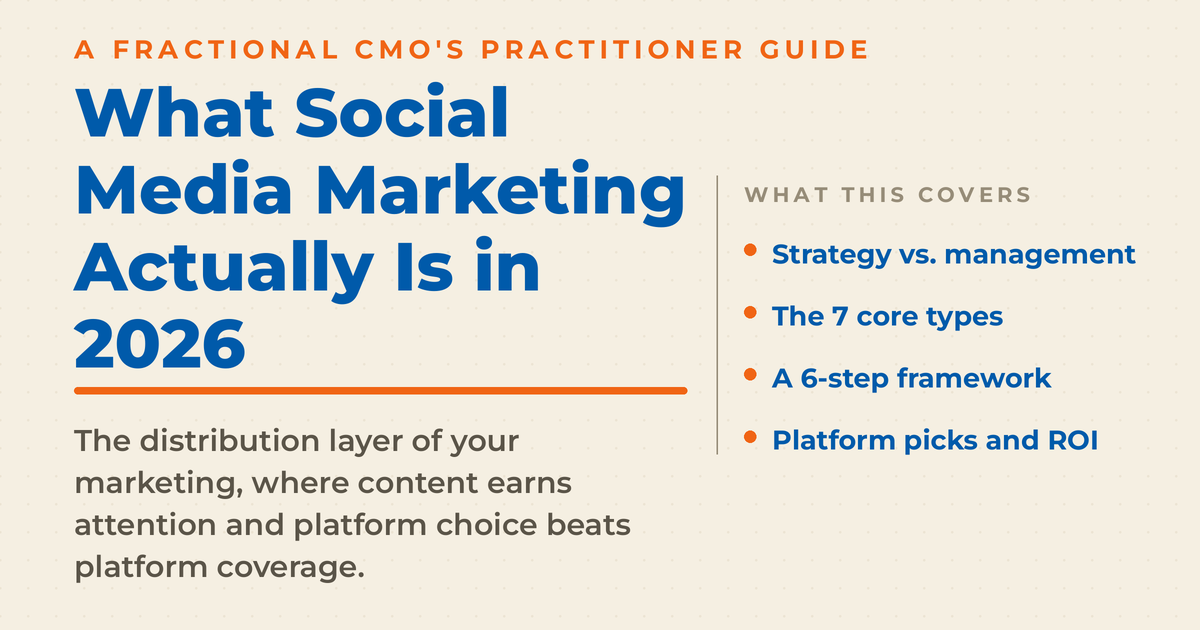
Social media marketing is the strategy layer: goals, audience, platform selection, content pillars, paid campaigns such as social media advertising for small business, and performance measurement. Social media management is the execution layer: scheduling posts, responding to comments, running the daily operation. Marketing defines what and why. Management handles how and when.
A lot of people use the terms interchangeably, and honestly, in a small business, one person is doing both. But when you’re hiring, budgeting, or evaluating a freelancer, the distinction matters. A social media manager who’s great at posting consistently won’t necessarily know how to build a strategy that ties back to revenue. And a marketer who builds a beautiful strategy deck can’t execute alone. That gap is exactly why the market for a social media consultant who can do both keeps growing.
For a deeper breakdown, check out my guide on what social media management is and what social media managers actually do.
Why Does Social Media Marketing Matter for Your Business?
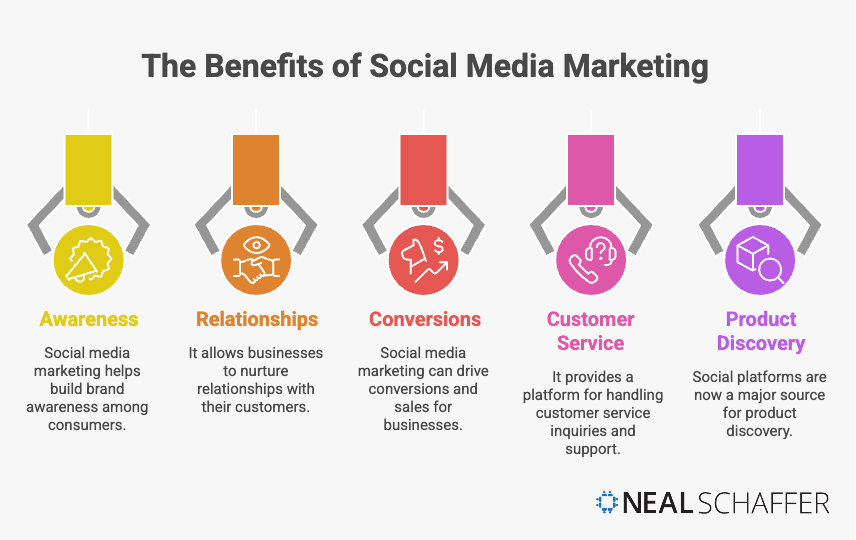
Social media marketing matters because it’s one of the few channels where you can build awareness, nurture relationships, drive conversions, and handle customer service simultaneously, often at a lower cost than any other channel. According to the 2025 Sprout Social Index, 90% of consumers now rely on social media to keep up with trends and cultural moments, making it non-negotiable for brand visibility.
Here’s a quick way to think about it. Traditional advertising interrupts attention. Search marketing captures existing intent. Email marketing deepens relationships you already have. Social media marketing is the only channel that does all three at once, interrupt, discover, and deepen, and it’s where new customers find you before they even know they need you.
That compound effect is massive. Consider the numbers:
- Social platforms are now where the majority of product discovery happens, with TikTok, Instagram, and YouTube collectively outpacing Google as a discovery surface in 2026.
- Total social media advertising spend is projected to reach $317.33 billion in 2026, according to Statista.
- According to Wyzowl’s 2026 Video Marketing Report, 91% of businesses now use video as a marketing tool, and 93% of marketers consider it an important part of their overall strategy.
If you’re doing any serious digital marketing at all, ignoring social is a rounding error that compounds into a real competitive gap over time. Worth noting: social media marketing and digital marketing are related but distinct disciplines, and understanding the difference matters for how you budget and staff each one.
What Are the Main Types of Social Media Marketing?
The main types of social media marketing are organic content, paid advertising, influencer marketing, social selling, community building, social commerce, and employee advocacy. Most successful brands combine three or four of these rather than trying to do all seven well. The mix depends on your budget, audience, and stage of business. Community building is the type most often misread as a Facebook Groups exercise, when a good share of those conversations actually happen on Reddit instead. My explainer on what a subreddit is covers how those communities are organized before you decide to invest in one.
Here’s the practitioner-level breakdown I use when I’m working with a client for the first time:
| Type | What It Is | Best For | Biggest Pitfall |
|---|---|---|---|
| Organic content | Unpaid posts, stories, reels, carousels, videos | Brand building, trust, top-of-funnel awareness | Expecting it to convert on its own |
| Paid advertising | Boosted posts and ad campaigns on each platform | Fast reach, testing messages, retargeting | Running ads without organic credibility |
| Influencer marketing | Partnering with creators to reach their audience | Credibility, niche targeting, product launches | Chasing follower count instead of engagement |
| Social selling | Sales reps using social to build pipeline | B2B sales, relationship-driven categories | Treating it like cold outreach |
| Community building | Groups, Discord, Reddit, loyal subscriber bases | Retention, feedback, word-of-mouth | Building a community you never show up in |
| Social commerce | Shoppable posts, in-app checkout, TikTok Shop | Direct response, impulse-friendly products | Treating it like another storefront, not a native experience |
| Employee advocacy | Your team sharing content from their own accounts | B2B credibility, reach amplification | Forcing scripted posts that sound like press releases |
If you’re starting out, my honest recommendation is to master organic content first, layer in paid advertising second, and only get into influencer marketing once you know what messages actually convert. I go deep on this full taxonomy in my book Age of Influence, which focuses specifically on how influencer marketing changes the game for all the other types.
How Do You Build a Social Media Marketing Strategy?
Building a social media marketing strategy starts with defining clear business goals, researching your target audience, auditing your current presence, selecting the right platforms, developing content pillars, and creating a measurement plan. The whole thing should fit on one page. If your strategy needs 40 slides to explain, it’s probably not a strategy. It’s a content calendar with pretensions.
The Digital Marketing Playbook for Small Teams
My latest book helps small businesses, entrepreneurs, and marketers bring search, email, and social together into one digital marketing strategy that actually compounds.
Drawing on my work as a Fractional CMO, Digital Threads turns complicated tactics into a clear, practical plan you can follow, whatever your budget or team size.
Grab your copy on Amazon and start weaving your own digital threads. Click the cover or the button below to get started.

Here’s the six-step framework I use with every Fractional CMO client:
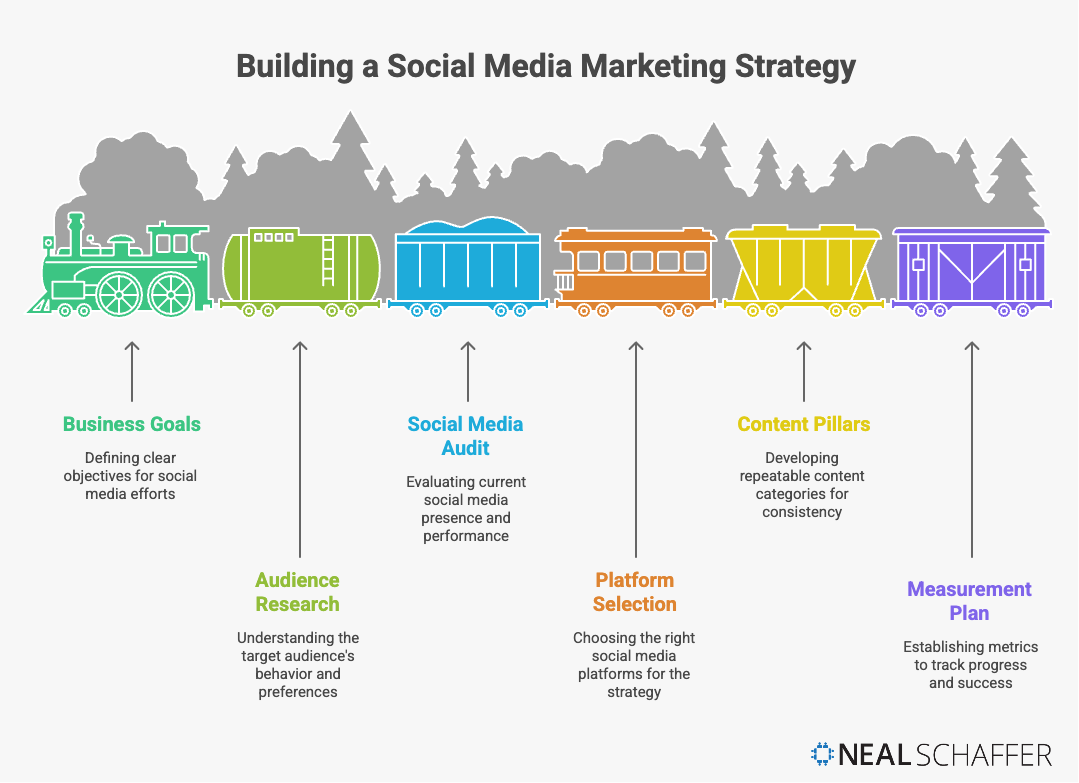
Step 1: Define business outcomes, not vanity metrics. What do you actually need social to do? Drive demo requests? Increase direct-to-consumer sales? Build a talent pipeline? If you can’t tie the goal to a number leadership cares about, you’re going to have a hard time defending your budget.
Step 2: Research your audience like a journalist. Not a persona document full of made-up details. Actually watch what they watch, read what they read, and note what they share. This is the step most brands skip and pay for later.
Step 3: Audit what’s already working. Before you design anything new, look at your existing content. Conduct a social media audit to identify which platforms, formats, and topics are already generating engagement, and, just as important, which ones are silently wasting your time.
Step 4: Pick two platforms, not seven. Concentration beats coverage. The rule I give clients: one discovery platform (TikTok, Reels, Shorts, YouTube, Pinterest) and one relationship platform (LinkedIn, email, a community space, or Facebook Groups depending on your market). Discovery builds audiences. Relationship platforms convert them.
Step 5: Build content pillars. Four to six repeatable content categories, each with an owner, a format, and a posting ratio. I’ve seen small businesses scale from zero presence to meaningful pipeline just by committing to pillars instead of posting whatever came to mind that week.
Step 6: Establish your measurement plan before you post anything. Define the 3-5 metrics you’ll review monthly. Tie them to business outcomes. Stop reporting follower count to your CEO. It’s hurting your credibility.
For a more detailed framework, see my complete social media strategy guide, which walks through the full process in more depth than I can cover here.
Which Social Media Platforms Should You Use in 2026?
The right platforms depend on your audience, industry, and business model, not on which networks are trending. For B2B, LinkedIn is the anchor, and my guide to B2B social media marketing breaks down how the rest of the mix should be weighted around it. For B2C with a younger audience, TikTok and Instagram dominate. For visual-heavy products, Pinterest and Instagram. For tutorials and long-tail SEO benefit, YouTube. Being present on fewer platforms well beats being mediocre across all of them.
In the US market specifically, Pew Research Center’s 2025 social media survey found that YouTube (84%) and Facebook (71%) remain the most widely used platforms, followed by Instagram at 50%. That matters because platform trendiness isn’t the same thing as platform reach. If you’re serving a mainstream US audience, skipping YouTube and Facebook because they feel old is a mistake.
Here’s the platform landscape as it stands in 2026:
| Platform | Monthly Active Users (approx.) | Best For | Content That Wins |
|---|---|---|---|
| ~3 billion | Local businesses, Facebook Groups, older demographics | Community posts, local events, retargeting ads | |
| ~2 billion | Lifestyle brands, B2C, creators | Reels, carousels, Stories, creator partnerships | |
| TikTok | ~2 billion | Discovery, younger audiences, viral reach | Short-form video, trends, storytelling |
| ~1 billion | B2B, thought leadership, recruiting | Personal posts from leaders, long captions, carousels | |
| YouTube | ~2.5 billion | Long-tail search, how-to, authority | Long-form tutorials, Shorts |
| X (Twitter) | ~600 million | Real-time news, community, B2B SaaS | Short takes, threads, live commentary |
| ~500 million | Visual discovery, ecommerce, evergreen traffic | Pin-optimized images with keywords |
A warning from the field: what looks like a platform choice is actually a content choice. If you can’t produce short-form video consistently, TikTok is not your platform no matter how much your intern thinks it should be. Pick based on what you can sustainably produce, not on what’s trendy. Once you’ve picked your platforms, dial in your cadence. My guide on the best times to post on social media breaks this down by network so you’re not guessing at timing.
How Has Social Media Marketing Changed in 2026?
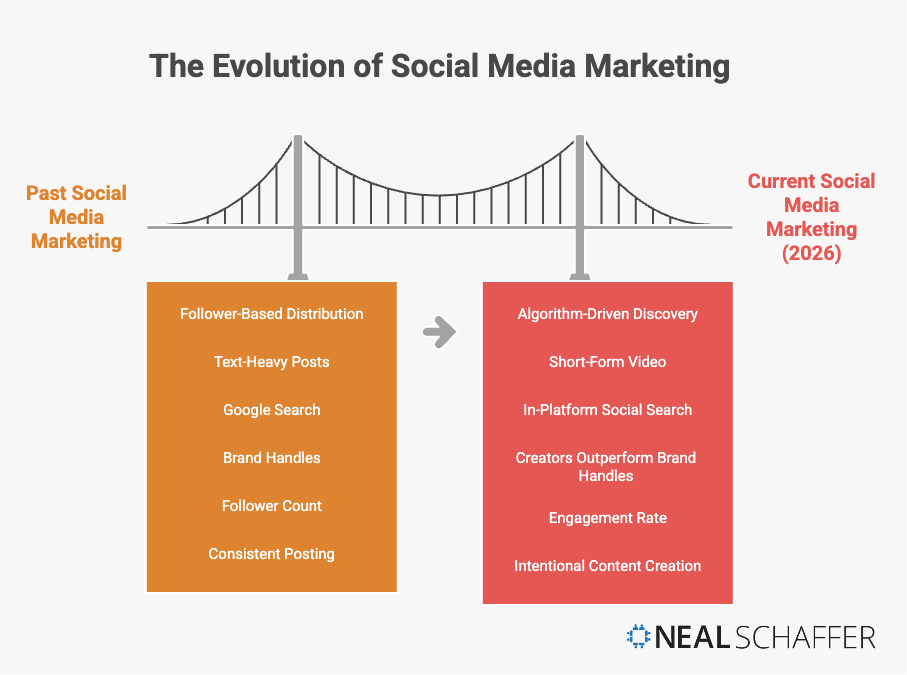
Social media marketing in 2026 has shifted from follower-based distribution to algorithm-driven discovery, from text-heavy posts to short-form video, and from Google search to in-platform social search. The old playbook of “post consistently and your followers will see it” is functionally broken. Algorithms now decide who sees your content based on engagement signals, not who follows you.
Three shifts matter more than the others. Ignore them at your peril.
Shift 1: Social search is eating Google’s lunch. According to Rise at Seven’s Multi-Channel Search Report, TikTok, Instagram, and YouTube collectively account for over 60% of product discovery in 2026, while Google handles only 34.5% of total search share. What this means for your strategy: you can’t just optimize for Google anymore. Your social posts need to be searchable. Use keywords in captions, descriptions, and hashtags. Create content that answers the questions your customers are typing into TikTok’s search bar right now.
Shift 2: Creators outperform brand handles. In 2026, a post from a known creator will out-reach a branded post from your company account almost every single time. Platforms reward native-feeling content from real people. I work with clients who have effectively moved their “social media strategy” into an “employee and creator amplification strategy,” and they’re seeing 3x to 5x the reach of what they used to get from brand pages. Hootsuite’s 2026 Social Trends Report confirms this as one of the biggest structural shifts of the year.
Shift 3: Engagement rate has replaced follower count as the success metric. Engagement is what tells the algorithm your content deserves more distribution. It’s also what tells your leadership team that real people care. Vanity metrics like follower count mean almost nothing in 2026 if your posts aren’t earning saves, shares, and comments.
As Sprout Social’s Briana Doe noted in a Sprout Social post on organic growth: “There are so many platforms and ways that brands can show up online. It’s tempting to believe you have to be everywhere. Provide what your current and prospective audience members are looking for, be intentional instead of trying to be everything to everyone.”
Beyond these three shifts, the landscape keeps moving. I keep a running analysis of the latest social media trends worth tracking that I update as platforms and behaviors evolve.
What Is the ROI of Social Media Marketing?
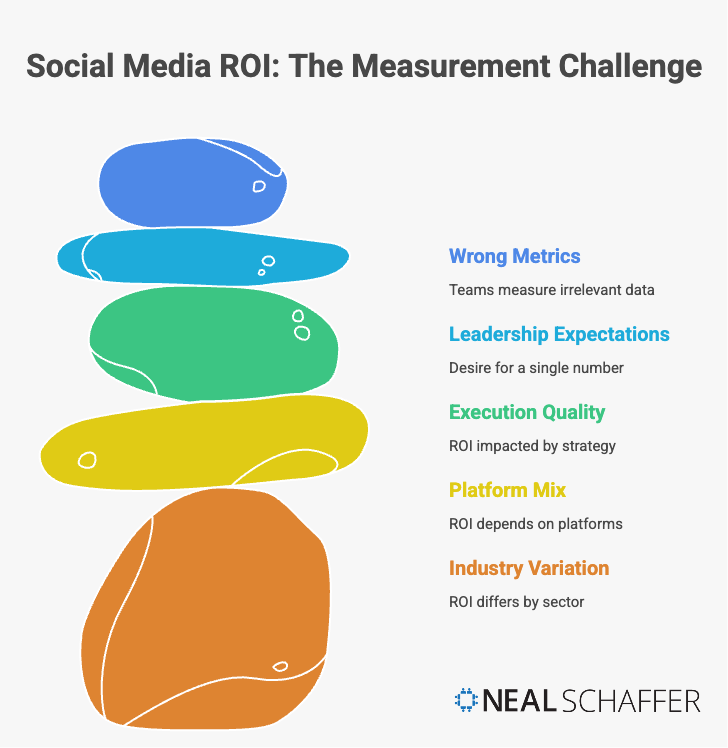
The ROI of social media marketing varies enormously by industry, platform mix, and execution. For most businesses, the real ROI is a combination of direct revenue (from social commerce, ads, and attributed leads) and indirect business value (brand awareness, customer retention, word-of-mouth). Measuring only the direct side will drastically understate what social is actually doing for you.
According to HubSpot’s 2026 State of Marketing Report, organic and paid social media are two of the top five most impactful channels for brands, with Instagram recently overtaking Facebook as the platform brands rank highest for ROI. That’s a significant shift from even two years ago, and it tells you where to focus if you’re deciding where to concentrate your effort.
Here’s the honest truth about social media ROI that most guides won’t tell you. When leadership asks “what’s the ROI?” they want a number, and most social marketers can’t confidently give one. That’s not because social doesn’t deliver ROI. It’s because most teams are measuring the wrong things.
The framework I use with Fractional CMO clients:
- Define the business metric first. Revenue attributed to social? Qualified leads? Customer retention rate? Pick one primary metric.
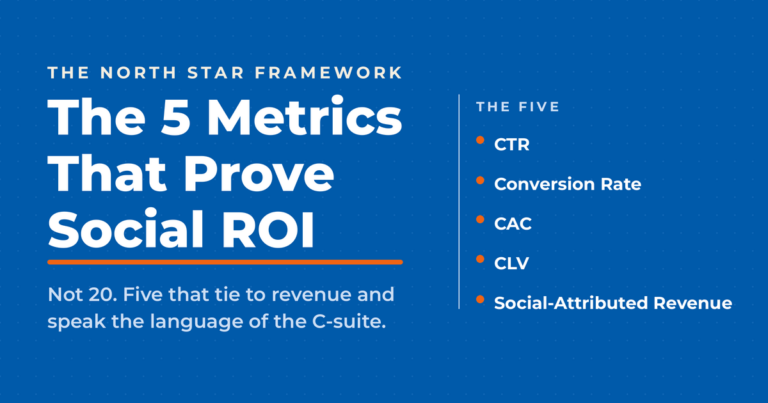
- Pick 3-5 social KPIs that ladder up to it. Not 20. I wrote a whole post on the 5 social media metrics that actually prove ROI because the 20-metric dashboard is how teams drown in data without getting clarity.
- Use UTMs ruthlessly. Every link you post from social should have UTM parameters so you can see exactly what’s driving traffic.
- Track leading and lagging indicators separately. Saves, shares, and comment velocity are leading. Pipeline and revenue are lagging. Don’t conflate them.
- Review monthly with your CEO or your client. If you’re not having this conversation regularly, you’re not managing ROI. You’re crossing your fingers.
For a deeper practical look at how to calculate this specifically, see my breakdown of how to calculate engagement rate and the full list of social media KPIs worth tracking. And if you need a tool to actually pull and report this data, my guide to the best social media analytics tools covers what I recommend to clients.
What Common Mistakes Should You Avoid?
The most common social media marketing mistakes are trying to be on every platform, posting without a strategy, obsessing over follower count, ignoring comments, copying competitors, and treating social as a one-way broadcast channel. Almost every struggling social media account I audit is making at least three of these mistakes simultaneously.
Here are the ones I see most often, in rough order of how much damage they cause:
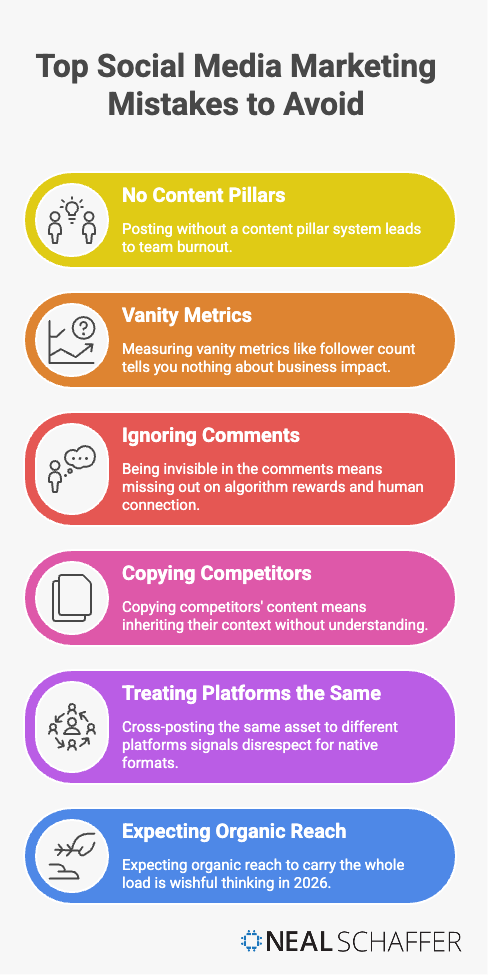
Mistake 1: Posting without a content pillar system. If every post requires a brand new creative brainstorm, your team will burn out inside six months. Guaranteed. If you’re stuck for ideas, my roundup of social media engagement post ideas that actually work has 18 proven formats you can steal and adapt.
Mistake 2: Measuring vanity metrics. Follower count is the social media equivalent of “website visits.” It tells you nothing about business impact. Stop reporting it.
Mistake 3: Being invisible in the comments. Your content isn’t the conversation. The comments are. Brands that engage get rewarded by the algorithm and by human beings. Buffer’s 2026 engagement study, based on an analysis of more than 52 million posts, found that creators and brands who reply to comments consistently outperform those who don’t across every major platform. The single simplest lever most brands ignore.
Mistake 4: Copying your competitors. Your competitors’ content was optimized for their audience, their voice, and their goals. Copying it means inheriting all their context without any of the understanding.
Mistake 5: Treating every platform the same. Cross-posting the same asset to LinkedIn, Instagram, and TikTok signals to each platform that you don’t respect its native format. Repurpose, don’t duplicate.
Mistake 6: Expecting organic to carry the whole load. In 2026, with organic reach where it is, this is wishful thinking. Paid amplifies organic. Organic builds credibility for paid. They need each other.
FAQ: What People Ask Me Most About Social Media Marketing
Yes, but only if you pick a maximum of two platforms and commit to them for at least six months. Small businesses that fail on social usually fail because they try to be everywhere, post inconsistently, and give up after three months. A small business on one platform with consistent, valuable content will outperform a Fortune 500 brand on seven platforms posting lazy content every time.
For small businesses, realistic budgets in 2026 start around $1,000 to $3,000 per month for meaningful results, including content creation, some paid amplification, and basic tools. Mid-market brands typically spend $5,000 to $15,000 per month. Enterprise budgets start at $25,000 and scale from there. The biggest-impact spend is usually not on ad budget but on the person or team who actually produces and distributes the content.
Consistency matters more than frequency. A good starting cadence is 3 to 5 posts per week on your primary platform with responsive engagement in the comments, plus a handful of Stories or ephemeral posts weekly. Posting 10 times per day with mediocre content will hurt you more than posting twice a week with excellent content.
LinkedIn is the clear leader for B2B in 2026. According to LinkedIn’s own research, 92% of B2B marketers prefer LinkedIn over all other platforms. If you’re selling to businesses, your strategy should start there and extend to YouTube for long-form thought leadership. My book Maximizing LinkedIn for Business Growth goes deep into exactly how to make LinkedIn work for B2B.
You measure it by tying 3-5 social KPIs (engagement rate, reach, saves/shares, click-through rate, conversion rate) to a single business outcome metric (qualified leads, pipeline, revenue, retention). If you can draw a line from a social post to a business result, you have a measurement plan. If you can’t, you’re reporting activity, not impact.
Ready to Get Serious About Your Social Media Marketing?
Social media marketing in 2026 rewards clarity over effort. Pick two platforms where your audience actually spends time, commit to content pillars you can sustain, measure the right metrics from day one, and give it at least six months before you evaluate whether it’s working. That’s the entire secret, and it’s harder than it sounds because every other article you’ll read will try to convince you there’s a shortcut.
If you’re building a social strategy that actually ties back to revenue and need a thought partner, I offer Fractional CMO services for companies serious about digital transformation. If you want a playbook for integrating social with the rest of your digital marketing, grab a free preview of my book Digital Threads. And if you want weekly insights on what’s actually working right now, subscribe to my newsletter. I send it every Friday to thousands of marketers trying to figure this out alongside you.