Practical advice on social, content, influencer, and search marketing, plus the AI tools that make each one easier. Join thousands of founders and business owners who read it.
DIY your digital marketing with AI.
Practical advice on social, content, influencer, and search marketing, plus the AI tools that make each one easier. Join thousands of founders and business owners who read it.
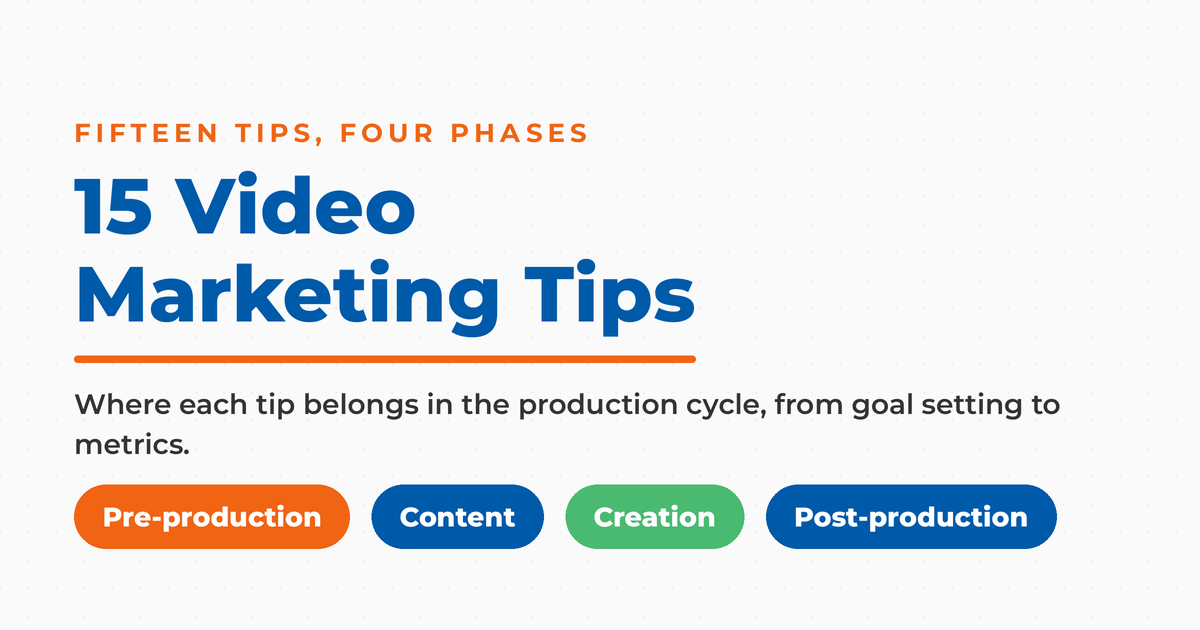
Video marketing is one of those strategies that most companies have under-invested in despite its many business benefits. It’s been growing in popularity for years and, with the immense popularity of TikTok, doesn’t seem to be slowing down anytime soon. So if you want to stay ahead of the curve, read on for 15 video marketing tips to help you succeed this year and beyond.
Key Takeaways
✅ Pick one goal before you pick up a camera. If you are just starting with video, I recommend keeping your goals simple. Awareness or sales, not both at once, so you know which number tells you whether it worked.
✅ Video is table stakes now.91% of businesses use video as a marketing tool, and 82% of marketers report a good ROI. Both figures come from Wyzowl’s 2026 State of Video Marketing report. Nine out of ten of your competitors are already publishing video, so quality is what separates you.
✅ Tell a story, not a sales pitch. Videos built around a transaction lose the viewer’s attention. Videos built around a story hold it, which is why customer testimonials and behind-the-scenes footage usually beat a polished product spot.
✅ Assume the sound is off. Captions, on-screen text, and a visual hook in the first few seconds keep your message intact for anyone scrolling in public. They also make your video accessible and easier for search engines to read.
✅ Optimize on YouTube, then measure against the goal you set. YouTube is the second largest search engine, so that is where I would optimize your titles, descriptions, and thumbnails first. The numbers in my YouTube statistics post show where the audience actually is.
Video Marketing Tips for the Pre-Production Phase
If you’re newer to video marketing, you’ll want to make sure that you walk before you run with these tips. Even if you are experienced in video, I recommend you keep reading so that you don’t miss out on any tips.
1. Determine your video marketing goals
Before you start creating videos, setting some SMART goals for your video marketing is essential. What do you want your videos to achieve? For example, are you looking to create brand awareness or drive sales? Once you have a goal in mind, you can start thinking about the best ways to achieve it.
If you’re starting, I recommend keeping your video goals reasonably simple. Otherwise, you might become overwhelmed. Later, I’ll discuss how to tie your goals specifically to the type of video you produce. But for now, let’s focus on setting some general video goals.
2. Choose your video platform(s)
If you want to start a video marketing campaign, you might wonder where the best place to publish your videos is. There are many options, and it can be tough to know where to begin. Luckily, I’ve got some helpful tips to get you started.
The first thing to consider is your target audience. Where do they spend most of their time online? Once you know that, you can start to narrow down your options. For example, if you’re targeting a younger audience, TikTok or even Snapchat might be a good bet.
But if you’re trying to reach a more general audience, Facebook or Instagram might be better choices as the best video hosting platforms, only after Youtube.
Once you’ve decided which platform(s) to target, it’s time to start thinking about your video marketing strategy. What kind and style of videos do you want to make? How often will you post them? What’s your budget for video production? These are all critical factors to consider as you develop your video marketing efforts.
3. Content strategy planning and production
Before you start creating videos, it’s essential to understand the different types of videos available and how they can be used to achieve your business and video goals. Here’s a quick overview of the different types of video content you can create:
Live video: Live video is one of the most popular types of social video. It lets you connect with your audience in real-time and creates a sense of urgency and excitement.
Video and search ads are a great way to reach new audiences and promote your product or service. They can be used on social platforms like Facebook, Instagram, and Snapchat and are effective on other platforms like YouTube and even TV.
Product videos: A demonstration video is a great way to show off a product’s features and benefits.
Tutorial videos: Explainer videos are one type of a tutorial video which is a great way to educate your audience about your product or service.
Customer testimonial videos: Customer testimonials are an excellent way to build trust and credibility with your target audience.
Behind-the-scenes videos: Behind-the-scenes style of videos are a great way to give your audience an exclusive look at your business.
Other types of video content include animated videos, a type of visual content. This type of video can be a 15-second video or one-minute video max that shows educational content or informative content. Before choosing it, weigh animation against real people on camera for the message you need to deliver.
As you can see, there are many different types of content that you can create to achieve your business and video goals. The key is understanding which type of online video best suits each goal. Once you’ve decided which type of video you want to create, it’s time to start planning your video marketing strategy.
5. Communicate your message with and without sound
No question that adding sound to your video can make it more engaging and effective. But what if you don’t have the budget for a professional voiceover or music track? Or maybe you want to keep things simple and avoid potential copyright issues.
No problem. You can still create a compelling educational video with just a bit of creativity and some basic audio editing skills. Here are a few tips:
Use natural sounds whenever possible. Ambient noise or the sound of people talking can effectively set the tone for your video. Just be careful not to use any copyrighted music without getting permission first.
Use text captions to narrate your story. This is a great way to communicate your message without worrying about copyright issues.
Use free or public domain sound effects. There are lots of great resources for free sound effects online. Just do a quick search and you’ll find tons of options.
Create your music. If you’re feeling creative, you can always try your hand at creating your background music. Many excellent software options make it easy to create professional-sounding tracks.
Use silence strategically. Sometimes, the best way to emphasize a point is to let the audio drop out altogether. This can be effective if used sparingly, like in animated videos.
These tips should help you create a great video ready without breaking the bank. Just remember to be creative and have fun.
6. Focus on tutorials and demos
Video marketing is an excellent way to show customers how your products work. You can create content that demonstrates the use of these items, providing buyers with information they need to convince them to buy it.
For instance, if I want a new backpack for hiking purposes but am not sure which brand would be best suited based on online reviews alone (there are too many options), then viewing demos and explainer videos on YouTube will enable me to make my decision easily by comparison shopping between features like size, capacity, etc.
One Strategy to Connect All Your Marketing
My latest book helps small businesses, entrepreneurs, and marketers bring search, email, and social together into one digital marketing strategy that actually compounds.
Drawing on my work as a Fractional CMO, Digital Threads turns complicated tactics into a clear, practical plan you can follow, whatever your budget or team size.
Grab your copy on Amazon and start weaving your own digital threads. Click the cover or the button below to get started.
7. Share behind the scenes
Sharing behind-the-scenes footage in your digital marketing videos can be a great way to create a more personal connection with your audience.
By giving them a glimpse of what goes on behind the scenes, you can show them that you’re just like them and that you care about your current customers. This can help to build trust and encourage viewers to stick around until the end of your videos.
Additionally, behind-the-scenes footage can be used to show off your company’s culture and values. For example, if you have a fun and friendly work environment, you could share clips of employees goofing around and having a good time. When culture and values are the entire message rather than a glimpse, you are making one of the types of brand video, which follow their own playbook.
This will make viewers feel good about supporting your company and may even encourage them to become customers.
8. Incorporate customer-generated content and testimonials
Letting others do the talking for you is a smart marketing strategy, and video is no different.
Make an effort to source customer testimonials and other customer-generated video content and include them in your video marketing.
The benefits of doing so include establishing social proof, bolstering credibility, and humanizing your brand and products.
9. Work with other brands and influencers
There are many benefits to collaborating with other brands and influencers regarding video marketing.
For one, it helps to broaden your reach and increase your visibility. When you team up with other brands or influencers, you can tap into their existing fan base and reach a whole new and wider audience that may be interested in your physical products or services.
Additionally, collaborating with others can help to build trust and credibility. If potential customers see that you’re working with other big names in your industry, they’ll be more likely to trust your brand and consider doing business with you.
Finally, collaborating on videos can be a lot of fun and might become viral. It’s a great way to get creative and develop new ideas together. And when everyone involved is passionate about the project, it shows in the final product.
If you’re interested in collaborating with other brands or influencers on video projects, reach out and start a conversation. You never know where it might lead.
10. Go live
Going live on social media platforms is a great way to increase engagement and reach actual customers. It’s a personal way to connect with viewers and allows them to feel like they’re getting an exclusive behind-the-scenes look at your business.
On some platforms, live videos might even be more likely to be shared, liked, and commented on than pre-recorded videos. Even if this isn’t the case, they are still a smart and diversified way to boost exposure for your business and help you build relationships with potential customers.
Video Creation Marketing Tips
As you can see from above, there is a lot that goes into your video content. Here are some additional tips that will help you create more engaging and effective videos.
11. Use the video intro wisely
Attention spans online are short. That’s why you need to begin your story and message quickly, for the viewer (and potential customer) not only understand what they’re about to see but also feel confident that this video will be worth their time – especially since we all know how busy life can make us.
12. Include CTA’s
A call-to-action does precisely what its name suggests: It calls attention and invites people to take some desired next step, such as subscribing or watching more videos from this single channel.
You should always include some ending credits at least 10 seconds before concluding. Hence, viewers know how they’re able signup for future updates via email, etc., and also include mid-roll CTAs so viewers who don’t stick to the end can get your message sooner.
The call-to-action should ideally be placed strategically throughout the video but with moderation. After all, you don’t want your video to become one huge call-to-action.
Post-Production Video Marketing Tips
Now that you’ve finished filming your videos your work is not done! Here are a few extra things you’ll make sure you do for maximum effectiveness of your video marketing strategy.
13. Include closed captions
Closed captions can be essential for video marketing for a variety of reasons.
For one, closed captions can help to make your videos more accessible to deaf or hard-of-hearing viewers. Closed captions can also help boost your videos’ search engine optimization (SEO) efforts, as they can help make your videos more visible and searchable on platforms like YouTube.
Closed captions can also be helpful for viewers watching your videos in a noisy environment or watching them on a mobile device. By providing closed captions, you can ensure that all of your viewers have an optimal viewing experience.
14. Make your content optimized for search engines
You’ve invested time into creating your videos. Don’t you want to make sure they have lasting impact?
Optimizing them for SEO is the exact way to do that.
While there is something to be said for optimizing your choice of hashtags for TikTok or Instagram videos, YouTube being the second largest search engine will be the best platform to optimize for from an SEO perspective.
There are many things you can do to optimize your video for search engines. You can read a more in-depth article about this very subject on my site by clicking here, but here are some quick tips for starters:
Use descriptive and relevant keyword-rich titles. This will help Search Engines understand your video and potentially index it for relevant searches.
Use transcripts or captions for your videos. Again, this helps Search Engine Bots understand the content of your video and makes it much more likely that they’ll index it properly.
Optimize your thumbnail image. Make sure it’s relevant and engaging, as this often appears in search results.
Use tags and annotations judiciously. These can help search engines understand the context of your video and make it more likely to appear for relevant searches.
Promote your videos across the web. The more places your videos appear, the more likely they’ll be found by search Engines.
By following these simple tips, you can ensure your videos are much more likely to be found by search engines ( especially the largest search engine, Google) and get the exposure they deserve.
15. Understand & analyze metrics
Understanding and analyzing the metrics of your entire video strategies is essential to optimizing your campaigns and improving your return on investment (ROI). Here are some of the key metrics you should be looking at:
Video Views: This is the most basic metric, but it’s still important to track. You want to ensure that as many people see your videos as possible.
Click-Through Rate (CTR): This measures how many people click on your video after seeing it in their newsfeed or web page. Achieving a high CTR is essential because it shows that people are interested in watching your video.
Engagement: This includes things like shares, likes, and comments. It’s an excellent way to gauge how your video resonates with viewers.
Time Watched: This metric tells how long people watch your video. If you notice that viewers are only watching a few seconds of your video, that’s an indication that they’re not interested, and you need to make some changes to reduce the bounce rate.
Conversion Rate: This measures how many people take the desired action after watching your video. That action could be anything from subscribing to your YouTube channel to making a purchase.
You’ll see what’s working and what’s not by tracking these video marketing metrics. Use this information to make changes to your strategy so you can get better results.
Frequently Asked Questions About Video Marketing
How long should a marketing video be?
Between 30 seconds and two minutes for most marketing videos. 71% of video marketers say that range is the most effective, according to Wyzowl’s 2026 report. Go shorter for social feeds, and go longer only when the topic genuinely requires it, such as a detailed product demo.
Which platform should I publish my videos on first?
YouTube, for most businesses. Wyzowl’s 2026 survey found YouTube both the most widely used video platform at 82% and the highest rated for effectiveness at 69%. It also doubles as a search engine, so a YouTube video keeps earning views months after a social post has scrolled out of the feed.
Do I need professional equipment to start video marketing?
No. A recent phone, good daylight, and an inexpensive external microphone cover what most small businesses need. Audio quality matters more to viewers than video quality, so if you buy one piece of gear, buy the microphone.
What kind of video should a small business make first?
Make a how-to video that answers a question your customers already ask you. Those questions are proof that demand exists. You already know the answer too, so you skip the hardest part of video production, which is deciding what to say.
How do I know if my video marketing is working?
Measure against the goal you set at the start rather than against view counts. If the goal was awareness, track views and reach. If it was revenue, track clicks, leads, and conversions, because views can climb while the business result stays flat.
Video Marketing Tips Roundup
So there you have it, 15 killer video marketing tips to help make your videos successful in 2026. I hope you found this post helpful and informative. Now that you know the basics of making a great video, it’s time to get out there and start creating.
Keep these tips in mind as you go, and good luck with your next video project.
Share with your network!
Neal Schaffer
Neal Schaffer is an international speaker, digital marketing consultant, Fractional CMO, university educator, and the author of six books on digital and social media marketing, including Digital Threads (2024), The Age of Influence (HarperCollins Leadership, 2020), Maximize Your Social (Wiley, 2013), and Maximizing LinkedIn for Business Growth (2nd ed., 2026). He teaches social media marketing to executives at Rutgers Business School and personal branding and influencer marketing at UCLA Extension, hosts the Your Digital Marketing Coach podcast, and has keynoted in 14 countries across 4 continents. His work has been featured in the Wall Street Journal, Fortune, Inc., Mashable, Huffington Post, the Christian Science Monitor, and the LinkedIn Business Blog, and he serves as an official Adobe Express Ambassador. Neal is President of PDCA Social and is based in Irvine, California. He is fluent in Japanese and Mandarin Chinese. Learn more about Neal →
Practical advice on social, content, influencer, and search marketing, plus the AI tools that make each one easier. Join thousands of founders and business owners who read it.
DIY your digital marketing with AI.
Practical advice on social, content, influencer, and search marketing, plus the AI tools that make each one easier. Join thousands of founders and business owners who read it.
Your Privacy Choices
I use cookies to see how people find this site and to support advertising on other platforms. Statistics and marketing cookies only run if you accept. You can change your mind at any time.
Functional
Always active
Required for the site to work, including page caching and form security. These cannot be switched off.
Preferences
The technical storage or access is necessary for the legitimate purpose of storing preferences that are not requested by the subscriber or user.
Statistics
The technical storage or access that is used exclusively for statistical purposes.Helps me understand which posts people read and how they found the site. This data is aggregated and is not used for advertising.
Marketing
Used to show you relevant ads on Facebook and other platforms, and to measure whether those ads worked.
I use cookies to see how people find this site and to support advertising on other platforms. You can adjust what gets collected below. California and other state residents can opt out of the sale or sharing of personal information at any time.
Functional
Always active
Required for the site to work, including page caching and form security. These cannot be switched off.
Preferences
The technical storage or access is necessary for the legitimate purpose of storing preferences that are not requested by the subscriber or user.
Statistics
The technical storage or access that is used exclusively for statistical purposes.Helps me understand which posts people read and how they found the site. This data is aggregated and is not used for advertising.
Marketing
Used to show you relevant ads on Facebook and other platforms, and to measure whether those ads worked.