


Do you have legal consent posting employee pictures on company websites or social media? Publishing employee photos without consent might be against the law. Read on for the reasons why.
Smart companies take a holistic approach to their social media marketing efforts. With so much emphasis these days on enlisting employees to promote their employers via “employee advocacy” efforts, smart companies get their Human Resources department involved in setting strategy and making policies. Related to those efforts to use employees in marketing is an employers desire to showcase “real employees” and not paid actors in social media campaigns, on websites, as well as printed marketing materials. Unfortunately, having employee photos/videos on webpages and social media marketing campaigns is not as simple as a “click” of a camera.
Key Takeaways
✅ California puts a price on using an employee’s photo without consent. Under California Civil Code Section 3344, anyone who knowingly uses a person’s photograph for advertising without prior consent owes the greater of $750 or the actual damages. Since January 2026, a court can also order the image taken down.
✅ Written consent before each use is the safest practice. A good consent form explains how and why the image will be used, confirms that participation is voluntary, and spells out how to revoke it.
✅ Declining should end the conversation. Employers should respect a refusal without pressure, retaliation, or questions about the reason behind it.
✅ Legal compliance is not the only concern employees raise. Some ask whether they will be paid, while others are camera shy, have religious objections, or fear being located by a stalker. Some are comfortable with photos of their work but not with pictures from social events.
✅ Every departure turns employee photos into a replacement cost. Website images, social posts, and printed materials featuring a former employee need replacing, and copies already shared online never fully disappear.
Employees Have Privacy Rights
Though they work for a company, employees do have privacy rights regarding their own image, photo, identity and voice, particularly when others (like an employer). While there is no federal law prohibiting employers in the United States from using employees for photos, videos, etc., there are many state laws restricting how an image/photo/video/voice can be used for commercial purposes. These state laws use various labels, including “Right to Privacy”, “Right of Publicity”, and “Personality Rights.” No matter what these laws are called, most provide that employee photos can be used once the employee consents to such use. For example, see California Civil Code Section 3344 and Revised Code of Washington 63.60.010.
Employees May Make Other Demands or Have Other Objections
Even if an employee does not work in a state with one of these laws, an employee may have other concerns about appearing on the employer’s website, Facebook feed, and other marketing materials whether on-line or hardcopy. One common question employees ask is if they will be paid for allowing the company to use their image? Other employees are simply camera shy, or have other concerns. Still others may have more serious objections including philosophical and/or religious reasons, or fear of stalking (particularly if a already a victim of stalking). Employers should consider how to respond to such questions and concerns.
Additionally, concerns may center around what activity is being featured in the video/photo. Employees may be fine with photos of themselves performing their job functions, or at a community service event, however they may object to photos at social events or the like. Employers should expect that instinct to keep work life and personal life separate to shape which photos an employee is willing to approve. The same instinct shows up on personal accounts, which is the subject of this look at five reasons not to friend co-workers on social media.
Employers Should Obtain Prior Written Consent before Posting Employee Pictures on Company Websites or Social Media
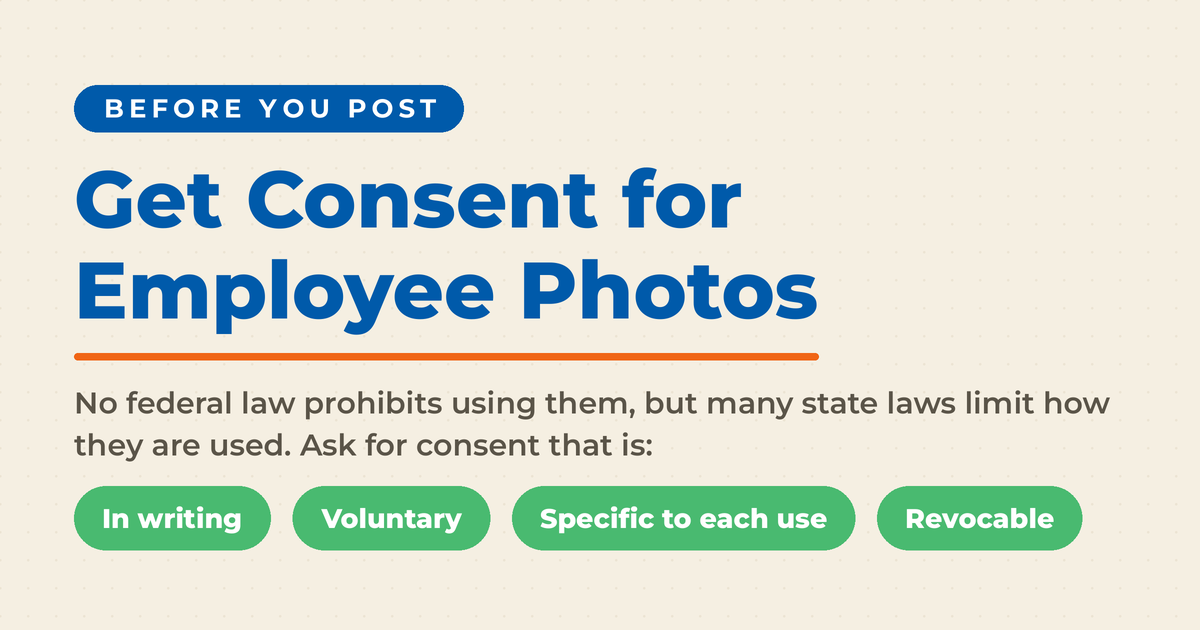
To ensure that employers are complying with law, and also addressing employee concerns and objections, employers should obtain each employee’s consent, in writing, before proceeding. Ideally, the consent will be sought and obtained prior to each time a photo/video, etc. of the employee will be used. The consent should spell out, among other things, the purposes for using the photo/video, how the material will be used, that employee consent is completely voluntary, that the consent can be revoked, and the process for revocation. Furthermore, employers should inform employees if they will be allowed to see the photo/video before it is used.
Employers should respect the decision of those who do not consent, and of course, avoid any retaliation, or pressure tactics to attempt to have the employee relent and consent. Further, employers should avoid asking for details about why the employee has declined to consent. If the employee’s answer is no, just leave it at that.
Some Other Practical Considerations for Posting Employee Pictures on Company Websites or Social Media
As always, in addition to legal issues, there are practical considerations. And, of course, one of these practical considerations is about money and the company’s budget. Employers who take a holistic approach should consider at the outset, that if an employee leaves the company, then the social media and marketing collateral will become obsolete. The idea of having “real employees” is destroyed if the marketing materials contain images of “real former employees,” particularly if those former employees were fired for misconduct. Indeed, while websites can be updated, and Facebook posts can be removed from newsfeeds, those images will never truly disappear from the internet, and will need to be replaced at some cost to the company. And, the printed hardcopy materials should be replaced too.
Another practical consideration concerns the use of staff headshots. These are typically on websites who routinely post employee headshots for the “about us” or “bios” pages, or other social media uses, like on company LinkedIn pages. In these situations, it still makes sense to get prior written consent. However, if the employees are asked to get their headshots done by the company, or a company vendor, and they know what the headshot will be used for, then their agreement to sit for the headshot ought to be at least as good as a written consent form.
Frequently Asked Questions About Posting Employee Pictures
Not safely in states that restrict commercial use of a person’s image. California’s statute, noted in the Key Takeaways, requires prior consent before a photograph is used for advertising. Washington’s personality rights law, linked in the privacy rights section, treats the same use without consent as an infringement.
At minimum, the purpose of the photo or video, how the material will be used, a statement that consent is voluntary, and the process for revoking it. The form should also tell employees whether they will see the image before it is published.
It can, if employees know how the headshot will be used. When the company or its vendor arranges the shoot, agreeing to sit for it should work about as well as a written form. A signed consent form is still the better record to keep on file.
They become pictures of former employees, which undercuts the whole point of featuring real staff, so website images, social posts, and printed materials all need replacing. In California, a former employee who never consented can also ask a court to order the images removed under the same statute noted above.
Conclusion: Posting Employee Pictures on Company Websites or Social Media
Some individuals routinely over-share on social media, and may not have concerns about being included in company website and/or social media marketing efforts. Others, however, may have such concerns, or develop them later. As a best practice, employers can easily use a consent form to reduce liability risk. Certainly, such consent forms must be used if state or other applicable law requires it. Make sure that before posting employee pictures on company websites or social media you are aware of these legal issues. Photo consent is only one publishing obligation, and the blogging laws covering privacy policies, image rights, and disclosure apply to a company blog as much as a personal one.
Information provided on this website is not legal advice, nor should you act on anything stated in this article without conferring with the Author or other legal counsel regarding your specific situation. No attorney-client relationship is created via this website.







I left an employer last year, he still has all of my pictures on his social media/marketing website I never signed anything consenting this use. I would like him to remove them all as I am still in the same industry but never signed a non-compete/solicit contract with him.
can an employer require me to give them blanket authorization to publish photos of me (including caricature), as well as my biometrics – My offer letter includes such a paragraph and my soon-to-be-hopefully employer is unwilling to remove the paragraph in question – do i have the right to opt out without jeopardizing my employment ?
If you sign anything with that paragraph then they have the right to move forward. It sounds like the company is forcing you to be a member of their social media presence. Do you really have a future with this type of company?
Can a company use my name in a review from a customer that doesn’t work for the company anymore on their website to promote new business?
Any thoughts on what to do if an employee “opts out” of releasing his/her image or voice (in writing) and yet an image accidentally goes out on social media and shared. The company might be able to remove the post from its own social sites but the shared content will live in Cyber space.