Editorial Note: I may earn a commission when you visit links that appear on my website.
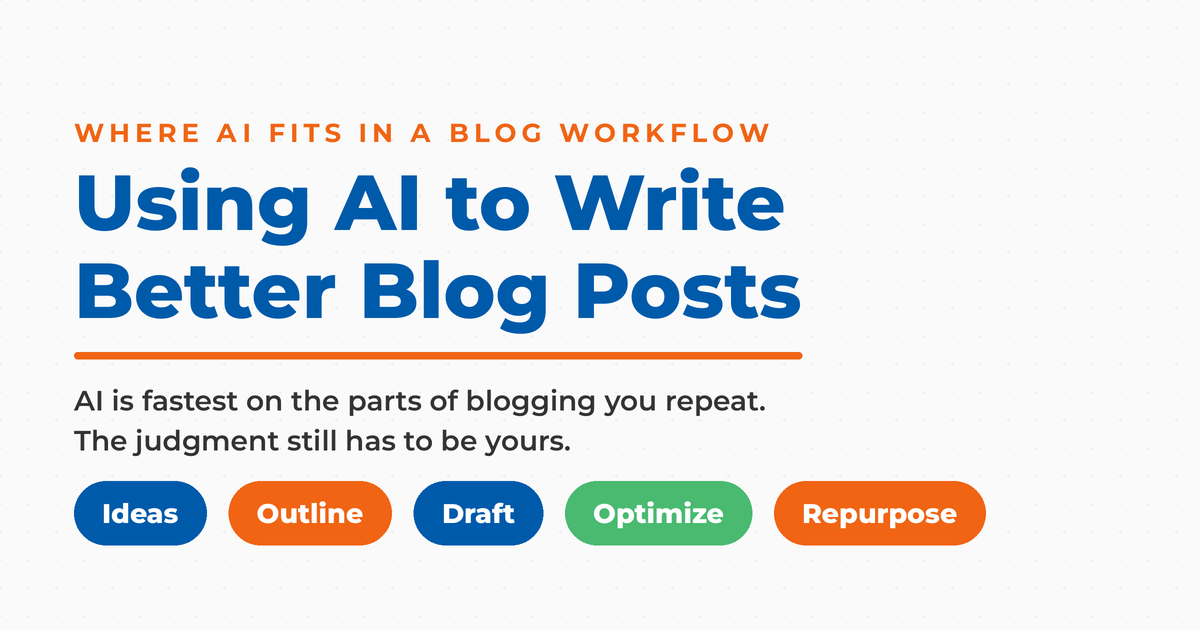
AI Blogging: How to Use AI to Write Blog Posts and the 11 Best Tools You Need
Nowadays, it’s hard to imagine an effective blogging process without the use of artificial intelligence. With high-end AI software, creators can generate text, images, and videos from scratch. Blogging software increases your weekly blog output while also optimizing articles for Google and other search engines.
In this post, I want to share 11 innovative solutions that will streamline your blog management. Besides content generation, these programs are ideal for automated content repurposing, search engine optimization, and other writing tasks.
Key Takeaways
✅ AI is best used as your researcher, outliner, and editor. The thinking and the point of view still have to be yours.
✅ Not every stage of blogging benefits equally. Idea generation, outlining, and SEO optimization get the biggest lift. Full drafting gets the least.
✅ Google does not ban AI content. It devalues unhelpful content published at scale, which is what fully automated blogging usually turns into.
✅ Your stack matters less than your process. Two or three tools you actually use beat eleven you tested once.
✅ Whatever the AI drafts, you edit it for accuracy and voice before publishing. That single step is what separates AI-assisted blogging from AI slop.
5 Best Ways How to Use AI for Blog Writing
Modern AI programs are extremely versatile, managing the entire blogging process from the earliest phases. You can use them to generate dozens of blog topic ideas, create blog post outlines, as well as generate, optimize, and edit articles.
1. AI for Idea Generation
The best AI text tools can generate hundreds of ideas for content. They help you analyze audience interests and discover what’s trending on the web. Among other things, they discover content gaps, which allows you to explore blog topic ideas that aren’t properly covered by other authors. Feed the tool your existing content strategy first. Ideas that fit a plan are worth ten that don’t.
Some of the most powerful tools from this category include MarketMuse, AnswerThePublic, and HubSpot’s Content Strategy program.

2. AI for Outlining and Content Briefs
Through the power of artificial intelligence and natural language processing, you can generate incredible blog outlines for your future posts. AI processes your target SEO keywords, creating potential titles, subheadings, and main talking points for your articles.
To make things even better, outline builders are usually more thorough than human writers, covering all angles for a particular topic. The most popular description generator tools are Frase and Jasper.
3. AI for Drafting Content:
Once you create general outlines, you can use a paragraph tool to fill the content for particular sections. The software will follow your instructions to the T, generating meaningful text that follows the previous train of thought.
These powerful tools help authors struggling with writer’s block. Alternatively, you can use them for automated content generation when you lack time to finish a project. Besides generating paragraphs, these tools also serve as blog title generators, SEO-friendly meta title generators, and for all other content writing needs. Output quality here tracks input quality almost exactly, so if your drafts come back generic, the problem is usually the prompt. I go deeper on both in my guides to AI writers and AI prompt generators.
Some of the most famous programs in this category are Writesonic, Jasper, and Copy.ai.
4. AI for Editing and Proofreading:
Once you finish writing social media posts, articles, emails, and review content, you should do another checkup before publishing. With editing tools, you can proofread each piece to address grammar mistakes and other errors. These programs increase readability and can check your pieces for duplicate content.
My favorites for grammar checking are Grammarly and ProWritingAid.
5. AI for SEO Optimization:
With these programs, you improve content for SEO purposes. These programs generate a list of exact keywords you need to introduce into your articles. They also calculate words and headings, images, links, and other relevant factors. None of that helps if the underlying page is thin, so treat these as a finishing pass on top of solid blog SEO fundamentals. I cover the wider workflow in my guide to using AI for SEO.
This type of software will help your epic long-form blog posts by making it easier for crawlers to detect the pages. The best SEO solutions include Yoast, SurferSEO, and Clearscope.
The 11 Best AI Tools for Bloggers
With these programs, a content writer can simplify his day-to-day work. These programs allow a human blogger to generate articles within seconds, monitor SEO performance, and perform longer-form content editing. AI is only one slice of the stack, though, so pair this list with my wider roundup of apps for bloggers covering the everyday tools that still do plenty of the work.
AI Tools for Textual Content
If you’re looking to streamline your writing process, you should definitely consider some of the robust blogging tools from this list. These programs provide AI-generated outlines, article and image generation, SEO keyword research, and relevant analytical data.
1. ChatGPT

ChatGPT is a revolutionary software that has changed the world of digital marketing forever. With this powerful tool, you can generate blog post ideas as well as original content within seconds. The writing tool works as an AI chat assistant, allowing you to ask various questions and get adequate answers.
The best thing about ChatGPT is that it memorizes your previous communication. The program learns from your input, providing more and more refined answers. While this doesn’t always work in practice, and the tool is still prone to logical errors, we can’t neglect all the benefits it provides to content creators. It is no longer the only serious option for long-form writing either. If you are choosing between the two main assistants, I put them side by side in Claude vs ChatGPT.
2. Jasper

Unlike ChatGPT, Jasper AI is a much more structured tool. It offers numerous features that are tailor-made for your content marketing efforts. With it, you create comprehensive marketing campaigns emphasizing data privacy, team collaboration, integration, and brand voice.
With Jasper AI, each new piece of AI-generated content resembles the previous one. There isn’t any fall-off in quality, and readers will have a hard time realizing that the blog content was made by artificial intelligence. Another thing I love is that you can use Jasper for your current tech stack, combine it with various innovative automation solutions, or add it to your search engine browser.
The Digital Marketing Playbook for Small Teams
My latest book helps small businesses, entrepreneurs, and marketers bring search, email, and social together into one digital marketing strategy that actually compounds.
Drawing on my work as a Fractional CMO, Digital Threads turns complicated tactics into a clear, practical plan you can follow, whatever your budget or team size.
Grab your copy on Amazon and start weaving your own digital threads. Click the cover or the button below to get started.

3. Writesonic

Besides generating high-quality content, Writesonic excels at optimizing your articles for search engines. The blog writing tool calculates the presence of relevant keywords, their placement, and the total number of words. It also evaluates your competition to show you how you stack against other ranking articles.
Similar to ChatGPT, Writesonic’s assistant provides information about various topics, making it ideal for generating content ideas. With its internal chat, you can scan entire articles and PDFs to find exact keywords and get answers to different questions. Lastly, it’s worth mentioning that Writesonic generates images and modifies audio files for your projects.
4. Copy.ai

Copy.ai is a solution meant to streamline your campaigns end-to-end. The content and SEO tool boosts your online presence by performing keyword research, generating article ideas, and writing content from scratch. By relying on three language models, it provides unique long-form content that’s very similar to human writing.
Like most other entries on the list, Copy.ai uses brand voice to make each piece distinct to your company. Besides generating entire blog posts, the software also works for a wide range of social media posts, ads, emails, and other types of high-quality content.
5. Rytr

The best thing about Rytr is that it supports numerous use cases. Among other things, the program features a paragraph rewriter, sentence shortener and expander, an SEO meta description tool, a keyword research tool, a CTA generator, a Google Ad writer, and more.
Before generating high-quality blog posts, users can choose a language and tone of voice. Select the number of variants and creativity level, and watch as the content creation tool pumps out full-fledged articles within seconds.
6. Anyword

Anyword integrates various AI technologies to generate complete articles for your business. The thing that makes this platform stand out is the predictive features. You can see how a piece will perform within search engines even before you publish it. The software shows your intended target audience for the blog post and predicts how they’ll react.
Anyword comes with built-in templates that will speed up your content creation process. All you need to do is pick a use case and guide the software as it quickly generates article ideas for your business.
7. Scalenut

Scalenut is a perfect solution for SEO-optimized content. It controls the entire content workflow, from keyword research to the selection of customizable templates and eventual AI content generation. The keyword research feature, in particular, is really amazing, providing you with valuable insights about optimal phrases for your business.
Besides generating a list of blog post ideas with your brand voice, Scalenut also does interlinking and comprehensive competition analysis. Once you’re done with creative processes, you can monitor the results from the analytics dashboard and make tweaks when necessary.
AI Tools for Visual Content Creation
This particular tool allows you to generate images and text within seconds. This makes it ideal for brands who don’t want to hire graphic teams or simply want to expedite the creative process.
8. Elementor

Elementor is mostly known for its hosting features. However, the company has recently added article generation features that will come in handy. You can now generate images, product descriptions, SEO titles, meta descriptions, and entire texts within WordPress with minimal effort.
The page builder also integrates a built-in plagiarism checker, ensuring each piece is on point. While Elementor isn’t the ideal option for your writing process, I was more than satisfied with its image generation.
AI Tools for SEO Optimization
With these programs, you improve content for search engines. These content creation tools show you whether your article is lacking competitive keywords and what kind of improvements you need to make so that search crawlers “pick it up.”
9. Frase

Frase is a powerful tool I use on a daily basis. The software provides a list of keywords for optimizing each text. By following a simple scoring system, you significantly increase the relevance of your high-quality competing posts so they rank higher in Google.
Besides optimization, Frase can generate epic long-form blog posts. It uses a technology similar to Jasper, Copy.ai, and other textual programs, helping you create articles based on extensive instructions.
10. SurferSEO

SurferSEO is another incredibly popular tool for optimizing various pieces of content. Besides providing ideas for keywords, the program improves each piece so it’s more suitable for Google.
After inserting a specific phrase, SurferSEO does a quick analysis showing you how many words, headings, and phrases you need to insert. The blog writer software streamlines the entire content process and is rather easy to use.
AI Tools for Editing
Editing content is a critical part of the digital marketing process. Once you’re done with writing, you need to improve your AI-generated blog posts to increase their readability, thus making them more suitable for the human eye.
11. Grammarly

Nowadays, most marketers rely on Grammarly when writing blog posts. This incredible software checks your articles, social media posts, emails, and other types of content, to see if they’re properly written.
The software shows you if you need to make grammar and error corrections while also increasing readability. Besides editing features, Grammarly also serves as a blog post generator, making it an all-in-one platform for all article writers.
A Word of Caution on AI Blogging Tools
Most people use blog post generators to create articles with minimal effort. While this sounds like a phenomenal solution, providing a bunch of AI-generated content within seconds, I would caution against it. The output reads flat, and that flatness is visible to readers before any algorithm gets involved. If you want to see what your drafts look like from the outside, run them through an AI content detector and then fix the passages that need a more human voice.
Using artificial intelligence and deep learning to boost your content output leads to various potential issues:
- AI-generated content lacks a human touch. Unlike articles created by human writers, these posts often seem out of sorts, without a clear direction or intention. They usually rely on formal language that is too stiff for readers.
- The finished product might be factually incorrect. Even high-end AI software borrows ideas for content from other sources without previously checking it. So, artificial intelligence writers can cause a wide range of issues for companies.
- Generally speaking, search engines allow AI-generated content as long as it’s helpful. Unfortunately, given these tools lack human intelligence, they might lead to a bunch of problems that will cost you in the long run. There are even cases of websites being penalized for these types of articles.
While you can still use artificial intelligence to boost your blogging process, I would recommend caution. For example, these innovative automation solutions are perfect for generating ideas for keywords and work well as outline builders. However, I would avoid paragraph rewriters, blog title generator tools, and other software that makes things “too easy.”
Frequently Asked Questions About AI Blogging
Does Google penalize AI-generated blog posts?
No. Google’s guidance on AI-generated content focuses on whether content is helpful and original rather than on how it was produced, and its spam policies target automation used mainly to manipulate rankings. A post drafted with AI and then fact-checked and edited by you can rank fine. A hundred untouched AI drafts usually will not.
What is the best AI tool for blogging?
There is no single best tool, because blogging is really four jobs: ideas, outlines, drafting, and optimization. Most bloggers do fine with one general assistant like ChatGPT or Claude, one SEO tool like Frase or SurferSEO, and one editor like Grammarly. A fourth tool rarely adds anything you were missing.
How much of a blog post should AI actually write?
Use AI heavily for the parts nobody sees: research, outlines, keyword mapping, and first-pass structure. Keep the parts readers judge you on, your opinions, your client examples, your stories, in your own words. That split is what keeps an AI-assisted post from reading like everyone else’s.
Do I need to disclose that I used AI to write a blog post?
Google does not require a disclosure in order to rank, though it does suggest adding one when a reader would reasonably wonder how the content was made. A simple rule works: disclose when AI shaped the substance of the advice, and skip it when AI only helped with an outline or grammar.
Can AI detectors tell if a blog post was written by AI?
Not reliably. Detectors return probability scores, and they flag human writing as AI often enough that nobody should treat the output as proof. Use them as one signal on drafts you did not write yourself, never as a verdict.
Conclusion
AI and natural language processing will move the needle for just about any business. Tools for content creation can be a real game-changer as they significantly boost the creative processes. They generate incredible ideas while focusing on broad match keywords relevant to your business.
While these tools can generate a bunch of blog post within minutes, they can also get you in trouble. Search engines, in particular, frown upon these articles, which leads to a full site penalty.
Because of that, you need to use common sense when using this type of software. Don’t use these programs for content at scale. Instead, you should only use them for smaller tweaks and ideation. If you need more posts than you can write yourself, a human writer is the other route, and I compare outsourced blog writing services in a separate post.
Actionable advice for your digital / content / influencer / social media marketing.
Join 13,000+ smart professionals who subscribe to my regular updates.