
One of the biggest challenges on social media is getting your organic content discovered. After all, social networks are more inclined than ever to prioritize paid or boosted content, to the expense of high-quality free posts. While Facebook is the most famous for this, as marketers we need to be mindful of what it takes to get our message to the right people.
Like all other social media platforms, Twitter runs on an algorithm trying to decide what content to serve each user in their newsfeed, and there is no better indicator of content quality in the eyes of any social network than the engagement it receives from your followers and other users. That is why just like any other social network if you are engaged on Twitter for business, engagement matters.
Key Takeaways
✅ Twitter engagement is every action that shows up in your notifications, plus link clicks and video views. Likes and retweets get all the attention, but link clicks are the ones that turn into leads, so measure the whole set.
✅ Aim for an engagement rate of 1% or higher, and benchmark against yourself before anyone else. Rates swing hard by account size and niche, so your own last 90 days is a more useful comparison than any all-industry median.
✅ Put a photo, GIF, or native video on as many tweets as you can. Visual posts take up more room in the timeline and give people something to stop scrolling for, which is most of the battle in a feed made of text.
✅ Engagement is reciprocal, so work it in both directions. Reply to everyone who engages with you, and set aside time each day to engage with accounts outside your own follower list.
✅ Trending topics and polls will both lift a tweet, but only when the subject genuinely fits your niche. Jumping on a trend nobody expects from you costs more credibility than the extra impressions are worth.
✅ Give yourself one to three months of testing before you lock in a routine. In my 13 plus years on the platform, the winning combination of timing and format has always been account-specific, so run the test rather than copying someone else’s schedule.
What is Twitter Engagement?
Twitter engagement is a measure of how people interact with your brand or profile on Twitter. It includes Twitter metrics such as:
- Likes: People simply pushing the “like” button to say that a post is good.
- Retweets: When a user shares your Tweet with their audience through the Retweet function.
- Replies: Users answer your question or make comments on Twitter about what you said.
- Mentions: Another Twitter user directs a Tweet in your direction using @username.
- Link clicks: Just what it sounds like: people click through a link to discover your landing page or piece of content.
- Video views: How many times do people watch the videos you post on Twitter? Here, I mean the ones posted directly to the network, rather than the ones linked to and hosted elsewhere.
- Follows: Users opt to have your Tweets added to their feed on a regular basis.
- List additions: If there is a Twitter list in your niche (or for one of the hashtags you target), this metric reflects how often your account gets added to the list. When this happens, you get a lot of extra chances for Twitter engagement because people visit your profile more often.
In other words, anything that shows up in your notifications can be considered an engagement, in addition to if people take action on your post such as watching a video or clicking on a link. This means that your overall Twitter engagement involves a wide variety of actions, all of which can result in sales over time.
Is Twitter Engagement Important?
The whole purpose of social media marketing is to engage social media users, so if you are investing in Twitter marketing, it goes without saying that you want people to engage with your content and profile! This is true no matter what your goal is for each campaign, be it awareness, sales, PR, or anything else.
Taking it one step further, Twitter allows you to tap into its hundreds of millions of users and build brand awareness amongst them. One way to measure that brand awareness is through engagement on your content and profile. In addition, when people click through links there’s often an opportunity to get a sales lead or even make an immediate sale. This means that effective Twitter marketing can have a great ROI, part of which is measured through engagement.
What is the Twitter Engagement Rate?
Not to overcomplicate things here but there are a few ways at looking at what is a Twitter engagement rate depending on your objective that I have seen in my career as a marketer:
- Number of engagements / tweet. In other words, a global measurement of how many times people exhibit any kind of Twitter engagement, per Tweet.
- Number of engagements / tweet impressions. Here, we’re interested in how often people engage after seeing the Tweet. This means we’re mostly interested in the number of eyeballs that engage.
- Number of engagements / followers. How many followers engage with your content, and how many are just lurking?
- Numbers of engagements per tweet / followers. When you send a Tweet, how many followers engage with that specific Tweet. In other words, this metric only counts the engagement from your followers for each Tweet, rather than everyone on Twitter like you see in option 1. This gives an idea of how effective you are at getting engagement from your followers.
Inside Twitter Analytics, they define Twitter engagement rate as a number of engagements/tweet impressions, so that is probably the standard here, but note that there are other ways to think about Twitter engagement rate that you should keep in mind.
What is a Good Twitter Engagement Rate?
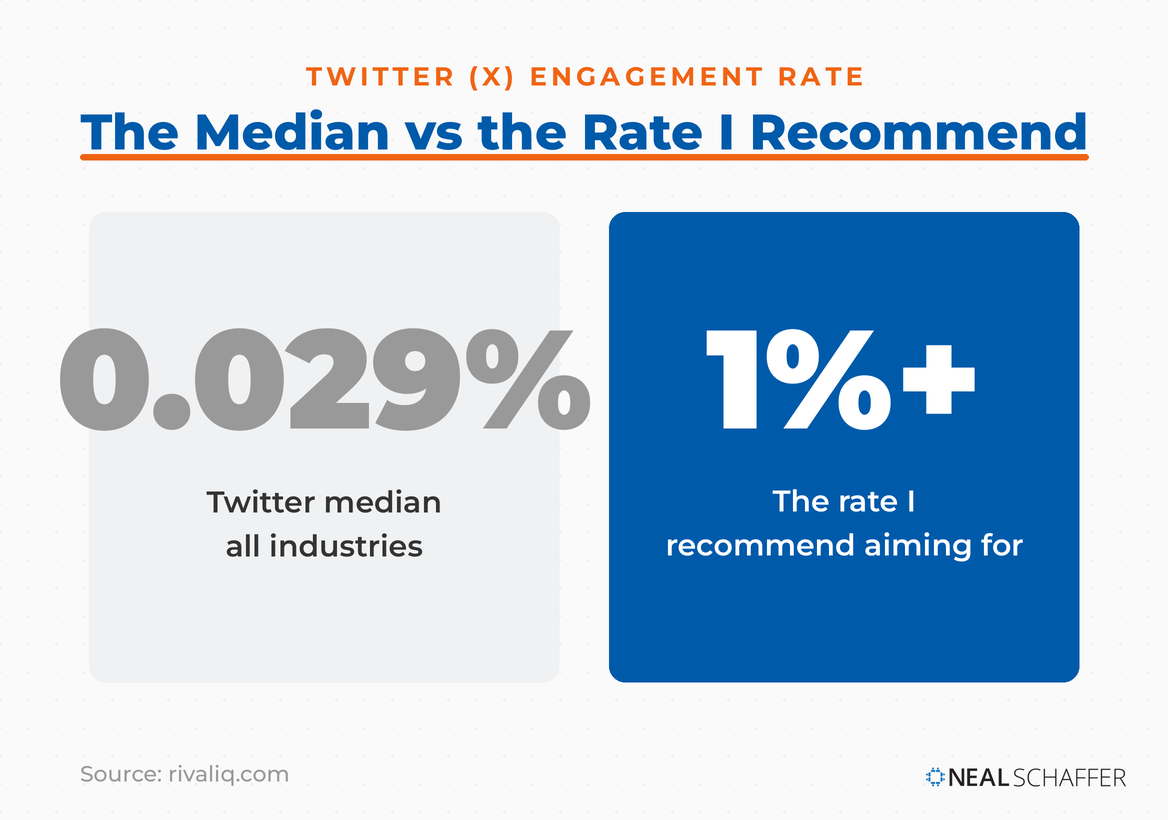
While there is no one rule, I would recommend establishing a rate of 1% or higher as a good rate in alignment with other social networks such as Instagram. There are days when my own engagement rate is more than double that, but it is a good rule of thumb to measure yourself against. Remember, some days you’ll do better than others, and for a variety of reasons. The important thing is always to learn from your successes and failures.
Note that one recent study found that the median engagement rate on Twitter is actually much lower at 0.029%. This would mean that my engagement rate is very high. As always engagement rates vary from account to account and community to community, so your best comparison should be to yourself and your immediate competitors. This way, you can avoid comparing apples to oranges.
What Content-Type Gets the Most Engagement on Twitter?
As you can imagine, there are several factors that can influence how much Twitter engagement a particular Tweet gets. Most of these can be adjusted to improve overall performance over time. And as with many other things social media, analytics are your best friend. Some factors to consider are:
- Timing of the post: what time of day is it for your target audience when the Tweets go out?
- Competition with other tweets at the time: This one’s harder to control, in that you can’t alter when your competitors Tweet. However, you might be able to change your Tweet time to get slightly higher twitter engagement.
- Format of content shared (video vs photo vs link vs status update vs poll). Depending on your niche, you might find that your audience prefers one format over another.
- Relevance of the content to your followers. It almost goes without saying, but if you tweet something that your followers won’t be interested in, or that fewer of them will care about, you’ll likely get lower Twitter engagement for that post. Of course, your audience and brand voice will help determine how far off the beaten path you can go.
- Hashtag usage. The right hashtags can enhance Twitter engagement by getting your Tweet discovered by the right people. Hashtags can also backfire if you pick the wrong ones or select those that have very high competition.
The best way to find out for your own Twitter account is to experiment over the course of 1 to 3 months sharing multiple combinations of tweets that fall under the above factors so that you can find out the individual answer for your business based on doing this type of Twitter audit.
How to Increase Your Twitter Engagement
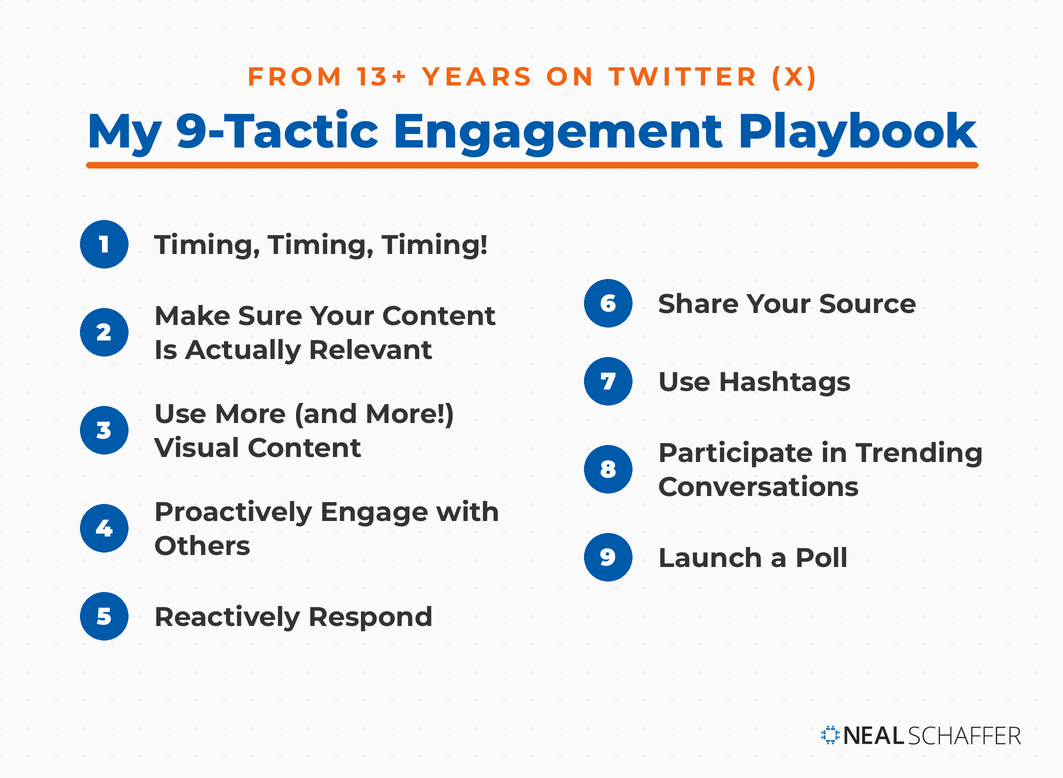
Now that you’re sold on the importance of all of this, here is my advice on how to increase your Twitter engagement based on my 13+ years of being active there. Some of these approaches will work better for certain people, and certain accounts, than others. However, each of my tips remains a reasonably good guide to boosting Twitter engagement.
1. Timing, Timing, Timing!
This goes without saying, but you should tweet when you think most of your followers are online. Unfortunately, this isn’t always easy, especially when your audience lives across several time zones. However, I’ve found that the best thing to do is to experiment with tweeting at different hour intervals on a regular basis and examine your Twitter analytics to get a feel as to when the best time to post for your audience is. In addition, you can consider sending out Tweets throughout the day to catch more people online.
2. Make Sure Your Content Is Actually Relevant
Next, you want to ensure that your content is something that people want to read. To do this, experiment with different content categories and then look at your Twitter Analytics to better understand what your followers are engaging with and publish more of it. While you might not want to use the same content all the time, knowing what mix works well while keeping everyone interested is the best policy.
3. Use Visual Content, and Watch Where You Put Your Links
Like any other social media platform, photos and videos tend to do well and/or get more visibility in the newsfeed. Especially on Twitter, the sea of words can get blurry as people scroll through their feed. In the meantime, viewers are much less apt to contribute to Twitter engagement.
Visual posts are also interactive and take up more space in the timeline, beckoning you to engage with them. If nothing else, viewers are more likely to stop and enjoy a picture or video. In turn, this helps reinforce your brand message. The gap between visual posts and plain text has narrowed a lot though, and it is worth knowing by how much before you rebuild a content calendar around images. Buffer’s 2026 study of more than 45 million posts put images on X at a 3.40% median engagement rate, just behind plain text at 3.56%. So use an image to hold attention in a feed made of words, not because you expect it to multiply the number.
Let’s look at this another way. Video is the format most marketers reach for first, and on X it does not lead. In that same Buffer analysis, videos landed third with a 2.96% median engagement rate, and posts carrying an outbound link came last at 2.25%. That last figure just might be the most useful one in the whole study. If a tweet has to carry a link, it is worth testing the link in a reply instead, so the tweet itself competes on a format that performs better.
4. Proactively Engage with Others
You follow people for a reason, right? Engaging with their content by Retweeting or commenting on it will often lead to them checking out and engaging with your content. After all, curiosity will draw them in if nothing else. In addition, should the other user respond to your engagement, chances are that the algorithm will see this as a signal and might allow your future tweets to be more discoverable in their feed. Over time, this can build Twitter engagement even further. Following outward like this does move your followers-to-following ratio, and that post covers whether the ratio is worth protecting or just something people worry about.
Keep in mind, being proactive also means to be proactively following and engaging with relevant people outside of your followers as well. This helps you discover new people, but it also introduces you to others who haven’t heard from you yet. Start with followers of your followers, or look at who reacts to other people’s Tweets with relevant hashtags. Live audio is one of the better ways to do this, because speaking in someone else’s room puts you in front of an audience that has never seen a tweet of yours, and my complete guide to Twitter Spaces covers how to request the mic and what hosts look for. Remember, hashtags are very useful.
5. Reactively Respond
It goes without saying that engagement builds engagement so make sure you respond when others engage with you to keep the engagement – and conversation – going! Or, viewed another way, people like it when you reciprocate their Twitter engagement. By responding further, you’ll show reciprocity that helps build relationships and, in turn, invites other people to check out your content because someone they follow is engaging with you.
6. Share Your Source
Giving other people credit where it is due always pays dividends. I go out of my way to try to share the source of my tweets if I share them from another source. This gives your tweet more credibility, shows respect to the content creator, and actually gives you a chance to garner engagement from someone who just might be an influencer. Crediting the original creator is also one of the basics of Twitter etiquette for marketers.
This is why I always say, when done right, content curation in this manner is the best way to get started with influencer marketing. Influencers gain that position on Twitter because they are thought leaders on some level. And in the process of earning that designation, they need to interact with their followers. If you attract their interest, then that Twitter engagement can bring you to the attention of the influencer’s followers.
7. Use Hashtags
While hashtags are not as critical as Instagram, Twitter’s own research found that adding a hashtag gave a tweet a 16% boost in Retweets. That study ran in 2014 and looked only at verified accounts, so read the number as a direction rather than a promise. The mechanism behind it has not changed: a hashtag sorts your tweet into a topic, which is what makes it findable by people who are not already following you.
Third-party numbers on hashtags swing wildly enough that I would not build a routine on any single one of them. X’s own help documentation is a steadier starting point: it recommends no more than two hashtags per post, while noting you can technically use as many as you like. Two is the ceiling I would work to, because past that a tweet reads as promotion before anyone has taken in the first word of it.
8. Participate in Trending Conversations
This is an often-overlooked way to try and boost engagement. Think about it: Twitter shows trending hashtags for a reason. Use them and join the conversation when it makes sense to do so. As a general rule, it makes sense to join the discussion when the trending topic is relevant to your niche or touches on an issue your company is passionate about. Run it through the four-question filter in my guide to Twitter trends first, because most brands should be joining far fewer trends than they do.
9. Launch a Poll
Finally, you might try to launch a poll. While not as viral as polls on LinkedIn, chances are that Twitter polls can gain more engagement for you than an average tweet, but like with everything else, your mileage might vary. With that said, polls are often useful if your company is looking to make some changes in their product line or wants feedback for some other reason. In a few instances, if brand-appropriate you can try a “just for fun” poll. Some people love to feel that they have a voice. These 11 ways to use Twitter polls for marketing show what each type of poll looks like in practice.
Frequently Asked Questions About Twitter Engagement
X reports it as engagements divided by impressions, the same definition covered earlier in this post. Each post shows its like, reply, repost and view counts publicly, but the account-level analytics dashboard now sits behind an X Premium subscription, so you either pay for it or read your numbers through a scheduling tool instead. My guide to Twitter analytics covers which metrics are worth reporting each month and where to find each one.
There is no universal number, and chasing one is how most accounts end up posting into dead hours. What matters more is showing up on the days your own audience is active and spreading your tweets across the day instead of firing them all at once. Work out your window using the method in my guide to the best time to tweet, then hold that schedule for a full month before you judge it.
They still sort your tweet into a topic that people search and follow, which is the job they have always done. Keep it to one or two per tweet, and pick tags your target audience actually browses rather than the biggest ones you can find. My guide to using Twitter hashtags walks through how to research them.
Start with the ordinary explanations before you assume the algorithm turned on you. Posting less often, or quietly shifting what you post about, will move the number on its own. If impressions fell off a cliff while your posting habits stayed the same, and your tweets stopped surfacing in hashtag and keyword searches, run a Twitter shadowban test to rule out a visibility restriction. Audience drift is the other ordinary explanation nobody checks, and my comparison of Threads vs X covers how to work out whether your people simply went somewhere else.
Where to Start With Your Twitter Engagement
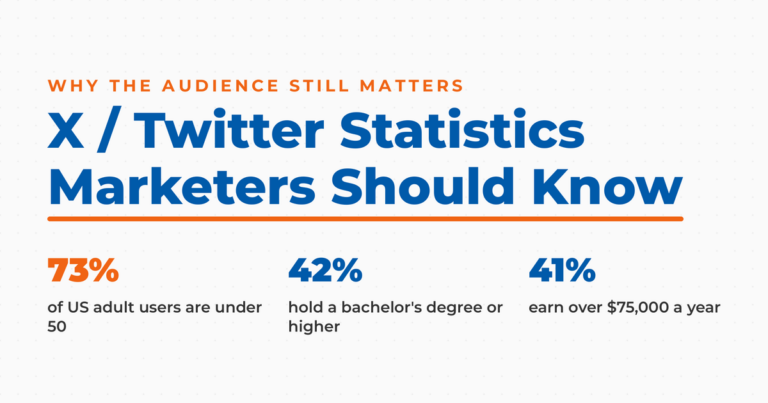
Boosting your Twitter engagement may feel like a daunting task. After all, Twitter isn’t as “cool” as it once was. It remains a powerful force in some sectors though, and the audience behind it is larger than most marketers assume, which my roundup of Twitter user statistics lays out in detail. Pick two tactics from the nine above, run them for a month, and judge the result against your own previous month rather than against an industry median.
If you want the wider toolkit for that work, my free Digital and Social Marketing Tools Buyer’s Guide covers the platforms I recommend for scheduling, listening and measurement across every channel, not X alone.
And if Twitter is one piece of a larger problem, that is the work I do as a Fractional CMO for companies that need a marketing leader without a full-time hire. Teams that would rather build the capability in-house can join my Digital First Mastermind, and event organizers can book me to speak on digital and social media marketing.