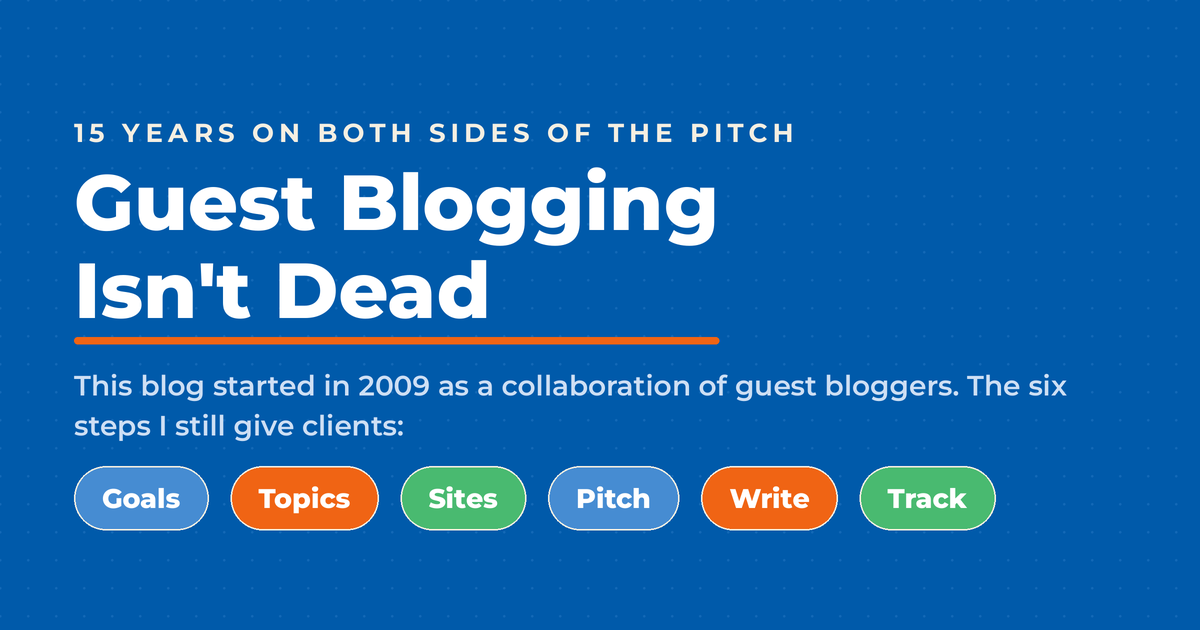

Guest blogging has been a cornerstone of content marketing — and my own blogging journey — since the earliest days of the blogosphere. In fact, this very blog started as a collaborative project of guest bloggers back in 2009.
Fast forward 15+ years, and guest blogging remains one of the smartest and most scalable ways to build visibility, authority, and SEO — if you do it right.
In this guide, I’ll walk you through everything I’ve learned from being on both sides of the guest blogging equation: pitching high-authority blogs and hosting them on my own site. Whether you’re just starting to become a guest author or looking to refine your guest blog post strategy, this post will give you a roadmap built on real-world results — not recycled advice.
I also go into this topic more in-depth in a downloadable guide you can grab for free to serve as a more detailed companion to this blog post by clicking on its title here: The Definitive Guide to Guest Blogging
Key Takeaways
✅ Guest blogging still works, but the payoff comes from relationships, not volume. Most of my best opportunities came from people who already knew me, not from cold outreach.
✅ Google’s line is intent, not format. Its spam policies name paid articles that pass ranking credit, and optimized anchor text placed in guest posts distributed across sites, as link spam. An original article written for a real audience is not.
✅ A single placement can outrun a year of your own publishing. ProBlogger’s Darren Rowse traced 3 million visitors and over 150,000 social shares to one guest post and the series it set off (2013).
✅ Pitch the gap, not yourself. After reviewing hundreds of pitches, the ones I accept are the ones that fill a hole in my archive. Study what a blog has not covered, then propose exactly that.
✅ Hosting guest bloggers is the other half of the strategy. This site began in 2009 as a guest blogger collaboration, and I have been on both sides of the desk ever since.
What Is Guest Blogging?
Guest blogging is the practice of writing blog posts for other websites to build domain authority, earn SEO backlinks, drive referral traffic, and expand your online presence.

TL;DR: Guest blogging isn’t dead just like blogging isn’t dead — but the wrong strategy will waste your time and hurt your SEO. In this post, I’ll show you how to guest blog the right way, based on my 15+ years of experience in influencer marketing and digital PR.
What Are the Benefits of Guest Blogging?
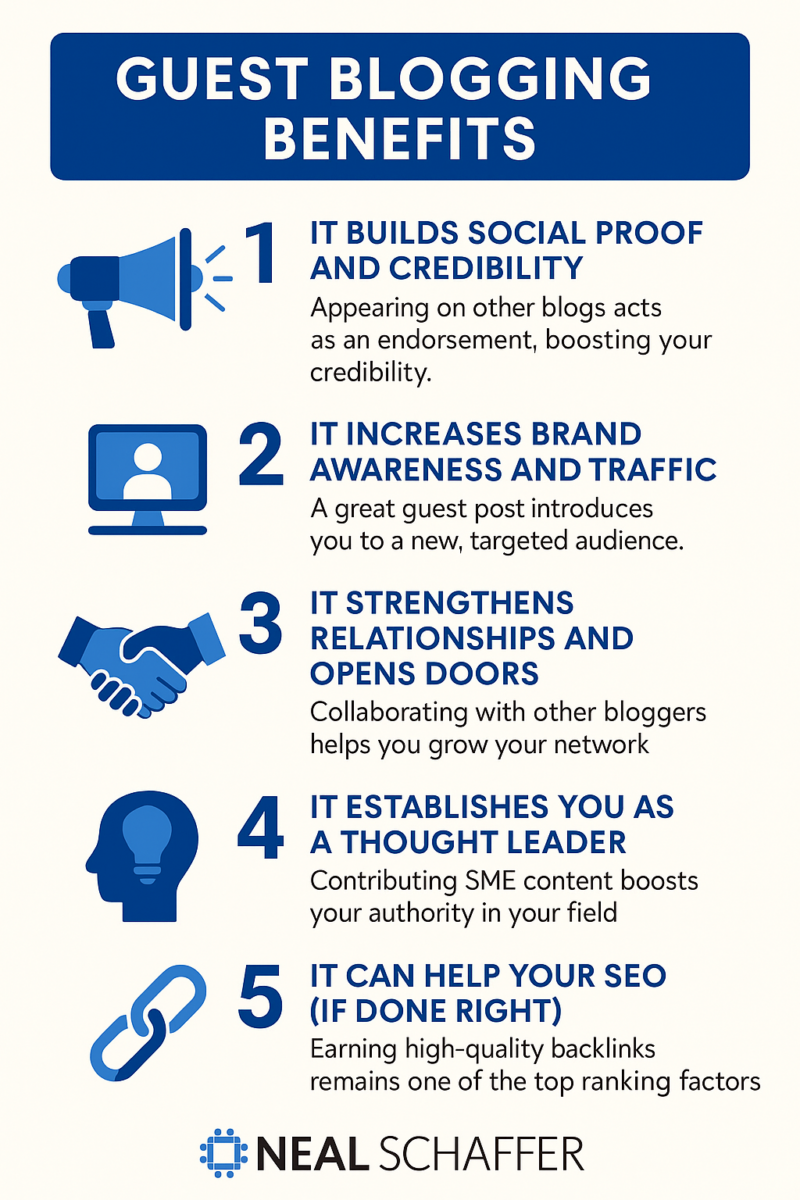
Guest blogging isn’t just an outdated relic of the early blogosphere — it’s still one of the most effective and multifaceted tools for building authority, connections, and traffic online. Here’s why:
1. It Builds Social Proof and Credibility
Appearing on someone else’s blog — or featuring others on yours — serves as a public endorsement. This works just like influencer marketing or social media: when someone trusts the blog you’re featured on, that trust rubs off on you.
It’s powerful social proof that says: “This person is worth listening to.”
2. It Increases Brand Awareness and Traffic
A great guest post introduces you to a new, targeted audience. If the content is valuable, readers will naturally click through to learn more about you or your brand. Over time, this consistent exposure leads to sustained referral traffic.
ProBlogger’s Darren Rowse credits a single guest post, and the follow-up series it inspired, with generating 3 million website visitors and over 150,000 social media shares.
3. It Strengthens Relationships and Opens Doors
Guest blogging is also a powerful networking tool. Collaborating with other content creators, influencers, and brands can lead to new partnerships, podcast invites, or co-marketing opportunities. It’s a form of value-first outreach.
4. It Establishes You as a Thought Leader
When you’re invited to contribute to respected industry blogs, you signal subject matter expertise (SME). Over time, this builds trust and authority — both with readers and search engines.
5. It Can Help Your SEO (If Done Right)
Backlinks from authoritative sites remain a top ranking factor in SEO. Google favors external links from relevant, high-quality websites — and a thoughtful guest blogging strategy is one of the most legitimate ways to earn them. In fact, 60% of bloggers publish between 1 and 5 guest posts per month to support their link building efforts.
That said, this only works if:
- You write original, valuable content
- You contribute to relevant, trustworthy sites
- You avoid low-quality or spammy link schemes
Remember: One high-quality backlink can carry more link juice than hundreds — or even thousands — of low-quality ones.
Pro Tip: Google’s concept of E-E-A-T (Experience, Expertise, Authoritativeness, and Trustworthiness) applies here. Being published on credible sites supports your expertise in Google’s eyes — especially when your name is consistently attached to high-value content.
How to Start Guest Blogging: A Step-by-Step Framework
Here’s a high-level playbook I recommend to my clients — one that aligns marketing objectives with actual results:
Step 1: Set SMART Goals
Before you write a single word, get clear on why you’re guest blogging. Guest blogging can serve multiple purposes — but without specific marketing goals, you won’t be able to measure success or improve over time.
Use the SMART framework (Specific, Measurable, Achievable, Relevant, Time-bound) to define your objectives. For example:
One Strategy to Connect All Your Marketing
My latest book helps small businesses, entrepreneurs, and marketers bring search, email, and social together into one digital marketing strategy that actually compounds.
Drawing on my work as a Fractional CMO, Digital Threads turns complicated tactics into a clear, practical plan you can follow, whatever your budget or team size.
Grab your copy on Amazon and start weaving your own digital threads. Click the cover or the button below to get started.

- SEO goal: “Earn 10 high-quality backlinks from DA 40+ sites within 3 months.”
- Traffic goal: “Drive 1,000+ referral visitors to my lead magnet by publishing 4 guest posts in Q3.”
- Thought leadership: “Get featured on 3 industry blogs that reach CMOs in the B2B SaaS space this year.”
- Lead generation: “Convert at least 5 new leads from each guest post through strategic CTAs and landing pages.”
Having clarity on your goals helps you:
- Choose the right guest posting sites and topics
- Craft a more focused pitch
- Track meaningful KPIs, not vanity metrics
Pro Tip: Don’t try to chase every outcome with one post. Choose one main goal per piece and optimize your strategy around it.
Step 2: Choose the Right Topics
Once your goals are locked in, it’s time to map them to content topics that resonate with your target audience — and the host blog’s.
Start by identifying your core content pillars: the 3–5 themes your brand is known for (or wants to be). Then brainstorm guest-friendly blog formats within those pillars, such as:
- Tactical how-tos
- Strategy guides
- Personal lessons learned
- Industry trend analysis
- Expert roundups or opinion pieces
Then, research what’s already been published on the host blog. You want to:
- Avoid redundant topics
- Spot content gaps
- Offer a unique perspective or update on an older post
Tools like BuzzSumo, Semrush Topic Research, or Google Trends can help you find trending and relevant angles within your niche.
Pro Tip: Think like a magazine editor — what’s timely, relevant, and speaks to their readers right now?
Step 3: Identify the Right Sites
To make guest blogging worth your time, you need to pitch the right blogs — ones that have authority, organic traffic, and an audience aligned with your niche.
Use tools like Ahrefs, Semrush, or even simple Google search operators to uncover opportunities. Try queries like:
"write for us" + [your niche]"guest post by" + [industry keyword]"submit a guest post" + [topic]
Once you find a potential site, evaluate it for:
- Domain authority
- Relevance to your audience
- Engagement level (comments, shares, publishing frequency)
Pro Tip: If the site provides a dedicated submission form, use that — many blog editors prefer pitches through the channels they specify. If there’s no form, look for a relevant contact email address (editor, content manager, etc.).
You can also streamline this process using blogger outreach tools like BuzzStream, Respona, or Pitchbox, which help you find contact info, automate follow-ups, and track responses.
Step 4: Craft a Compelling Pitch
Your pitch is your first impression — and most editors get dozens of them per week. If yours isn’t clear, relevant, and reader-focused, it’s unlikely to get a response.
Here’s what makes a pitch stand out:
- Personalization: Mention the editor’s name, reference a recent article, or comment on their content style.
- Relevance: Align your proposed topic with their blog’s audience and editorial tone.
- Brevity: Get to the point. Editors are busy — 150–200 words is often enough.
- Proof of credibility: Briefly showcase your experience, niche authority, or links to prior posts.
Make it about what you can offer them, not about what you need from them.
Even a well-written pitch can get missed, so always follow up once within 5–7 business days. Keep it polite and professional.
Pro Tip: Have 2–3 headline options ready. Give them a choice, but show you’ve thought it through.
Step 5: Write with Their Audience in Mind
One of the biggest mistakes I see? Recycling your own blog content without tailoring it to the host site.
Instead, write original, high-value content that’s aligned with their audience’s interests, tone, and editorial guidelines. Study their top-performing posts to understand:
- Content structure (How-tos? Case studies? Thought leadership?)
- Tone of voice (Conversational? Technical? Data-driven?)
- Preferred formats (Length, use of visuals, subheadings, etc.)
While you can use AI tools to help generate or repurpose blog post ideas, be cautious — many blogs now run submissions through AI detection tools, and originality still matters. If you do use AI, treat it as a first draft assistant, not a final content generator.
Pro Tip: Always ask yourself, “What would make this valuable to their readers — not just mine?” That mindset is what gets your guest post accepted (and promoted).
Step 6: Track Your ROI
Use UTM links in your guest posts (if possible) and then use Google Analytics together with your preferred SEO tool to measure:
- Traffic from the post
- Backlinks gained
- Leads or list growth
- Overall content reach
Pro tip from my own experience: The best-performing guest posts I’ve written didn’t just match my expertise — they matched the content gaps of the host site. I always study what they haven’t covered yet and pitch there first.
How to Find Guest Posting Opportunities
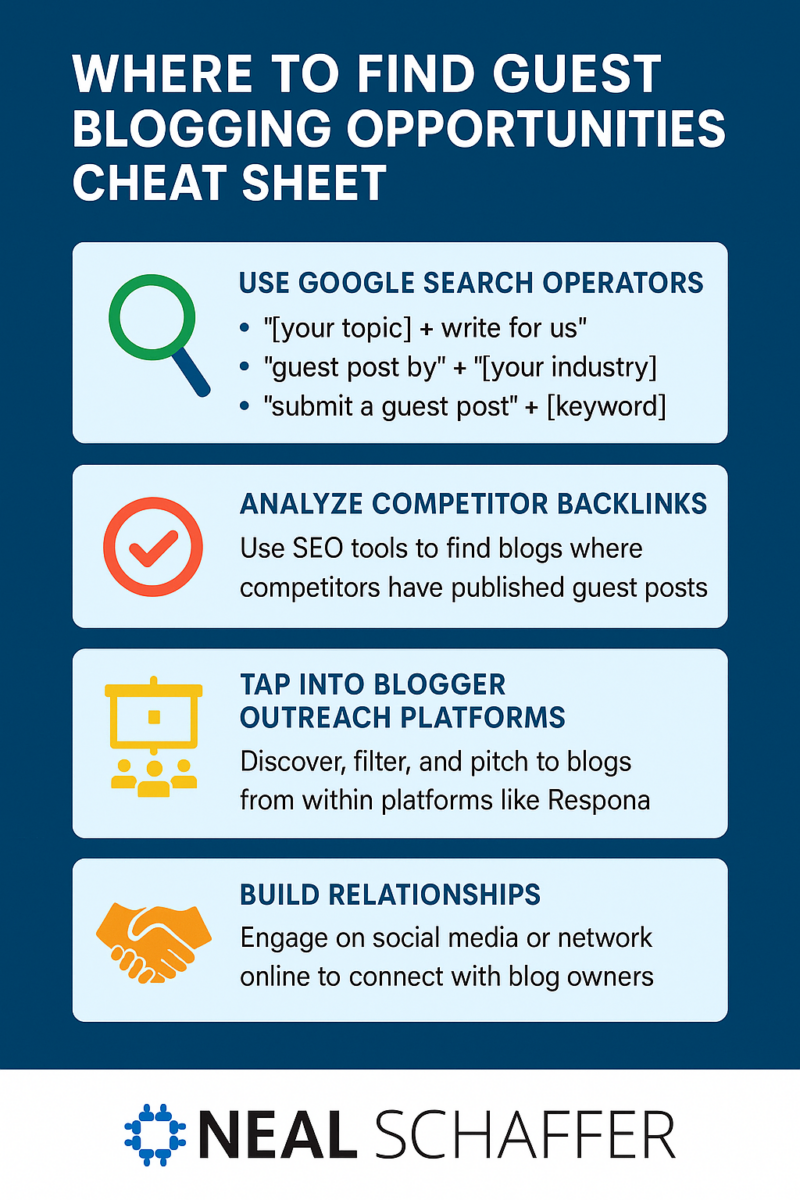
You can’t guest blog if you don’t know where to pitch. Fortunately, finding opportunities isn’t as hard as it seems — if you know where to look.
Here are four proven ways I use and recommend to find guest post sites:
1. Use Google Search Operators
Try advanced search phrases like:
- “[your topic] + write for us”
- “guest post by” + [your industry]
- “submit a guest post” + [keyword]
This can help you surface hidden pages on relevant blogs that accept guest contributors.
2. Analyze Competitor Backlinks
Use SEO tools like Ahrefs, Semrush, or Moz to find competitors backlinks as part of a competitor SEO analysis. Plug in a competitor’s domain and look at their top referring domains — especially blogs. If they’ve been published there, you might be able to, too.
3. Tap into Blogger Outreach Platforms
Try tools like Respona, Pitchbox, or BuzzStream. These platforms let you search by niche, filter by domain authority, and pitch from within the app. They handle the logistics, but the message itself still has to be worth opening, which is what my guide to email outreach walks through.
4. Build Relationships (My Favorite Method)
Some of my best opportunities came from networking — not cold outreach. Use LinkedIn, mastermind groups, or social engagement to build rapport with blog owners before you pitch.
Pro Tip: Before pitching any blog, scan it for recent guest posts. If they haven’t published one in 6–12 months, it may not be worth your effort.
How to Write a Winning Guest Pitch (Template Included)
If there’s one thing I’ve learned after reviewing hundreds of guest pitches, it’s this: Most people write about themselves — not what they can do for the blog.
Here’s how to stand out with a personalized pitch that gets read (and accepted).
Keep it Short, Specific, and Reader-Focused
- Mention a post you liked on their blog
- Suggest a relevant topic or two
- Explain what you bring to their audience
My Go-To Email Pitch Template:
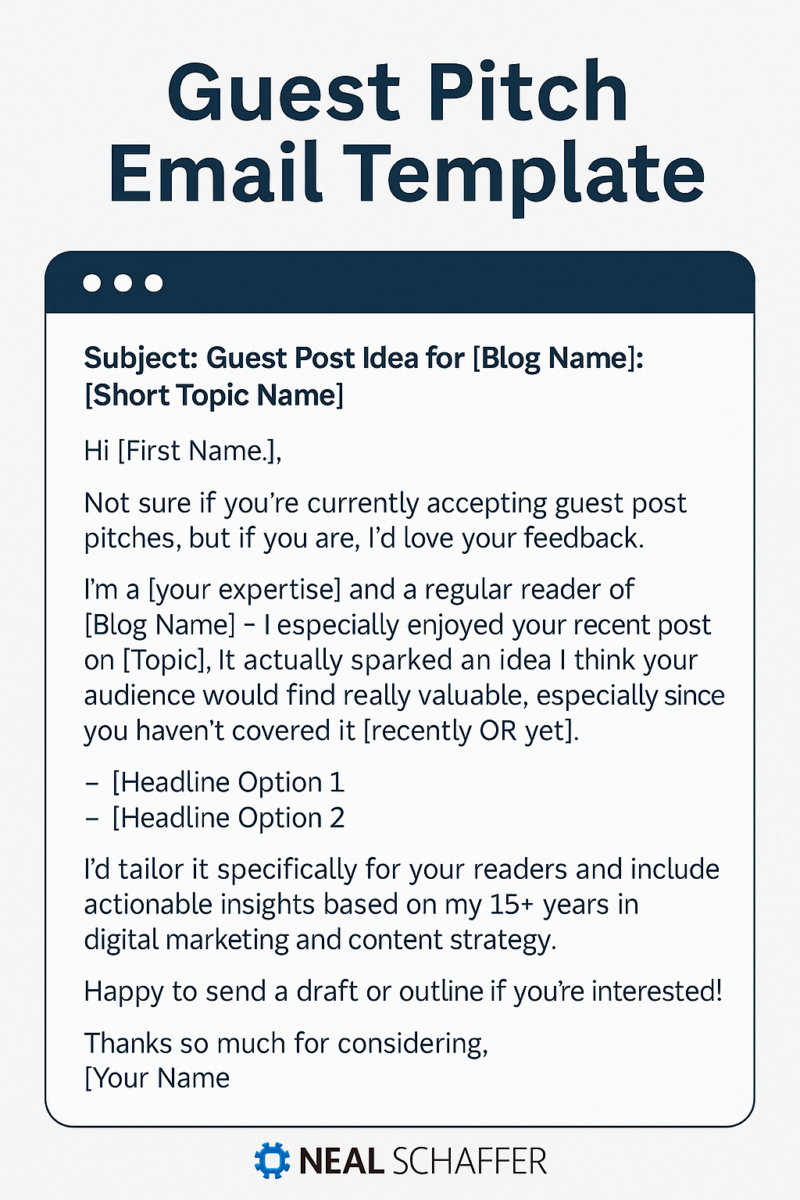
Subject: Guest Post Idea for [Blog Name]: [Short Topic Name]

Hi [First Name],

Not sure if you're currently accepting guest post pitches, but if you are, I’d love your feedback.

I’m a [your expertise] and a regular reader of [Blog Name] — I especially enjoyed your recent post on [Topic]. It actually sparked an idea I think your audience would find really valuable, especially since you haven’t covered it [recently OR yet].

Would you be open to a guest post like:

– [Headline Option 1]
– [Headline Option 2]

I’d tailor it specifically for your readers and include actionable insights based on my 15+ years in digital marketing and content strategy.

Happy to send a draft or outline if you’re interested!

Thanks so much for considering,
[Your Name]
[Website/LinkedIn]
Pro Tip: If they don’t respond, follow up once — usually 5–7 business days later. If still no reply, move on. It’s not a rejection, it’s bandwidth.
Scaling Your Guest Blogging Strategy: Tools, Teams, and Tactics
In fact, you can scale your efforts. There are several ways to do this, such as hiring freelancers, using some of the blogger outreach tools mentioned above, and building relationships with other bloggers.
Did you notice how guest blogging success is still a relatively social endeavor? Over time, you’ll end up working smarter not harder, while at the same time, boosting other bloggers besides yourself and your host.
How to Get Guest Bloggers for Your Blog
Of course, most of us want to benefit from guest blogging the other way: by having guests on our blogs. Finding and managing guest blogging on your site requires many of the same skills as guest blogging, at least in terms of ensuring a successful hosting experience. However, being on the other side of the desk makes it much easier to find potential guests. It also puts the attribution and rights questions on your desk, so settle those in writing before a guest post goes live rather than after, which is one of several legal considerations for bloggers that get harder to fix once something is published.
- Link to external sites: it’ll get you noticed.
- Boost your search engine rankings: it’ll make your blog a more desirable host for would-be blogger collaborations.
- Invite influencers to guest post.
- Get listed on guest bloggers-welcome directories. Google is your best friend here but here’s one to check out: 150+ Sites to Guest Post in 2025
- Create a page dedicated to your guest blogging policies
Try Out Some Tools
Lastly, check out some guest blogging tools. Often, you can use existing tools for your home blogs, such as copy checking and backlink research. In addition, there are dedicated tools for finding opportunities. Be sure to check out my recommended list in this e-book that I wrote on this very topic: The Definitive Guide to Guest Blogging
Frequently Asked Questions About Guest Blogging
Yes, when the goal is audience and authority rather than link count. A post on a site your buyers actually read earns referral traffic, credibility, and often an editorial backlink as a byproduct, which is the only kind of link building I would spend time on today. Chasing links alone is the part that stopped working.
Guest blogging is not, but link-driven guest posting is. Google’s spam policies list paid articles that pass ranking credit, along with optimized anchor text placed in guest posts distributed across other sites, as link spam. Write for the readers and the backlinks take care of themselves. Write for the anchor text and you are in violation.
Only if the link is qualified with rel=”sponsored” or rel=”nofollow”. Google treats exchanging money for links, or for posts that contain links, as link spam, and it says sponsorship is acceptable as long as the link carries one of those attributes. A paid followed link breaks the policy no matter what the invoice calls it.
Fewer than you think. I would rather place two posts a year on sites my audience genuinely reads than twenty on sites that exist to sell links. The quality of the host, not the number of placements, decides what the effort returns, and blogger outreach tools only help you sort candidates faster.
Yes, if you edit them like a publisher. Google’s site reputation abuse policy targets third-party content published mainly to borrow the host site’s ranking signals, and it explicitly exempts articles of a genuine editorial nature. I have hosted guest bloggers here since 2009, and the ones worth publishing are the ones I would have commissioned anyway.
Final Thoughts on Guest Blogging
Getting started with guest blogging can seem daunting. However, as you can see from this brief post, a lot of it is about building relationships. Once you’ve done that, it’s relatively easy to write a guest post. And, at the same time, you’ll be part of a win-win situation where both parties get SEO and other benefits for each other’s blogs. Want more information? Download the e-book today here or below: