Earn the Links That Get Your Website Found
Get my free 8-step guest blogging strategy.
The SEO and content marketing community are full of chatter as of now about Google’s Helpful Content update. The update started rolling out on the 25th of August 2022 and will take about two weeks to be fully implemented.
Every time Google updates its algorithm in a significant way, content marketers and SEO specialists worry about their site rankings and traffic. However, Google updates have had a pattern for a long time.
They have always prioritized content that answers search questions – to the intent and depth of the query. In one sense, the updates have always been “helpful content updates.” If you are someone who has always created content for humans instead of machines, congratulations. Your site will probably do well with this update.
With the update at the forefront, the digital marketing community also wonders what the future will look like for content. What will it take to win a position in the SERP in 2026? If you have asked this question, then this article is for you.
In this article, we will unpack what SEO content is, in its past, present, and possible future form. We will also take a look at the new trends that will affect SEO ranking in 2026. Finally, let’s see how we can create content that can rank in the coming year.
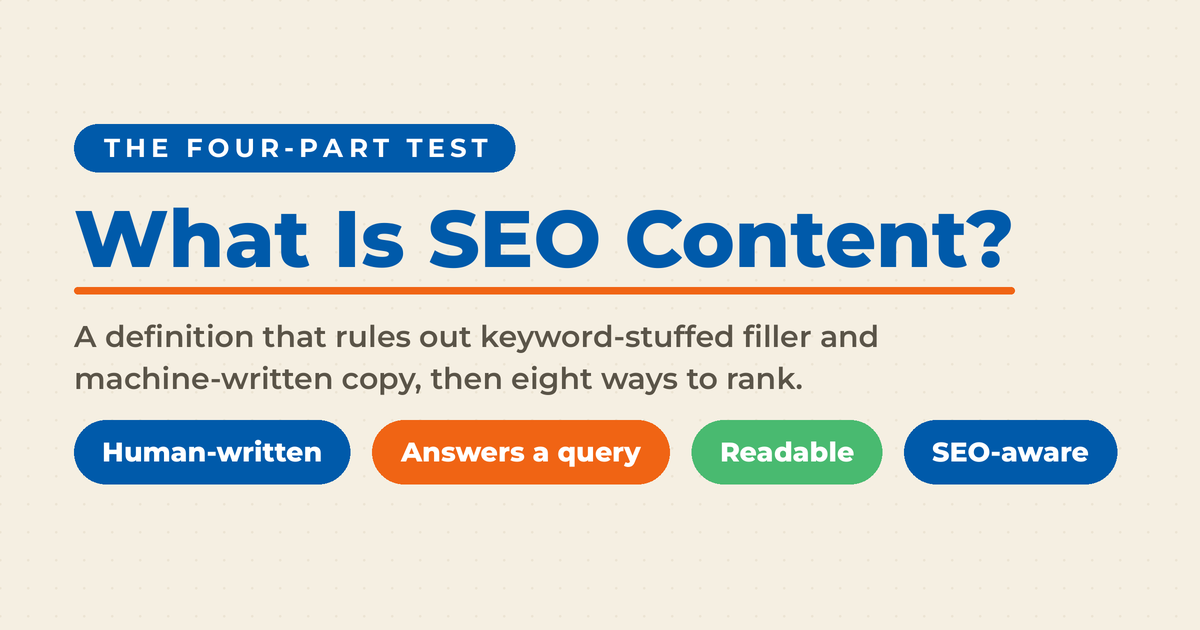
✅ SEO content is written by a human to answer a real search question, and it earns traffic by answering that question better than the pages already ranking.
✅ Most of Google’s ranking signals sit outside your content, in your domain, your backlinks, and how people experience your site. Among the signals that are about content, depth and relevance matter most.
✅ Thought leadership, product-led content, and audio or video versions of your best posts are what separate pages that rank in 2026 from pages that stall.
✅ Strategy comes before keyword research. Decide who you are writing for and what they need answered, then open your SEO tool.
✅ Refreshing an old post that once drove traffic is usually faster and cheaper than publishing a new one.
The word “SEO content” can have so many different meanings. It can refer to cheap, mass-produced articles stuffed with keywords that clogged the web sometime back. The Panda update put an end to the practice for the most part.
Increasingly, it refers to content produced by AI writers. The quality of AI writing has rapidly improved over the years. Google has announced that machine-created content goes against its guidelines. But some in content marketing think AI content would become indistinguishable from human content in most ways. Therefore, there would be no stopping the bots from creating all lower-level content focused on keywords.
For the purpose of this article, we will define SEO content as,
Search engine algorithms are constantly changing. Most Google updates are too minor to notice. Others, like the Helpful Content Update, can change the entire landscape of SEO.
According to Google, it uses over 200 factors when deciding which content to rank. Only around 60 of these are directly related to content. The rest deal with other things, including
Factors directly related to content are called page level factors. This includes the well know items you find in SEO checklists. But the most important ones are the depth, relevance, and the quality of content.
What matters in SERP rankings is a never ending debate in digital marketing. But most would agree that the above factors matter and are the ones to focus on.
With the Helpful Content update rolled out, content that ranks in 2026 will have to do more than tick off a checklist. The basics of SEO still apply, but content marketers will have to go beyond that.
Paying attention to the following trends and incorporating them into your content strategy and writing could pay off.
There is a lot of disagreement about what people mean when they say thought leadership content. But in general, it is content that is aimed at building trust and loyalty, written with perspectives, information, and insights unique to your brand.
With the rise of AI and the explosion of the amount of content online, ranking for utility keywords (how to do A, what is B) is harder and harder. Try doing something your competitors might not be doing.
Product-led content is content that helps the reader solve their problems using your product. True product-led content is created from a strategic perspective and is extremely effective for SaaS when done right.
The changes in content consumption trends indicates that video and audio content will become more and more important. People like to watch and listen, often in binges and in background. Having video and audio content can also increase the dwell time on your website, giving an SEO boost.
If you have been producing mostly written content, it might be worth considering to repurpose some of the best performing content into audio and video. It is also a good call to complement new written content with audiovisual content.
While audio and video content are growing, there is still a need to produce written content. Some things are better said over writing – especially complex topics.
My latest book helps small businesses, entrepreneurs, and marketers bring search, email, and social together into one digital marketing strategy that actually compounds.
Drawing on my work as a Fractional CMO, Digital Threads turns complicated tactics into a clear, practical plan you can follow, whatever your budget or team size.
Grab your copy on Amazon and start weaving your own digital threads. Click the cover or the button below to get started.

If you have been using an SEO-first approach to your content, then it might be time to put content strategy first. Answer questions like,
Then head over to your favorite SEO tool.
Unhelpful content comes in many different forms. If you are guilty of any of these practices, please do better. The problem is the output, not the tool that produced it, which is why the question of whether Google penalizes AI content almost always comes down to whether a human added anything of value to the draft.
Typical SERP analysis includes looking at the top-ranking search results and then analyzing the word count, subheaders, and content in the resulting web pages. Paying attention to what is ranking is important, but make sure to answer these questions as well.
There are several steps to take to make sure you are not slavishly trying to placate the algorithm at the expense of your readers.
Content marketers can learn a lot about writing from journalists. Even if you have no experience being one, here are some journalistic practices to improve your content.
Gone are the times when anyone could produce content on any topic and expect to rank. You need an in-depth understanding of the topics you cover to get traffic. That expectation is what Google’s quality raters are grading when they assess a page, and the framework behind it is set out in this guide to what E-E-A-T actually asks for. Some tips for creating expert content are as follows.
It is now easier than ever to hit go back and visit another site. Make sure your content is easy to read.
It is easy to forget your old content and focus on creating new. But refreshing your past content can give a boost in SEO and help your site ranking. Identify blog posts that drove traffic but fell by the wayside. They are the best posts to refresh. A content audit is how you find them, by sorting your library into what to keep, what to update, and what to remove.
SEO content is any page written to answer a question people are actually searching for, structured so search engines can understand and rank it. It covers blog posts, product pages, landing pages, and glossary entries. The label describes intent and structure, not a particular format.
No. Content marketing is the wider practice of publishing to attract and keep an audience across every channel you own. SEO content is the subset built to earn organic search traffic, which is one channel inside that practice.
It can. Google’s guidelines target content produced to manipulate rankings rather than the tool used to write it, so thin AI output fails for the same reasons thin human output fails. Pages that add expertise, original data, or first-hand experience still hold up.
Track its organic clicks and average position in Google Search Console over a 90-day window rather than day to day. A page that holds impressions but earns few clicks usually has a title and meta description problem rather than a content problem.
Review your library at least twice a year and prioritize posts that once ranked and have since slipped. Update stale figures, cut sections that no longer apply, and add coverage for questions that have entered the search results since you published.
It is getting harder and harder to rank in the SERP. Competition is getting stiffer and Google is evolving as ever. But using the tips here will set you apart from many other digital marketers. Good luck with your 2026 SEO efforts.
Author Bio
Kasun Pathirage is a freelance writer for B2B fintech and SaaS brands. Visit his website to learn more about his work and services.

We respect your privacy. Unsubscribe at anytime.
Practical advice on social, content, influencer, and search marketing, plus the AI tools that make each one easier. Join thousands of founders and business owners who read it.