
Ask ten marketers what the creator economy is and you will get ten answers. Half of them describe a market size. The other half describe influencer marketing wearing a new name tag.
Neither answer tells you what to do differently on Monday morning.
This post is written for marketers, business owners, and the people who sign off on media budgets. If you are a creator trying to figure out how to get paid, there is plenty of good material out there, and almost none of it is this. And if you are an investor trying to size a market, you will find the numbers here thin on purpose.
My name is Neal Schaffer. I wrote a book about influence in 2020 and have taught influencer marketing at UCLA Extension since. I also run a business that sits inside the thing I am describing. Six books, a podcast past 400 episodes, courses, a membership community, an ambassadorship with Adobe. So when I write about how creators earn and what platforms do to them, I am not reporting from the sidelines.
What follows is the working definition and the money. Then the part that actually matters to you: what changes about how you get found, how you spend, and who your audience believes.
Key Takeaways
✅ The creator economy is the whole ecosystem of independent people who build audiences and earn from them. Influencer marketing is one commercial layer inside it, not a synonym for it.
✅ Attention has moved to individuals. The Reuters Institute found that more than a quarter of people now get news each week from creators. Creators are supplementing traditional media rather than replacing it.
✅ Creator income is concentrated at the top. Goldman Sachs Research estimated that only about 4% of global creators are professionals earning six figures, and expected that share to hold steady as the market grows.
✅ Budget has followed. The IAB now counts creator advertising as a media channel of its own rather than a social media line item, and nearly half of buyers call creators a must-buy.
✅ Every creator relationship you build sits on infrastructure somebody else owns. Pair creator distribution with search and email, or you are renting your entire audience.
What Is the Creator Economy?
The creator economy is the ecosystem of independent individuals who build their own audiences and earn money directly from them. It also takes in the platforms, tools, and brands paying into that system. Goldman Sachs Research sized its total addressable market at roughly $250 billion in 2023, growing toward $480 billion by 2027.
Treat that number as a ceiling estimate rather than a bank balance. It counts brand spend, platform payouts, subscriptions, and commerce together, and different firms count different things, which is why published market sizes vary so widely. If you want the current data set rather than a single headline figure, the creator economy statistics page is where I keep it updated.
The word “economy” is doing real work in that phrase. An economy has producers, buyers, intermediaries, and rules. Creators produce, audiences and brands buy, platforms intermediate and take a cut, and the platforms also write the rules. Once you see it that way, your role in it becomes a lot clearer.
You are a buyer. And in most cases, not the biggest one in the room.
That raises the obvious next question, because “creator” has stretched to cover an enormous range of people.
Who Counts as a Creator?
A creator is anyone who builds an audience by publishing their own content and earns from that audience. That includes influencers, YouTubers, podcasters, newsletter writers, online educators, streamers, and UGC creators who produce content without ever distributing it. The category is much broader than “influencer,” which is the part of it that sells.
Every influencer is a creator. Not every creator has influence you can borrow, and the difference shows up in what you are actually buying. A UGC creator sells you production. An influencer sells you production plus distribution plus a relationship with an audience. Those are different purchases at different price points, and I dig into where the line sits in content creator vs influencer.
The definitional question also cuts by size. A creator with 4,000 engaged followers in a narrow professional niche can outperform someone with 400,000 general followers, which is the whole argument for micro influencers and nano influencers. If you are trying to work out which tier fits your budget and your goal, start with influencer tiers rather than with follower counts.
One thing I have come back to since writing The Age of Influence: your community is always a subset. The creator you want is rarely the biggest name in your category. They are the one whose subset overlaps yours.
Which brings us to the money, because how a creator earns shapes what they will and will not do for you.
How Do Creators Actually Make Money?
Creators earn from five or six sources, and the mix probably tells you more than the total. EMARKETER forecasts that in 2026, creators will take 59% of their revenue from sponsored content, 24.4% from platform payouts, and 8.2% from affiliate marketing. Brand money, in other words, is the largest single line in most creator businesses.
That dependence is your negotiating context, and it is also your risk.
| Revenue source | Who pays the creator | Creator control | What you can buy here | Best use for a marketer |
|---|---|---|---|---|
| Brand deals and sponsored content | You | High on price, low on reach | Content plus the creator’s distribution and credibility | Awareness and consideration in a niche you cannot reach organically |
| Platform ad share | The platform | Very low, thresholds move | Nothing directly, but it tells you how stable their income is | Context for negotiation, not a buy |
| Affiliate and commissions | You, on performance | Medium | Measurable sales at variable cost | Lower funnel, once the creative has already proven out |
| Subscriptions and memberships | Their audience | Very high | Access to a paying, self-selected audience | Sponsorships where trust counts for more than volume |
| Digital products and courses | Their audience | Highest | A partner with their own business, not a freelancer | Long-term ambassadorships and co-created products |
What a creator’s income mix tells you before you negotiate
The stability of a creator’s non-brand income tells you how the relationship will go. Someone whose living comes entirely from sponsorships needs your deal. Someone with a paid community and a course has options, and will hold the line on creative control.
I sit on the creator side of this table too. In January 2024 I walked through how my own business did in 2023 on the podcast, stream by stream. Nine income streams in 2022, and I added a tenth in 2023. The overwhelming majority came from services, meaning my fractional CMO work plus speaking and teaching. Everything digital filled in around that. Six figures, not seven. Across recent years my services line has run in six figures while sponsored content and AdSense have each sat in four, and affiliate has moved between four and five. So my mix runs close to the inverse of the EMARKETER average, where sponsored content carries almost 60%.
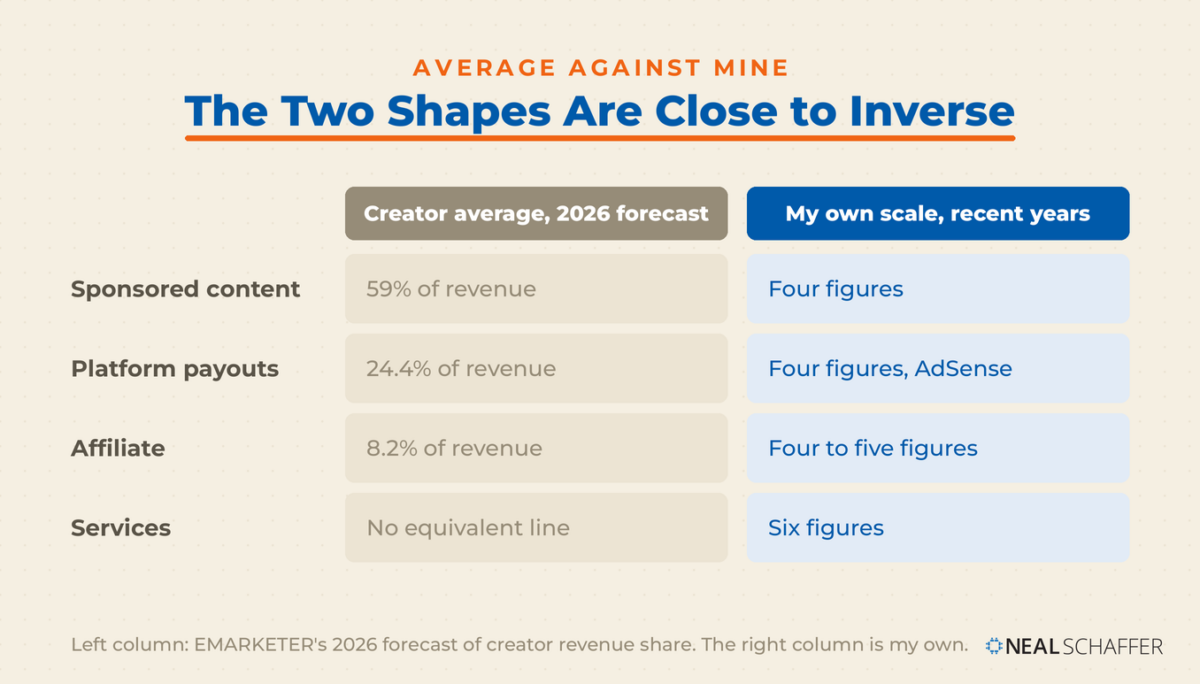
Take that as one creator in one year rather than a template. My affiliate income went up close to 400% in 2023 while my sponsored content went down, so even my own proportions moved a lot inside twelve months. The percentages are not really the useful part anyway. Brand deals were a small line for me, so anyone pitching me a sponsorship that year was talking to someone who could say no. Ask a creator what they earn from besides brand deals before you talk price, and you will know which conversation you are in.
Is LinkedIn Actually Bringing You Business?
My latest book helps professionals, entrepreneurs, and business owners turn LinkedIn from a static profile into a real source of clients and growth.
Maximizing LinkedIn for Business Growth gives you clear, practical steps to build a profile that gets noticed and a network that actually sends business your way.
Grab your copy on Amazon and put it to work this week. Click the cover or the button below to get started.

Why platform payouts are shakier than they look
Platform payout rules give you the clearest read here, because they are published. TikTok set the bar for its Creator Rewards Program at 10,000 followers and 100,000 video views in the last 30 days. Plenty of the creators worth partnering with sit under that bar and earn nothing from the platform itself.
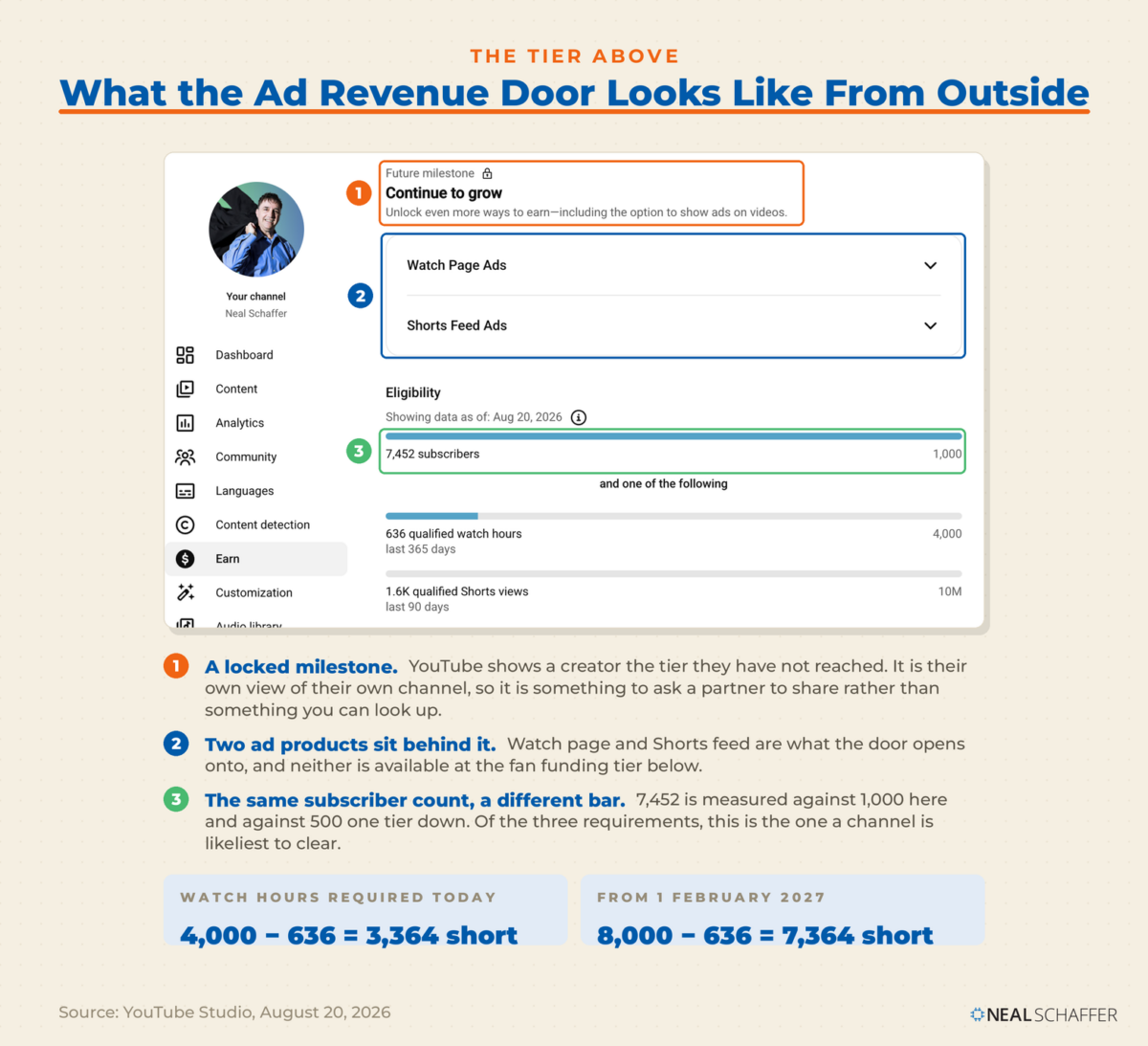
I am one of them. In August 2026 my own YouTube channel had 7,452 subscribers and earned me nothing from YouTube. YouTube runs two separate tiers, and the lower one, for fan funding and shopping, needs 500 subscribers. I clear that bar almost fifteen times over. I fail the other two requirements. Zero uploads in the last 90 days against a requirement of three, and 636 qualified watch hours in a year against a requirement of 3,000.
Those 90-day and 365-day windows roll forward, so eligibility is not something a creator earns once and keeps. In 2023 I published 92 videos and my watch time went up 767%. I stopped publishing, and the platform income went with it. So follower count just might be the least useful number on a creator’s media kit. Ask what they published in the last 90 days instead.
So the pay is uneven and the middle is thin. What changed on your side of the table is bigger.
What Changed for Brands?
Distribution moved. Attention used to concentrate in institutions you could buy a slot inside. It now concentrates in individuals who own their own audiences. The Reuters Institute’s 2026 Digital News Report marked the crossover: social media and video networks reached 54% for news across 48 markets, ahead of news organizations’ own sites and apps at 51%.
The audience did not move to a channel, it moved to people
Pew Research Center found that 21% of US adults regularly get news from news influencers. Of those readers, 52% say most of the people they follow are independent of any news organization. They are following a person, not a masthead.
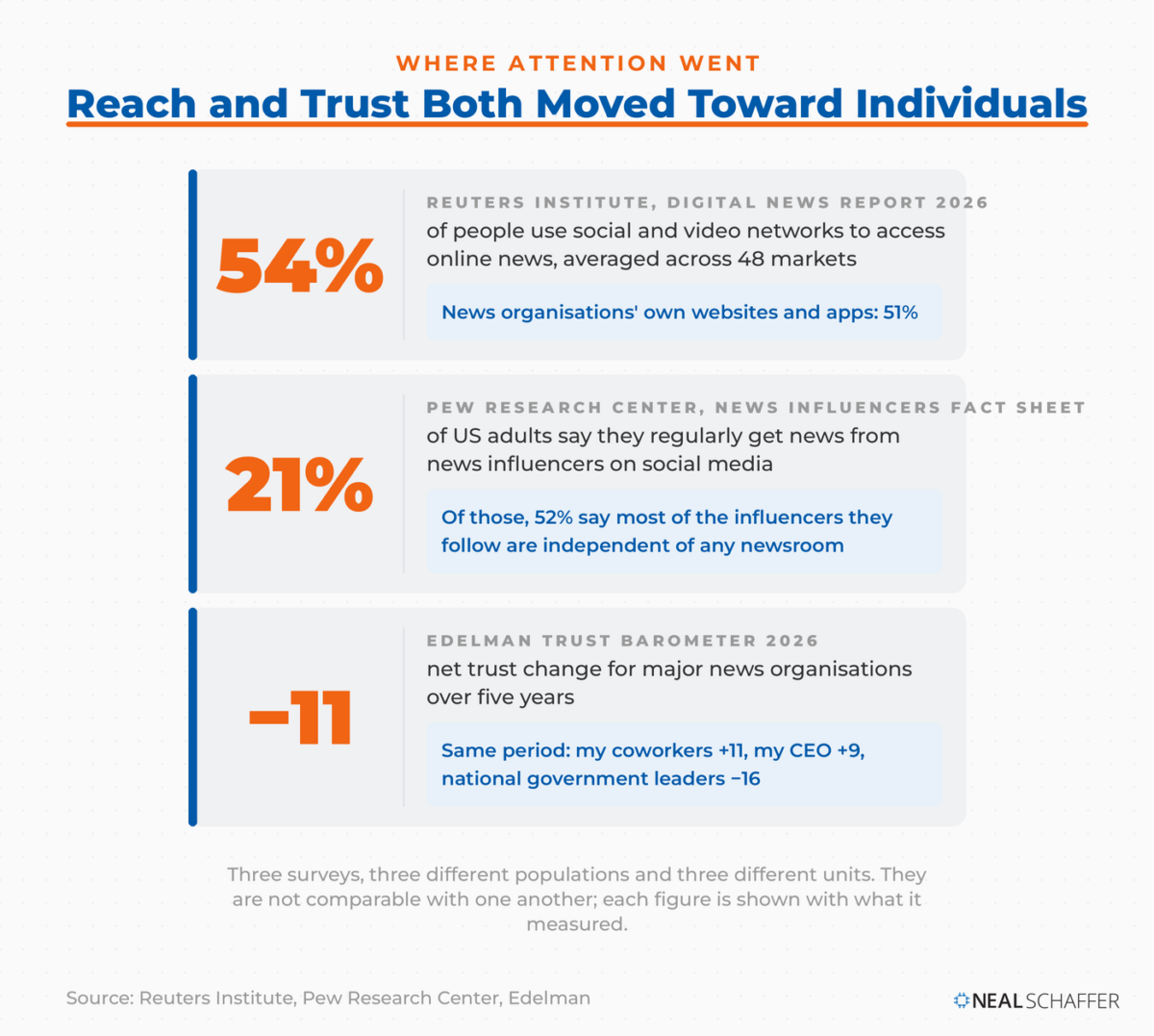
Edelman’s 2026 Trust Barometer measures the same drift as a net change. Over five years, trust fell 16 points for national government leaders and 11 points for major news organizations, while it rose 11 points for both coworkers and neighbors and 9 points for people’s own CEOs. Proximity gained what institutions lost.
You will meet a louder version of this claim, usually a figure saying employee posts earn eight times the engagement of brand posts. I would not put that number in a deck. Chase it back and it lands on vendor blogs citing each other, with the original study never linked once. The direction holds up fine. The multiplier does not, so argue the direction.
The practical version costs less than hiring anyone. On my podcast I walked through how Buffer turned its own team into creators instead of paying influencers to speak for it. Your media budget starts buying people rather than placements, and your logo stops being the thing carrying the message.
The budget followed, and it moved fast
US creator ad spend reached $37 billion in 2025 and is projected at $44 billion in 2026, growing close to four times faster than the media industry overall. The IAB puts the rise since 2021 at more than double.
Be careful about reading that as pure upside. The same report names creator selection among the top challenges buyers face. I would argue that is the real bottleneck: money arrived faster than the discipline to spend it well.
Which makes the next question a practical one. If creators are a channel now, where in your plan does each kind of them actually sit?
Where Do Creator Partnerships Fit in Your Marketing Mix?
Creator partnerships are one commercial layer of the creator economy, and there are several of them. Influencer marketing, UGC production, ambassador programs, affiliate partnerships, and employee creators all draw from the same pool of people. They buy different things, cost different amounts, and belong in different parts of your plan.
| Partnership type | What you are buying | Typical cost model | Where it belongs |
|---|---|---|---|
| Sponsored content | Reach plus credibility | Flat fee per deliverable | Awareness, launches, category entry |
| UGC production | Content only, no distribution | Per asset | Paid social creative, product pages, email |
| Brand ambassadors | Repeated association over time | Retainer or hybrid | Consideration and brand preference |
| Affiliate creators | Attributable sales | Commission | Lower funnel, always-on |
| Employee creators | Insider credibility at low cost | Internal time | Recruiting, B2B trust, sales support |
Why the second collaboration is worth more than the first
Back in 2021 I recorded an episode of my podcast Your Digital Marketing Coach on this exact question. What I said then: “content creators now have the upper hand in the brand influencer relationship.” Five years on, that has only hardened.
Which is why I put it this way in The Age of Influence: influencer marketing is a marriage, not a one-night stand. The reason has nothing to do with romance and everything to do with cost. A first collaboration is where you pay for a creator to learn your product, your category, and your compliance requirements. Stopping there means paying that tuition again with the next person.
The order to build them in
If you are starting from zero, work in this order. Get your influencer marketing strategy written down before you contact anyone, because the alternative is negotiating without knowing what a win looks like. Then build a repeatable influencer program instead of running one-off campaigns, either in house or through one of the influencer marketing agencies that will run it for you. Then decide whether performance-based deals suit you better than flat fees, which is the real question behind influencer marketing vs affiliate marketing.
Two operational notes before you sign anything. Put disclosure in the brief. The FTC’s guidance for social media influencers counts free or discounted product as a material connection, not only cash, and puts the duty to disclose on the creator. Write it into the contract so nobody is guessing. And platform choice changes economics, so TikTok influencers price and perform differently from newsletter sponsorships. If all you want is creative for your own paid media, UGC marketing is the cheaper door.
All of which assumes the platforms stay put. They do not.
What Happens When You Build on Rented Land?
Every creator relationship runs on infrastructure somebody else owns and can change without asking. Platforms set the thresholds, the payout formulas, and the reach, and they revise all three. When they do, the creator you built a program around can lose income and audience overnight, and your access goes with it.
August 2026 gave a clean example. YouTube announced that from February 2027, new applicants will need 8,000 qualified watch hours or 20 million qualified Shorts views to share in ad revenue. Creators already in the program keep their status. Everyone applying after that date watched the ladder get pulled up a rung.
I have no special sympathy to offer creators here, because I am one of those applicants. The upper tier, the one that shares ad revenue, needs 1,000 subscribers plus 4,000 qualified watch hours. My channel sits at 636 hours. From February 1 the requirement becomes 8,000, so my gap widens from 3,364 hours to 7,364 without a single thing changing on my channel that morning.
The 2020 version of this hit me on a different channel. I spoke at Social Media Marketing World in San Diego on March 3, 2020. The Age of Influence published two weeks later, on March 17, and by then the stages I had lined up to promote it were gone.
What replaced them was already running. My publisher told me the two best ways to promote a book were bloggers and podcasters, so I set out to get interviewed on 100 different podcasts and left no stone unturned for six months. By that August I was saying on my own show that 2020 might turn out to be my best year financially, because the travel that speaking demands had stopped and more companies were reaching out for fractional CMO work.
None of that was luck. My podcast was already past 170 episodes and the consulting practice already existed, so when the stages closed there was somewhere for the work to go. That only happens if you build the other channels before you need them.
That is the argument at the center of Digital Threads. Search, email, and social compound when you run them together, and each one covers the others’ failure modes. Social finds people. Email keeps them when the algorithm stops delivering. Search brings them back years later without paying anyone for the privilege.
Applied to creator work, that means three specific things. Route creator traffic to a page you own, not to a platform profile. Capture email from that page, because a subscriber survives a policy change and a follower does not. And repurpose creator content onto your own site and channels, where it keeps working after the campaign ends.
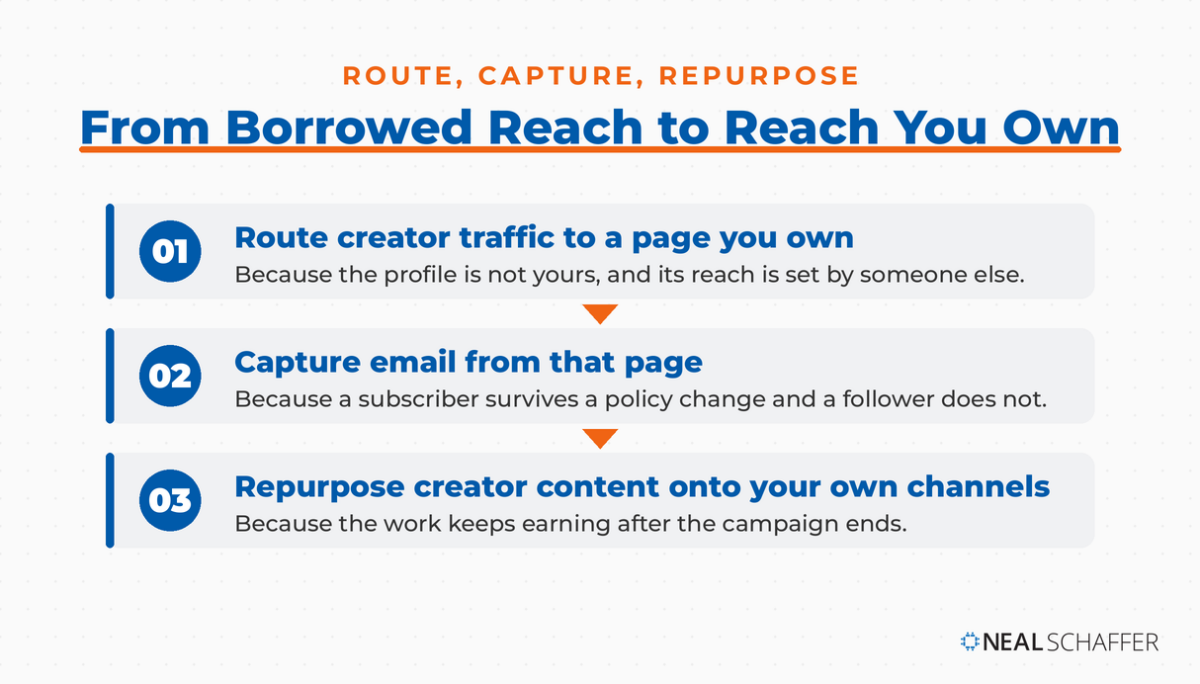
None of that reduces what creators are worth. It just stops a single platform decision from taking your whole distribution with it.
The other force reshaping the supply side is harder to price.
How Is AI Changing the Creator Economy?
AI is lowering production cost faster than it is lowering the cost of trust, and that gap is where the interesting effects sit. More content gets made, by more people, at higher apparent quality. Whether audiences value it the same way is a separate question, and the early evidence says they do not.
Deloitte’s 2026 TMT Predictions put it plainly: generative AI video approaching Hollywood quality is empowering independent creators while raising the odds of a stronger regulatory response against social video platforms. Supply goes up. Scarcity moves somewhere else.
That somewhere else is the part you cannot generate. From what I have seen working with clients and running my own channels, three things are holding their value. Firsthand experience, a named human attached to the work, and a track record an audience can check. Those are exactly what a creator partnership buys you, and exactly what a synthetic alternative does not.
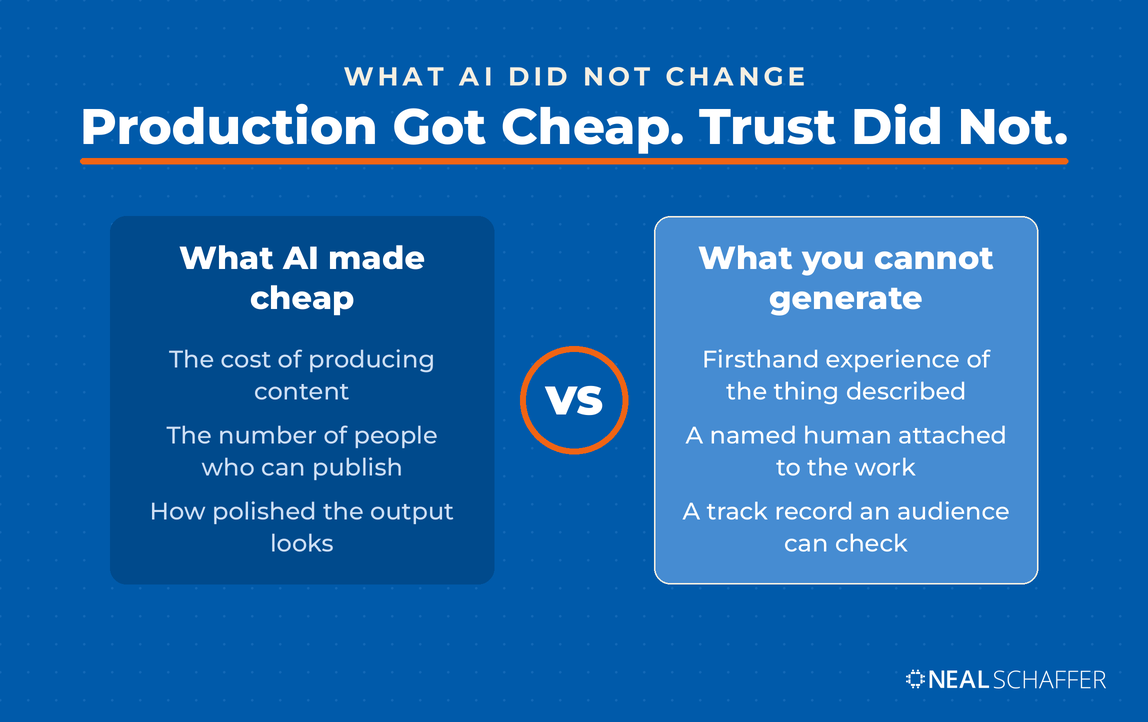
Consumers are already pricing this in. EMARKETER reports that 89% of marketers say they have no plans to partner with virtual influencers, and consumer enthusiasm for AI-generated creator content has fallen sharply since 2023.
Use AI where it belongs, which is production, not persona. I use Adobe Express for most of my own visual work, and I should disclose that I am an Adobe Express ambassador. The tool speeds up the making. It does not manufacture the reason anyone listens.
The case for creators holds. That does not mean it holds for you yet.
Who Should Not Chase Creator Partnerships Yet?
Some brands should leave creator partnerships alone for now. If you cannot measure what happens after a click, or you need results inside a month, creator work will burn through budget and teach you very little in return. It rewards patience and infrastructure, and it punishes the absence of both.
Four situations where I tell clients to wait.
You have no owned destination. If creator traffic lands on a homepage with no offer and no email capture, you are paying to send people to someone else’s platform. Fix the landing page and the capture form first. That is a two-week job, not a quarter.
Your product has an unresolved quality problem. Creators amplify what is already there. Paying someone with a trusting audience to point that audience at a product that disappoints is the most expensive way to accelerate bad word of mouth.
Nobody owns the relationship internally. Creator programs die when they are assigned to whoever has spare hours. If no one is accountable for briefing, approvals, and renewals, you will get one campaign and no program.
You need attribution you cannot yet build. Creator content mostly moves awareness and consideration, which means last-click reporting will make it look like a failure. If your organization only funds what last-click can prove, sort that out before spending here, or the program gets cut in month four regardless of what it did.
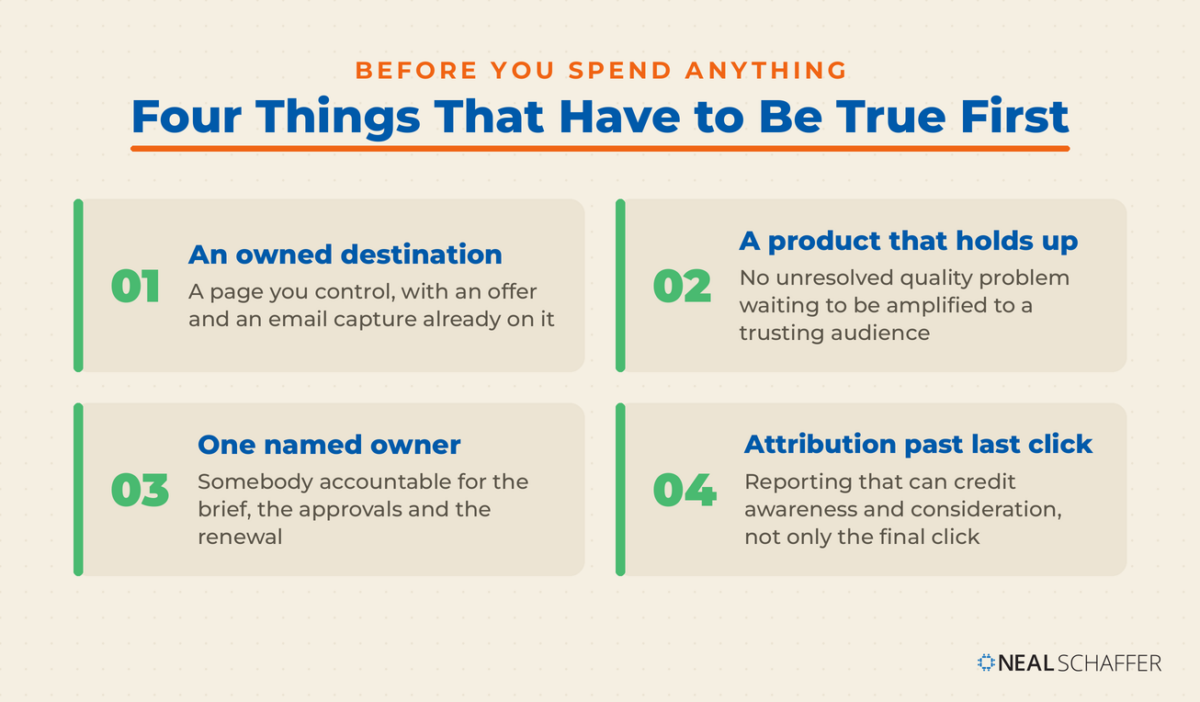
None of that is permanent. It is a sequencing problem, and sequencing problems get solved.
Frequently Asked Questions
No. The creator economy is the whole ecosystem of independent people earning from audiences they built, including podcasters, newsletter writers, and educators who never take a brand deal. Influencer marketing is the commercial layer where brands pay creators for reach and credibility, which is a subset of it. My working definition of the wider practice sits in <a href=”https://nealschaffer.com/what-is-influencer-marketing/”>what is influencer marketing</a>.
Estimates vary enormously because firms count different things. Some include platform payouts, creator software, and agency revenue; others count only money reaching creators. The most-cited projection came from Goldman Sachs Research in 2023, and as noted above it sizes a total addressable market rather than money actually reaching creators.
No, though you do need a repeatable process. Smaller creators often work for product, affiliate commission, or modest flat fees, and their audiences tend to convert better than large ones. The constraint is usually time and coordination rather than money, which is why a defined <a href=”https://nealschaffer.com/influencer-marketing-strategy/”>influencer marketing strategy</a> just might matter more than budget size at the start.
A creator publishes content and builds an audience. An influencer has enough standing with that audience to change what they think or buy. All influencers create; not all creators influence. If you are working out which one your campaign actually needs, start with <a href=”https://nealschaffer.com/what-is-an-influencer/”>what is an influencer</a>.
Put the Creator Economy to Work in Your Next Planning Cycle
The creator economy is not a channel you add to your plan. It is the environment your plan now operates inside, which means the questions worth asking are about distribution, trust, and ownership rather than about which platform to post on next.
Start with one audit. List the three people your customers already listen to in your category, and write down what each one sells besides brand deals.
Next, fix your owned destination before you spend anything, so creator traffic has somewhere to land that you control.
Then run one partnership properly, with a real brief and a renewal conversation built in, rather than five campaigns you never repeat.
If you want the current numbers as you build the case internally, the creator economy statistics are worth bookmarking, and the wider influencer marketing statistics cover the commercial layer specifically. For the thinking behind the partnership model, download a free preview of The Age of Influence. And if you would rather build this alongside your search and email work with help, take a look at my fractional CMO services. The Digital First Mastermind is where a lot of these conversations happen weekly.