
So you’re thinking of entering a new market and expanding your business and hiring in China. Starting a business in a new country is challenging. And one of the most problematic issues is finding and hiring reliable workers.
The question “Where can I find talent?” becomes even more complex when we speak about a new cultural environment. Even the social networks are different, and this overview of the most popular platforms for social media marketing in China is a quick way to learn which ones matter.
The Chinese government sets strict rules for foreign companies employing workers based in China. As per Chinese law, only companies based in China may be employers. So before you start to look for employees in China you need a Chinese license. Let’s say you have a license. What’s next?
Key Takeaways
✅ A company based overseas cannot hire directly into China. As Hawksford explains in its guide to hiring in China, you need a local entity such as a WFOE or a representative office, or a licensed employer of record that signs the contract under its own name.
✅ WeChat is a recruiting channel, not only a marketing one. Employers publish openings to Moments and through public accounts so that friends and industry contacts can refer candidates who have already been vouched for.
✅ LinkedIn no longer operates a service inside mainland China. It ended user-generated content there in 2021 and closed its China-only InCareer app in August 2023, so it now reaches returnees and Chinese professionals based abroad rather than candidates on the mainland.
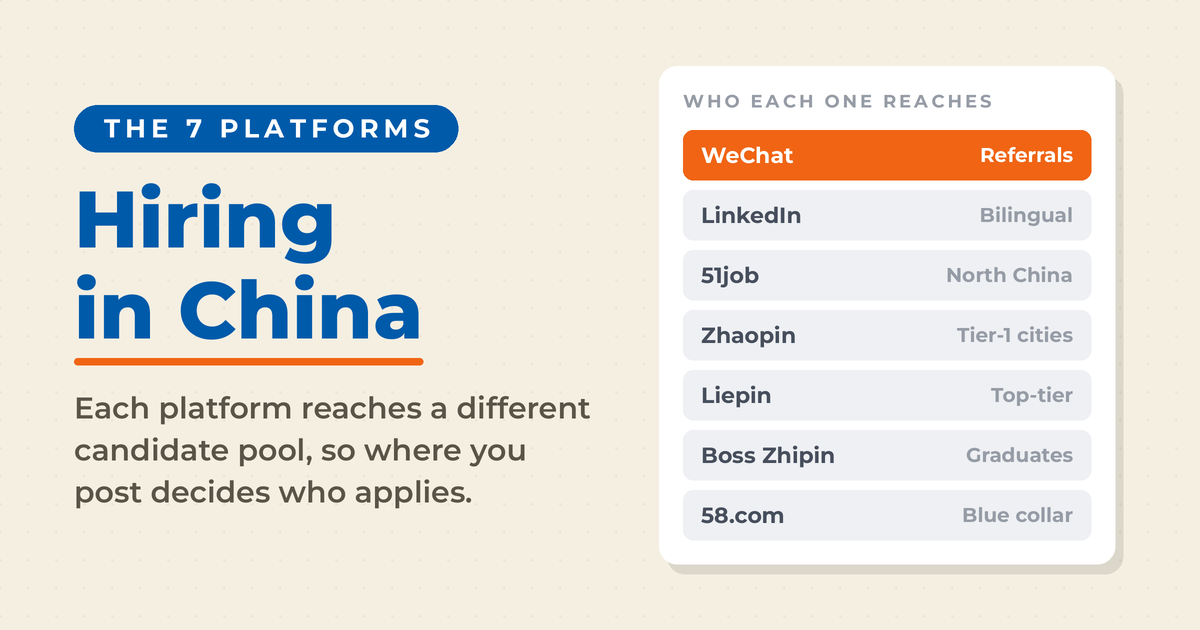
✅ The job boards split by seniority and by region. 51job and Zhaopin cover white-collar and management hiring, Liepin concentrates on senior and executive searches, Boss Zhipin puts candidates straight into chat with the employer, and 58.com carries blue-collar and service roles.
✅ Post in Chinese, and expect your own footprint to be read. Local candidates respond to Chinese-language listings, and the account doing the posting becomes part of the employer brand they research before they apply.
How is hiring in China handled?
Vacant positions are generally advertised via email, through the Service Office (for Chinese national positions), on employment websites and on the Consulate-General website. Selection criteria and job descriptions are provided, a closing date and time for applications are specified. The job advertisement provides a contact person, the salary range and methods for applying.
Recruiting in China can be extremely difficult for foreign companies. Language barriers and cultural differences make recruiting challenging. Thus, as a foreigner recruiting in China, it’s necessary to do your best to adapt to the recruiting habits of Chinese recruiters. If you want to get luck on your side and attract the best talent you’ll adapt to Chinese recruiting standards. The majority of Chinese companies mainly recruit through personal networks and social network sites. However, it can be challenging to recruit through personal networks if you cannot speak Chinese. And if you’ve just entered the market and have no local networks yet.
Smartphones are revolutionizing almost all industries and taking on another bastion of tradition, the job sector. Young people in China, especially those who were born in the 1980s and 1990s grew up with electronic gadgets. They watch TV shows, shop, and now land a job on their phones. Which app they are holding matters, because the audience you are recruiting from is spread across a far wider set of Chinese social media apps than most foreign employers expect.
Therefore turning to social networks and other methods may be the better option. However, be aware that when a company wants to hire in China through Chinese platforms, it is better to communicate in Chinese with local candidates. Employer brand matters here as much as the job post itself, and paid reach is one way to build it, which is what my guide to Weibo advertising covers: how Fan Tunnel and Fan Headline placements put a company account in front of a Chinese audience that has never heard of it.
WeChat (微信)

WeChat is not just a place for people to view friends’ colorful travel photos. Many headhunters and HR managers at hiring companies hope to get introduced to talented and reliable candidates via their connections in the industry. Brands use the same accounts for marketing, and these WeChat campaigns from Givenchy, Montblanc and DAMAC show what that looks like.
Instead of posting on careers sites or turning to head hunters, more and more employers either advertise job opportunities on News Feeds, posts only seen by friends, or launch public accounts designed to publish recruiting announcements.
By doing so, business people can make the maximum use of connections formed by friends on WeChat. Friends can recommend candidates after seeing the job posts on News Feeds.
Job seekers also like this way too. Tech-savvy college graduates opt to subscribe to prospective employers’ WeChat public accounts and wait for updates.
As far as you started to hire or look for a job via WeChat be careful about what you’re posting. Now it’s part of your brand, no matter personal or corporate. Your friends, language and habits will form a 3D resume that employers can check any time. This includes things you’ve posted in the past. Running a social media audit on your own accounts before you start recruiting is the fastest way to find out what that resume currently says about you.
It’s also the history of your company, which any potential employee will check before they apply. Once someone is hired, the line between personal and work accounts matters too, and this employment lawyer’s case for not friending co-workers on social media explains the risks.
LinkedIn (领英)
No, it is not a Chinese platform, and it no longer runs a Chinese one either. LinkedIn ended user-generated content and member-to-member interaction in mainland China in October 2021, then closed InCareer, its China-only jobs app, on August 9, 2023. Any user count you find for LinkedIn in China predates that exit, so treat the platform as a route to Chinese talent rather than as a mainland job board.
What it still reaches is the Chinese talent pool outside the mainland: overseas graduates and returnees, plus professionals at multinationals who kept their profiles. If you are looking for candidates with good English and an understanding of the international market, that is the pool worth working. For hiring inside the mainland, the domestic platforms below are where the candidates are.
Before you start to use LinkedIn to hire make sure that your profile contains all the keywords that would allow you to feature prominently in a search by someone who didn’t know your name or company name and is looking to find a China-based position. Pepper your summary with the keywords that will help recruiters and job seekers to find you. Use the free trial at WordTracker to browse suggestions. The About section gives you 2,600 characters, so spend them on the keywords that represent your brand and area of expertise while keeping the writing readable. These LinkedIn summary examples show what a summary that does both jobs looks like.
51job (前程无忧)
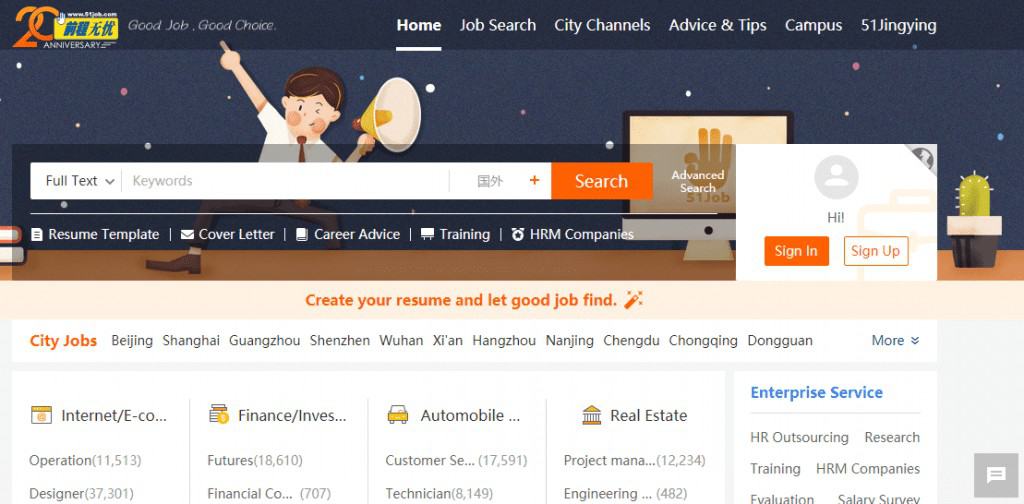
51job’s online recruitment platforms and mobile applications connect job seekers with employers across mainland China every day. The company was taken private in May 2022 in a deal valued at around $4.3 billion, led by DCP Capital, Ocean Link and CEO Rick Yan, and it does not publicly report current member or resume figures. 51job also provides a number of other value-added HR services, including business process outsourcing, training, professional assessment, executive search, and compensation analysis.
It’s a leading provider of integrated human resource services in China. Especially in North Mainland China. Founded in 1998, 51job meets the needs of enterprises and job seekers through the entire talent management cycle, from initial recruitment to employee retention and career development. The main target is white-collar workers, middle and senior management positions.
Leveraging technology and expertise with a large staff of experienced professionals, 51job serves hundreds of thousands of domestic and multinational corporate clients with 25 offices on Mainland China.
Zhaopin (招聘)
Zhaopin is not as big as 51job but it also covers a wide range of industries all over China. It provides jobs offers to about 100 million white-collar workers, mostly in East China and 1 or 2-tier cities.
Make LinkedIn Your Best Source of Clients
My latest book helps professionals, entrepreneurs, and business owners turn LinkedIn from a static profile into a real source of clients and growth.
Maximizing LinkedIn for Business Growth gives you clear, practical steps to build a profile that gets noticed and a network that actually sends business your way.
Grab your copy on Amazon and put it to work this week. Click the cover or the button below to get started.

Started as a headhunting firm in 1994, Zhaopin has been one of China’s top job hunting sites. It allows job hunters to create an account, upload their resume and search job by category, location, and other conditions. The site also recommends jobs to subscribers via email.
The main advantage of this platform is the opportunity to find highly qualified workers in big and busy cities as Shanghai or Beijing.
Liepin (猎聘)

Liepin, popular in the South of China is the largest and most professional community-based recruitment site. It focuses on providing recruiting services for top-tier talent only. Unlike other online recruitment services, Liepin has stayed away from an advertising and information distribution service model. Instead, it focuses on providing paid and offline services to customers.
Liepin was launched in 2011 and by now is constantly growing in users and popularity.
Its customers include headhunters, professionals seeking employment, and organizations. It offers its services to headhunters free of cost as it believes that the headhunters help accelerate the collection of user data and attract more opportunities. It charges a fee to professional members and organizations.
Organizations are able to post jobs, download resumes, and reach out to potential employees. Jobseekers are able to send resumes and get contacts information for enterprises or headhunters and apply for job openings.
Boss直聘
Boss ZhiPin markets itself as a platform where job seekers can chat directly with employers. It’s the main difference and feature of the platform and it’s why most graduates love it most.
The candidate can skip resume application, round A interviews, round B interviews, and chat directly with the boss online to improve the efficiency of job-hunting. So freshmen without a good resume, experience, and personal brand have an opportunity to get attention from potential employers.
Boss ZhiPin is a leading app-based recruitment platform in China, and its parent company reports the numbers every quarter. Kanzhun reported average monthly active users of 70.2 million for the second quarter of 2026, the first quarter in which the app passed 70 million, alongside 7.2 million paid enterprise customers over the preceding twelve months. Those monthly actives are verified accounts on both sides of the market, job seekers and employers counted together.
It aims to put both employers and job applicants on a fast recruitment track. It enabling applicants to have one-on-one chats with company representatives that wish to hire people, which will shorten the recruitment process.
58同城

This platform differs from all previous by its targets and goals.
58 contains local information for approximately 480 cities across lots of content categories, including jobs, real estate, used goods, automotive and yellow pages. Users can browse and search for free for local information. Both consumers and merchants can also post content for free.
Jobs covers a range of job categories, such as salespeople, skilled workers, food and beverage staff, delivery staff, and homecare and cleaning staff. Its 58 and Ganji platforms include blue-collar job listings and resumes. Employers can search and review resumes on its database. In addition, this content category contains other tools that help employers manage, organize and streamline the recruitment and hiring process.
Unfortunately, this platform has no regulatory system and it could be hard to distinguish what is true and false.
Frequently Asked Questions About Hiring in China
Not directly. A company based overseas needs a Chinese entity such as a WFOE or a representative office, or it can work through a licensed employer of record that becomes the legal employer on paper while the client company still directs the work.
It depends on the role. 51job and Zhaopin suit white-collar and management hiring, Liepin is built for senior and executive searches, Boss Zhipin is popular with recent graduates because it opens a direct chat with the employer, and WeChat works best when a referral matters more than reach.
For local candidates, yes. A Chinese-language listing reaches people that an English-only post never will, and it signals that the company can actually work with a Chinese-speaking team. Bilingual roles aimed at returnees are the exception, where LinkedIn and an English listing tend to do better.
Both. Employers publish openings to Moments and through public accounts, and the referral chain that follows is what makes it work, since a candidate arrives already recommended by someone in the network rather than as a cold application.
Where to Start With Hiring in China
Finding and hiring people never was an easy task, and it gets harder when a foreign company is hiring Chinese employees. Settle the legal structure first, because nothing else matters until there is an entity or a licensed employer of record that can sign the contract. Then pick two channels instead of six: one job board matched to the seniority of the role, and WeChat for the referral traffic a board will never give you. Post in Chinese, and clean up the accounts a candidate will look at before they apply.
The part foreign employers underestimate is how much of this is marketing work. A job post is an ad, a company account is a channel, and the impression a candidate forms before applying is employer brand. Neal Schaffer’s free preview of Digital Threads lays out how the pieces of a digital presence connect, and his guide to building a social media strategy covers the presence a candidate will check. Get that right and the platforms above stop being job boards and start being a pipeline.