
Facebook Groups represent one of the most powerful community-building tools available to marketers, businesses, and organizations today. With almost 1.8 billion people using Facebook Groups every month, they offer unprecedented opportunities to connect with audiences around shared interests.
But creating a group is just the beginning. The real challenge lies in attracting the right members and fostering meaningful engagement. Facebook Ads provide a strategic solution to this challenge.
This guide walks through exactly how I approach paid promotion for a group: what Facebook will and will not let you do, what a member realistically costs, how to target, and how to tell whether the members you bought are worth having.
Key Takeaways
✅ Almost 1.8 billion people use Facebook Groups every month, across 25 million monthly active public groups, which is where community attention on Facebook actually sits.
✅ There is no “join my group” ad objective. You promote a group with traffic or engagement campaigns, and Facebook will not pixel a visit to the group itself, so the funnel has to be built around your website and your Page.
✅ Traffic campaigns average $0.70 per click, per WordStream’s Facebook ads benchmarks, which is the number to build your cost-per-member math on before you set a budget.
✅ Fix the group before you fund the ad. Description, rules, pinned welcome post, and seeded content decide whether a click becomes a member, and no targeting fixes an empty group.
✅ Narrow targeting beats broad reach. Stacked interests, custom and lookalike audiences built from your email list and Page engagers, and a tight geographic net produce members who post.
✅ Cost per member is the wrong finish line. Track what percentage of new members contribute something in their first week, because that is the only number that tells you whether the ad found the right people.
Understanding the Power of Facebook Groups
Facebook Groups matter tremendously. They create spaces where people connect around shared interests, challenges, or goals. These communities have become central to the Facebook experience for billions of users worldwide.
The numbers tell a compelling story. There are 25 million monthly active public groups on Facebook, creating endless opportunities for community building across virtually every niche imaginable.
What makes groups so valuable for businesses and organizations? Groups foster deeper connections than traditional pages. They create two-way conversations rather than one-way broadcasts. Members engage directly with each other, not just with your brand.
Groups offer several key benefits for organizations:
- Direct audience access – Communicate directly with your most engaged followers
- Algorithm advantages – Group content often receives higher visibility in feeds
- Community building – Foster relationships among members, not just with your brand
- Market research – Gain insights through discussions and member feedback
- Lead generation – Nurture prospects in a value-focused environment
As Facebook has evolved its platform priorities, Groups have moved to center stage. The company has consistently emphasized community building, making Groups a key focus area for both users and organizations.
Why Promote Your Facebook Group with Ads?
Organic growth has limits. Even the most compelling Facebook Groups face visibility challenges in today’s crowded digital environment. Facebook’s algorithm prioritizes certain content types, and without promotion, your group may remain hidden from ideal potential members.
Paid promotion solves this discoverability problem. Facebook Ads allow you to place your group directly in front of your target audience, dramatically increasing visibility and membership growth potential.
The reach is the whole argument for paying. Meta’s own ad planning tools now report that Facebook ads can reach 2.39 billion people worldwide, which is the largest addressable audience of any social platform except YouTube. One caution worth carrying into your budget: that is a planning estimate of reachable accounts, not a count of active humans, so treat it as the ceiling on your targeting, never as a promise of who will actually see your group.
Performance metrics back this up. Facebook lead-generation ads average a 2.59% click-through rate and traffic campaigns average 1.71%, per WordStream’s analysis of more than 1,000 campaigns. Traffic campaign click-through improved year over year, which matters because traffic is the objective you will use most for group promotion.
Let’s examine some key Facebook advertising performance metrics that demonstrate why ads are worth considering for your group promotion efforts:
| Metric | Performance | Relevance to Group Promotion |
|---|---|---|
| Average CTR (Traffic Campaigns) | 1.71% | Indicates how often users click through to view your group |
| Average CTR (Lead Generation) | 2.59% | Relevant for collecting information before group joins |
| Average Cost Per Click | $0.70 (Traffic), $1.92 (Lead-gen) | Helps budget for member acquisition costs |
| Average Conversion Rate | 7.72% (lead-gen campaigns) | Percentage of ad viewers who take desired actions |
These statistics demonstrate why ads represent a valuable investment for group growth. With proper targeting and creative execution, your cost per new member can be quite reasonable.
The quality of members matters more than quantity. Ads help you reach people who truly align with your group’s purpose. This targeting precision leads to higher engagement rates, more meaningful discussions, and stronger community development over time.
I believe the most valuable aspect of Facebook Ads for group promotion is the ability to find exactly the right people. When members join who genuinely care about your topic, the entire community benefits from their contributions.
Setting Up Your Facebook Group for Ad Success
Before spending a single dollar on ads, optimize your group. First impressions matter tremendously. When potential members click your ad and visit your group, they quickly decide whether to join based on what they see.
Your group description needs clarity. Write a concise, compelling explanation of who the group serves and what value members receive. Focus on benefits rather than features, answering the critical question: “What will I gain by joining this group?”
Set clear expectations about posting frequency, content types, and community guidelines. This transparency helps attract members who appreciate your approach while filtering out those seeking something different.
The LinkedIn Playbook for Real Business Growth
My latest book helps professionals, entrepreneurs, and business owners turn LinkedIn from a static profile into a real source of clients and growth.
Maximizing LinkedIn for Business Growth gives you clear, practical steps to build a profile that gets noticed and a network that actually sends business your way.
Grab your copy on Amazon and put it to work this week. Click the cover or the button below to get started.

Consider these essential group optimization steps before advertising:
- Create a memorable cover image that visually communicates your group’s purpose
- Write a detailed “About” section explaining who should join and why
- Establish clear group rules to set behavioral expectations
- Pre-populate with valuable content so new members see immediate value
- Add relevant tags to improve organic discoverability alongside your ad efforts
The welcome experience deserves special attention. Set up automated welcome messages that guide new members on how to introduce themselves and start participating. Consider creating pinned posts with frequently asked questions or getting-started information.
Remember that member retention begins with this initial experience. A thoughtfully designed group that clearly delivers on its promised value will convert more ad clicks into long-term, engaged members.
Types of Facebook Ads for Group Promotion
Facebook offers several ad formats, each with unique advantages for group promotion. Understanding when to use each type helps maximize your advertising effectiveness and budget efficiency.
Let’s compare the main ad formats you can use to promote your Facebook Group:
| Ad Format | Best For | Key Advantages | Limitations |
|---|---|---|---|
| Image Ads | Simple, direct group promotion | Easy to create, cost-effective | Limited space to showcase group benefits |
| Video Ads | Demonstrating group activity and value | Higher engagement, shows community in action | Requires more production effort |
| Carousel Ads | Highlighting multiple group benefits | Can show different aspects of your community | More complex to create effectively |
| Collection Ads | Showcasing various group content types | Creates immersive mobile experience | Works best with visual-heavy groups |
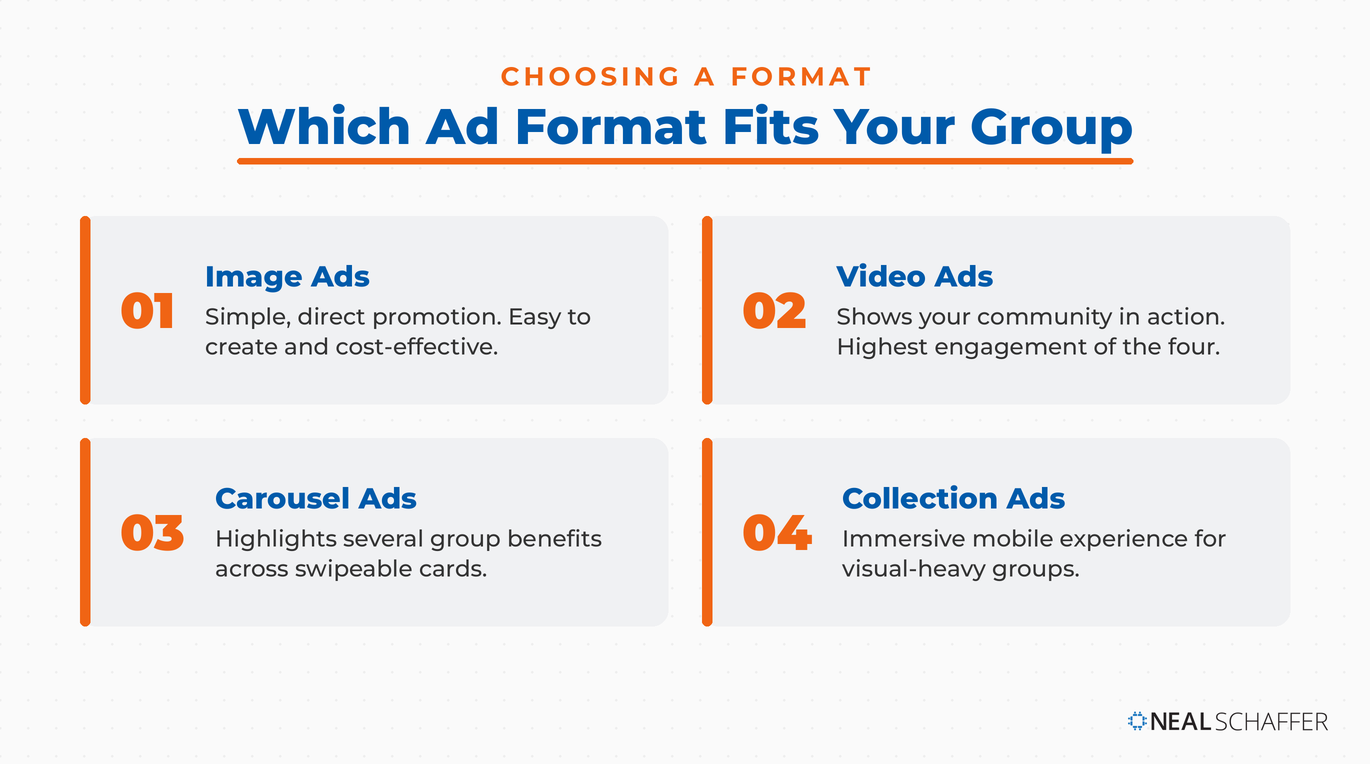
This comparison helps guide your format selection based on your specific group promotion goals. Now, let’s explore each format in more detail.
Image Ads for Group Promotion
Image ads offer simplicity and directness. A single compelling visual paired with persuasive copy can effectively communicate your group’s core value proposition. These ads work well when you have a clear, straightforward message about your group’s purpose.
When creating image ads, select visuals that represent your community authentically. Images showing real group interactions or benefits perform better than generic stock photos. People want to see what they’re actually joining.
The copy accompanying your image should answer three key questions: who the group is for, what members will gain, and why they should join now. Create a sense of belonging by using “you” and “your” language that speaks directly to your ideal members.
Video Ads for Group Promotion
Video content dominates Facebook engagement. The platform reports that video now represents 60% of time spent on Facebook, with Reels driving significant growth in video consumption.
This engagement makes video ads particularly effective for group promotion. Video allows you to showcase your community in action, demonstrate the discussions taking place, and highlight member success stories or testimonials.
Keep videos brief and focused. The first few seconds must capture attention immediately. Consider these approaches for group promotion videos:
- Tour your group’s key features and benefits
- Share testimonials from current members
- Showcase examples of valuable discussions
- Explain how the group has helped members achieve goals
- Present a problem your group helps solve
Mobile optimization is crucial since most users will view your video on smartphones. Use captions or text overlays, as many viewers watch with sound off.
Carousel Ads for Showcasing Group Benefits
Carousel ads allow you to display multiple images or videos in a single ad unit. This format works exceptionally well for group promotion because you can showcase different aspects of your community.
Each card in your carousel should highlight a specific benefit or feature of your group. For example:
- Card 1: Introduce the group’s purpose
- Card 2: Showcase example discussions
- Card 3: Highlight exclusive resources
- Card 4: Feature member testimonials
- Card 5: Include a strong call-to-action to join
The sequential nature of carousel ads creates a narrative about your group’s value. Users who take the time to swipe through multiple cards demonstrate higher interest levels, often leading to more committed members.
Targeting Strategies for Facebook Group Ads
Effective targeting makes or breaks your group promotion efforts. Facebook’s robust targeting capabilities allow you to reach precisely the right potential members based on demographics, interests, behaviors, and connections.
The key principle is specificity. Resist the temptation to target too broadly. Smaller, more focused audiences typically yield better results for group promotion because the relevance to potential members is higher.
Let’s explore the most effective targeting approaches for group ads:
Interest-Based Targeting
Interest targeting helps you reach people passionate about your group’s topic. Facebook analyzes user behavior to determine interests, creating powerful targeting opportunities.
When selecting interests, start with those most directly relevant to your group’s purpose. Then consider expanding to complementary interests that your ideal members might have.
For example, if running a digital marketing group, you might target:
- Primary interests: Digital marketing, social media marketing, content marketing
- Complementary interests: Business entrepreneurship, small business ownership, online business
Combine multiple interests to refine your audience further. The intersection of several relevant interests often identifies people most likely to become active group members.
Avoid overly broad interest categories. Terms like “business” or “health” cast too wide a net. Instead, target specific niches within these broader categories for better relevance.
Custom and Lookalike Audiences
Custom audiences represent Facebook’s most powerful targeting tool for group promotion. They allow you to reach people already connected to your brand in some way.
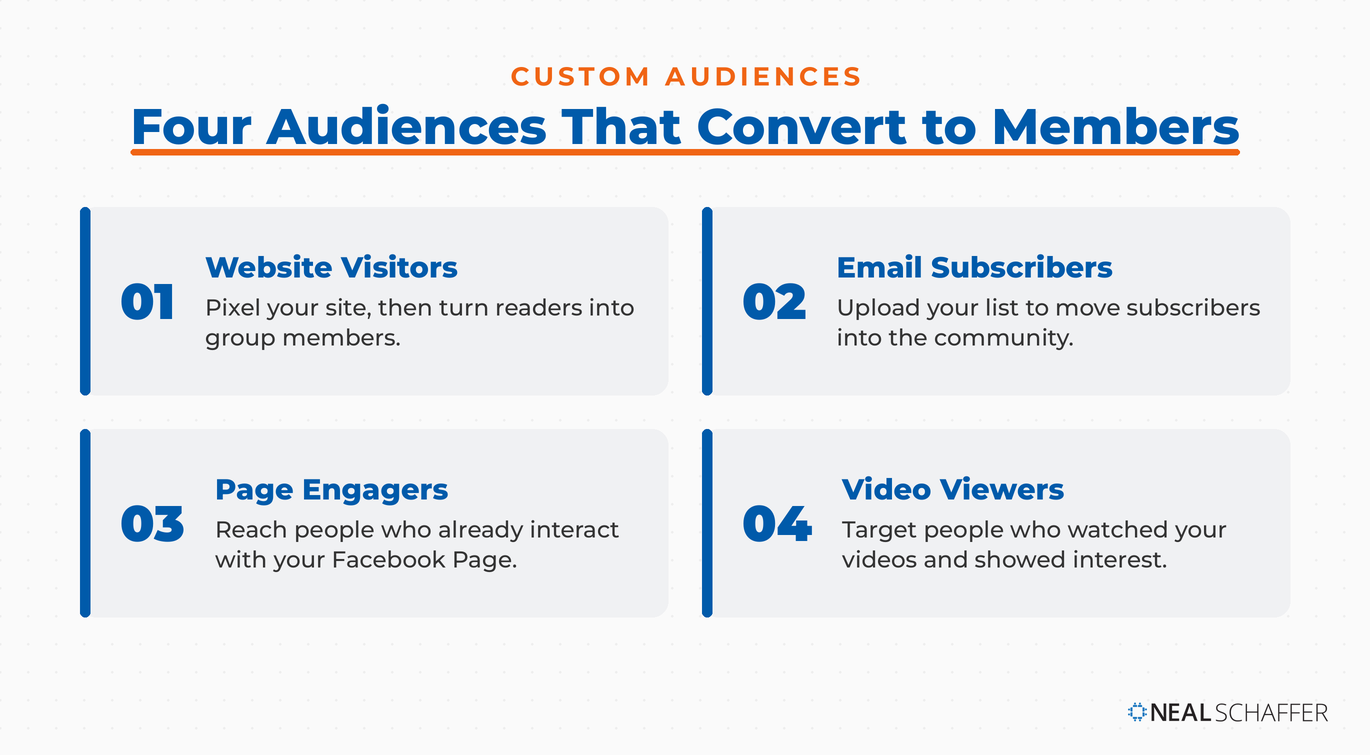
Here’s how to create effective custom audiences for group ads:
| Custom Audience Type | How to Create | Best Use Case |
|---|---|---|
| Website Visitors | Install Facebook pixel and create audience of recent site visitors | Converting website readers into group members |
| Email Subscribers | Upload your email list to Facebook | Moving subscribers into your community |
| Page Engagers | Target people who’ve interacted with your Facebook Page | Converting casual followers into group members |
| Video Viewers | Target people who’ve watched your videos | Engaging with already interested audiences |
Lookalike audiences extend your reach beyond known contacts. Facebook finds users who share characteristics with your custom audience, essentially saying, “Find more people like these.”
For group promotion, create lookalike audiences based on:
- Your current most active group members
- Email subscribers who open and click frequently
- Website visitors who spend significant time on your content
These lookalike audiences often produce the highest-quality new group members because they mirror the characteristics of people already engaged with your content.
Campaign Setup and Budget Management
Setting up effective campaigns requires careful planning. To develop a comprehensive Facebook ads strategy, start by defining clear goals for your group promotion.
When creating your campaign, select the appropriate objective. For group promotion, these objectives typically work best:
- Traffic: When driving people to view your group before joining
- Engagement: When focusing on group joins directly
- Conversions: When you have a multi-step process before group membership
Budget allocation requires strategic thinking. What it costs to advertise on Facebook depends on your targeting and your competition, but the platform averages give you a floor to plan against: $0.70 per click on traffic campaigns and $1.92 on lead-generation campaigns. Multiply that click cost by the number of visitors it takes to produce one join, and you have a defensible cost per member before you spend anything.
Start with a test budget before scaling up. This approach allows you to gather data on which audiences and creative executions perform best before committing larger resources.
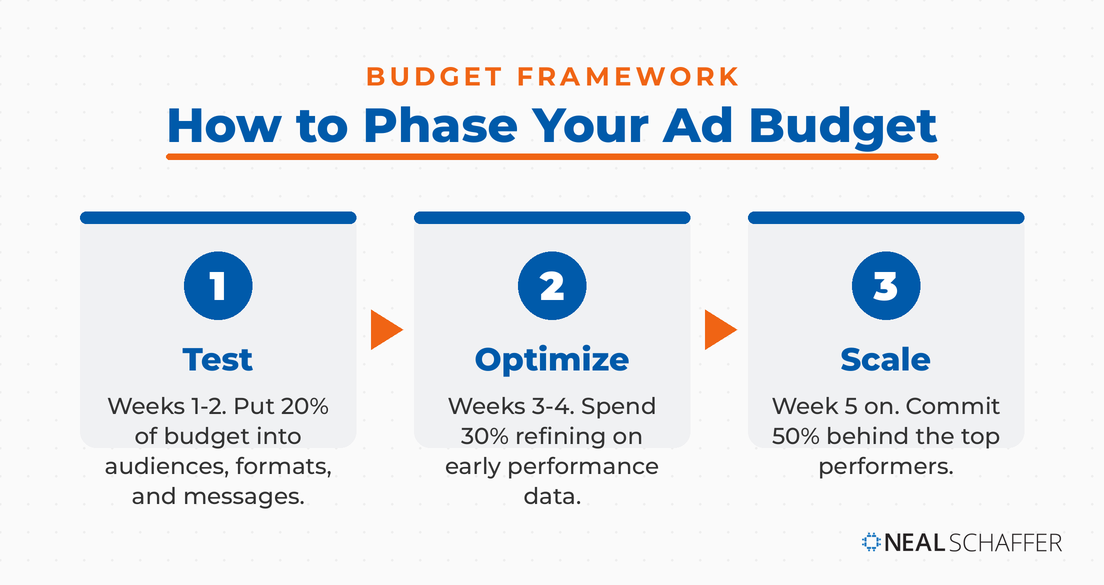
Consider this budget allocation framework for group promotion:
| Campaign Phase | Budget Allocation | Primary Focus |
|---|---|---|
| Testing (Week 1-2) | 20% of total budget | Testing audiences, ad formats, and messages |
| Optimization (Week 3-4) | 30% of total budget | Refining based on initial performance data |
| Scaling (Week 5+) | 50% of total budget | Increasing spend on top-performing combinations |
This phased approach maximizes efficiency by ensuring you invest most heavily in what works best for your specific group.
For bidding strategy, start with Facebook’s automated bidding options while learning. As you gather more data, you can experiment with manual bidding to control costs more precisely.
Creating Compelling Ad Content for Groups
The creative elements of your ads directly influence performance. With over 3 billion monthly active users on Facebook, the potential reach for group promotion is massive, but you need compelling content to capture attention.
Effective Headlines and Copy
Your headline must instantly communicate value. Focus on the specific benefit members receive from joining your group. Questions often perform well because they engage the reader’s curiosity.
Ad copy should be concise yet persuasive. Address potential objections, highlight exclusive benefits, and create a sense of community. Use a conversational tone that matches how your group members actually talk.
Call-to-action selection significantly impacts results. Research shows that changing the CTA from “Sign Up” to “Learn More” increased CTR by 22.5%, while the “Sign Up” CTA produced a 14.5% higher conversion rate, demonstrating the importance of testing different options.
Essential elements of effective group ad copy include:
- Clear value proposition – What specific benefit do members receive?
- Social proof – Mention member count or engagement statistics
- Exclusivity – What makes this group special or unique?
- Urgency driver – Why join now rather than later?
- Objection handling – Address common concerns (time commitment, privacy, etc.)
Personalization improves performance. Reference the specific interests or challenges of your target audience in your copy. This relevance signals that your group directly addresses their needs.
Visual Elements That Drive Group Joins
Visuals create the first impression of your group. Select images or video thumbnails that clearly represent your community’s purpose and energy.
Consider these visual approaches for group promotion:
- Show real group discussions (with permission)
- Feature happy, engaged members (avoid obvious stock photos)
- Showcase valuable content shared within the group
- Use text overlays to highlight key benefits
- Include your branding for recognition
Color psychology matters in ad visuals. Blues and greens convey trust and growth, while reds and oranges create urgency and excitement. Choose colors that align with your group’s purpose and the emotions you want to evoke.
Mobile optimization remains essential. Test how your visuals appear in mobile news feeds, where most users will encounter them. Ensure text remains readable and key elements visible at smaller sizes.
Measuring and Optimizing Group Ad Performance
Performance measurement enables continuous improvement. Facebook’s ad platform provides robust analytics to track how effectively your group promotion campaigns perform.
Key metrics to monitor include:
| Metric | What It Measures | Target Benchmark |
|---|---|---|
| Click-Through Rate (CTR) | Percentage of people who click after seeing your ad | Above 1.71% (platform average) |
| Cost Per Click (CPC) | Average cost for each click on your ad | Below $0.70 for traffic campaigns |
| Conversion Rate | Percentage of clickers who join your group | Above 7.72% (platform average) |
| Cost Per Group Join | Total ad spend divided by new members | Varies by niche (set your own target) |
Beyond these acquisition metrics, track post-join behaviors. How many new members become active participants? What percentage contributes content within their first week? These engagement metrics reveal the true quality of members your ads attract.
Optimization requires systematic testing. Creating engaging posts for your Facebook group starts with understanding your audience’s needs. Test different:
- Ad formats (image vs. video vs. carousel)
- Headlines and copy approaches
- Call-to-action buttons
- Targeting parameters
- Posting times and frequency
A/B testing provides data-driven insights. Test one variable at a time while keeping others constant. This methodical approach identifies exactly which elements drive performance improvements.
Use Facebook’s Campaign Budget Optimization (CBO) feature to automatically allocate more budget to better-performing ad sets. This automation helps maximize results without requiring constant manual adjustments.
Advanced Facebook Group Ad Strategies
Once you master the basics, these advanced strategies can further enhance your group promotion efforts:
Building Audiences for Group Growth
Since Facebook Groups don’t support pixel tracking, focus on building audiences through other touchpoints. Create custom audiences of people who:
- Clicked on previous group promotion ads (tracked through ad engagement)
- Visited your website pages related to the group topic
- Engaged with your Facebook page posts about the group
- Interacted with your content on other platforms where you can track engagement
These engaged audiences, while not directly tied to group viewing behavior, represent people who’ve shown interest in your group’s topic and are more likely to join than completely cold audiences.
Multi-Stage Funnel Approaches
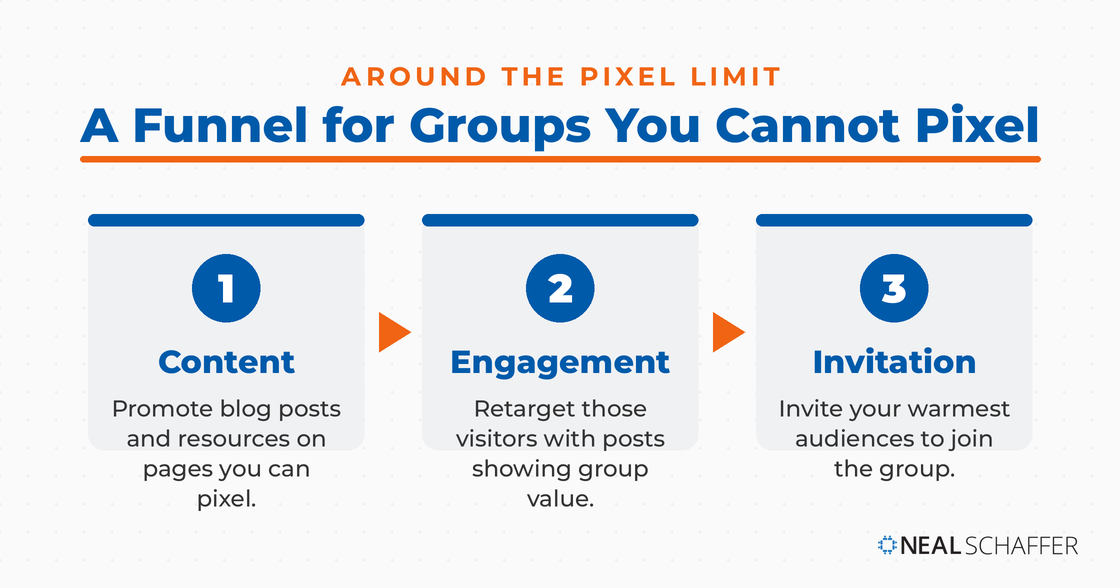
Since you can’t track group visits directly, build awareness and trust through content before promoting membership:
- Content Campaign: Promote valuable blog posts, videos, or resources related to your group’s topic on your website (where you can pixel visitors)
- Engagement Campaign: Retarget website visitors and content engagers with Facebook posts showcasing group discussions, member success stories, or exclusive content previews
- Direct Invitation Campaign: Target your most engaged audiences with clear group joining invitations, emphasizing the community benefits and exclusive access
This approach builds familiarity with your brand and topic expertise before asking for the commitment to join your group, working around Facebook’s group tracking limitations while still nurturing interested prospects.
Integration with Other Marketing Efforts
Your group promotion ads should integrate with your broader marketing ecosystem. Consider these connection points:
- Email marketing: Promote your group to subscribers
- Blog content: Create posts that naturally lead readers toward group membership
- Events: Invite webinar or event attendees to continue conversations in your group
- Customer journey: Position your group strategically within your overall customer experience
This integrated approach ensures consistent messaging across channels and leverages existing audience relationships.
Common Mistakes to Avoid with Facebook Group Ads
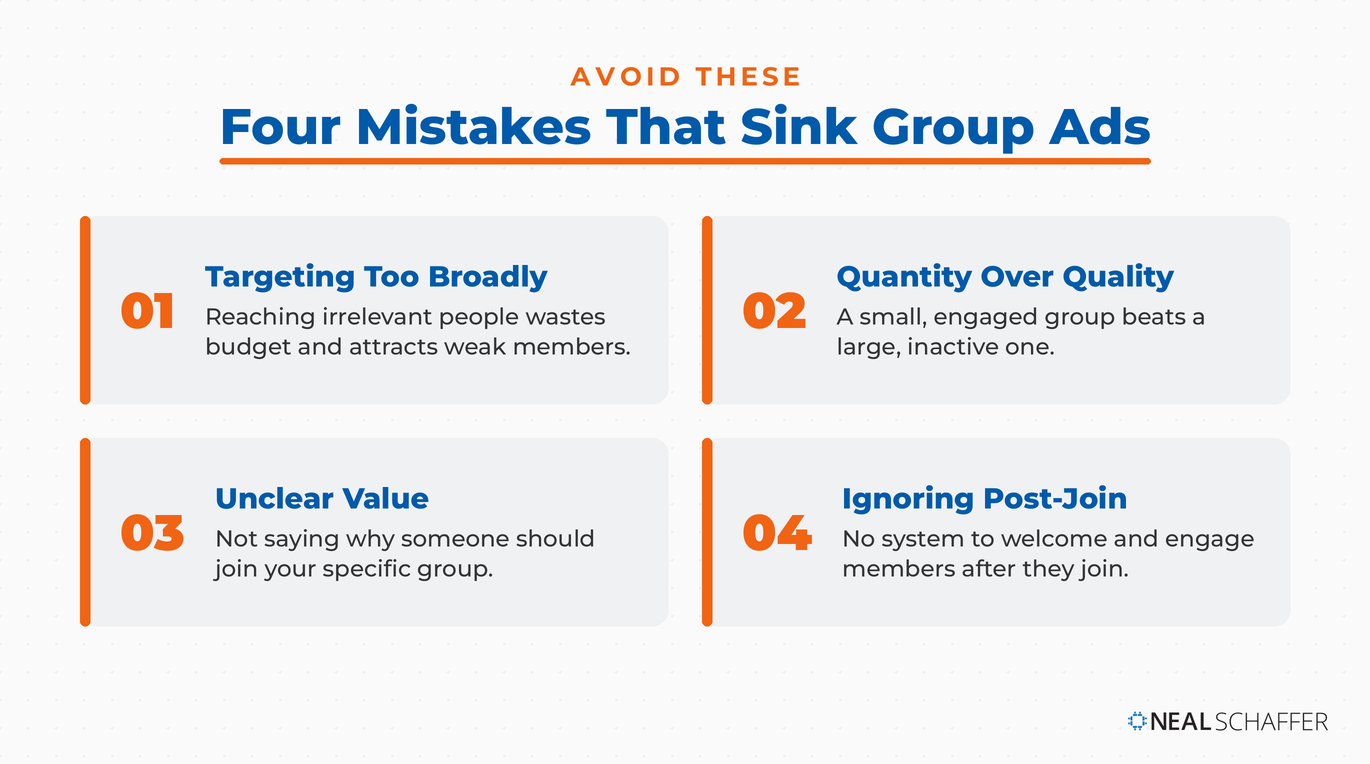
Even experienced marketers make these common errors when promoting groups:
- Targeting too broadly – Reaching irrelevant audiences wastes budget and attracts low-quality members
- Focusing on quantity over quality – A smaller, engaged group outperforms a large, inactive one
- Unclear value proposition – Failing to articulate why someone should join your specific group
- Neglecting the post-join experience – Not having systems to welcome and engage new members
- Inconsistent group management – Promoting a group that doesn’t deliver on its promises
Avoiding these pitfalls improves both ad performance and long-term group success. Remember that your ads create expectations that your actual group experience must fulfill.
Frequently Asked Questions
Not as a dedicated objective. Facebook has no “group joins” campaign type, so you point a traffic or engagement campaign at the group’s URL and let people take the last step themselves. That also means the group page cannot be pixeled, so every measurement workaround in this guide exists because of that limitation.
Budget from the traffic-campaign averages: about $0.70 per click, with lead-generation campaigns closer to $1.92. Your real cost per member is that click cost divided by the share of visitors who actually join, which is why the group’s description and pinned content matter as much as the ad. See my breakdown of Facebook ads cost for how the numbers move by industry.
Traffic is the default when the group page itself does the selling, and engagement works when you want conversation on the ad before the click. Conversions only makes sense when you route people through a landing page you control first, because that is the only step you can measure.
No. Boosting a post amplifies one piece of content with limited targeting controls, while a proper campaign in Ads Manager lets you build the audience, test creative, and control placement. Boosting can seed awareness cheaply, but it is a poor tool for sustained member acquisition.
Look past cost per join. Measure how many new members post, comment, or answer a welcome prompt in their first seven days, and compare that rate between audiences. An audience that costs more per member and produces active members is the cheaper audience.
Yes. Ads run from a Page, and the Page is also where you build the engagement custom audiences that make group targeting work. If you have not created a group linked to your Page yet, do that first.
Next Steps
Facebook Ads provide powerful tools for growing and engaging your group community. The strategic approaches outlined in this guide help you attract the right members efficiently while maximizing your advertising investment.
Facebook lead-generation campaigns convert at 7.72% on average across industries, down from the prior year but still strong for paid media, which tells you the clicks are convertible if the destination earns them. For a group, that destination is your About section and your pinned post.
To implement these strategies effectively, follow these steps:
- Audit your current group – Ensure it’s optimized for new members
- Define your ideal member profile – Create detailed targeting parameters
- Create compelling ad creative – Develop messages that highlight unique value
- Set up proper tracking – Ensure you can measure true performance
- Start small and scale gradually – Test and optimize before major investment
Remember that successful group promotion combines effective advertising with excellent community management. The ads bring people in, but the actual group experience determines whether they stay and engage.
I believe the most valuable groups create genuine connection and provide consistent value to members. When your advertising accurately represents this value, you create a virtuous cycle of growth and engagement that benefits everyone involved.