
Here’s something most marketers get wrong: they treat copywriting and content writing like they’re the same thing. They’re not. And that confusion costs businesses real money.
I’ve spent over 15 years working in digital marketing, serving as a Fractional CMO for companies across industries. I’ve written six books on marketing, taught at UCLA Extension and Rutgers Business School, and consult with both Fortune 500 brands and scrappy startups. One pattern I see constantly? Businesses blurring the line between these two disciplines, then wondering why their content isn’t converting or their copy isn’t building loyalty.
So let me break this down for you the way I wish someone had explained it to me early in my career.
Key Takeaways
✅ Copywriting persuades readers to take immediate action (buy, subscribe, click), while content writing educates and builds long-term trust and authority.
✅ Content marketing generates 3x more leads than outbound marketing and costs 62% less, making both disciplines essential investments.
✅ Personalized calls-to-action convert 202% better than generic ones, proving copywriting’s direct impact on revenue.
✅ Most businesses need both: content writing attracts and nurtures prospects, copywriting converts them into customers.

What Is the Difference Between Copywriting and Content Writing?
Copywriting is writing that sells. Content writing is writing that educates, informs, and builds relationships. Both fall under the content marketing umbrella, but they serve completely different purposes in your marketing strategy. Copywriting pushes for immediate action (buy now, sign up, click here). Content writing pulls readers in over time by providing genuine value.
Think of it this way: your blog marketing strategy is content writing. The button at the bottom of that blog post asking someone to download your guide? That’s copywriting.
What Is Copywriting?
Copywriting is the art and science of writing persuasive text designed to prompt immediate action from the reader. It’s the words on your landing pages, email subject lines, product descriptions, Facebook ads, and sales pages. Every sentence has one job: move the reader closer to a specific action.
Great copywriting gets straight to the point. It understands human psychology. And it converts. The shortest version of it is the slogan, where the whole positioning argument has to survive in a handful of words, and I walk through seven formulas for writing one in my guide to writing a slogan.
As legendary copywriter David Ogilvy famously said: “On average, five times as many people read the headline as read the body copy. When you have written your headline, you have spent eighty cents out of your dollar.”
Where You’ll Find Copywriting
| Format | Purpose | Success Metric |
|---|---|---|
| Landing pages | Drive conversions | Conversion rate |
| Email campaigns | Generate clicks and sales | Open rate, CTR |
| Ad copy (PPC, social) | Attract clicks | Click-through rate |
| Product descriptions | Encourage purchases | Add-to-cart rate |
| Sales pages | Close deals | Revenue |
I’ve written about email copywriting that converts specifically because so many businesses struggle here. The principles are the same across all formats: know your audience, speak to their pain points, and make the next step crystal clear.
What Is Content Writing?
Content writing is the creation of informative, educational, or entertaining material designed to attract, engage, and retain an audience over time. It’s your blog posts, how-to guides, thought leadership articles, and long-form content. The goal isn’t an immediate sale. It’s building trust.
I’ve covered what is content writing in depth before, but here’s the short version: content writing positions you as the expert your audience wants to learn from.
Where You’ll Find Content Writing
| Format | Purpose | Success Metric |
|---|---|---|
| Blog posts | Educate and attract organic traffic | Time on page, shares |
| Ebooks and guides | Generate leads through value | Downloads |
| Case studies | Build credibility | Engagement, lead quality |
| Social media content | Nurture community | Engagement rate |
| Newsletter content | Maintain relationships | Open rate, retention |
According to the Content Marketing Institute’s B2B research, 58% of B2B marketers report content marketing directly increased sales and revenue. And 82% of consumers develop more positive feelings about a brand after reading customized content.
That’s the power of content writing done well.
Copywriting vs Content Writing: The Core Differences

Let me put this in one table so you can reference it easily:
| Aspect | Copywriting | Content Writing |
|---|---|---|
| Primary Goal | Drive immediate action | Build trust and authority |
| Time Horizon | Short-term conversions | Long-term relationships |
| Tone | Persuasive, urgent | Informative, helpful |
| Length | Short and punchy | Often long-form |
| Success Metrics | Conversion rate, sales, clicks | Traffic, engagement, shares |
| Audience Stage | Decision-ready buyers | Researching prospects |
| SEO Focus | Secondary | Primary |
Here’s the thing most people miss: B2B buyers complete 57% to 70% of their research before ever contacting sales. That research phase? Content writing territory. The moment they’re ready to buy? Copywriting takes over.
Your content marketing funnel needs both.
Do I Need a Copywriter or a Content Writer?
You likely need both, but which one you prioritize depends on where your marketing is weakest. If you have traffic but low conversions, you need better copywriting. If you’re struggling to attract an audience in the first place, content writing should come first.
Ask yourself these questions:
- Are people finding my website but not buying? (Copywriting problem)
- Do my ads get clicks but my landing page doesn’t convert? (Copywriting problem)
- Is my organic traffic flat or declining? (Content writing problem)
- Do people not know who we are or what we stand for? (Content writing problem)
I’ve worked with clients who invested heavily in PPC ads but had weak landing page copy. Their traffic was expensive and didn’t convert. Others had fantastic blog content but no clear call-to-action anywhere on their site. Both are fixable, but you need to diagnose the right problem.
For more on aligning your content with business goals, check out my guide on the benefits of content marketing.
Can One Person Do Both?
Yes, but it takes different skill sets. Some writers excel at both. Many don’t.
Make LinkedIn Your Best Source of Clients
My latest book helps professionals, entrepreneurs, and business owners turn LinkedIn from a static profile into a real source of clients and growth.
Maximizing LinkedIn for Business Growth gives you clear, practical steps to build a profile that gets noticed and a network that actually sends business your way.
Grab your copy on Amazon and put it to work this week. Click the cover or the button below to get started.

According to salary data from Indeed, content writers typically earn around $61,000 annually while copywriters often command higher rates, especially those specializing in direct response or conversion-focused copy.
The skills overlap, but the mindset differs:
| Skill | Copywriters | Content Writers |
|---|---|---|
| Research | Customer psychology, pain points | SEO keywords, topic trends |
| Writing Style | Concise, action-oriented | Thorough, educational |
| Primary Focus | Conversion | Value delivery |
| Testing | A/B testing headlines, CTAs | Updating for relevance, SEO |
If you’re hiring, know what you need. If you’re doing it yourself, recognize which hat you’re wearing. I’ve shared my recommendations for AI writer tools that can help with both, though I always emphasize that AI assists the process but doesn’t replace strategic thinking.
How AI Is Changing Both Disciplines
You can’t talk about copywriting and content writing in 2025 without addressing AI. Here’s where we are: 89% of marketers now use generative AI tools for content creation. That’s a reality, not a trend.
But here’s what I’ve observed as someone who’s been experimenting with AI in marketing for years: AI is excellent at first drafts, brainstorming, and handling repetitive tasks. It’s not great at strategy, genuine human insight, or capturing a unique brand voice.
According to HubSpot’s State of Marketing report, 54% of content marketers use AI to generate ideas (up from 43% the previous year). The top use cases include:
- Generating first drafts
- Repurposing content across formats
- Optimizing for SEO
- Brainstorming headlines and angles
My advice? Use AI as a tool, not a crutch. I’ve covered AI blog writers in detail if you want to explore options. But the strategy, the human connection, the authentic voice? That’s still on you.
How to Use Copywriting and Content Writing Together
The best marketing strategies integrate both disciplines throughout the customer journey. Here’s how I think about it:
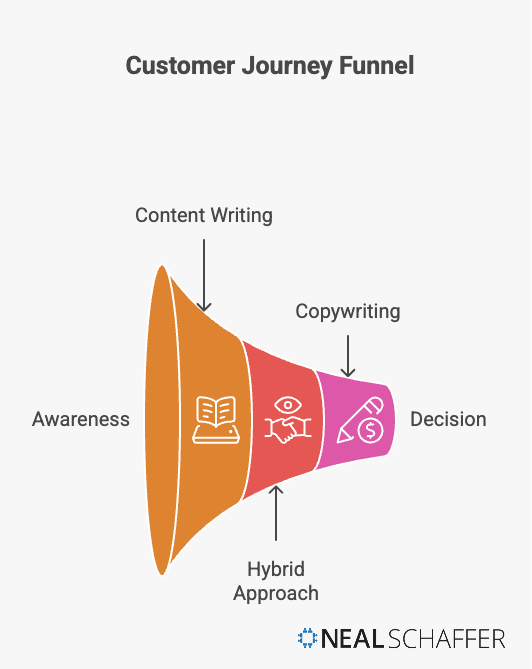
Top of Funnel (Awareness): Content writing dominates. Blog posts, SEO content, educational videos, social media content. You’re attracting people who don’t know you yet.
Middle of Funnel (Consideration): A hybrid approach. Case studies, comparison guides, email sequences that combine value with strategic CTAs. You’re building trust while gently guiding toward a decision.
Bottom of Funnel (Decision): Copywriting takes over. Landing pages, sales pages, product descriptions, promotional emails. You’re asking for the sale.
According to research from Gartner, 75% of B2B buyers now prefer a rep-free sales experience. That means your content and copy need to do the selling that salespeople used to handle in person.
For a deeper look at mapping content to the buyer journey, see my article on types of content marketing.
Practical Tips for Better Copywriting
Want to improve your copywriting right now? Here are the principles I come back to constantly:
1. Lead with benefits, not features. Nobody cares about your product’s specifications. They care about what it does for them.
2. Use the word “you” liberally. Make it about the reader, not about you.
3. Create urgency without being sleazy. Real deadlines and real scarcity work. Fake countdown timers destroy trust.
4. Write at an 8th-grade reading level. This isn’t about dumbing down. It’s about clarity. Even highly educated readers prefer easy-to-scan content.
5. Test everything. Personalized CTAs convert 202% better than generic ones. Small changes make massive differences.
For more, my guide on blog titles covers headline writing principles that apply to all copywriting.
Practical Tips for Better Content Writing
And for content writing? Here’s what works:
1. Answer real questions. Use tools like Answer the Public or review your customer support tickets. What are people actually asking?
2. Go deeper than competitors. Thin content doesn’t rank anymore. If the top results have 1,500 words, you probably need 2,000 or more.
3. Format for scanners. Most people don’t read online. They scan. Use headers, bullet points, and short paragraphs. I’ve written about blog post formatting specifically for this reason.
4. Update regularly. Content gets stale. Add new data, refresh examples, keep it current. Search engines notice.
5. Include original insights. Anyone can summarize. Share your experience, your data, your perspective. That’s what builds real authority.
I cover more of this in my breakdown of content marketing examples worth studying.
Measuring Success: Different Metrics for Different Goals
You can’t manage what you don’t measure. But you need to measure the right things for each discipline.
Copywriting Metrics
- Conversion rate
- Click-through rate (CTR)
- Cost per acquisition
- Revenue per email
- A/B test lift
Content Writing Metrics
- Organic traffic
- Time on page
- Pages per session
- Social shares
- Backlinks acquired
- Return visitor rate
For a deeper look at tracking content ROI, check out my guide on calculating content marketing ROI.
FAQ: Copywriting vs Content Writing
Copywriting typically commands higher rates, especially for direct response and conversion-focused work. According to Indeed, specialized copywriters often earn 20-30% more than general content writers, though both can be lucrative with the right expertise.
Absolutely. Many successful marketers develop skills in both disciplines. Start by understanding the different goals and mindsets, then practice each separately. Over time, you’ll recognize when to apply which approach.
It depends on volume and budget. For smaller teams, a versatile writer who understands both disciplines works well. Larger organizations often benefit from specialists who can go deeper in their respective areas.
No. AI can assist with drafts and variations, but strategic copywriting that truly understands human psychology and brand voice still requires human expertise. 85% of marketers using AI for content still involve significant human oversight.
Content writing attracts and educates your audience throughout their research phase. Copywriting converts them when they’re ready to act. Most successful marketing strategies use both, mapped to different stages of the buyer journey.

Where to Go From Here
You’ve made it this far, which tells me you’re serious about getting this right. Good.
Here’s my challenge: audit your current marketing. Look at where you’re using content writing when you should be using copywriting, or vice versa. Check if your blog posts have clear calls-to-action. Examine whether your landing pages provide enough value before asking for the sale.
Small adjustments in how you deploy these two disciplines can dramatically change your results. I’ve seen businesses double their conversion rates just by sharpening their landing page copy. And I’ve watched organic traffic explode when companies finally commit to consistent, valuable content.
If you want to go deeper on any of this, my podcast covers these topics regularly with guests who are in the trenches making this work every day.