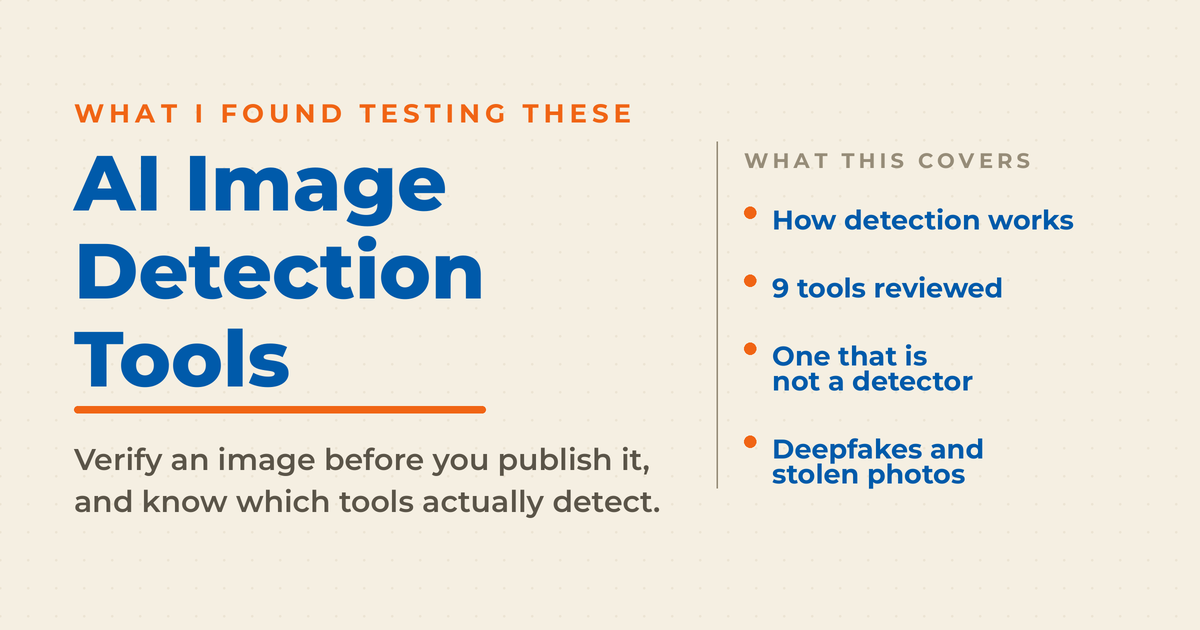

Generative AI made image manipulation cheap, fast, and very hard to spot. Whether you’re a content creator, a marketer, or just someone who saw a photo online and had a bad feeling about it, an AI image detector gives you a second opinion in seconds.
I tested nine of them against AI images I generated myself, plus a set of my own real photos as a control. What follows is what actually happened, including the tool that got it badly wrong. As a Fractional CMO who advises brands on their digital marketing, I care about this for a simple reason: one unverified image can undo a lot of careful brand work.
Key Takeaways
✅ No detector is reliable on its own. The same AI-generated file produced very different verdicts across these nine tools, so treat any single score as one opinion rather than proof.
✅ Hive Moderation and AI or Not performed best in my testing. Both correctly flagged fully AI-generated images, and both named the model family behind them.
✅ Winston AI missed badly. It rated an image that was 100% AI as 83% likely human, which is a reminder that a confident percentage isn’t the same as a correct one.
✅ Hugging Face is a platform, not a detector. You get access to community-built detection apps there, and quality varies a lot between them.
✅ The free options cover most marketing use cases. Illuminarty, SightEngine, and Hive Moderation all let you check images without paying, and Illuminarty doesn’t even ask you to register.
✅ Detection is one layer, provenance is the other. The metadata and Error Level Analysis in FotoForensics tell you whether a file was edited, which often matters more than whether a model generated it from scratch.
An Overview of AI Image Detection Technology
In the last few years, AI images have become a major thorn in many people’s side. The AI image generators that made this possible are now free, fast, and good enough that most people can’t tell the difference at a glance. Anyone can take a personal photo and drop it into a completely different, negative context.
Inappropriate content might pose an even bigger threat than the violation of intellectual property. Attackers have already used AI to smear people’s good name and place them in situations that never happened. Deepfake content is especially troublesome because it’s often hard to distinguish from real photos and videos. The same underlying technology now powers fully synthetic personas, including the AI influencers that brands have started working with.
While this form of use might be entertaining to some people, it can affect reputation and trust for the damaged party. The best example of that was the recent AI images featuring Taylor Swift. Furthermore, your competition might use this technology to ruin your business with barely any effort or investment.
Luckily, with AI image detection, you can easily notice when something was made by artificial intelligence.
AI image detection technology utilizes advanced algorithms and machine learning to analyze and verify the authenticity of digital images. This technology can detect various forms of image manipulation, such as edits, deepfakes, and alterations. By examining patterns, inconsistencies, and metadata, AI image detection tools provide a reliable assessment of an image’s credibility. As a result, these tools are invaluable for industries that rely on visual content, offering a robust solution for maintaining the integrity and trustworthiness of images used in marketing, journalism, and social media.
Importance and Applications of Image Detection
Unlike general image detection and recognition, AI image detection has a very specific purpose. By relying on this technology, we can establish if a photo was tampered with by using artificial intelligence. In that sense, these tools can provide the following benefits:
- Determine if the content has any AI elements.
- Establish authenticity of photos and other visual files.
- Determine which technology was used for AI modifications.
As AI photos become more widespread, the importance of these tools will increase. They will become crucial for establishing content authenticity, which can prove invaluable in the court of law.
That is why marketers should treat detection as part of the normal content workflow. A manipulated image attached to your brand does real reputational damage. The volume of visual content moving through social platforms every day, which the social media marketing statistics I maintain put into perspective, makes eyeballing everything impossible. Checking an image before you publish also protects you legally when a stock photo or a freelancer deliverable turns out to be undisclosed AI work. I think about detection the same way I think about every other item in my AI marketing tools stack: a small check that saves a large cleanup.
9 Recommended AI Image Detection Tools
Before testing these tools, I generated a few photos with popular image generators. After saving them on my PC, I started copy-pasting them in all these programs. As I knew they were AI generated, I wanted to see if the software will recognize artificial intelligence elements. I also used my own private photos for secondary control.
Based on this analysis, here’s what I’ve found about the best AI image detection tools on the market:
1. Hugging Face

Hugging Face isn’t actually an image detector. It is a comprehensive artificial intelligence platform where creators come together to share their tools with other users. Hugging Face features various solutions based on OpenGPT, Midjourney, and Stable Diffusion technology.
Among others, you can here find several image detection apps that can help you with your daily tasks. During my testing, I had a chance of testing a few of them. For example, I tried “Maybe’s AI Art Detector” and “DF-Net” detection tool. Both apps told me that my AI image was half human, half AI.
It seems these apps had trouble differentiating between objects in images, and could only detect fake content that was 100% artificial intelligence. They couldn’t recognize the AI background as such, which made for some poor image labeling. However, this is quite normal for this category of tools.
It’s worth mentioning these are just two of the platform’s apps for AI and deepfake images. There are lots of other content detectors worth a try, so I suggest you go through different solutions by yourself.
2. TinEye

Similar to Hugging Face, TinEye is a platform that helps with various deep learning image recognition tasks. Their main product, reverse image search, is prominently showcased on the homepage. The online tool allows you to check if your images can be found elsewhere on the web. Based on my testing, the software does its job as intended.
Besides this program, there are numerous other nifty apps that can assist you with your artificial images. TinEye features advanced image identification (determines if your images were altered by other users), image tracker (finds where your images are featured online), image verification (check if images comply with copyrights), and a few other tools.
The wide range of tools allows you to check all your digital images and their properties in one place. TinEye doesn’t necessarily feature a checker for AI-generated content, but has numerous other apps that assist with content moderation. However, their advanced technology is based on artificial intelligence and machine learning.
The Digital Marketing Playbook for Small Teams
My latest book helps small businesses, entrepreneurs, and marketers bring search, email, and social together into one digital marketing strategy that actually compounds.
Drawing on my work as a Fractional CMO, Digital Threads turns complicated tactics into a clear, practical plan you can follow, whatever your budget or team size.
Grab your copy on Amazon and start weaving your own digital threads. Click the cover or the button below to get started.

3. Content at Scale

Content at Scale is a marketing platform built around generative AI tools. They specialize in written content, and their SEO tools sit alongside the kind of AI content detectors and AI plagiarism checkers that do the same job for text. Their image detection tool is part of the same offer, though it sits separately from their flagship product.
The thing I love about their content detection software is its simplicity. All you have to do is drag your AI or real images to the online tool, or upload an URL. In just a second or two, Content at Scale with detect AI within pics with a high accuracy. The tool supports .JPG, .PNG, and .WEBP formats.
Similar to other software on the list, the program gives you human vs. AI probabilities (for example, 30% chance that an image is AI, and 70% chance its made by humans). It provided similar results as Hugging Face during testing, which is why I believe its legit.
4. FotoForensics

In many ways, FotoForensics is like Content at Scale tool. The software is placed prominently on company’s homepage and it features simple interface. You can use the image detector by copy-pasting suspicious URL or dragging/copying visual content from your device. However, this is where the similarities stop.
FotoForensics doesn’t only help you differentiate real from fake images. Instead, it has numerous features within application for image descriptions, file categorization, image annotations, and more. For example, you can determine the percentage of .JPEG within the image. If its not a .JPEG, FotoForensics tells you what kind of image file you’re dealing with.
Another thing I liked is the metadata section. You get a full read on image size, format, color type, compression, and more. The tool’s main feature is ELA, or Error Level Analysis, which shows whether the original file was altered. That matters because plenty of suspicious images aren’t fully generated at all. They’re real photos run through AI photo editors, and a straight AI-or-not score will miss that entirely.
5. Winston AI

One of the biggest tools in this category, Winston allows you to check AI-generated visual media. It does a complete analysis of photos, by tracking down anomalies. The software does the check several times, analyzing objects and other elements against DALL-E, Midjourney, and Stable Diffusion technology.
Unfortunately, I didn’t have a positive experience testing Winston AI. After using the same sample I’ve used in other checkers, the software gave me 17% chance that the image was AI, and 83% it was human. The image was fully made by artificial intelligence and you can easily tell that just by looking at it. In that sense, Winston did a poor job with anomaly detection.
It was also annoying that I had to register for this software. Winston AI gives you 2,000 credits, which will serve for 6 or 7 image checkups. As for the positive things, I did like image classification and other stats. You can check the color type, filter, compression, and interlace used for image in question.
6. AI or Not

Unlike many of these entries, AI or Not isn’t a simple online tool. Instead, it is a complex platform that comes with a separate dashboard and several nifty features. Besides image processing service, the program also supports audio content. You can use it for .JPEG, .WEBP, .PNG, .BMP, .GIF, and .TIFF formats.
After uploading a photorealistic image, the software will show you the likelihood of being generated by artificial intelligence. The software did a great job with my AI-generated images, so I’m glad to recommend it to my readers.
I also love the fact you can see which tech was used for AI generation, between DALL-E, Stable Diffusion, Midjourney, and Adobe Firefly. The software can perform a few other vision tasks, such as detecting inappropriate content and assessing image quality.
It’s worth noting that some of these features aren’t available with free plan. So, if you want to analyze a dataset of images, it wouldn’t be a bad idea to invest in this amazing program.
7. Hive Moderation

Hive Moderation is an all-in-one platform that helps you detect artificial content and unwanted content. You can use it to analyze AI-generated text, artificial images, audio files, and video content. The software has numerous practical applications for businesses, especially those working with a lot of visual content.
The software works a bit differently from other entries. It doesn’t determine the likelihood of an image being AI. Instead, it shows you whether the content elements and objects that are made by artificial intelligence tech. As a result, it immediately flags AI content such as the one I used.
The last step of the document processing is analyzing the underlying tech. Hive content moderation includes checking the photo against Stable Diffusion, Sora, Pika, DALL-E, and other deep learning models. Based on what I’ve seen, the software doesn’t give false positives or false negatives, offering a lot of value to users especially given that it’s free.
8. SightEngine

SightEngine is fantastic for image labeling and classification, but also for other content tasks. For example, the software checks AI-generated audio files and texts. With this program, you can perform object localization, object recognition, and a few other actions, making it ideal for commercial applications.
My favorite thing about SightEngine’s image detector is its simplicity. While the software doesn’t provide a detailed analysis like some other entries, it’s on point in terms of its AI assessment. It passed all my tests, differentiating between real photos and those made by artificial intelligence. Another fantastic thing is that you can check as many high-quality photos as you want for free.
9. Illuminarty

Illuminarty gives you two options: to check images or text against artificial intelligence and explicit content. If you go with the prior option, you’ll get instant results following the image input. My favorite thing about Illuminarty is that it’s completely free, doesn’t require log in or anything of that sort, and has simple interface.
The software uses cloud-based AI models to differentiate between deepfake images, AI generated visuals, and normal pics. While the program doesn’t have image editing or any fancy features, it does a good job of detecting AI. Based on my tests, the software’s custom model managed to detect AI in three separate images.
Frequently Asked Questions About AI Image Detection
Accuracy varies enormously between tools and depends heavily on which generator produced the image. In my testing, Hive Moderation and AI or Not identified fully AI-generated files correctly, while Winston AI rated the same image as 83% likely human. Run anything important through two or three detectors before you trust a single result.
This is where most of them struggle. Several tools, including the Hugging Face apps I tried, came back with “half human, half AI” on images with generated backgrounds because they couldn’t separate the synthetic elements from the real ones. FotoForensics and its Error Level Analysis are more useful for partial edits than a straight AI-or-not score.
Yes, and the free options are good enough for most marketing work. Illuminarty runs without registration, SightEngine lets you check as many images as you want, and Hive Moderation is free while also covering text, audio, and video.
Most are built for still images and treat deepfake-style manipulation as part of a general AI-generation score. Hive Moderation goes further by checking content against specific models, including Sora and Pika. For video specifically, expect lower confidence than you get on stills.
A manipulated image attached to your brand name does damage that takes months to walk back. Stock libraries and freelancer deliverables now contain undisclosed AI work, which creates a licensing exposure most teams haven’t thought about. Checking a suspicious image before you publish costs you almost nothing.
Conclusion
AI image detection tools are essential assets for marketers and businesses looking to uphold content authenticity and safeguard their brand reputation. By investing in these advanced technologies, you can confidently verify the integrity of your visual content, streamline your verification processes, and enhance trust with your audience. Embrace AI image detection tools to stay ahead in the digital landscape and ensure that your brand is always represented with genuine, high-quality images.