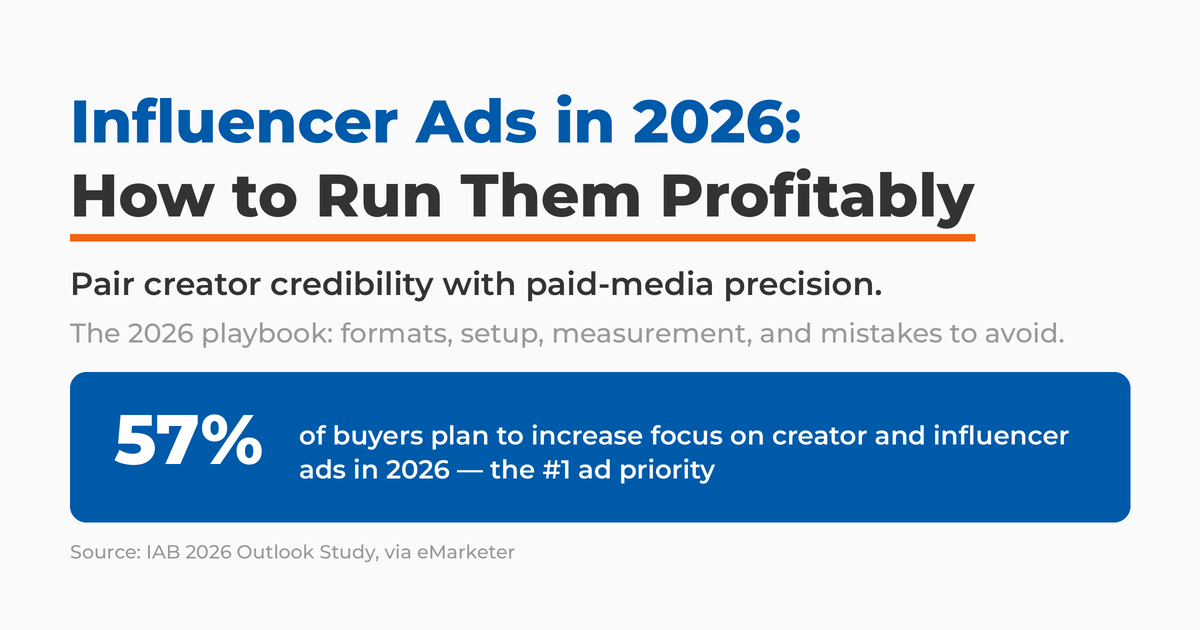

Influencer ads are now the single ad format buyers most want to grow. Creator and influencer ads or partnerships are the type of advertising the most buyers (57%) plan to put increased focus on in 2026, up from 48% a year earlier, according to the IAB’s 2026 Outlook Study as analyzed by eMarketer.
And yet plenty of brands still run influencer marketing the way they did in 2018: gift a product, cross their fingers, and hope a post goes semi-viral.
What actually works right now is the convergence of creator credibility with paid-media precision. When you treat creator content as a media buy instead of a favor, influencer ads start posting the kind of ROAS numbers that earn a permanent line in your budget.
I wrote The Age of Influence, I teach influencer marketing at UCLA Extension, and I’ve spent years helping brands get this right as a fractional CMO. So I’ll be blunt about who this guide is for: brands and media buyers who are ready to hold creator content to the same standard as the rest of their paid media. If that’s you, here is how to run influencer ads that move the needle.
Key Takeaways
✅ Influencer ads are paid media that runs through or features a creator’s content, with full targeting and measurable outcomes. That makes them a performance channel, not a brand-awareness favor.
✅ Creator content earns its lift honestly: it drove 17 times more engagement than brand-owned content across standout Fortune 100 brands, per CreatorIQ.
✅ The four formats worth prioritizing in 2026 are TikTok Spark Ads, Meta Partnership Ads, LinkedIn Thought Leader Ads, and YouTube BrandConnect.
✅ Validate content organically before you boost it, brief for the message rather than the script, and lock usage rights in writing before anything gets created.
✅ Measure with ROAS, CPM, CPA, engagement rate, and completion rate, and calculate ROAS on total cost including the creator fee, not media spend alone.
✅ Authenticity is now a performance variable. As AI-generated content floods every feed, a real person with a real opinion becomes a sharper signal.
What Are Influencer Ads (and How Are They Different from Influencer Marketing)?
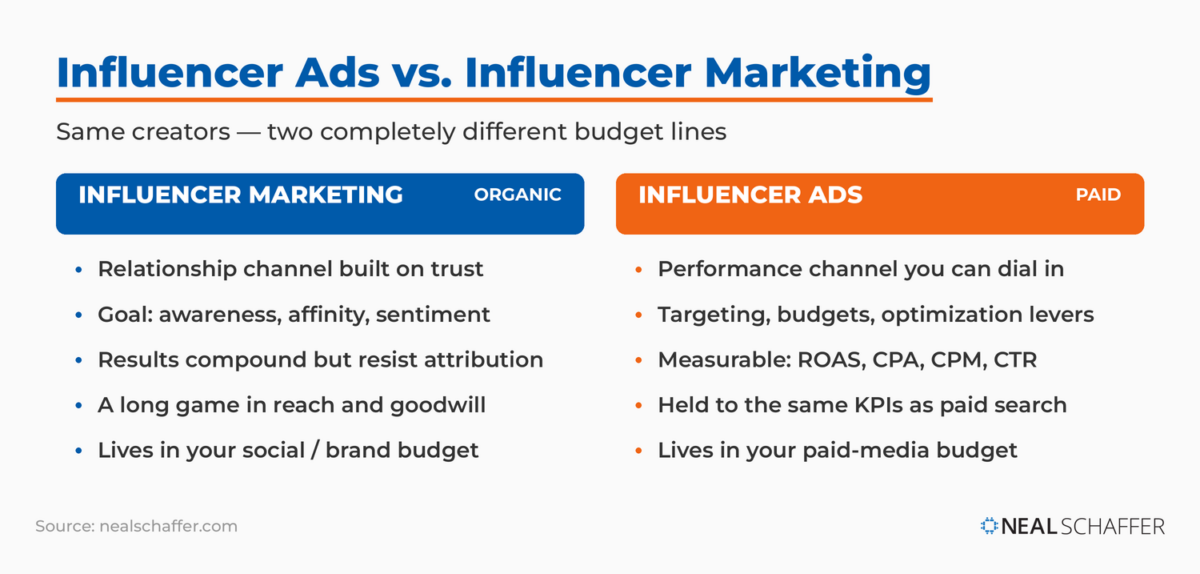
Influencer ads are paid media placements that run through or feature a creator’s content. The creative looks like it came from the creator, because it did, but the distribution is fully paid and targeted. That is the line that separates them from influencer marketing more broadly, and it changes how you budget for them.
You can run them two ways. You can boost a creator’s post directly from their handle, or you can allowlist their account so your brand runs it as a standard ad.
Organic influencer marketing is a relationship channel. You work with creators to build awareness, trust, and affinity. Results compound, but they are hard to attribute and harder to control. You are playing a long game, investing in reach and sentiment.
Influencer ads sit in a different bucket. They carry targeting, budgets, optimization levers, and measurable outcomes, so you can hold them to the same KPIs as your Facebook or Google campaigns: ROAS, CPA, CPM, and so on. They belong in your paid-media budget and should be evaluated there.
Why Are Influencer Ads Outperforming Traditional Paid Creative?
Creator content beats brand-produced ads for a few specific reasons, and each one affects how you brief, select, and deploy that content. People trust creators, platforms reward native-feeling content, the engagement gap is real, and the rise of AI-generated media is making genuine human contact more valuable. Understanding the mechanics tells you where the performance actually comes from.
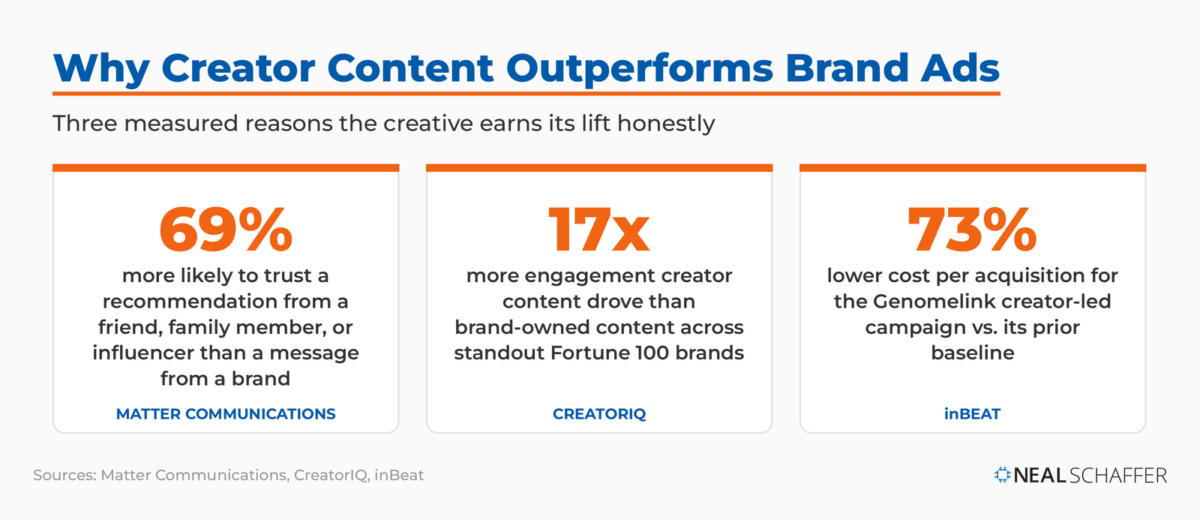
Start with trust. 69% of consumers say they are more likely to trust a recommendation from a friend, family member, or influencer than information that comes directly from a brand, according to a Matter Communications survey. When that trusted voice is also the ad unit, you are not fighting the same skepticism that makes most paid creative work so hard.
Then there is delivery. Platforms optimize for engagement, and people engage more with content that does not feel like an interruption. Creator-led ads, especially when run from the creator’s own handle, blend into the feed in a way polished brand creative does not.
The engagement gap shows up in the data, and it lines up with the broader influencer marketing statistics. As noted above, CreatorIQ’s research across standout Fortune 100 brands found creator content drove 17 times more engagement than brand-owned content. Better engagement signals mean better delivery, which means lower CPMs for the same reach.
Performance agency inBeat saw this play out with the ancestry app Genomelink. Creators like Armaan Talreja opened with a personal hook, in this case finding long-lost cousins in Dubai through the app, then let the interface and real user stats do the selling.
That creator-led approach helped Genomelink cut its cost per acquisition by 73%, inBeat reported.
What Types of Influencer Ads Can You Run in 2026?
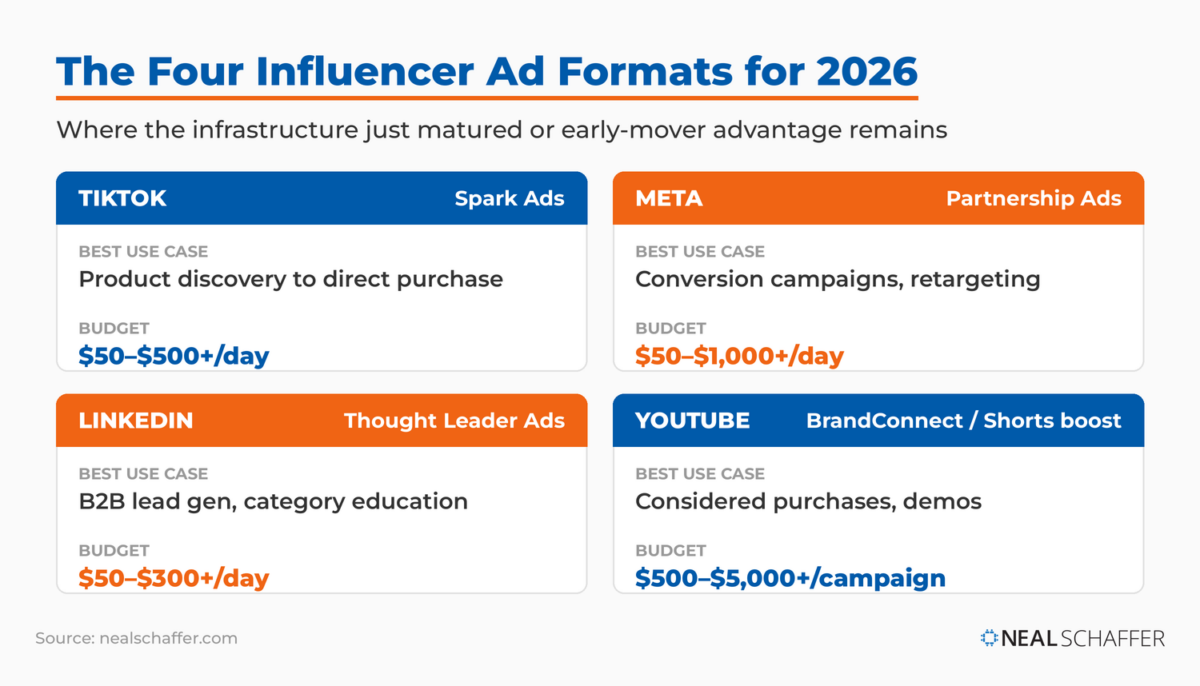
The formats below are not every creator-ad product on the market. They are the four worth prioritizing this year, either because the platform infrastructure just matured, because early-mover advantage is still available, or because recent platform changes raised the performance ceiling. Each one rewards native creator content, and each fits a different stage of the funnel.
| Platform | Ad Format | 2026 Relevance | Best Use Case | Budget Range |
|---|---|---|---|---|
| TikTok | Spark Ads | TikTok Shop integration enables full-funnel reach | Product discovery to direct purchase | $50-$500+/day |
| Meta | Partnership Ads | Meta AI optimization rewards authentic engagement signals | Conversion campaigns, retargeting | $50-$1,000+/day |
| Thought Leader Ads | Low saturation, CPM advantage still available | B2B lead gen, category education | $50-$300+/day | |
| YouTube | BrandConnect / Shorts boost | Cleaner attribution via Google Ads integration | Considered purchases, product demos | $500-$5,000+ per campaign |
TikTok Spark Ads
Spark Ads have always worked as an awareness format, because boosting a creator’s existing post from their handle preserves the likes, comments, and social proof. That native feel pays off: Spark Ads carry a 134% higher completion rate and a 157% higher six-second view-through rate than standard In-Feed Ads, per TikTok for Business.
Photomyne is a good example. The photo-app brand used TikTok Creator Marketplace to partner with TikTok creators on loosely briefed organic videos, then amplified the top performers as Spark Ads. The campaign delivered a 5X increase in video views and a 50% lower CPA on free trials, according to TikTok’s case study.
What makes Spark Ads more compelling in 2026 is TikTok Shop integration. A Spark Ad can now link directly to a product page inside TikTok Shop, collapsing the path from discovery to purchase into a single tap. That matters when US TikTok Shop sales hit $15.82 billion in 2025, up 108% year over year, with eMarketer projecting the channel will pass $20 billion in 2026 and top $30 billion by 2028. For brands selling physical products, Spark Ads have become a full-funnel play.
Instagram and Facebook Partnership Ads
Partnership Ads matter more in 2026 than they did two years ago because of how aggressively Meta has built out its AI ad optimization. The engagement signal from authentic creator content now produces meaningfully different delivery than polished brand creative does.
One Strategy to Connect All Your Marketing
My latest book helps small businesses, entrepreneurs, and marketers bring search, email, and social together into one digital marketing strategy that actually compounds.
Drawing on my work as a Fractional CMO, Digital Threads turns complicated tactics into a clear, practical plan you can follow, whatever your budget or team size.
Grab your copy on Amazon and start weaving your own digital threads. Click the cover or the button below to get started.

The numbers back it up. Adding Partnership Ads to a campaign delivers 19% lower CPAs and 13% higher click-through rates on average, according to Meta’s own data reported by Marketing Dive. And that gap is likely to widen as the algorithm gets better at rewarding content that earns genuine attention. As of December 2025, Meta also surfaces high-performing organic creator posts, including UGC and affiliate content, inside its Partnership Ads Hub so you can convert proven content into ads instead of guessing.
LinkedIn Thought Leader Ads
This is the least saturated format on the list, which is exactly why it belongs here. You sponsor an individual’s organic LinkedIn post to push it beyond their existing network. The format is still new enough that CPMs are relatively low and audience fatigue has not set in.
For B2B brands especially, a credible industry voice making the case for your product carries different weight than a company-page ad. Right now you can still buy that attention cheaply.
YouTube BrandConnect and Shorts Boosting
These are worth revisiting if you dismissed them a year or two ago. Shorts finally has mature monetization and boosting infrastructure, and the logic mirrors Spark Ads: amplify content that already proved itself organically rather than pushing cold creative. BrandConnect’s deeper integration with Google Ads in 2026 also means attribution is cleaner than it has historically been for YouTube influencer campaigns, which closes one of the main objections marketers had to the channel.
YouTube’s own creator channel walks through how this works in its overview of Brand Partner Video Access via BrandConnect:
For longer-consideration purchases where a three-to-eight-minute creator walkthrough genuinely moves buyers, BrandConnect remains one of the few formats that can credibly operate at the bottom of the funnel.
How Do You Set Up and Run Influencer Ads?
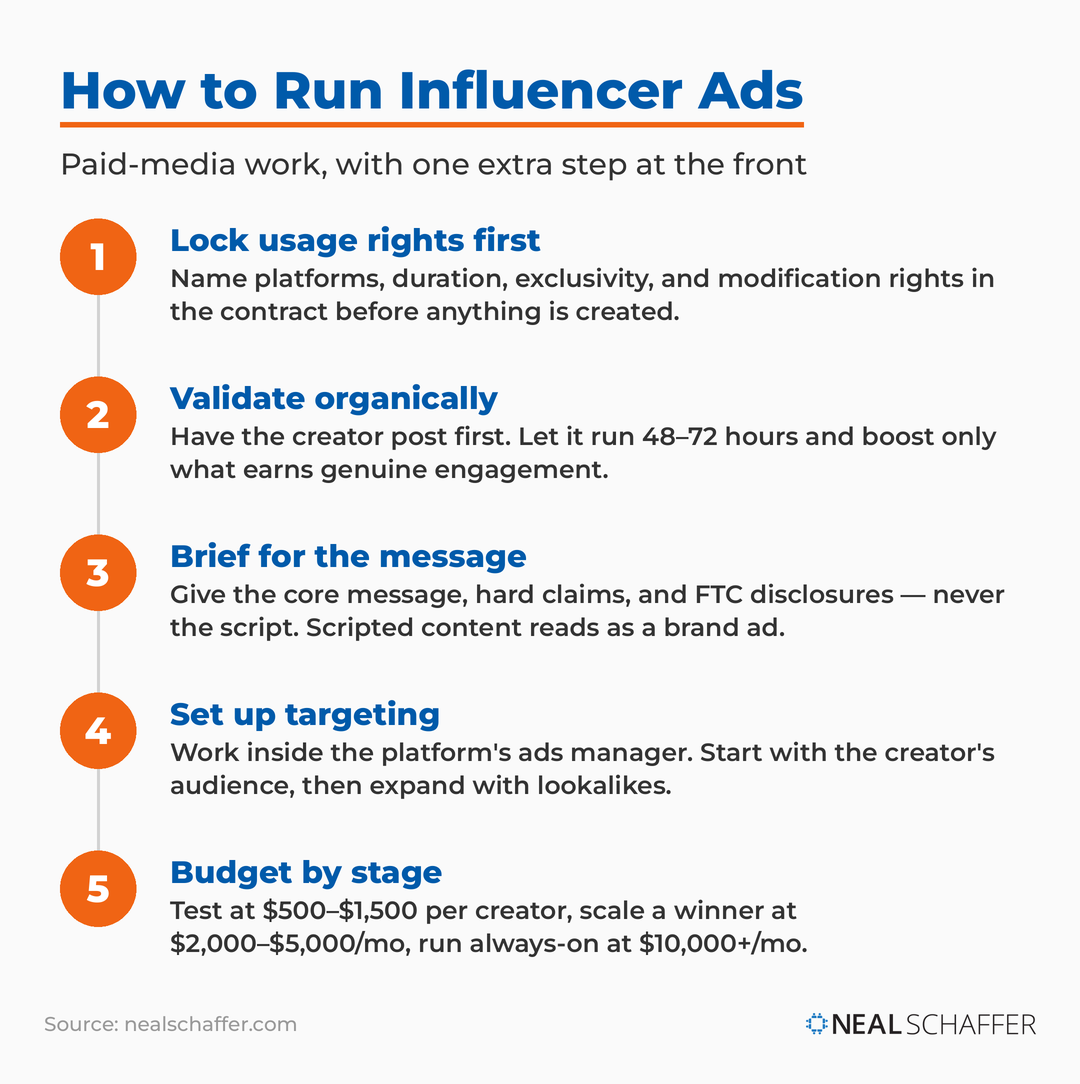
Setting up influencer ads is mostly paid-media work with one extra step at the front: securing rights to the creator’s content. Lock usage rights in writing first, validate the content organically before you spend, brief for authenticity, build targeting inside the platform’s ads manager, and budget by stage.
1. Sort Out Contracts and Usage Rights First
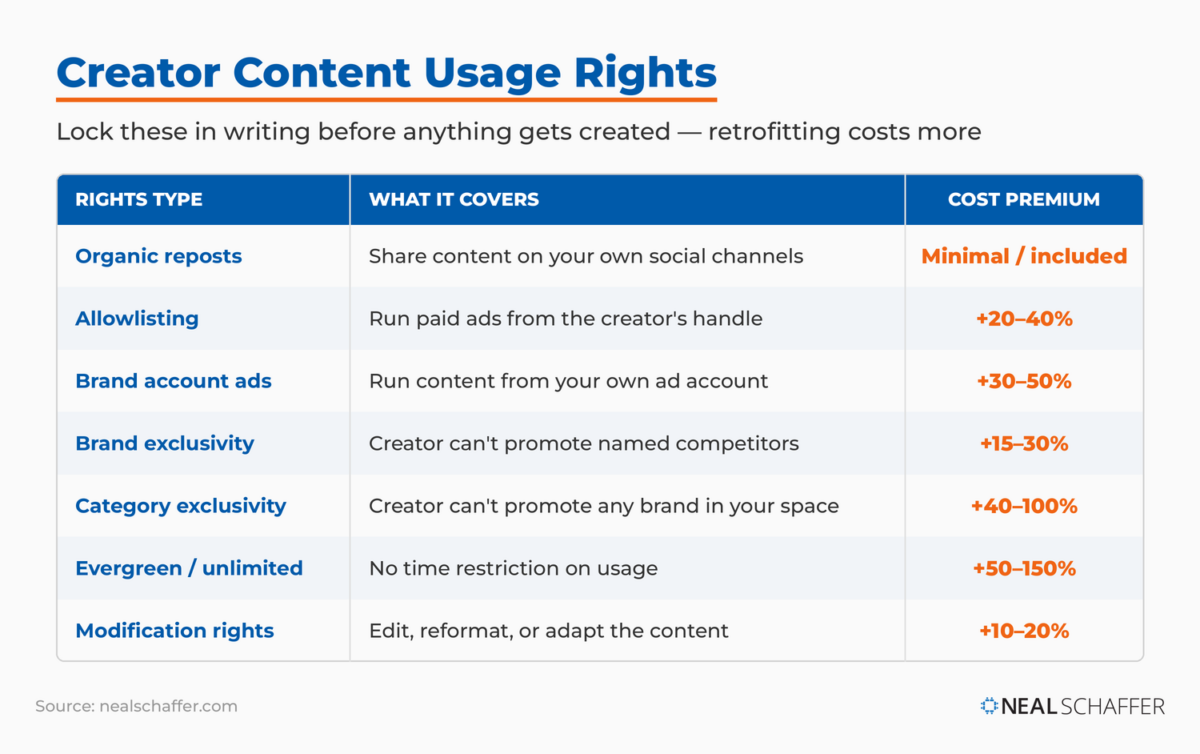
Before anything gets created, nail down usage rights in your influencer contract. The moment you reach out to a creator, you are eager to get content moving, but retrofitting rights after a post performs is always more expensive than building them in upfront. Four terms need to be explicit:
- Platforms: Where can you run the content? Organic reposts, paid ads from the creator’s handle (allowlisting), paid ads from your brand account, third-party placements, or all of the above. Each step up costs more and should be named in the contract.
- Duration: How long can you use it? Windows of 30, 60, or 90 days are standard for paid ads. Evergreen rights of 6 to 12 months are worth negotiating upfront if the content is strong.
- Exclusivity: Can the creator work with your direct competitors during the term? Category exclusivity costs significantly more than brand exclusivity. For most SMBs, brand exclusivity is enough.
- Modifications: Can you trim the content for different formats, add subtitles, overlay a CTA, or adapt it for a new market? Many creators restrict this by default, so multi-format campaigns need explicit modification rights.
| Rights Type | What It Covers | Typical Cost Premium | Best For |
|---|---|---|---|
| Organic reposts | Sharing content on your own social channels | Minimal / often included | Brand awareness, content library |
| Allowlisting | Running paid ads from the creator’s handle | +20-40% on creator fee | Performance campaigns, social proof |
| Brand account ads | Running content from your own ad account | +30-50% | Full targeting control, retargeting |
| Exclusivity (brand) | Creator can’t promote named competitors | +15-30% | Competitive categories |
| Exclusivity (category) | Creator can’t promote any brand in your space | +40-100% | High-stakes launches |
| Evergreen / unlimited | No time restriction on usage | +50-150% | Hero content, always-on programs |
| Modification rights | Edit, reformat, or adapt the content | +10-20% | Multi-platform campaigns |
2. Validate Organically Before You Spend
Do not boost content you have not tested. Have the creator post first, let it run for 48 to 72 hours, and look at retention, engagement rate, and comment sentiment. The content that earns genuine responses organically is what you put paid dollars behind. This validate-then-amplify approach also gives the algorithm an engagement head start before you boost, which improves paid delivery.
3. Brief for Authenticity
A good brief includes the core message, any hard claims that must be accurate, mandatory FTC disclosures, anything the creator cannot say or show, and a few video ideas for inspiration. That is the whole list. Do not script the dialogue, dictate the structure, or send a mood board that turns the video into a brand asset. The moment a creator’s content starts looking like a brand ad, you have lost the advantage of running it through their handle.
4. Set Up Targeting Like Any Paid Campaign
Once you have allowlisting access, you are working inside Meta Ads Manager, TikTok Ads Manager, or LinkedIn Campaign Manager like normal. Layer your targeting: start with the creator’s existing audience as a baseline, since their followers have already converted once, then expand with lookalikes or interest targeting. For retargeting, creator content works especially well as a mid-funnel touchpoint for people who have already visited your site.
5. Budget by Stage
Match spend to where you are in the process when structuring your influencer marketing campaign:
- Testing phase: $500 to $1,500 per creator to validate creative before scaling.
- SMBs scaling a winner: $2,000 to $5,000 a month across two or three creators.
- Larger brands running always-on programs: $10,000+ a month, typically split across multiple creators and platforms.
Start narrow with one creator, one platform, one objective. Then expand based on what the data tells you.
How Do You Measure Influencer Ad Performance?
Measuring influencer ad performance matters more in 2026 because platform tracking is less reliable and journeys are fragmented, so weak attribution quietly wastes budget. Track ROAS, CPM, CPA, engagement rate, and completion rate, calculate ROAS on total cost including the creator fee, and build attribution from UTM parameters, promo codes, and affiliate links.
Key Metrics to Track
- ROAS is your primary profitability signal: revenue divided by total ad spend, including the creator fee. A common mistake is calculating ROAS on media spend alone, which inflates the number and distorts your read on whether influencer marketing ROI is actually working.
- CPM tells you how efficiently you are buying reach. Creator content typically earns lower CPMs than brand creative because of the engagement advantage.
- CPA is what matters most for conversion campaigns. Track it at the creator level, because one creator can drive 80% of your conversions at half the CPA of the others.
- Engagement rate matters more here than for standard paid social because it directly affects delivery. Low engagement on a boosted post signals to the algorithm that the content is not resonating, which drives up your CPMs. Watch it early and pause underperformers fast.
- Completion rate is the key metric for video, especially on TikTok. Drop-off in the first three seconds means the hook is not working. Drop-off at the halfway point means the payoff is not landing.
What “Good” Actually Looks Like
Benchmarks vary by platform, objective, and category, but here is a realistic starting point from my experience advising brands:
| Metric | Realistic Benchmark | Strong Performance |
|---|---|---|
| ROAS | 2-4x | 5x+ |
| CPM | $8-$15 | Below $8 |
| CPA | Category-dependent | 20-30% below your paid-social baseline |
| Engagement rate | 3-6% | 8%+ |
| Video completion rate (TikTok) | 25-40% | 50%+ |
| Video completion rate (YouTube) | 30-45% | 60%+ |
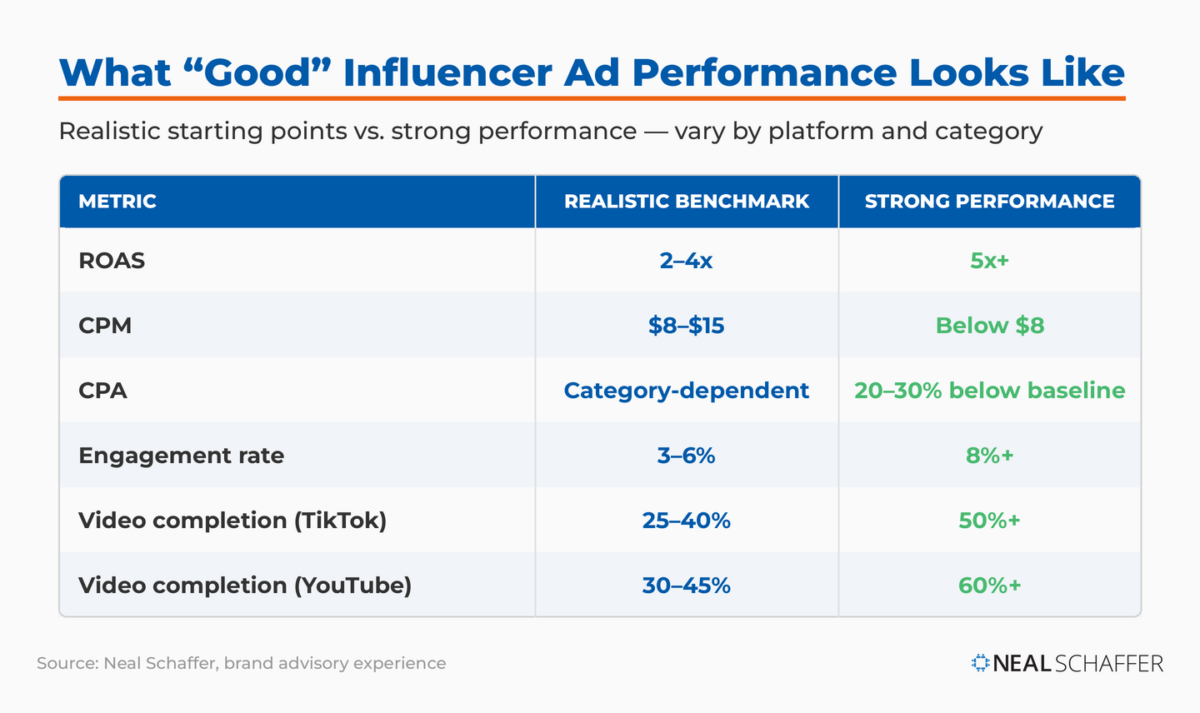
One word of caution: do not over-index on ROAS in the first 30 to 60 days. Optimize for learning instead, testing creators, formats, and hooks. The campaigns that consistently hit 5x or better are almost always built on several rounds of iteration.
Attribution Challenges and How to Address Them
Influencer ads sit in an awkward middle ground. They drive both direct conversions and assisted ones that show up elsewhere. Lean only on platform-reported numbers and you will undercount; ignore cross-channel effects and you will overcount. A more honest picture comes from three habits:
- UTM parameters on every link, organic and paid, structured consistently by source, medium, campaign, and creator. This lets you isolate creator-driven traffic in Google Analytics and compare it against other channels on equal footing.
- Promo codes capture conversions outside the direct click path. Someone sees the ad, does not click, searches your brand later, and converts. A creator-specific code (NEAL20, SARAH15) ties that sale back to the source even when the click chain breaks.
- Affiliate links automate attribution for always-on programs where creators post regularly, and they align creator incentives with actual conversions.
For bigger campaigns, consider a brand-lift study through TikTok or Meta to measure the delta in awareness, recall, and purchase intent between exposed and unexposed audiences. It will not replace conversion tracking, but it captures the full-funnel effect that UTMs miss.
What Are the Biggest Mistakes Brands Make with Influencer Ads?
The biggest mistakes are not new, but the cost of making them in 2026 is higher because the channel is more competitive and budgets are under more scrutiny. The five that drain the most budget are over-scripting creator content, skipping the organic test phase, ignoring disclosure requirements, treating every platform the same, and failing to lock usage rights upfront.
Over-scripting creator content. As AI-generated content floods every platform, audiences are getting sharper at spotting inauthenticity. A word-for-word scripted video signals “brand ad” in a feed where genuine human content is the differentiator. That is why you brief the message, not the delivery. inBeat’s work with the juicer brand Hurom is a good model. Creator Annie Suave opened on a relatable frustration, how annoying juicers are to clean, and the post ran through The Plant Collective’s account so it felt native to a wellness audience. A discount code in the caption handled tracking.
That approach helped lift Hurom’s ROAS to 2.5x, inBeat reported.
Skipping the organic test phase. With media costs rising, boosting unvalidated content is a more expensive gamble than it used to be. A post that earns genuine engagement in the first 48 hours has already proven it resonates.
Ignoring disclosure requirements. The FTC and ASA have not softened, and platforms are tightening enforcement themselves. Meta’s paid-partnership label and TikTok’s branded-content toggle are non-negotiable. Audiences who feel misled do not convert, and in 2026 they are quicker to call it out publicly.
Treating all platforms the same. TikTok Shop integration, LinkedIn’s Thought Leader Ads, and YouTube’s improved attribution have made each platform more distinct. Repurposing creative across them without adapting to each channel’s native grammar leaves performance on the table.
Not negotiating usage rights upfront. With ambassador programs and always-on partnerships becoming the dominant model, usage windows and modification rights matter more than ever. Retrofitting rights after a post goes viral is always more expensive than building them into the original contract.
Which Influencer Ad Trends Should Shape the Rest of 2026?
Four trends should act as decision inputs for the campaigns you are running right now: hybrid compensation is replacing flat fees, ambassador programs are delivering the strongest ROI, the AI content flood is making human signal more valuable, and social commerce is turning creator ads into direct sales channels.
Hybrid Compensation Is Replacing Flat Fees
The pure flat-fee deal is losing ground to hybrid structures: a base fee for the creator’s time plus performance-based commission on actual sales. The model works for both sides. Creators get security, and brands only pay up for results that materialize. If you are negotiating new creator contracts in 2026, building in an affiliate layer from the start is worth the extra conversation.
Ambassador Programs Are Delivering the Strongest ROI
One-off campaigns have their place, but the data favors long-term relationships. Brand ambassador programs delivered the highest ROI of any influencer strategy, according to Aspire’s internal campaign data and survey of hundreds of brands. Repeated exposure compounds, audience trust deepens, and content quality climbs over time. The upfront investment is higher, but the return curve is steeper.
The AI Content Flood Is Making Human Signal More Valuable
AI-assisted content is becoming the baseline. 86% of creators now actively use generative AI across their workflows, according to Adobe’s Creators’ Toolkit Report. Audiences are reacting. Nearly half of consumers (46%) are uncomfortable with brands using AI influencers, Sprout Social’s Q3 2025 Pulse Survey found, with only 23% saying they are comfortable. Tech journalist Taylor Lorenz put it plainly: “AI influencers don’t engender trust. Humans do.” As synthetic content scales, a real person with a genuine point of view becomes a sharper signal in the feed. Authenticity is becoming a performance variable, so use it.
Social Commerce Is Turning Creator Ads Into Direct Sales Channels
TikTok Shop has moved well past the experimental phase. US sales reached $15.82 billion in 2025, and the path from discovery to purchase now collapses to a single tap when a Spark Ad links straight to a product page. For brands selling physical products, that integration is worth prioritizing now, and it means creator ads can serve the bottom of the funnel, not just the top. The shift also reflects a wider behavioral change. As eMarketer analyst Rachel Wolff put it, TikTok’s blend of shopping and entertainment is turning the platform into an ecommerce powerhouse.
Frequently Asked Questions
There are two cost layers: the creator fee and the media spend. Creator fees vary widely by influencer tier. A micro-influencer with 10K to 100K followers typically charges $500 to $5,000 per piece of content, while mid-tier creators with 100K to 500K run $5,000 to $25,000. Media spend on top of that can start as low as $500 a month for a test and scale to $50,000+ a month for always-on programs.
Yes, particularly on LinkedIn. Thought Leader Ads let you sponsor content from individual employees or industry voices and push it beyond their existing network, which is a different signal than a company-page ad. The key is choosing creators with genuine professional credibility in your category rather than chasing follower count. For B2B, a 15,000-follower niche expert will usually outperform a 500,000-follower generalist.
They are the same thing: a creator granting your brand access to run paid ads through their account handle. The ad appears to come from the creator, preserving their social proof and native feel while giving you full targeting control behind the scenes. Allowlisting is simply the newer, preferred term.
Yes, and the model often suits SMBs better than large brands. Micro and nano influencers charge lower fees, post higher engagement rates, and reach more targeted audiences. A $3,000 to $5,000 test that covers one or two creators and a modest media budget is enough to get meaningful data. Start with one platform, one creator, one objective, and let performance guide where you scale.
Not necessarily to start. The ad mechanics live inside Meta Ads Manager, TikTok Ads Manager, or LinkedIn Campaign Manager, which you may already use. Platforms and agencies help most with finding the right creators, contract management, and scaling across many creators at once. For your first few campaigns you can manage it manually. Once you are running five or more creators concurrently, dedicated tooling starts to pay for itself.
Put These Influencer Ad Tactics to Work
The brands pulling strong returns from influencer ads in 2026 apply the same rigor they use on search and paid social: they test before scaling, track the right metrics, negotiate rights properly, and iterate on what works. What is different is the creative input, because they are putting a creator’s voice and credibility behind the media buy. That combination of performance infrastructure and authentic creative is hard to replicate with traditional paid media alone, and it only gets more valuable as AI-generated content keeps flooding every feed.
The starting point does not need to be complex. Pick one platform where your audience is already active, find one or two creators whose content genuinely resonates, sort out the usage rights, and run a $1,500 to $3,000 test. Validate what works organically, boost it with paid, measure it like any other performance campaign, then scale what earns it.
If you want to see where the channel is heading before you commit budget, the latest creator economy statistics are worth bookmarking. And if you would like help building influencer ads into a coordinated paid-media strategy across your channels, that is exactly the kind of work I do as a fractional CMO.