


You have seen the word everywhere. You have probably called someone an influencer, or rolled your eyes when someone else did. But if I asked you to define the term in one sentence, could you?
Most people can’t. And that is a problem, because influence is now one of the biggest forces in marketing. I’m Neal Schaffer, and I wrote a whole book about it, The Age of Influence, published by HarperCollins Leadership, and I teach influencer marketing at UCLA Extension. So let me give you the clearest definition I can, from someone who works in this every day rather than someone writing around the word.
This guide covers what an influencer actually is, the different types, what they do, how they make money, and how someone becomes one. Whether you want to work with influencers, become one, or just understand the term, you will leave knowing more than the dictionary will tell you.
Key Takeaways
✅ An influencer is someone who can shape what other people think, do, or buy within a specific niche or community, usually through social media content.
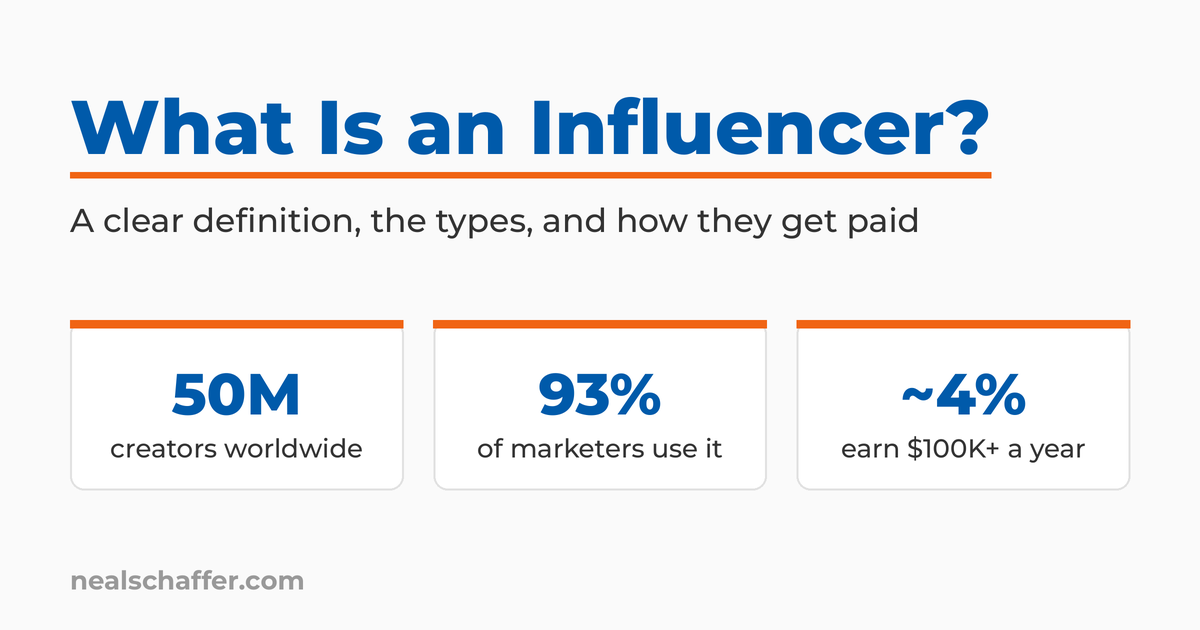
✅ Influence has been democratized. You no longer need to be famous in traditional media. Goldman Sachs estimates 50 million people now work as creators, and influence has scaled with them.
✅ There are two ways to classify influencers, not one: by audience size (nano to celebrity) and by brand affinity (from your own employees to total strangers). I cover both below.
✅ Influencers are content creators first. You cannot hold influence on social media without consistently creating content people actually want.
✅ Most influencers are not rich. Goldman Sachs estimates only about 4% of creators earn over $100,000 a year, so “influencer” describes a role, not a salary.
✅ For business, influence is a marketing channel. 93% of marketers have used influencer marketing, which is why understanding the term matters.
What Is an Influencer?
An influencer is a person who can shape the attitudes, decisions, or buying behavior of others within a specific niche, usually by building a trusted audience through social media content. The key word is trust. Followers are a vanity number. Real influence is when people actually listen and act on what you say.

That lines up with how the term is understood broadly. Wikipedia describes an influencer as a person who builds an online presence through engaging content and direct audience interaction, growing a platform through social media rather than pre-existing fame. The same entry makes a point I strongly agree with: having a lot of followers does not necessarily mean having much influence over them. I have seen accounts with hundreds of thousands of followers move nobody, and accounts with 4,000 followers drive real sales. The number on the profile is not the point. The trust behind it is.
It also helps to know what an influencer is not. An influencer is not simply a celebrity, though some celebrities are influencers. They are not simply someone with a big follower count, though many have one. And the term is no longer limited to social media stars selling makeup. As I explain throughout The Age of Influence, a B2B thought leader quoted in a trade publication is an influencer too. So is the engineer whose opinion your whole team trusts before buying software.
How Did “Influencer” Become Such a Big Deal?
Influence is not new, but the democratization of influence is. A generation ago, you had to be famous in traditional media to sway people at scale. Today anyone with a phone and a point of view can build an audience, which is why the creator economy has exploded into a market Goldman Sachs expects to reach roughly half a trillion dollars.
When I was in high school, the influencers were the people you saw on TV and in magazines. I have talked about this before: the weekend after Top Gun came out, a friend showed up to school with a motorcycle and Tom Cruise hair, and half the girls in my class wanted to look like Madonna. You had to be famous in traditional media to have that kind of pull.
Now look at who moves my kids. It is TikTokers, Instagrammers, and YouTubers, many of whom I have frankly never heard of. That shift is the whole story. The barrier to building an audience collapsed, and influence spread to everyday people with a niche and a camera. Goldman Sachs estimates there are 50 million creators worldwide, growing 10 to 20% a year.
I have been making this argument for a long time. On my podcast Your Digital Marketing Coach, back when most marketers were still chasing celebrity endorsements, I put it this way: “Don’t follow the influencers, don’t necessarily retweet the influencers. Become the center of influence. Become an influencer.” That was years before “influencer” was a job title. The democratization I saw coming is now the entire market.
What Does an Influencer Actually Do?
At the core, an influencer creates content, builds a community around it, and earns enough trust over time that people act on their recommendations. Everything else is a variation on those three things. The format changes, the platform changes, the niche changes, but content, community, and trust are the constants.
First and foremost, an influencer is a content creator. You cannot hold influence on social media without content, because content is the fuel. That covers a huge range: short videos, photos, blog posts, livestreams, newsletters, podcasts. What unites strong influencers is that their content is good enough and relevant enough that people want to consume it, and focused enough on a niche that an audience knows what to expect.
This is also why the line between “influencer” and “content creator” has basically dissolved. A few years ago we drew a distinction: creators made content, influencers sold things. Today most influencers are creators and most successful creators have influence. Where the two roles still pull apart is purpose, which I break down in my comparison of content creator vs influencer. When you become an influencer, you are first a content creator, because that is the fuel of digital and social media.
The second job is building community. Posting into the void is not influence. Influence is when you engage, when people feel seen, and when a back-and-forth turns followers into a community that trusts your judgment. That trust is the asset brands are actually paying for when they run influencer marketing campaigns.
What Are the Different Types of Influencers?
Influencers are classified two ways, and most articles only tell you about one. The common method sorts influencers by audience size, from nano-influencers up to celebrities. The method I teach in The Age of Influence adds a second, more useful lens for business: brand affinity, or how connected the person already is to your brand. You need both to understand the landscape.

Classifying Influencers by Audience Size
This is the familiar tier system. Follower count does not equal influence, but audience size is a convenient way to sort the field and it tends to track with both reach and cost.
| Tier | Typical Follower Range | What They Offer |
|---|---|---|
| Nano | 1,000 to 10,000 | Highest engagement, deep niche trust, lowest cost |
| Micro | 10,000 to 100,000 | Strong engagement with broader reach than nano |
| Macro | 100,000 to 1 million | Wide reach, professionalized content, higher cost |
| Mega / Celebrity | 1 million+ | Mass awareness, lower engagement, premium pricing |

The smaller tiers surprise people. Nano-influencers reach a narrow audience, but because the following is small and personal, engagement is often the highest of any tier, and they are perceived as more authentic. That is why brands like Aerie have built campaigns around everyday customers doing real fit checks instead of polished celebrity shoots. Micro-influencers extend that engaged-niche advantage to a wider audience.
Macro-influencers carry 100,000 to a million followers and deliver more professionalized content and longer brand partnerships. A good example was the partnership between influencer Chrissa Sparkles and furniture brand Joybird in the wake of the Barbie movie. At the top, mega-influencers and celebrities trade engagement for sheer reach, which makes them best for large-scale awareness. When Dunkin’ brought together Ben Affleck and Ice Spice for a campaign, the goal was mass exposure, not niche trust.
Classifying Influencers by Brand Affinity
The second lens is the one most guides miss, and it is the one I find more useful for business. Instead of asking how big someone’s audience is, ask how connected they already are to your brand. Affinity runs along a spectrum.
Turn LinkedIn Into a Real Growth Channel
My latest book helps professionals, entrepreneurs, and business owners turn LinkedIn from a static profile into a real source of clients and growth.
Maximizing LinkedIn for Business Growth gives you clear, practical steps to build a profile that gets noticed and a network that actually sends business your way.
Grab your copy on Amazon and put it to work this week. Click the cover or the button below to get started.


At the high-affinity end are the people already invested in you: your employees, your customers, your suppliers. They have genuine reason to talk about you, and their endorsement reads as authentic because it is. At the low-affinity end are influencers with no prior relationship to your brand, the ones you pay to talk about you. Both can work. But the high-affinity people are usually cheaper, more credible, and completely overlooked, which is exactly why I spend so much of The Age of Influence on them. Formalize a few of those relationships for the long term and you have the start of a brand ambassador program.
This matters because the size lens and the affinity lens point you in different directions. Size tells you about reach and cost. Affinity tells you about authenticity and trust. A nano-influencer who is already your loyal customer can outperform a macro-influencer who has never heard of you.
Where Do Influencers Build Their Influence?
Influencers build influence wherever their audience already pays attention, which today means primarily Instagram, YouTube, and TikTok, with LinkedIn and blogs playing major roles in B2B and long-form niches. There is no single right platform. The right one is wherever your specific audience spends its time.
Instagram remains the original influencer platform, built for visual storytelling through photos, Reels, and Stories. YouTube owns long-form video and the trust that comes from watching someone for twenty minutes at a time. TikTok turned discovery upside down, letting an unknown creator reach millions through its recommendation engine rather than their existing following. Those three are where most consumer influence lives.
But influence is not only a B2C, Instagram-centric phenomenon, which is exactly where a lot of definitions fall short. LinkedIn has become the home of B2B influencers and thought leaders. Especially for B2B brands, industry experts are a critical kind of influencer: before a company buys new equipment or software, someone on the team checks what respected voices in the field recommend. That used to mean flipping through a trade magazine. Now it means searching LinkedIn and reading the people they trust. Blogs still matter too, because they go deep and they feed search. As I have always argued, a blog can be the center of your influence, not a afterthought to it.
How Do Influencers Make Money?
Influencers make money primarily through brand deals, with the most common methods being free product, affiliate commissions, paid sponsored posts, and brand ambassador contracts. Goldman Sachs estimates brand deals account for about 70% of creator revenue, with the rest coming from platform ad shares and direct fan support. I cover the full picture in my guide to how influencers make money, but here are the main ones.
Gifting product is how most brands start with nano-influencers. It is low cost, and it lets the influencer actually use the product before talking about it, which makes the content better. Affiliate marketing pays a commission on each sale the influencer drives, so the brand only pays for results. Paying per post is a flat fee negotiated up front, based on audience size and the work involved. And brand ambassador contracts work like a retainer, paying a fixed amount over a longer term in exchange for an ongoing relationship.
| Method | How It Works | Best For |
|---|---|---|
| Free product (gifting) | Brand sends product in exchange for a post | Nano and micro-influencers, product trials |
| Affiliate commission | Influencer earns a cut of sales they drive | Performance-focused, results-only budgets |
| Paid sponsored post | Flat fee per post or campaign | Predictable reach at a known cost |
| Brand ambassador contract | Fixed fee over a longer term | Ongoing, long-term brand relationships |

What an individual influencer actually earns varies enormously, which is the part most people get wrong. Goldman Sachs estimates only about 4% of creators are professionals earning more than $100,000 a year. So “influencer” is a role, not an income bracket. If you want the real ranges, I break them down in my guide to how much influencers make.
How Do You Become an Influencer?
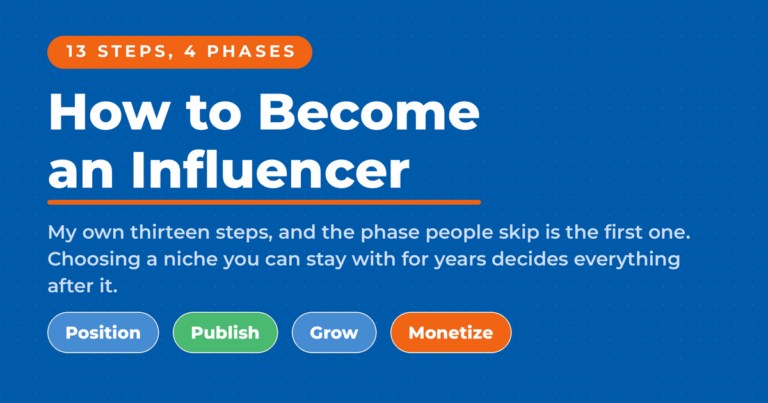
You become an influencer by picking a specific niche, creating consistent high-quality content for it, engaging genuinely with the audience that gathers, and building trust over time until people act on your recommendations. There is no certification and no shortcut. It is content plus consistency plus community, repeated.
Start with a niche narrow enough that people know exactly what to expect from you. Then commit to a consistent posting schedule, because consistency is how trust compounds. Engage with the people who show up, in comments and DMs, so the relationship goes both ways. And give it time. Most overnight influencers were posting for years before anyone noticed. I walk through the full process in my guide to becoming an influencer, and the same principles apply whether you want to be a mom influencer sharing parenting tips or a B2B voice in your industry.
One newer wrinkle worth knowing: not every influencer is even a real person anymore. Virtual and AI influencers are computer-generated personas built and run with AI, and brands are partnering with them too. The definition is stretching, but the core idea holds. Influence is about the trust and attention an audience gives, whoever or whatever holds it.
Why Influencers Matter for Business
For business, an influencer is access to a trusted audience you do not own, which is why influencer marketing has become a core channel rather than an experiment. The data backs this up: I keep a running roundup of influencer marketing statistics, and the through-line is that people increasingly trust recommendations from creators over traditional ads, across both consumer and B2B buying.
If you run a business, the practical takeaways are simple. Influence is no longer optional, your own customers and employees may be your best untapped influencers, and the work of finding the right influencers matters more than chasing the biggest names. One non-negotiable: anytime money or free product changes hands, disclosure is required, so make sure any partnership follows the FTC’s influencer guidelines. For the full strategy, see my definition of what influencer marketing is.
Frequently Asked Questions
An influencer is someone who can shape what other people think, do, or buy within a specific niche, usually by building a trusted audience on social media. The emphasis is on trust and action, not follower count. Someone with a small but engaged audience can have more real influence than someone with a million passive followers.
There is no minimum. Nano-influencers with 1,000 to 10,000 followers are a recognized and valuable tier, often with the highest engagement rates. Brands work with them precisely because their smaller audiences trust them more. What matters is engaged, relevant trust, not a specific number.
They overlap almost completely now. A content creator makes content; an influencer uses content to shape opinions and decisions. In practice most influencers are creators and most successful creators have influence, so the terms are largely interchangeable today. Influence simply starts with content.
Most do not. Goldman Sachs estimates only about 4% of creators earn more than $100,000 a year. A small number earn a great deal, many earn part-time income through sponsored posts and gifting, and most do it alongside other work. “Influencer” is a role, not a salary.
Absolutely. Industry experts and thought leaders are influencers, and they matter enormously in B2B, where buyers research respected voices before purchasing. LinkedIn in particular has become a hub for B2B influence. Your own employees and customers can also be powerful influencers because of their genuine connection to your brand.
Ready to Put Influence to Work?
Now you know what an influencer is: someone who has earned enough trust within a niche to shape what their audience thinks and buys, in an era where almost anyone can build that kind of audience. The next step is deciding what to do with that understanding, whether you want to become an influencer yourself or work with them in your business.
If you want to go deeper on the business side, my definition of what influencer marketing is picks up where this guide leaves off, and you can download a free preview of The Age of Influence, my definitive book on building an influencer marketing strategy. And if you would like help building influence into a coordinated marketing strategy for your company, that is exactly what I do as a Fractional CMO.



I like this article. To become a great influencer, we must understand proper personal branding. Developments in content technology, such as the presence of AI, make it easier for us to produce a lot of content. However, the content produced must still be of high quality and provide meaningful value.
That is correct Andri!